
Out-of-network billing isn't just a patient complaint problem anymore. In a major national study published in JAMA Internal Medicine, the share of emergency department visits with at least one out-of-network bill rose from 32.3% in 2010 to 42.8% in 2016, and inpatient admissions rose from 26.3% to 42.0%, while mean potential patient liability climbed from $220 to $628 for ED visits and from $804 to $2,040 for inpatient admissions, all at in-network hospitals (JAMA Internal Medicine study). That's the pivot point. The financial exposure moved from an occasional billing nuisance to a repeatable revenue recovery workflow that has to be engineered upstream and defended downstream.
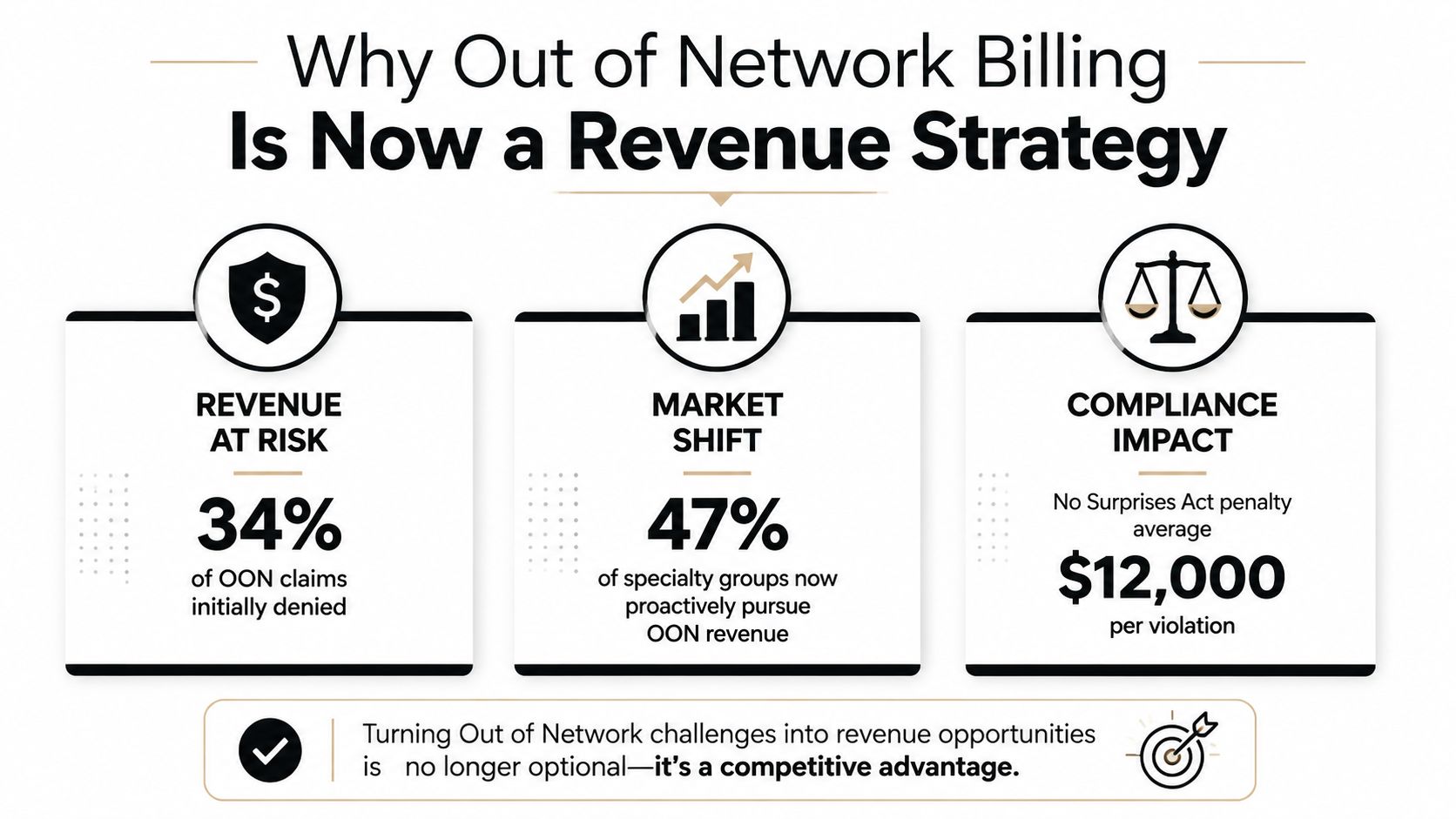
Why Out of Network Billing Is Now a Revenue Strategy
One commercial-insurer analysis found that out-of-network billing was already embedded in hospital-based care before the No Surprises Act changed the rules, with out-of-network claims showing up across anesthesiology, pathology, radiology, and assistant-surgeon services at in-network hospitals. A separate national analysis found that more than 20% of in-network ED visits involve an out-of-network physician. That is the operational reality. Out-of-network revenue exists, but it only turns into collected revenue when the record can support it, the claim can survive payer review, and the dispute package can stand up in IDR.
The business case is embedded in emergency and hospital-based care
The concentration of out-of-network billing in emergency and facility-based specialties is the part many groups still miss. In a large commercial-insurer analysis, 11.8% of anesthesiology care, 12.3% of pathology care, 5.6% of radiology claims, and 11.3% of assistant-surgeon cases at in-network hospitals were billed out of network (Health Affairs analysis). Another national analysis found that more than 20% of in-network ED visits involve an out-of-network physician. That is not a side issue. It is built into how hospital care gets delivered, especially where the physician, the facility, and the patient's plan do not line up cleanly.
Practical rule: If your specialty depends on hospital privileges, emergency coverage, or ancillary support inside an in-network facility, you are already in the out-of-network billing business. The only choice is whether you run it deliberately.
The No Surprises Act shifted the operational question into a documentation problem. The claim file has become the asset. Groups that treat the process as a compliance chore usually leave money behind because their records are thin, their coding is inconsistent, or their evidence package does not match what arbitrators and payers weigh. Groups that treat it as revenue recovery start with eligibility verification, preserve consent where it applies, code the encounter for dispute strength, and assemble a file that can survive scrutiny.
The practical takeaway is simple. Upstream RCM quality and downstream IDR performance are the same workflow, just viewed at different points in time. If the encounter is clean, the claim is coded correctly, and the evidence is built for benchmarking, the dispute is recoverable much more often than groups assume. For teams still trying to tighten the front end, eligibility verification workflows are where revenue leakage usually starts.
Verifying Eligibility and Securing OON Consent
A scheduled case can look clean on the surface and still fail the first payer challenge because the file never proved who was in network, who was out of network, and what the patient agreed to. Eligibility checks carry that burden. Before the encounter, confirm the member's plan, the facility's network status, and the rendering clinician's contract status. Emergency care follows a different documentation path because consent rules and NSA protections change what you can ask for and what you must preserve.
The first miss is assuming the facility's network status covers the physician. It does not. The second miss is treating a verbal assurance from the front desk, or a payer portal screenshot with no audit trail, as enough to defend the claim later. The record needs to show who checked eligibility, when they checked it, and what the patient was told.
Build the encounter file before the claim ever leaves
For scheduled services, capture the plan lookup, the in-network or out-of-network status for both the facility and the professional, and any notice-and-consent material where it is allowed. For emergency encounters, flag the case immediately as NSA-sensitive and route it for special handling. The billing team should be able to see, in the chart or practice management system, whether the encounter involved emergency treatment, post-stabilization services, or another category where notice-and-consent is restricted.
The strongest files are ordinary on purpose. They do not depend on memory, and they do not require someone to reconstruct the story after the fact. They answer the payer's first question before the payer asks it.
If the file cannot show why the patient was out of network, stronger coding later will not fix the gap.
Use a standard checklist at check-in and again at case close. Keep it tight:
- Plan and network verification: Confirm the member plan, the facility contract status, and the rendering provider's status.
- NSA exception review: Mark whether the service is emergency, post-stabilization, or another protected category.
- Consent capture where permitted: Store the signed notice-and-consent documents in the chart and the billing system.
- Communication log: Record what the patient was told, by whom, and on what date.
- Escalation flag: Send any ambiguous encounter to a senior billing reviewer before the claim is dropped.
A clean eligibility workflow does more than reduce denials. It protects the claim's out-of-network status when the payer later argues that the case was misclassified or that consent was incomplete. Groups that want to tighten this front end usually start with medical eligibility verification workflows, because that is where the first revenue leak usually appears.
Building Dispute Ready Claims and Coding the Encounter
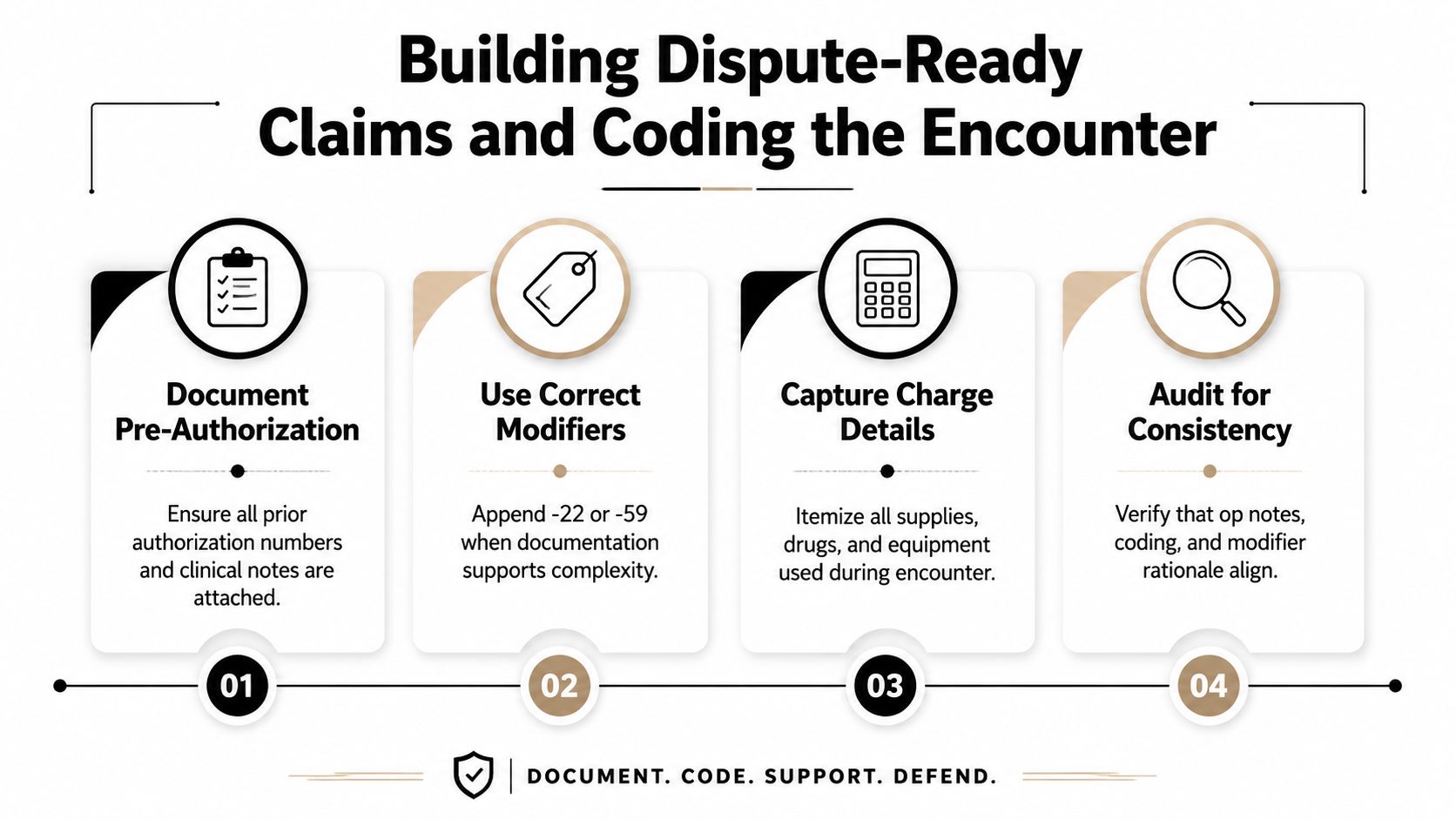
Most out-of-network revenue leaks before the payer ever sees the claim. The problem isn't just missing codes. It's mismatched documentation, weak charge capture, and files that don't look like they were built for an eventual IDR reviewer. A claim that's fine for routine adjudication can still be useless in arbitration if the documentation doesn't prove complexity, service intensity, and medical necessity.
Code for the record, not for hope
Start with the basics. CPT, ICD-10-CM, HCPCS, place of service, provider taxonomy, NPI, and credentialing status all have to agree with the chart. If any of those fields are sloppy, the payer can downcode the claim or question the service category. That's especially dangerous in out-of-network billing because weak claims invite weak offers.
Modifier use matters too, but only when the documentation supports it. A modifier should explain the encounter, not decorate it. The same applies to charge capture. If supplies, drugs, equipment, or extended time aren't fully reflected in the charge master, the final claim tells a smaller story than the one the clinical team lived.
Build the evidence file while coding
Arbitration-grade claims need more than a clean superbill. They need a record set that supports the billed rate. Prior authorization numbers, operative notes, procedure notes, consult documentation, training credentials, and any service-specific complexity notes should all be easy to retrieve. If your team expects to challenge an underpayment later, assemble the file as if a neutral reviewer will compare it against in-network benchmarks.
The arbitration literature is clear on what tends to matter. Prior research found the median arbitration decision was 5.7 times prevailing in-network rates and was strongly aligned with the 80th percentile of provider charges (PubMed study). That doesn't mean every claim should be priced aggressively. It does mean your charge structure, documentation, and comparable-rate data need to be coherent.
Operational insight: The cleanest claims aren't always the highest ones, but the highest recoveries almost always start with the cleanest claims.
For teams that need a process reference, coding compliance guidance is useful as a framework, but the key point stays the same. If the documentation can't support the modifiers, the diagnosis, and the billed complexity, the claim will be hard to defend later.
Negotiating With Payers and Running the IDR Process
Payer negotiation and IDR aren't separate worlds. They're one revenue cycle with two decision points. If the front end of the cycle is weak, the back end becomes expensive and unpredictable. If the claim is clean and the evidence is specific, negotiation becomes a screening step instead of a dead end.
Sequence the file with the dispute in mind
The federal process starts with a claim submission and the open-negotiation window. If that stalls, the case moves into IDR, where each side submits an offer and evidence. Under the post-2024 CMS batching guidance, grouped disputes have to be handled more carefully, so the practice can't treat batching like a convenience feature. It's an eligibility and packaging decision.
The current arbitration environment also shows why strategy matters. In one analysis of the federal No Surprises Act arbitration pathway, providers won about 80.1% of 7,076 disputes, with a median settlement of $564 and a mean of $1,333. The same analysis found the QPA averaged $255 overall, which tells you how wide the gap can be between payer anchors and dispute outcomes (PMC analysis). That gap is why submission quality matters so much.
What wins more often
The strongest files are specific. They include charge master excerpts, comparable in-network pricing, service-level documentation, training or certification details where relevant, and a concise narrative that explains why the case is different from the payer's anchor. They do not read like generic appeals letters. They read like organized proof.
A winning sequence usually looks like this:
- Submit a clean claim. The claim file should already be complete, so the payer can't dismiss it on formatting or missing-data grounds.
- Use negotiation as a filter. If the payer will move on price or medical necessity, capture that path. If not, preserve the record for IDR.
- Build the offer around benchmark data. The offer should reflect your documentation, comparable rates, and the service intensity in the chart.
- Keep the case packaged for review. Certified representatives and counsel can help, but they shouldn't create a fragmented process.
- Track decision and payment separately. A favorable ruling isn't cash until the payment posts and matches the award.
For teams building the process from scratch, independent dispute resolution guidance is a practical reference point. One option in this space is RevGuard, which pairs RCM work with NSA-compliant IDR support, including evidence assembly and dispute filing. That kind of structure matters because the dispute file, not the phone call, is what ultimately gets reviewed.
Communicating With Patients Through the OON Journey
Patients don't need legal theory. They need a clear explanation of what they can expect, what the plan covers, and why the bill looks the way it does. When the communication is vague, billing teams spend more time chasing questions and complaints than they spend collecting. When the language is direct, most of that friction disappears.
Use plain language at every handoff
Before service, give a short explanation of network status and financial responsibility in normal English. If the service is protected by NSA rules and consent isn't required, say that clearly instead of hiding behind policy jargon. After the claim posts, show the payer payment, the contractual or other adjustment, and any patient responsibility in a way that mirrors the actual ledger.
A useful phone script sounds like this:
“We're reviewing your coverage and the service location now. We'll tell you whether the provider, the facility, or both are out of network, and we'll explain any notice or consent requirements before the visit.”
For written communication, keep it even tighter:
- Before service: “Your plan status may affect what you owe, and we'll confirm the network details before your appointment.”
- When consent is permitted: “You may choose to sign notice-and-consent forms if the service qualifies, and we'll explain the financial implications in plain language.”
- After billing: “This statement shows what the payer paid, what was adjusted, and what, if anything, remains your responsibility.”
Keep the message consistent across facility partners
In-network facilities, physician groups, and billing vendors should use the same language. If one team says the claim is fully covered and another says the patient may owe more, trust breaks fast. That's how complaints happen, even when the billing itself is technically correct.
Patient communication also protects revenue. People are more likely to pay, less likely to escalate, and less likely to dispute when the process is transparent. That's especially true for out-of-network billing, where surprise is often the trigger, not the amount alone.
Measuring OON Performance With the Right KPIs
If you can't see the out-of-network book clearly, you're managing by instinct. That works until payer behavior shifts, a specialty starts leaking margin, or IDR outcomes begin drifting. The teams that stay ahead of this track the right metrics at the encounter, payer, and dispute level.
Build the dashboard around recoverability
The most useful KPIs are practical, not decorative. You want OON encounter rate by payer and facility, denial mix by reason code, clean-claim rate for NSA-eligible services, IDR initiation rate, IDR win rate, time to decision, settlement-to-QPA relationship, and net revenue per out-of-network encounter. Those measures tell you where the money is going and why.
A simple dashboard structure works better than a crowded one. Put weekly monitoring on the metrics that move fast, like denial mix, claim cleanliness, and dispute backlog. Review monthly on the metrics that reflect process health, like payer behavior patterns and win rate. If the review cadence is too slow, the team finds out about leakage long after the case has aged.
Use the scorecard to spot payer behavior
Some payers consistently force disputes. Others downcode aggressively or drag the process long enough to pressure providers into accepting low offers. A good scorecard separates those patterns by payer and facility, so the billing team can adjust the submission strategy before the next batch goes out.
What to watch: a payer that repeatedly produces weak offers or slow payment is not just a billing nuisance. It's a workflow problem that should trigger a review of documentation, negotiation posture, and arbitration packaging.
For groups that manage multiple specialties, scorecards should also isolate high-volume service lines. Air ambulance, emergency, anesthesia, radiology, and other facility-based specialties don't behave the same way in dispute resolution. The dashboard has to show that difference, or leadership will miss where recoveries are eroding.
Common Pitfalls That Quietly Bleed OON Revenue
The biggest out-of-network losses usually come from process failures, not bad luck. Teams lose money when notice-and-consent forms are incomplete, credentialing files drift out of date, charge masters understate complexity, and appeal letters never rise to arbitration quality. The hardest part is that each failure looks small in isolation.
Fix the leaks that keep repeating
A missing consent form can turn a defensible case into a payer win. Outdated credentialing can make a provider look incorrectly in network or create confusion about who rendered the service. A weak charge master can suppress the rate before the dispute even starts, and a generic appeal letter signals that the organization didn't prepare for IDR at all.
The batching issue is another common miss. CMS' 2024 guidance narrowed federal IDR batching rules after court action, which means groups have to be more disciplined about which claims are grouped and how they're submitted (CMS out-of-network billing guidance). If batching is treated as a shortcut instead of a filing decision, disputes can get delayed or mishandled.
Here's the operational sequence that catches most problems early:
- Day 0 to 30: Lock down eligibility, consent, and documentation baselines, then take a current-state KPI snapshot.
- Day 31 to 60: Tighten claim engineering, benchmark payer behavior, and stand up the IDR pipeline.
- Day 61 to 90: Build dashboards, payer scorecards, and a recurring review rhythm for continuous improvement.
If dispute volume is high, payer complexity is messy, or the organization spans multiple states, internal staff can get overloaded fast. That's usually the point where a specialty RCM and IDR partner earns its place, not because the team lacks effort, but because the process now needs dedicated operational capacity.
If your group is still treating out-of-network billing as a collection afterthought, it's time to reset the workflow. RevGuard works across eligibility verification, coding discipline, payer negotiation, and NSA-compliant IDR, which makes it a practical fit for specialty groups that need cleaner files and stronger recoveries. Visit RevGuard if you want to compare your current process against a dispute-ready revenue recovery model.