

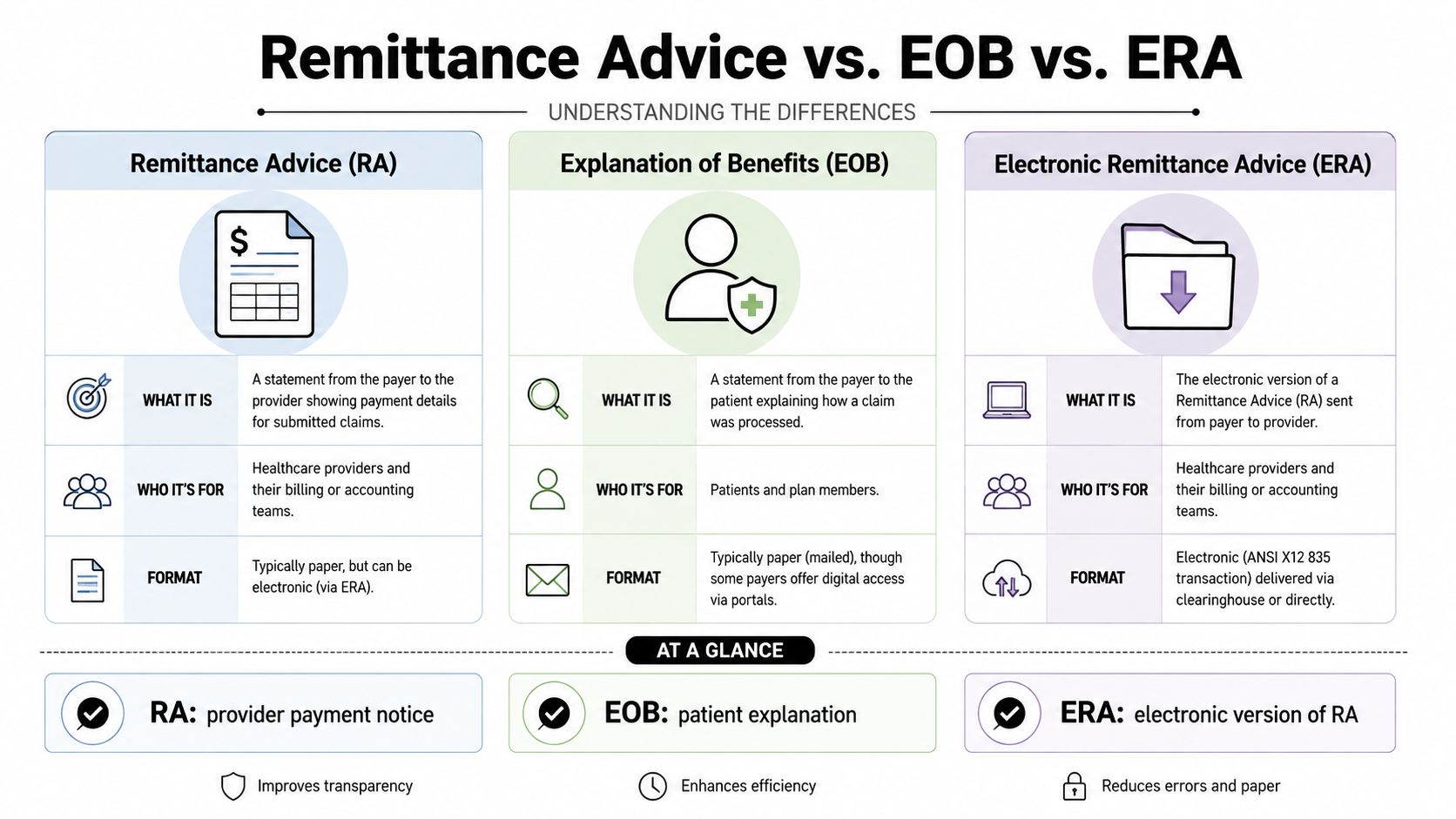
A remittance advice is the payer-issued payment notice that shows how each claim or line was paid, adjusted, denied, or assigned to the patient. In electronic form, it is the standardized ASC X12 835 Health Care Claim Payment/Advice transaction, commonly called an electronic remittance advice, or ERA.
The deposit has arrived, but the numbers don't tie. One claim shows a payment, another carries a contractual adjustment, and a third has a denial that someone must appeal before the filing window closes. The remittance advice is the record that connects those outcomes to the money in the bank.
For a billing or denial team, it shouldn't be treated as a back-office receipt. Read correctly, it connects payment posting, patient responsibility, denial ownership, contract variance analysis, and dispute-ready evidence. The same line that tells your posting team what to enter can tell an underpayment analyst whether the payer followed the contract and tell an IDR team whether a case deserves escalation.
Remittance Advice in Plain Language and How It Differs from an EOB and ERA
A remittance advice is a payment explanation sent by a payer to a healthcare provider after claim adjudication. It identifies, claim by claim and often line by line, what the payer paid, reduced, denied, or assigned to the patient. The format may be paper, a portal document, or an electronic file.
The practical test is simple. If a document came with a check or EFT and lists provider payments and adjustments, it functions as an RA. If it was sent to the patient and summarizes what the plan covered and what the patient may owe, it functions as an EOB. If it arrived as an X12 835 file through a clearinghouse, it's an ERA, which is the electronic version of provider-facing remittance advice.
The distinction matters because the documents serve different workflows. An EOB helps a member understand the adjudication. An RA gives the provider the financial and coding detail needed to post the payment, transfer eligible responsibility, classify the adjustment, and decide whether follow-up is required. For a fuller patient-facing comparison, see this explanation of EOB in medical billing.
Practical rule: Classify the document by its audience and operational use, not only by the label printed at the top.
CMS describes the ERA as an explanation from a health plan to a provider about a claim payment, and identifies the ASC X12 835 as the compliance standard for electronic remittance transactions in the United States. The CMS overview of ERA and EFT transactions also makes the relationship clear: the ERA explains the adjudication, while the EFT or check is the payment mechanism.
The RA also shouldn't be confused with proof that funds cleared. A trace number and deposit record help establish the payment connection, but the RA's main job is to explain what the payment represents and how the payer calculated it. That difference becomes important when cash is deposited but remains unapplied, or when a payer's payment explanation conflicts with the contracted expectation.
The Core Components of a Remittance Advice
A useful remittance advice answers four operational questions:
- Who sent the money?
- Which provider and claims does it belong to?
- How did the payer calculate the result?
- What should happen next?
Start at the payment level. Confirm the payer identifier, provider identifier, payment date, payment amount, payment method, and check or EFT trace number. The trace number is the bridge between the remittance file and the bank activity. Without that bridge, staff may post a valid payment to suspense while they search for the matching explanation.
Next, verify the claim identity. The claim control number should connect the remittance back to the original submission and to the account in the practice management or patient accounting system. At the service-line level, review the billed amount, allowed amount, paid amount, patient responsibility, and adjustment codes. These values show whether the difference between billed and paid resulted from the contract, the patient's benefits, a payer action, or another adjustment.
The standard adjustment groups provide the first ownership signal:
- CO, Contractual Obligation: Usually points to an amount governed by the payer-provider agreement.
- PR, Patient Responsibility: Identifies amounts that may belong on the patient account, subject to billing rules and applicable protections.
- OA, Other Adjustments: Captures adjustments that don't fit the contractual or patient categories.
- PI, Payer-Initiated Reductions: Identifies reductions initiated by the payer.
- CR, Correction and Reversal: Signals a correction or reversal that needs careful pairing with the original activity.
On an 835, these details appear in structured segments and loops, including CLP, CAS, and AMT. On paper, the same information may appear as labeled columns, subtotals, and code fields. The presentation differs, but the reconciliation logic doesn't.
| RA Field | What It Shows | Why It Matters for Reconciliation |
|---|---|---|
| Payer and provider identifiers | The parties connected to the payment | Prevents posting to the wrong entity or tax identification structure |
| Check, EFT, or trace number | The payment reference | Matches the RA to bank activity |
| Claim control number | The payer's claim-level identifier | Links adjudication to the submitted claim |
| Billed amount | The submitted charge | Establishes the starting point for variance review |
| Allowed amount | The payer's recognized amount | Supports contract and fee schedule analysis |
| Paid amount | The amount issued for the claim or line | Drives payment posting |
| Adjustment group and code | The category and reason for the difference | Routes the balance to contract, patient, denial, or exception work |
| Patient responsibility | Amount assigned to deductible, coinsurance, copay, or another patient category | Supports accurate patient statements and secondary billing decisions |
CMS notes that remittance advice associates an item with each claim or line-item payment, reduction, or denial. That structure is why a team shouldn't reconcile only at the total-payment level. A payment can balance overall while one line is incorrectly categorized, omitted from follow-up, or transferred to the patient when it belongs in a contractual adjustment.
Reading Reason Codes and Adjustment Groups Like an Operator
Reason codes aren't decorative text. They are routing instructions. The group code tells you who owns the balance, the CARC describes the financial action, and the RARC adds clarification that can determine the next work step.
Read them in that order:
- Identify the group code. Decide whether the balance points toward the contract, the patient, the payer, or another exception queue.
- Read the CARC. Determine what action the payer took, such as a reduction, denial, bundling adjustment, or missing-information edit.
- Read the RARC. Use the supplemental explanation to understand the payer's stated rationale and document the follow-up.
For example, a CO-45 adjustment indicates that the charge exceeds the contracted or allowable fee schedule. The group code is the critical part for ownership. It tells the team that the balance is contractual rather than automatically billable to the patient. A RARC can add payer-specific context, but it doesn't erase the routing implication of the group code.
CMS maintains the code infrastructure that supports this machine-readable explanation. The CMS remittance advice remark-code guidance explains the relationship between claim adjustment reason codes and remark codes. A RARC supplies clarification or supplemental information for an adjustment already identified by a CARC.
Turn code pairs into work queues
A team that stores only the broad denial category loses the detail needed for prevention. Track the payer, procedure, rendering provider, group code, CARC, RARC, and final disposition together. That combination distinguishes a recurring contract adjustment from a correctable denial.
Common operational paths include:
- CO-97, bundled or included service: Review coding, edits, modifier use, and documentation before deciding whether a corrected claim or appeal is appropriate.
- CO-16, missing or incomplete information: Identify the missing data, correct the claim or documentation, and resubmit within the payer's rules.
- CO-109, not covered by this payer: Confirm payer responsibility, coordination of benefits, eligibility, and routing before writing off or billing.
- PR adjustments: Validate that the patient balance is permitted and supported by the adjudication before statement generation.
The X12 explanation of the 835 transaction reinforces why this detail matters. The transaction carries structured claim and line-level adjudication, so a system can distinguish paid, reduced, denied, deductible, coinsurance, copay, and bundling outcomes instead of treating every variance as the same exception.
The operator's objective isn't merely to decode a code. It's to convert the code pair into a defensible action, with the right owner, documentation, deadline, and financial treatment.
Paper Remittance Advice and 835 ERA Side by Side
Paper and electronic remittances often describe the same adjudication, but they expose different operational risks. A paper document presents fields for a human to read. An 835 presents a structured transaction that a posting system can parse, match, and route.
On paper, a team may see a provider identifier, claim number, billed amount, allowed amount, paid amount, contractual adjustment, and patient responsibility in adjacent columns. In an 835, those values are distributed across transaction loops and segments. CLP carries claim payment information, NM1 identifies parties, SVC describes service-line payment detail, CAS carries adjustment groups and reason codes, and AMT reports associated monetary values.
The transition problem is rarely the existence of the fields. It's the mapping. A paper subtotal may combine several adjustment types that the 835 separates into distinct CAS entries. If the interface sums them incorrectly, the payment can appear balanced while denial ownership, patient responsibility, or contractual variance is wrong.
| Paper RA Field | 835 ERA Segment or Loop | Data Carried |
|---|---|---|
| Payer and provider details | NM1 loops and related header information | Entity names and identifiers |
| Claim number | CLP claim payment loop | Link to the adjudicated claim |
| Billed amount | CLP and service-line payment structures | Submitted claim or service charge |
| Allowed amount | AMT and payer-specific implementation details | Recognized or adjudicated amount |
| Paid amount | CLP and SVC payment values | Claim-level or line-level payment |
| Contractual adjustment | CAS with CO group code and CARC | Contract-related reduction |
| Patient responsibility | CAS with PR group code and CARC | Deductible, coinsurance, copay, or related balance |
| Service detail | SVC loop | Procedure or service-line adjudication |
| Supplemental explanation | RARC data associated with the adjustment | Additional payer clarification |
The Massachusetts 835 payment advice guidance describes the 835 as a variable-length record used for wire transmission and explains why translation is necessary before application systems can use it. In practice, your interface or clearinghouse converts the file into fields the billing platform can process.
Transition warning: Never approve an 835 mapping because the total payment balances alone. Test claim lines, multiple adjustment groups, reversals, patient responsibility, and provider-level activity separately.
A native 835 supports automation, but electronic doesn't automatically mean clean. Payer-specific configurations, missing enrollment, split files, unfamiliar codes, and unmatched deposits still create exceptions. Teams moving from mailroom posting to electronic workflows should use a field-level test matrix, not a single successful payment test. The operational details of that process are covered in remittance processing.
Step-by-Step Reconciliation and Follow-Up Workflow
A reliable reconciliation process separates routine posting from exceptions that require judgment. The workflow below keeps payment, denial, underpayment, and patient balances from collapsing into one manual queue.
1. Receive and control the file
Collect the 835 from the clearinghouse, payer connection, or provider portal. Record the file name, receipt time, payer, payment reference, and transmission status. Preserve the original file before translation or editing. If the bank shows an EFT without a corresponding remittance, open a missing-RA exception rather than posting from assumptions.
2. Validate the transaction
Run structural and business-rule checks. Confirm that the transaction can be parsed, that the payer and provider identifiers are recognized, and that the payment-level totals reconcile with the claim and service-line detail. Check for reversals, duplicate files, rejected records, and provider-level adjustments before releasing the file to automatic posting.
3. Match claims and payments
Use the claim control number, patient account, dates of service, payer, and trace information to match the ERA to the practice management system. The system should identify exact matches automatically and place ambiguous or missing matches in an exception queue. Staff should investigate the exception rather than force a match that could mispost cash.
4. Post routine activity
Post paid claims and standard adjustments according to payer-specific rules. Transfer eligible PR amounts to the patient balance, apply contractual adjustments to the correct category, and preserve the CARC and RARC on the account. Keep provider-level adjustments separate when they don't belong to a specific claim.
5. Flag financial variances
Compare actual allowed and paid amounts with the expected fee schedule or contract logic. A variance threshold should route a likely underpayment for review, while a zero-payment or reduced-payment result should route according to its group code and reason-code pair. Don't treat every difference from billed charges as an underpayment. The allowed amount is the relevant comparison point for contract analysis.
6. Assign follow-up
The queue should state the action, not merely the code. A missing-information denial may need corrected documentation or claim resubmission. A contractual underpayment may need payer reconsideration or appeal. A patient-responsibility balance may move to statements after validation. A recurring or high-value dispute pattern may require a structured evidence file and escalation review.
Use operating checkpoints to prevent drift:
- Daily: Reconcile deposits, review unmatched ERAs, release clean postings, and assign exceptions.
- Weekly: Review aging in denial and underpayment queues, inspect recurring CARC/RARC pairs, and confirm appeal deadlines.
- Monthly: Compare payer performance, validate contract variances, review unapplied cash, and confirm that the original remittance files are retained.
A good process doesn't eliminate human review. It reserves human review for the cases where interpretation, documentation, or payer strategy changes the outcome.
Using Remittance Advice to Prepare Disputes and IDR Escalation
A remittance advice becomes dispute evidence when it preserves the payer's exact adjudication. The EOB narrative may help explain the result to a patient, but the provider-facing RA contains the structured financial record that shows which claim or line was reduced, which adjustment group was used, and what amount remains in question.
For a potential No Surprises Act IDR case, start with the adjudication itself. Pull the original 835 and preserve its envelope and transaction integrity. Then extract the claim-level CLP, the CAS groups and amounts, the line-level SVD adjudication when present, the rendering provider information, the payment trace, and the dates of service. Tie those fields to the claim submission, contract or payment expectation, clinical documentation, and correspondence.
The reason pattern helps determine whether ordinary correction, appeal, negotiation, or IDR review is appropriate. A downcoding decision paired with a medical-necessity denial may require a clinical and coding analysis. A bundling adjustment may require an edit review and documentation of separately reportable services. Emergency and behavioral health cases may require additional No Surprises Act compliance analysis, particularly where payer conduct or required processes appear inconsistent with the applicable protections.
Build the file around the disputed line
A dispute file should let a reviewer answer these questions without reconstructing the claim from scattered systems:
- What service was billed?
- What did the payer allow and pay?
- Which CARC and RARC explain the reduction?
- Which group code assigns financial responsibility?
- What amount is being disputed?
- What clinical, contractual, or regulatory evidence supports the provider's position?
- What communication and appeal steps have already occurred?
The RA doesn't prove every part of a dispute by itself. It proves the payer's adjudication and gives the evidence file a precise financial anchor. Keep the original 835, the translated representation used for posting, the associated EFT or check record, and the supporting claim and clinical documents together.
For organizations evaluating the next step, No Surprises Act IDR support should be assessed against the actual remittance pattern, filing requirements, evidence burden, and case economics. The central discipline is simple: don't send an argument disconnected from the payer's coded action. Start with the exact RA line and build outward.
Best Practices That Turn Remittance Advice into a Revenue Control
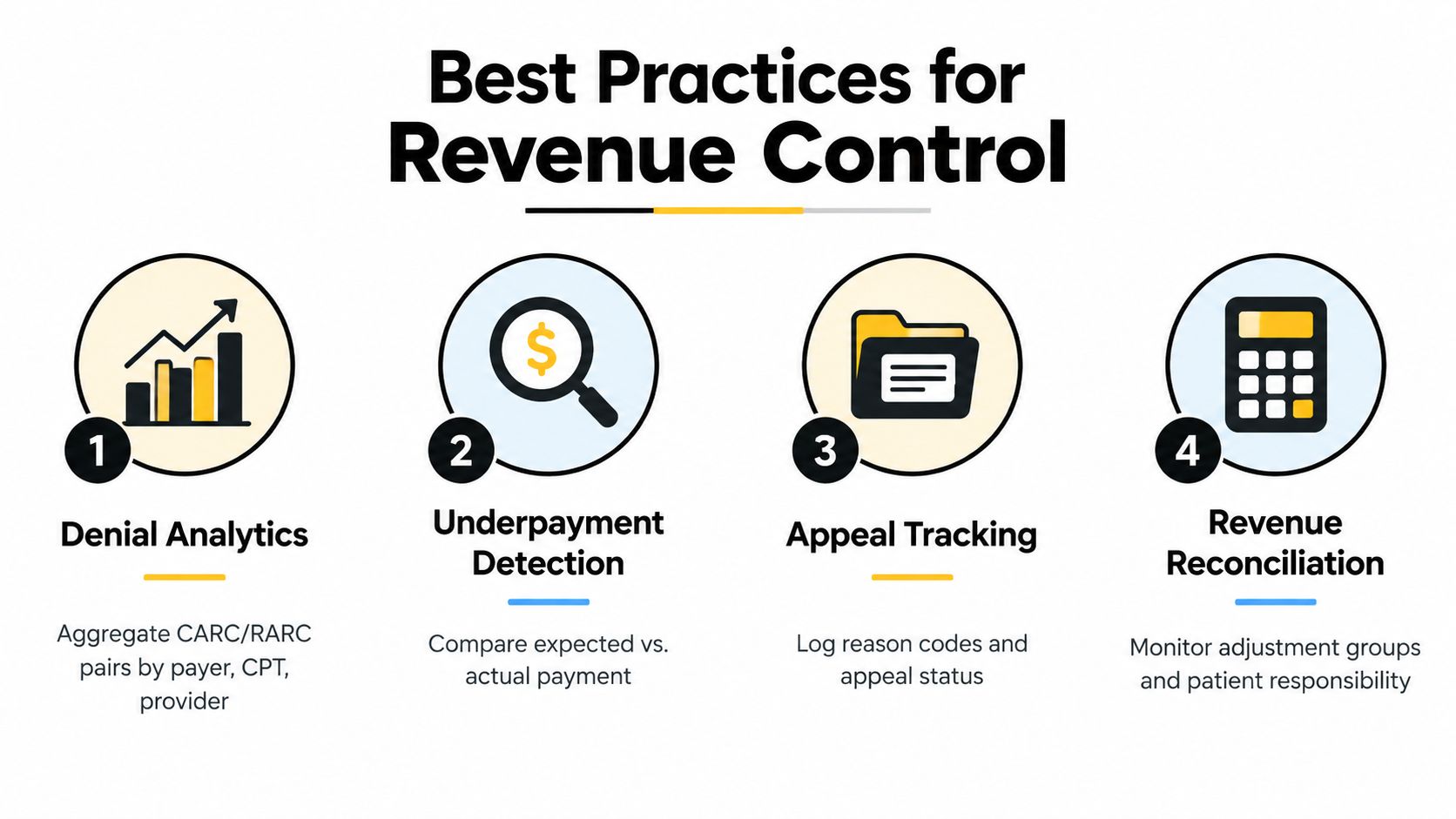
A remittance advice becomes a revenue control when the organization uses it to change behavior upstream, not merely to close an account downstream. Posting is the first use. Denial prevention, contract validation, appeal selection, and dispute preparation are the higher-value uses.
Denial analytics
Aggregate CARC and RARC combinations by payer, procedure, rendering provider, specialty, location, and claim type. A recurring CO-16 pattern may point to registration, authorization, or documentation weakness. A recurring CO-97 pattern may expose coding or bundling issues. The useful output isn't a list of denied claims. It's a prioritized work queue with an accountable owner and a corrective action.
Underpayment benchmarking
Compare the expected allowed amount against the actual payer result. Separate contractual reductions from true payment shortfalls, and use a documented variance rule to trigger review. The team should retain the expected calculation, the RA values, and the follow-up disposition so an appeal or payer discussion begins with evidence rather than a general complaint.
Audit trails
Store the original 835, paper remittance, portal document, EOB, EOP, payment record, and posting activity in a unified claim-level repository. Index the records by claim number, payer, patient account, service date, and trace number. This makes it possible to reconstruct the payment decision and supports defensible review when a payer, auditor, patient, or dispute process challenges the account.
Contract alignment
Feed observed adjustment behavior into contract modeling. If a payer repeatedly uses an adjustment pattern that doesn't match the fee schedule, capitation logic, or stop-loss terms, the contract team needs that evidence. Revenue cycle leaders should review the resulting dashboards monthly alongside days in accounts receivable, denial overturn rate, underpayment recovery rate, unapplied cash, and queue aging.
RevGuard is one example of a healthcare revenue protection option that connects specialty-specific RCM workflows with enforcement-focused NSA IDR processes, using remittance data to support payer analysis, follow-up, and dispute evidence. Whatever tools you use, the control design matters more than the interface. Every queue should have a clear owner, every adjustment should have a financial category, and every disputed payment should retain its source record.
Pulling It All Together for Your Revenue Cycle
The remittance advice is the connective tissue between claim submission, payment posting, denial follow-up, underpayment capture, patient billing, and NSA IDR escalation. Its value comes from the fact that it records the payer's decision at the same level where your team must act, often down to the service line.
Start a 30-day review with a focused operating checklist:
- Pull 30 days of 835 ERAs into a denial and underpayment analytics layer.
- Map the top five CARCs by payer and assign each a workqueue owner.
- Reconcile two full weeks of ERAs against the practice management system.
- Validate fee schedule variances on ten sampled claims.
- Open one test IDR-ready dispute file using the original remittance and supporting evidence.
Treat every remittance line as both a closing document and a potential opening move for recovery. If the payment is correct, post it cleanly. If the code reveals a preventable denial, fix the upstream process. If the amount conflicts with the contract or the payer's obligations, preserve the evidence and escalate deliberately.
RevGuard helps provider organizations connect remittance processing, denial intelligence, payment variance review, and No Surprises Act IDR preparation in one revenue-protection workflow. Visit RevGuard to review how your team can turn payer adjudication data into cleaner follow-up and dispute-ready evidence.