
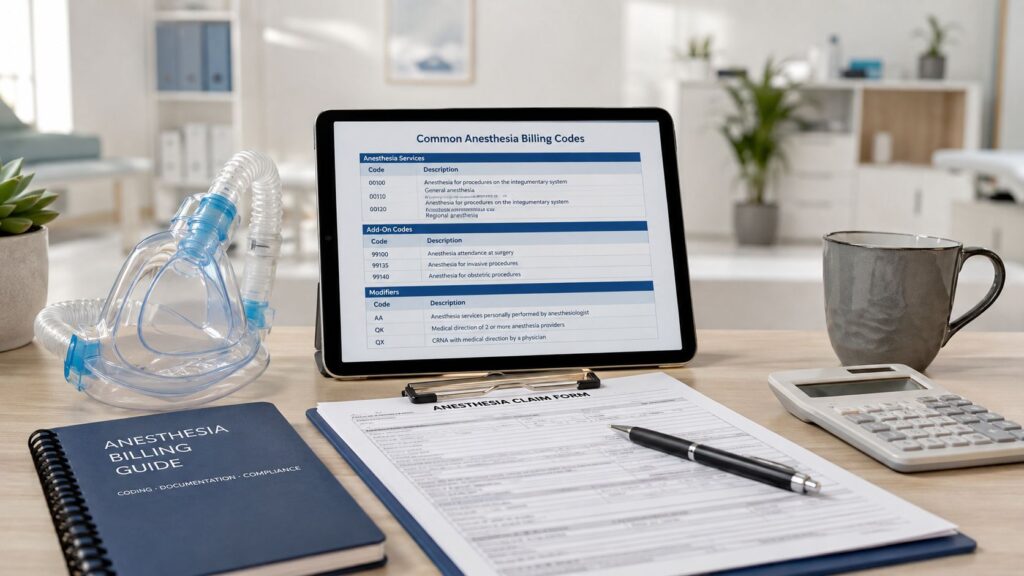
Most anesthesia billing guides start with CPT selection and modifier checklists. That advice is necessary, but it misses where many groups lose revenue after submitting a technically correct claim: systemic underpayment, payer-driven delays, and weak dispute preparation. Clean coding gets a claim into the payment system. It doesn't guarantee that the payer will apply the right contract terms, make a timely offer, or pay an amount that reflects the service.
Anesthesia billing still depends on accurate codes, defensible time, complete records, and payer-specific rules. But a workable anesthesia billing guide must also treat underpayment as a revenue-cycle event. The No Surprises Act has made that especially important for out-of-network emergency and facility-based services, where providers may need to negotiate or use the federal dispute process instead of balance billing the patient. CMS explains the No Surprises Act protections and dispute framework, including protections that affect anesthesia providers.
How Anesthesia Billing Formulas Work
Anesthesia reimbursement starts with a unit formula, but the formula alone does not determine what reaches the bank account:
(Base Units + Time Units + Modifying Units) × Conversion Factor = Payment
Base units reflect the anesthetic complexity assigned to the anesthesia CPT code. Time units come from the documented duration of anesthesia care. Modifying units may capture qualifying circumstances or other payer-recognized factors. Payer rules and claim configuration determine how those units are accepted and priced.
Medicare-style guidance counts anesthesia time in 15-minute increments. 60 minutes equals 4 time units under that approach. Time begins when the anesthesia professional starts preparing the patient and ends when the patient can safely transfer to postoperative supervision. It does not match incision-to-closure time, so the anesthesia record must support the reported start and stop points.
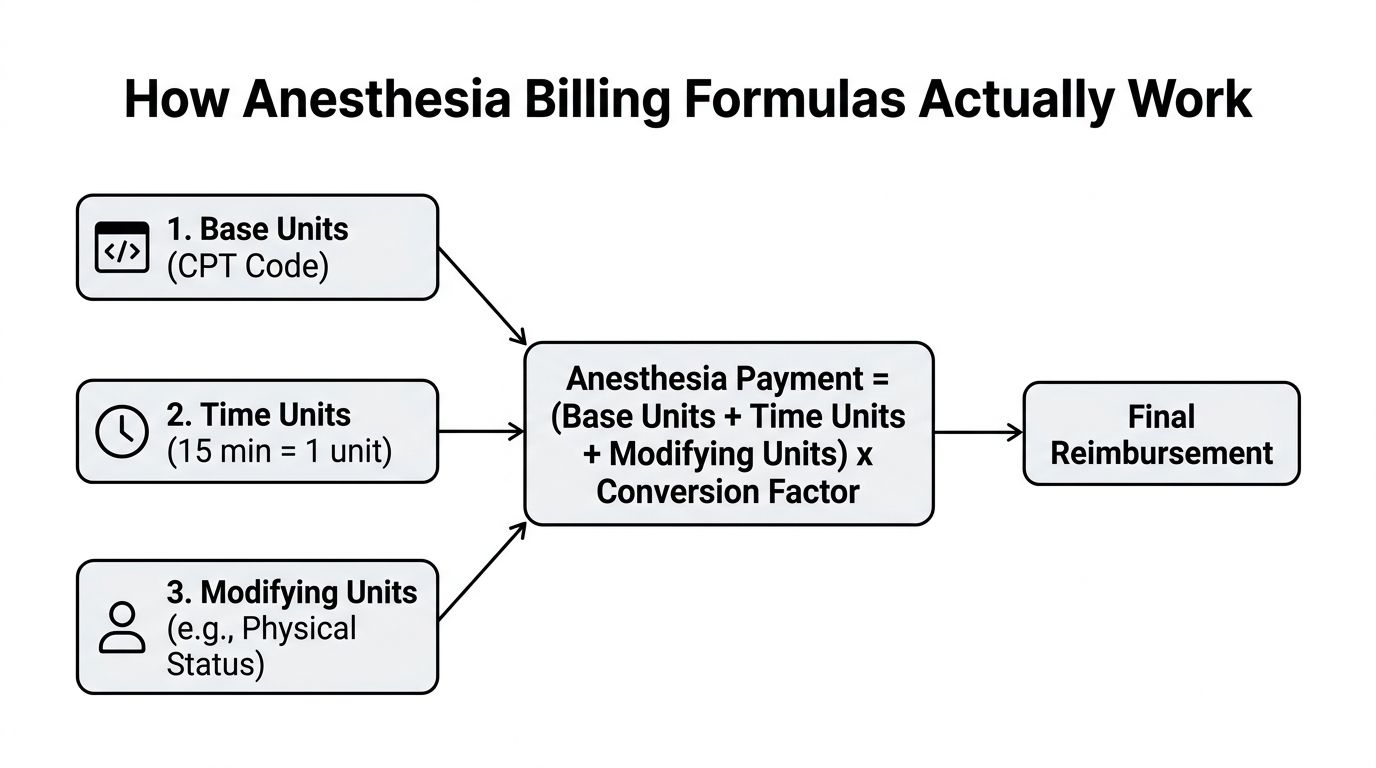
Consider a case with 8 base units, 60 minutes of anesthesia time, and no additional modifying units. The claim contains 12 total units before the conversion factor is applied. With an applicable conversion factor of $21.15, the mathematical result is $253.80, assuming the payer accepts the units and uses that factor. That example relies on a locality-specific 2026 Medicare factor listed in the federal anesthesia conversion-factor table, not a universal national rate.
| Component | Definition | Example |
|---|---|---|
| Base units | Units assigned to the anesthesia CPT code based on procedural complexity | 8 base units |
| Time units | Units derived from documented anesthesia duration | 60 minutes = 4 units |
| Modifying units | Additional payer-recognized circumstances when supported | 0 units in this example |
Why the formula does not settle payment
Two providers can perform the same anesthetic service and receive different reimbursement because conversion factors vary by locality, payer, contract, and physician status. Federal tables show that participating physician factors differ within a locality and across listed years. A group that forecasts collections from one assumed rate will miss that variation.
Commercial reimbursement can also differ sharply from Medicare. An ASA summary cited in the anesthesia billing guideline review compared a 2022 Medicare conversion factor of $21.5623 with a median commercial factor of $78.00. Accurate units establish the claim, while payer math determines the cash result. Track conversion factors, allowed amounts, payment delays, and underpayment patterns alongside coding accuracy. A structured revenue cycle metrics framework can organize that review.
Selecting the Right CPT Codes and Modifiers
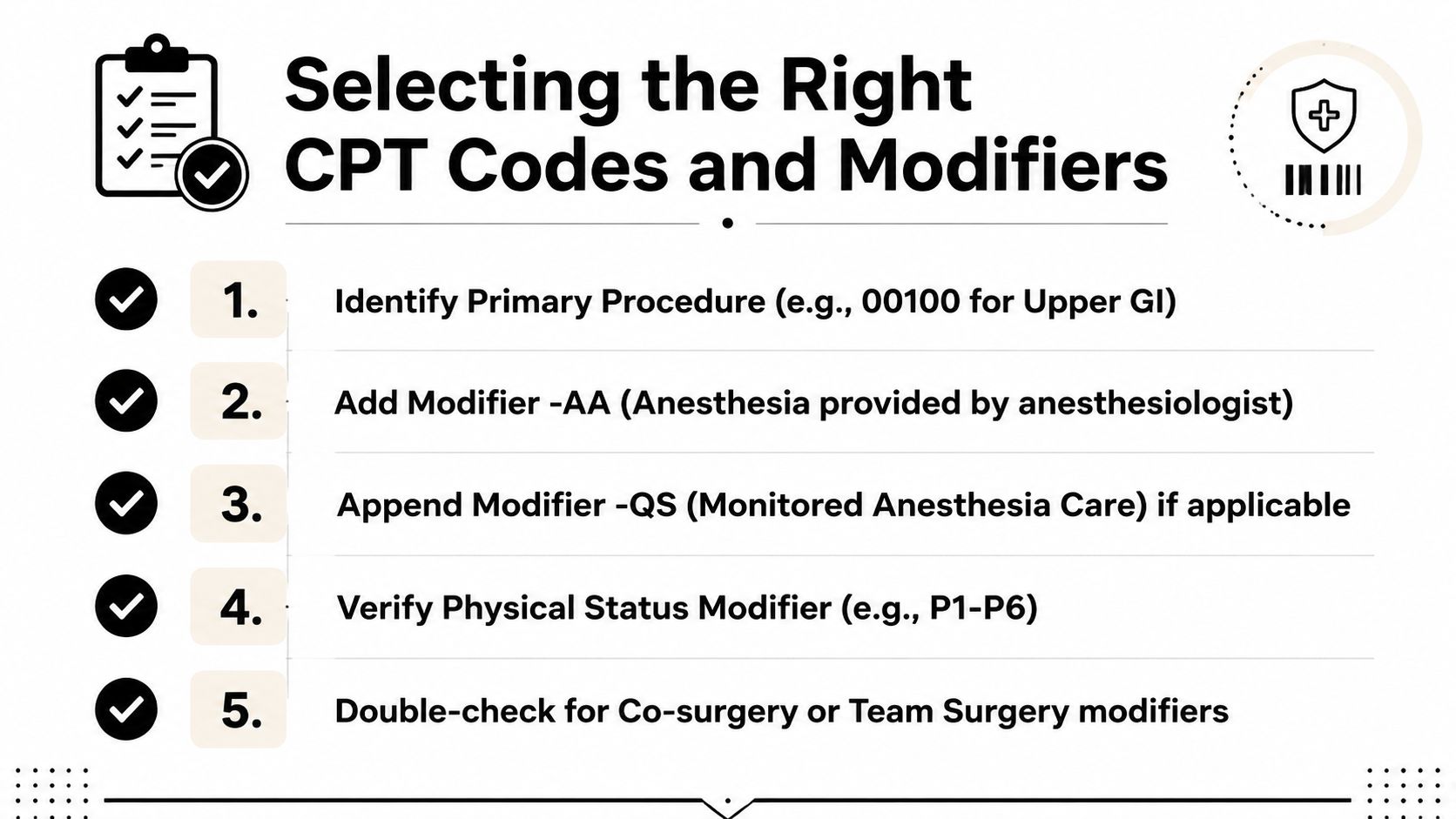
Correct coding is table stakes. Revenue is still lost when a defensible code is paired with the wrong provider model, unsupported modifier, or payer edit. Start with the anatomic region and surgical service, then translate the operative description into the anesthesia CPT code and confirm the payer's current unit rules.
Use this review sequence:
- Match the anesthesia code to the operative procedure. Verify the body region, approach, and complexity. A prior claim for the same surgeon is a reference, not proof that the code fits the current case.
- Validate the service model. Identify whether the anesthesiologist personally performed the service, medically directed a CRNA, or whether the CRNA worked independently where permitted.
- Apply supported modifiers only. Physical status, MAC, provider participation, discontinued services, and qualifying circumstances each need a distinct factual basis.
- Reconcile the claim with the record. The modifiers must agree with the anesthesia record, staffing arrangement, and payer requirements.
Modifier decisions require clinical context
Modifier AA indicates personal performance by an anesthesiologist. QK, QY, and QX relate to medical direction arrangements, while QZ applies to qualifying independent CRNA services where permitted. Modifier QS identifies monitored anesthesia care when the record supports MAC rather than merely labeling the case “sedation.”
Modifiers 52 and 53 address different situations. Use 52 when the service was intentionally reduced. Use 53 when the service was discontinued because the patient's condition or another clinical circumstance prevented completion. Modifier 63 may apply to certain procedures involving infants, subject to the anesthesia record and payer policy. Qualifying circumstance codes likewise require documentation of the circumstance itself, not a convenient label such as “urgent.”
| Modifier | When to use | Impact on payment |
|---|---|---|
| AA | Anesthesiologist personally performs the anesthesia service | Identifies the provider model and affects payer processing |
| QS | Monitored Anesthesia Care is provided | Signals MAC billing when supported by the record |
| P1-P6 | Physical status is documented and clinically supported | May affect units or payment under payer rules |
| 52 | Service is reduced from the reported procedure | May reduce payment and requires clear explanation |
| 53 | Service is discontinued under appropriate circumstances | Payment depends on payer adjudication and documentation |
Coding discipline: A modifier should explain a documented fact. Do not add it because a previous claim used it or because it appears financially attractive.
Modifier stacking creates exposure in both directions. Excessive use can invite audit attention or downcoding. Omitting a supported modifier leaves legitimate reimbursement unclaimed. Before submission, a focused coding compliance workflow should compare the anesthesia record, provider model, physical status, qualifying circumstances, and payer edits. That check catches coding defects before they become payer-driven delays or disputes.
Documentation Requirements That Protect Your Claims
A claim can contain the correct anesthesia CPT code and still fail because the record doesn't prove the billed service. Auditors usually look for a coherent timeline, a supported physical status, clear provider participation, and evidence that each modifier describes what happened.
The anesthesia record should show exact start and stop times. Start time begins when the anesthesia professional begins preparing the patient for anesthesia. Stop time ends when the patient can safely transfer to postoperative supervision. The operative report may show a different procedural timeline, so the billing team shouldn't substitute incision and closure times for anesthesia time.

Build the record around the claim
A defensible record should connect each claim element to a clinical entry:
- Time evidence: Record the precise beginning and ending of anesthesia care, with transfer-of-care documentation.
- Clinical status: Document the conditions supporting the selected physical status modifier.
- Technique: Identify whether the service was general anesthesia, MAC, or another supported technique.
- Provider participation: For medically directed cases, document the anesthesiologist's required activities and availability.
- Qualifying circumstances: Explain the emergency, extreme age, controlled hypotension, or other circumstance rather than relying on a checkbox alone.
- Post-anesthesia care: Include the evaluation and the patient's status at transfer.
When multiple cases overlap, the record must support the actual staffing and participation model. A modifier such as QK or QX cannot repair missing evidence that the anesthesiologist performed the required medical-direction activities.
An auditor doesn't review the formula in isolation. The auditor tests whether the record tells one consistent story from preparation through transfer.
Retrospective reconstruction is where many groups become vulnerable. If the anesthesia record, operative report, scheduling log, and claim disagree, a payer may question the entire service even when the difference began as a simple workflow problem. Before billing, perform a record-to-claim check that verifies times, code, modifiers, provider identity, and supporting notes.
Eligibility Verification and Payer-Specific Requirements
Eligibility verification is the cheapest point in the workflow to prevent a denial. Once a claim reaches the payer with inactive coverage, an authorization gap, or the wrong network assumption, staff must spend time correcting a problem that could have been identified before the case.
Anesthesia groups should verify more than whether a patient has an insurance card. Confirm active coverage for the date of service, benefits for anesthesia, network status for both the facility and anesthesia group, referral requirements, authorization rules, and any site-of-service restrictions. A facility's in-network status doesn't automatically answer whether the anesthesia provider is treated the same way under the patient's plan.
A pre-case verification checklist
- Coverage: Confirm the member is active and identify the correct payer and plan.
- Benefit rules: Check anesthesia coverage, exclusions, deductibles, and patient responsibility.
- Network position: Verify the anesthesia group and facility separately.
- Authorization: Confirm whether the procedure, setting, diagnosis, or anesthesia service requires authorization.
- Referral rules: Identify primary-care or specialist referral requirements where applicable.
- Documentation rules: Note payer-specific requirements for MAC, physical status, medical direction, and qualifying circumstances.
- Case changes: Recheck when the procedure, facility, surgeon, or payer information changes.
Medicare contractor instructions and commercial payer policies won't always use the same claim edits or documentation expectations. Keep payer rules in a controlled reference library, assign ownership for updates, and place the relevant requirement into the pre-bill work queue rather than leaving it in a static manual.
Verification won't eliminate every denial. It will, however, separate preventable eligibility and authorization failures from downstream payment disputes, allowing the team to focus its follow-up on claims that require actual payer intervention.
Common Denial Reasons and How to Prevent Them
Anesthesia denials usually point to a process failure upstream. Treating each denial as an isolated clerical issue leads to repeated rework. A denial log should capture the payer, facility, anesthesia code, modifier combination, reason, first submission date, correction, appeal result, and final payment disposition.
Timing mismatches
A payer may reject or question a claim when anesthesia start and stop times don't align with the record or conflict materially with the operative timeline. The root cause is often manual data entry, late completion of the anesthesia record, or staff using procedure times instead of anesthesia times.
Fix: Compare the claim against the signed anesthesia record before submission. If the payer requests clarification, send the source record and a concise explanation rather than changing time units without documentation.
Modifier stacking errors
Automated edits often catch incompatible, unsupported, or excessive modifier combinations. Examples include reporting MAC without evidence of MAC, using a physical status modifier unsupported by the pre-anesthesia evaluation, or pairing provider modifiers that don't match the staffing arrangement.
Fix: Use an edit table that tests the provider model, physical status, technique, qualifying circumstances, and discontinued-service status as separate decisions. Don't let a single checkbox generate a complete modifier string.
Eligibility and authorization gaps
Inactive coverage, an authorization tied to a different facility, and a changed procedure can all produce denials after the service has already occurred. These failures are especially expensive because the group may have limited ability to correct the underlying coverage issue after the case.
Fix: Make verification a documented work step, not an informal phone call. Record the payer response, reference details, authorization scope, and any limitations so the biller can prove what was verified.
Denial control rule: Track the first preventable cause, not merely the final payer message.
Review denial patterns by payer and location. Repeated timing denials suggest documentation or interface problems. Repeated modifier denials suggest coding education or edit logic issues. Repeated eligibility failures require front-end accountability. That distinction matters because a denial team can appeal a claim, but only operations can remove the process that keeps creating the same denial.
When to Escalate to IDR and Arbitration
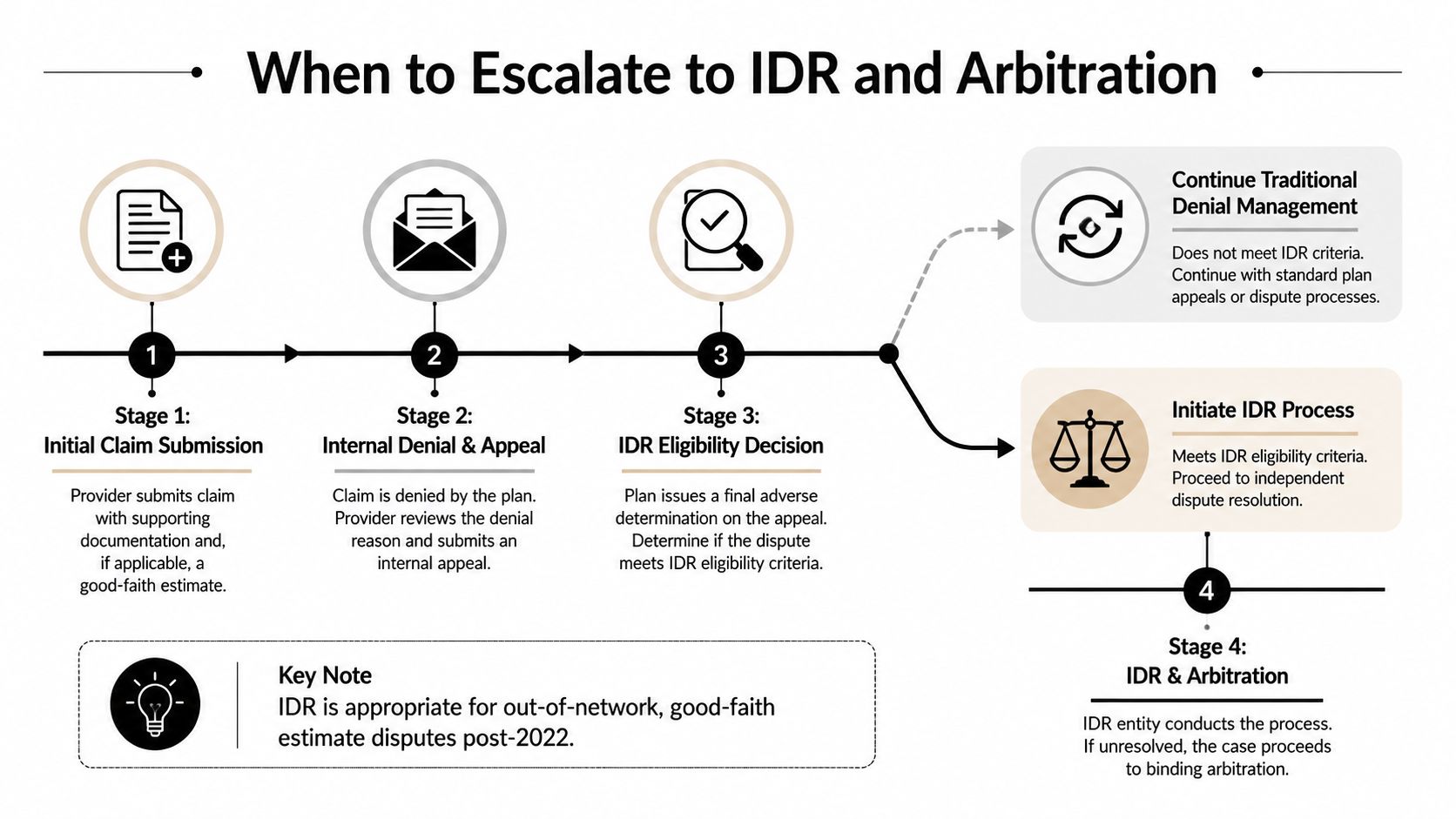
Traditional denial management and the No Surprises Act dispute process solve different problems. An ordinary coding denial may need correction, reconsideration, or appeal. A qualifying out-of-network payment dispute may require negotiation and, if unresolved, Independent Dispute Resolution rather than another routine appeal.
CMS states that the No Surprises Act bans surprise bills for most emergency services and certain non-emergency services delivered at in-network facilities. Anesthesia is among the specialties affected by these protections. Providers should not treat the patient as the recovery strategy when balance billing is prohibited.
Choose the right recovery path
| Situation | Traditional denial management | IDR or arbitration |
|---|---|---|
| Wrong CPT code or missing record | Correct and resubmit | Usually premature |
| Eligibility or authorization failure | Investigate coverage and appeal | Usually not the first route |
| Repeated underpayment on qualifying out-of-network services | Negotiate and document the pattern | Consider when statutory eligibility is met |
| Low initial offer after required negotiation | Continue the required process | Evaluate federal dispute eligibility and deadlines |
| Payment delay without a qualifying dispute | Escalate through payer channels | Use only if the dispute meets applicable requirements |
A dispute-ready file includes the claim, remittance, contract or payment terms, documentation, network status, negotiation history, and evidence explaining why the payment is inadequate. The qualifying payment amount and other required information must be handled according to the applicable federal process. Deadlines are strict, so a group shouldn't wait until an aging report becomes the only evidence.
The strongest IDR files are consistent. The code matches the record, the record supports the time and modifiers, the payment history shows the payer's behavior, and the group can explain the requested amount without unsupported assumptions. A single underpaid claim may belong in standard follow-up. A recurring pattern of low offers or delayed payment deserves a structured review through RevGuard's independent dispute resolution service.
Escalation test: If the claim is wrong, fix the claim. If the claim is right and the payer's payment behavior is systematically deficient, preserve the evidence and evaluate the dispute pathway.
IDR isn't a substitute for clean billing. Weak submissions create weak dispute files. The better operating model connects front-end verification, coding, documentation, payment posting, negotiation, and dispute preparation so every stage preserves evidence for the next one.
Building an Actionable Anesthesia Billing Checklist
A useful checklist should follow the claim from scheduling through final payment. It should also assign an owner for each step. If every task belongs to “billing,” gaps will remain hidden between clinical documentation, authorization, coding, payment posting, and dispute work.
Before the case
- Confirm patient coverage: Verify active eligibility, benefits, network status, referrals, and authorization requirements.
- Confirm the facility relationship: Check whether the anesthesia group and facility have separate network positions under the patient's plan.
- Identify the expected service model: Establish whether the anesthesiologist personally performs, medically directs, or supervises the service, and whether a CRNA bills independently where permitted.
- Flag special circumstances: Note possible MAC, physical status, qualifying circumstances, discontinued services, or obstetric coding pathways before the claim reaches the queue.
During and immediately after the case
- Capture anesthesia time: Record exact start and stop times based on anesthesia care, not the surgical incision and closure times.
- Complete the clinical record: Document the pre-anesthesia assessment, plan, intraoperative care, transfer, and post-anesthesia evaluation.
- Support every modifier: Ensure the record explains the physical status, technique, provider participation, and qualifying circumstances reported.
- Reconcile the case: Compare the anesthesia record with the operative report, schedule, facility data, and provider assignment.
Before submission
- Select the anesthesia CPT code: Match the code to the actual procedure and anatomic region.
- Validate units: Confirm base units, time units, and any supported modifying units under the payer's rules.
- Run payer edits: Test modifier compatibility, provider identifiers, authorization, place of service, and claim format.
- Preserve evidence: Store the signed record, verification details, authorization, claim image, and relevant payer correspondence.
After adjudication
- Post the remittance accurately: Separate contractual adjustment, denial, underpayment, patient responsibility, and unresolved payer balance.
- Compare payment with expectation: Use the applicable payer contract, fee schedule, locality, physician status, and documented units.
- Classify the problem: Decide whether the issue is a corrected claim, ordinary appeal, negotiation matter, or potential No Surprises Act dispute.
- Track patterns: Group results by payer, facility, code, modifier, provider model, and denial reason.
- Protect deadlines: Assign a specific owner to negotiation and IDR eligibility review, with documented due dates.
A practical escalation decision tree
- Is the claim inaccurate or unsupported? Correct the coding or documentation issue and resubmit when permitted.
- Is the claim accurate but unpaid or underpaid? Review the remittance, contract, network status, and payer explanation.
- Does the dispute involve a qualifying out-of-network emergency or facility-based service protected by the No Surprises Act? Evaluate the applicable negotiation and IDR requirements.
- Is there a repeated payer pattern? Build a claim-level evidence set instead of handling each payment as an unrelated exception.
- Can the group explain the requested payment with documented facts? If yes, prepare the dispute file. If not, fix the data foundation before escalating.
The strongest anesthesia billing operation doesn't choose between accuracy and recovery. It treats accuracy as the entry requirement, then uses payment analytics and disciplined dispute workflows to address what happens after the claim leaves the practice.
RevGuard manages anesthesia revenue cycle work across eligibility verification, specialty-specific coding, documentation controls, payer follow-up, and underpayment analysis, with dispute workflows tied to the No Surprises Act. Visit RevGuard to discuss how your anesthesia group can build cleaner, dispute-ready claims and recover payer underpayments without shifting prohibited balances to patients.