

In 2024, the average initial medical claim denial rate reached 11.8% across U.S. payer types, up from 10.2% in 2020, while roughly $262 billion in medical claims are initially denied each year. The problem is operational as much as clinical. One widely cited benchmark says 84% of denials may be avoidable, and 44% originate at registration or eligibility verification. (Medical billing denial statistics)
Medical billing denials aren't just a billing-office nuisance. They delay cash, consume staff capacity, create write-off exposure, and often sit next to underpayments that never receive the same level of scrutiny. The right operating model connects front-end prevention, disciplined appeals, payer-specific analytics, and enforcement under the No Surprises Act.
What Medical Billing Denials Are and Why They Matter Now
The scale is large enough to change how leaders should manage revenue. A claim denial is a payer decision that a submitted claim isn't payable as submitted after the payer processes it under its policy, contract, or claim rules. That definition matters because a denial isn't the same thing as every other payment problem.
A rejection usually occurs before adjudication because the claim fails a format or data edit. A pending claim remains under payer review. A partial payment means some billed services or lines were paid while others weren't. An underpayment means the payer issued money, but below the amount supported by the contract, applicable law, or reimbursement methodology. A contractual adjustment, meanwhile, is an expected reduction recorded under the payer agreement, not a lost claim that staff should automatically appeal.
Practical rule: Before assigning work, identify whether the payer rejected, denied, delayed, partially paid, or underpaid the claim. Each outcome requires a different remedy.
The operational cost of a denial
A denied claim creates a work queue. Staff must read the remittance, identify the actual defect, gather records or corrected data, select the right submission path, and track the next deadline. That rework extends accounts-receivable aging and diverts employees from clean claims, patient service, and timely follow-up.
Cash-flow damage can appear in several places:
- Rework labor: Billing, coding, clinical, and authorization staff may touch the same account repeatedly.
- A/R extension: The organization waits through correction, appeal, payer review, and possible escalation.
- Patient-balance leakage: Confusing payer decisions can leave balances unresolved or incorrectly transferred to patients.
- Write-off risk: Claims that miss filing or appeal deadlines become harder, and sometimes impossible, to recover.
Teams should also separate avoidable denials from legitimate coverage disputes. Registration defects, missing authorization data, coding inconsistencies, and incomplete claim information call for process correction. Medical-necessity disputes may require clinical evidence, peer review, or external review. Underpayments require contract analysis and payment enforcement, not a standard denial letter.
A practical diagnostic begins with three questions: What was the payer decision? Who owns the next action? What revenue remains recoverable? The health insurance claim denial rates guide can help frame the exposure, but your own remittance data must determine the operating response. Denial management works only when prevention and recovery operate as one loop, with downstream findings changing upstream registration, authorization, coding, and contract workflows.
The Five Denial Categories You Will Actually See
A useful taxonomy makes triage faster. Payer remittance language often describes the payment result, not the process failure that caused it, so teams need categories that point directly to an owner and a remedy.
Administrative denials
An administrative denial usually involves a missing prerequisite, filing issue, referral, or required document. For example, a specialist claim may receive CARC 197, “Precertification/authorization/notification absent.” If the payer requires a referral and the referral wasn't captured, the billing team shouldn't send a generic appeal. The correct response is to verify whether a valid referral existed, attach the supporting record if permitted, or correct the workflow that allowed scheduling without the prerequisite.
Administrative denials also include duplicate submissions, untimely filing, and missing medical records. The remit may say “not payable,” but the root cause may be a registration hand-off or an authorization record that never reached the claim.
Clinical denials
A clinical denial challenges medical necessity, level of care, or policy criteria. A payer may use CARC 50, “These are non-covered services because this is not deemed a ‘medical necessity' by the payer.” The fix isn't a copied diagnosis list. It requires a focused clinical package, including the ordering rationale, relevant history, treatment failure where documented, procedure note, and payer policy criteria.
A peer-to-peer request can be appropriate when the payer offers that route. The clinician's submission should answer the payer's specific criteria rather than restate the entire chart.
Eligibility denials
Eligibility problems occur when coverage, coordination of benefits, or plan status doesn't match the claim. CARC 27, “Expenses incurred after coverage terminated,” is a straightforward example. If coverage terminated before the date of service, a corrected claim won't solve the problem. Staff must verify whether another active plan exists, confirm the date of service and member data, and route the balance according to the organization's patient-financial policy.
The upstream fix is reliable eligibility verification, not more aggressive follow-up after adjudication.
Coding and claim-edit denials
Coding denials arise when the submitted code combination conflicts with payer edits, clinical documentation, or procedure rules. An NCCI edit may identify bundled services, while a modifier may be missing, unsupported, or incorrectly placed. CARC 97, “The benefit for this service is included in the payment or allowance for another service or procedure,” commonly signals a bundling issue.
A coder should review the operative or procedure documentation, confirm whether the services were distinct, apply an appropriate modifier only when supported, and submit a corrected claim when correction is the proper path. An appeal that ignores the edit repeats the original error.
Payment and underpayment denials
Some accounts are labeled denials even though the payer issued payment below the contracted amount. A procedure may be down-coded, a multiple-procedure reduction may be applied incorrectly, or a device-intensive service may be collapsed into a payment that doesn't match the agreement. The remedy is contract comparison, fee-schedule validation, line-level payment analysis, and a demand for corrected payment.
A denial asks whether the claim should be paid. An underpayment asks whether the payer paid the right amount. Don't send both through the same queue.
Denial KPIs That Matter and the Benchmarks to Beat
Denial programs are moving from a volume problem to a severity problem. A denied claim worth $80 and one worth $8,000 may share a reason code, but they don't deserve identical staffing, escalation, or appeal decisions. Experian's healthcare claims reporting notes that providers increasingly face higher-value denied amounts, with average denied amounts rising 12% for inpatient services and 14% for outpatient services in the cited hospital benchmarks. (Experian Health's claims denial statistics)
Track the measures below at claim and dollar level. The benchmark column isn't a universal law. It's an operating target that should be adjusted for specialty, payer mix, contract design, and service complexity.
| KPI | Definition | Industry Average | Best-in-Class Target |
|---|---|---|---|
| First-pass denial rate | Claims denied during initial adjudication divided by submitted claims | U.S. average initial denial rate was 11.8% in 2024 (industry benchmark) | Set a declining target by payer and specialty, with front-end causes separated from clinical causes |
| Final denial rate | Claims still unpaid after correction and appeal activity | Hospital median final denial rate rose from 2.5% in 2024 to 2.7% in 2025 (Experian Health) | Reduce final loss by prioritizing high-value, recoverable accounts |
| Overturn or recovery rate | Denied dollars or claims recovered after correction, appeal, negotiation, or escalation | Historical benchmarks vary by organization and workflow | Measure separately for corrected claims, internal appeals, external review, and IDR |
| Initial denial dollars at risk | Total allowed or expected reimbursement attached to new denials | Not a single universal benchmark | Rank daily work by financial exposure and recovery likelihood |
| Mean days to payment | Time from original submission to final payment | Varies by payer and service | Shorten the interval by assigning first action immediately |
Measurement errors can make a weak program look healthy. Don't mix denied lines with denied claims, count a corrected claim as an appeal overturn, or double-count reversals as recovered revenue. Store the original claim, denial event, action, resubmission, payer decision, and final payment as separate events.
The dashboard tells leadership how much is leaking. Root-cause analysis tells the team where to intervene, which is why denial KPIs should always be segmented by payer, location, specialty, provider, code family, authorization status, and owner.
How Denial Patterns Differ Across Specialties
The same payer category can produce completely different work in a specialty queue. A generic “coding denial” label isn't enough for an IONM team, anesthesia group, ASC, air ambulance provider, or radiology practice.
An IONM claim may be submitted with split services and time-based monitoring. The payer treats the work as bundled because the surgeon's documentation supporting distinct monitoring isn't attached. The remedy is not to add a random modifier. The coding team must validate the monitoring timeline, operative documentation, physician participation, and payer-specific billing rules before correcting or appealing.
Anesthesia creates another failure pattern. A claim may trigger a medical-direction denial because the payer's records don't support the submitted relationship between the anesthesiologist and CRNA. A credentialing gap can independently create a nonpayment problem, even when the procedure and anesthesia record are otherwise complete. The response requires review of medical-direction documentation, provider enrollment, supervision requirements, and the applicable contract.
At an ASC, a clean claim can become an underpayment when the payer collapses a device-intensive service or applies multiple-procedure logic that conflicts with the agreement. The recovery team needs the contract, fee schedule, implant or device detail, and line-level remittance analysis.
Air ambulance claims often fail when mileage, origin, destination, ZIP data, or GPS evidence isn't attached in the format the payer expects. The file should connect the transport record, flight log, origin and destination, medical necessity documentation, and applicable modifiers.
Radiology denials frequently begin with prior authorization or clinical-policy mismatches. An ordering provider NPI mismatch can make a properly performed study look unauthorized, while an imaging policy review may question whether the indication meets the payer's clinical criteria. The fix combines authorization verification, ordering-provider identity, diagnosis specificity, and supporting clinical documentation.
| Specialty | Dominant Denial Type | Root Cause | Primary Remedy |
|---|---|---|---|
| IONM | Bundling or documentation denial | Split-claim and time-based monitoring support not attached | Reconcile timeline, operative note, physician documentation, and payer edits |
| Anesthesia | Medical-direction or credentialing denial | Supervision evidence or CRNA enrollment gap | Validate records, credentialing, provider status, and contract rules |
| ASC | Underpayment or multiple-procedure edit | Device-intensive service or reduction logic applied incorrectly | Compare remittance with contract and submit payment dispute |
| Air ambulance | Data and documentation denial | Mileage, origin-destination, ZIP, or GPS evidence missing | Assemble transport, flight, location, and medical-necessity records |
| Radiology | Authorization or medical-necessity denial | Ordering NPI mismatch or policy criteria not demonstrated | Match authorization to ordering provider and clinical indication |
Two of these scenarios, particularly certain air ambulance and out-of-network emergency-service disputes, can move beyond ordinary payer appeals into Independent Dispute Resolution under the No Surprises Act when the statutory requirements are met. That makes specialty-specific evidence capture a revenue function, not just a coding preference.
A Prevention Workflow That Stops Denials at the Source
Prevention needs hard hand-offs. A checklist that says “verify insurance” without naming when, what, and who owns the result won't control denial volume.
Five checkpoints
Run the first eligibility check 72 hours before the visit. Confirm active coverage, member identity, plan benefits, secondary insurance, and coordination-of-benefits indicators. Flag gaps early enough for staff to contact the patient or referring office.
Re-verify on the day of service. Coverage can change between scheduling and treatment. Compare the day-of response with the earlier result, document the transaction, and route changes before the encounter closes.
Attach authorization data to the encounter and claim. Store the authorization number, approved service, units or visits, rendering provider, and expiration date. Track expiration against the date of service, not the scheduling date, because a scheduled appointment can outlive the approved window.
Run a payer-aware coding review. Scrub NCD, LCD, NCCI, modifier, and payer-published claim edits. Add a same-specialty modifier audit for services where distinctness, supervision, or multiple-procedure rules create recurring errors.
Reject defects before submission and inspect the ERA the day it posts. A clearinghouse scrub should stop a preventable claim before it reaches the payer. Once the ERA arrives, code the denial, assign the owner, record the next action date, and route the account within 24 hours instead of batching work at month-end.
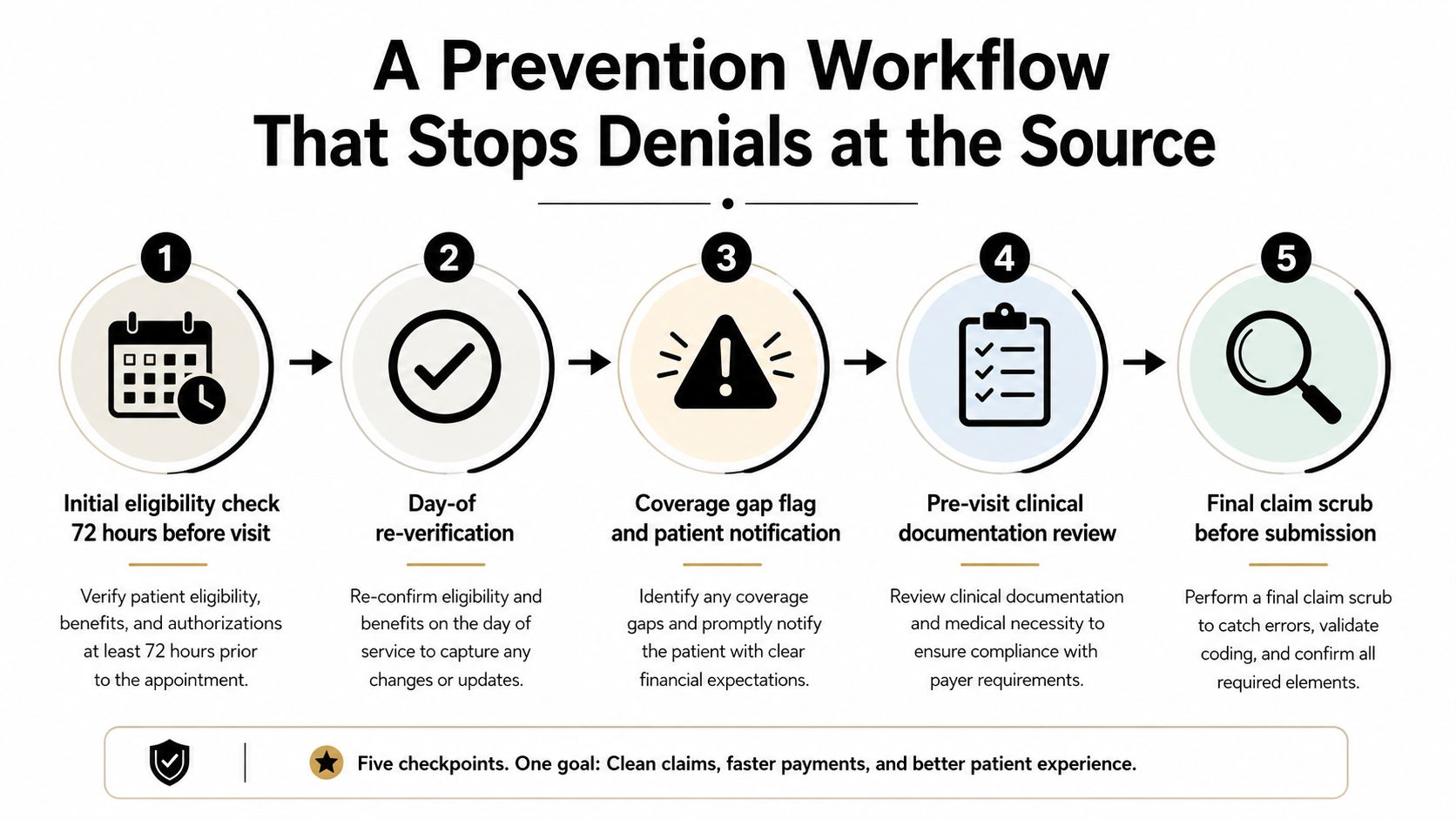
The control point is the hand-off. Front-desk staff own demographic and coverage accuracy. Authorization staff own approval matching. Coders own supported code selection. The clearinghouse and billing team own transmission integrity. Denial analysts own classification and feedback.
Don't let technology become an excuse for weak ownership. Eligibility tools, payer portals, clearinghouse edits, encoder software, and clinical-documentation prompts can identify risk, but a named employee still needs to resolve the exception and record what changed.
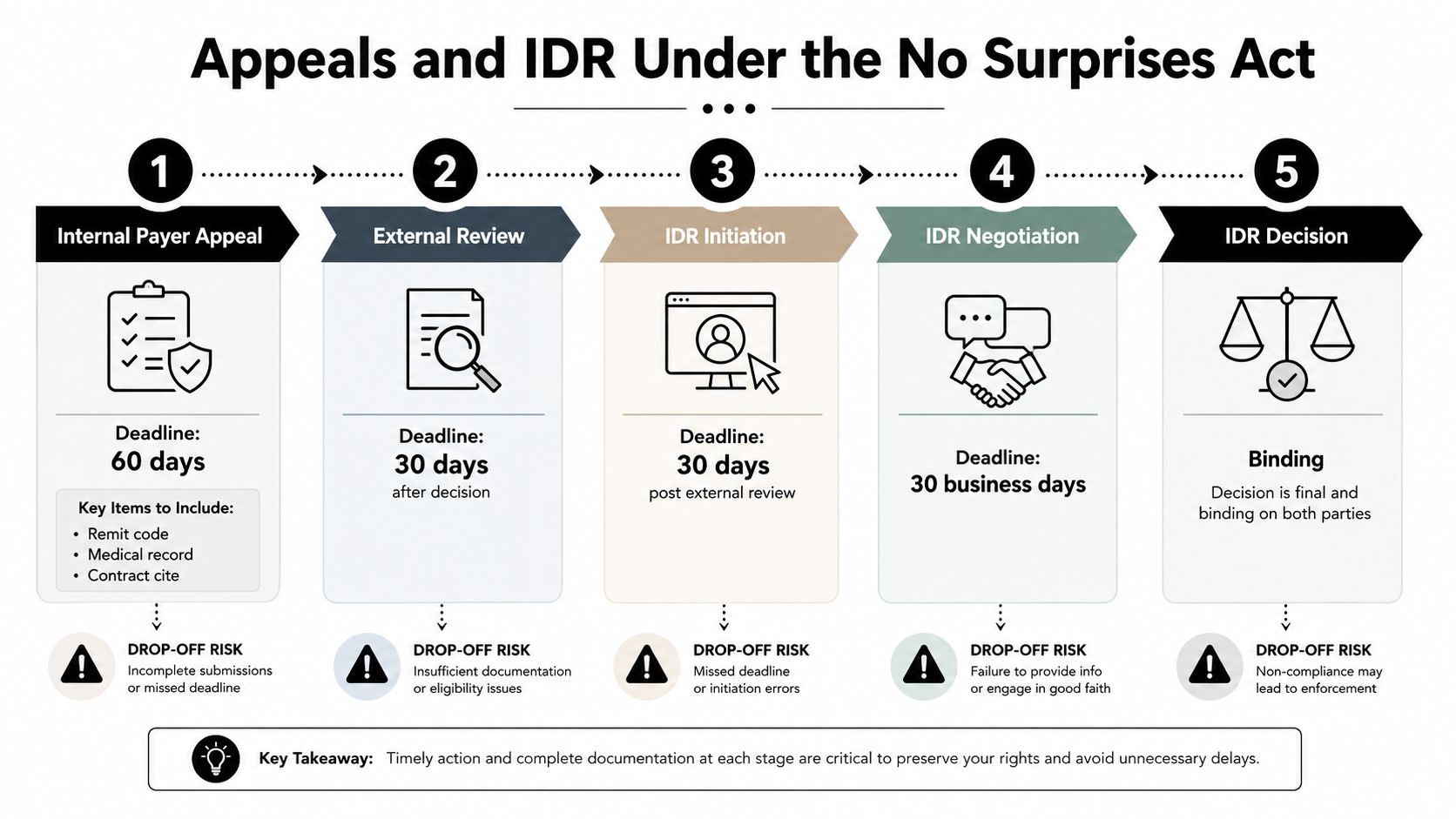
Appeals and IDR Under the No Surprises Act
Appeals fail more often from missed process requirements than from weak clinical arguments. Build a ladder that preserves every option and treats each deadline as a production control.
The five-rung recovery ladder
First, file the internal payer appeal. Start with the remit code, the payer's reason, the relevant medical record, and the contract or policy provision that supports payment. The payer's filing window commonly falls between 60 and 180 days, but the governing plan document and remit instructions control. Log the received date, deadline, submission channel, and confirmation number.
Second, request a higher-level internal review. Use a peer-to-peer letter when the dispute turns on clinical judgment. The clinician should answer the payer's criteria in the order presented, cite the applicable guideline, and identify the exact chart evidence supporting the service.
Third, pursue external review when available. A state independent review entity or Medicare administrative path may require a new evidence package designed for a clinical audience. Don't recycle a claims-office cover letter. Explain the diagnosis, treatment decision, failed alternatives where documented, and policy standard in a concise clinical narrative.
Fourth, evaluate IDR eligibility. For qualifying No Surprises Act items, the parties generally enter an open negotiation period before IDR. An eligible dispute can proceed after that period, subject to the federal process, applicable deadlines, batching rules, and certified IDR entity requirements. The No Surprises Act IDR resource should supplement, not replace, a current compliance review.
Fifth, consider civil litigation for residual underpayments. Litigation is not a default denial tactic. It can become relevant when contractual or statutory payment disputes remain material after available appeal and IDR options.
The IDR evidence file
Before opening a dispute, confirm the claim is eligible, the parties are correctly identified, and the deadline is tracked centrally. Assemble the remittance, claim form, patient and service details, contract information, relevant payment or offer history, medical records where relevant, provider credentials, and evidence supporting the payment position.
Common drop-off points include an expired deadline, incomplete batching, inconsistent service dates, missing negotiation documentation, and evidence that doesn't explain the requested payment. Assign one owner to compliance and another to evidence quality when volume justifies the separation.
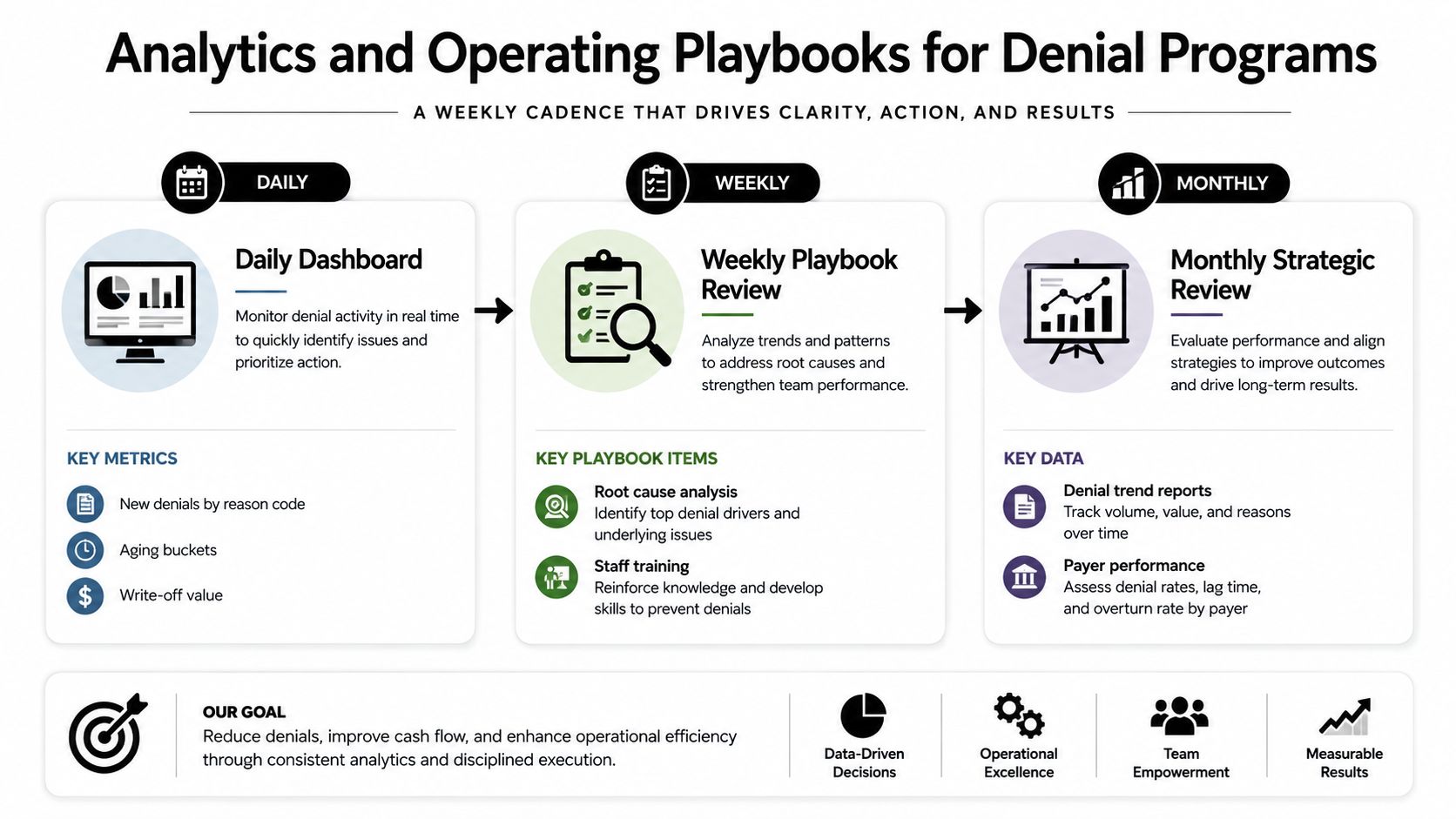
Analytics and Operating Playbooks for Denial Programs
Raw 835 and ERA files become useful only after the team converts them into decisions. Build a cadence that distinguishes immediate account action from recurring process correction.
The daily dashboard should show new denials by reason code, aging buckets, assigned owner, and write-off value. It should answer a simple question: which accounts require action today to preserve recoverability?
The weekly denial huddle should examine the top five payer reason codes, overturn rates by representative, recurring authorization gaps, and the highest-value unresolved accounts. Each recurring reason needs an owner, a root-cause hypothesis, and a testable workflow change.
The monthly leadership review should focus on denial rate by payer contract, cost to collect, net realization, underpayment exposure, and IDR eligibility. Leadership should decide whether to change staffing, edit rules, payer escalation, or contract strategy.
Operating principle: A dashboard that doesn't produce an owner and a decision is a report, not a denial program.
Normalize reason codes before drawing conclusions. For example, consolidate Reason Code 16, non-covered services, and MA130 into a coordination-of-benefits category when the underlying issue is COB. Keep the original codes available for audit, but use a management taxonomy that reduces noise.
Create a payer-behavior matrix with three dimensions:
- Denial volume: How often the payer creates avoidable or disputed work.
- Appeal success: Which reason codes and service lines overturn.
- IDR eligibility: Which underpayments or out-of-network disputes may qualify for escalation.
The weekly meeting should end with three decisions: which upstream edit changes, which accounts receive priority, and which payer behavior needs escalation. Add the responsible owner and due date to the denial platform. RevGuard can be one operating option for organizations that need specialty-specific RCM, denial analytics, and NSA IDR workflows connected in the same revenue-protection process.
Linking RCM and IDR to Protect Revenue at Scale
Denial prevention and IDR enforcement belong to the same revenue-protection function. The front end determines whether the claim is clean, the appeals team determines whether a payer's decision can be reversed, and the IDR team determines whether an eligible underpayment deserves formal enforcement. Separating those teams without a shared evidence loop guarantees repeated defects.
If an appeal overturn succeeds because a payer accepted a particular documentation element, that evidence should change the registration prompt, authorization checklist, coding edit, or clinical documentation template. If a payer repeatedly underpays a service line, the contract team should see the pattern alongside denial volume and appeal results. The organization needs one view of revenue at risk, revenue recovered, and revenue that should have been paid correctly the first time.
For qualifying cases under the No Surprises Act, IDR can apply to situations such as out-of-network emergency services, certain post-stabilization services, and eligible air ambulance claims. Screening must happen before the account ages out of the process. Staff also need a reliable way to collect QPA-related evidence, negotiation records, service details, and the payer's payment position.
Quarterly audit checklist
- Screen every out-of-network claim: Confirm whether NSA protections and IDR eligibility may apply.
- Track deadlines centrally: Record open negotiation, initiation, submission, and response dates in one system.
- Feed overturn reasons upstream: Convert successful appeals into coder, authorization, registration, and documentation edits.
- Unify recovery reporting: Combine denial recovery, underpayment recovery, and IDR recovery into a revenue-protection view.
- Review payer behavior by contract: Use denial volume, appeal outcomes, payment variance, and IDR results during payer negotiations.
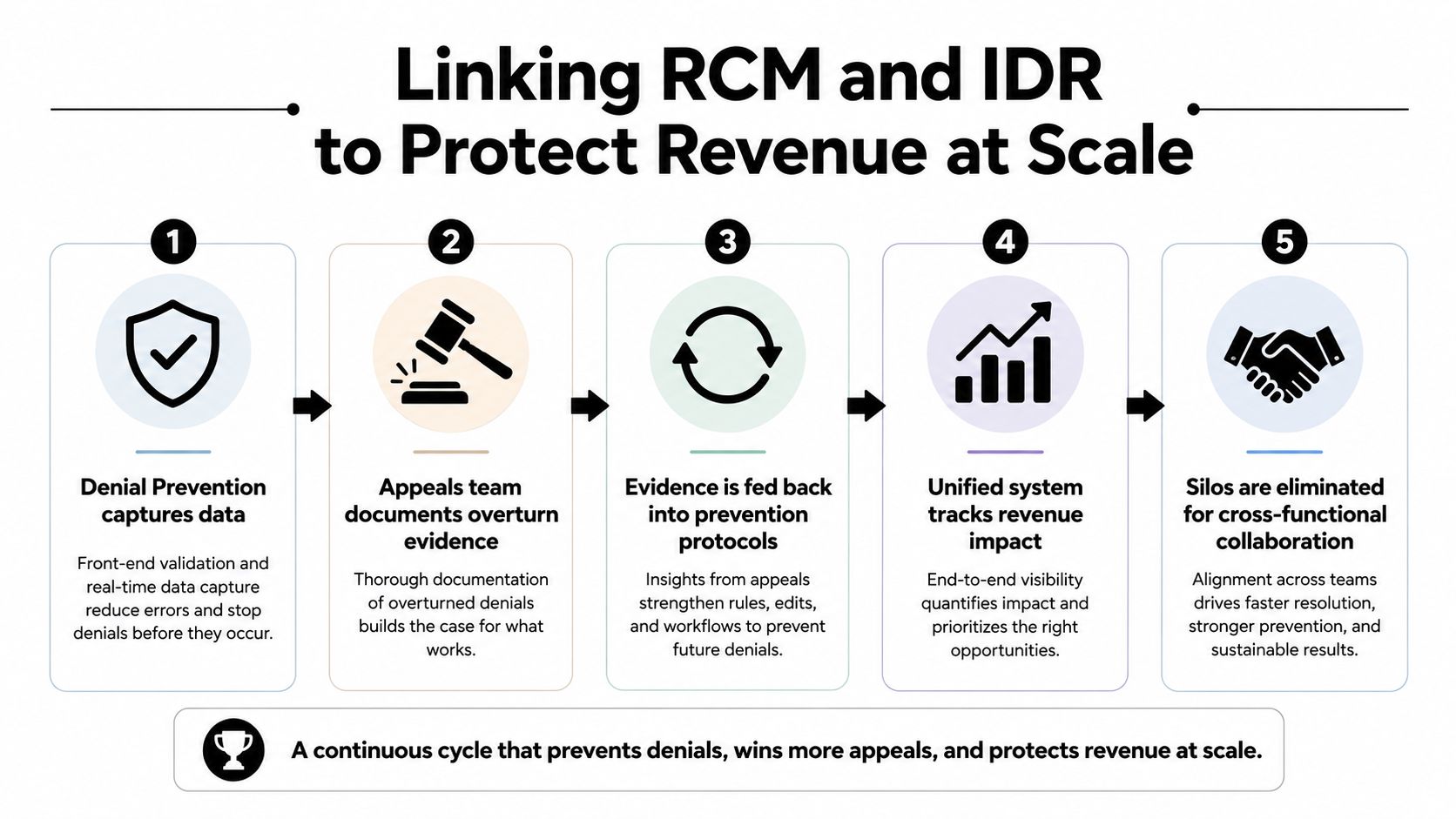
The unit economics change when teams prioritize recoverable dollars instead of raw account counts. A smaller number of severe underpayments can require more attention than a large queue of low-value correctable claims, and the same payer intelligence can improve both prevention and enforcement.
RevGuard helps provider groups connect eligibility, coding, credentialing, denial management, payer negotiations, and No Surprises Act IDR into a coordinated revenue workflow. Visit RevGuard to assess where your organization is losing money between clean-claim creation, payer adjudication, appeals, and underpayment recovery.