
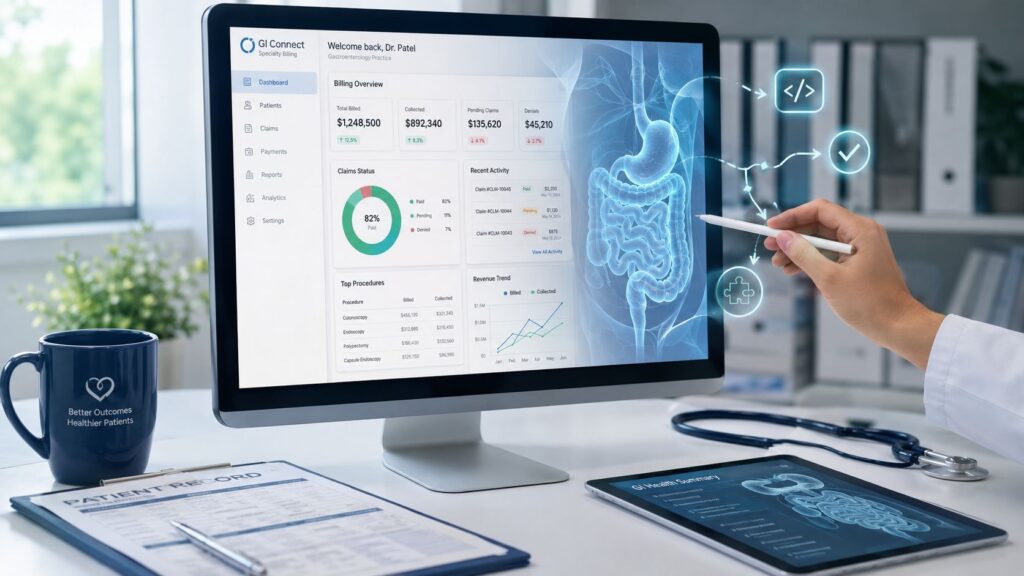
Monday morning starts with three procedure rooms, an ambulatory surgery center, and a hospital outpatient department sending charges into the same billing queue. The team has EGDs, colonoscopies, pathology, anesthesia, follow-up visits, and screening procedures that became diagnostic after findings were documented. Someone is already comparing a procedure note with a superbill, while someone else is chasing an authorization that may not match the code scheduled for the patient.
That workload exposes the central problem with generic billing tools. Gastroenterology billing software isn't just an electronic medical record add-on or a payment-posting utility. It's the rules engine between clinical documentation and payer submission. It must translate specialty encounters into accurate code combinations, apply payer edits, preserve supporting documentation, and give staff a clear path when a claim fails.
What Gastroenterology Billing Software Actually Does in a GI Practice
A GI billing platform begins with the encounter, not the invoice. It takes procedure details from the EHR or endoscopy system and helps convert them into the correct CPT and ICD-10-CM relationships, modifiers, place-of-service values, and documentation requirements. The American Gastroenterological Association's coding resources reference ICD-10-CM diagnosis codes used in GI practice, while CPT and ICD-10 code sets are updated annually and remain central to claim submission and reimbursement, as outlined in this overview of gastroenterology medical codes.
That coding environment makes specialty awareness essential. A colonoscopy may begin as a screening service and become diagnostic after a polyp or other finding is documented. An EGD may involve biopsy, pathology, anesthesia, or a same-day evaluation and management service. A generic platform can transmit a claim, but transmission isn't the same as correctly interpreting the encounter.
The claim layer between documentation and payment
Think of the software as a controlled translation layer:
- Capture the encounter: Pull the procedure note, diagnosis, findings, provider details, and supporting documentation from the clinical system.
- Construct the claim: Match diagnoses and procedures, apply modifier logic, and preserve the relationship between the service and its medical necessity.
- Scrub before submission: Validate code combinations, payer edits, authorization data, and required attachments.
- Submit and monitor: Send the claim through the clearinghouse, track payer responses, and distinguish front-end rejections from adjudicated denials.
- Post and route: Apply electronic remittance advice, identify underpayments, and send unresolved accounts to the right work queue.
Generic tools often treat a GI encounter like an ordinary office visit. That approach misses the operational details that determine whether endoscopy claims are paid correctly, including biopsy relationships, infusion add-ons, pathology linkage, and screening-to-diagnostic changes.
Practical rule: If a vendor can't demonstrate how its rules engine handles a real colonoscopy with a finding, biopsy, pathology, and same-day E/M service, it hasn't demonstrated GI capability.
Administrators should expect the platform to own code suggestion, claim scrubbing, submission, ERA posting, denial routing, authorization tracking, and GI-specific reporting. The system should also expose why an edit fired. A black-box rejection message forces staff back into manual investigation, which defeats the purpose of automation.
Specialty-Specific Features That Separate GI Software from Generic Tools
The strongest GI platforms don't sell isolated features. They connect procedure coding, payer rules, documentation, and denial resolution through one specialty rules library. That architecture matters because a coding decision made at charge capture should remain visible during claim scrubbing, payment posting, and appeal preparation.
Procedure logic must follow the clinical story
A useful system should support the coding patterns that appear in daily GI work:
- Upper and lower endoscopy: Procedure pickers should distinguish among EGD, colonoscopy, therapeutic services, biopsy, and related work.
- Screening conversion: The platform should recognize when a screening colonoscopy becomes diagnostic after a finding is documented, then apply the applicable claim logic.
- Modifier controls: It should maintain rules for modifiers such as -PT, -59, and -XS, with explanations that staff can review rather than automatically changing the claim.
- Sedation and pathology relationships: The workflow should connect documentation and related services without assuming that every same-day line can be billed independently.
- Infusion and biologic services: For practices managing inflammatory bowel disease, the system should preserve drug, administration, diagnosis, and place-of-service details through charge capture.
The platform should then carry those decisions into payer-aware scrubbing. It needs CPT, ICD-10-CM, modifier, and documentation validation before submission, along with awareness of payer edits such as NCCI and LCD rules. Real-time eligibility, authorization matching, and attachment logic belong in the same workflow.
The denial queue should understand GI failure modes
A denial dashboard that only says “denied” isn't enough. Staff should be able to separate medical-necessity issues from bundling edits, missing modifiers, authorization mismatches, non-covered services, credentialing problems, and documentation gaps. Each category should route to an appropriate owner and appeal workflow.
| Capability | Generic Billing Software | GI Billing Software |
|---|---|---|
| Endoscopy coding | Basic procedure selection | Specialty logic for EGD, colonoscopy, findings, biopsy, and related services |
| Modifier handling | General edit library | GI-aware rules for screening conversion and same-session services |
| Documentation | Standard attachment workflow | Procedure, pathology, authorization, and medical-necessity linkage |
| Denial management | Broad payer categories | GI-specific queues, root-cause tags, and appeal workflows |
| Reporting | Overall collections and denials | Drill-down by procedure family, payer, provider, location, and denial reason |
The value comes from the connection. When an appeal identifies a recurring modifier error, the correction should update the scrubber and charge-capture workflow. When a payer changes an edit, the same rule should reach scheduling, coding, and pre-bill review instead of living in a staff spreadsheet.
Prior Authorization and Denials Management for High-Volume Endoscopy
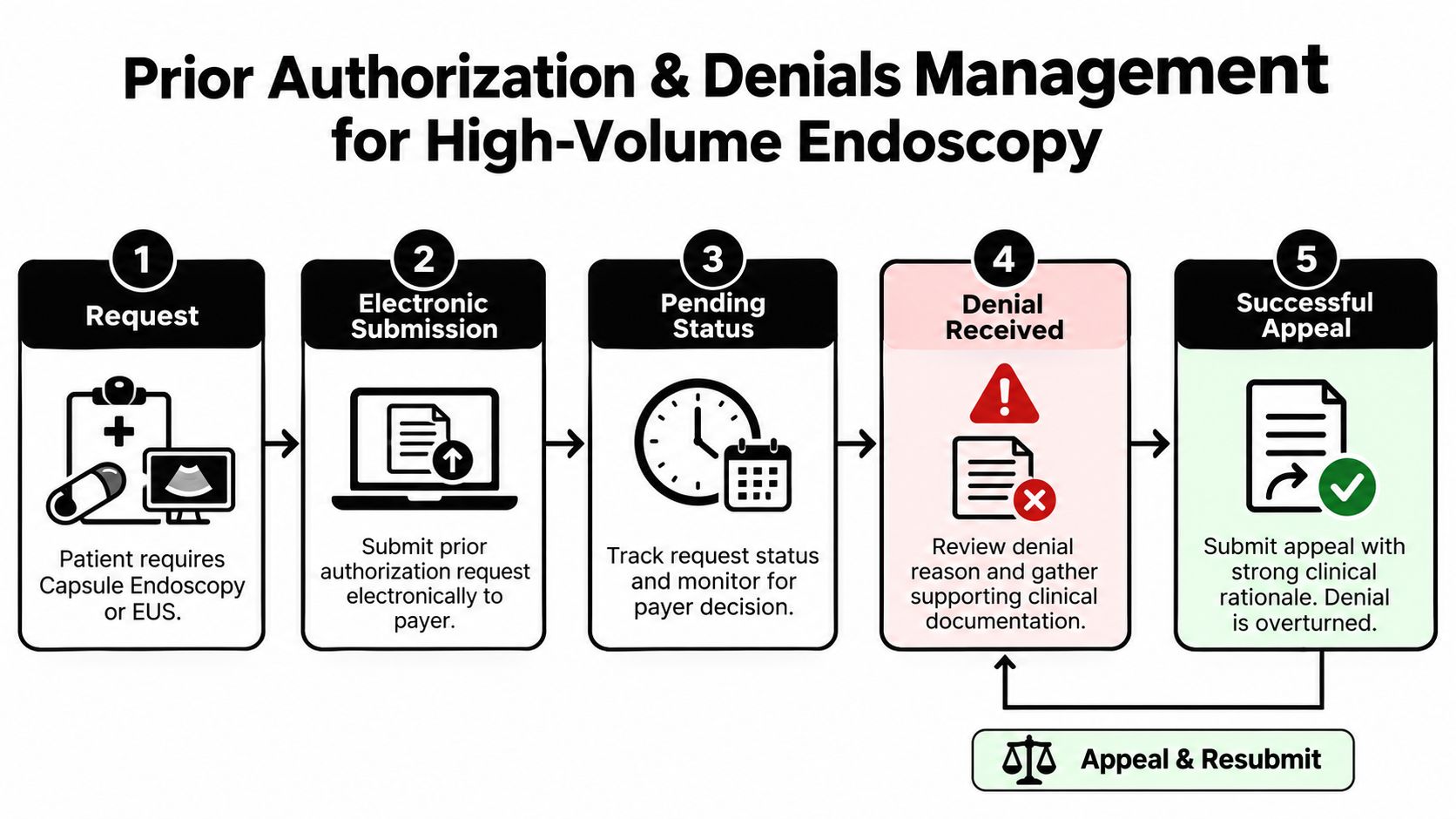
Authorization work starts before an endoscopy reaches the schedule. For capsule endoscopy or EUS, staff should submit the request through the payer portal or integrated workflow, attach the required clinical records, track the decision, and confirm that approval covers the exact planned service. Treat the software as the upstream rules engine. If it validates the case early, outsourced RCM staff spend less time correcting claims, and fewer disputes reach No Surprises Act IDR.
A workable process should let the scheduler select the procedure and payer, check eligibility and authorization requirements, submit clinical notes and diagnosis information, and store the authorization number, expiration date, approved service, and status. Scheduling should remain blocked until the authorization matches the procedure and date. Before submission, the scrubber should compare the approved CPT and ICD-10-CM combination with the charge.
Use a five-step prior authorization workflow as a vendor evaluation benchmark. The platform must show each handoff, owner, and exception, rather than displaying an authorization status field.
The authorization record must be structured data, not a scanned attachment sitting outside the billing workflow. The system should compare it with the final claim and reject mismatches, because approval for one service does not authorize a different code merely because both belong to the same clinical family.
Denials need classification, ownership, and feedback
When the payer responds, the system should route the account to a defined queue for medical necessity, bundling, non-covered service, credentialing, missing modifier, or documentation. Each category needs an assigned owner and a matching evidence checklist.
AI-assisted appeals can gather the encounter note, operative report, pathology result, authorization record, and remittance details into one review packet. Keep compliance review with staff, but use automation to eliminate searches across disconnected systems. Root-cause tags should update the scrubber, turning repeated errors into pre-bill edits.
High-volume centers should replace spreadsheets and shared inboxes with a workflow that connects authorization, claims, denials, outsourced RCM, and IDR preparation. The software should determine whether downstream arbitration is necessary at all.
EHR and Practice Management Integration for Clean Charge Capture
Integration fails when vendors define it as “data can be exported.” GI practices need a reliable data path from the endoscopy note to the paid claim, with no manual transcription of procedure details that already exist in the clinical record.
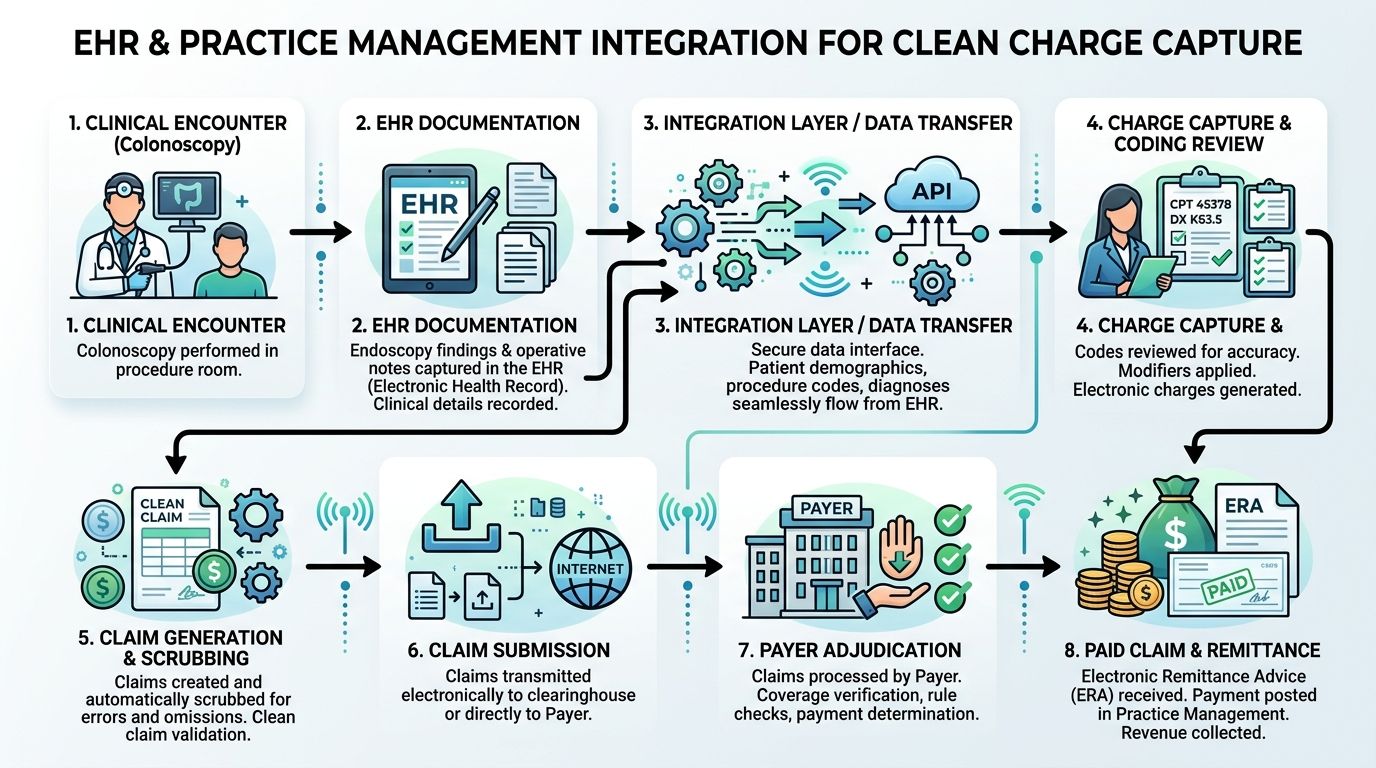
A colonoscopy encounter typically moves through several systems:
- Clinical documentation: The endoscopist records indication, extent of exam, findings, interventions, specimens, and recommendations.
- Practice management integration: The system receives the encounter and maps clinical details to charge candidates.
- Charge capture: Staff or rules-based workflows confirm CPT, diagnosis, modifiers, units, provider, and place of service.
- Claim generation: The platform applies payer edits and attaches supporting documentation.
- Payer response: Remittance, rejection, denial, and payment data return to the billing workflow.
Where information disappears
The first failure point is the procedure note to superbill handoff. If the note says a biopsy occurred but the charge workflow doesn't receive that detail, staff must identify the omission manually. The second is reconciliation among endoscopy images, pathology, and the final procedure report. A specimen record that sits outside the billing workflow can leave the claim without necessary support.
The third problem appears in in-office biologic infusions. Drug identifiers, administration services, units, diagnoses, and authorization data must travel together. The fourth is place-of-service reconciliation when the same physician works across the office, ASC, and hospital outpatient department.
Clean integration should support HL7 or FHIR feeds, bi-directional eligibility checks, and one authoritative encounter record. It should also expose exceptions instead of presenting a green “integrated” status while omitting fields.
Ask vendors to prove integration with your own data. Request a test encounter containing a screening colonoscopy that becomes diagnostic, a biopsy, pathology, anesthesia, and a separate place of service. Then ask:
- Which fields arrive automatically?
- Which fields require staff confirmation?
- Can the platform show the original source value beside the mapped billing value?
- What happens when the EHR and PM system disagree?
- Can eligibility and authorization status return to scheduling?
- How are interface failures reported and escalated?
A credible medical billing software demonstration should follow the encounter all the way to a scrubbed claim, not stop at a successful data import.
Where Software Ends and Outsourced RCM and IDR Begin
A GI practice can still lose revenue after a claim leaves the billing system. The platform should prevent avoidable failures by validating eligibility, authorization, coding, modifiers, documentation, and payer edits. An outsourced RCM partner then works the accounts that require human judgment, including aging follow-up, appeals, credentialing, payer escalation, underpayment analysis, and payment reconciliation. No Surprises Act independent dispute resolution belongs at the end of that process, for qualifying out-of-network payment disputes that remain unresolved after the claim and negotiation record are documented.
The rules engine determines the downstream workload
Poor claim data creates expensive manual work. A missing modifier or authorization reference can send an RCM specialist back to correct an avoidable error instead of pursuing a legitimate underpayment. The software should separate rejections from denials, preserve payer reason codes, and route accounts by cause, value, filing deadline, and recovery potential.
That control matters for NSA IDR. HHS announced an IDR eligibility threshold of $1,250 for calendar year 2026, so qualifying disputes at or above that amount require disciplined documentation and case selection. The threshold appears in the HHS announcement on the 2026 IDR process.
The platform should preserve the billed service, contracted or expected amount, payer response, authorization history, clinical documentation, and underpayment reason. With that record intact, the RCM partner can negotiate, assemble evidence, and initiate IDR only when the dispute meets the applicable requirements. Better software therefore reduces unnecessary arbitration by resolving preventable claim problems before they become payment disputes.
| Task | Software | Outsourced RCM | IDR |
|---|---|---|---|
| Eligibility verification | Runs checks and records results | Resolves exceptions and escalates gaps | Not applicable |
| Claim construction | Maps codes, modifiers, and documentation | Reviews exceptions and corrects accounts | Uses final claim record |
| Denial prevention | Applies payer edits before submission | Identifies recurring payer and workflow causes | Not applicable |
| Appeals | Creates work queues and evidence links | Drafts, files, and follows appeals | Not applicable |
| Underpayment review | Flags variance against expected reimbursement | Analyzes patterns and contacts payer | Supports dispute selection |
| Negotiation | Preserves payment history and documentation | Leads payer negotiation | Receives qualifying unresolved dispute |
| IDR filing | Produces the underlying data packet | Determines strategy and submits eligible cases | Decides the dispute under the applicable process |
Do not expect an outsourced partner to repair a billing system that loses clinical details or misclassifies services. Evaluate revenue cycle management outsourcing as an extension of the platform. Require shared data definitions, shared denial categories, clear ownership of each work queue, and reporting that separates preventable denials from legitimate payer disputes. Ask the vendor to show which records feed negotiation and IDR, which staff member reviews them, and where unresolved exceptions are escalated.
How to Choose and Implement the Right GI Billing Software
A GI practice can lose revenue before an outsourced RCM team ever touches a claim. If the system drops a modifier, misreads a screening conversion, or sends incomplete documentation, downstream staff spend time correcting preventable errors instead of resolving payer disputes. Buy the platform that makes those failures visible and controllable.
Do not select software for its dashboard or feature count. Require a live demonstration using your endoscopy workflows, payer rules, and documentation standards.
Four filters should decide the shortlist
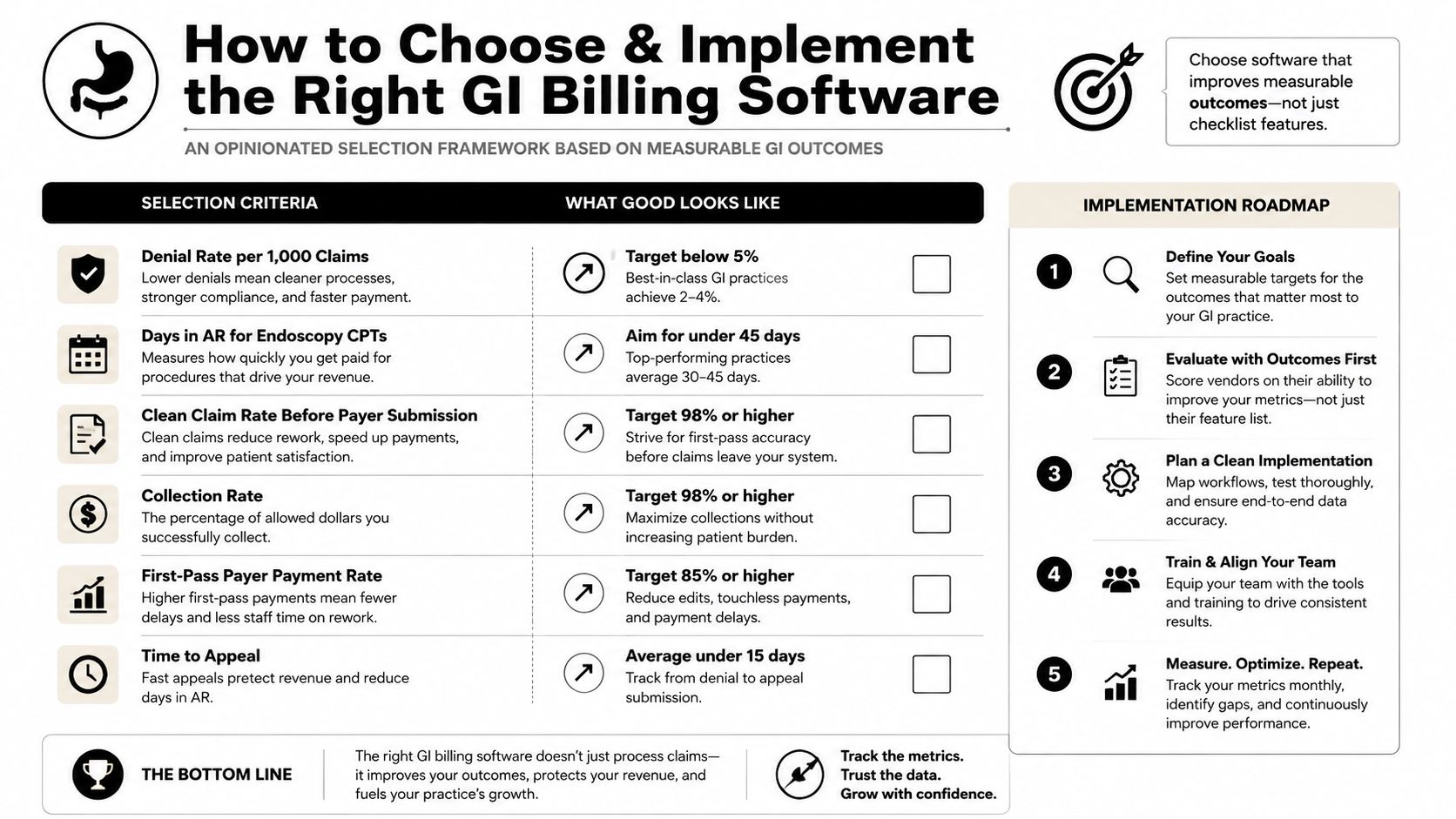
Require specialty-native coding content. The platform should demonstrate screening-to-diagnostic logic, biopsy handling, modifier controls, pathology relationships, infusion workflows, and payer-specific edits. A general clearinghouse with a GI-themed dashboard does not meet that standard.
Test integration depth. The vendor must map data from your EHR, endoscopy system, pathology workflow, ASC, and hospital interfaces. Ask how the system handles missing fields, duplicate encounters, conflicting place-of-service values, and interface downtime. These failures can distort charge capture before a claim reaches billing staff.
Demand procedure-level denial analytics. Your team should be able to examine denial rates, endoscopy-specific CPT families, payer behavior, provider patterns, and the root cause of each failure. A report showing only total denials cannot tell administrators what to change.
Reject opaque pricing. Compare full EHR and billing platforms with standalone billing services, implementation fees, interface charges, and collection-based pricing. Ask for every recurring and one-time charge in writing. Treat vendor pricing as a reference point, not a substitute for a practice-specific proposal.
Use a controlled rollout
Start with a data migration audit. Reconcile payer enrollment, fee schedules, provider identifiers, location values, existing authorizations, and open accounts before loading records into production. Redesign the superbill around actual GI services instead of copying the old template into a new interface.
Keep the authorization workflow aligned with the detailed process in the prior section. The implementation team should confirm that required payer data, clinical documentation, and status changes move correctly between systems, without recreating that workflow in a second queue.
Train staff on endoscopy-specific edits, screening conversion, modifier use, documentation requirements, and place-of-service distinctions. Review performance after go-live, then compare denial causes and clean-claim results with the pre-implementation baseline.
Ask vendors how they maintain -59 and -XS logic, track MPFS and ASC fee schedule updates, and batch documentation for IDR. Those answers show whether the vendor maintains an active specialty rules library or supplies static code tables. Require the system to preserve the records an outsourced RCM partner needs for negotiation and IDR, because poor upstream rules can create an arbitration case that should never have existed.
ROI and Revenue Cycle Impact You Can Realistically Expect
A GI practice can buy software, keep the same documentation gaps, and see little financial change. The return comes from preventing avoidable errors before submission, routing work to the right queue, and giving staff evidence for follow-up. Specialty platforms can improve revenue performance compared with general-purpose tools, but vendor projections are not operating targets.
One market review reports 8% to 15% higher collections for practices using gastroenterology-focused billing software, linking the difference to modifier accuracy and fewer coding errors on complex endoscopy claims. Treat that figure as a market reference, not a promise. Software cannot correct weak documentation, unfavorable payer contracts, poor payer mix, compressed fee schedules, or missing provider enrollment. It can stop an obvious error from leaving the practice, but it cannot establish medical necessity that the record does not support.
A separate market report values the gastroenterology EMR and billing software market at USD 1.2 billion in 2024 and projects it to reach USD 2.5 billion by 2033. That growth indicates sustained demand for these tools, not a guaranteed return for your practice. The figures are summarized in this specialty software market review.
Model your own baseline before signing
Pull current claim, payment, denial, authorization, and aging data before selecting a vendor. Set targets around your payer mix, procedure mix, staffing model, and documentation habits. Require the vendor to show how the platform will change each target and how your outsourced RCM partner will receive the resulting work.
| KPI | Pre-Implementation Baseline | Post-Implementation Target | Primary Driver |
|---|---|---|---|
| Clean claim rate | Your measured rate before payer submission | Improve through fewer code, modifier, authorization, and attachment errors | Pre-bill scrubbing |
| Denials per 1,000 claims | Your measured GI denial count | Reduce preventable categories while preserving legitimate dispute visibility | Rules, edits, and root-cause feedback |
| Days in AR for endoscopy CPTs | Your current endoscopy-specific aging | Shorten avoidable rework and accelerate follow-up | Rejection routing and denial work queues |
| Net collections per encounter | Your current allowed and collected amount | Increase accurate payment capture without unsupported coding | Code linkage, modifier accuracy, and underpayment review |
| Appeal turnaround | Your current staff cycle time | Move evidence gathering into a structured workflow | Documentation retrieval and templates |
Review results during the first 90 days after implementation. Separate rejected claims from denials, compare screening and diagnostic colonoscopy performance, audit modifier-related variance, measure authorization mismatches, and inspect payment posting accuracy. The useful test is operational: can staff identify a failure earlier, assign it correctly, and prevent its recurrence?
Software is the upstream rules engine for outsourced RCM and No Surprises Act IDR. Correct coding, documentation, payer validation, and underpayment flags determine whether a downstream dispute is needed at all. If the platform creates incomplete or poorly supported claims, an RCM partner inherits avoidable rework and an arbitration case that should never have existed.
RevGuard combines specialty-focused RCM with IDR workflows for claim preparation, payer-aware validation, underpayment analysis, and dispute support for qualifying cases. Visit RevGuard to assess how that model fits your billing controls and payer strategy.