

More patient volume is the advice healthcare operators hear most often when cash is tight. It's also one of the easiest ways to make a weak revenue cycle more expensive. If claims leave the practice with missing authorization details, incorrect modifiers, incomplete documentation, or unverified coverage, every additional encounter can create more receivables that require rework before they become cash.
The practical answer to how to improve cash flow in a healthcare practice starts earlier than collections. It starts with claim quality, payment accuracy, aging discipline, and a clear decision about which payer disputes deserve scarce staff time. In healthcare revenue cycle data, average time to payment improved to 55.2 days in 2025, more than two days faster than in 2024. Median A/R days also improved from 54.9 to 52.6, while net revenue collected within 30 days rose from 48.6% to 51.7%. Those movements show why payment velocity belongs in the operating conversation, not just the billing department's monthly report. HealthLeaders' 2025 revenue-cycle analysis provides the benchmark context.
Why More Patients Will Not Fix Your Cash Flow Problem
A full schedule can conceal a weak cash position. Patient volume creates charges, but charges do not pay payroll, rent, anesthesia vendors, or equipment obligations. Cash arrives only after the claim survives eligibility checks, authorization rules, coding edits, payer adjudication, payment posting, and follow-up.
That distinction carries greater weight in specialty practices, where fixed costs remain substantial while reimbursement can slow. A high-volume schedule with weak first-pass performance creates more work queues, avoidable denials, and aging A/R. Production may rise while the bank balance becomes less predictable.
The operating question should be, “How quickly and completely did each encounter become collectible cash?” Historical healthcare benchmarks support that focus. One industry analysis found the average cash conversion cycle fell by about 24% between 2019 and 2022, reaching 54 days in 2022, while average DPO rose from 71 days to 77 days over the same period. The analysis placed top-quartile organizations at roughly 30 to 35 days of DSO, while poor performers exceeded 60 days. The healthcare cash-cycle analysis from HighRadius links receivables discipline with working-capital performance.
Measure yield, not activity
A useful dashboard places clean claim rate, first-pass resolution, initial denial rate, days in A/R, payment speed, and net collection performance beside encounter volume. Production still matters, but it should not obscure declining yield per encounter.
| Metric | Practice A, High Volume | Practice B, High Efficiency |
|---|---|---|
| Encounters | More scheduled visits | Fewer or steadier visits |
| Claim quality | Inconsistent edits and rework | Strong pre-submission controls |
| Payment pattern | Less predictable | More consistent |
| Staff workload | Reactive follow-up | Targeted exception management |
| Cash-flow risk | Volume amplifies leakage | Efficiency protects liquidity |
Use the table as a management framework, then populate it with the practice's payer, specialty, and service-line data. An anesthesia group, ASC, and air-ambulance provider will not have identical claim economics or payer rules.
Operating rule: More volume is useful only when the practice can preserve payment accuracy and collection speed as volume grows.
A/R aging identifies where immediate attention belongs. Net revenue collected within 30 days improved to 51.7% in 2025, according to the HealthLeaders benchmark cited earlier. The portion of A/R older than 90 days still deserves close review because aged balances usually require more follow-up and offer lower collection potential.
Review aging by payer, location, provider, procedure family, and denial reason. If one payer repeatedly produces old balances, adding encounters will not resolve the contract, authorization, or adjudication problem. The remedy begins by tracing the claim from its first preventable defect through payment variance and, where applicable, the enforcement options available under the No Surprises Act.
Upstream Claim Hygiene That Prevents Revenue Leakage
Cash-flow acceleration begins before the claim reaches the clearinghouse. The front desk, clinical team, coding staff, authorization coordinator, and biller each control a part of the claim's payment path. A clean-claim program assigns ownership at every checkpoint instead of asking the billing team to repair problems created upstream.
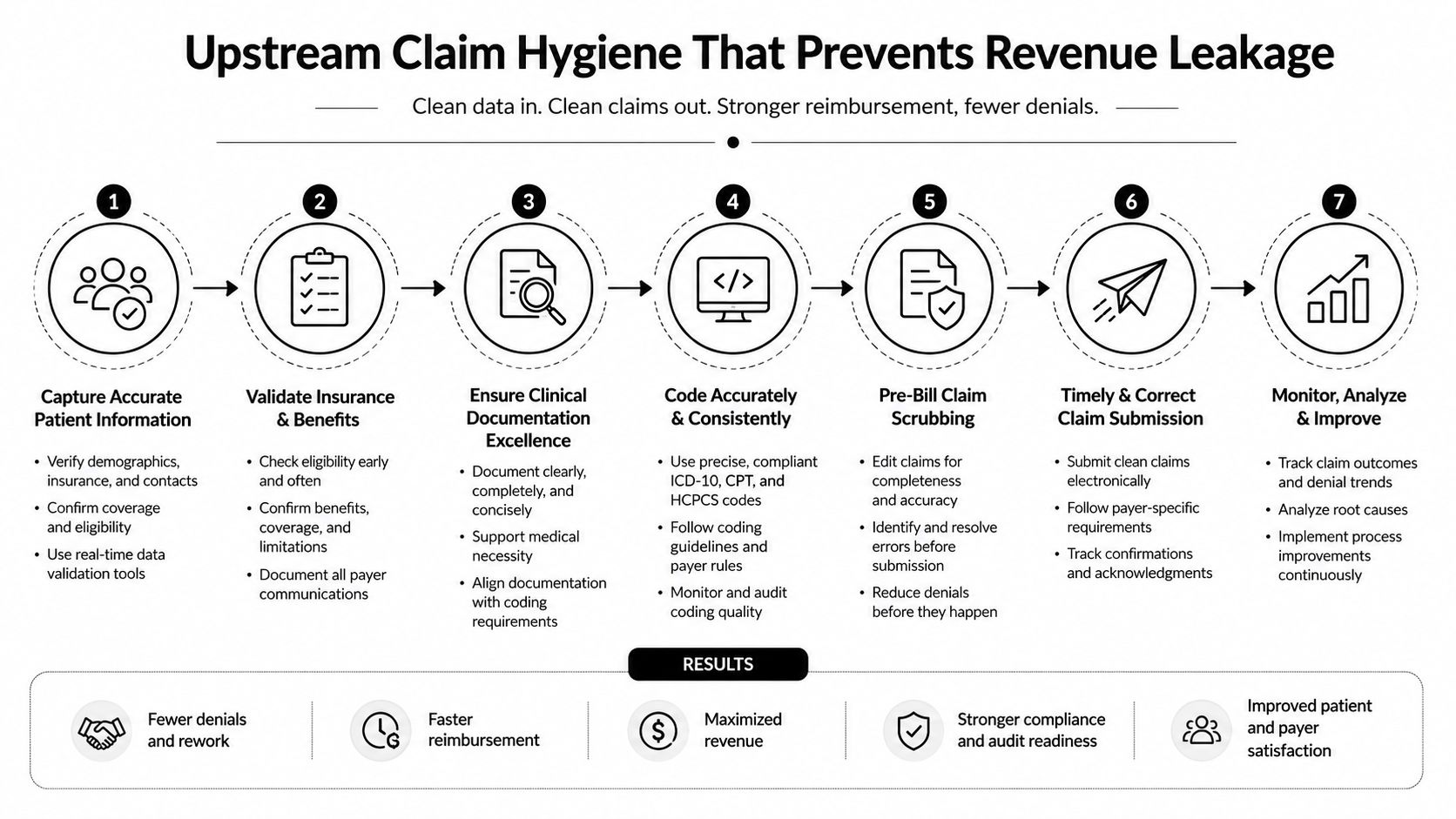
Build gates before submission
Eligibility verification should occur before the appointment and again when payer information changes. Staff need to confirm active coverage, benefit limitations, coordination of benefits, and the member information required by that payer. A failed eligibility response shouldn't sit in an inbox. It should create a task for a named owner, with escalation to registration leadership when the issue isn't resolved before service.
Authorization control requires a procedure-specific workflow. The authorization record should match the scheduled service, rendering provider, facility, date range, and payer. Specialty procedures often fail when staff obtain a general approval but don't confirm the exact service or site. The system trigger should flag missing or mismatched authorization data before charge release.
Documentation and charge capture connect the clinical record to the billable service. Coding staff should verify that the documented service supports the submitted code, modifiers, units, diagnosis linkage, and any payer-specific requirements. An ASC or medication-heavy service also needs careful review of product identifiers and related billing fields.
A practical pre-submission scrub should flag:
- Missing modifiers: Route technical edits to certified coding staff before claim release.
- Diagnosis and procedure mismatches: Send clinical validation questions to the appropriate provider or coding lead.
- NDC and product-code errors: Apply specialty-specific edits where drugs, supplies, or transport services are billed.
- Credentialing conflicts: Confirm that the rendering and billing providers align with payer enrollment records.
- Duplicate or incomplete charges: Compare encounter documentation, charge capture, and claim lines before transmission.
Give every exception a destination
The scrubber is only useful if the practice decides what happens after an edit fires. A technical issue may go to billing, a documentation question to the provider, and a payer enrollment conflict to credentialing. Set a service-level expectation for each queue, then track unresolved exceptions as operational work rather than allowing them to disappear into a generic hold bucket.
Automation can support these controls, but it can't replace payer-specific judgment. A practice evaluating medical billing automation should ask whether the workflow can identify exceptions, preserve audit trails, and route work to the person who can resolve it.
Practical rule: Never measure a claim scrubber by the number of edits it generates. Measure whether staff resolve the right edits before submission and whether the same error stops recurring.
Use a weekly error review to identify patterns by provider, location, payer, and service. If one payer repeatedly rejects a modifier, update the payer rule and retrain the relevant team. If a provider repeatedly omits documentation needed for a procedure, address the clinical workflow rather than writing off the downstream denial. The cash benefit comes from preventing the next error, not merely correcting the last one.
Denial Prevention and Collections Optimization
Denials aren't one problem. A missing member identifier, an unsupported medical-necessity decision, and an inactive policy require different owners, different evidence, and different prevention work. A denial dashboard that shows only a total rate gives leadership a number without a diagnosis.
Start by separating denials into technical, clinical, and eligibility categories. Technical denials usually involve claim construction, coding, formatting, duplicates, or provider data. Clinical denials call for documentation, authorization, medical-necessity, or coding review. Eligibility denials point to registration, coverage validation, coordination of benefits, or patient communication.
Turn denial data into operating instructions
Track the denial at the claim level, then aggregate it into a small set of management views:
- Initial denial rate: Shows how much submitted work fails before payment.
- Denial overturn rate: Indicates whether the team is recovering claims that deserve payment.
- Average days to resolve: Exposes delays inside appeal and correction queues.
- Write-offs without appeal: Identifies potentially recoverable revenue being abandoned.
- Repeat denial frequency: Shows whether prevention work is changing behavior.
The key is to connect each measure to an action. A high technical-denial pattern may require edits in the practice-management system. A low overturn rate for a clinical category may indicate weak documentation or poor appeal evidence. A growing unresolved queue requires capacity planning, not another general reminder to “follow up.”
A structured denial workflow can be managed through a specialized healthcare denial-management process, an internal team, or a combination of both. The choice depends on claim complexity, payer mix, available expertise, and whether leadership can see recovery and prevention results separately.
Treat patient balances as a workflow
Patient collections deserve the same discipline as payer A/R. Statements should go out promptly, payment options should be clear, and staff should use consistent language when explaining balances. Digital payment links, documented financial policies, and targeted outreach can reduce friction, but they shouldn't replace accurate estimates and transparent communication before service.
A/R escalation should be visible by aging bucket. At the earliest stage, confirm that the balance is valid and that the claim or statement was sent correctly. At the next stage, assign a specific follow-up action. When an account becomes seriously aged, require leadership review, a documented collection decision, or an approved write-off. The exact timing should reflect the practice's payer contracts, patient policies, and legal requirements.
The best collections team isn't the one that calls the loudest. It's the one that prevents valid balances from becoming confusing, disputed, or forgotten.
Cash flow improves when denial prevention and collections share feedback. If patients receive confusing statements because payer payments were posted incorrectly, fix the posting workflow. If a payer denial results from missing clinical documentation, return the lesson to the provider education process. Recovery without feedback creates a permanent repair department.
Detecting Underpayments and Negotiating Payer Contracts
A paid claim isn't necessarily a correctly paid claim. Standard workflows often close the account when an explanation of benefits arrives, even if the payer reimbursed below the contracted amount. That makes underpayment detection one of the most overlooked cash-flow controls in specialty healthcare.
Industry coverage notes that hospitals may lose 1% to 11% of net patient revenue annually to underpayments, and that Medicare reimbursed hospitals at 83 cents on the dollar in 2024, producing more than $100 billion in underpayments. Those figures come from RevEcor's discussion of health-system denials and underpayments. They describe hospital-level exposure, so a practice shouldn't apply them mechanically to its own book. The operational lesson still applies: payment posting must compare actual reimbursement with contractual expectation.
Make variance detection systematic
Load payer fee schedules, contracted rates, carve-outs, bundling provisions, multiple-procedure rules, and site-of-service terms into the practice-management or contract-management environment. Then produce a variance report that compares expected and actual payment at the claim-line level.
A good workflow includes:
- Normalize the contract: Translate language into usable rules for codes, modifiers, units, and payment conditions.
- Match the claim: Link the remittance, contract, provider, location, and service line.
- Flag the variance: Separate true underpayments from contractual adjustments, patient responsibility, and posting errors.
- Prioritize recovery: Rank discrepancies by value, payer recurrence, appeal feasibility, and filing deadline.
- Close the loop: Record the result and update the payer rule when the contract or adjudication pattern changes.
The practice should track underpayment rate, recovery dollars per FTE, average recovery by payer, contract variance trends, and unresolved variance aging. The first three help leadership see return on labor. Variance trends show whether a payer is consistently short-paying a procedure family or improperly bundling related services.
| KPI | Target benchmark | Red flag threshold | Action trigger |
|---|---|---|---|
| Underpayment rate | Defined from the practice's validated contract model | Repeated variances from one payer or code family | Audit the contract rule and remittance pattern |
| Recovery dollars per FTE | Established from actual recovery history | Labor cost approaches expected recovery | Tighten triage and automate low-value review |
| Contract variance trend | Stable variance within documented terms | Persistent negative variance | Prepare payer escalation or amendment request |
| Unresolved variance aging | Visible queue with assigned owners | Older items lack documented action | Escalate to revenue-cycle leadership |
These are management targets, not universal industry benchmarks. A practice should establish them after validating its own contracts and payment history.
Negotiate from evidence
Payer negotiations work better when the practice brings a clean record of recurring variance, affected codes, service locations, contract language, and requested correction. Renewal windows create a natural point for amendment discussions, but a clear pattern of systematic short payment can justify earlier escalation under the contract's dispute provisions.
Don't lead with an accusation. Lead with a reconciliation package that allows the payer to verify the discrepancy. If the payer won't correct the issue, preserve the evidence for formal appeals, contract remedies, or qualifying dispute pathways. Underpayment recovery isn't just a billing function. It's contract governance.
Using Independent Dispute Resolution to Recover Revenue
Independent Dispute Resolution can recover underpaid out-of-network revenue, but filing more cases does not automatically improve cash flow. The practical question is whether the practice can identify qualifying claims, assemble defensible evidence, meet deadlines, and collect more than the process costs. Federal dispute volume makes disciplined selection important. Reuters' 2026 reporting on NSA IDR updates describes the scale of the process and the need for providers to manage it carefully.
For emergency and specialty providers, IDR belongs downstream of clean claim preparation. A weak claim can carry eligibility, coding, credentialing, or documentation defects that an arbitration filing will not repair. Upstream claim hygiene determines whether downstream enforcement has a credible record.
Triage before filing
Start with a qualifying out-of-network claim review. Confirm that the service falls within the applicable No Surprises Act framework, that required preliminary steps are complete, and that the claim remains within the relevant submission window. Compare the potential recovery with filing costs, arbitrator fees, internal labor, case-management effort, and the likelihood that the evidence supports the requested amount.
The practice should assess:
- Eligibility: Does the claim qualify for the federal process, rather than a state pathway or excluded arrangement?
- Payment gap: Is the disputed amount material after filing and case-management costs?
- Evidence strength: Can the practice document service complexity, acuity, staffing, geographic constraints, and contract history?
- Qualifying payment amount: Does the available benchmark support the position without unsupported assumptions?
- Operational fit: Can the team meet deadlines while continuing ordinary A/R follow-up?
Batching similar claims can reduce administrative work, provided the grouping follows applicable rules and reflects genuine factual similarity. A batch cannot replace claim-level evidence. A specialty practice may recover more from a smaller portfolio with well-supported records than from indiscriminate volume filing.
Assemble a dispute-ready record
Build the evidence package when the claim is created, not when an IDR deadline appears. Preserve the original claim, remittance, authorization and eligibility records, clinical documentation, credentialing status, payer communications, good-faith effort records, and relevant contract or benchmark information.
Assign one calendar owner to track notice dates, negotiation milestones, submission windows, evidence requirements, and payment enforcement. A third-party IDR specialist can help when the practice lacks legal-process familiarity, handles multi-state complexity, or has more cases than internal staff can manage. See this guide to Independent Dispute Resolution for the workflow. In-house management may fit a focused service line with stable processes and reliable documentation controls.
IDR is an enforcement pathway, not a substitute for clean claims.
Leadership should not receive a fixed success rate or guaranteed timeline without reviewing the specialty, payer, claim facts, and governing rules. Some disputes may be ineligible or resolved outside a determination. Track qualified cases submitted, recovery per case, administrative cost per recovery, time from decision to payment, and cases rejected for preventable reasons.
A practical 90-day sequence can organize the work: stabilize claim preparation, select qualifying cases, assign deadline ownership, and review recovery results before expanding submission volume.
Building Your Cash Flow Acceleration Playbook
Cash flow improves when the practice manages claim creation, payment variance, and dispute enforcement as one operating system. Fixing eligibility while ignoring payer variance leaves earned revenue behind. Filing IDR cases before claim quality improves creates costly disputes supported by weak evidence. The sequence matters because downstream recovery depends on accurate upstream records.
Use a phased rollout
Phase one, stabilize the front end. Review recurring denial reasons, confirm real-time eligibility workflows, standardize intake fields, and assign owners for authorization and documentation exceptions. Establish baseline measures for days in A/R by payer, clean claim rate, denial rate by category, and cash collected as a share of net revenue. These measures show whether the practice is preventing avoidable work before it reaches billing.
Phase two, expose payment variance. Load contract terms, validate expected reimbursement logic, generate underpayment reports, and audit recurring payer discrepancies. Decide which tasks existing billing staff can handle and which require a dedicated analyst or outside support. The staffing choice should reflect claim volume, specialty complexity, payer diversity, and the quality of available data.
Phase three, enforce selectively. Build a dispute-ready claim record, create an IDR triage policy, and assign responsibility for deadlines and evidence. Add a cash-flow dashboard that separates collections, denials, underpayments, patient balances, and dispute recoveries. Leadership should see both cash recovered and cash protected from leakage.

Forecast improvement without fiction
A credible 12-month cash-flow projection starts with current A/R aging, expected payer receipts, contractual adjustments, patient collections, payroll, vendor obligations, and planned capital spending. Model separate scenarios for faster payment, fewer repeat denials, recovered underpayments, and selective IDR wins. Do not present an unsupported percentage improvement as a forecast.
Review the projection monthly against actual cash. Faster payment paired with rising underpayment variance means the practice shifted the problem. Falling denial volume paired with aging patient balances shows that front-end performance improved while patient financial workflows remained weak.
Track these measures together:
- Days in A/R by payer: Shows where liquidity is trapped.
- Clean claim rate: Tests upstream execution.
- Denial rate by category: Directs prevention work.
- Underpayment recovery dollars: Quantifies payment reconciliation.
- Cash collection as a share of net revenue: Connects activity to financial outcome.
- IDR recovery and cost per case: Tests whether enforcement is economically rational.
The healthcare benchmark cited earlier provides context: median A/R days improved from 54.9 to 52.6, net revenue collected within 30 days rose from 48.6% to 51.7%, and A/R older than 90 days declined from 35.2% to 33.7% in the reported comparison. The HealthLeaders benchmark can frame the discussion, but payer and specialty-level results should drive decisions.
Cash flow improves when the practice treats every unpaid dollar as a process signal, not merely a follow-up task.
Start with a focused baseline, assign owners, and review results at a fixed cadence. RevGuard provides specialty-focused revenue cycle management, underpayment identification and recovery, A/R optimization, and NSA IDR support that connects claim hygiene with downstream payment enforcement. Visit RevGuard to assess where the practice is losing payment speed or reimbursement value and build a recovery plan around those findings.