

A provider's aging report can look healthy until someone isolates out-of-network claims by payer, service line, and payment level. Then the pattern appears: emergency services paid near the insurer's Qualifying Payment Amount, clinical complexity ignored, and balances moved toward write-off. The No Surprises Act's independent dispute resolution process gives providers a path to challenge those payments, but the result depends less on filing a form than on understanding how the arbitration rules shape evidence, offers, deadlines, and reviewer behavior.
For revenue cycle teams, IDR isn't a legal side project. It's an operating discipline. Providers that treat it as an afterthought accept payer benchmarks as if they were market truth. Providers that build dispute-ready claims, document the permitted factors, and control every deadline can turn underpayment management into a repeatable recovery function.
Why Arbitration Rules Now Determine Provider Revenue Recovery
A mid-size emergency medicine group discovers the problem during a payer reconciliation project. Its RCM director separates out-of-network claims from ordinary denials, then sorts them by payer and reimbursement level. One national payer has been paying emergency claims at or close to the QPA for months. The total shortfall reaches $1.2 million in the group's internal review.
The payer hasn't necessarily made a clerical mistake. It has established a payment position and benefited from the likelihood that the provider won't assemble enough evidence to challenge it. The RCM director sees that individual appeals haven't changed the pattern. The group needs a process that treats the payment as a dispute, not merely as another unpaid balance.
That's where the No Surprises Act IDR framework changes the revenue conversation. The provider must show why the service warrants an offer different from the payer's benchmark, and it must do so within a rule-bound process. The statutory framework gives the certified IDR entity specific factors to evaluate, including the QPA and permitted additional circumstances. A provider that misses the filing window or submits a generic narrative may lose the opportunity before the clinical merits receive serious attention.
Operational reality: A payer's QPA can become the practical ceiling when the provider doesn't give the arbitrator a clear reason to move away from it.
The commercial stakes extend beyond one claim. Repeated underpayments consume staff time, distort service-line margins, and make contracted and noncontracted reimbursement look more alike than they really are. If the RCM team writes off the balance without analyzing the pattern, the organization effectively absorbs the difference.
The group's answer isn't to dispute every claim indiscriminately. It builds a selection process. Claims are screened for eligibility, grouped by defensible similarities, and supported with evidence that addresses acuity, specialty qualifications, facility characteristics, and payment context. The important shift is organizational: arbitration rules become part of revenue protection, not a compliance footnote reviewed after ordinary collections fail.
How the No Surprises Act IDR Process Actually Works
Federal IDR is a sequence of controlled steps. The provider's first task is to establish that the claim is eligible and that the initial payment or denial creates a qualifying dispute. From there, the parties must follow the statutory timetable rather than negotiate indefinitely.
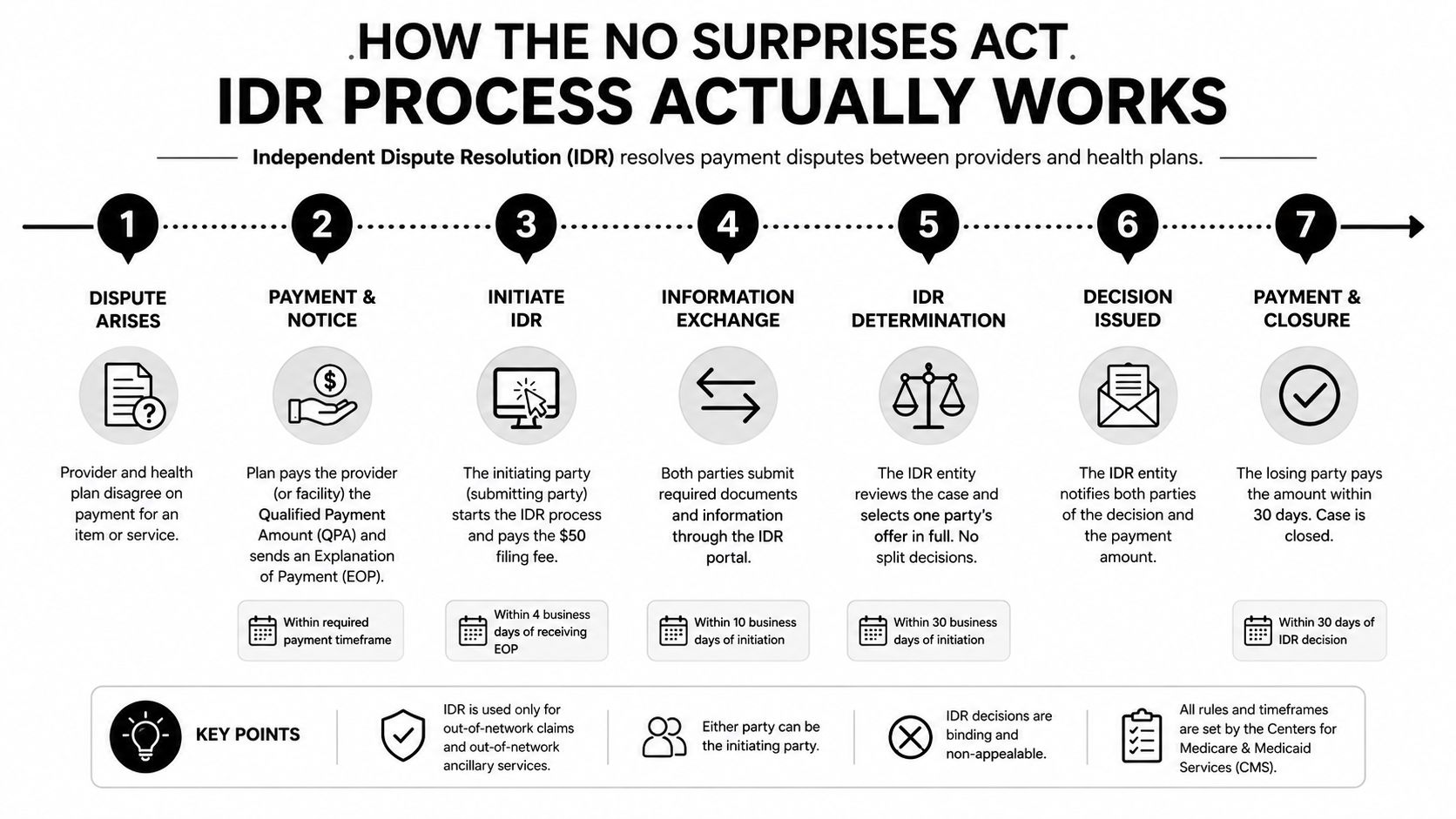
The process is deadline-driven
The practical sequence generally looks like this:
- Review the payment or denial. Confirm the service, payer, patient, coverage, dates, codes, and out-of-network status. Preserve the explanation of benefits and related correspondence.
- Start open negotiation. The parties have a 30-business-day open negotiation period, as described in the No Surprises Act IDR process guidance. The provider should use this period to test whether the payer will resolve the dispute and to preserve a clean record of the amount in contention.
- Initiate IDR on time. If negotiation fails, the initiating party must submit the dispute within the applicable window. A late filing can eliminate the claim regardless of how strong the clinical evidence is.
- Use an eligible certified IDR entity. The dispute proceeds before a certified entity selected under the federal process. Administrative requirements and fees must be addressed as part of filing preparation.
- Submit one final offer. Each side submits a payment offer and supporting information.
- Allow the entity to evaluate the statutory factors. The QPA is considered alongside permitted additional circumstances, such as provider training and experience, quality and outcomes, market share, patient acuity, and prior contracting history.
- Receive the decision and monitor payment. The entity selects one offer as the final out-of-network payment amount. It doesn't average the bids or create a compromise figure.
The final-offer structure is the strategic center of the process. Providers can't rely on an arbitrator to split the difference between an ambitious charge and a payer's low benchmark. The offer must be credible enough to win, yet high enough to protect the value supported by the evidence.
Why batching and preparation matter
Batching can allow similar eligible claims to proceed together when the claims satisfy the applicable requirements. That makes claim classification important. Teams should group claims only when the service, payer, plan, and relevant payment characteristics support a coherent filing. A large batch built on weak similarity can create an administrative problem and dilute the evidence narrative.
The QPA also affects how the packet is written. Under the federal framework, the insurer's 2019 median in-network rate for the same or similar service in the same geographic market, indexed for inflation, forms the benchmark that the provider must address. The provider's submission should explain why the disputed service differs from that median, then connect the explanation to documents rather than conclusions.
The QPA Anchoring Effect and What It Means for Your Cases
The QPA is not the only factor in an IDR decision, but it's the number that frames the dispute. The federal process defines it as the insurer's 2019 median in-network rate for the same or similar item or service in the same geographic market, adjusted for inflation, as outlined in the Congressional Research Service analysis of the federal IDR process.
Consider a $4,500 emergency department visit with a payer QPA of $1,800. The provider's billed charge alone doesn't explain why the offer should exceed the benchmark. An arbitrator needs a reasoned bridge between the clinical facts and the requested amount. Without that bridge, the QPA can dominate the review even when the provider believes the payment is commercially inadequate.
What moves a reviewer away from the benchmark
The strongest additional-circumstances evidence is specific, comparable, and easy to verify. A provider might document unusually high acuity, complex comorbidities, unusual procedural demands, relevant specialist training, teaching or facility characteristics, or a meaningful difference in outcomes and quality measures. The submission should identify the factor, show where it appears in the record, and explain how it affects the value of the service.
Generic language fails because it asks the arbitrator to supply the reasoning. “The patient was complex” is a conclusion. A better submission identifies the clinical features that increased resource intensity, explains how those features affected decision-making, and ties them to the service performed.
The same discipline applies to market evidence. Comparable payments from other payers may help establish that the QPA doesn't reflect the provider's actual market position, but the comparison must be like-for-like. A different service, facility, geography, or contract structure can weaken rather than strengthen the argument.
| Evidence Strategy | Typical QPA Gap | Arbitrator Response | Win Rate Above QPA |
|---|---|---|---|
| Generic acuity statement | Not quantified | Usually provides little reason to depart from the benchmark | No reliable rate should be assumed |
| Claim-specific clinical summary | Clearly explained in the record | Gives the reviewer a usable connection between complexity and value | No reliable rate should be assumed |
| Comparable market payments | Matched to service and geography | Can support a broader payment context | No reliable rate should be assumed |
| Specialty and facility evidence | Connected to the disputed service | Strengthens the explanation of why the median is not representative | No reliable rate should be assumed |
The table intentionally avoids invented outcome percentages. Providers should measure their own results by payer, service, QPA distance, evidence category, and IDR entity. A case-management dashboard such as the workflow described in QPA analysis for provider disputes can help teams track those variables without treating one award as a universal prediction.
The question isn't whether the claim is expensive. It's whether the packet proves why this claim belongs above the payer's median.
Building Evidence Packages That Win Arbitration Decisions
Most weak IDR submissions fail before the filing stage. They contain a bill, an explanation of benefits, and a short narrative that repeats the provider's preferred payment amount. That packet may establish disagreement, but it doesn't make the arbitrator's decision easy.
A dispute-ready package should read like a structured answer to the statutory factors. The reviewer should be able to identify the service, understand the clinical circumstances, verify the market context, and see why the offer is more persuasive than the QPA.
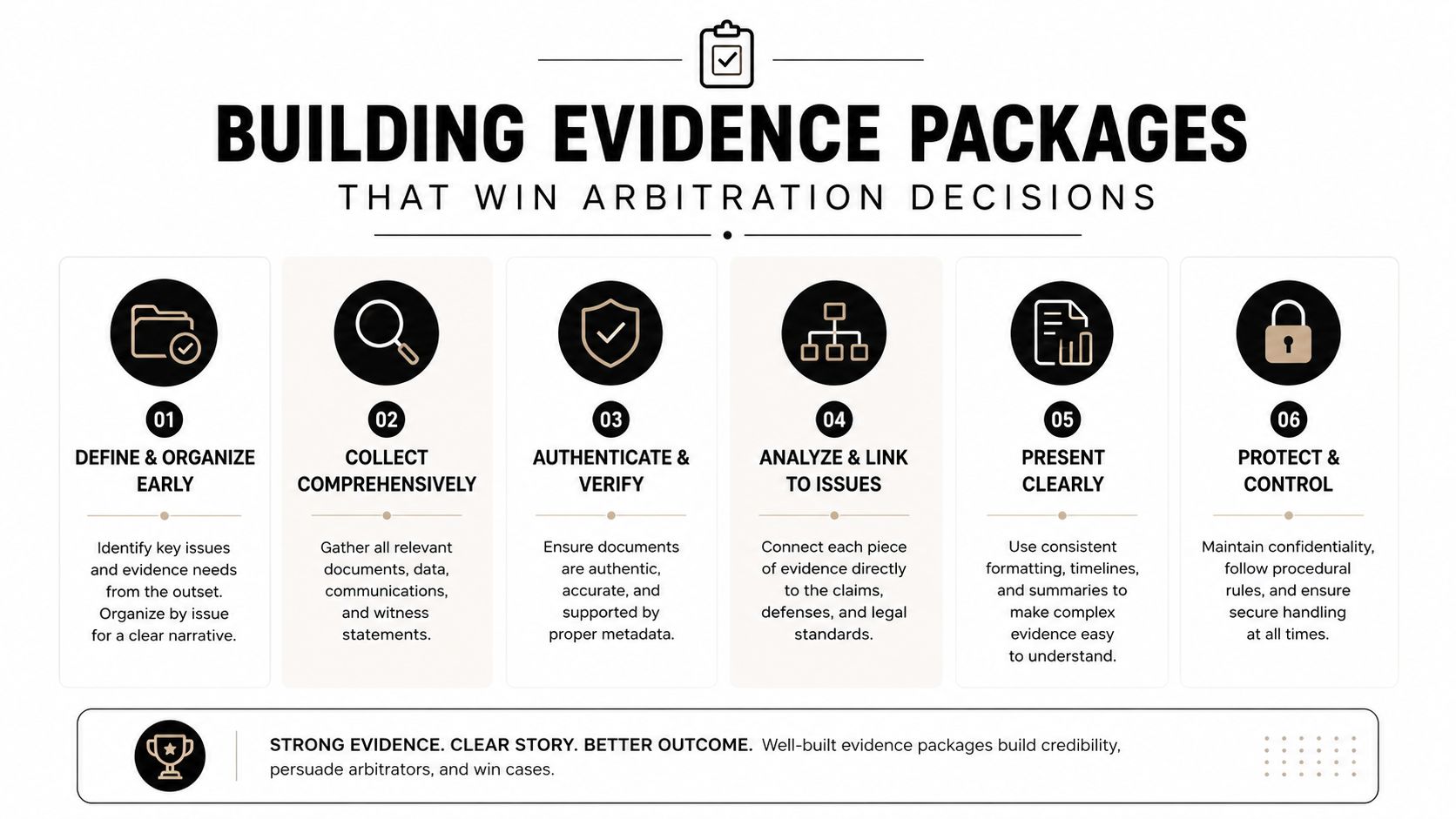
Start with a claim-specific clinical record
A useful clinical summary doesn't copy the entire chart. It extracts the facts that matter to the disputed service and presents them in language a non-clinician reviewer can follow.
Include:
- Clinical complexity: Identify acuity, comorbidities, complications, unusual risk, and the decisions those conditions required.
- Service intensity: Explain the work performed, the specialist involvement, and any circumstances that made the service materially different from a routine case.
- Provider qualifications: Document relevant training, experience, specialty credentials, and the role those qualifications played in care.
- Facility context: State relevant teaching, trauma, emergency, technology, or resource characteristics when they bear directly on the service.
- Outcome and quality evidence: Use reliable internal records or recognized quality measures when they illuminate the provider's value.
The goal isn't to overwhelm the entity with clinical detail. It's to eliminate unsupported leaps. A concise summary with page references often works better than a large undifferentiated chart export.
Add market and payer evidence
Market context should answer a practical question: why does the QPA fail to represent this service? Comparable payments can help, provided the services and markets are genuinely comparable. Cost context, facility characteristics, specialty scarcity, and prior contracting history may also matter when the record supports them.
Payer behavior deserves its own evidence trail. Preserve prior underpayments, repeated explanation-of-benefits language, negotiation correspondence, and claim-level patterns. Don't describe a payer as systematically underpaying unless the packet shows the pattern through organized records.
Batching can strengthen the narrative when the claims are similar. A unified explanation of a service line, clinical profile, and payment issue can be more coherent than dozens of thin submissions. But the batch still needs claim-level support. One strong example won't cure unrelated claims that lack documentation.
Evidence standard: Every important conclusion should point to a document, a claim field, or a verifiable comparison.
Treat assembly as a workflow. Build templates for clinical summaries, payer-history exhibits, QPA comparisons, and final-offer calculations. Then require a reviewer to test whether each claimed factor is both permissible and supported before the packet is filed.
NSA Arbitration Rules Versus Traditional Commercial Frameworks
Experience with commercial arbitration can help a provider understand procedure, but it can also create bad instincts. In many traditional settings, parties negotiate more openly, submit broader evidence, and expect the arbitrator to exercise substantial discretion over the final amount. Federal NSA IDR is narrower and more binary.
| Dimension | NSA Federal IDR | Traditional Commercial Arbitration |
|---|---|---|
| Offer mechanics | Each side submits a final offer, and the entity selects one | The tribunal may determine relief under the applicable agreement and rules |
| Evidence standards | Focused statutory factors, QPA analysis, and permitted additional circumstances | Broader evidentiary and procedural flexibility is common |
| Timeline constraints | Strict statutory deadlines and a defined decision timetable | Timelines depend on the agreement, institution, tribunal, and case complexity |
| Cost allocation | Administrative fees and process costs follow the federal IDR framework | Costs and fees depend on the contract, institutional rules, and tribunal orders |
| Appeal rights | The process is designed for a final payment determination, with limited avenues to challenge procedural or legal defects | Court review depends on the governing arbitration law and applicable standards |
The offer cannot be treated like an opening bid
In ordinary negotiation, an aggressive number can create room for compromise. In baseball-style final-offer arbitration, an unsupported number can make the payer's offer look safer. The provider must calculate an amount that the evidence can defend, not merely an amount that reflects the original charge.
The QPA creates another distinction. Even where the provider argues that the benchmark shouldn't control the result, the submission must address it directly. Ignoring the QPA leaves the reviewer without a disciplined basis for choosing the provider's offer.
Traditional habits that need adjustment
Broad discovery expectations don't translate well to a process built around limited submissions and quick review. Nor should a provider assume that a general appeal letter can be repurposed as an IDR packet. The appeal may preserve the dispute, but the arbitration submission must organize the record around the factors the certified entity is permitted to evaluate.
Traditional arbitration experience remains useful for issue spotting, document control, and offer discipline. It becomes harmful when the team expects a negotiated midpoint, unlimited evidentiary expansion, or a long period to repair an incomplete record.
Linking Revenue Cycle Management to Arbitration Outcomes
IDR performance is usually decided before the petition is drafted. Claim accuracy, documentation quality, denial coding, and negotiation records determine whether the later arbitration packet has anything persuasive to work with.
A clean claim helps in two ways. It reduces avoidable disputes, and it gives the provider a reliable factual record when the payer underpays for a service that should proceed to IDR. Modifier accuracy, eligibility verification, timely filing, credentialing data, and clinical documentation all affect the credibility of the later submission.
The first response creates the record
When a payer denies or underpays a claim, the RCM team should capture more than the balance. It should record the reason code, payment calculation, QPA information when available, dates, correspondence, appeal activity, and the clinical documents requested or supplied.
That record reveals patterns. If one payer repeatedly applies the same payment logic to comparable services, the team can evaluate whether those claims qualify for batching and whether a unified evidence narrative is appropriate. If clinical documentation repeatedly fails to describe acuity or complexity, the provider can send that finding back to its documentation improvement process.
A structured dispute log should answer:
- What happened: Was the claim denied, reduced, delayed, or paid near the benchmark?
- Why it matters: Does the issue affect a repeatable service-line or payer pattern?
- What supports the case: Which clinical, market, and contracting records are available?
- What deadline controls: Has open negotiation started, ended, or been documented?
- What did the payer do next: Did it revise the offer, repeat the QPA position, or stop responding?
RevGuard offers an RCM and IDR workflow that connects claim operations with evidence development, filing control, and payment monitoring. Whether a provider uses an outside platform or builds internally, the operating principle is the same: IDR should receive structured inputs from RCM, not a last-minute folder of disconnected documents.
Turning Arbitration Rules Into a Strategic Revenue Engine
Providers gain an advantage when they stop viewing IDR as a series of isolated filings. The durable benefit comes from building institutional knowledge around which claims qualify, which evidence persuades, how payers behave, and where internal workflows create preventable weaknesses.
A strategic program starts with selection. Review underpayments by payer, specialty, service, geography, and clinical profile. Then separate defensible disputes from balances that are better resolved through ordinary appeal or contract enforcement. Filing volume alone isn't a strategy. A disciplined provider protects staff capacity for cases with a coherent factual and legal basis.
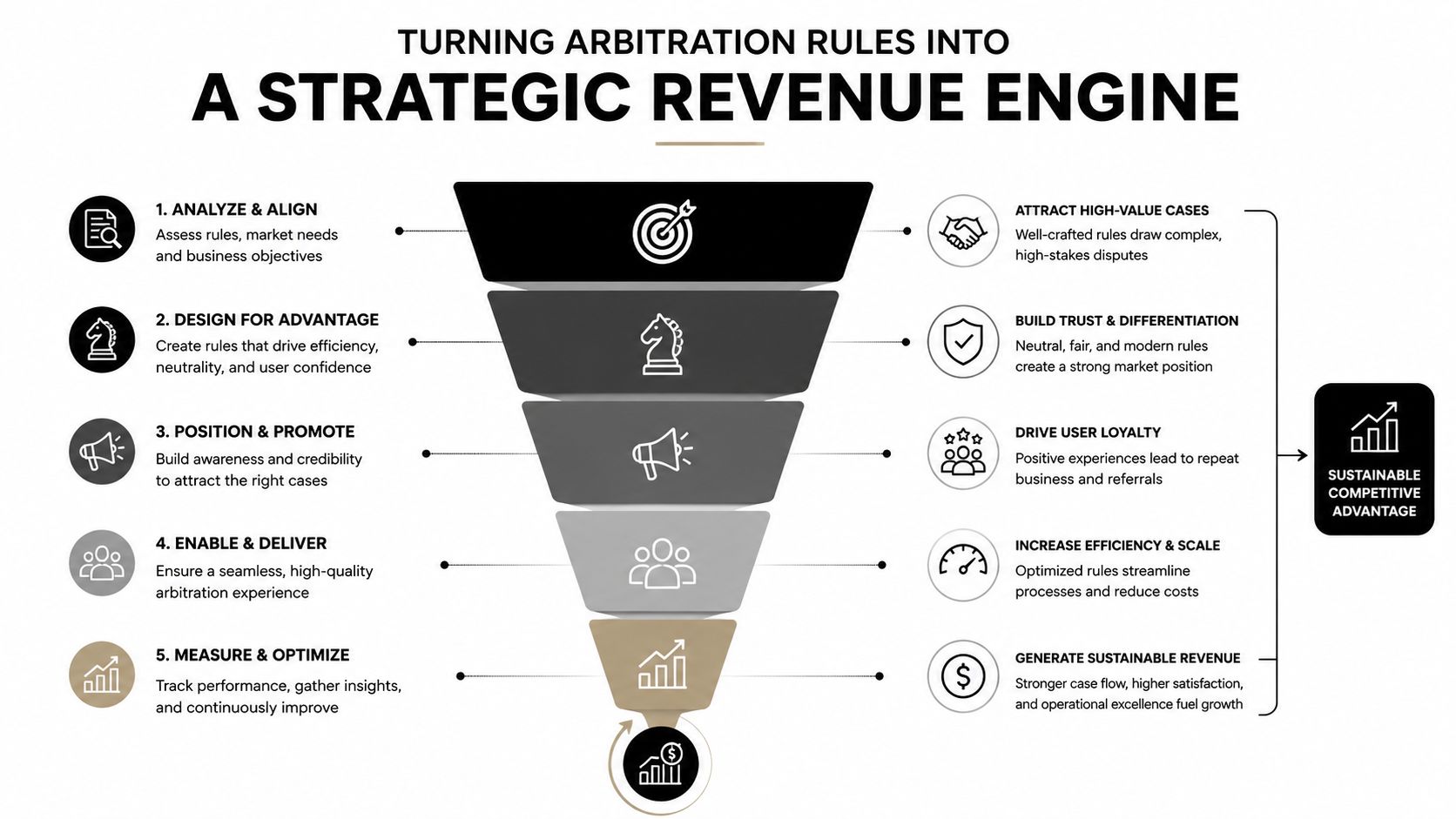
Build a feedback loop
Every decision should improve the next case. Track the QPA, final offers, evidence categories, payer responses, IDR entity outcomes, payment timing, and procedural defects. Use those records to refine claim selection and identify documentation gaps.
The RCM, clinical, contracting, and IDR teams should review the same evidence patterns. If arbitrators repeatedly discount a generic acuity statement, clinical leaders can revise documentation prompts. If a payer's payment data conflicts with the provider's market evidence, contracting staff can investigate the underlying network and rate information.
A successful program also protects enforcement. Winning an award matters only when the organization monitors payment, reconciles the remittance, and escalates nonpayment through the available channels. The process should end with confirmed cash, not merely a favorable decision in a tracking spreadsheet.
The right question for leadership is not whether arbitration creates another administrative task. It's whether the organization can afford to leave recurring underpayments unmanaged. Providers that operationalize the No Surprises Act arbitration rules create a repeatable defense against benchmark-driven reimbursement. Those that rely on ad hoc appeals leave payer behavior, documentation gaps, and missed deadlines to determine revenue recovery.
RevGuard connects specialty-specific revenue cycle management with NSA-compliant IDR strategy, including evidence development, filing control, award monitoring, and enforcement workflows. Visit RevGuard to evaluate how a structured RCM and arbitration process can help your organization challenge systemic underpayments and protect recoverable reimbursement.