

A clean claim is a claim with no defect or missing information that can be processed without special handling, and under the No Surprises Act framework, that status starts the payer's 30-calendar-day initial payment-or-denial clock. If the payer still needs information to decide the claim, the practical question becomes whether that clock has started at all.
A billing team can submit a claim that looks complete in the practice-management system and still watch it sit in pending status. The problem may be a missing authorization reference, a subscriber identifier that doesn't match the payer's file, a diagnosis code that lacks the required specificity, or documentation the payer needs before adjudication. These aren't cosmetic issues. They determine whether the claim moves through normal processing or gets pulled aside for correction, development, or dispute.
The Claim Lifecycle Problem Most Billing Teams Underestimate
Monday is submission day at a busy multispecialty billing office. Claims leave the charge-entry and coding queues after review, then staff spend the week answering eligibility questions, clearing clearinghouse messages, and responding to documentation requests. By Friday, some remittances have arrived while other accounts remain in pending status, without a clear denial to assign.
A useful way to see the problem is a triage pipeline. The clearinghouse performs an initial screening, similar to checking whether a referral has the required fields. The payer then performs a deeper review. A claim can pass the first checkpoint and still be routed to a holding queue because the payer needs records, questions medical necessity, checks an authorization, or finds provider information that does not match its credentialing file.
Practical rule: Clearinghouse acceptance confirms file format, not payer readiness. The payer needs enough accurate information to adjudicate the claim.
Consider a routine service with verified coverage, complete documentation, and correct coding. It can enter the ordinary payment path. Add one missing data point, such as an authorization number or required provider identifier, and processing may stop until staff correct the defect. The exact delay depends on the payer and contract, but the operational effects are predictable: cash conversion becomes less reliable, follow-up work increases, and the patient may receive confusing billing updates.
Why pending claims deserve attention
Formal denials create a visible work queue, so teams often prioritize them. Pending claims are quieter. They can still consume staff time through repeated calls, record exchanges, status checks, and resubmissions.
Track pending claims by:
- Reason: Separate missing information, policy review, authorization, medical necessity, and provider-file issues.
- Age: Measure how long claims remain unresolved, not only how many claims were submitted.
- Payer: Compare recurring edits across commercial plans, Medicare, and Medicaid.
- Upstream owner: Identify whether registration, verification, coding, documentation, or submission introduced the defect.
A clean-claim process gives each claim a clear path and gives each exception an owner. The billing office can then distinguish a claim awaiting payer review from one that never supplied the information needed to begin normal adjudication.
The useful question is not whether a claim was eventually paid. Ask whether it contained everything the payer needed when it first arrived, and whether the payer's payment-or-denial clock had started.
Defining a Clean Claim From the Front Desk to Federal Law
A registrar sees a claim at the first checkpoint. If the patient's identity, coverage, provider, service, diagnosis, and required documentation are present and accurate, the claim appears ready to send. For day-to-day billing, a clean claim is complete, accurate, and ready for payer processing without a request for more information or special handling.
Federal law applies a tighter test. Under 42 CFR § 405.902, Medicare defines a clean claim as one without a defect, impropriety, missing substantiating documentation, or another special circumstance that would prevent timely payment. The Medicare regulation defining a clean claim connects clean status to whether the payer can make a timely payment decision under the applicable requirements.
The difference resembles medical-intake triage. A patient may complete the intake form, yet the clinician cannot place the patient in the correct care pathway until an allergy, medication, or identification detail is confirmed. A claim can look complete in the billing screen while still requiring a referral, clinical record, authorization detail, or corrected provider information before adjudication can proceed.
That distinction determines whether the payer's clock has started.
The No Surprises Act connection
The No Surprises Act gives clean-claim status a specific operational meaning. Federal guidance says the plan's initial payment-or-denial period begins after it receives the information needed to decide the claim, commonly called a clean claim. Under this framework, the period is 30 calendar days. The Department of Labor's No Surprises Act FAQ explains why receipt of decision-ready information matters.
A claim with an unresolved eligibility mismatch may therefore be complete from the front desk's perspective but defective under the payer's process. The submission can remain in review, generate a request for records, or require correction. Its arrival alone does not establish that normal adjudication has begun.
For teams handling eligibility, medical eligibility verification belongs in clean-claim preparation rather than as a separate administrative step. Verification checks whether the payer, member, service, authorization, and coverage details align before submission. That check helps the billing team distinguish a claim awaiting a payer decision from one that has not yet supplied the information needed to start the decision period.
The Eight Elements That Decide Clean or Defective
A payer-ready claim has to pass several gates at once. The following eight elements reflect the core information provider-facing guidance identifies for clean processing, including patient and provider identification, service details, coverage, authorization, coding, and supporting documentation. A claim can fail because of one field even when every other field is correct.
| Required Element | What Clean Looks Like | Common Defect That Breaks Clean Status |
|---|---|---|
| Patient demographics | Legal name, birth date, address, and other identifiers match the payer record | Misspelled name, incorrect birth date, or missing apartment number |
| Subscriber and member details | Member ID, group information, and relationship code match the active policy | Typo in the member ID or an incorrect patient-to-subscriber relationship |
| Payer identification | Correct payer name, electronic payer identifier, and routing information | Claim sent to the wrong payer or outdated electronic payer identifier |
| Date of service | Service date matches the clinical record and charge entry | Incorrect date, overlapping dates, or a date outside the coverage period |
| Place of service | Location code accurately reflects where the service occurred | Office, facility, emergency, or telehealth setting reported incorrectly |
| Provider information | Billing and rendering NPIs, taxonomy, and roles align with enrollment records | Outdated taxonomy, missing rendering NPI, or provider mismatch |
| Diagnosis coding | Codes reflect the documented condition at the highest supported specificity | Unspecified diagnosis when the record supports a more precise code |
| Procedure coding | CPT or HCPCS code, modifier, units, and required authorization details are valid | Invalid modifier, missing units, incompatible code combination, or absent authorization |
Why field-level accuracy matters
A missing apartment number may seem minor, but it can create a demographic mismatch. A single incorrect member digit can make active coverage appear unverified. An outdated taxonomy can cause a payer to question whether the clinician is eligible to report the service.
Coding defects create a similar problem. If the documentation supports laterality, encounter detail, or a more specific diagnosis, an unspecified code may trigger a payer edit. The claim isn't necessarily fraudulent or clinically wrong. It may not meet the payer's processing requirements.
A clean claim is not a claim with “most” of the required information. It is a claim whose required information agrees across registration, coverage, documentation, provider records, and coding.
Payers don't always announce that they've reclassified a submission as incomplete. The claim may appear as pending, rejected by an internal edit, or subject to a documentation request rather than a conventional denial. That's why teams should record the exact defect reason and feed it back into the responsible upstream workflow.
How a Claim Stays Clean From Registration to Adjudication
A claim can leave the front desk looking complete and still fail at the payer. One wrong address, an outdated policy, an incorrect service location, or unsupported coding detail can break the chain before submission. Each team hands the claim to the next, like runners passing a baton. A weak handoff forces the next runner to slow down or stop.
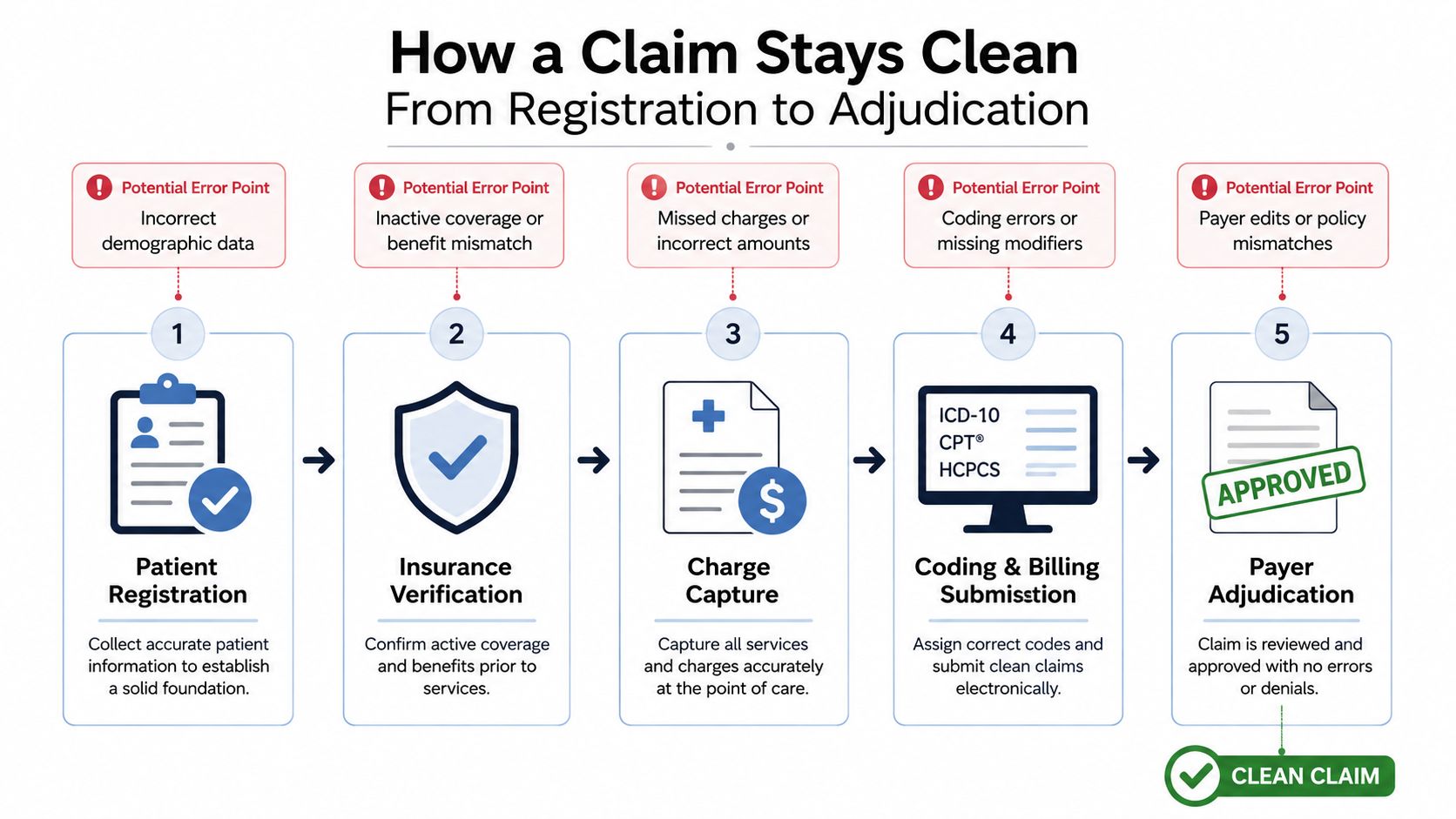
Five handoffs to control
- Patient registration: Confirm spelling, birth date, address, guarantor details, and subscriber relationship. Ask the patient to report changes instead of relying on an old chart.
- Insurance verification: Validate active coverage, benefits, payer routing, network status, authorization requirements, and referral rules. Store the response or reference details where billing staff can retrieve them.
- Charge capture: Match each charge to the service, location, provider, date, units, and documentation. A missing charge creates a separate revenue problem. An inaccurate charge can make the submitted claim defective.
- Coding and submission: Review diagnosis specificity, CPT or HCPCS selection, modifiers, units, NPI relationships, attachments, and payer edits before transmission. Staff can use this claim adjudication process guide to connect submission checks with payer decisions.
- Payer adjudication: Record whether the payer paid, rejected, denied, or placed the claim on hold. Route the stated reason to the workflow owner who can prevent the same defect.
The payer's clock begins only when the submission contains the information needed for a decision. Under the No Surprises Act framework, that point relates to the 30-calendar-day initial payment-or-denial period described in the federal guidance on payment and denial timing. If the payer requests more information, the dispute may concern when the claim became complete enough for adjudication, not when staff first transmitted it.
Review outcomes across the entire relay. A rejected member ID should change registration edits. A recurring authorization issue should update scheduling checks. A provider-file mismatch should reach credentialing instead of remaining a billing-only issue. That feedback keeps a clean claim from being a one-time inspection and turns it into a controlled workflow.
Why Clean Claims Drive Cash Flow and Denial Rates
Clean claims support cash flow because they remove avoidable interruptions between submission and payment. When a claim contains the information the payer needs, the payer can adjudicate it without the provider's staff repeatedly correcting fields, sending records, or responding to requests. That reduces administrative touchpoints and gives the revenue-cycle team a clearer view of expected collections.
Clean status also serves as a practical denial-prevention control. It won't eliminate denials caused by benefit exclusions, medical-necessity determinations, contractual disputes, or payer misprocessing, but it addresses the defects the provider can control before submission.
Recent provider-reported market data shows why teams shouldn't treat this as a minor quality issue. 68% of providers said submitting clean claims was more challenging than a year earlier, and 41% reported denial rates above 10%, up from 38% in 2024, according to Experian Health's State of Claims report. The same source reports that 54% of providers said claim errors are increasing and that 90% of denials are reworked with at least some human review before resubmission.
Why specialty billing feels the pressure
High-complexity specialties expose more points where payer rules, clinical documentation, and provider data must align. Emergency medicine may involve uncertain coverage information and time-sensitive documentation. Anesthesia and radiology often require precise procedure relationships, modifiers, rendering-provider details, and facility alignment. Behavioral health teams may need careful coordination of coverage, authorization, diagnosis, and supporting records.
Specialty teams should measure more than total denials. Review:
- First-pass acceptance: Which claims clear payer and clearinghouse edits without correction?
- Defect category: Are failures concentrated in eligibility, authorization, coding, provider enrollment, or documentation?
- Rework ownership: Which department receives the returned claim, and how quickly does it correct the root cause?
- Payer variation: Does the same service remain clean across every payer, or only under selected policies?
The health insurance claim denial rates resource can support a broader denial-management discussion, but each organization still needs its own payer-specific defect analysis. A clean-claim program works when it prevents repeat errors before the next batch leaves the billing system.
Two Real Claim Examples Compared Side by Side
Consider two hypothetical submissions for the same laparoscopic cholecystectomy. The clinical service is identical, but the billing workflows produce different results because one claim is assembled as a complete, internally consistent package and the other contains unresolved information gaps.
The clean version begins with front-desk eligibility confirmation under the correct plan. The authorization record is attached or referenced, the documentation supports the reported diagnosis and procedure, the CPT and ICD-10 codes match the encounter, required modifiers are present, and the billing and rendering providers are linked correctly. The claim passes submission edits, reaches the payer ready for adjudication, and the remittance advice reflects payment under the applicable contract terms.
The defective version has two weaknesses. The referring-provider NPI is missing, and an imaging add-on reports unspecified laterality even though the clinical record should support a more precise code. The first issue can produce a front-end rejection. After correction and resubmission, the laterality problem may trigger a payer edit, documentation request, or partial denial on the imaging line.
| Stage | Clean Claim | Defective Claim |
|---|---|---|
| Registration and coverage | Correct plan and patient information are confirmed | Coverage may be correct, but the claim package contains unresolved provider or coding information |
| Authorization and documentation | Authorization is available and supporting records align with the service | The payer must request or validate information before deciding |
| Coding and provider linkage | Procedure, diagnosis, modifiers, units, and NPIs agree | Referring-provider NPI is missing and imaging laterality is unspecified |
| Initial submission | Claim enters normal adjudication | Claim is rejected or held for correction |
| Rework | No avoidable correction cycle | Staff corrects, resubmits, and responds to a payer request |
| Remittance | Payment posts according to applicable contract terms | Imaging line may be partially denied while the team continues follow-up |
The operational cost isn't limited to the denied line. Staff must identify the defect, locate the missing NPI, review the clinical record, update the code, transmit a replacement claim, and monitor the payer's response. During that time, the account can move between work queues and produce patient-service friction.
The clean submission wins before the payer makes a payment decision. Once a defect reaches adjudication, the team is paying for an avoidable investigation.
Best Practices for High-Denial Specialties in 2026
High-denial specialties need a repeatable operating playbook, not a generic reminder to “scrub claims.” Emergency medicine, behavioral health, and outpatient surgery each have different failure patterns, so the checkpoint must reflect the service line.
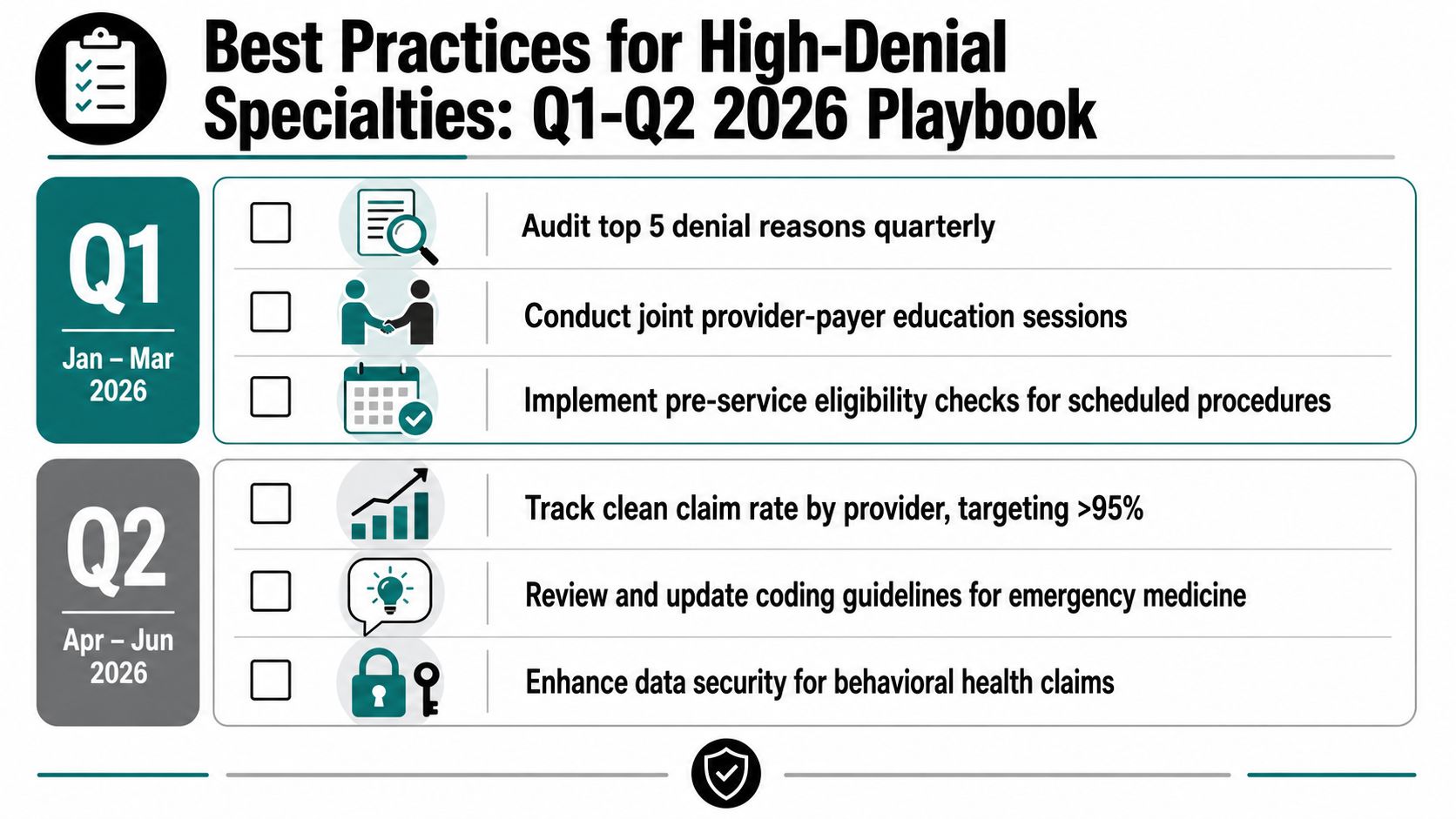
Build the checkpoint around payer rules
Create a pre-submission checklist that maps every required element to each major payer. Don't use one universal rule set if a payer requires a particular authorization reference, attachment, modifier combination, taxonomy, or referring-provider field.
- Emergency medicine: Verify coverage and payer routing as early as the encounter allows, then confirm that trauma-level, facility, provider, and documentation details support the submitted service.
- Behavioral health: Check primary and secondary coverage, coordinate applicable explanation-of-benefits information, and make sure the diagnosis and treatment documentation support the billed service.
- Outpatient surgery: Link procedure, modifier, rendering NPI, facility, authorization, and diagnosis information before releasing the claim.
The checklist should stop transmission when a required field is absent or contradictory. A warning that staff can bypass without documentation isn't a control.
Turn denial codes into a heat map
Use CARC and RARC codes to group returned claims by root cause. Review the heat map by payer, provider, location, procedure family, and registration team. A recurring eligibility-related code points to front-end verification. A provider-identification pattern may belong with credentialing. A documentation pattern may require a revised clinical template.
Review the map on a recurring quarterly basis and assign an owner to each major defect category. The purpose isn't to rank employees. It's to identify where the system permits the same error to reach the payer repeatedly.
Protect the original payment opportunity
Set a 48-hour rework SLA for claims returned by the clearinghouse or payer. The timeline should cover assignment, correction, resubmission, and confirmation that the replacement claim was accepted.
That SLA matters because a correction left untouched can lose context, move into a later queue, or create a second defect. Require the reworker to record the corrected field and the prevention action, such as a registration prompt, coding edit, authorization checklist, or provider-file update.
For organizations evaluating operational support, RevGuard offers specialty-specific revenue-cycle services that include eligibility and benefits verification, claim creation, charge entry, clean-claim submission, and clearinghouse oversight. A team can compare that model with internal controls, a clearinghouse scrubber, or another RCM partner, provided the selected workflow gives staff visibility into payer-specific defects and rework ownership.
Turning Clean Claims Into a Revenue Protection Strategy
A claim can leave registration with accurate patient details, pass verification, and still lose payment time because one later checkpoint fails. Revenue protection connects those checkpoints. Registration accuracy protects the claim before the visit becomes a charge. Verification confirms that coverage and the payer pathway make sense. Coding and documentation support the billed service, while submission controls preserve the information through adjudication.
Federal law applies a stricter test. A clean claim does not present the payer with a defect, impropriety, missing substantiating documentation, or special circumstance that blocks timely payment. The No Surprises Act makes this distinction commercially important. The plan's 30-calendar-day initial payment-or-denial period starts when it receives the information needed to decide the claim, as described in the No Surprises Act payment-timing guidance. A claim accepted by a clearinghouse may therefore still need attention before the payer has a decision-ready record.
Measure the process, not just the volume
Submission volume alone cannot show whether the workflow protects reimbursement. Pair it with measures that expose defects, delays, and ownership:
- Clean-claim rate: Define clean precisely, including whether measurement ends at acceptance, adjudication, or payment.
- Defect threshold: Set payer-specific rules for missing information, coding edits, authorization gaps, and documentation requests.
- Pending inventory: Track unresolved claims by age and reason.
- Rework ownership: Assign each defect to the process that can prevent its recurrence.
- Days sales outstanding: Connect upstream claim quality with cash conversion instead of treating clean claims as an isolated billing measure.
Review these measures weekly with registration, verification, coding, clinical documentation, credentialing, and accounts-receivable leaders. If a payer changes an edit or documentation expectation, update the checkpoint and notify the people who create the affected claim data.
A complete, decision-ready claim gives the organization a better chance of predictable reimbursement. An unresolved defect returns control of payment timing to the payer. Clean-claim discipline strengthens revenue leadership discussions rather than remaining confined to the billing work queue.
RevGuard helps provider organizations build specialty-specific workflows for eligibility verification, coding, clean-claim submission, payer follow-up, and revenue protection when claims are delayed or underpaid. Visit RevGuard to evaluate how its RCM and No Surprises Act dispute-support capabilities can fit your clean-claim and reimbursement process.