

Denials aren't an inevitable cost of healthcare billing. Many are created before a claim reaches the payer, through an expired eligibility record, missing authorization, incomplete documentation, credentialing mismatch, unsupported code, or contract term that never matched the workflow. Treating every denial as back-office rework hides the operational failure that produced it.
The case for prevention is substantial. HFMA has cited research showing that $262 billion of $3 trillion in submitted claims were denied, and that about 90% of denials are preventable, with roughly two-thirds of preventable denials successfully appealable (HFMA denial-management guidance). Those figures point to a control-system problem, not just a collections problem.
Effective claim denial prevention connects eligibility, financial clearance, authorization, credentialing, clinical documentation, coding, pre-submission validation, analytics, contract design, and escalation. Track first-pass acceptance, denial rate by root cause, clean claim rate, days to payment, appeal recovery, and payer-specific trends. RevGuard is one relevant example of an integrated model that links specialty-specific revenue cycle management with enforcement-driven Independent Dispute Resolution, so teams can prevent avoidable errors and prepare evidence when payer resistance remains.
1. Pre-Claim Eligibility Verification and Real-Time Authorization
Eligibility verification should happen before scheduling becomes a clinical commitment. Staff need to confirm active coverage, member identity, benefit limitations, network status, coordination of benefits, authorization requirements, and policy exclusions before the patient arrives. A static insurance card isn't enough because coverage and payer rules can change between intake and service.
Build verification into several workflow checkpoints. Scheduling should capture the correct payer and subscriber information. Pre-registration should validate benefits and authorization requirements. A final check shortly before service should confirm that the authorization still covers the planned procedure, location, provider, and service date. The exact timing depends on payer and specialty workflow, but the control should be repeated rather than treated as a one-time administrative task.
An ambulatory surgery center, for example, can route every scheduled procedure through a pre-service work queue. An anesthesia group can verify the surgeon's patient coverage before OR scheduling, then attach the verification result to the encounter. An orthopedic practice should distinguish workers' compensation from commercial coverage during intake because the responsible payer, authorization path, and documentation requirements differ.
Assign ownership before the appointment
Front-desk teams own data capture. Authorization staff own payer-rule confirmation. Clinical scheduling teams own escalation when the planned service changes. No claim should move forward when those responsibilities are unclear.
Use an authorization record that includes:
- Payer response: Save the eligibility transaction, reference number, effective dates, and benefit notes in the EHR.
- Service match: Confirm that the approved service, diagnosis, provider, facility, and date align with the scheduled encounter.
- Exception queue: Escalate inactive coverage, conflicting payer information, and missing authorization before the patient reaches the procedure date.
- Patient communication: Explain coverage limitations early, using written summaries rather than relying on a phone conversation.
Teams strengthening this control can also review RevGuard's prior authorization process as a model for connecting authorization work to the wider revenue cycle.
Track authorization completion, eligibility exception volume, avoidable eligibility denials, and the time between an exception and its resolution. Review results by payer and plan type. If one payer repeatedly requires a step that isn't visible in the standard workflow, update the work queue instead of asking billers to repair the same problem after submission.
2. Specialty-Specific Clinical Documentation and Coding Optimization
Generic coding education won't protect a specialty claim that depends on nuanced clinical facts. Documentation must explain what happened, why the service was necessary, how complex it was, and which coding elements the payer expects. The clinician creates the source record, the coder translates it, and the reviewer tests whether the submitted claim can be defended.
An IONM provider may need patient-specific risk factors, surgical complexity, and the monitoring performed during the procedure. An air ambulance record should capture the clinical justification for flight, crew credentials, and equipment used. Anesthesia documentation must support the ASA physical classification, time-based billing, and applicable modifiers. Orthopedic surgery records should make bilateral procedures, distinct services, and surgical difficulty clear enough to withstand bundling scrutiny.
Build documentation around service lines
Create concise checklists for each specialty and high-risk payer workflow. Don't give an anesthesia clinician the same documentation prompt used for dermatology or radiology. The checklist should identify required clinical facts, not instruct clinicians to copy billing language into the medical record.
A strong review process includes:
- Pre-bill documentation review: Hold claims when the operative note, anesthesia record, medical-necessity support, or required signature is incomplete.
- Specialty coding audits: Review recurring errors by service line and payer, then send findings to clinicians and coders.
- Modifier controls: Require a documented reason for modifiers, laterality, distinct procedural services, and time-based adjustments.
- Feedback loops: Convert coding denials into focused training rather than treating each error as an isolated correction.
Practical rule: If a coder can't identify the clinical fact supporting a code or modifier, the claim isn't ready for submission.
Use peer-reviewed clinical literature, CPT guidance, payer policies, and contract language to define defensible documentation thresholds. RevGuard's clinical documentation improvement resources are relevant to organizations building this upstream connection between clinical records and reimbursement logic.
Measure documentation completion before billing, coding correction volume, medical-necessity denials, modifier-related denials, and denial recurrence by clinician. Don't promise that documentation improvement will eliminate denials. Require evidence that the workflow is catching predictable weaknesses earlier and producing a stronger record for both initial payment and later dispute review.
3. Proactive Payer Credentialing and Network Management
A claim can be clinically correct and still fail because the payer's provider file is wrong. Credentialing errors include expired licenses, inactive enrollment, mismatched identifiers, missing facility information, outdated practice locations, and network participation gaps. These failures often sit outside the billing department, but billing discovers them only after payment is delayed or denied.
Centralize provider and facility credentialing. Maintain one authoritative roster for names, National Provider Identifiers, tax identifiers, licenses, malpractice coverage, board certifications, DEA registrations where applicable, facility affiliations, and payer participation. Reconcile that roster against payer databases on a defined schedule. When a provider moves across states or facilities, update the payer record before the first affected claim is generated.
A multi-state orthopedic platform needs a different control from a single-site practice. Its credentialing team must map each provider to each location, payer, and service line. An air ambulance organization may need to coordinate medical director licenses, crew records, aircraft or base information, and operational compliance documentation. Anesthesia groups should monitor certifications and registrations that can affect enrollment status. ASC networks must track facility accreditation and payer participation separately from individual clinicians.
Give credentialing a revenue-cycle owner
Compliance should own the policy. Credentialing staff should own submissions and renewals. Revenue-cycle leaders should receive exception reports showing where a provider or facility is not billable under the intended payer arrangement.
Set up:
- A renewal calendar: Use early alerts, with a defined internal deadline that gives staff time to resolve payer delays.
- Roster reconciliation: Compare internal records with payer databases and investigate every mismatch.
- Enrollment evidence: Store submissions, confirmations, approvals, and payer correspondence in a searchable record.
- Change control: Require credentialing review when a provider, location, facility, tax entity, or service line changes.
Track claims held for credentialing, credentialing-related denials, time to resolve enrollment exceptions, and provider-file mismatches by payer. Escalate when the same payer continues to process claims against outdated information. A clean credentialing record also supports appeals, audits, contract enforcement, and IDR preparation because it establishes that the billing provider and service location were properly positioned to receive payment.
4. Patient Cost Transparency and Financial Clearance
Financial clearance isn't a courtesy conversation after the claim is submitted. It starts before care, when the organization can still verify benefits, estimate patient responsibility, explain limitations, and offer a workable payment path. Patients may challenge a bill when the amount differs from what they were told, when coverage was misunderstood, or when an elective procedure proceeded without clear financial agreement.
Give patients a written summary of the information available from eligibility verification. Use plain language for deductibles, copayments, coinsurance, out-of-pocket limits, exclusions, and estimated responsibility. Make clear that an estimate isn't a guarantee when the payer's adjudication depends on final coding or contract terms. Document what was communicated, when it was communicated, and whether the patient accepted the proposed financial arrangement.
The workflow matters most in elective specialty care. A dermatology ASC can provide a procedure estimate and insurance-verification summary before service. An orthopedic practice can identify uninsured or underinsured patients early and discuss cash pricing or payment plans before the appointment. An anesthesia group can explain how professional anesthesia charges relate to the surgical encounter. Air ambulance providers should communicate available coverage information and the limits of any estimate without presenting uncertain reimbursement as guaranteed.
Separate patient responsibility from payer responsibility
Financial counselors should not ask patients to solve a payer denial caused by incorrect coding, missing authorization, or network misclassification. Create separate queues for patient balances, payer disputes, and unresolved coverage questions.
Use these controls:
- Signed responsibility form: Record the patient's understanding of estimated responsibility and payment options.
- Benefits summary: Provide the relevant eligibility findings in patient-friendly language.
- Escalation path: Send disputed estimates or coverage conflicts to a financial counselor before service.
- Post-service follow-up: Issue an itemized bill with clear payment instructions and a contact route for questions.
Track estimate delivery before service, financial-clearance exceptions, patient billing disputes, self-pay conversion, and unresolved responsibility questions. The aim isn't to shift payer problems to patients. It's to create a transparent record, prevent avoidable disputes, and ensure the organization knows which balances are appropriate to pursue.

5. Claim Pre-Submission Validation and Clean Claims Testing
The last internal checkpoint should challenge the claim before the payer does. A pre-submission validation process checks patient identifiers, diagnosis and procedure relationships, modifiers, laterality, bundling, authorization details, provider enrollment, network status, documentation, and payer-specific edits. It should also distinguish a true claim error from a payer rule that requires an evidence package or escalation.
Build a testing environment around actual payer behavior. A claim scrubber can flag missing data and standard coding conflicts, but staff still need to review specialty-specific logic. An air ambulance claim requires a defensible medical-necessity record. An IONM claim may require attention to bundling and procedure relationships. A dermatology ASC may need laterality or lesion details to align the claim with the record. Validation rules should change when a contract, payer policy, code set, or facility workflow changes.
Hold claims long enough for correction without creating an unnecessary backlog. The appropriate interval depends on the organization's volume and staffing. What matters is that the hold has a service-level expectation, an owner, and an escalation route.
Test the claim, not just the code
A clean claim is not merely a claim with valid code syntax. It is a claim whose data, documentation, authorization, provider status, and contract position support the expected payment.
Track:
- First-pass acceptance: Measure by payer, specialty, procedure, facility, and rejection reason.
- Clean claim rate: Define the metric consistently so teams don't hide unresolved errors in different categories.
- Pre-submission edit rate: Identify which edits catch actionable problems and which create unnecessary friction.
- Days to payment: Compare claims passing validation with claims requiring correction.
- Dispute readiness: Confirm that supporting records are assembled before submission when payer resistance is foreseeable.
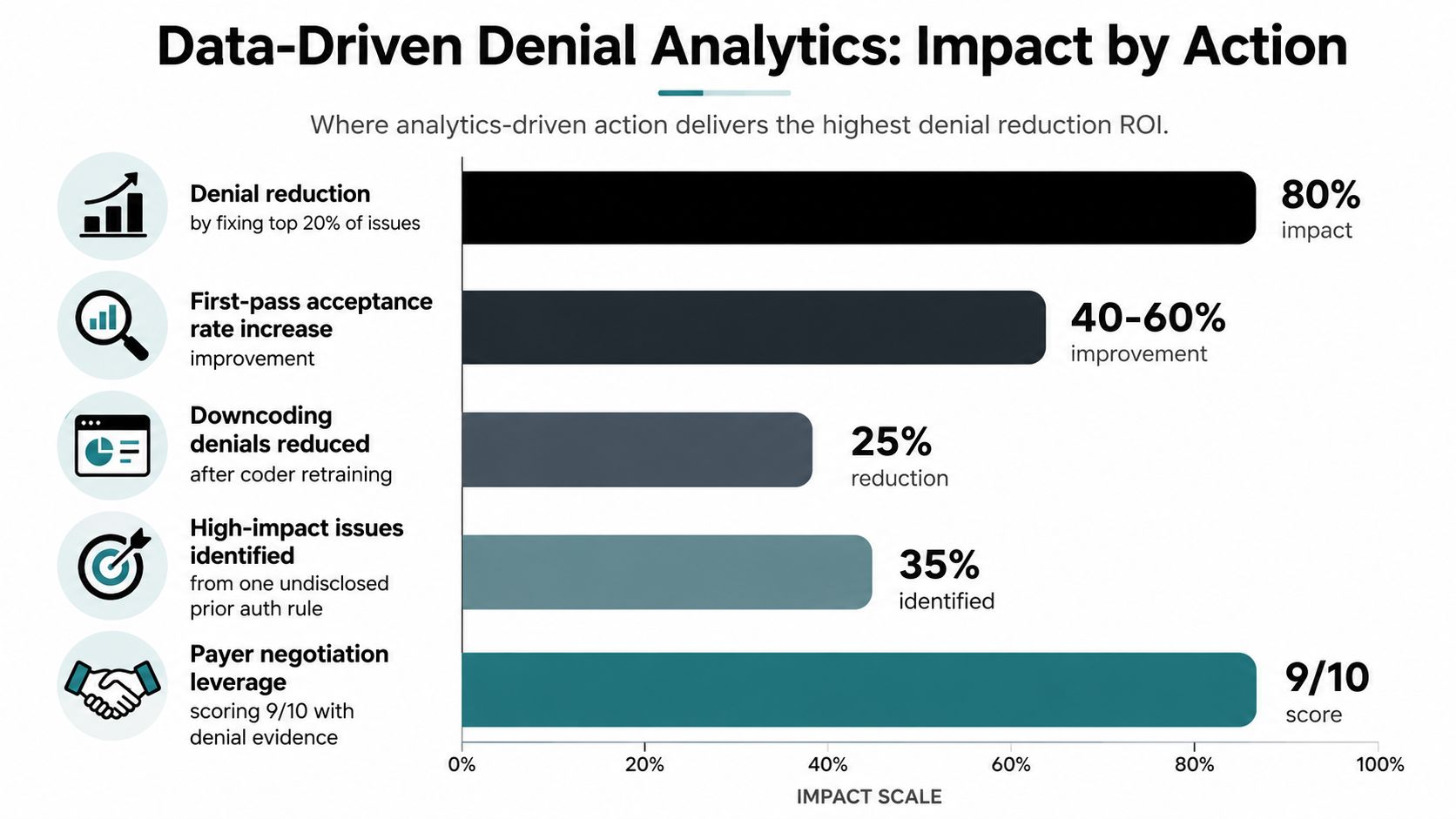
A strong validation program doesn't guarantee payment. It prevents the organization from submitting claims with known weaknesses and creates a record of why the claim was submitted in that form.
6. Data-Driven Denial Analytics and Root Cause Analysis
A denial code is an event. A root cause is an operational diagnosis. If the analytics team reports only total denied claims, leaders can't tell whether the priority is eligibility, authorization, documentation, coding, credentialing, network status, medical necessity, underpayment, or payer processing behavior.
Classify every denial at a useful level of detail. Capture payer, plan, facility, provider, specialty, procedure, diagnosis, modifier, authorization status, claim type, billed amount, allowed amount, paid amount, denial reason, appeal status, and resolution. Separate preventable denials from payer disputes and from claims that require clinical judgment. The same adjustment code can represent different failures depending on the service line and contract.
The scale of the problem warrants disciplined analytics. Insurers selling qualified health plans on HealthCare.gov denied 19% of in-network claims and 37% of out-of-network claims in 2024, according to KFF's analysis of claims denials and appeals. Use that context to prioritize network validation, authorization controls, and pre-submission review, but don't treat a broad market benchmark as an internal performance target.
Turn patterns into assigned actions
Review denial data weekly. A monthly leadership meeting should decide which systemic issues require investment, payer escalation, contract review, or clinician education.
Use a root-cause register with:
- A named owner: Assign the fix to registration, authorization, coding, clinical operations, credentialing, contracting, or payer relations.
- A prevention action: Change a form, edit, work queue, documentation prompt, payer rule, or training module.
- An escalation threshold: Escalate repeated payer behavior, material underpayment, or a pattern that survives internal correction.
- A validation date: Confirm that the change altered the intended KPI without creating new errors elsewhere.
Revenue-cycle automation is already part of many organizations' operating model. A hospital survey cited by Experian Health found that 74% of healthcare organizations automate some revenue-cycle operations, while 80% of organizations not yet using automation planned to do so by the end of 2025 (Experian Health's State of Claims survey). Analytics should guide that investment, not replace accountability. Teams can use healthcare revenue cycle analytics to organize payer behavior, denial causes, and KPI reporting around operational decisions.
7. Payer Contract Optimization and Rate Negotiation
Some payment problems originate in the contract, not the claim. Ambiguous bundling language, unclear modifier treatment, narrow medical-necessity definitions, weak appeal procedures, and missing payment timelines create recurring disputes even when the provider follows its workflow correctly.
Contract review should begin with the denial and underpayment ledger. Identify services that are repeatedly bundled, downcoded, paid below the expected methodology, or rejected because the payer interprets a term differently from the provider. Then map each issue to the contract language, fee schedule, payer policy, claim examples, and prior correspondence. A negotiation backed by a pattern is stronger than a negotiation based on anecdotal frustration.
An orthopedic ASC may need clear treatment of bilateral procedures, add-on codes, and services the payer says are bundled. An anesthesia group should address preservation of applicable modifiers and payment treatment for high-complexity cases. An air ambulance platform needs precise language around medical justification and reimbursement eligibility. Cardiology practices may need contract terms that distinguish office-based laboratory services from bundled care.
Write the enforcement path into the agreement
A useful contract defines more than rates. It should specify:
- Payment methodology: State how codes, modifiers, units, bilateral services, and add-on procedures are priced.
- Bundling rules: Identify which services are included and which remain separately payable.
- Documentation standards: Define the records required to support medical necessity and payment.
- Appeal procedure: Set submission requirements, response responsibilities, and escalation steps.
- Dispute resolution: Clarify contractual remedies and how they interact with applicable federal processes.
- Operational commitments: Establish measurable expectations for claim handling and payment timing where negotiable.
Review contracts annually and after material payer-policy changes. Track underpayment by payer, code, specialty, facility, and contract version. Use appeal outcomes to refine negotiations. Never accept a favorable headline rate that is undermined by restrictive bundling or a process that makes payment disputes impractical to pursue.
8. Enforcement-Driven Independent Dispute Resolution and Appeal Strategy
Prevention doesn't mean accepting every payer decision. Some denials and underpayments reflect payer interpretation, network-status disputes, payment methodology, or disagreement over documentation. The organization needs a disciplined appeal process and an evidence record that can support escalation when correction alone won't resolve the issue.
The federal No Surprises Act IDR process launched on April 15, 2022, creating a national mechanism for resolving certain out-of-network payment disputes after underpayment or nonpayment (Congressional Research Service report on the IDR process). More than 2 million disputes had been initiated through 2024, and federal reporting later counted 1,433,289 disputes initiated between January 1 and May 31, 2026, bringing the cumulative total to 6,336,032 disputes from April 15, 2022 through May 31, 2026 (the same CRS report). The volume shows why dispute readiness belongs inside revenue-cycle operations rather than in an isolated legal file.
The process has also produced measurable provider outcomes. CMS-linked reporting showed providers won 85% of payment determinations in one six-month period, while awards exceeded the qualifying payment amount in 87% of determinations (Congressional Research Service report). Those figures don't mean every dispute should be filed. They do mean organizations should evaluate eligible claims systematically instead of abandoning recoverable payment.
Create an evidence-first escalation path
Start with a complete claim record. Include eligibility and authorization findings, credentialing status, clinical documentation, coding rationale, contract terms, remittance details, payer correspondence, appeal deadlines, and the calculation of the disputed amount. Assign a single case owner who can coordinate billing, coding, clinical review, contracting, compliance, and counsel.
Use an escalation matrix based on financial materiality, recurring payer behavior, eligibility for IDR, filing deadlines, and the strength of the evidence. A single low-value correction may stay in ordinary appeals. A repeated underpayment across a specialty or payer should trigger payer-relations review and contract analysis. An eligible pattern with complete records should move into an IDR-readiness queue.
Track appeal submission timeliness, overturn rate, recovery by root cause, underpayment value, payer response time, IDR eligibility, filing status, and net recovery after costs. Feed outcomes back into pre-service verification, documentation, validation rules, and contract negotiations. The objective is not aggressive escalation for its own sake. It's to stop avoidable denials upstream and make unavoidable payer resistance expensive enough to manage intelligently.
8-Point Claim Denial Prevention Comparison
| Strategy | Implementation Complexity | Resource Requirements | Expected Outcomes | Ideal Use Cases | Key Advantages |
|---|---|---|---|---|---|
| Pre-Claim Eligibility Verification & Real-Time Authorization | Medium, payer API + EHR integration | Integration engineers, ongoing payer maintenance, staff training | Prevents ~25–40% of eligibility denials; clearer patient liability | ASCs, surgical scheduling, specialty clinics with prior auth needs | Fewer denials, improved patient cost clarity, reduced rework |
| Specialty-Specific Clinical Documentation & Coding Optimization | Medium–High, templates, training, AI tuning | CDI tools, coder/clinician training, AI-assisted review | Reduces coding denials 30–50%; better charge capture | Procedure-intensive specialties (IONM, anesthesia, air ambulance, ortho) | Accurate coding, stronger appeals, reduced undercoding revenue loss |
| Proactive Payer Credentialing & Network Management | Medium, centralized workflows, multi-state complexity | Credentialing staff or vendor, CAQH/Relay, tracking system | Prevents ~5–10% of credential-related denials; fewer rejections | Multi-state platforms, large groups, multi-facility networks | Ensures claims continuity, compliance, fewer administrative denials |
| Patient Cost Transparency & Financial Clearance | Low–Medium, process and communication setup | Financial counselors, estimation tools, patient materials | Reduces patient-initiated disputes; faster collections, higher satisfaction | Elective procedures, ASCs, practices reliant on patient payments | Fewer billing disputes, legal protection (transparency compliance), improved collections |
| Claim Pre-Submission Validation & Clean Claims Testing | Medium, validation software + rule maintenance | Claims validation platform, payer rule updates, review staff | Increases first-pass acceptance by ~40–60%; faster payment cycles | High-volume billers, specialties with complex payer rules | Higher first-pass payment, fewer resubmissions, defensible audit trail |
| Data-Driven Denial Analytics & Root Cause Analysis | High, BI integration and data quality effort | BI tools, data engineers, clean claims data | Identifies top denial drivers; enables targeted denial reduction ROI | Organizations seeking systemic remediation and payer negotiation | Prioritizes high-impact fixes, supports negotiations, continuous improvement |
| Payer Contract Optimization & Rate Negotiation | High, legal/negotiation expertise required | Contract analysts, benchmarking data, negotiation resources | Secures better rates and clearer terms; reduces underpayment disputes | Specialty practices facing payer consolidation or poor contract terms | Improved reimbursement, clarified bundling/modifier rules, appeal leverage |
| Enforcement-Driven IDR & Appeal Strategy | High, legal, clinical evidence assembly | Legal counsel, clinical experts, appeal/IDR infrastructure | Recovers substantial underpayments (high recovery on appeals); deters bad-faith payers | Systematic underpayment, high-value denials, multi-state disputes | Revenue recovery, enforcement leverage, precedent-setting outcomes |
Turn Denial Prevention Into a Managed System
Claim denial prevention works when leaders manage the revenue cycle as a connected control system. Eligibility verification supports authorization. Financial clearance clarifies responsibility. Credentialing protects provider and facility status. Specialty documentation gives coding a defensible clinical foundation. Pre-submission validation tests the complete claim. Analytics identifies recurring failures. Contract management defines what the payer should pay. Appeals and IDR preserve influence when the payer doesn't follow the agreed or applicable payment framework.
Assign an owner at every checkpoint. Registration should own accurate insurance data. Authorization staff should own approval evidence and expiration monitoring. Clinicians should complete service-specific documentation. Coders should validate code selection and modifiers. Credentialing should reconcile payer records. Contracting should investigate systematic underpayment. Revenue-cycle leadership should maintain the denial taxonomy, dashboard, and escalation rules.
Use a practical operating cadence:
- Before service: Verify eligibility, network status, benefits, authorization, and patient responsibility.
- Before coding: Confirm that documentation supports the service, medical necessity, complexity, and modifiers.
- Before submission: Run payer-specific edits, review exceptions, and assemble supporting records.
- Weekly: Analyze denials by payer, root cause, specialty, provider, procedure, and facility.
- Monthly: Review first-pass acceptance, denial rate, clean claim rate, days to payment, appeal recovery, and underpayment trends.
- At contract review: Compare actual adjudication with negotiated terms and identify recurring disputes.
- At escalation: Preserve deadlines, complete the evidence file, and decide whether ordinary appeal, payer negotiation, contractual dispute resolution, or IDR is appropriate.
Set benchmarks by payer and specialty rather than relying on one enterprise-wide average. A high-complexity air ambulance claim, an anesthesia case, an orthopedic procedure, and a dermatology encounter don't carry the same documentation or authorization risks. Monitor both prevention and recovery. A lower denial rate is valuable, but it shouldn't come from suppressing valid claims, delaying submission, or transferring payer problems to patients.
The key distinction is simple. Avoidable denials should be prevented. Unavoidable payer resistance should be met with a dispute-ready claim and a defined escalation path. RevGuard can support organizations that want to connect specialty-specific RCM, payer intelligence, contract enforcement, and No Surprises Act IDR within one revenue-protection model.
Review your highest-volume denial causes, assign an owner to each upstream control, and build a payer-specific dashboard for first-pass acceptance, clean claim rate, days to payment, appeal recovery, and underpayments. RevGuard connects eligibility, coding, credentialing, documentation, payer negotiation, and IDR support for specialty providers. Visit RevGuard to evaluate an integrated approach to claim denial prevention and revenue protection.