

In 2023, at least 86 public payer-provider disputes were reported, compared with 51 in 2022, a 69% increase, and 44% failed to reach agreement, sending patients or members out of network, according to PayerSet's dispute data. That's not a renewal-calendar problem. It's an operating-risk problem involving access, cash flow, authorization, denials, and executive credibility.
Healthcare payer contract negotiations work only when the contract, the claims operation, and the escalation process are managed as one system. A rate increase means little if the payer can change its policies without consent, recoup payments without a practical limit, or deny an authorized service after care has been delivered. The payer's fee schedule is only the visible layer. The economics live in the definitions, notice provisions, audit rights, response times, and remedies underneath it.
Why Healthcare Payer Contract Negotiations Are an Operating Function
A payer contract governs far more than the reimbursement line in a spreadsheet. It shapes eligibility workflows, prior authorization, claim submission, adjudication, appeals, credentialing, payment posting, underpayment recovery, and, when applicable, Independent Dispute Resolution. If those functions sit in separate silos, your organization can negotiate one concession, then lose its value through a denial rule or an administrative requirement nobody connected to the agreement.
The operating burden is substantial. A large 2024 analysis of hospital-insurer contracting found that hospitals in the sample negotiated a mean of 52 contracts and worked with a mean of 33 payers, with payer counts ranging from 21 to 59 and contract counts ranging from 35 to 82, as described in PayerPrice's analysis of payer contract negotiations. Across 524 contracts, the median contract contained 9 service description-code observations, while the mean contained 1,285, and 59.4% used more than one reimbursement methodology.
That complexity changes the job description. The person accountable for the contract should have visibility into the denial queue, credentialing file, payer scorecard, and underpayment log. Otherwise, the negotiation team sees rates while the revenue cycle team sees consequences, and the same weaknesses return at the next renewal.
Practical rule: Treat every denial pattern, delayed payment, and payer policy change as contract intelligence, not merely as a billing issue.
Use a continuous cycle rather than a renewal-only calendar.
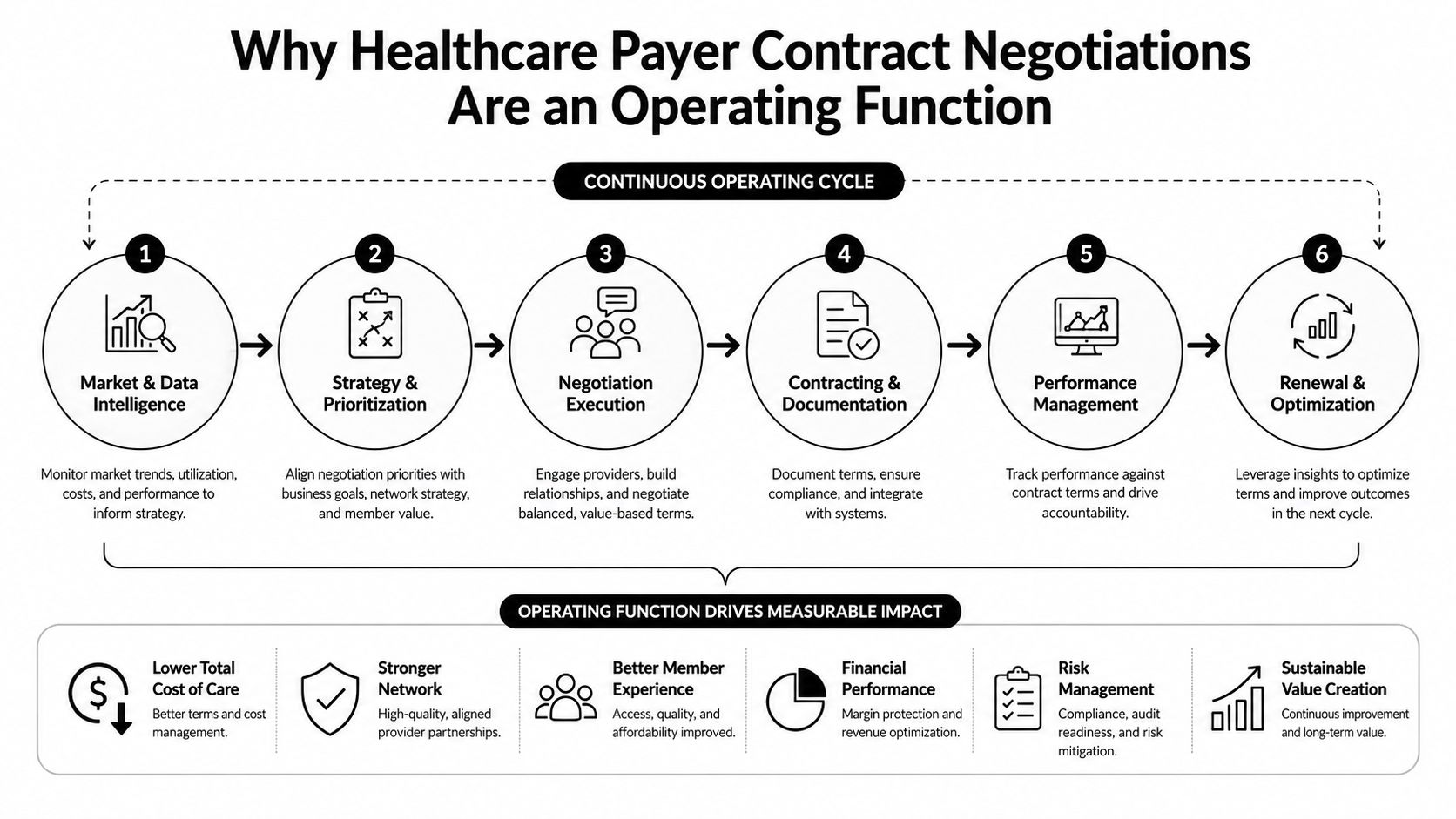
The cycle starts with claims evidence, moves through benchmarking and negotiation, then continues into implementation, monitoring, and enforcement. A revenue cycle optimization framework can help connect those activities, but the ownership decision has to come from leadership. No vendor or dashboard can compensate for a contract that nobody actively operates.
Building the Preparation Stack Before You Sit Down
A payer meeting should begin with an evidence packet, not an opening demand. Pull 12 to 24 months of internal claims history, as recommended by TruBridge's payer negotiation guidance, and scrub it by payer, service line, procedure, place of service, denial reason, allowed amount, paid amount, and payment timing.
The first pass should answer practical questions. Which services drive volume? Which services drive contribution margin? Where does the payer's allowed amount differ from the contracted schedule? Which denials result from authorization, medical necessity, coding edits, timely filing, or missing information? A raw denial percentage is less useful than a denial inventory tied to contractual language and recoverable dollars.
Build the evidence in layers
Your preparation stack should contain four working documents:
- Payer scorecard: Track reimbursement behavior, denial categories, payment delays, appeal outcomes, policy changes, credentialing status, and unresolved disputes.
- Ask sheet: List each requested rate or clause change, the supporting evidence, the opening position, the target, and the minimum acceptable outcome.
- Concession log: Record every movement, the condition attached to it, and the payer commitment required in return.
- Executive brief: Reduce the negotiation to the payer relationship, financial exposure, access value, operational burden, and walk-away alternatives.
Benchmarking should use defensible external reference points. Depending on the specialty and market, teams may compare internal reimbursement with FAIR Health data, MGMA benchmarks, CMS geographic fee-schedule information, and available transparency data. The important discipline is to document the methodology, service definitions, geography, and comparison basis so the payer can't dismiss the analysis as anecdotal.
Credentialing belongs in the same preparation file. Confirm current CAQH attestations, service locations, NPIs, tax identifiers, provider rosters, delegated arrangements, and effective dates. A strong rate agreement that never activates because the payer says a roster or location is incomplete isn't a negotiated win.
| Artifact | Data Source | Owner |
|---|---|---|
| Payer scorecard | Claims, remittance data, appeals, credentialing records | Managed care and revenue cycle |
| Ask sheet | Contract, benchmark files, service-line economics | Contracting lead and finance |
| Concession log | Meeting notes, redlines, payer correspondence | Negotiation lead |
| Executive brief | Scorecard, modeling, risk assessment | Finance and executive sponsor |
Use performance benchmarking resources to strengthen the comparison, but keep the source files and assumptions available for review. A payer is more likely to engage with a focused, reproducible analysis than with a broad complaint about rising costs.
Contract Terms That Decide Long-Term Economics
The headline rate is only one input in the contract model. A fee schedule can look attractive while the agreement makes collection difficult through restrictive filing windows, narrow appeal rights, weak authorization language, or unilateral policy changes.
Start with the reimbursement methodology. Identify the fee-schedule basis, code set, conversion method, multiple-procedure logic, bilateral rules, assistant-surgeon provisions, modifiers, supplies, drugs, implants, and unlisted services. If the contract references another document, attach the exact version and define which document controls when terms conflict.
Separate price from control
A payer-friendly template may say the payer can revise manuals, policies, or fee schedules by posting an update to its website. A balanced version requires written notice, a defined implementation period, and provider consent for material reimbursement changes. The first approach transfers operational control to the payer. The second gives your team a chance to assess the impact, update workflows, and reject or renegotiate a material change.
The same distinction applies to process terms. Confirm timely filing, corrected-claim rules, appeal deadlines, retroactive authorization, coordination of benefits, payment sequencing, and documentation requirements. These provisions determine whether your team can pursue payment after an initial denial or whether the claim expires before the issue is resolved.
A contract can also contain bilateral most-favored-nation language that makes one concession contagious across other agreements. Review whether a payer can demand the benefit of a more favorable arrangement without matching the obligations, volume, quality, or service conditions attached to that arrangement.
A modest rate increase with enforceable notice and audit rights can outperform a larger increase that the payer can dilute through policy changes and recoupment.
| Term Category | Example Clause | Risk If Unaddressed | Negotiation Priority |
|---|---|---|---|
| Rate methodology | Defined fee schedule, code hierarchy, modifier rules | Payment varies from the modeled amount | High |
| Amendments | Written notice and consent for material changes | Payer changes economics mid-term | High |
| Appeals | Clear deadlines and required denial detail | Valid claims become practically unrecoverable | High |
| Authorization | Approved services remain payable when conditions are met | Post-authorization denials | High |
| Audit and recoupment | Defined scope, notice, lookback, and repayment process | Retroactive offsets and cash disruption | High |
| Termination | Balanced notice and continuity obligations | Abrupt network disruption | Medium to high |
Before signing, model the contract against actual claims, not hypothetical examples. A payer contract management workflow should connect the signed language to claim edits, payment variance reports, and escalation ownership. That connection is what turns legal language into collected revenue.
Red Flags and Silent Language to Eliminate
Read the agreement for control transfer, not just for the proposed reimbursement. Payer templates often place the most consequential terms in exhibits, manuals, policy references, and amendment provisions. If your team reviews only the rate sheet, it may approve a deal whose operating rules are still controlled elsewhere.
The first red flag is unilateral amendment authority. A payer should not be able to materially change reimbursement, coding requirements, authorization rules, or medical policies by posting an online update. If mutual written consent isn't available, seek written notice, a meaningful implementation period, and a termination right tied to material adverse changes.
Other language deserves equal scrutiny:
- Evergreen renewal: Require a clear renewal date, notice deadline, and review trigger so the agreement doesn't continue without deliberate approval.
- Termination for convenience: Seek balanced rights, adequate notice, patient-transition obligations, and protection for active treatment.
- Recoupment: Define the lookback period, audit notice, sampling method, dispute process, offset limits, and repayment deadline.
- Clean claim: Specify the information required and prevent the payer from keeping a claim “unclean” through repeated, unstructured requests.
- Medical necessity: Tie the standard to defined clinical criteria and identify the governing policy version.
- Site of service: Clarify how facility, office, ambulatory, and outpatient settings are classified.
- Most-favored-nation language: Confirm that any parity obligation includes comparable volume, quality, access, and administrative commitments.
- Notice delivery: Name current contacts and require delivery through a method your organization monitors.
A vague audit clause is not neutral. It can permit broad record access, retrospective extrapolation, indefinite review, and immediate offsets. Ask for a defined scope, reasonable notice, a sampling methodology, a correction period, and repayment rules that apply equally to both parties.
| Red Flag | Why It Matters | Negotiable Fix |
|---|---|---|
| Unilateral policy changes | Operational requirements can change without agreement | Mutual consent, or written notice and a defined implementation period |
| Unlimited recoupment | Old claims can become future payment offsets | Defined lookback, notice, dispute rights, and offset limits |
| Vague clean-claim language | The payer can delay adjudication by requesting more information | Objective clean-claim definition and capped requests |
| Evergreen renewal | Rates and terms remain unreviewed | Renewal calendar, advance notice, and mandatory review |
| One-sided termination | Network or patient access can change abruptly | Balanced notice and continuity-of-care obligations |
| Incorporated manuals without version control | The governing rules can shift invisibly | Complete attachments, dated versions, and order of precedence |
For every red flag, prepare a redline, a fallback position, and an internal owner. If leadership accepts the risk, record it as a priced concession. Silence isn't a strategy.
Negotiation Strategies That Actually Move Rates
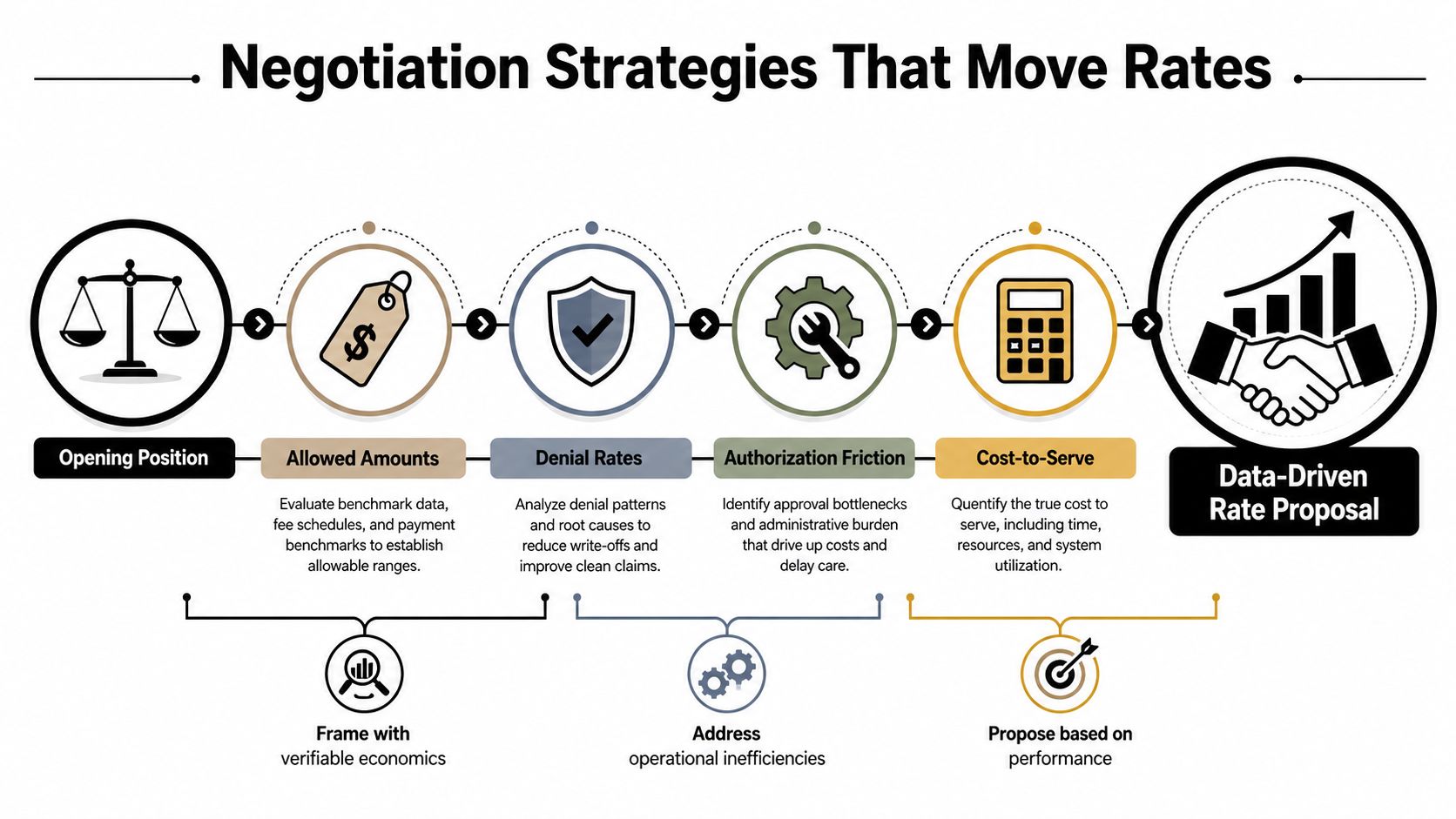
Payers respond to economics they can verify. Lead with allowed amounts, service mix, denial friction, authorization workload, access value, quality performance, and the cost the payer incurs when patients leave the network. Don't open with a total revenue demand that gives the payer no practical way to evaluate the request.
Present the proposal by procedure and site of service. Show the current allowed amount, the requested amount, the benchmark basis, and the operational condition attached to the request. If the payer's schedule is below a defensible market comparison, state that clearly and identify the services that matter most.
Trade deliberately
A trade package can include volume, access, quality reporting, referral retention, faster documentation, or administrative commitments. Those concessions need boundaries. Never trade an uncapped administrative burden for a modest rate improvement, and don't promise access or reporting obligations that your credentialing, clinical, or revenue cycle teams haven't approved.
When the payer asks to “meet in the middle,” answer with the economics:
“The midpoint has to recognize our denial workload and unit cost. If we move on the rate, what process commitment or volume condition is moving with it?”
Then stop talking. Silence gives the payer room to respond, while a written concession log prevents later confusion about what was exchanged.
Hold back your strongest rate position until the payer addresses the terms that affect realization. Payment timing, authorization burden, appeal access, prior-authorization lock language, and recoupment controls can be worth more than a small fee-schedule adjustment. Test every promise by asking three questions:
- Who owns the commitment?
- How will performance be measured?
- What remedy applies when performance fails?
Use denial data as live leverage. If a payer's authorization process creates repeated avoidable denials, connect the requested rate to a measurable process correction. If your team has reliable quality and access data, use it to show why the payer's network benefits from retaining the relationship.
End each meeting with a written recap. List the agreed terms, unresolved points, conditions, owners, deadlines, and required legal attachments. Don't treat a verbal assurance as a contract amendment. The final agreement should be conditioned on approved language, complete exhibits, fee schedules, implementation dates, and credentialing confirmation.
Choosing the Right Reimbursement Model
The right model follows service-line economics and risk tolerance. It shouldn't be selected because a payer calls it novel or because a fixed schedule feels familiar.
A fixed fee schedule is usually the clearest structure for organizations with stable coding, predictable volume, and the ability to negotiate specific procedures. Its weakness is staleness. If new services, higher-cost supplies, complex cases, or unusual site-of-service requirements aren't addressed, the schedule can understate the cost of care.
Percent-of-Medicare arrangements can provide a recognizable reference point and adjust with changes to the underlying Medicare schedule. They still require careful drafting. Define the applicable geographic schedule, code year, conversion basis, exclusions, modifiers, and treatment of services that Medicare doesn't price in the same way.
Match risk to control
Capitation can fit primary care or other settings where the provider can influence utilization and manage attributed patients. It becomes dangerous when attribution is unreliable, costs are outside the provider's control, or stop-loss protection is absent. Spell out attribution, exclusions, data access, reconciliation, quality gates, and payment timing.
Value-based reimbursement needs even more precision. Define quality measures, attribution, benchmark periods, risk adjustment, data sources, shared-savings calculations, audit rights, and reconciliation. A promise to share savings isn't meaningful if the payer controls the denominator and refuses to provide the data needed to verify it.
| Model | Best Fit | Primary Risk |
|---|---|---|
| Fixed fee schedule | Stable services, predictable coding, procedure-focused specialties | Rates become outdated or miss complex services |
| Percent of Medicare | Services that track Medicare valuation and have clear geographic rules | Ambiguous schedules, exclusions, or conversion methods |
| Capitation | Providers able to manage utilization and attribution | Uncontrolled clinical risk and unreliable patient assignment |
| Value-based reimbursement | Organizations with measurable outcomes and usable payer data | Unclear benchmarks, attribution, or reconciliation |
| Hybrid model | Groups seeking a predictable base with limited upside exposure | Incentives become complex and difficult to audit |
Model each option against actual allowed amounts, collection cost, denial leakage, reporting expense, quality requirements, shared-risk exposure, and network consequences. Require a defined term, baseline, reconciliation schedule, data-access obligation, and termination right if the payer's assumptions prove inaccurate.
Performance Metrics and Audit Clauses That Enforce the Deal
A signed contract isn't performing until your team can measure compliance. Every important obligation needs a definition, a clock, an owner, an evidence source, and a remedy. “Prompt payment” and “timely response” aren't operating standards unless the agreement explains what starts the clock and what happens when the payer misses it.
Build a service-level schedule around the events that create cash friction:
- Claim adjudication: Define clean claims, receipt confirmation, required payment timing, and the treatment of claims suspended for additional information.
- Denial notices: Require the payer to identify the reason, code, policy, records relied upon, appeal route, and deadline.
- Authorization: Set response times for determinations, additional-information requests, and appeals. Cap repeated requests for the same records.
- Credentialing: Require acknowledgment of completed files, identification of deficiencies, and communication of effective dates.
- Payment variance: Establish a process for correcting systematic underpayments and preserving the provider's right to recover them.
The response-time issue deserves particular attention. Neutral industry guidance recommends defining maximum timelines for coverage determinations, appeal reviews, and additional-information requests, along with remedies when the payer misses those deadlines, as outlined by CorroHealth's analysis of process-focused payer contracts. The same source reports that 41% of providers saw denial rates of 10% or higher in 2025, up from 38% in 2024, making process obligations directly relevant to revenue protection.
Make audit rights usable
An audit clause should answer:
- What records can each party review?
- How much notice must the auditor provide?
- What sampling method applies?
- How far back can the payer review?
- Can the payer extrapolate from a sample?
- How does the provider challenge a finding?
- When must repayment occur?
- When does interest begin?
- Can the payer offset disputed amounts?
The remedy should match the breach. A missed payment deadline may trigger interest. A recurring authorization failure may trigger executive escalation, a corrective-action plan, or a termination-for-cause right. A systematic underpayment should trigger a lookback, corrected payment, interest, and an obligation to fix future claims.
| Metric | Acceptable Threshold | Enforcement Remedy |
|---|---|---|
| Clean-claim adjudication | Contract-defined payment window | Interest, escalation, and corrective-action plan |
| Denial notice detail | Specific reason, policy, records, and appeal path | Reprocessing or appeal deadline extension |
| Authorization response | Defined maximum timeline | Escalation and deemed approval or other agreed remedy |
| Additional-information requests | Limited, relevant, and time-bound | Closure of request or escalation |
| Underpayment correction | Defined review and repayment period | Interest, corrected payment, and systemic remediation |
| Audit process | Defined scope, sample, notice, and dispute rights | Challenge procedure and limits on offsets |
Connect escalation to IDR
The enforcement loop begins inside the claims workflow. A missed SLA should surface quickly through a dashboard, not wait for a year-end reconciliation. Track payer response times, denial categories, underpayment variances, policy changes, authorization outcomes, appeal results, and unresolved balances by contract.
Escalation should follow a written ladder:
- Account-manager complaint with claim and contract evidence.
- Formal written notice identifying the breach and requested cure.
- Executive sponsor review with a deadline for resolution.
- State Department of Insurance complaint when the issue falls within applicable state authority.
- IDR or arbitration initiation after checking eligibility, timing, jurisdiction, documentation, and forum requirements.
The No Surprises Act IDR process is not a substitute for contract drafting. It is a downstream enforcement tool for eligible disputes, and the documentation that supports a case begins upstream with the contract, authorization record, claim, remittance, appeal history, and proof of payment responsibility. CMS-linked reporting cited by Becker's payer coverage of IDR disputes notes that 42% of challenged No Surprises Act disputes were found ineligible in both Q3 and Q4 of the prior year. Eligibility checks therefore belong in the escalation protocol before a filing is prepared.
For eligible matters, assess filing timing, administrative fees, batching rules, the qualifying payment amount dispute, and the evidence packet. Similar claims may be batched when the applicable rules permit it, but similarity must be documented rather than assumed. The packet should include the contract or applicable payment terms, claim details, remittance information, authorization records, clinical or service documentation where relevant, payer correspondence, appeal results, and a concise explanation of why the requested payment is supported.
Quarterly monitoring keeps the cycle alive. Review variance reports, denial trends, recoupment logs, SLA breaches, unresolved appeals, policy amendments, credentialing changes, and potential contract triggers. Recent reporting found 171 public payer-provider disputes in 2025, compared with 127 in 2024 and 86 in 2023, while 22 disputes ended in terminations, according to Becker's coverage of the dispute environment. Those figures reinforce a practical point: escalation planning should exist before the relationship reaches a public breakdown.
RevGuard combines specialty-specific revenue cycle management with payer contract negotiations, underpayment analysis, claims evidence packaging, and enforcement-focused IDR workflows under the No Surprises Act. Visit RevGuard to connect contract language, denial intelligence, and dispute-ready documentation into one operating discipline.