

The same denial-prevention playbook can't serve anesthesia, IONM, oncology, or air ambulance providers. Their revenue depends on different combinations of time capture, procedure coding, authorization, credentialing, medical-necessity evidence, payer contracts, and post-payment variance review. That difference is measurable across the broader market. A Medscape survey of 17,461 U.S. clinicians recorded denial and resubmission rates of 20% in radiology, 19% in anesthesiology, and 18% in orthopedics according to the specialty denial benchmark.
The financial exposure also extends beyond rejected claims. The federal No Surprises Act took effect on January 1, 2022, creating an Independent Dispute Resolution pathway for certain out-of-network emergency and specialty claims. Federal IDR disputes increased from 679,156 in 2023 to more than 1.46 million in 2024, showing how quickly specialty reimbursement disputes became a large-scale revenue-cycle problem in the analysis of federal IDR activity.
This guide evaluates eight medical billing specialties through one practical framework: billing mechanics, denial drivers, documentation and credentialing pressure points, recoverable revenue, upstream controls, and the conditions under which payer underpayments may require structured dispute escalation. RevGuard is relevant to organizations that need to manage the full revenue lifecycle, from eligibility and coding through payment posting, appeals, contract variance review, and NSA-compliant IDR.
1. Anesthesia Medical Billing
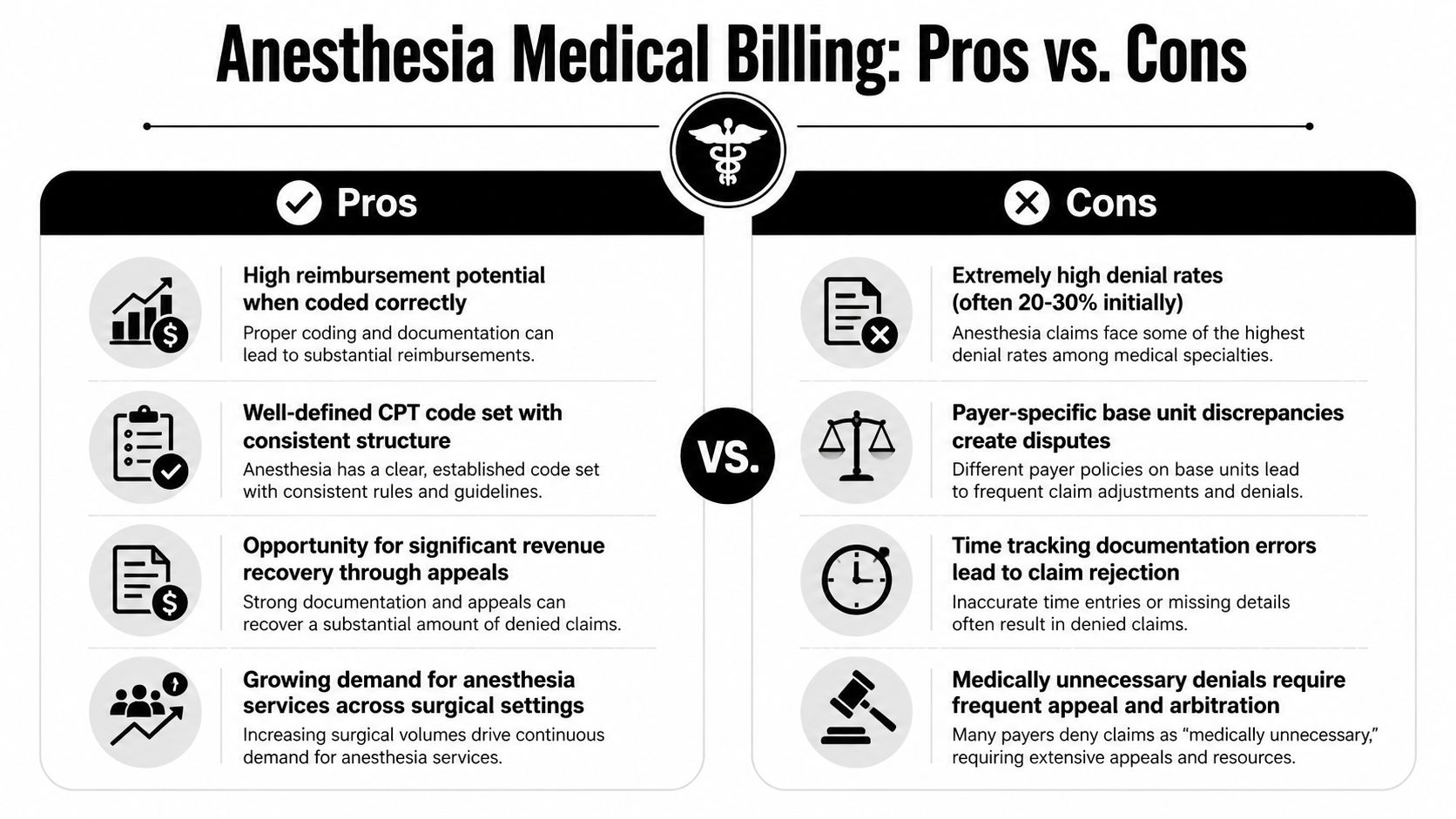
Anesthesia reimbursement can fail because a few minutes, a modifier, or a payer-specific conversion factor was recorded incorrectly. Unlike evaluation-and-management billing, anesthesia claims depend heavily on base units, time units, qualifying circumstances, physical-status modifiers, and documented anesthesia start and stop times. A clean operative note alone may not support the full claim if the anesthesia record doesn't establish exactly what happened and when.
The highest-risk scenario occurs when the OR schedule, anesthesia information system, and claim do not agree. Payers may challenge medical necessity, apply an incorrect modifier interpretation, or downcode base units when the billed service isn't supported by the payer's policy. Credentialing creates another pressure point, especially when anesthesiologists, CRNAs, supervising physicians, and facility contracts require different enrollment or billing relationships.
Practical rule: Treat the anesthesia record as the primary revenue document, not as a clinical attachment added after a denial.
Controls that protect the claim
Anesthesia groups should maintain a payer-aware code and contract library, then review it on a defined schedule. Pre-bill review should reconcile:
- Time capture: Match anesthesia start and stop times against OR timestamps and provider attestations.
- Modifier selection: Confirm physical-status and qualifying-circumstance modifiers against the clinical record.
- Unit calculation: Recalculate base and time units before submission rather than relying on a static charge interface.
- Credentialing status: Verify that the rendering and billing relationships align with each payer enrollment record.
A dispute file should preserve the anesthesia record, operative report, patient status, time logs, contract terms, and the payer's explanation of payment. That evidence helps separate a legitimate coding correction from a systematic underpayment pattern. If the payer repeatedly downcodes comparable claims, the organization should quantify the variance by payer and procedure, then determine whether the claim falls within a federal IDR pathway.
The broader benchmark matters because anesthesiology recorded a 19% denial and resubmission rate in the cited clinician survey specialty benchmark data. That figure shouldn't become a target or universal expectation. It should prompt anesthesia leaders to inspect whether time documentation, modifier edits, payer libraries, or credentialing gaps are driving avoidable rework.
2. Intraoperative Neuromonitoring IONM Billing
IONM billing requires the claim to explain not only that monitoring occurred, but also why it was clinically appropriate, how it was performed, and what the professional interpretation contributed during surgery. Electromyography, somatosensory evoked potentials, motor evoked potentials, and related services generate technical and professional documentation that must remain connected to the procedure.
Payers often scrutinize IONM for perceived overutilization, bundling, and medical-necessity weaknesses. A generic operative note may identify the surgery but fail to show the neurologic risk, monitoring modality, signal changes, alerts, and physician interpretation. Coding staff also need to distinguish related services accurately, because a code selection that doesn't match the actual monitoring work can trigger downcoding or a medical-necessity denial.
Build evidence before the procedure
The strongest IONM workflow begins before the patient enters the operating room. Authorization staff should verify coverage, payer-specific requirements, site-of-service rules, and bundling policies. The authorization request should link the planned monitoring to the procedure, diagnosis, risk profile, and surgeon's clinical rationale.
A practical IONM control set includes:
- Procedure-risk mapping: Maintain a matrix connecting surgical procedures with relevant neurologic risks and monitoring modalities.
- Technical logs: Record equipment, electrodes, baseline signals, signal quality, alerts, interventions, and significant changes.
- Interpretation records: Preserve the interpreting physician's timing, findings, communications, and final impression.
- Code validation: Review code differentiation against the actual service and payer policy before billing.
IONM organizations also need a disciplined credentialing process. The group should know which entity performed the technical component, which professional interpreted the study, and whether each provider is enrolled for the relevant payer and service location. Specialized IONM coding support can fit into that workflow when the practice needs tighter alignment between clinical records, coding, and dispute preparation.
A real-world scenario illustrates the exposure. A spine network may perform monitoring during a complex procedure, document the signals in a technical log, and still receive a denial because the authorization file never connected the monitoring to surgical risk. The remedy isn't just a stronger appeal letter. It is an upstream process that makes the medical-necessity narrative visible before submission, then preserves the same evidence for appeal or IDR if the payer continues to underpay.

3. Air Ambulance and Emergency Transport Billing
Air ambulance billing combines clinical urgency with operational data. The claim may depend on transport mode, distance, flight or travel time, patient acuity, interventions, destination rationale, and the absence of a suitable alternative. A missing GPS record or vague crew note can turn a medically necessary emergency transport into a payer dispute.
Transport providers face a difficult reimbursement environment because coverage rules vary by payer, geography, network status, and service type. Ground and air providers may also divide responsibility across a single episode, creating opportunities for inconsistent documentation or incorrect modality selection. Patient financial exposure adds another layer, particularly when coverage is unclear before departure.
Make the transport record auditable
The transport organization should integrate dispatch, GPS, aircraft, and clinical systems where possible. The goal isn't technology for its own sake. It's to ensure that the billed distance, transport time, crew activity, and patient condition are supported by contemporaneous records.
The documentation should answer four questions:
- Why was transport necessary? Record the patient's condition, acuity, and services required.
- Why was air transport appropriate? Explain distance, time sensitivity, geography, or clinical capability.
- Why was the destination selected? Identify the receiving facility's relevant capability or availability.
- What did the crew do? Capture assessments, interventions, monitoring, and critical-care activity.
Payer-specific coverage maps can help front-end teams identify authorization requirements and service-area restrictions before transport. They won't eliminate emergency uncertainty, but they can direct staff toward the correct verification and escalation path. After payment, the provider should compare allowed amounts with contract terms and applicable federal requirements instead of treating every zero balance as final.
The No Surprises Act is especially relevant to emergency transport disputes, but eligibility and filing requirements must be assessed claim by claim. Providers evaluating that route can use the No Surprises Act framework for air ambulance claims alongside their transport records and payment history.
A recurring underpayment pattern deserves more than isolated appeals. If a payer consistently applies an unsupported rate or rejects comparable medically necessary transports, the organization should group the claims, preserve the clinical and operational evidence, and escalate through the appropriate negotiation or IDR process.

4. Orthopedic Surgery and Musculoskeletal Billing
Orthopedic revenue leaks across the entire episode of care. The procedure claim may be correct while related imaging, modifiers, facility charges, global-period services, or workers' compensation routing create downstream problems. Orthopedic practices therefore need to manage the claim as a connected surgical episode, not as separate transactions.
Medical necessity is a frequent fault line for procedures such as rotator cuff repair, ACL reconstruction, shoulder arthroscopy, and knee interventions. Payers may also dispute whether imaging is separately reportable, whether a bilateral procedure was coded correctly, or whether a postoperative service belongs inside the global period. Credentialing and payer enrollment matter when surgeons operate across hospitals, ASCs, and office settings with different billing entities.
Control the episode before submission
A pre-bill orthopedic audit should review the operative report, imaging, diagnosis, modifiers, authorization record, and global-period status together. Separate routing rules should identify commercial insurance, workers' compensation, and auto liability claims before the claim reaches the wrong payer workflow.
Useful controls include:
- Bundling review: Compare imaging and procedure combinations against current payer rules.
- Laterality validation: Confirm RT, LT, bilateral, and distinct-procedure modifiers against the operative documentation.
- Global-period tracking: Flag postoperative services that are included, separately reportable, or unrelated.
- Authorization escalation: Trigger an appeal when the payer denies a preauthorized procedure or changes the approved scope.
The cited specialty benchmark places orthopedic denial and resubmission at 18% in the Medscape clinician survey, while broader specialty reporting places orthopedics at 13% to 17% the specialty denial-rate analysis. These figures come from different benchmarking approaches, so they shouldn't be blended into one universal rate. They do support a more useful conclusion: orthopedic leaders need to separate coding, authorization, global-period, and imaging denials instead of reporting one undifferentiated denial percentage.
Consider a surgeon whose postoperative visit is denied as included in the global package even though the record documents an unrelated complication. The appeal depends on the clinical distinction, the correct modifier, and the payer's policy. If the same payer repeatedly misapplies the global rule, the practice should preserve examples, calculate the payment variance, and consider structured escalation rather than treating each denial as a one-off error.
5. Cardiology and Cardiac Procedure Billing
Cardiology claims often combine diagnostic testing, imaging, intervention, device management, and professional interpretation. That combination creates a sequencing problem. A diagnostic service may precede a catheterization, ablation, or device procedure, but the claim must show which services were distinct, which were bundled, and which were part of the same procedural episode.
The risk increases with newer technologies and payer-specific coverage rules. A cardiology group may document a clinically appropriate intervention, obtain authorization, and still face a denial because the authorization covered one component while the submitted claim included another. Device billing introduces additional coordination among the physician, facility, manufacturer, and payer, particularly when the reimbursement logic distinguishes professional work, technical services, supplies, and device-related components.
Separate clinical intent from billing sequence
The most effective cardiology controls begin with a procedure map. Staff should identify whether the encounter contains diagnostic imaging, an interventional procedure, device work, or a combination. The record should then support each separately reportable service with its own medical rationale, interpretation, and timing.
A strong workflow should:
- Validate bundling: Review combinations of ECG, stress testing, echocardiography, catheterization, and intervention before claim creation.
- Track authorization scope: Compare the approved service, diagnosis, site, and date with the final procedure.
- Coordinate device evidence: Retain device identifiers, manufacturer documentation, implant records, and payer-specific billing requirements.
- Monitor policy changes: Maintain a controlled library for newer technologies and update the clinical evidence requirements when payer policies change.
Cardiology has a cited denial benchmark of roughly 8% to 12%, while gastroenterology is cited at 10% to 16% in a separate specialty benchmark source specialty-specific RCM benchmarks. The important operational point isn't to rank the specialties. It's to recognize that a cardiology denial can conceal a sequencing or bundling defect that a generic edit won't identify.
Suppose a payer denies an ablation because it treats the diagnostic study as bundled, even though the clinical record supports a separate service under the payer's rules. The team should build the appeal from the procedure timeline, authorization, interpretation, code set, and policy language. Repeated denials should move into payer-pattern analysis, contract variance review, and, where eligible, an IDR case file.
6. Gastroenterology Billing
Gastroenterology depends on precise distinctions between screening, surveillance, diagnostic, and therapeutic services. An endoscopy may begin as a screening procedure and become therapeutic after a lesion is found. If the documentation and code selection don't reflect that transition, the practice can face a denial, incorrect patient responsibility, or an underpayment for separately reportable work.
Bundling is another persistent exposure. The base endoscopy, biopsies, polypectomy, dilation, banding, stent placement, and pathology-related services must be represented consistently across the clinical record and claim. Frequency limits and payer authorization rules can also vary by diagnosis, procedure, and patient history.
Preserve the clinical transition
GI teams should document the purpose of the procedure before it starts, then record what changed during the encounter. The physician's report should distinguish the initial indication from findings, interventions, specimens, complications, and follow-up recommendations. That distinction gives coding staff a defensible basis for selecting the appropriate procedure family and diagnosis relationship.
A practical GI revenue workflow includes:
- Screening conversion review: Identify when findings transformed a screening encounter into a diagnostic or therapeutic service.
- Add-on validation: Confirm that biopsies, polypectomy, dilation, banding, or stent services are supported and not incorrectly bundled.
- Frequency control: Check payer limits and authorization requirements against the patient's prior procedures.
- Pathology coordination: Match specimen documentation, pathology orders, and claim details before submission.
The gastroenterology benchmark cited in industry guidance ranges from 10% to 16% specialty RCM metric guidance. That range should lead a practice to segment denials by procedure type. A high denial rate for screening claims may point to frequency or diagnosis issues, while therapeutic denials may indicate documentation, bundling, or authorization failures.
Consider a colonoscopy in which a polyp is removed after the procedure begins as screening. If the claim only reflects the original screening intent, the practice may lose payment for the therapeutic work or shift an avoidable balance to the patient. A pre-bill audit should compare the endoscopy report, pathology record, diagnosis, authorization, and payer edits. If the payer repeatedly rejects properly supported therapeutic components, the organization should assemble a pattern-based appeal or eligible IDR submission rather than resubmitting identical claims.
7. Dermatology Medical Billing and Procedural Services
Dermatology's central revenue distinction is often clinical rather than technical: medical treatment must be separated from cosmetic care in the documentation, coding, scheduling, and patient communication. Mole removal, scar revision, laser treatment, lesion destruction, and pathology may look similar operationally, but reimbursement depends on indication, symptoms, diagnosis, site, size, number of lesions, and payer exclusions.
A practice can lose revenue in two opposite ways. It may submit a medically necessary service without enough evidence, leading to a cosmetic exclusion, or it may combine multiple lesion treatments in a way that obscures distinct sites and procedures. Pathology coordination adds another risk when the specimen record and physician procedure note don't align.
Document the indication, not just the procedure
Dermatologists should record why the service was performed, what symptoms or risk factors supported it, the exact anatomical sites, the lesion characteristics, and whether tissue was submitted for pathology. For borderline services, the note should make the medical rationale clear without relying on assumptions that a payer reviewer won't share.
A dermatology control program can include:
- Coverage verification: Check medical benefits and cosmetic exclusions before scheduling high-risk procedures.
- Site and lesion mapping: Record separate sites, lesion counts, dimensions, and treatment methods.
- Modifier review: Validate distinct-procedure logic when multiple services occur at one visit.
- Pathology reconciliation: Match the specimen, diagnosis, procedure, and pathology submission.
The cited benchmark places dermatology denial exposure at about 6% to 12%, while another specialty source reports 8% to 11% comparative specialty RCM benchmarks. The variation reinforces why a practice should track denial triggers rather than rely on a single specialty average.
A patient may schedule removal of a lesion described informally as a “mole,” while the clinician documents irritation, bleeding, suspicious change, or another medical indication. If the claim lacks those clinical facts, the payer may apply a cosmetic exclusion. A dispute-ready record should include the examination, indication, procedure details, pathology, authorization where required, and payer policy. That record supports an appeal and helps the practice identify whether a particular payer systematically treats medically indicated services as cosmetic.
8. Oncology and Cancer Treatment Billing
Oncology billing carries clinical, financial, and timing risks at the same time. Chemotherapy and immunotherapy claims may include drug-specific codes, administration services, infusion duration, treatment planning, laboratory support, and physician management. A payer can deny the treatment, approve the drug but not the administration, or reimburse the drug under a rate that doesn't match the contract.
Prior authorization is central, particularly for biologics, immunotherapy, targeted therapies, and other high-cost treatment modalities. Off-label treatment creates an even stronger documentation burden because the record must establish the patient's condition, prior treatment history, clinical rationale, supporting evidence, and the reason standard alternatives aren't appropriate. Specialty pharmacy coordination can also affect sourcing, site of care, buy-and-bill responsibility, and payment variance.
Build the evidence chain before infusion
An oncology authorization file should be assembled as a clinical case, not a form submission. It should connect diagnosis, staging or disease characteristics, treatment intent, prior therapies, requested drug and dose, administration plan, and relevant clinical evidence. The practice should track authorization status closely enough to escalate delays before the scheduled treatment is disrupted.
Core controls include:
- J-code and contract review: Compare drug coding, units, acquisition information, payer terms, and payment posting.
- Administration validation: Reconcile infusion start and stop times, sequential services, and separately reportable administration work.
- Policy library maintenance: Keep payer coverage rules for biologics, immunotherapy, targeted treatments, and newer modalities current.
- Off-label evidence preservation: Store clinical rationale, published support, peer review, and treating-physician documentation in the case file.
- Financial counseling: Explain coverage uncertainty, patient responsibility, assistance options, and appeal status before treatment whenever possible.
The oncology revenue cycle management resource reflects the need to connect authorization, coding, payment review, and escalation rather than assigning each task to an isolated queue.
The recoverable revenue question is especially important after payment. A zero balance doesn't prove that the payer paid according to the contracted drug rate or that every administration line was reimbursed. Line-by-line variance checks can identify underpayments that ordinary denial reports miss. When a payer repeatedly underpays indicated treatment or rejects a well-supported authorization, the organization should preserve the clinical file, payment detail, contract terms, and correspondence for a structured appeal or eligible IDR process.
Comparison of 8 Medical Billing Specialties
| Specialty | Implementation complexity | Resource requirements | Expected outcomes | Ideal use cases | Key advantages |
|---|---|---|---|---|---|
| Anesthesia Medical Billing | Very high, time/unit calculations, complex ASA/CRNA modifiers, payer base-unit variance | Real-time OR time-tracking, trained coders, payer conversion libraries, appeals/IDR team | High per-case reimbursement if accurate; initial denial rates ~20–30%; recoverable via appeals | Hospitals, ambulatory surgery centers, anesthesia groups | High reimbursement potential; well-defined CPT set; strong recovery opportunities |
| Intraoperative Neuromonitoring (IONM) Billing | High, specialized CPTs, strict medical‑necessity linkage, frequent pre-authorization | Detailed intraop logs, standardized templates, pre-auth workflows, arbitration expertise | High-value claims ($800–3k+); denials 30–50%+ for medical necessity; strong recovery with solid documentation | Spine, neurosurgery, ENT, vascular procedures; dedicated IONM providers | High per-case value; growing demand; favorable arbitration when well-documented |
| Air Ambulance & Emergency Transport Billing | Very high, distance/weight calculations, geographic and payer variability, intense medical‑necessity scrutiny | GPS/flight-data integration, crew acuity notes, payer coverage maps, patient financial counseling, arbitration capacity | Very high per-flight revenue ($2k–10k+); denial rates 40–60%; recoverable via documentation and arbitration/patient collections | Air medical operators, hospital flight programs, regional transport networks | High-value emergency claims; legally defensible emergency care; clear data-driven appeal support |
| Orthopedic Surgery & Musculoskeletal Billing | High, broad CPT range, global-period and imaging bundling complexity, modifier usage | Pre-bill bundling audits, global period tracking, modifier protocols, worker's comp routing | Consistent volume and revenue; denials 25–40% (imaging/bundling); significant recoveries possible | Orthopedic practices, surgical centers, imaging-heavy clinics | High-volume specialty; established procedure codes; steady demand and minimally invasive growth |
| Cardiology & Cardiac Procedure Billing | High, diagnostic + interventional coding, device components, hybrid procedure bundling | Device coordination, pre-authorization workflows, imaging bundling validation, manufacturer liaison | High-value cases ($1.5k–5k+); denials 30–45% for bundling/necessity; recovery with structured protocols | Cardiac centers, interventional cardiology suites, device clinics | High reimbursement per case; strong clinical evidence; manufacturer support for coding/reimbursement |
| Gastroenterology Billing (Endoscopy & Procedures) | Moderate–High, endoscopy base/add-on codes, biopsy bundling, screening vs diagnostic distinctions | Pre-bill coding audits, payer-specific bundling libraries, screening documentation, pre-auth tracking | High-volume stable revenue; denials 20–35% for bundling/necessity; recoverable via audits and arbitration | GI clinics, ambulatory endoscopy centers, preventive screening programs | Steady procedure demand; clear code set; reliable screening revenue stream |
| Dermatology Medical Billing & Procedural Services | Moderate, E/M plus procedural codes, cosmetic vs medical distinctions, pathology coordination | Medical‑necessity templates, pre-bill cosmetic checks, lab/pathology coordination, bundling/modifier rules | Consistent patient volume; cosmetic exclusion denials common; moderate recoverable underpayments | Dermatology clinics, cosmetic/aesthetic practices, dermatologic surgery centers | High-volume specialty; clear coding structure; additional aesthetic revenue opportunities |
| Oncology & Cancer Treatment Billing | Very high, drug J-codes, infusion/administration bundling, complex prior authorization needs | Specialty pharmacy coordination, automated prior-auth with clinical evidence, J-code rate tracking, appeals for off-label | Very high per-treatment revenue ($2k–15k+); denials 30–50% for novel therapies; major cash-flow risk from prior-auth delays | Cancer centers, infusion clinics, hospital oncology departments | Very high-value claims; expanding treatment options; established pathways for standard-of-care reimbursement |
Turn Specialty-Specific Risk Into Protected Revenue
The eight specialties point to one operating conclusion: medical billing specialties don't share one denial profile because they don't share one clinical or payer workflow. Anesthesia depends on time and unit integrity. IONM depends on procedure-linked medical necessity and technical logs. Air ambulance depends on transport data and acuity. Orthopedics depends on episode-level bundling and global-period controls. Cardiology depends on sequencing and device coordination. Gastroenterology depends on screening-to-therapy distinctions. Dermatology depends on medical-versus-cosmetic evidence. Oncology depends on authorization, drug reimbursement, administration, and treatment-specific documentation.
That segmentation should begin with the denial ledger. A practice, ASC, hospital, or multi-state platform should classify every denial by specialty, payer, procedure, root cause, and financial impact. A generic “medical necessity” category hides important differences. In one service line, it may indicate a missing authorization. In another, it may indicate incomplete surgical-risk evidence, an unsupported diagnosis, or a payer policy applied to the wrong code combination.
The current benchmark environment makes that discipline more important. Across 2026 industry benchmarks, initial medical-claim denial rates are reported at about 11.8% to nearly 12%, while well-managed environments are reported around 5% to 7% and weaker operations can reach 15% to 20% industry benchmark reporting. Those figures describe operating ranges, not guaranteed outcomes. They show why denial prevention should be managed as a measurable revenue lever, especially in procedure-heavy specialties.
A four-layer protection model
First, strengthen the front end. Verify eligibility, benefits, network status, credentialing, authorization, site of service, and payer-specific requirements before care. Front-end staff should know which procedures require clinical evidence and which provider or entity must appear on the authorization.
Second, engineer the claim. Use specialty-specific coding edits, modifier rules, bundling logic, drug or device libraries, time validation, and documentation checks. A claim scrubber should reflect the service line and payer, not merely generic syntax.
Third, preserve the record. Keep the clinical note, authorization, operative or transport record, technical log, contract terms, remittance advice, correspondence, and appeal history together. This turns a rejected claim into an explainable case and a recurring underpayment into a pattern that leadership can measure.
Fourth, escalate intelligently. Denials require correction when the claim is wrong. Underpayments require variance analysis when the claim was accepted but paid below the applicable expectation. Public guidance increasingly distinguishes these problems and emphasizes line-by-line checks because underpayments can remain hidden in zero-balance systems emerging medical billing trends.
The No Surprises Act adds a formal escalation route for eligible disputes. Federal IDR activity reached more than 1.46 million disputes in 2024, following 679,156 disputes in 2023 federal IDR analysis. Provider organizations should therefore assess whether their evidence, payer communications, qualifying payment information, contract records, and filing processes are ready for NSA-compliant IDR when negotiations don't resolve systematic underpayments.
RevGuard integrates specialty-specific RCM with enforcement-driven IDR, covering the revenue lifecycle from eligibility, coding, and credentialing through payer follow-up, patient collections, payment analysis, and dispute preparation. Provider groups, ASCs, hospitals, and multi-state platforms can use that model to compare their highest-value leakage points with the specialty workflows that create them, then prioritize the controls most likely to protect reimbursement.
RevGuard connects specialty-specific revenue cycle management with dispute-ready documentation and NSA-compliant IDR support for organizations facing denials, downcoding, and underpayments. Review how its RCM and IDR capabilities fit your highest-risk service lines, and visit RevGuard to evaluate the next step for protecting specialty reimbursement.