

Electronic claim submission reached 98% adoption across U.S. healthcare administration by 2023, with 9,467 million medical claim transactions processed nationally. CAQH also reported that medical claim-submission spending had risen 67% to $19 billion, while volume increased from 7,219 million transactions in 2021. CAQH's 2023 Index Report makes the operational reality clear: providers don't need another argument for going electronic. They need a better way to keep electronic claims from failing before payment, entering adjudication with preventable defects, or becoming too poorly documented to support a later dispute.
Why Electronic Claim Submission Is No Longer the Hard Part
Electronic claim submission is now a mature infrastructure layer, not a modernization project. The central question for a multi-specialty group has shifted from “Are we submitting electronically?” to “What happens to every claim after our billing system creates it?”
A claim can be generated correctly in an EHR or practice management system and still fail at several points. The clearinghouse may reject the file because of a structural problem. A payer may return a 277CA because a member identifier, diagnosis, or provider combination fails a trading-partner edit. A claim may pass those gates and later be denied because authorization, documentation, coding, or coverage requirements weren't satisfied.
That sequence matters because each failure creates different work. A rejected claim usually needs correction and resubmission. A denied claim requires an analysis of the payer's adjudication decision, followed by correction, reconsideration, or appeal. Treating both as “claims needing follow-up” hides the point at which revenue leakage began.
Scale changes the economics
CAQH estimated that more than 3 billion commercial medical claims were submitted nationwide in 2012, when 91% of analyzed claim-submission transactions were already electronic. The same report placed the cost of a paper claim at $2.58, compared with $0.54 for an electronic claim, demonstrating why electronic workflows became an administrative-efficiency milestone. The CAQH 2012 transaction report also documented more than a billion electronic professional 837 claims and more than a hundred million institutional 837 claims in its transaction breakdown.
The modern pipeline handles far greater volume. At that scale, small improvements in validation, acknowledgement handling, and correction speed can affect substantial cash flow without changing reimbursement rates.
Operational rule: A clean, dispute-ready claim starts at submission. It doesn't start when an analyst opens an appeal.
The workflow must therefore be managed end to end: generate the correct 837 transaction, validate the claim against payer rules, transmit through a connected clearinghouse, monitor TA1 and 999 responses, interpret 277CA statuses, correct rejections quickly, and preserve the data needed for remittance review or a later payment dispute. Electronic submission is the transport mechanism. Submission quality is the revenue-cycle control.
Building the EDI 837 Pipeline and Choosing a Clearinghouse
An effective pipeline starts with the source data, not the clearinghouse screen. The practice management system or EHR creates a structured ANSI X12 transaction, typically an 837P for professional claims or an 837I for institutional claims. Dental billing uses the 837D format. The transaction carries patient, subscriber, provider, service, diagnosis, charge, authorization, and routing information in a format that downstream systems can validate.
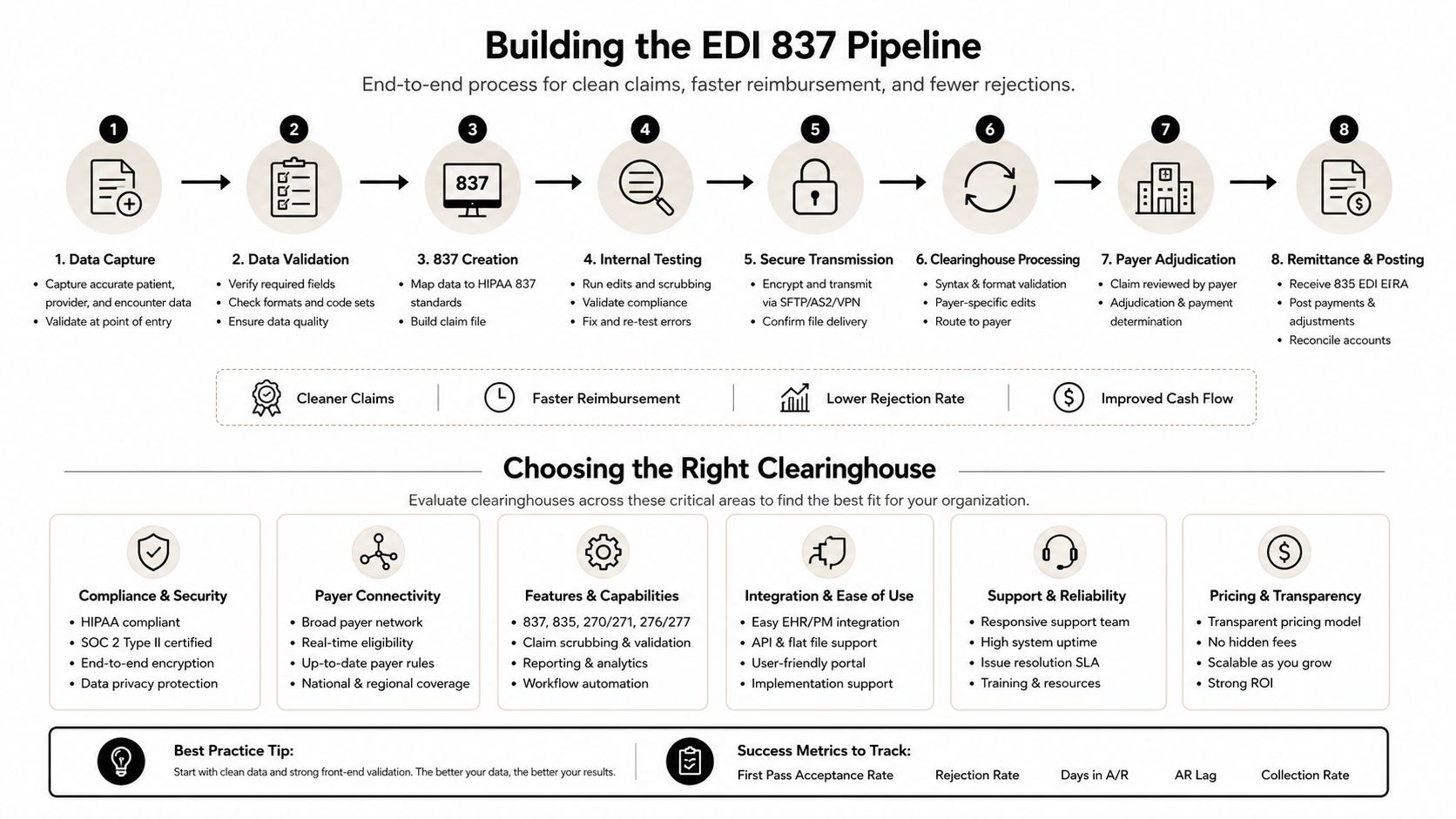
Follow the claim through each handoff
The practical sequence looks like this:
- Create the claim: Pull encounter and billing data from the EHR or practice management system.
- Apply internal rules: Check coding, provider configuration, authorization data, and required claim fields.
- Build the 837: Translate the claim into the appropriate professional, institutional, or dental transaction.
- Run clearinghouse edits: Identify malformed segments, missing values, routing problems, and known payer requirements.
- Transmit to the payer: Send the accepted transaction through the clearinghouse connection.
- Read acknowledgements: Separate interchange, syntax, and payer-level responses.
- Correct exceptions: Assign rejected claims to a work queue with a documented correction path.
- Track adjudication: Reconcile payer decisions with the remittance and preserve the claim record.
A clearinghouse does more than forward files. It provides payer connectivity, applies front-end edits, translates responses, and gives billing teams a monitoring layer between the source system and payer adjudication. Providers evaluating clearinghouses in medical billing should assess operational visibility, not just a vendor's payer logo list.
Select for operational fit
The right clearinghouse depends on specialty mix and workflow complexity. A group with anesthesia, radiology, facility-based services, and office-based specialties may need different payer connectivity and companion-guide logic than a single-specialty practice.
Evaluate these capabilities before signing:
- Payer connectivity: Confirm that the clearinghouse reaches the plans your providers bill, including regional and specialty-specific payers.
- Companion-guide maintenance: Ask how payer rule changes are identified, tested, and deployed.
- 277CA detail: A generic “rejected” status isn't enough. Staff need claim-level reason codes and traceable correction instructions.
- Exception reporting: Dashboards should expose error categories, payer patterns, aging, and repeated defects.
- Integration quality: Reliable field mapping between the billing system and clearinghouse matters more than brand recognition.
- Enrollment support: Confirm who manages payer enrollment, testing, and production cutover.
A multi-specialty group switching clearinghouses may reach payers that previously required paper submission, but the transition only works when provider identifiers, payer IDs, billing configurations, and response mappings are reconciled. A new connection can transmit bad data faster. Connectivity without governance accelerates rework.
Claim Scrubbing and Pre-Transmission Validation That Actually Works
A scrubber should behave like a clinical safety check, not a final cosmetic review. It must validate the claim's business meaning, payer requirements, and transmission structure before the 837 leaves the organization.
Independent industry sources describe front-end electronic rejection rates commonly in the 5% to 10% range for invalid codes, missing required fields, and mismatched member or provider data. Industry guidance on electronic claim rejection patterns also warns that a structurally clean 837 can still fail when payer-specific edits, eligibility information, or code-set rules aren't synchronized.
Use a layered scrub
A reliable validation sequence starts with identity:
- Subscriber ID: Confirm the identifier, patient relationship, payer routing, and demographic fields match the eligibility response.
- Provider identity: Verify billing, rendering, and referring NPIs, taxonomy, enrollment, and location data.
- Coverage and eligibility: Check active coverage and payer order before submission, especially where coordination of benefits applies.
- Coding relationships: Confirm diagnosis-to-procedure linkage, modifiers, units, and specialty-specific coding logic.
- Authorization: Match the authorization number, approved service, provider, location, and dates to the claim.
- Place of service: Reconcile the setting with the procedure, facility, provider, and payer policy.
- Code-set currency: Apply the payer's current companion guide and active coding requirements, not merely the billing system's default edits.
The order matters. If the subscriber ID is wrong, correcting a procedure modifier won't solve the claim. If authorization data is present but attached to the wrong rendering provider or place of service, the claim may pass a superficial check and still fail payer validation.
Replace spot checks with root-cause control
Manual review has a role for unusual services, but it shouldn't be the primary defense against recurring defects. Configure automated rules for predictable failures and route exceptions to specialists who can resolve the underlying source data.
For example, if a payer repeatedly returns claims because a rendering provider's taxonomy doesn't match its enrollment record, the fix belongs in provider master data and payer configuration. Reworking each claim individually only conceals the defect until the next submission.
Use a root-cause view that answers four questions:
- Which payer returned the claim?
- Which 277CA or clearinghouse code identified the problem?
- Which source field produced the error?
- What permanent control will prevent recurrence?
A clean-claim process should record the original value, corrected value, responsible team, and resubmission date. Guidance on what qualifies as a clean claim is useful only when the organization turns those requirements into executable edits.
Handling TA1, 999, and 277CA Acknowledgements the Right Way
Acknowledgements are not interchangeable receipts. They represent different validation layers, and the team that monitors them must know which system has accepted or rejected the claim.
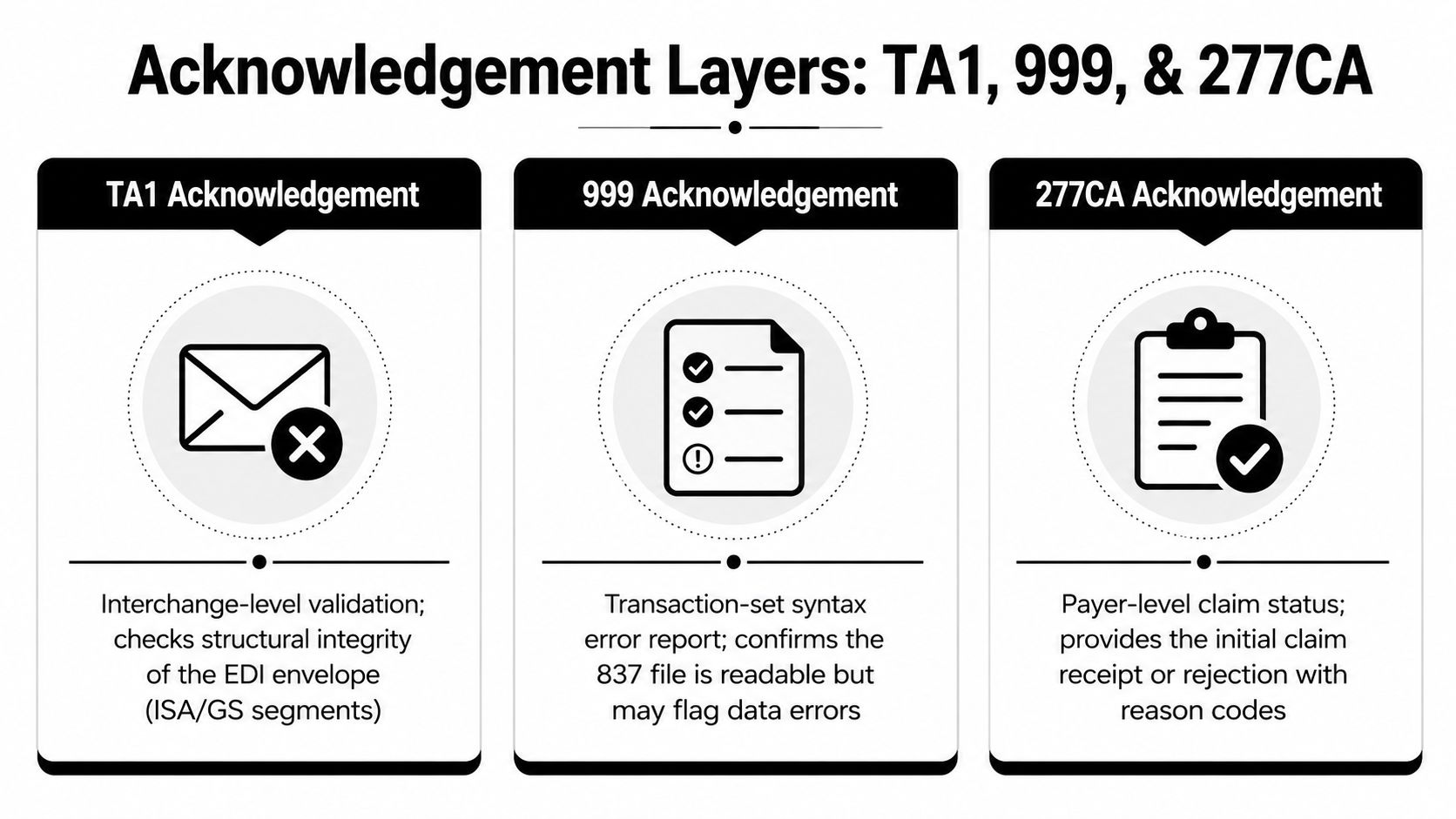
Read the response in sequence
TA1 addresses the interchange envelope. It indicates whether the EDI interchange itself passed basic integrity checks, including the outer ISA and GS structure. A TA1 failure is not a coding denial. The organization should investigate transmission construction, envelope values, sender and receiver configuration, or other interchange-level defects.
999 addresses the transaction set. It confirms whether the 837 can be read as an X12 transaction and identifies syntax or implementation errors. A 999 response can flag problems in the transaction's structure or data presentation before the payer evaluates the claim.
277CA provides payer-level claim acknowledgement. It can indicate that the payer received the claim, rejected it before registration, or placed it into a status requiring further tracking. The response's status category, status code, and payer message should drive the work queue.
The operational mistake is to monitor only the clearinghouse's top-line status. “Accepted by clearinghouse” doesn't necessarily mean “accepted by payer.” Staff need the acknowledgement layer, payer trace information, claim control number, and actionable reason code.
Make rejection versus denial the decision point
A payer manual states that a rejected claim is returned without registration in the claim-processing system, while a denied claim is registered but fails payment requirements. The Keystone First Pennsylvania claims manual also documents a payer move toward point-of-submission rejection for certain diagnosis errors effective July 1, 2026, using 277CA codes A7 and 255.
That distinction determines what staff should do:
| Claim state | What happened | Correct workflow |
|---|---|---|
| Rejected | The payer didn't register the claim for adjudication | Correct the defect, create a replacement or corrected submission as required, and resubmit |
| Denied | The payer registered the claim but found it didn't meet payment requirements | Review the denial reason, verify contract and clinical support, then pursue correction, reconsideration, or appeal |
| Pending | The payer has acknowledged the claim but hasn't completed its decision | Track payer timing, investigate stalled status, and avoid unnecessary duplicate submission |
A7 and 255 should not be treated as ordinary denial codes because they appear in a payer response. When the payer returns a claim at the point of submission, the organization must fix the diagnosis or related data before resubmission. Appealing a claim that never entered adjudication wastes time and can create duplicate or timely-filing risk.
Decision test: If the payer didn't register the claim, correct and resubmit. If the payer registered it and declined payment, analyze the denial and preserve the appeal path.
Payer-Specific Rules, Attachments, and the Interoperability Shift
A claim isn't validated against “the payer's rules” in the abstract. It's validated against a specific payer, product, state configuration, provider relationship, service, and place of service. Two claims with identical clinical services can follow different correction paths because companion-guide requirements and trading-partner edits differ.
That's why a single universal scrubber rule set underperforms. The organization needs a shared core of HIPAA and coding validation, plus payer-specific overlays that control required fields, authorization formats, attachment triggers, routing, and corrected-claim instructions.
Treat attachments as part of the claim
Documentation shouldn't be an afterthought triggered by a denial. For services that commonly require clinical notes, operative reports, imaging, or other records, the billing workflow should identify the likely attachment requirement before transmission and link the documentation to the claim's control record.
That approach helps the team answer practical questions:
- Was the documentation requested before or after adjudication?
- Did the payer receive the attachment?
- Does the record support the billed service and diagnosis?
- Can the organization reproduce the submitted claim and documentation later?
In high-denial specialties, authorization status and attachment readiness belong in the same exception queue as claim defects. A claim with valid syntax but absent clinical support remains operationally fragile.
Claims are becoming an interoperability signal
CMS's 2026 interoperability framework describes claims-based encounter access, allowing payers to query clinical data tied to a claim submitted within the last 60 days. The same framework connects this development with the federal prior-authorization initiative, which pushed standardized FHIR-based API submissions and set a target for real-time responses to 80% of electronic prior authorization requests by 2027. CMS's health technology interoperability framework shows why claim data can't remain isolated inside billing.
The practical implication is significant. Authorization status, clinical data, attachments, claim identifiers, and payer responses increasingly need consistent cross-system references. Providers that submit incomplete or inconsistent data may create problems not only in adjudication, but also in authorization follow-up, clinical-data exchange, and documentation retrieval.
Electronic claim submission is becoming one event in a connected revenue-cycle record. The strongest workflows preserve the same identifiers and source data across eligibility, authorization, claim transmission, clinical documentation, remittance, and dispute preparation.
KPIs, Common Errors, and the Path to Dispute-Ready Claims
High electronic adoption hasn't eliminated denial risk. CAQH reported an average initial denial rate of almost 12% across 1,500 U.S. hospitals in the first half of 2022, compared with 10% in 2020. CAQH's healthcare claim issue brief also provides context for a 2024 production evaluation of AI-assisted EDI 837 workflows that reported 95.1% first-pass acceptance and a decline in denial rates from 18.8% to 3.8% across 487,800 claims.
Those figures shouldn't be copied into a local target without understanding the workflow, payer mix, specialty, and measurement definitions. They do establish the management point: structured validation and automation can affect downstream outcomes when the organization applies them consistently.
Measure the claim lifecycle, not just submission volume
The most useful dashboard separates acceptance from payment:
- First-pass acceptance: The share of claims accepted without correction at the first submission.
- Clean claim rate: The percentage meeting the organization's operational definition of clean before or at payer intake.
- Days to correction: The time from rejection receipt to corrected resubmission.
- Rejection root-cause mix: The distribution of failures across eligibility, identifiers, coding, authorization, routing, and documentation.
- Initial denial rate: The share denied after payer registration and adjudication.
- Exception aging: The time unresolved claims remain in work queues.
- Underpayment inventory: Claims paid below expected reimbursement and ready for contract review or dispute analysis.
A team that reports only total submissions can miss a growing rejection problem. A team that reports only denials can overlook defects that never reached payer adjudication.
Common errors and correction paths
| Error | Signal | Correction Path | Prevention |
|---|---|---|---|
| Invalid subscriber ID | 277CA rejection or eligibility mismatch | Verify coverage and resubmit with the correct identifier | Eligibility verification and demographic matching before 837 creation |
| NPI or taxonomy mismatch | Payer-level rejection or provider validation error | Correct the billing or rendering provider data and resubmit | Maintain synchronized credentialing, enrollment, and billing records |
| Diagnosis and procedure conflict | Diagnosis-related 277CA code or denial | Validate linkage, correct the claim, or appeal only if adjudication occurred | Specialty-specific coding edits and payer companion-guide rules |
| Missing authorization | Rejection, denial, or documentation request | Confirm authorization scope, then correct or appeal based on claim status | Match authorization to service, provider, location, and date |
| Filing-limit problem | Hard rejection or automatic denial | Determine whether a corrected submission or timely-filing exception applies | Daily work queues and rapid acknowledgement monitoring |
For No Surprises Act IDR, submission discipline also protects the evidence record. A claim that preserves the billed service, provider status, authorization history, clinical support, payer response, remittance, and expected payment gives the team a stronger foundation when a payer downcodes or underpays.
Remittance processing should therefore connect back to the original claim, not operate as a separate posting task. The objective is a dispute-ready claim file, built before a disagreement becomes urgent.
Your Next 30 Days of Cleaner Claim Submission
Start with the data already in your systems. Pull the prior month's rejections, group them by 277CA and clearinghouse reason, and identify the source field behind each recurring defect. Don't begin by buying another platform. Begin by proving where the current workflow breaks.
A practical first month
- Audit rejection codes: Separate TA1, 999, and 277CA responses, then distinguish correction work from adjudicated denial work.
- Reconcile payer guides: Compare companion-guide requirements with active scrubber rules and payer configuration.
- Verify provider data: Check NPI, taxonomy, enrollment, location, and rendering-provider mappings across every specialty.
- Create a daily queue: Assign rejected claims to named owners with turnaround expectations and escalation rules.
- Baseline first-pass acceptance: Define the numerator and denominator clearly so operational changes produce a comparable trend.
- Preserve dispute evidence: Store the submitted 837, acknowledgements, authorization, attachments, remittance, and correction history together.
Most avoidable rejection problems are concentrated in a manageable set of fields and payer rules. Fixing those controls is more valuable than asking staff to work denials faster after the payer has already rejected payment.
The long-term aim is one continuous revenue-protection process. Pre-submission validation reduces rework, acknowledgement discipline protects filing opportunities, and complete claim records strengthen later recovery or IDR action. Electronic claim submission works best when billing, clinical documentation, credentialing, remittance, and dispute teams operate from the same claim history.
RevGuard provides specialty-focused revenue cycle management that includes claims submission and clearinghouse oversight, clean-claim workflows, payer follow-up, and downstream payment recovery. If your team needs to connect submission quality with denial prevention and No Surprises Act dispute preparation, visit RevGuard to assess the workflow.