

Revenue cycle management, or RCM, is the end-to-end financial workflow that turns a patient encounter into collected reimbursement. With claim denial rates near 12% and the U.S. RCM market estimated at $90.6 billion in 2026, RCM is a core revenue protection system, not a back-office task.
For a specialty practice, the distinction matters because revenue can leak long before a biller sees a rejected claim. An incorrect demographic field, an unverified benefit, a missing authorization, incomplete documentation, an undercoded service, or a payer underpayment can each weaken the financial result of a clinically appropriate encounter.
The practical question isn't only, “Did the claim go out?” It's, “Did the organization capture the service accurately, obtain the reimbursement it was entitled to receive, and recover the money when the payer challenged or reduced payment?” That is the operating definition of RCM.
What RCM Means in Medical Billing Today
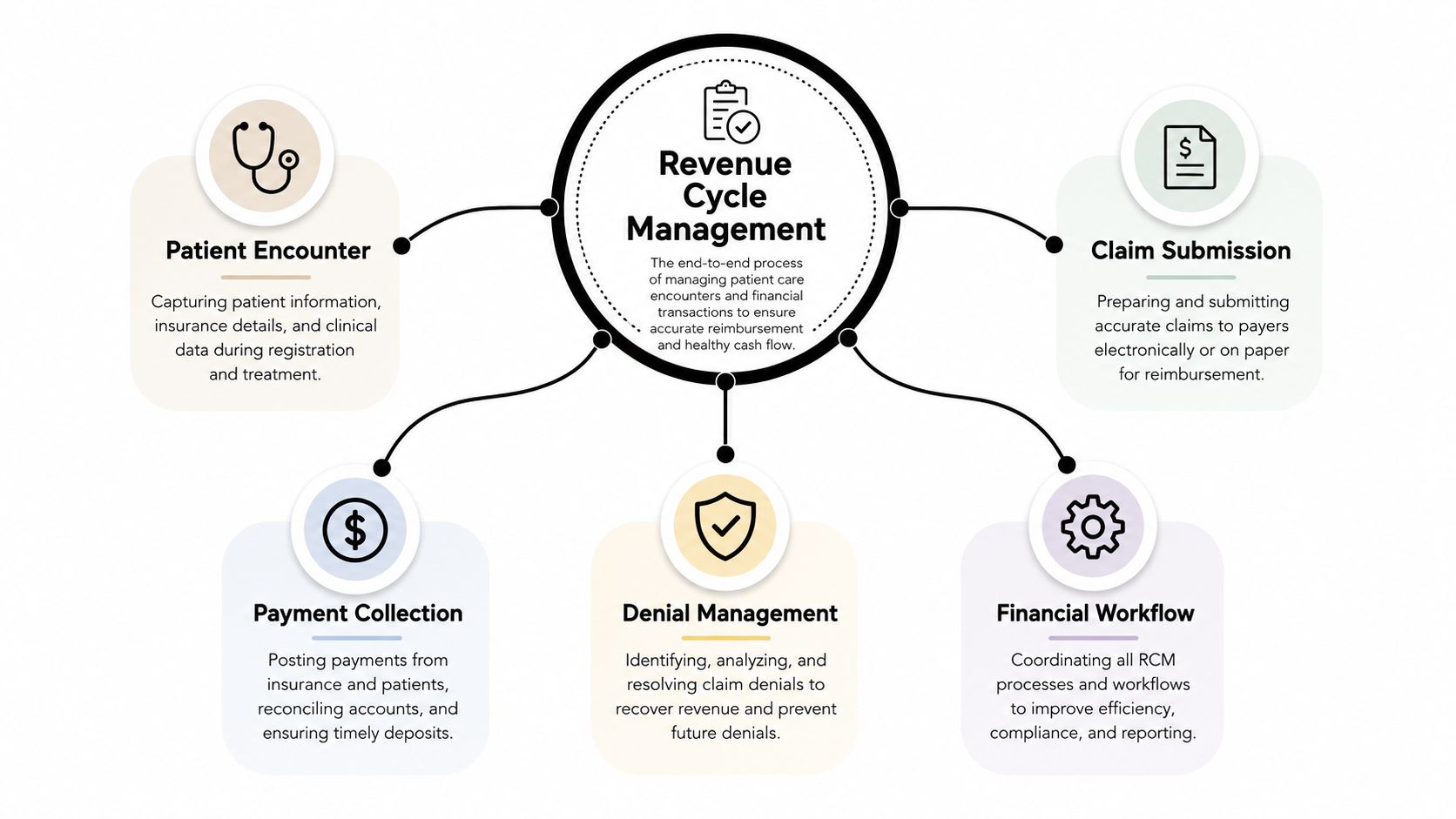
RCM in medical billing is the complete financial workflow that follows a patient encounter from registration and insurance verification through coding, claim submission, denial handling, collections, and final payment. The process includes both administrative and clinical-financial controls. It starts before the appointment and can continue after a payer has processed the claim if the payment is incomplete or disputed.
The current financial pressure makes that broad scope necessary. One industry review estimated the U.S. RCM market at about $90.6 billion in 2026 and projected it to reach $308 billion by 2030. The same review reported industry-wide claim denial rates of nearly 12% in 2026, with average denied amounts rising 14% in hospital outpatient settings and 12% in inpatient settings compared with 2025. These figures are reported in the 2026 state of revenue cycle management review.
A useful analogy is closed-loop plumbing. Registration and eligibility open the valve, clinical documentation and coding direct the flow, claim submission moves the bill toward the payer, and payment posting confirms that the money reached the account. Denial management and underpayment recovery repair leaks. If a practice only watches the claim submission step, it can miss problems at either end of the system.
The scope of RCM ownership
A complete RCM function usually includes:
- Front-end controls: Demographic capture, insurance verification, benefits review, authorization, and financial clearance.
- Mid-cycle accuracy: Charge capture, clinical documentation, coding, modifier review, and claim edits.
- Back-end recovery: Remittance posting, denial appeals, underpayment analysis, patient balances, and aged accounts receivable.
- Management oversight: Payer-specific reporting, root-cause analysis, workflow correction, and accountability for net reimbursement.
That's why a practice evaluating revenue cycle management services should ask who owns the outcome after the claim is submitted. The right owner tracks whether the encounter becomes accurate, timely, and fully paid revenue.
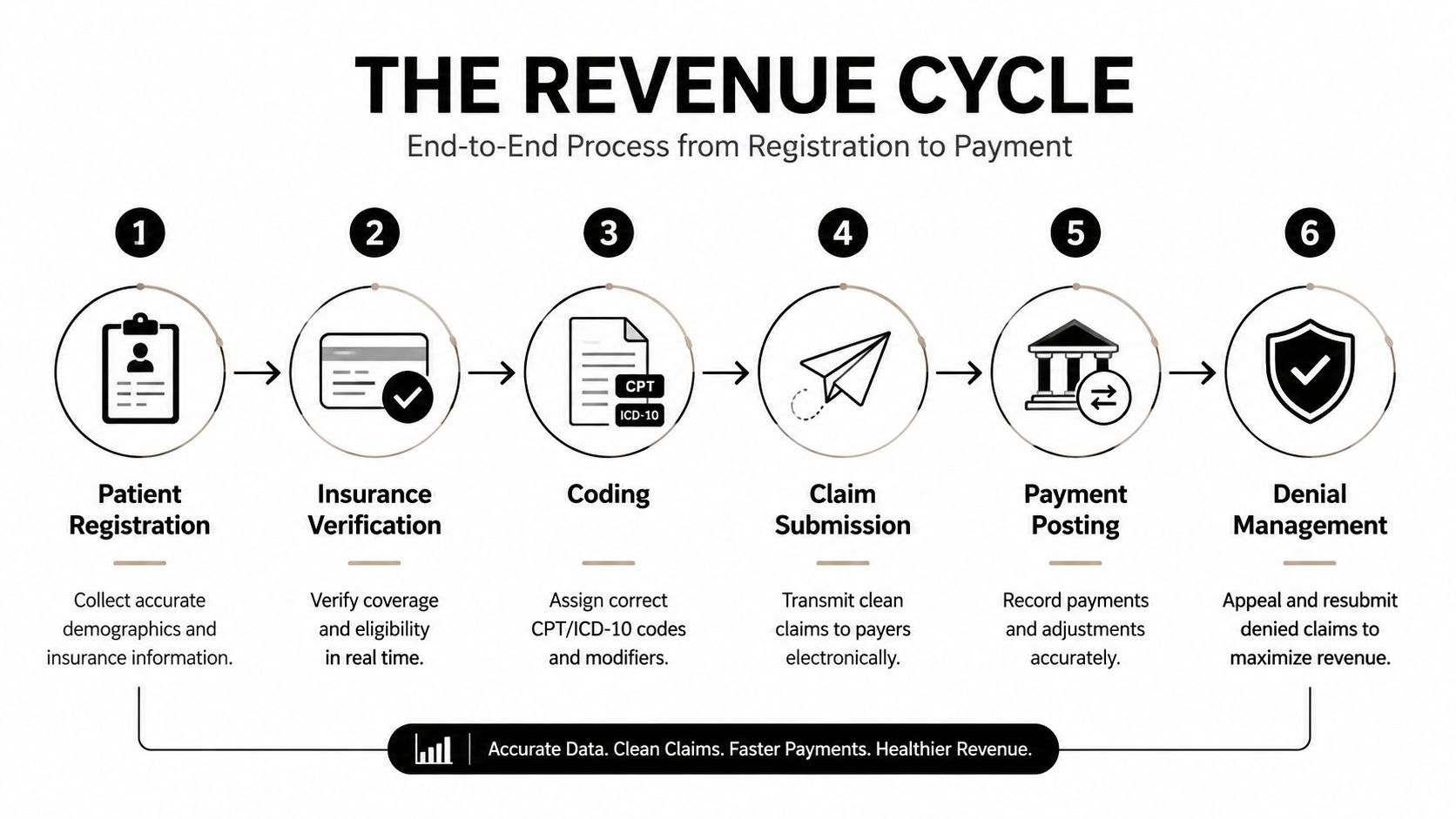
The Full Revenue Cycle From Registration to Payment
The revenue cycle is sequential, but responsibility is shared. A failure in one stage often appears as rework in another, which is why senior RCM teams trace denials back to their point of origin instead of treating each rejection as an isolated billing event.
The front end establishes whether payment is possible
Registration staff collect the patient's legal name, address, date of birth, contact details, guarantor information, and insurance identifiers. The work is done correctly when the record matches the payer's information and the practice can connect the encounter to the correct coverage.
Eligibility and authorization teams then verify active coverage, benefits, network status, referral requirements, and prior authorization. Their failure mode is predictable: a service is delivered under inactive coverage or without required approval. The claim may be clinically valid, but the payer can still reject responsibility.
The middle of the cycle translates care into a bill
At the point of service, clinical staff and charge-capture personnel record every billable service, supply, procedure, and relevant circumstance. Missed charges create an invisible loss because the practice can't collect for a service it never bills.
Certified coders and clinicians connect the documented care to the appropriate diagnosis and procedure codes. Their work must support medical necessity, modifiers, units, and payer-specific requirements. Incomplete notes, unsupported code selection, or a mismatch between the diagnosis and procedure can create a denial or reduce the allowed payment.
Billing staff and clearinghouse teams scrub claims for missing fields, invalid code combinations, formatting errors, and payer edits before submission. Done correctly, the claim contains consistent patient, provider, service, and coverage information and reaches the payer within the filing window.
The back end determines what the practice actually keeps
Payment-posting specialists apply electronic remittance advice and paper explanations of benefits to the patient account. They record payments, contractual adjustments, patient responsibility, and remaining balances. Reconciliation matters because a posted amount can look correct until it's compared with the contracted allowance.
Denial specialists classify the payer's reason, correct the underlying issue, appeal when appropriate, and resubmit within the applicable deadline. A denial left untouched can age into a write-off, while a denial corrected without addressing its root cause will recur.
Patient-account teams send statements, explain balances, process payments, and follow up on outstanding responsibility. Their work should follow the payer's adjudication and the practice's financial policies, not replace payer follow-up.
Finally, RCM leaders and analysts review patterns by payer, provider, code, location, and denial category. That reporting feeds changes back into registration, authorization, coding, and submission. The cycle improves only when the team uses back-end results to prevent the next front-end failure.
How RCM Differs From Basic Medical Billing
Basic medical billing is usually transactional. A biller enters charges, submits claims, posts payments, and may follow up on obvious rejections. Those tasks are necessary, but they represent only part of the financial workflow.
RCM adds end-to-end ownership. It connects eligibility, authorization, coding, documentation, claims, remittances, denials, underpayments, patient balances, and analytics. The responsible team isn't finished because the clearinghouse accepted the file. It remains accountable for whether the payer adjudicated correctly and whether the practice received the expected reimbursement.
| Dimension | Basic Medical Billing | Revenue Cycle Management |
|---|---|---|
| Scope | Charge entry, claim submission, and payment posting | Front-end clearance through final payment, appeals, underpayment recovery, and reporting |
| Ownership | A biller manages transactions and handoffs | An RCM team coordinates the full financial workflow |
| Primary question | Did the claim get submitted? | Did the encounter produce accurate, timely, and complete reimbursement? |
| Denials | Often handled after rejection | Analyzed by root cause and prevented upstream |
| Underpayments | May remain hidden in remittance posting | Compared with expected reimbursement and pursued |
| Performance view | Submission volume and posted payments | Denials, accounts receivable, collection performance, and recovery outcomes |
The measurement standard also changes. The HFMA guidance on standardizing denial metrics defines initial denial rate as denied claims divided by total submitted claims, measured by both claim volume and claim dollars. That distinction helps a CEO see whether a small number of high-value denials are doing more damage than a larger number of low-dollar issues.
IDR makes the difference even sharper. A basic billing workflow may stop after an appeal is denied. An RCM function with broader accountability asks whether the claim is eligible for further dispute, whether the record supports the billed service, and whether the organization can assemble the evidence needed to pursue payment.
KPIs That Measure Real RCM Performance
A useful RCM scorecard converts workflow activity into financial risk. Benchmarks vary with specialty, payer mix, service complexity, and contract terms, so a CEO should use external ranges as context, then establish an internal baseline. Four measures provide a practical starting point.
HFMA's denial definition separates claim volume from claim dollars. That distinction matters because a smaller group of high-value denials can create more cash-flow pressure than many low-dollar denials.
| KPI | What It Measures | Target Range |
|---|---|---|
| First-pass claim rate | The share of claims accepted without clearinghouse or payer rejection | Set a high internal target and review rejected claims by edit reason |
| First-pass denial rate | Denied claims divided by submitted claims, measured by volume and dollars | High-performing organizations often target below 5%; the reported industry rate was 11.8% in 2024 (healthcare RCM benchmarks) |
| Days in accounts receivable | How long reimbursement remains outstanding after billing | Establish a specialty-specific baseline, then monitor the average with aging detail |
| Net collection rate | The portion of expected reimbursement the practice actually collects | Compare with contracted allowances and the practice's historical baseline |
How to interpret movement
A falling first-pass denial rate generally indicates that registration, authorization, documentation, and coding controls are improving. A rising rate calls for root-cause analysis. Separate eligibility, authorization, coding, medical necessity, duplicate, timely filing, and payer-processing categories instead of placing every issue in one denial bucket.
Days in A/R need an aging view beside them. A stable average can conceal a growing concentration of old balances when newer claims are paid quickly. Review aging by payer and assign each account to the right action, such as a corrected claim, appeal, contractual review, or patient follow-up.
Net collection rate shows what submission volume can hide. If claims are filed consistently but expected reimbursement is not posted, investigate underpayments, incorrect contractual adjustments, missed secondary billing, and unresolved patient balances.
A single KPI can mislead. A lower denial rate paired with rising A/R may mean the team is avoiding difficult claims rather than recovering them.
Once the primary measures are stable, add underpayment variance, denial aging, and appeal overturn rate. These indicators show whether the practice is preventing leakage, resolving disputes promptly, and recovering payment after a payer challenges the claim. A detailed RCM metrics framework can organize each measure by owner and workflow stage. That last layer matters because clean claims alone do not complete the financial process. Denied claims still require evidence, escalation, and, where eligible, dispute or IDR follow-through.
Where Revenue Leaks for Specialty Practices
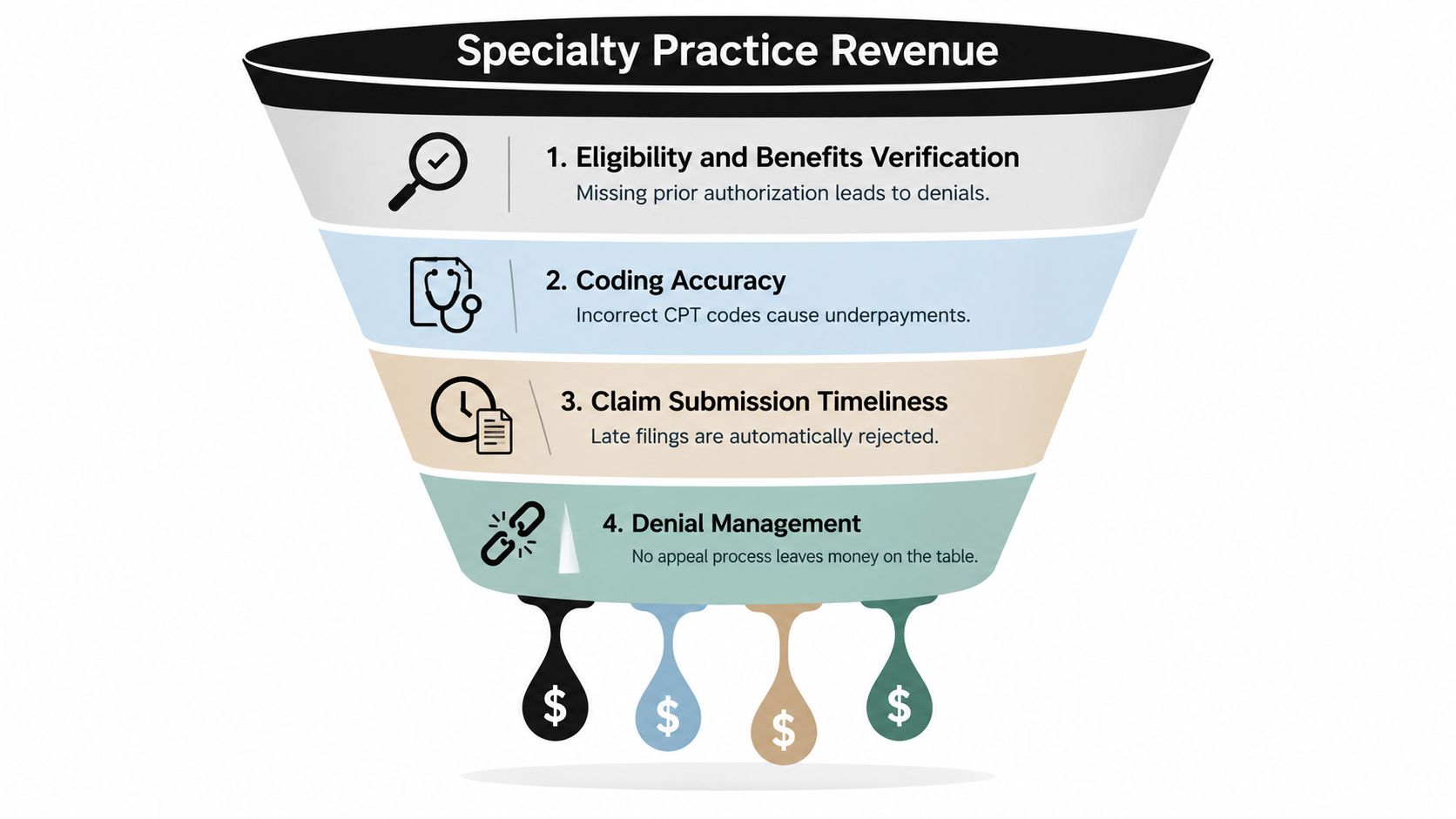
Specialty practices often lose revenue through ordinary workflow gaps, not dramatic billing mistakes. The service is performed, the claim is filed, and the financial result still falls short because the practice didn't control a dependency early enough or didn't challenge the payer's final decision.
Eligibility and authorization
An orthopedic practice schedules a surgical case. The team confirms that the patient has insurance but doesn't document whether the specific procedure requires prior authorization. The payer later denies the claim because approval was missing. The financial problem began at scheduling, even though the rejection arrived in billing.
The same pattern appears in anesthesia, imaging, and emergency services. A coverage check that confirms active insurance isn't necessarily a benefits review. Staff must verify whether the service, setting, provider, and diagnosis meet the plan's requirements.
Coding and documentation
An ambulatory surgery center may capture the primary procedure but fail to document or code an eligible add-on service. The claim can process, yet the center receives less than the care delivered supports. An RCM review should compare operative notes, charge capture, code selection, modifiers, and remittance outcomes.
Coding teams shouldn't be judged only on speed. They need clear escalation rules for ambiguous documentation and feedback from denials and underpayment reviews. Otherwise, the same missing detail continues to affect later encounters.
Underpayments and downstream disputes
Underpayments are harder to spot than denials because the claim appears paid. A payer may apply an incorrect allowable, mishandle a modifier, bundle a separately payable service, or apply an adjustment that conflicts with the contract. Payment posting records the transaction, but contract-aware reconciliation determines whether it was correct.
The final leak occurs when a denied or underpaid claim is closed without a structured recovery path. Teams should categorize the balance, preserve clinical and authorization evidence, calculate the reimbursement gap, and determine whether an appeal, payer negotiation, or IDR pathway applies.
Industry reporting cited an 11.8% initial denial rate in 2024, while high-performing organizations often target rates below 5%. Every percentage-point reduction can convert part of stranded receivables into cash and reduce the manual work associated with appeals and resubmissions, as discussed in health system denial and underpayment reporting. The exact value depends on claim volume, reimbursement, and specialty mix, so the practice should measure its own dollars at risk.
Why IDR Now Belongs in the RCM Conversation
Independent dispute resolution under the No Surprises Act changes where the revenue cycle ends. A claim that once moved from submission to payment or appeal can now become a formal dispute requiring eligibility review, evidence assembly, filing, and enforcement.
CMS reported nearly 1.2 million federal IDR submissions in the first half of 2025, about 40% more than in the second half of 2024. About 20% were ineligible for IDR, which shows why front-end case classification matters before staff invest time and fees in a dispute. These figures are summarized in reporting on No Surprises Act IDR activity.
Dispute readiness starts before the denial
An emergency services group can't build a persuasive IDR case from a payment screen alone. The team needs documentation that supports the level of care, provider identity, service circumstances, eligibility for the process, and the reimbursement position being asserted.
That evidence begins with the original encounter. Coders and clinical reviewers need documentation that accurately reflects the service. Billing staff need to preserve authorization and eligibility records. Denial specialists need to identify whether the payer's action is a routine correction, an appeal issue, or a possible dispute.
A dispute process can't repair evidence the practice failed to capture at the point of care.
CMS reported that certified IDR entities rendered payment determinations in 1,145,039 disputes from July 1 through December 31, 2025, and provider wins remained at 85% across approximately 1.15 million disputes during that six-month period. CMS also reported that 363,099 disputes remained outstanding, although 96.5% of disputes submitted since the program began were resolved or less than 30 business days old. The CMS fact sheet on clearing the IDR backlog provides that context.
For RCM leaders, the operational lesson is direct. “Appeal denied” shouldn't automatically close the account. The team needs a defined handoff from billing to dispute resolution, with documented eligibility, complete records, transparent fee decisions, and a feedback loop that improves future coding and payer analysis. Resources explaining the independent dispute resolution process can help practices define that handoff.
Building an Integrated RCM and IDR Engine
Specialty groups need one operating model for claims, denials, underpayments, and disputes. Fragmented vendors create handoff risk. The biller may know why the payer denied the claim, while a separate dispute team lacks the original documentation, payer history, or contract context needed to pursue recovery.
A practical partner evaluation should focus on integration rather than a long service list.
- Connect denial analytics to dispute eligibility: The system should identify recurring payer behavior and flag cases that may qualify for further action.
- Use certified coding expertise upstream: Coders should prepare documentation that supports accurate claim submission and possible later review.
- Define transparent IDR fees: The practice should understand who approves filing, how costs are tracked, and how the organization handles ineligible cases.
- Combine operational and recovery dashboards: Leaders should see first-pass performance, denial aging, underpayment variance, appeals, and dispute outcomes in one view.
- Assign one accountable owner: The partner should explain who owns the case after a denial and when responsibility moves from billing to dispute resolution.
A quarterly review can turn those expectations into action:
- Audit denials by payer and reason. Separate eligibility, authorization, coding, documentation, medical necessity, processing, and contractual issues.
- Review potentially eligible disputes from the previous year. Preserve the claim, remittance, correspondence, clinical record, and payer information needed for evaluation.
- Test the handoff. Choose a sample of denied or underpaid cases and trace whether the recovery team received complete evidence.
- Set financial objectives. Track net collection rate, days in A/R, denial dollars, underpayment recovery, and successful dispute outcomes.
- Hold the partner to an operating cadence. Require regular root-cause meetings, payer trend reports, and documented corrective actions.
RevGuard offers specialty-specific RCM, including eligibility verification, coding, claims management, payment reconciliation, denial and underpayment recovery, patient billing workflows, KPI dashboards, and an IDR process for appropriate disputes. That model connects the initial claim record with downstream recovery rather than treating arbitration as an unrelated service.
For a specialty practice, RevGuard can connect front-end revenue protection, clean claim workflows, denial management, underpayment recovery, and IDR readiness in one operating model. Visit RevGuard to review how its RCM and dispute-resolution services can help your team identify leakage and protect reimbursement.