

A claim can fail after a clinically appropriate service, accurate documentation, and correct coding because one identifier doesn't match the payer's record. The patient was seen, the procedure was performed, and the practice did its work. Yet a misspelled insured name, an incorrect rendering provider NPI, or a diagnosis pointer that doesn't support the service can stop payment before adjudication is complete.
That's why the question “what is the CMS-1500 form?” deserves more than a definition. The form is a structured communication layer between a professional provider and a payer. When it's completed correctly, it helps the payer identify the patient, coverage, provider, service, diagnosis, and payment destination. When it's incomplete or inconsistent, it creates rejections, manual review, corrected claims, and revenue leakage.
The Foundation of Professional Medical Billing
A claim can reach the payer with the service correctly performed and still create a payment problem if its financial details are incomplete or inconsistent. The CMS-1500 is the standard paper claim form for professional healthcare services. CMS identifies the current paper form as CMS-1500 (08/05) in its billing guidance, while the 02/12 revision replaced the older version for new professional claims. The National Uniform Claim Committee maintains the form's design, and CMS recognizes it as the standard paper professional claim format in its professional claim form guidance.

From an RCM perspective, the form is the encounter's first financial translation. Clinical documentation becomes diagnosis and procedure codes. Registration records become patient and insured information. Credentialing records become provider identifiers. Place of service, service date, units, charges, and diagnosis pointers turn the visit into data a payer can evaluate.
Practical rule: Treat a CMS-1500 as a dispute-ready claim record, not an administrative cover sheet.
That standard affects the work required after a payer questions a service, requests clarification, or applies the wrong processing assumption. A complete claim gives the billing team a clear record for correction, appeal, or payment follow-up. An incomplete claim forces staff to reconstruct the encounter from separate systems after reimbursement has already been delayed.
The form carries the claim's logic
Every populated field answers a payer question: Who received care? Which plan is responsible? Which provider performed the service? Where did the service occur? What was performed? Which diagnosis supports it? Who should receive payment?
A missing value may not signal a clinical mistake. It can produce an identity mismatch, enrollment conflict, authorization issue, or medical necessity question. CMS explains that its field instructions correspond with the electronic ASC X12 837 Professional standard, so the same data logic affects paper claims and electronic professional transactions.
The 02/12 revision also aligned paper billing more closely with electronic standards. CMS's 837P CMS-1500 form reference documents the addition of a field identifying whether ICD-9 or ICD-10 coding was used and the expansion of diagnosis reporting from 4 codes to 12 codes. The older 08/05 version stopped being accepted for new claims after March 31, 2014, making the 02/12 version the operational standard for that transition.
Why small errors become revenue problems
A claim rejected at intake consumes staff time before the payer evaluates the service. A denial after adjudication can require coding review, documentation retrieval, corrected submission, payer correspondence, or formal appeal. Both delay reimbursement, but they create different work queues and require different controls.
Revenue cycle teams should therefore measure CMS-1500 accuracy before submission. Review registration data, provider master records, coding edits, service-location mapping, and claim-scrubber rules upstream. Proper completion protects the individual claim and supports a payment workflow that can withstand payer questions. That is the foundation RevGuard's dispute-ready approach is designed to reinforce.
Who Uses the CMS-1500 and Why It Matters
The CMS-1500 applies primarily to non-institutional providers and suppliers billing for professional services. That includes physician practices, specialty groups, individual practitioners, and other organizations whose claims represent professional services rather than facility charges. The distinction is important because a hospital or facility claim generally follows an institutional format, while a professional claim focuses on the provider's services, diagnoses, procedures, and associated claim data.
A practice should answer three questions before building its workflow:
- What service is being billed? If the claim represents professional work, the CMS-1500 structure may apply. If it represents an institutional or facility charge, another claim format may be appropriate.
- Who is submitting the claim? The billing entity, rendering provider, and referring provider can have separate roles and identifiers.
- Is paper submission allowed? Paper use isn't automatically permitted just because the practice has a CMS-1500 printer.
Electronic submission is the normal path
Most professional claims are expected to move electronically through the 837P transaction, the electronic counterpart to CMS-1500 field logic. CMS states that non-institutional providers and suppliers may use the paper CMS-1500 only when they qualify for a waiver from the ASCA electronic-submission requirement. The CMS-1500 billing explanation also highlights the operational importance of understanding when paper submission is permitted.
That creates a common workflow mistake. Some organizations focus on learning how to print the form but don't confirm whether the payer, provider type, or exemption permits paper claims. A paper claim submitted outside an applicable waiver can create an avoidable compliance and processing problem, even when every field is accurate.
Paper remains operationally relevant
Paper billing still matters when a provider qualifies for an applicable waiver, when a payer's process calls for it, or when staff need to inspect the claim structure during troubleshooting. The form also remains valuable as a visual model for electronic claim mapping. An 837P may never look like a printed page in the clearinghouse, but its professional claim data follows the same underlying logic.
For revenue cycle leaders, the practical answer is to maintain both capabilities without treating them as interchangeable. Electronic workflows need accurate enrollment, mapping, edits, and clearinghouse controls. Paper workflows need the correct form version, printing specifications, attachments, mailing process, and payer-specific instructions.
Know the boundary between professional and institutional billing
A specialty practice may bill professional services on CMS-1500 logic while an affiliated facility submits separate institutional claims. An ambulatory surgery center can also encounter both professional and facility billing responsibilities, depending on which entity performed and billed each part of the encounter.
That boundary should be documented in the billing department's procedures. Staff should know which entity owns the claim, which provider is rendering, which location is reported, and which submission channel is allowed. Confusing those roles is more expensive than selecting the wrong template. It can send a valid claim into the wrong adjudication pathway.
A Practical Guide to Key CMS-1500 Fields
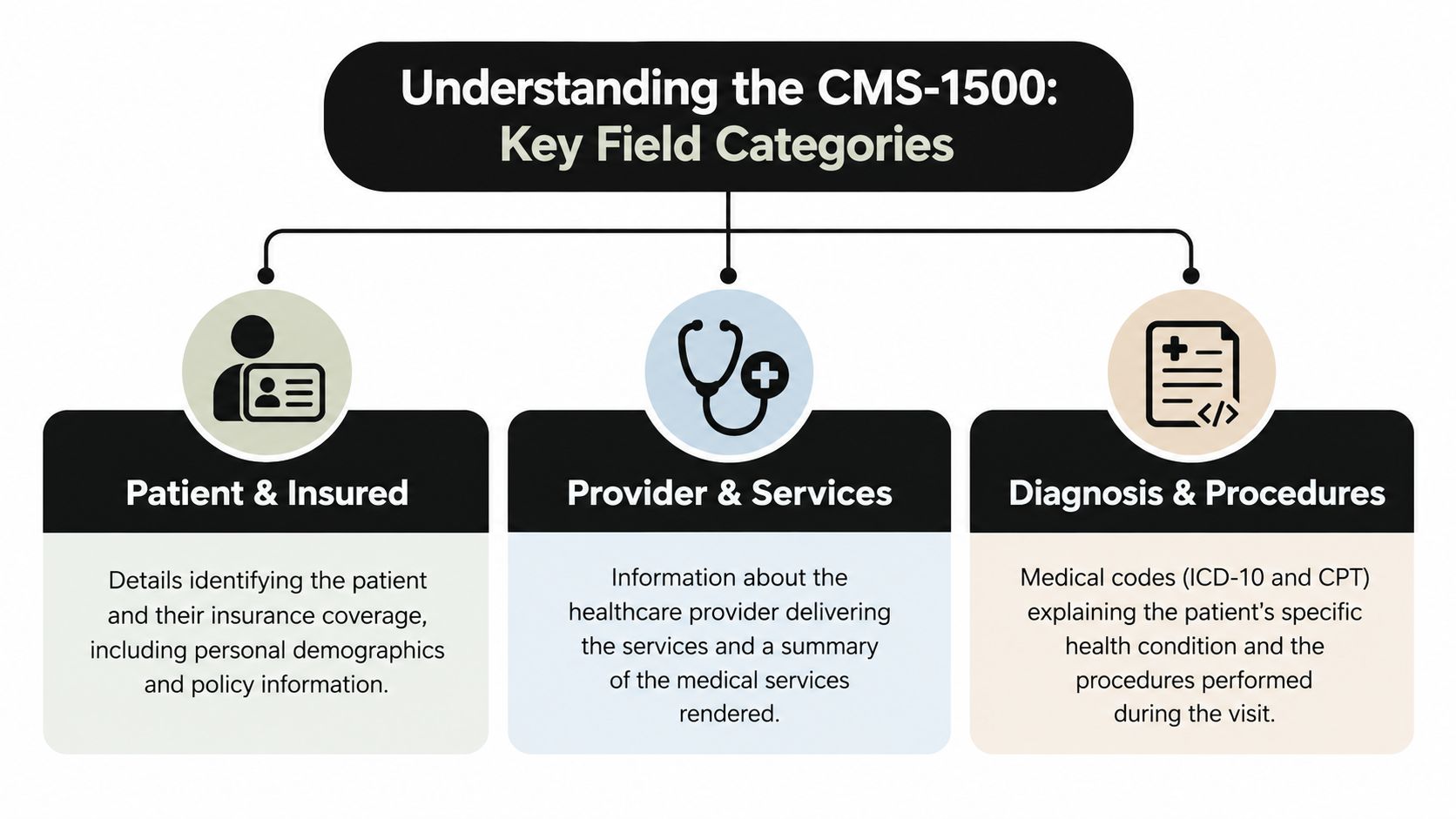
A claim can contain accurate clinical work and still fail before adjudication if its fields do not establish who received care, who provided it, what was done, and why it was appropriate. The CMS-1500 has 33 numbered fields, but billers should use it as a control point for claim integrity, not as a memorization exercise. Each entry must support a payer decision and remain traceable when the claim is questioned.
Patient and insured information
Boxes 1 through 13 establish the patient's identity and the coverage attached to the claim. They identify the payer, patient demographics, insured information, policy details, the patient's relationship to the insured, and authorization-related information. A mismatch in this group can stop a claim before the payer evaluates the services.
Box 1 identifies the type of health coverage. The selection routes the claim through the payer's expected processing rules. Choosing the wrong coverage type can produce a front-end rejection even when the member information is otherwise correct.
Boxes 4, 6, and 7 establish who is insured and how the patient relates to that person. These fields become especially important when the patient is not the policyholder. An incorrect relationship can interfere with eligibility matching, coordination of benefits, and payment responsibility.
Box 11 carries policy and plan information. Staff should compare the subscriber ID, group details, plan information, and payer record with the current insurance card. Relying on a stored value creates revenue leakage when coverage has changed but the practice management system has not.
Provider, service, and diagnosis information
Boxes 14 through 24 connect the encounter to the clinical record, the provider, and the services billed. This is the claim's dispute-ready evidence: each service line should have a clear provider, location, diagnosis relationship, and supporting documentation.
Box 17 and Box 17b identify the referring or ordering provider when applicable, including the provider's NPI. Diagnostic testing and specialty services frequently depend on this information. If the referring provider is absent, invalid, or inconsistent with payer requirements, the payer may be unable to validate the service pathway.
Box 21 reports the diagnosis codes that explain the patient's condition. The 02/12 version expanded diagnosis capacity from 4 codes to 12 codes. The added capacity does not remove denial risk. Codes must match the documentation, use appropriate specificity, and support the services reported.
Box 24 contains line-level details, including dates, place of service, procedure codes, modifiers, charges, units, and diagnosis pointers. Box 24E links each service line to the relevant diagnosis. A wrong pointer can make a supported service appear unrelated to the condition, even when the correct diagnosis is present elsewhere on the claim.
Box 24J identifies the rendering provider and reports that provider's NPI. This field requires close review in group practices, where the billing entity and the individual who delivered care may differ. Compare provider mapping with credentialing and payer enrollment records. The rendering provider must also be distinguished from other NPI roles, including the billing organization described in this guide to Type 2 NPI usage.
Billing and authorization details
Boxes 25 through 33 identify the billing entity, payment arrangements, service facility, signatures, and claim control information. These fields determine where responsibility and reimbursement are assigned.
Box 25 reports federal tax identification information for the billing entity. The tax ID, billing NPI, payer enrollment record, and remit-to configuration must agree. A mismatch can delay payment or direct it to the wrong destination.
Boxes 26 through 30 carry patient account, assignment, balance, and payment-related information. Values should reconcile with the practice management system and the payer's claim history. Conflicting account or prior-payment details can complicate adjudication and later patient-balance handling.
Boxes 31 through 33 support signatures, service facility data, and billing provider information. The service facility must show where care occurred, while the billing provider section must identify the entity submitting the claim. These details also need to map correctly into the electronic 837P workflow. Missing or mistyped patient identifiers, NPI information, or service-location data can cause electronic rejection or manual review.
The operational test is direct: every field should trace to a source system, provider record, or encounter documentation. If staff cannot explain where a value came from, the claim is not ready for submission. That traceability protects reimbursement and gives the practice evidence to resolve a payer dispute.
Common Errors That Trigger Claim Denials
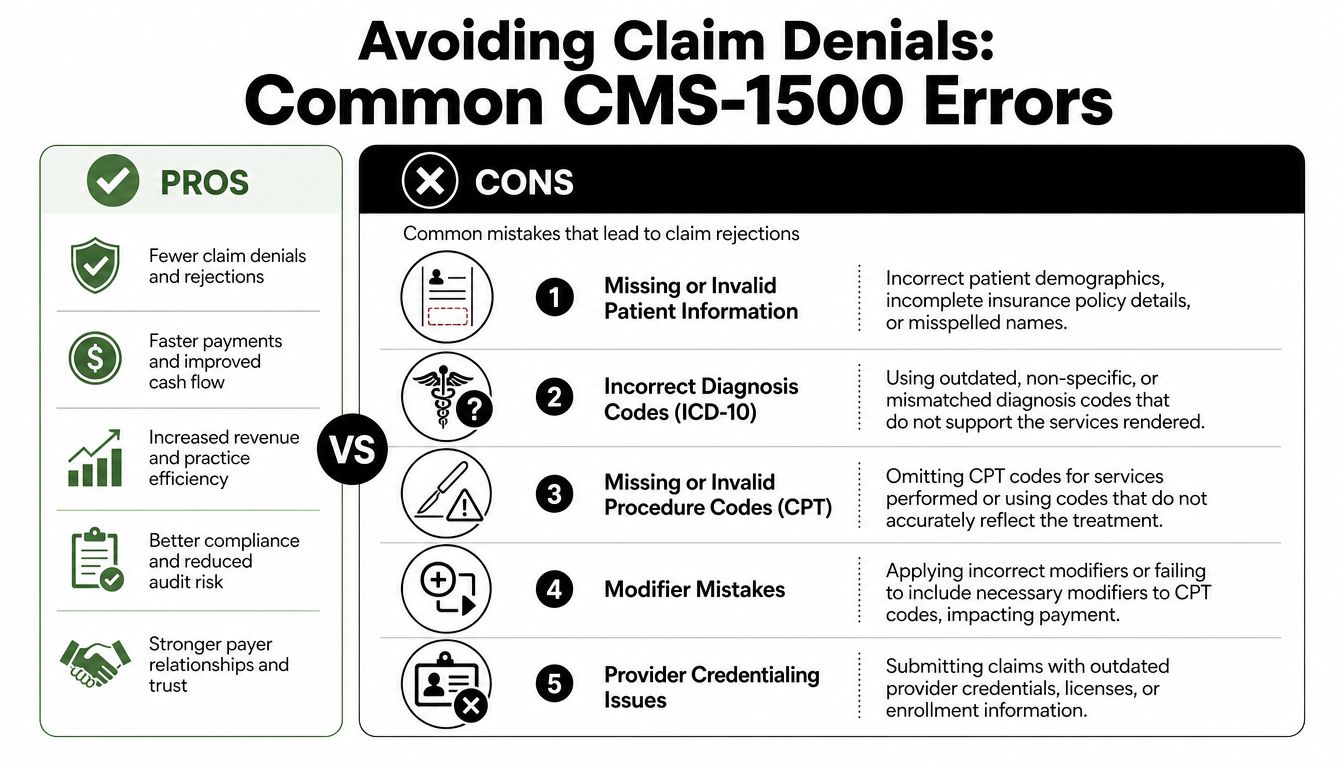
CMS-1500 denials usually reflect a process weakness somewhere upstream. The form is where the error becomes visible, but the source may be registration, credentialing, coding, scheduling, authorization, documentation, or claim mapping.
Identity and coverage mismatches
A misspelled patient name, incorrect date of birth, invalid member ID, or wrong subscriber relationship can prevent the payer from matching the claim to an active policy. The claim may return as an eligibility or demographic rejection rather than a clinical denial.
The root cause is often weak front-desk verification. If staff copy information from an old account without comparing it with the current insurance card and patient confirmation, the billing team inherits the mistake. A claim scrubber can flag formatting problems, but it can't reliably correct a policy number that was wrong at registration.
Diagnosis and procedure inconsistencies
Incorrect, outdated, or nonspecific diagnosis coding can weaken medical necessity. A procedure may be valid, and the diagnosis may be valid in isolation, but the payer still needs a defensible connection between the service line and the condition being treated.
Box 24E is a common failure point because the diagnosis pointer must link the procedure to the appropriate diagnosis in Box 21. When the pointer is missing or incorrect, the payer's adjudication logic may treat the service as unsupported. The solution is not limited to adding more diagnosis codes. Coders need to select diagnoses supported by the documentation and connect them deliberately to each billed service.
Provider and location errors
A missing or invalid rendering provider NPI can trigger a claim rejection, particularly in multi-provider practices. The same problem occurs when the billing provider, rendering provider, referring provider, and service facility location are mixed up.
CMS explains that CMS-1500 fields map directly to the electronic ASC X12 837 Professional standard, so miskeyed NPI and service-location data can cause electronic rejection or manual review. Provider credentialing systems should feed the billing platform, and changes to enrollment records should reach claim templates before the next submission cycle.
Procedure, modifier, and place-of-service mistakes
Procedure codes must describe the service documented in the record. Modifiers should clarify circumstances supported by the documentation, not compensate for an uncertain code choice. Place-of-service information must also match where the service occurred, because it can influence coverage and reimbursement logic.
These errors often originate in disconnected workflows. Scheduling may hold one location, the EHR another, and the billing system a default setting. A pre-submission review should compare the encounter, procedure, modifier, units, diagnosis pointers, provider, and location as one claim rather than checking each field in isolation.
Root-cause test: Don't ask only why the payer rejected the claim. Ask which person, system, or rule first introduced the bad value.
CMS-1500 vs UB-04 and 837P Explained
The easiest way to separate these formats is to identify the billing subject. CMS-1500 represents professional services, UB-04 or CMS-1450 represents institutional services, and 837P is the electronic transaction that carries professional claim data.
The CMS-1500's formal maintenance also matters. The CMS history of the 1500 form identifies the National Uniform Claim Committee as responsible for its design and maintenance. The form evolved from the HCFA-1500 name after the federal agency became CMS in 2001, but the underlying professional billing role remained central.
| Attribute | CMS-1500 (Paper) | UB-04 / CMS-1450 (Paper) | 837P (Electronic) |
|---|---|---|---|
| Primary purpose | Professional services | Institutional and facility services | Electronic professional claims |
| Typical billing entity | Physician or non-institutional provider | Hospital, facility, or institutional provider | Physician, group, or other professional billing entity |
| Main claim focus | Provider, patient, diagnosis, procedures, units, modifiers, and charges | Facility services, revenue reporting, accommodation, and institutional claim details | Structured professional claim data mapped from billing systems |
| Submission format | Paper form | Paper form | Electronic transaction |
| Closest relationship | Visual professional claim format | Institutional claim format | Electronic equivalent of CMS-1500 logic |
| Common risk | Wrong professional field or provider role | Wrong institutional claim detail | Incorrect mapping or missing electronic data |
The UB-04 form guide is useful when a team needs to distinguish facility billing from professional billing. A single episode of care may involve both formats because a facility and an individual professional can bill separately for their respective services.
Why 837P knowledge matters
A practice may never print a CMS-1500, yet its claims still use the form's logic electronically. The electronic transaction contains structured equivalents of patient, insured, provider, diagnosis, procedure, service-location, and payment data. That means a clean electronic workflow still depends on accurate source information and correct mapping.
The trade-off is straightforward. Electronic submission is faster to route and easier to edit systematically, but automation doesn't make inaccurate data correct. A wrong NPI in the provider master file can move through the system efficiently and still produce a rejection. Paper submission is more visible to staff, but it introduces physical-format, mailing, attachment, and manual-handling risks.
Choose the format based on the service, billing entity, payer rules, and submission requirements. Don't choose it merely because a familiar template is available.
Best Practices for Submission and Reimbursement
A strong CMS-1500 process begins before the claim is created. Registration staff should verify patient demographics, subscriber details, coverage order, and payer information. Credentialing staff should keep rendering, referring, billing, and service-location records current. Coding and billing staff should then confirm that the claim communicates one consistent encounter story.
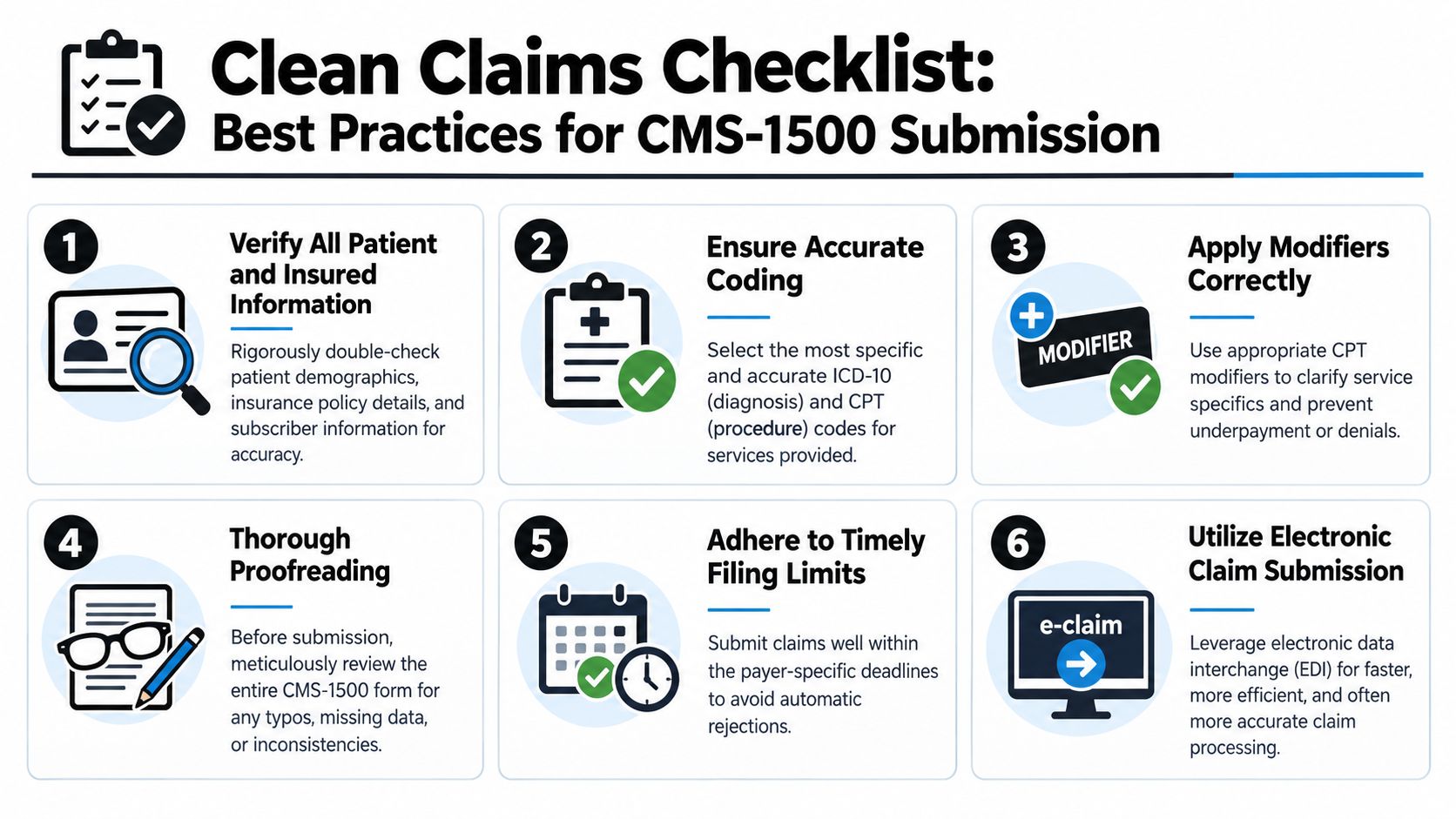
Use a claim scrubber, but don't outsource judgment to it. Scrubbing tools can identify missing fields, invalid formats, and selected payer edits. They won't replace documentation review, provider enrollment maintenance, or a thoughtful diagnosis-to-service check.
Build a pre-submission control
A practical review should confirm:
- Patient identity: Match the name, date of birth, policy number, subscriber details, and relationship to the insured.
- Provider identity: Validate the billing entity, rendering provider, referring provider when applicable, NPI values, and payer enrollment alignment.
- Clinical logic: Confirm that diagnosis codes are supported by documentation and that each service line points to the appropriate diagnosis.
- Service details: Review dates, place of service, procedure codes, modifiers, units, charges, and service facility information.
- Claim history: Identify whether the submission is an original, corrected, or replacement claim and include the required control information.
- Submission channel: Confirm whether the payer requires electronic filing or whether the organization qualifies for a paper exception.
Paper claims also have technical requirements. CMS specifies OCR-oriented physical standards, including 8.5 × 11-inch paper, Flint OCR Red ink, 10-pitch Pica type, and specified line spacing in its CMS manual guidance for OCR claim forms. Printing outside those specifications can cause scanner misreads, rejection, or manual processing.
Make denials feed the workflow
Review rejected claims by field category and assign ownership. Registration should receive demographic patterns. Credentialing should receive NPI and enrollment issues. Coding should receive diagnosis, procedure, modifier, and pointer trends. IT or the billing-system administrator should receive mapping and interface failures.
For organizations working to strengthen electronic workflows, electronic claim submission support can help connect claim construction, validation, and payer submission practices. RevGuard also combines specialty-focused RCM with enforcement-driven dispute resolution, so validated claim data can support later payment follow-up when a payer delays, downcodes, or underpays.
The CMS-1500 isn't low-level paperwork. It is the foundation of a claim that can be adjudicated, corrected, defended, and, when necessary, disputed with a clear evidentiary record.
If CMS-1500 errors are creating denials, rework, or underpayment exposure, RevGuard can help align eligibility, coding, credentialing, claim validation, and payment recovery into one revenue protection workflow. Visit RevGuard to assess where your professional claims are losing value and build a cleaner, dispute-ready process.