

In U.S. ACA Marketplace plans sold through HealthCare.gov, insurers denied 19% of in-network claims and 37% of out-of-network claims in 2024, producing a combined average denial rate of 20%. KFF estimated that roughly 85 million in-network claims were denied, with administrative reasons representing 25% of publicly reported in-network denial reasons. KFF's analysis of 2024 ACA Marketplace claims denials makes the central point clear: denial management in healthcare isn't a cleanup project for a small billing queue. It's a revenue protection discipline.
For specialty practices, air ambulance operators, ASCs, and hospitals, the practical question isn't whether denials will occur. It's whether the organization can identify payer variation early, prevent avoidable failures before service, build claims that are ready for dispute, and escalate legitimate underpayments when negotiation stops working.
Why Denials Are a Systemic Revenue Risk Right Now
A denied claim creates more than delayed cash. It can trigger rework across registration, authorization, coding, clinical documentation, billing, payer follow-up, and appeals. The same denial may also reveal a payer-specific rule that was never mapped into the organization's intake or charge-capture workflow.
The scale is substantial. The American Hospital Association denial analysis reported that hospitals and health systems spent an estimated $19.7 billion in 2022 trying to overturn denied claims. More than half of denied claims, 54.3%, were overturned after appeal, while nearly 15% of claims submitted to private payers were initially denied, including 15.7% of Medicare Advantage claims and 13.9% of commercial claims. Those figures describe an operating function, not an occasional exception.
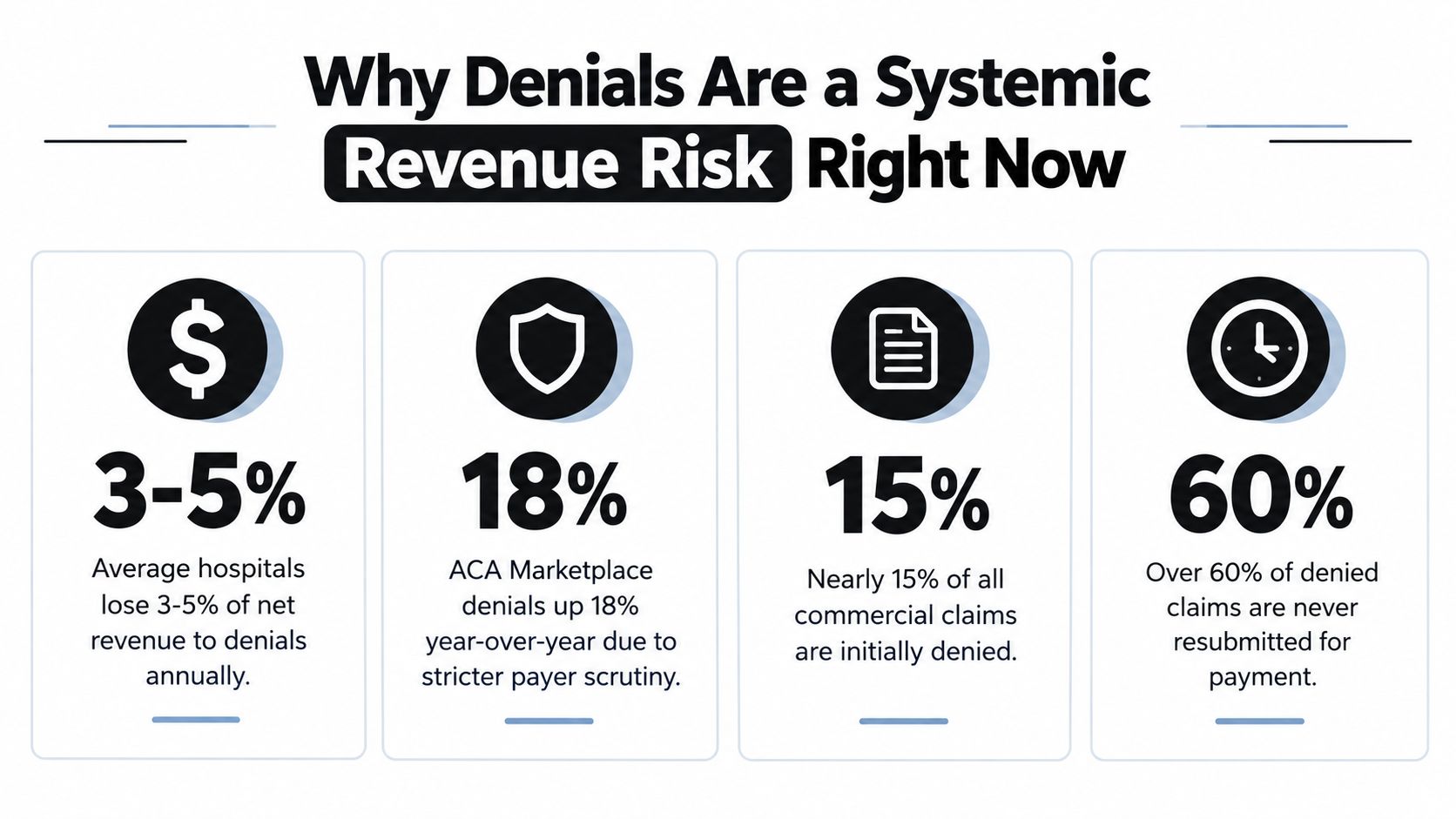
Denials follow payer behavior
Prior authorization is one of the clearest upstream signals. Public reporting for 2025 showed insurers denying 12% to 18% of standard prior authorization requests across Medicare Advantage, Medicaid managed care, and ACA Marketplace plans, with substantial variation among insurers within each market. Becker's coverage of payer prior authorization denial rates supports a practical conclusion: an authorization workflow built around generic payer rules will miss predictable differences by insurer, market, and service line.
That variation matters in anesthesia, orthopedics, imaging, oncology, and air ambulance. A payer may require an authorization for one procedure but not another, accept a particular site-of-service only under defined conditions, or apply a medical-necessity review after authorization has already been issued. Treating each denial as an isolated billing event hides the pattern.
Initial denials aren't final losses
Leaders also need to separate initial denial rate from final write-off rate. Recent provider reporting found that 41% of providers said at least 10% of claims were denied, while a 2025 hospital analysis placed the median final denial rate at 2.7% against an average initial denial rate of 11.6%. Experian Health's 2025 State of Claims reporting highlights the operational gap between a claim rejected on first pass and a claim that remains unpaid after correction, appeal, or escalation.
A mature program controls four connected outcomes:
- Prevention: Registration, eligibility, authorization, documentation, coding, and charge capture work together before submission.
- Recovery: Teams correct or appeal claims based on recoverability, financial impact, and filing deadlines.
- Enforcement: Contract rights, payer obligations, and Independent Dispute Resolution under the No Surprises Act are available when appropriate.
- Learning: Denial data changes payer-specific workflows instead of sitting in a retrospective report.
The strongest operating model links these functions. Clean claims make appeals easier, payer intelligence improves intake decisions, and enforcement data reveals which payers or services require a different commercial and clinical strategy.
Stopping Denials Before They Happen With Intake and Eligibility Controls
The front end decides whether the back end inherits a manageable claim or a preventable dispute. Registration staff, financial clearance teams, schedulers, and utilization reviewers need a shared workflow that verifies coverage, confirms benefits, records authorization details, and flags exceptions before the patient receives care.
Build a payer-specific intake record
Real-time eligibility is only the starting point. The team should capture the patient's exact name, date of birth, member identification, group information, coverage dates, network status, benefit limitations, and site-of-service requirements. A verification response should be stored with the encounter, not left in a temporary work queue where it can't support a later appeal.
Use medical eligibility verification to make the verification record part of the claim's evidence trail. For recurring care, the process must also account for coverage changes between visits. Rechecking eligibility for scheduled or ongoing treatment prevents teams from relying on an old response.
Authorization requires the same discipline. Record the authorization number, approved dates, approved units, service description, rendering provider, facility, and any conditions attached to approval. An authorization for a facility-based procedure may not support a different location, provider, code family, or date range.
Map payer variation by service line
A payer matrix should answer operational questions, not merely list phone numbers. For each payer and specialty, document:
- Trigger rules: Which procedures, diagnoses, locations, or levels of care require authorization?
- Submission route: Which portal, form, fax process, or electronic transaction does the payer accept?
- Evidence requirements: What clinical notes, imaging, failed conservative treatment, transport records, or physician orders must accompany the request?
- Expiration controls: How does the team monitor approved dates, units, and extensions?
- Escalation path: Who handles urgent reviews, peer-to-peer requests, reconsiderations, and formal appeals?
Anesthesia teams may need to validate the relationship between the planned procedure and the facility authorization. Orthopedic practices should connect imaging, conservative treatment, diagnosis, and procedure documentation before submitting a request. Air ambulance groups need a clear emergency-service record that supports the transport circumstances, medical necessity, origin, destination, and applicable payer pathway.
Know when to stop the case
A hard stop is appropriate when the organization has no active coverage confirmation, a required authorization is missing, the approved service doesn't match the scheduled service, or the payer's network and benefit rules make reimbursement uncertain. Hard stops shouldn't become a blunt tool that delays medically necessary care. They should route exceptions to a named financial clearance or clinical escalation owner with a documented decision.
Practical rule: Don't ask the billing team to repair an intake decision that the organization could have resolved before service.
The workflow should also distinguish cases that can proceed under an emergency exception, statutory protection, or documented payer communication. That distinction matters for air ambulance and other high-acuity services, where the operational response can't resemble elective scheduling.
Building Clean Dispute Ready Claims Through Coding and Charge Capture
A clean claim is more than a claim that passes an electronic scrubber. It's a claim whose codes, documentation, provider identity, authorization, charges, and payer rules tell the same story. A technically accepted claim can still fail medical-necessity review or be downcoded if the record doesn't support the billed service.

Align the record before submission
Coding review should begin with the clinical record, not with a denial code. The coder needs enough detail to connect the diagnosis to the service, establish the level of complexity, apply modifiers correctly, and support the documented site and provider. Clinical leaders should address ambiguous documentation before the claim leaves the organization.
For orthopedics, that may mean ensuring the record supports the diagnosis, laterality, procedure performed, conservative treatment history, and medical necessity rationale. In anesthesia, the chart must support the billed services, time or qualifying circumstances where applicable, and the relationship between the anesthesia service and the underlying procedure. Air ambulance documentation should preserve the transport narrative, clinical condition, reason ground transport was insufficient, and destination rationale.
Treat charge capture as a control point
Charge capture failures can create both underbilling and denials. The reconciliation process should compare the scheduled service, operative or procedure note, anesthesia record, implant or supply documentation, facility charges, and final claim lines. Someone must own the question, “What happened clinically, and did every billable component reach the claim accurately?”
Use coding compliance workflows to make that review consistent across providers and locations. The purpose isn't to maximize charges. It's to ensure the billed claim reflects the service delivered and the documentation that supports it.
Prepare evidence before a dispute
A dispute-ready claim has an evidence packet assembled while the information is still accessible. Depending on the service, that packet may include eligibility results, authorization records, clinical notes, orders, operative reports, transport documentation, coding rationale, provider credentialing records, and payer correspondence.
This preparation changes the economics of appeals. A missing attachment discovered after denial can require repeated chart retrieval, physician review, coder review, and payer follow-up. A documented rationale created during pre-bill review can be reused in a reconsideration, formal appeal, contract discussion, or eligible IDR case.
Documentation standard: If a payer challenged this claim tomorrow, another reviewer should be able to understand the service, its necessity, its authorization status, and its billed value without reconstructing the encounter from scattered systems.
Downcoding deserves the same attention as outright denial. Compare the payer's allowed amount and adjudication rationale with the contract, code set, modifier rules, and clinical record. If the payer's interpretation conflicts with the agreement or the documented service, preserve the issue for escalation rather than accepting an unexplained adjustment as a routine write-off.
Triage Appeals and Escalation Workflows That Actually Recover Revenue
FIFO is easy to administer and often poor at protecting cash. A low-value administrative correction with a clear fix shouldn't consume the same attention as a high-dollar medical-necessity denial, a recurring payer defect, or an underpayment that may qualify for an enforcement pathway.
Start with a denial inventory that combines root cause, claim dollars, payer, service line, filing deadline, appeal stage, and expected recoverability. HFMA defines initial denial rate using denied claims divided by submitted claims, while also recommending denial measurement by claim dollars. HFMA's guidance on denial metrics and revenue-cycle benchmarking explains why volume alone can hide serious leakage in expensive cases.
Rank work by recovery logic
A practical triage model gives each denial a path:
| Denial Category | Priority Signal | Best Next Action |
|---|---|---|
| Eligibility or demographic error | Correctable data with an open filing window | Validate coverage, correct the claim, and retain the verification record |
| Missing authorization | Authorization may exist, or an exception may apply | Retrieve payer evidence, request reconsideration, and escalate urgent cases through the payer's defined channel |
| Medical necessity or clinical validation | High dollars, strong record, and physician support available | Assemble a clinical appeal with documentation and applicable criteria |
| Coding or modifier dispute | Payer rationale conflicts with code or contract interpretation | Obtain coding review, correct if warranted, or submit a technical appeal |
| Underpayment or downcoding | Payment conflicts with contract terms or expected reimbursement | Compare remittance, contract, and claim evidence, then pursue payer escalation or eligible IDR |
| Noncovered service | Benefit exclusion or clear contractual limitation | Confirm the exclusion, document the decision, and avoid spending disproportionate appeal effort |
The matrix should be a working queue, not a static report. Denial analysts need authority to change priority when a payer changes behavior, a deadline approaches, or a pattern appears across a specialty.
Build appeals as evidence, not correspondence
A persuasive appeal answers four questions directly:
- What service was provided?
- Why was it covered, authorized, medically necessary, correctly coded, or contractually payable?
- Which records prove that position?
- What precise action should the payer take?
Avoid sending a generic letter with a large chart attachment and no indexed explanation. Use a short case summary, claim identifiers, denial rationale, relevant contract or policy language, clinical support, coding explanation, and a requested resolution. Physician involvement belongs where clinical judgment is central. Coding leadership belongs where the dispute concerns code selection or modifiers.
For eligible out-of-network emergency or surprise-billing disputes, IDR should be treated as part of the same revenue workflow, not as a separate legal project. Teams need a documented trigger, eligibility check, filing calendar, evidence packet, and owner for payer response and payment enforcement. The healthcare appeal process should connect ordinary payer appeals with escalation decisions so claims don't stall between departments.
Escalation test: If the payer's position conflicts with the record, contract, or applicable protection, label the claim for enforcement review before it becomes an unexamined adjustment.
Tracking What Matters and Staffing Your Denial Management Engine
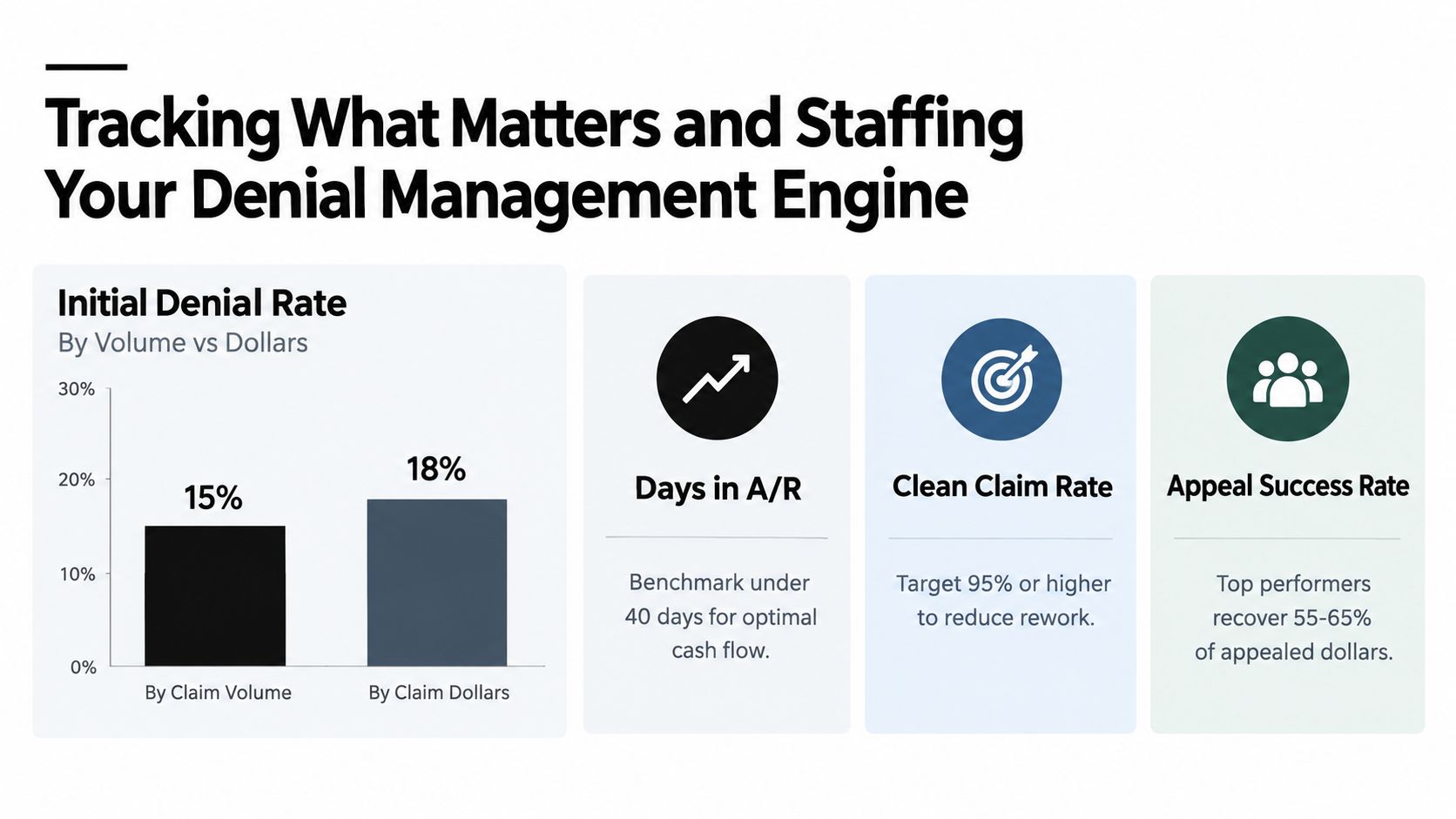
A denial dashboard can create false confidence if it reports only one rate. Leaders should track initial denial rate by claim volume and claim dollars, then separate those results from final write-offs. Volume shows how often the workflow fails. Dollars show where the financial exposure sits.
HFMA's metric guidance supports that distinction, and its benchmarking discussion reports 2024 denial rates of about 11.8% overall, with payer-specific rates of approximately 13.9% for commercial, 15.7% for Medicare Advantage, and 8.4% for traditional Medicare. The HFMA benchmarking resource provides the source for those comparisons. Use them as context, not as a universal target, because specialty mix, payer contracts, service setting, and claim complexity change the baseline.
Compare operating models
| Operating model | Works well when | Main trade-off |
|---|---|---|
| Centralized denial team | A multi-location organization needs consistent payer rules and reporting | Central staff may lack service-line clinical context |
| Specialty-aligned teams | Denials depend heavily on documentation, coding, or procedure knowledge | Expertise can become fragmented across locations |
| Internal analysts with automation | The organization has reliable data and clear work queues | Automation can accelerate the wrong decision if root-cause data is poor |
| External RCM support | Volume fluctuates or specialized appeal and enforcement skills are limited | Governance must protect visibility, compliance, and ownership |
The right answer is often hybrid. Centralize payer intelligence, reporting, and workflow governance. Keep specialty-specific review close enough to clinicians and coders that the team understands why a claim should be paid.
Staff around decisions, not queues
A denial engine needs distinct capabilities:
- Front-end owners resolve eligibility, registration, and authorization defects.
- Coding and clinical reviewers handle documentation, medical necessity, and downcoding disputes.
- Denial analysts identify patterns, maintain payer rules, and monitor deadlines.
- Appeal specialists assemble evidence and track payer responses.
- Escalation owners evaluate contract remedies and IDR eligibility.
Measure each role against an outcome it can influence. A registration team can own preventable eligibility defects. An appeal team can own recoverable dollars and timely submissions. An executive dashboard should show initial denials, final denials, dollars at risk, dollars recovered, aging, payer concentration, and recurring root causes.
Don't confuse a high overturn rate with a healthy program. A strong overturn result may indicate excellent appeals, but it can also reveal weak prevention. The objective is to reduce avoidable initial denials while preserving a disciplined path for legitimate recovery.
Your Next Moves to Reduce Denials and Protect Reimbursement
Denial management in healthcare works when prevention and enforcement operate as one loop. Intake controls reduce avoidable failures, dispute-ready claims improve the quality of appeals, and payer-specific escalation protects reimbursement when a payer's decision doesn't match the evidence or contractual obligation.
Start with a focused operating plan:
- First 30 days: Build a denial inventory by payer, service line, root cause, claim volume, and claim dollars. Identify the largest recurring front-end defect and assign one owner.
- By 60 days: Create payer-specific authorization and eligibility rules for the highest-friction specialties. Standardize evidence packets for medical-necessity, coding, downcoding, and underpayment disputes.
- By 90 days: Launch a triage queue that ranks recoverable claims and flags potential IDR cases. Review initial denial rates separately from final write-offs, and publish a short monthly report that drives workflow changes.
Avoid three common mistakes. Don't measure only claim counts. Don't send every denial through the same appeal process. Don't let the billing team carry responsibility for authorization, documentation, coding, and payer intelligence without support from the teams that create those inputs.
Progress should be visible in fewer recurring defects, stronger first-pass claim quality, faster resolution of high-value denials, and better recovery decisions. The program doesn't need to become complicated. It needs clear ownership, reliable evidence, payer variation data, and a willingness to escalate claims that deserve enforcement rather than abandonment.
RevGuard connects specialty-specific revenue cycle management with denial tracking, payer-behavior intelligence, appeal workflows, and Independent Dispute Resolution under the No Surprises Act. Visit RevGuard to evaluate how an upstream prevention and downstream enforcement model can protect reimbursement across specialty practices, air ambulance groups, ASCs, and hospital platforms.