

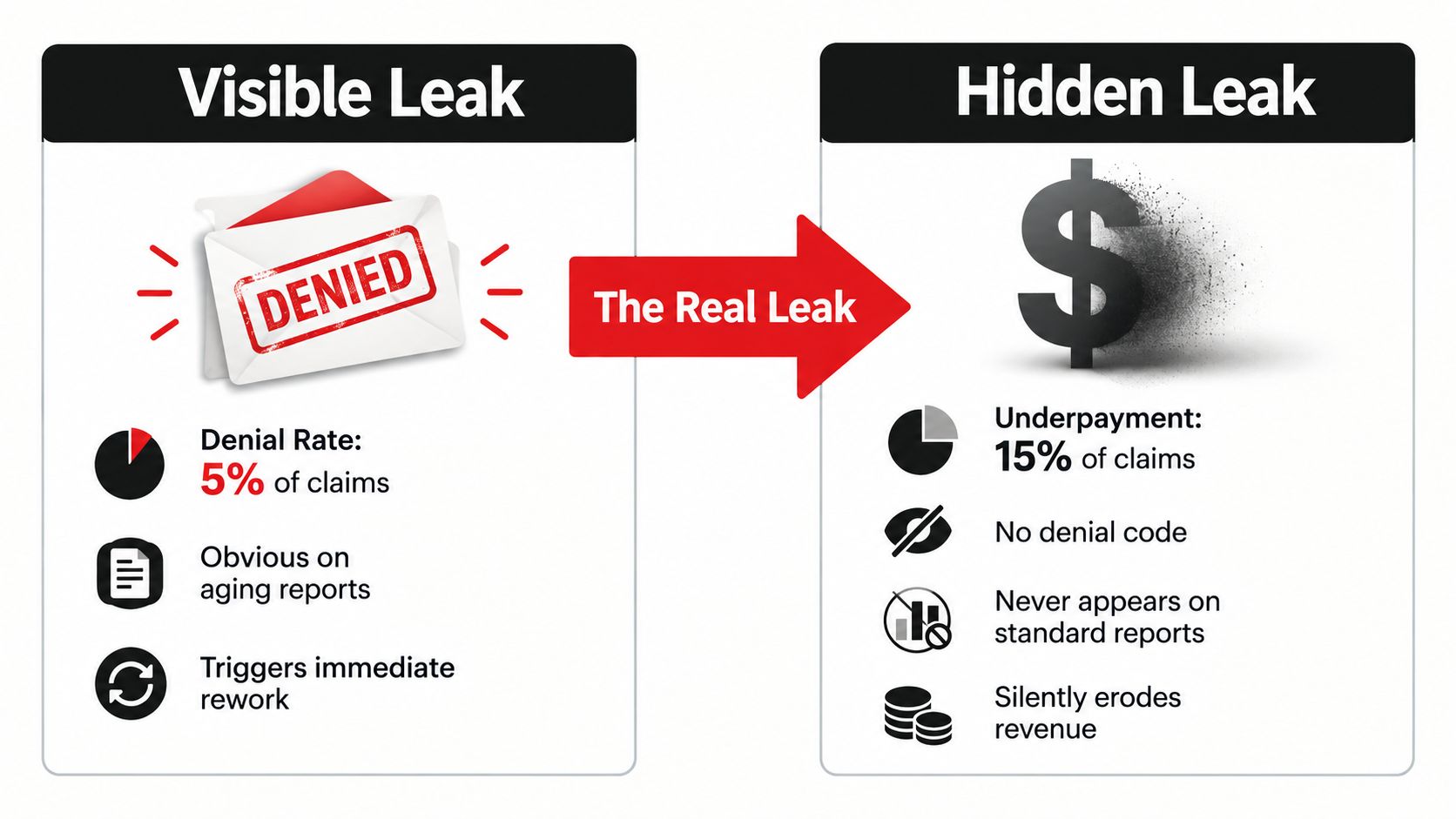
Most physician practices are told to fix revenue cycle management by attacking denials. That advice is incomplete. Denials are visible, easy to count, and naturally create work queues, while silent underpayment, payer downcoding, bundling edits, and unreconciled contract allowances can reduce reimbursement without generating a denial at all.
That distinction changes the operating plan. A practice can report an acceptable denial rate, submit claims cleanly, and still lose money on accepted claims. The strongest revenue cycle management for physician practices programs connect front-end verification, documentation, payment reconciliation, denial recovery, and escalation into one revenue-protection loop.
The Hidden Leak Most RCM Programs Miss
A denial appears on an aging report. Someone assigns it, works it, and records an outcome. Underpayment often gets posted as though the payer's reimbursement were correct, which means the loss disappears into normal payment activity.
A payer's adjudication engine may downcode an evaluation and management service, apply a bundling edit, or pay against an outdated fee schedule without issuing a denial. The claim closes, the account looks resolved, and nobody compares the allowed amount with the contracted expectation. For a specialty group processing a high volume of complex services, repeated small variances can matter more than a handful of obvious rejected claims.
Consider an established patient visit supported at a higher E/M level. The practice bills the service, the payer accepts it, and the remittance reflects a lower level. No denial code appears, so no appeal is filed. The practice loses the difference unless a reviewer compares the documentation, billed code, contract allowance, and actual payment.
Measure frequency and financial impact separately
HFMA's Claim Integrity Task Force standardized initial denial measurement using both claim volume and claim dollars, which prevents a practice from confusing frequent low-value denials with infrequent high-value losses. HFMA's denial-metric guidance also distinguishes denial rate by claim count from denial rate by claim dollars.
The distinction matters because MGMA reported a single-specialty aggregate first-submission denial rate of 8% in both 2019 and its 2023 dataset, while Optum's 2024 index found national denial rates remained around 12% in 2024. TechTarget reported an average initial denial rate of 11.6% in 2025. These figures come from different datasets and shouldn't be treated as interchangeable, but they all point to the same operational reality: denial work remains material, and it still doesn't capture every reimbursement problem. MGMA's practice-denial discussion provides the relevant specialty-practice context.
Your first control should compare expected reimbursement with actual payment by payer, CPT, modifier, provider, and location. Then connect exceptions to documentation review and appeal ownership. A useful revenue leakage framework treats accepted-claim underpayment as a recoverable workflow, not an accounting nuisance.
Front-End Eligibility and Prior Authorization Workflow
The front end determines whether the back end receives a collectible claim. Build the workflow in appointment order, not department order.
Start before the patient arrives
At scheduling, capture the exact insurance product, member information, referring provider details, and service requested. Run real-time eligibility verification 72 hours before the visit, then repeat the check when the patient presents if the payer or patient reports a change. Confirm active coverage, benefit limitations, deductible status, copay, coinsurance, referral requirements, and coordination of benefits.
Secondary coverage discovery deserves its own checkpoint. Staff should confirm which plan is primary, whether another policy exists, and whether the payer's record matches the patient's account. A plan that appears active can still produce a preventable denial when the practice submits to the wrong carrier or uses stale subscriber information.
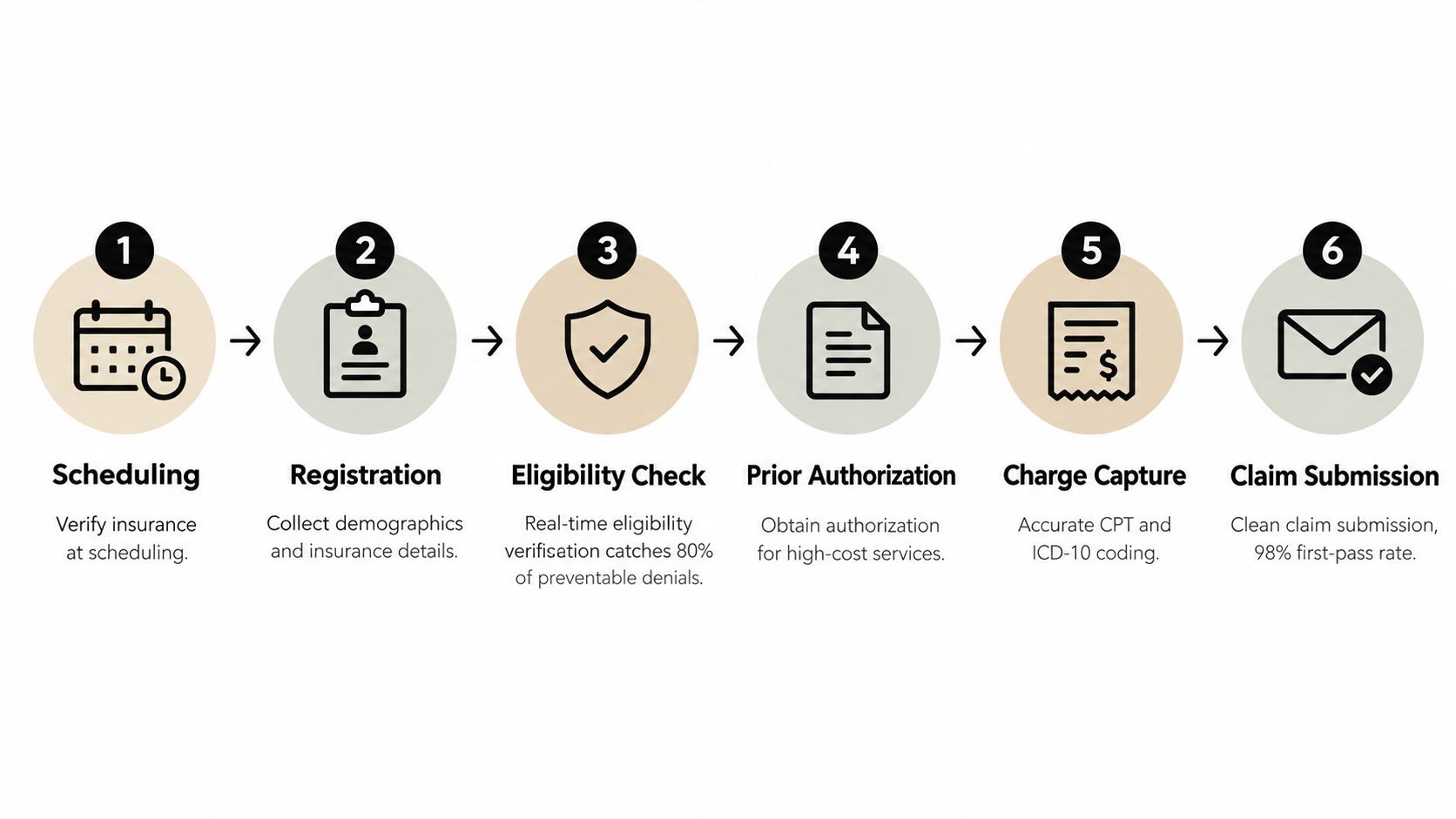
Prior authorization is separate from eligibility. Maintain a payer and procedure matrix that identifies which codes and services require authorization, referral, notification, or clinical review. Store the authorization number, approved codes, units, dates, rendering provider, facility, and payer in the EHR, with visible status flags such as pending, approved, expired, partially approved, or not required.
A missed authorization requires immediate triage, not a vague note to “follow up.” Ask the payer whether retroactive authorization is permitted, document the call reference, submit the clinical record through the accepted channel, and preserve the appeal deadline. A structured prior-authorization process should connect scheduling, clinical review, authorization tracking, billing, and denial follow-up.
Make financial clearance explicit
Use verified benefits to explain the patient's expected responsibility before service. The conversation should cover the estimated copay or deductible obligation, available payment methods, and what remains subject to final adjudication. Staff shouldn't promise a final amount when the payer hasn't processed the claim.
At the final handoff, reconcile demographics, subscriber data, authorization details, diagnosis, procedure, modifiers, and rendering provider. Termination lags, misspelled names, incorrect dates of birth, and mismatched plan identifiers routinely turn an otherwise authorized encounter into downstream rework.
Coding and Documentation That Withstands Payer Scrutiny
A clean claim isn't necessarily a well-supported claim. It may pass an electronic edit and still receive less reimbursement because the clinical record doesn't support the billed level or procedure.
An established visit billed at Level 4 with documentation supporting only Level 3 may be accepted without a denial. The financial loss appears as lower payment, not rejection. That's why coding audits must compare the billed service, the payer's adjudication, the medical record, and the applicable contract expectation.
Build dispute-ready documentation
For E/M services, documentation should make the clinical work legible to a payer reviewer. Depending on the coding method and encounter, that includes:
- Problem-specific findings: Record the condition-specific assessment and exam elements that support the service.
- Medical decision-making: State the problems addressed, data reviewed, and management risk in language that connects to the encounter.
- Time statements: Use clear time documentation when time-based coding applies.
- Procedure linkage: Tie the diagnosis to the procedure for injections, infusions, imaging, and other services that depend on medical necessity.
- Specific diagnoses: Select the most specific supported ICD-10 code rather than defaulting to an unspecified option.
Unspecified coding can weaken medical-necessity support, obscure the reason for treatment, and make a claim harder to defend. In risk-adjusted practices, HCC-supported documentation also needs to reflect conditions actively assessed and managed, not merely copied forward.
Practical rule: Every claim should be defensible in writing to a payer medical director who has no context beyond the record.
That standard matters when the practice challenges a downcode, underpayment, or disputed balance. Coding compliance controls should therefore do more than prevent technical errors. They should preserve the evidence needed for reconsideration, appeal, payer negotiation, or an Independent Dispute Resolution submission.
Providers need feedback that's specific and timely. Don't send a generic denial report. Show the code, the missing documentation element, the payer response, and the corrected note pattern. The objective isn't to maximize coding. It's to ensure the billed service accurately reflects the work performed and can survive payer scrutiny.
Charge Capture, Billing, and Collections as a Continuous Loop
Charge capture, billing, and collections shouldn't operate as separate departments with separate definitions of completion. The encounter isn't financially complete when the provider signs the note, when the claim leaves the clearinghouse, or when a remittance posts. It's complete when every billable service is captured, adjudicated, reconciled, and collected or appropriately resolved.
Find the handoff leaks
The vulnerable points are predictable:
- Encounter to charge: A procedure documented in the EHR never reaches the charge queue.
- Superbill to billing system: A manually prepared charge remains outside the claim workflow.
- Date of service to claim drop: Staff can't explain why a completed encounter hasn't produced a submitted claim.
- Remittance to reconciliation: Payment posting closes the account without comparing actual reimbursement to the expected allowance.
- Insurance balance to follow-up: An unpaid account sits untouched while timely-filing or appeal rights narrow.
- Patient balance to collection cadence: Statements and outreach aren't coordinated, so the balance ages without a defined next action.
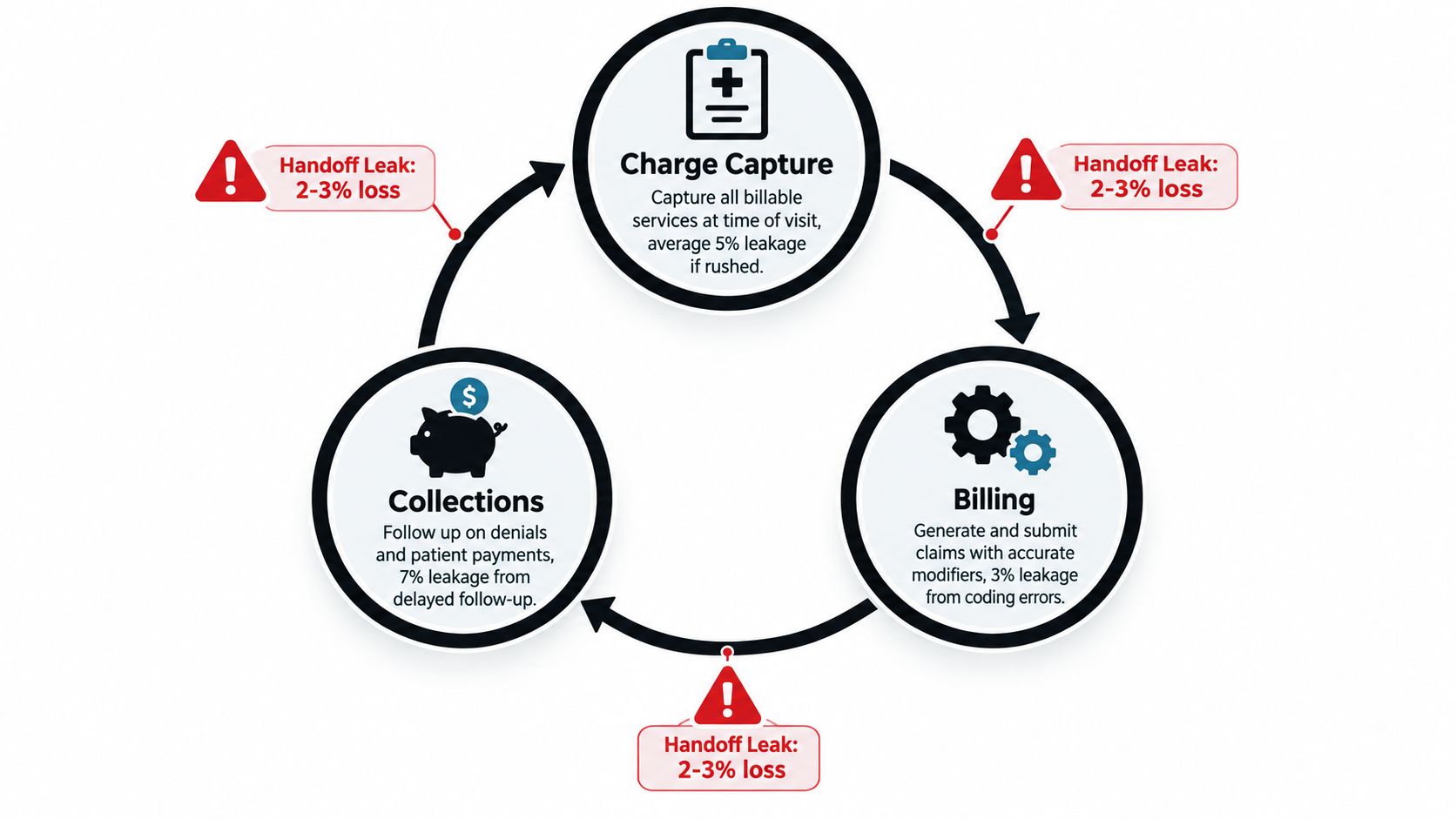
Instrument each handoff with a timestamp and an owner. Reconcile the daily schedule to completed encounters, charges, claims, and payments. A missing charge should create an exception before month-end, not surface during an annual review.
Manage aging by risk, not convenience
Days in accounts receivable is calculated as total current receivables divided by average daily charges. Benchmark guidance commonly places healthy performance around 30 to 40 days, with under 35 days described as best-in-class in outpatient settings. Healthcare RCM KPI guidance also emphasizes aging-bucket review and prioritizing old balances.
AR over 90 days signals increased write-off and collection risk. When AR exceeds roughly 50 days, the practice is generally outside its normal operating range and should investigate front-end, coding, billing, and follow-up failures rather than adding more collection touches.
Map every dollar through the same pipeline. Leadership should be able to ask where an expected payment changed, who owns the exception, what evidence supports recovery, and when the next action will occur. If the system can't answer those questions, activity is masking leakage.
Denial Prevention and a Tiered Recovery Playbook
Generic denial advice fails because different denials require different evidence, owners, and deadlines. Build the recovery system around root cause and timely-filing exposure.
Classify every denial into four operational buckets:
- Front-end eligibility: Coverage, subscriber, coordination-of-benefits, referral, or authorization failures.
- Coding: Invalid code combinations, modifier problems, diagnosis linkage, bundling, or documentation mismatch.
- Medical necessity: Clinical evidence, policy criteria, documentation requests, and benefit limitations.
- Credentialing: Enrollment, taxonomy, provider status, location, or payer-file discrepancies.
Use scrubber rules for recurring payer edits, but don't let the scrubber become the entire strategy. Log payer-specific behavior, including codes that routinely trigger medical review, narrow code-pair edits, and requests for additional information. High-value or clinically complex accounts should enter a specialist queue, even when the initial denial appears routine.
| Denial Category | Response Owner | SLA | Escalation |
|---|---|---|---|
| Front-end eligibility | Patient access lead | Same business day | Payer operations lead, then supervisor |
| Coding | Specialty coding lead | Prompt review after assignment | Provider clarification, then compliance review |
| Medical necessity | Clinical documentation or utilization lead | Before appeal deadline | Payer medical reviewer, then formal appeal |
| Credentialing | Enrollment lead | Immediate status validation | Payer contracting or credentialing escalation |
Track overturn rate by payer, denial reason, provider, and procedure. Send the result back to the person who can change the upstream process. If an authorization error repeats, retraining the follow-up team won't solve it. Fix the scheduling rule, EHR flag, or ownership gap that created the denial.
The recovery queue should show dollars at risk, deadline, required evidence, next action, and escalation level. A denial without a dated next action is not under management.
Analytics and KPIs That Actually Predict Cash
Most dashboards measure effort. Claim count, account touches, and work-queue completion can rise while collections remain flat. Leaders need metrics that reveal whether the practice is converting clinical work into expected reimbursement.
Separate activity from cash signals
Use a compact KPI set with clear definitions:
- Clean claim rate by payer: Measures whether the practice submits claims that avoid preventable rejection and rework.
- Net collection rate against adjusted contractual allowance: Shows how much collectible reimbursement the practice captures.
- AR over 90 days: Identifies balances most exposed to write-off risk and collection drag.
- Denial overturn rate: Measures whether the team recovers disputed reimbursement, not merely whether it touches accounts.
- Underpayment recovery rate against fee schedules: Shows whether accepted claims paid below expectation are being identified and recovered.
- Days in AR: Tracks cash conversion. Healthy guidance commonly places this around 30 to 40 days, while under 35 days is described as best-in-class in outpatient settings, according to the cited KPI benchmark guidance.
Denial rate still belongs on the dashboard, but it shouldn't stand alone. HFMA's framework supports reviewing denial rates by both claim count and claim dollars, allowing leaders to distinguish operational frequency from financial severity.
A practice also needs payer-behavior intelligence. The dashboard should answer which payer underpays a specific CPT, which carrier delays without issuing a denial, which plan repeatedly applies a bundling edit, and which code combinations attract medical-necessity review. Aggregate performance can look stable while one commercial contract steadily erodes reimbursement.
Know when internal capacity has failed
Set escalation triggers before the team reaches a crisis. The following signals indicate that the practice should consider outside specialty support or a formal recovery partner:
- A payer mix concentrated in a few high-friction commercial carriers.
- Denial overturn performance stalling below 50%.
- AR over 90 days rising beyond 20%.
- Repeated underpayments on high-value CPT codes.
- A backlog that prevents staff from meeting appeal or timely-filing deadlines.
These thresholds are operating triggers, not universal industry laws. Use them to force a leadership decision, then validate the diagnosis with payer-level data.
A dashboard that doesn't show expected reimbursement, actual reimbursement, and the variance between them is a production report, not a revenue-protection system.
Connect specialty RCM to IDR
Specialty RCM and Independent Dispute Resolution shouldn't be selected as unrelated vendor functions. The RCM team creates the clean, documented, contract-aware claim. The recovery function uses the payment record, clinical evidence, payer history, and applicable No Surprises Act requirements to determine whether escalation is appropriate.
For eligible out-of-network or disputed-balance claims, IDR may become the next recovery path after ordinary payer processes fail. The practice must confirm eligibility, preserve required documentation, meet applicable notice and filing requirements, and assemble an evidence package that supports the payment position. Not every underpayment belongs in IDR. Some require corrected claims, reconsideration, contract enforcement, or a credentialing fix.
A practical decision tree looks like this:
- Is the claim unpaid because of an operational error? Correct the front-end, coding, authorization, or credentialing issue.
- Was the claim accepted but paid below the expected allowance? Reconcile the remittance, contract, fee schedule, and documentation.
- Can the payer correct the payment through reconsideration or negotiation? Use the payer-specific recovery path and document the result.
- Is the dispute eligible for No Surprises Act IDR? Validate eligibility and deadlines, then prepare the case evidence.
- Is the pattern systemic? Change the workflow, contract strategy, or operating model so the same recovery isn't repeated manually.
RevGuard is one example of a provider-focused model that combines specialty RCM workflows, underpayment recovery, payer-behavior reporting, and IDR case support. The right partner should show exactly how it will reconcile payments, assign ownership, protect deadlines, and report recovered value.
Your 90-Day Revenue Protection Action Plan
A small or mid-sized practice shouldn't attempt every improvement at once. Sequence the work by cash impact, operational dependency, and available ownership.
Days 1 to 30
The revenue cycle director or practice administrator should tighten eligibility and authorization controls first. Add the 72-hour eligibility verification, confirm secondary coverage and coordination of benefits, make authorization status visible in the EHR, and define the retro-authorization response.
At the same time, a specialty coding lead should audit documentation for the practice's highest-volume billed CPT codes. Compare what was billed, what was supported, what the payer paid, and whether accepted claims were downcoded or underpaid. The billing manager should triage the denial backlog by category, dollar value, and deadline.
Output: a documented front-end workflow, a prioritized coding exception list, and a denial queue with owners and next actions.
Days 31 to 60
The operations manager should reconcile the daily schedule against charges, submitted claims, remittances, and patient balances. Find every handoff where a completed encounter can disappear. Build a payer-specific dashboard that shows clean claim performance, denial dollars, AR aging, payment variance, and underpayment recovery.
The administrator or contracting lead should review payer clauses, fee schedules, bundling provisions, and reimbursement terms that block legitimate payment. Don't negotiate from anecdotes. Bring payer-level variance and procedure-level evidence.
Output: a closed-loop reconciliation report and a payer performance view that identifies the largest recoverable variances.
Days 61 to 90
Leadership should decide which activities remain in-house and which require specialty support. Test one or two eligible IDR filings on documented underpayments only after confirming the claim meets applicable No Surprises Act requirements and the evidence is complete.
Lock in a weekly exception review, a monthly KPI meeting, provider feedback on documentation, and a quarterly payer-behavior review. The cadence matters more than a one-time cleanup.
Output: a defined escalation model, completed recovery tests, and named owners for keeping the revenue cycle closed.
RevGuard helps physician practices connect eligibility, coding, charge capture, denial recovery, underpayment analysis, and payer escalation into one revenue-protection workflow. Visit RevGuard to assess where accepted claims, aging balances, and payer disputes are leaving reimbursement unrecovered.