

More than 1.46 million disputes were initiated under the No Surprises Act independent dispute resolution process in 2024, more than double the prior year's volume and more than seven times the 2022 level, according to the Congressional Research Service overview of the federal IDR system. That shift changes the management question for specialty practices. IDR is no longer an occasional legal appeal. It's a high-volume revenue workflow where eligibility, documentation, batching, deadlines, and administrative capacity determine how quickly underpayments become cash.
The legal framework still matters, but the operational layer decides whether a valid dispute reaches the merits. A practice can have a credible reimbursement position and still lose time, money, or eligibility because its remittance records are incomplete, its claims are improperly batched, or its team misses a narrow filing window. The most reliable approach connects upstream revenue cycle management with downstream arbitration execution.
The Operational Reality of No Surprises Act Independent Dispute Resolution
Federal IDR volume has moved specialty practices beyond the occasional appeal queue. More than 1.46 million disputes were initiated in 2024, compared with 679,156 in 2023 and 200,112 in 2022, according to the Congressional Research Service. Those figures point to an operating model built around intake rules, clear ownership, queue controls, quality checks, and defined escalation paths.
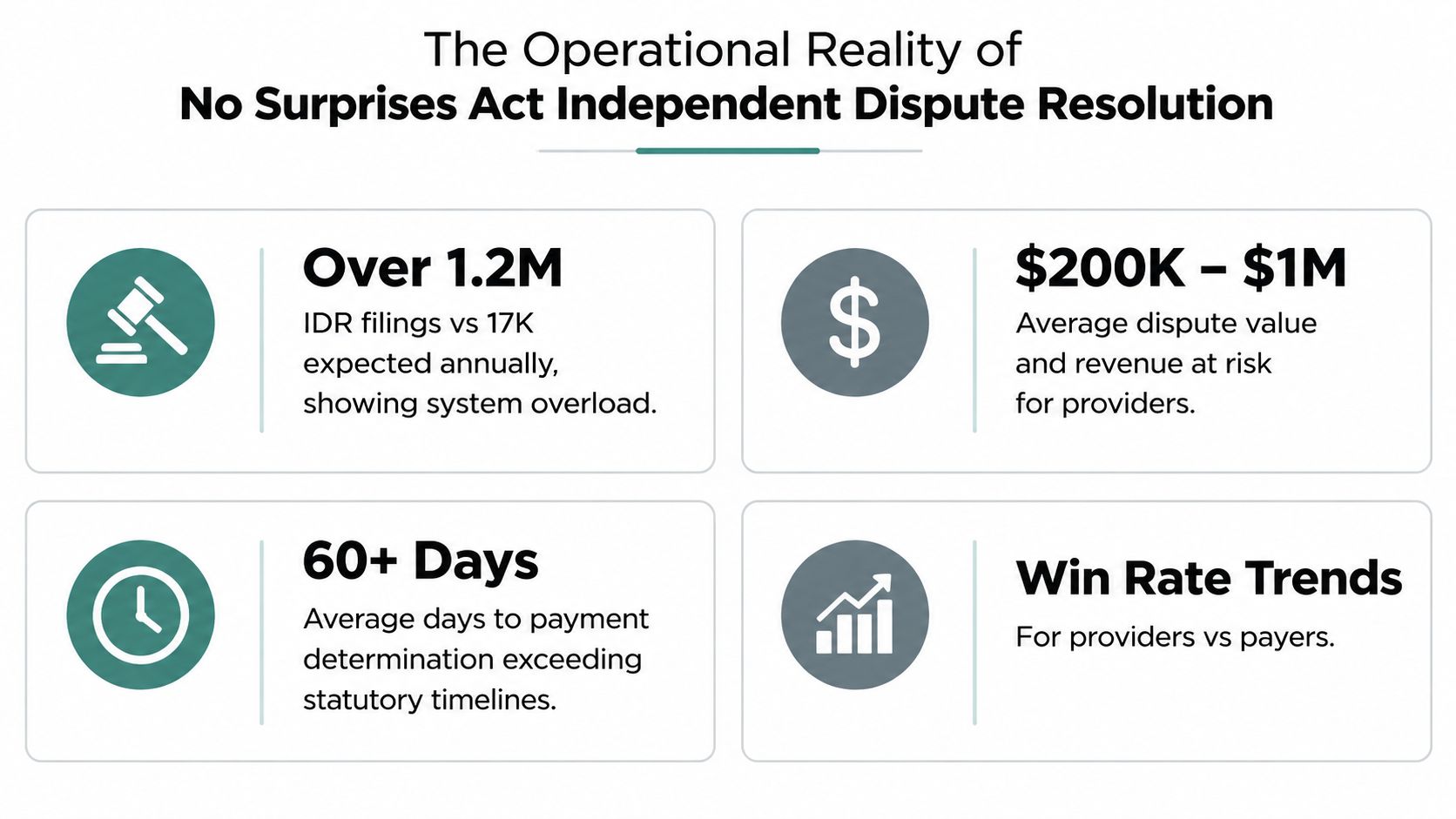
The statutory determination window is nominally 33 business days, yet the CRS analysis notes that administrators frequently missed that window in 2024. For a chief financial officer, the consequence is practical. Delayed determinations shift expected reimbursement, weaken cash forecasting, and require staff to investigate inactive cases, identify the source of delay, and decide whether intervention is needed.
Why occasional appeal management breaks down
An occasional appeal process starts too late. After a payer underpayment ages, someone reviews the explanation of benefits, determines whether the claim may qualify, gathers records manually, and submits the dispute. Individual judgment carries too much of the workflow, leaving gaps between the initial payment variance and the IDR filing.
High-volume disputes make those gaps visible:
- Unclear ownership: Billing, coding, compliance, legal, and collections teams handle separate steps without one accountable case owner.
- Inconsistent eligibility review: Staff may send every out-of-network payment dispute into an NSA queue, even though eligibility must be confirmed before the rate dispute can proceed.
- Manual evidence assembly: Teams search for remittance advice, contracts, clinical records, and QPA information while filing deadlines approach.
- Poor queue visibility: Leaders cannot tell whether a case is newly identified, waiting for payer information, pending an entity determination, or ready for payment enforcement.
Operational rule: Track every potential IDR case as a revenue asset from the first payment variance. Do not create the case only after the billing cycle ends.
CMS reported that by the end of 2025, 92% of submitted disputes had been resolved and 98% were either resolved or less than 30 business days old, as summarized in the CRS report. Those figures do not replace internal controls. They reinforce the need for accurate status data. One case may be nearing resolution, while another requires immediate action because its record is incomplete or its payment remains unpaid.
Throughput is part of reimbursement strategy
A specialty group needs repeatable intake rules that identify eligible claims, produce standardized case packets, and route exceptions before they become stale. Batching can reduce administrative work when permitted. Improper batching, however, can trigger objections, rework, and additional delay.
The strongest operating model begins upstream. It validates payer, service, payment, and eligibility data during normal revenue cycle work, then carries that record into IDR without a new manual investigation. The question is whether the organization can produce a complete, compliant case file repeatedly and at scale, even when experienced staff are unavailable. That capability supports reimbursement timing when federal administrators face capacity constraints.
Navigating Timelines and Procedural Requirements
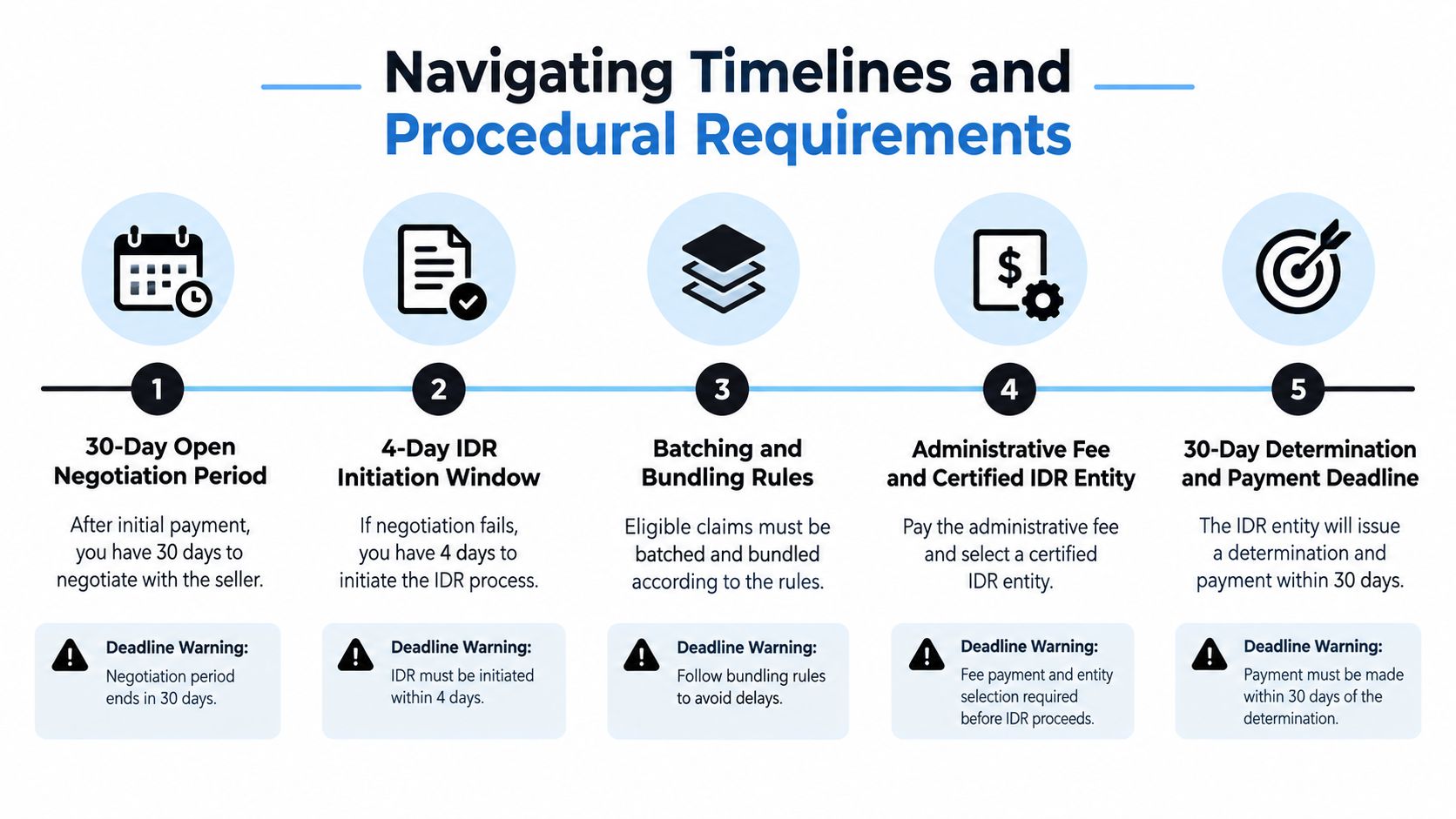
The federal IDR sequence looks linear, but each stage creates a separate deadline and documentation obligation. A provider's internal calendar should begin when the initial payment or denial notice arrives, not when someone decides to pursue arbitration.
Start with the open negotiation period
The first operational checkpoint is the 30-business-day open negotiation period after the provider receives the initial payment or notice of denial. During that period, the provider should confirm the claim facts, identify the applicable plan, validate the qualifying payment amount, and make a documented attempt to resolve the rate without formal IDR.
The open negotiation record should include the claim identifier, service date, service description, payment received, amount disputed, QPA information, and relevant correspondence. Don't rely on a phone call without a contemporaneous note. If the negotiation fails, the case file should show when the period began, what the payer offered, and why the parties didn't reach agreement.
Protect the initiation window
If open negotiation fails, the initiating party has a four-business-day window to initiate IDR, as described in the Congressional Research Service's explanation of the federal process. A calendar that tracks only the final submission date is insufficient. Your workflow should calculate the deadline automatically from the documented end of open negotiation and alert the case owner before the window closes.
The submission should be assembled before the negotiation period ends. Waiting until the final day creates predictable risks:
- Fact mismatch: The QPA, payment amount, or service details in the filing may not match the remittance advice.
- Missing eligibility support: The team may discover too late that it lacks evidence showing why the service falls within the federal framework.
- Batching errors: Similar claims may be grouped for convenience even though they don't meet applicable requirements.
- Fee or portal failure: A last-minute submission leaves little room to correct administrative rejection or payment issues.
Build the case around permitted evidence
The IDR entity evaluates the parties' offers under the statutory framework, including the QPA and other permitted factors. The provider's evidence should connect each factor to the service at issue, rather than presenting a large undifferentiated document dump.
A useful packet generally contains the initial payment or denial, remittance advice, negotiation communications, claim and coding records, patient and service facts relevant to eligibility, QPA materials, and a concise explanation of why the provider's offer better reflects the circumstances. Clinical documentation should support complexity, acuity, specialized expertise, and the actual work performed when those facts are relevant to the permitted factors.
Manage the clock as a portfolio
Federal delays can affect the determination timeline, but internal deadlines remain controllable. Maintain a case register with the open negotiation date, IDR initiation deadline, submission status, entity status, evidence gaps, determination status, and payment follow-up.
A portfolio view also reveals concentration risk. If one payer, specialty, or facility generates most disputes, leaders can address the underlying contracting, coding, or remittance problem instead of processing the same failure repeatedly.
Building Dispute-Ready Claims Upstream
The strongest IDR file usually begins before anyone mentions arbitration. Eligibility verification, coding accuracy, and clinical documentation establish the facts that later determine whether a dispute can proceed and how persuasive the payment position will be.
A claim packet should make the service easy to identify and hard to misclassify. For anesthesia, that may require clear linkage between the anesthesiology service, the procedure, the place of service, and the participating status of the relevant parties. For radiology or pathology, the file should distinguish the professional service from facility arrangements and preserve the coding context. Air ambulance and emergency service providers face their own eligibility and documentation issues, so a generic checklist won't provide enough control.
Repair the first failure, not only the final underpayment
An underpayment is often the visible result of an earlier data weakness. A missing payer identifier can complicate eligibility review. An incorrect service code can create a batching problem. Incomplete clinical records can make a legitimate complexity argument look unsupported.
Revenue cycle leaders should connect these fields across systems:
- Eligibility data: Plan identity, network status, service setting, and coverage information.
- Claim data: Codes, modifiers, units, dates, place of service, provider identity, and billed amount.
- Payment data: Initial payment, denial reason, remittance advice, QPA information, and adjustment codes.
- Clinical data: Records that substantiate the service, complexity, urgency, and specialty-specific circumstances.
- Process data: Negotiation dates, communications, submission status, determination, and collection activity.
The point isn't to collect every available document. It's to create a traceable record that answers the IDR entity's practical questions without forcing reviewers to reconstruct the claim.
Make RCM and IDR share the same facts
Siloed teams often create contradictory narratives. Billing describes a payment variance one way, clinical staff describe the service another way, and an external appeals team receives only a partial record. The resulting submission may be technically complete but strategically weak.
A revenue cycle readiness checklist for NSA IDR can help practices test whether their upstream controls produce the documentation needed downstream. The review should cover both clean-claim production and dispute conversion, because a process that identifies opportunities but can't assemble reliable evidence will still leak revenue.
The arbitration brief can't repair a claim record that was never built correctly.
The most effective operating model assigns IDR relevance to routine RCM controls. Staff should flag potential NSA claims during payment posting, preserve the relevant remittance materials automatically, and route the case for eligibility review while the underlying facts remain accessible. That turns IDR from a rescue effort into an extension of disciplined billing.
Anticipating and Countering Common Payer Tactics
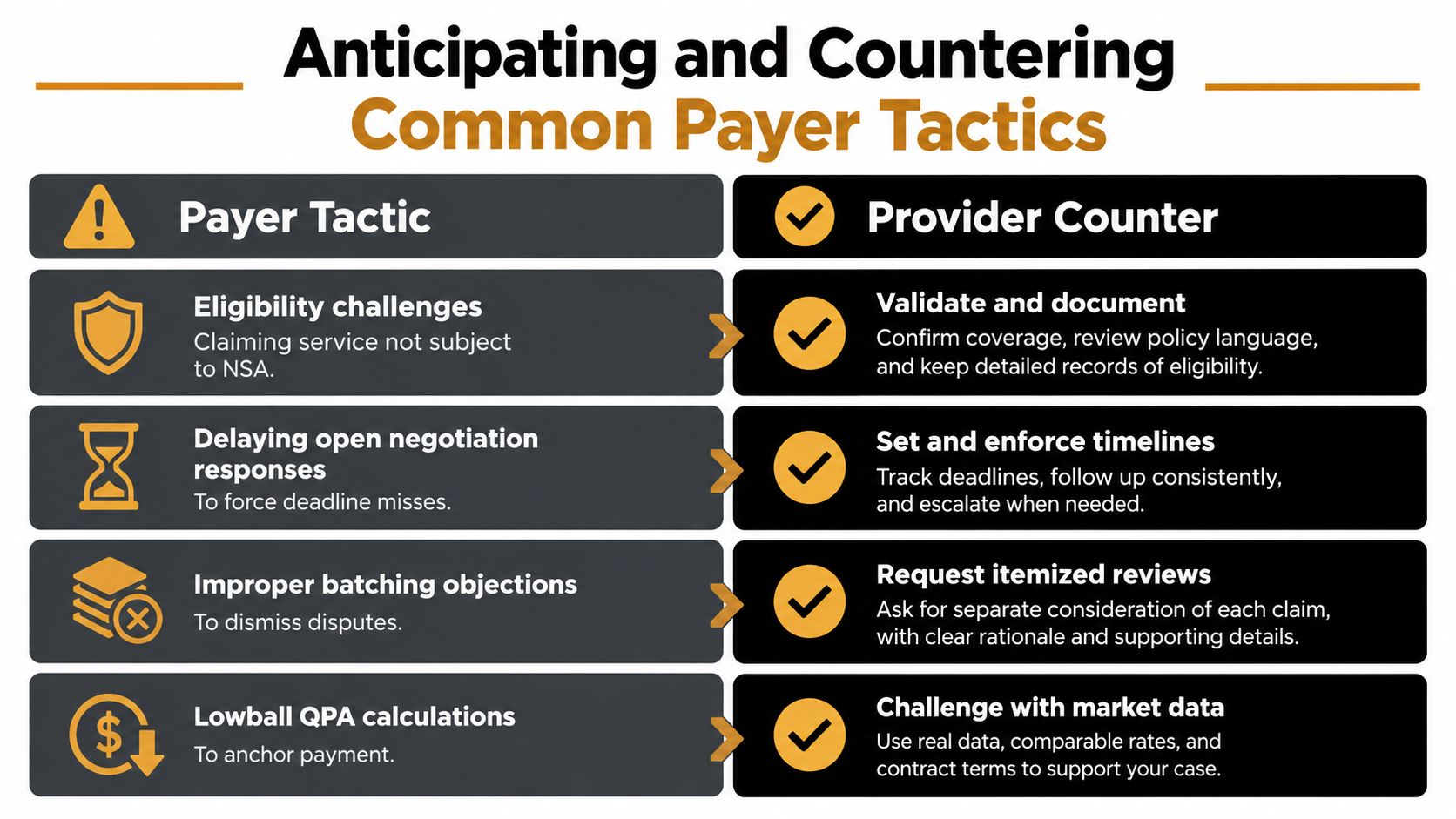
A payer's eligibility challenge can consume as much provider attention as the payment dispute. Treating the No Surprises Act independent dispute resolution process as only a rate-setting forum misses the first fight: whether the item or service qualifies for adjudication at all.
Give eligibility challenges their own workstream
A safety-net hospital analysis of 2025 activity reported that health plans challenged 40% of cases as ineligible, while IDRs upheld only 17% of those challenges, according to analysis discussed by the House Committee on Ways and Means. Providers should treat eligibility as a substantive procedural issue, not a box checked at submission.
A payer may question the service setting, coverage type, participating status, claim identity, or connection between the disputed item and NSA protections. The response should address the specific objection with primary records. A general statement that the claim was underpaid does not resolve an eligibility dispute.
Prepare the counter file before the objection
Each dispute file should establish:
- Who furnished the service: Provider identity, specialty, facility relationship, and network status.
- What happened: Service description, date, place of service, procedure or transport facts, and claim linkage.
- Which coverage applies: Plan information, payer correspondence, and records supporting the federal pathway rather than another dispute process.
- What the payer paid: Initial payment, denial notice, remittance advice, adjustment explanation, and QPA disclosure.
- What was negotiated: Open negotiation notice, response, offers, and payer objections.
This file changes the response from a search exercise into a documented explanation. The case owner can map each payer objection to a specific record and present the answer in chronological order.
Address delay without creating compliance risk
Provider teams should record missed responses, unclear payer instructions, and contradictory payment information. They should avoid unsupported accusations. Escalations work best when they remain factual, timely, and connected to the applicable portal or dispute procedure.
The payer tactics in IDR analysis can help revenue leaders build payer-specific playbooks. Each playbook should identify recurring objections, the records that resolve them, the staff member responsible for the response, and the point requiring compliance or legal review.
Batching requires the same control. Grouping claims can reduce repetitive preparation, but a batch that fails eligibility or similarity rules can create a broader rejection problem. Validate every group before submission, retain an item-level audit trail, and separate questionable claims instead of allowing one weak item to compromise otherwise eligible disputes. Upstream RCM controls determine whether the IDR team can respond quickly with evidence already organized.
Analyzing Expected Outcomes and Economic Impact
The financial case for IDR depends on what reaches determination. A peer-reviewed analysis of NSA IDR outcomes found that providers won 86% of cases, with mean decisions 2.7 times the QPA, as reported in the published analysis of federal IDR outcomes.
That finding supports disciplined case selection, not automatic filing. A well-supported portfolio can produce meaningful expected value when the disputed rate differs materially from the QPA, while weak eligibility records or incomplete claim files can erase that value before the merits are considered.
Win rate is only one part of the calculation
Practice leaders should evaluate each case through five operational questions:
| Decision factor | Operational question |
|---|---|
| Eligibility | Can the team prove the service belongs in the federal IDR pathway? |
| Evidence | Does the record support the provider's permitted rebuttal factors? |
| Economics | Is the expected recovery sufficient to justify preparation and fees? |
| Capacity | Can the team submit and monitor the case without weakening other work? |
| Collection | Does the organization have a process to pursue payment after determination? |
The reported provider win rate describes disputes that reached a determination. It does not capture opportunities abandoned during intake, filings rejected on eligibility grounds, or cases that lacked the documentation required for submission. Leaders should therefore measure intake yield, eligible-case conversion, preparation cost, and post-determination collection alongside arbitration results.
Clean RCM data affects every part of that calculation. Accurate service details, payment records, payer correspondence, and timely documentation reduce review time and help the team identify cases worth pursuing.
QPA analysis must be precise
Before accepting a payer's QPA, cross-reference it against the service, specialty, geographic context, and claim facts. The qualified payment amount guide can support that internal review. If the benchmark appears inconsistent, identify the specific discrepancy and connect it to records that support the rebuttal.
The practical task is to distinguish a reasonable payer benchmark from one that does not reflect the service or the permitted evidence. That review requires claim-level validation, not a general assumption about whether the QPA is favorable.
Scale changes the economics
Manual preparation may be tolerable for one dispute. A sustained portfolio requires triage, templates, data validation, automation, and outcome reporting. The goal is selective submission, with eligibility supportable, evidence complete, and likely recovery sufficient to justify administrative effort and fees.
The economic result is shaped upstream. Better documentation increases the quality of the eligible portfolio, reduces wasted submissions, and gives the team a clearer path to payment after a favorable determination. Practices that treat IDR as a standalone arbitration task may win individual cases while still losing time and recoverable revenue across the broader operation.
Implementing a Compliance and Documentation Strategy
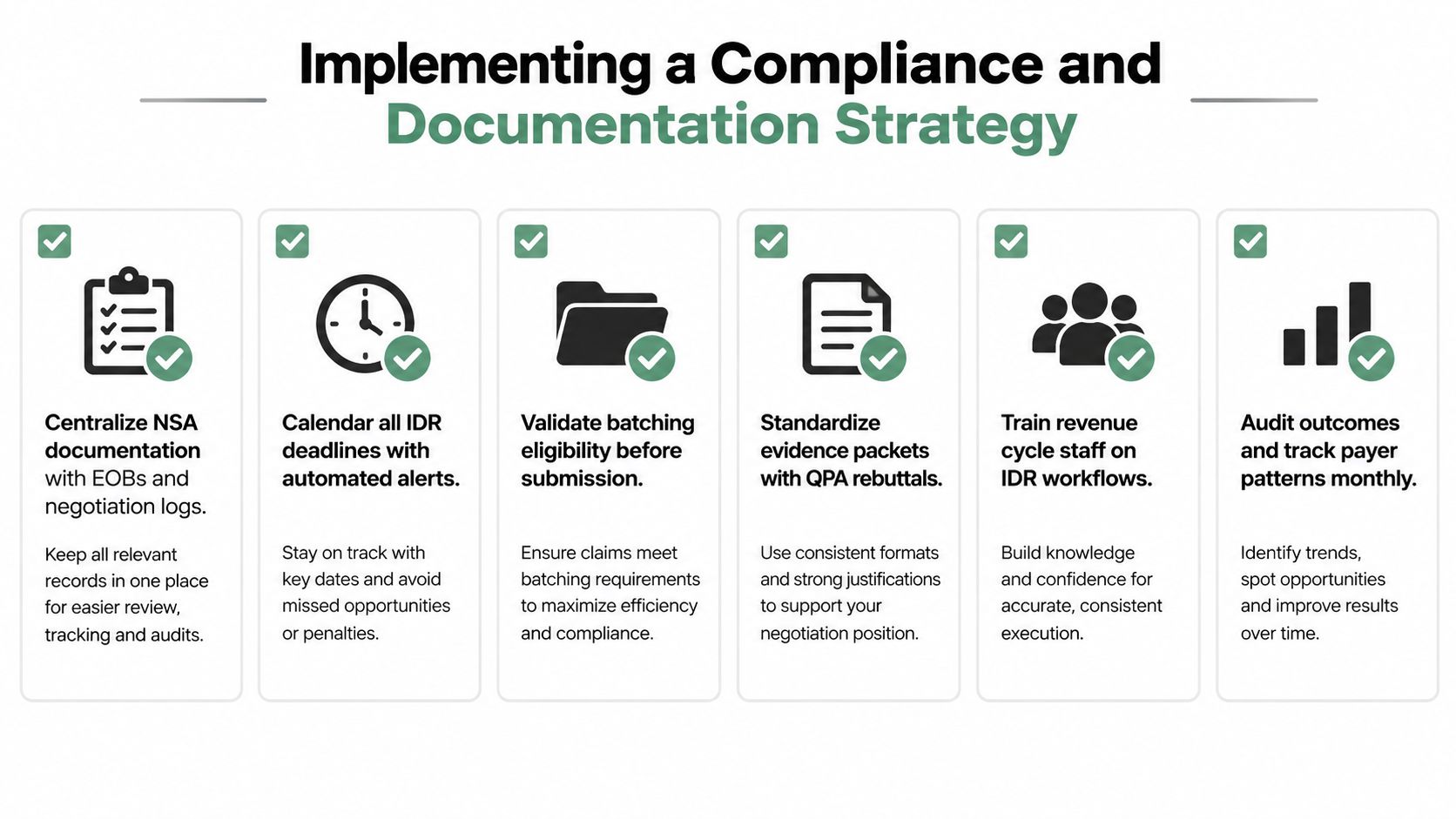
A scalable IDR program requires a standard operating procedure that staff can execute consistently, without reinterpreting requirements for each claim. Assign ownership, define the evidence standard, and maintain an audit trail from payment posting through collection. At volume, upstream RCM discipline determines whether an otherwise valid dispute can be filed, defended, and paid.
Use a six-point readiness check
Centralize the source record. Keep the EOB or remittance advice, claim detail, payer correspondence, QPA information, and negotiation log in one case file.
Calendar every trigger. Record the payment or denial date, open negotiation deadline, IDR initiation window, submission status, and follow-up dates. Send automated alerts to a named owner and backup reviewer.
Validate eligibility before packaging. Confirm the plan, provider, service, setting, and payment facts before preparing a full submission. This prevents staff from spending time on claims that cannot proceed.
Review batching separately. Test whether claims share the required characteristics, then preserve the item-level rationale so a reviewer can understand why the group was formed.
Standardize the evidence packet. Use a consistent order, index, clear file names, and a concise argument connecting each document to a permitted factor or eligibility element.
Audit outcomes monthly. Track payer objections, ineligible closures, missing documents, determination results, payment delays, and recurring coding or remittance failures. Trends should feed corrections back to payment posting and billing.
Keep compliance visible to operations
Compliance weakens when it remains in a policy folder. Train payment posters, billers, coding staff, and case managers on the fields that affect IDR eligibility and evidence quality. A focused exception report can show which cases lack a remittance record, which deadlines are approaching, and which payer responses require escalation.
Audit standard: Every submitted case should allow a second reviewer to reconstruct the timeline and rationale without interviewing the original preparer.
That standard limits the effect of staff turnover and makes quality measurable. It also gives leaders a defensible basis for deciding whether to correct, escalate, withdraw, or continue monitoring a case. Consistent records protect submission quality, while outcome reviews show where upstream workflow changes can improve recovery across the dispute portfolio.
The Advantage of Integrated Revenue Protection Partners
A provider group can divide responsibilities among a billing company, an internal compliance team, and outside counsel. That structure may work for low dispute volume, but it often creates gaps at the handoffs. The billing team owns the payment record, the legal team owns the filing, and no one owns the full path from eligibility verification to collected reimbursement.
An integrated partner uses the same claim facts across both stages. The RCM function identifies the underpayment, validates the payer and service data, preserves the remittance record, and corrects upstream weaknesses. The IDR function then determines whether the case qualifies, develops the evidence position, submits the dispute, monitors the determination, and supports enforcement and collections when payment doesn't arrive.
What integration changes in practice
Consider a recurring anesthesia underpayment. A siloed model may send an old claim to an appeals queue after payment posting, where a reviewer discovers that the service record doesn't clearly connect the provider, facility, procedure, and payer response. The case may be abandoned, delayed, or submitted with a weak eligibility record.
An integrated model flags the claim at payment posting. The team checks the service and plan details, captures the initial payment and QPA information, identifies missing documentation, and routes the case through a defined negotiation and IDR workflow. The result isn't guaranteed reimbursement. It is a cleaner decision process with less avoidable rework.
RevGuard provides a model of this structure by combining specialty-specific Revenue Cycle Management with NSA-focused Independent Dispute Resolution, including case development, evidence assembly, filing, enforcement, collections, and reporting. Its stated service scope covers the revenue lifecycle from eligibility and coding through payer negotiations and final payment, which is the type of integration needed when underpayments are systemic rather than isolated.
Choose a partner based on control, not promises
Provider leaders should ask prospective partners:
- Can the partner show how payment variances become IDR candidates?
- Does one system preserve the claim, remittance, negotiation, and arbitration record?
- How does the team validate eligibility and batching before submission?
- Who monitors deadlines and follows up after a determination?
- Can leadership see payer patterns, case status, and recoverable revenue without requesting manual reports?
The strategic shift is from reactive appeals to proactive revenue protection. Practices that make claims dispute-ready upstream give their teams better options downstream, whether the appropriate action is negotiation, IDR, collection, or closure.
RevGuard connects specialty-specific RCM with NSA IDR execution, including eligibility review, evidence development, filing, enforcement, and collections for qualified disputes. Visit RevGuard to assess where your current workflow is losing reimbursement and discuss a scalable plan for building dispute-ready claims.