

A new specialist starts Monday. The schedule is full, the clinical team is ready, and patients have already been referred. Then the practice manager discovers that the provider's payer enrollment isn't complete. The clinician may be able to deliver care, but the practice can't assume those services will generate collectible reimbursement.
That situation explains why health care credentialing is a revenue protection function, not just an administrative file review. It protects patient access, supports clinical privileges, helps satisfy accreditation and regulatory expectations, and determines whether a provider is recognized by the payer connected to the claim. The most reliable teams treat every credential, application, roster, and verification record as part of the revenue cycle.
Why Health Care Credentialing Decides When You Get Paid
A provider can be ready to see patients while the practice remains unable to collect payment for that work. Payers generally need to recognize the provider as eligible within the relevant network or program before billing is reliable. If enrollment or network recognition trails the start date, the organization may continue paying salary, scheduling, and facility costs while collectible revenue stays restricted.
Credentialing timelines commonly reach 90 to 120 days, and some cases extend to six months or more, according to a Physician Leaders Journal analysis. For a multisite group, the delay can differ by payer, state, specialty, or facility. A clinician may be approved at one location and still lack payer recognition at another.
The cash-flow risk is larger than the administrative fee. One industry compilation reports losses of about $7,500 per physician per day of delay, while credentialing one provider typically costs $200 to $400 (Medwave credentialing statistics). Actual exposure varies by market and payer mix, but the pattern is clear. The application cost appears on a budget. Missed billable capacity can remain invisible until denied or delayed claims reveal it.
Practical rule: Measure credentialing by more than closed files. Track where each provider is approved, where payment is possible, and where revenue remains blocked.
Credentialing also gives patients and organizations a documented basis for clinical trust. Accreditation and regulatory guidance call for direct verification of qualifications such as education, licenses, residency training, and board credentials. In the federal safety-net context, HRSA guidance identifies primary-source verification for licensure, education, training, and specialty certification (NAMSS credentialing standards document.pdf)).
The operational value is clinical trust, payer access, and audit defensibility. A practice manager who monitors all three can catch a missing document before submission, identify a payer bottleneck before the first claim, and show leadership where cash-flow leakage starts. Credentialing is the checkpoint between a provider being ready to work and the organization being positioned to get paid.
How Health Care Credentialing Really Works
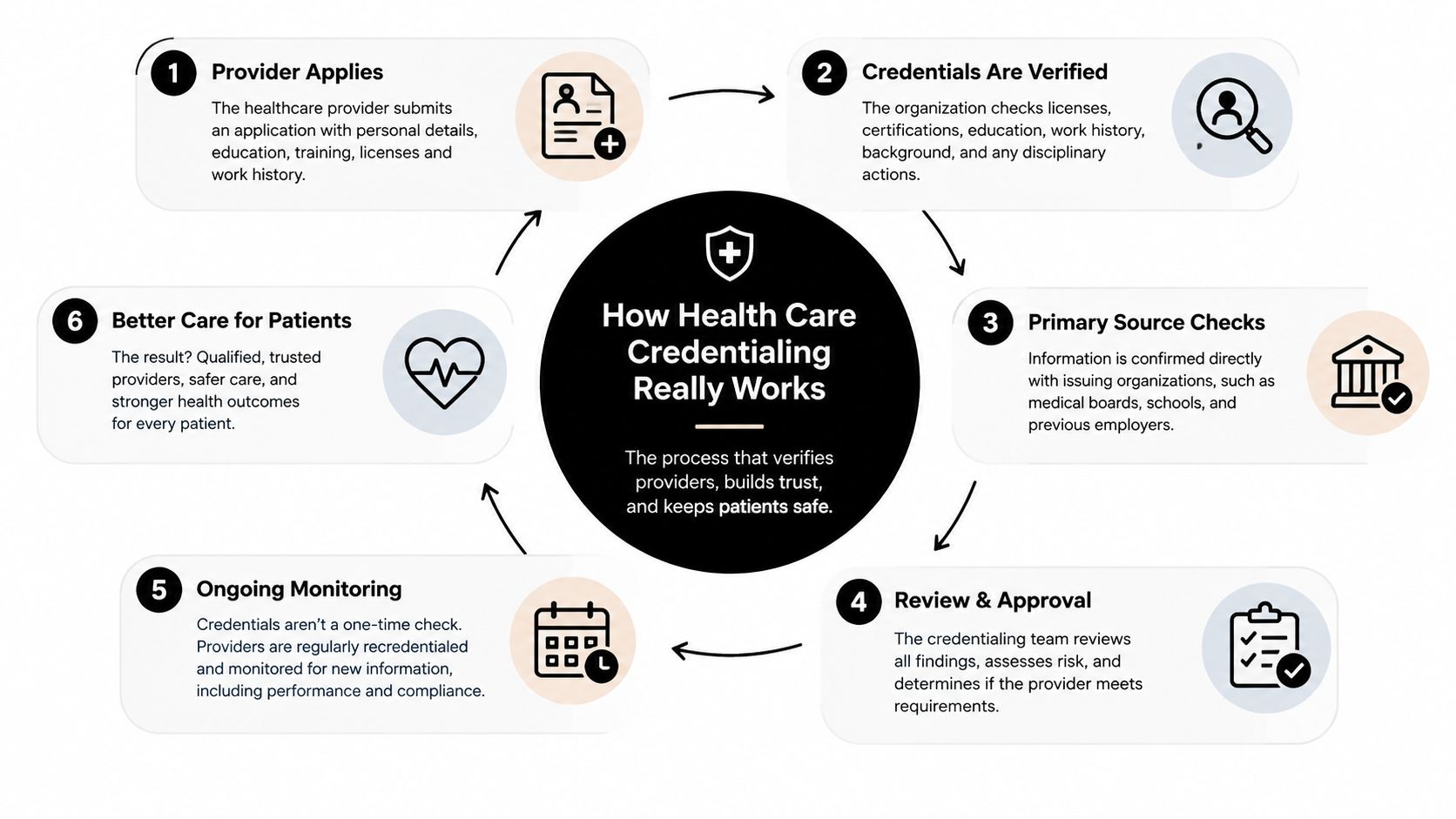
Think of credentialing as a background check for clinical trust. A provider submits information, but the organization doesn't treat the provider's copy of a diploma, license, or certificate as final proof. The credentialing team confirms the information with the original source that issued or maintains it.
That process is called primary-source verification, or PSV. The source might be a state licensing body, medical school, residency program, or specialty-certifying organization. Direct confirmation matters because a copied document can be outdated, incomplete, or altered, while the issuing entity can confirm the status associated with its own record.
The verification chain
A practical credentialing workflow usually follows this logic:
- Collect the provider's information. The team gathers education, training, licenses, certifications, work history, affiliations, and other documentation required by the organization or payer.
- Check completeness and consistency. Names, dates, locations, license states, specialties, and organizational affiliations need to agree across the application and supporting records.
- Verify from primary sources. The team contacts or queries the original issuing entities and records the result.
- Evaluate professional qualifications. The organization reviews whether the provider meets its standards for the intended role, network, or facility.
- Support privileging or enrollment. Verified information moves into the facility approval or payer participation process.
- Maintain the file. Licenses, certifications, attestations, and verification evidence need ongoing monitoring rather than one-time filing.
Why direct verification matters
Primary-source verification supports clinical privileging, payer enrollment, hospital policy, accreditation, and compliance. It creates a defensible record showing not only what the provider submitted, but also how the organization confirmed it.
Credentialing teams also manage the difference between proof of possession and proof of status. A provider may upload a license document, but the important question is whether the license is current, valid in the relevant state, and appropriate for the services being performed. The same principle applies to training, specialty certification, and other qualifications.
This is why credentialing isn't a one-time checklist. The file represents a provider's status at a particular point in time, and that status can change. A strong process therefore combines document management, source verification, review decisions, payer communication, and scheduled maintenance.
Primary-source verification turns a provider file from a collection of documents into an evidence trail.
For new practice managers, the simplest mental model is this: the provider supplies the information, the original source confirms it, the organization decides whether the provider qualifies, and the payer or facility records the resulting status. Each handoff can affect both patient access and payment.
Credentialing vs Privileging vs Payer Enrollment Explained
These terms describe related processes, but they answer different questions. Credentialing asks who the provider is and whether the qualifications are valid. Privileging asks what the provider may do at a particular facility. Payer enrollment asks whether the provider is recognized for participation and payment by a specific payer.
Confusing them creates avoidable gaps. A provider can be credentialed by an organization without being enrolled with every payer. A provider can be enrolled with a payer without holding privileges for a specific procedure at a hospital. Approval in one category doesn't automatically complete the others.
Credentialing vs privileging vs enrollment at a glance
| Process | Primary Purpose | Who Approves | Outcome for Provider |
|---|---|---|---|
| Credentialing | Verify qualifications, identity, education, training, licenses, and certifications | Payer, hospital, health system, or credentialing verification organization | A provider whose qualifications have been reviewed and verified |
| Privileging | Define the clinical services and procedures the provider may perform at a facility | Facility medical staff leadership or credentialing and privileging committee | Authorization to provide specified services at that facility |
| Payer enrollment | Register the provider with a payer and establish network or program participation | Payer enrollment and contracting teams | Recognition that supports billing and reimbursement under the payer relationship |
Consider a surgeon joining a hospital-based specialty group. The hospital may verify the surgeon's education, training, license, and board credentials through credentialing. The medical staff may then grant privileges for selected procedures based on the provider's qualifications and facility standards. Separately, commercial and government payers may require applications, contracts, group associations, service locations, and effective dates before recognizing the surgeon for payment.
For a practical explanation of the payer-facing process, review this guide to getting credentialed with insurance companies. The key operational point is to maintain separate status fields for each process rather than recording a single vague label such as “approved.”
A useful dashboard might show:
- Credentialing status: Complete, pending verification, returned for correction, or under review.
- Privilege status: Approved services, facility, committee date, and expiration or review date.
- Enrollment status: Payer, network, group, location, effective date, and billing readiness.
That separation gives billing, scheduling, medical staff services, and practice leadership a shared view of what the provider can do and where the organization can expect payment.
Inside the Credentialing and Enrollment Workflow
The workflow begins before a payer sees an application. The practice first defines the provider's role, service locations, specialties, billing entities, and payer targets. Those details determine which licenses, taxonomies, facility relationships, and forms the team must validate.
Start with one controlled provider record
The provider supplies core information and supporting documents. The credentialing team should compare the application against a controlled record rather than retyping information separately for every payer. That record should identify the legal name, national provider identifier, specialty, license states, group affiliations, service locations, and relevant dates.
CAQH often serves as a central profile that payers can access when authorized. It still requires active management. The provider and credentialing team must keep the profile accurate, complete attestations, upload current documents, and make sure the information matches payer applications.
Next comes pre-submission validation. Check whether the application is complete, whether the license covers the intended state, whether the taxonomy reflects the actual specialty, and whether the provider is associated with the correct group and location. This step prevents a common failure pattern: the payer receives an application, identifies a mismatch, and places the file into a correction cycle.
Follow the payer's path, not just the provider's file
After validation, the team submits the relevant payer application through the required portal or process. The payer may request additional documents, clarification, or confirmation of affiliations. Every request needs an owner, a due date, and a recorded response.
Primary-source verification may occur during credentialing review, while payer enrollment teams separately confirm participation details. Once the payer approves the application, the organization still needs to verify the effective date, billing entity, service location, and roster placement. A provider can be approved in principle and still appear incorrectly in a directory or roster.
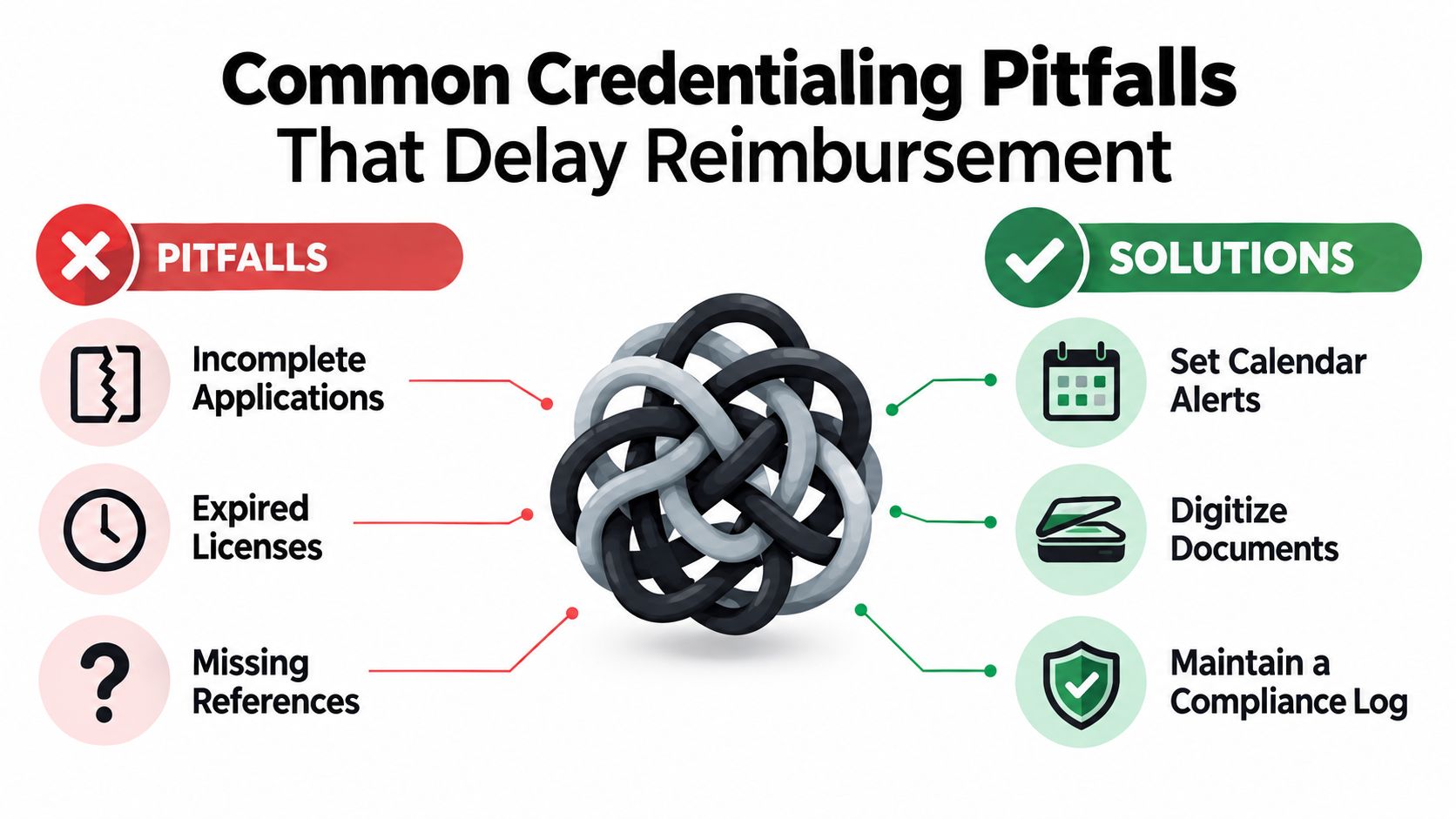
Operational checkpoint: Don't tell billing that a provider is ready until the payer, group, location, specialty, and effective date have been validated together.
Roster synchronization closes the loop. The practice should compare payer records with its internal provider master, scheduling system, billing setup, and public directory information. License-state matching matters especially for organizations operating across multiple states. A valid license in one state doesn't establish authority to practice or bill in another.
The workflow therefore has three participants with different responsibilities. The provider supplies accurate information and responds to requests. The credentialing team controls the file, verification, submissions, and follow-up. The payer determines approval, participation, and effective dates. Revenue protection depends on all three handoffs being visible.
Common Credentialing Pitfalls That Delay Reimbursement
A provider can be fully qualified and still generate no collectible revenue if a payer cannot match the application to the right group, location, or effective date. Credentialing delays often start with a small data error, then create clarification requests, corrections, and waiting periods. The lost time is only part of the problem. Without clear status visibility, managers cannot tell which payer, site, document, or handoff is holding up payment.
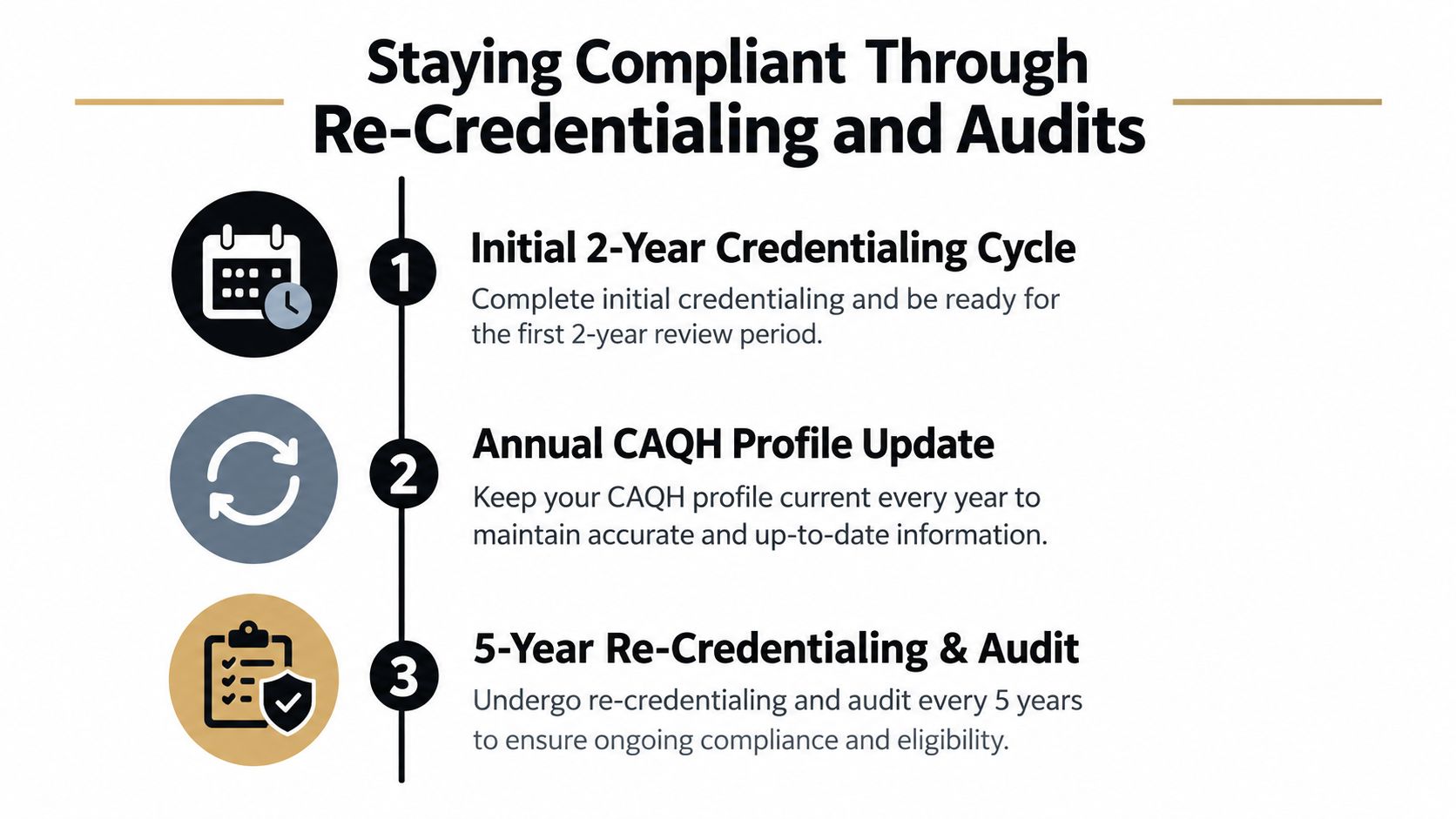
The first warning sign is an incomplete or inconsistent application. A CAQH profile may show one address while a payer form lists another. A license may be active but issued in a state unrelated to the submitted service location. A roster may place the provider under the wrong group or taxonomy. Each mismatch can prevent the payer from connecting the provider to a billable arrangement.
Where the process breaks
- Incomplete attestations: A required field remains unresolved, so the payer cannot finish its review. Use a pre-submission checklist and assign a second reviewer to high-impact fields.
- Expired or soon-to-expire documents: A license, certification, insurance record, or registration may lapse while the application is pending. Keep one expiration calendar with a named owner for each renewal.
- Mismatched identities and affiliations: Differences in legal name, group name, billing entity, NPI, taxonomy, or location can stop the payer from linking records correctly. Compare these fields before submission.
- Unanswered payer requests: A clarification request may reach an outdated address or an overloaded inbox. Send every request to a tracked queue with escalation rules and an accountable owner.
- Unclear status visibility: The team may know that an application was submitted without knowing whether it awaits primary-source verification, payer review, correction, contracting, or roster activation.
A payer enrollment and credentialing survey reports that 33% of organizations experienced delays of 30 to 45 days, while 18% reported delays of 60 days or more (2025 State of Payer Enrollment and Credentialing). The report also describes limited revenue-loss tracking. That gap prevents leaders from ranking open files by financial effect. A queue shows activity, but not which delayed provider is blocking the most scheduled or submitted claims.
Link each file to the provider's specialty, service site, payer, expected start date, and billing entity. Track every dependency separately instead of using one general application status. Organizations managing several states or payer programs can compare these controls with a medical credentialing service.
The revenue review should answer three questions: which scheduled services depend on approval, when can the provider submit a collectible claim, and which claims could be affected by an incorrect effective date or roster record? Credentialing issues account for about 1% of all claim denials, according to industry reporting. The percentage may look small, but the revenue risk begins before denial management and can extend through corrected claims, appeals, and payer reconciliation.
Staying Compliant Through Re-Credentialing and Audits
Approval is a milestone, not the end of the work. Providers change locations, renew licenses, add certifications, update affiliations, and move between payer networks. The organization must keep its records accurate while preserving evidence of what it checked, when it checked it, and who completed the review.
The compliance burden is tightening around both verification timing and directory accuracy. A 2025 compliance analysis reports that accredited plans now face a 120-day primary-source verification window instead of 180 days, while certified credentialing organizations have 90 days instead of 120 days (credentialing compliance environment analysis). The same analysis emphasizes that audit trails need to be maintained continuously rather than reconstructed from old spreadsheets and emails.
Build maintenance into ordinary operations
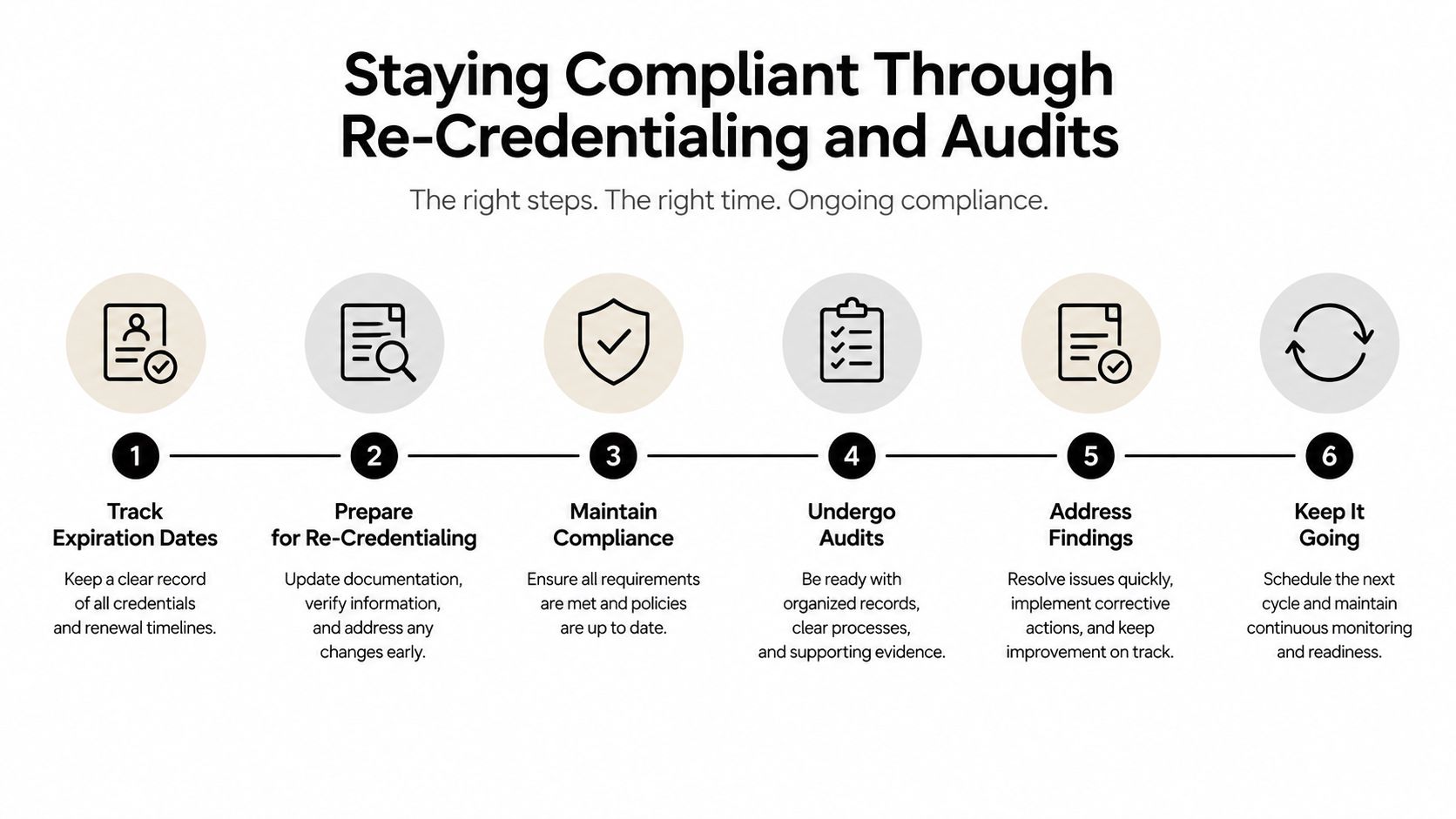
A durable program should include:
- Expiration monitoring: Track licenses, certifications, insurance, registrations, and other time-sensitive records before they lapse.
- Scheduled re-credentialing: Start reviews early enough to resolve missing information without creating a status gap.
- Ongoing primary-source evidence: Record the source, verification date, result, reviewer, and supporting documentation.
- Directory reconciliation: Compare internal provider data with payer rosters and public directories, then document corrections.
- Audit-ready reporting: Produce a clear history of actions without asking staff to rebuild the file manually.
Directory accuracy is more than a communications issue. If patients, payers, and internal teams rely on incorrect specialty, location, or availability data, referrals can move to the wrong provider and claims can connect to the wrong billing context. Compliance teams also need to explain how the organization identified and corrected inaccurate information.
An audit-ready system should show the work as it happens. A spreadsheet that looks complete today may not prove what happened yesterday.
Practice managers should therefore treat credentialing records as governed operational data. Access controls, standardized status definitions, time-stamped actions, and clear ownership reduce the temptation to rely on memory. They also help leadership distinguish a delayed application from a compliance exception that requires immediate escalation.
Best Practices to Accelerate Credentialing and Protect Revenue
A provider can be ready to see patients while a payer still has the application in a queue. During that gap, scheduled services may not produce timely reimbursement. The fastest process prevents rework, assigns ownership, and shows leaders where payment remains blocked.
Start with a standardized provider packet. Use consistent document names, approved field definitions, required-state and specialty checks, and a review before submission. Keep CAQH information aligned with payer applications, internal provider records, billing entities, and service locations. One incorrect location or taxonomy entry can send a claim into the wrong billing path.
Prioritize the controls that prevent leakage
- Create a readiness gate: Confirm documents, license states, taxonomy, group association, location, and payer requirements before submission.
- Automate reminders and routing: Send renewal alerts to the accountable person, not a general inbox. Escalate unanswered payer requests.
- Track status by payer and site: “Submitted” is only a starting point. Record the current queue, last action, next action, and expected effective date.
- Connect credentialing to billing: Block or flag claims when provider, payer, location, or effective-date data does not align.
- Review revenue exposure: Estimate the services and scheduled capacity affected by a delayed approval. Prioritize files with the greatest operational consequence.
Industry research has found limited real-time visibility into credentialing timelines and continued reliance on manual processes (2025 State of Payer Enrollment and Credentialing). The finding points to a visibility problem, not only a staffing problem. A team can work diligently and still lack the information needed to locate the actual bottleneck.
Technology should reinforce this operating model. A provider credentialing software platform can centralize records, deadlines, payer submissions, attestations, and status reporting. The system works only when the surrounding rules are clear. Define who owns each step, what counts as complete, how exceptions are escalated, and how credentialing status reaches scheduling and billing.
A useful dashboard answers practical questions: Which providers await primary-source verification? Which payer applications have no recent action? Which sites have roster mismatches? Which expirations could interrupt participation? Which specialty or payer is linked to the greatest blocked billable capacity?
Credentialing protects revenue when the organization can answer those questions before a claim fails. It becomes a management function when leaders measure speed and financial exposure, while retaining the evidence needed for compliance.
RevGuard connects credentialing and payer enrollment with revenue-cycle controls, including CAQH management, NPI and taxonomy validation, group and facility enrollment, and roster and directory management. Visit RevGuard to review its healthcare revenue protection workflows for reducing credentialing gaps, improving visibility, and moving providers toward faster payment.