

A clean claim arrives with the right diagnosis, the right modifiers, and complete documentation. The payer processes it, but the payment lands below the contracted amount. Nobody can immediately say whether the cause was an outdated fee schedule, a missed amendment, a credentialing issue, or a payer rule applied to the wrong service. The claim closes, the payment posts, and the difference becomes part of an unexplained balance.
That situation is common in specialty practices, ambulatory surgery centers, hospitals, and multi-state provider platforms. The contract exists, but the payment operation can't use it quickly enough to validate reimbursement, prevent avoidable denials, or prepare a dispute when the payer doesn't follow the agreement.
Provider contract management solves a larger problem than document storage. It turns negotiated terms into working payment controls that connect contracting, eligibility, coding, claims, remittance, denial prevention, post-pay review, and dispute enforcement. This guide builds that system from the ground up, starting with the meaning of contract management, then moving through the terms that control reimbursement, operating models, negotiation, revenue cycle integration, measurement, and implementation.
Why Contracts Decide Whether You Get Paid
A specialty practice can negotiate a favorable payer agreement and still collect the wrong amount. A fee schedule may sit in a contract file, an amendment may never reach the pricing workflow, or a payer rule may be applied to a service it does not govern. The payment posts, yet the organization lacks a reliable way to explain the variance or recover it.
That is the execution gap between contract language and cash. Contract management closes it by treating each agreement as a continuous payment-control system. Terms must guide claim configuration, expected reimbursement, remittance comparison, denial prevention, post-payment review, and dispute preparation.
Practical rule: A contract protects revenue only when staff can translate its terms into an expected payment, compare that expectation with the remittance, and act on the difference.
The need for that discipline is visible in payer-provider friction. Publicly reported disputes rose from 51 in 2022 to 171 in 2025, according to FTI Consulting dispute data reported by Becker's Hospital Review. Those disputes involved termination risk, reimbursement pressure, and other contract concerns across provider organizations. Legal review may identify the right, but operational teams must preserve the evidence and apply the agreement consistently.
The No Surprises Act shows how contract-related enforcement can become a production workflow. Federal data summarized by the Health System Tracker analysis of surprise billing disputes shows Independent Dispute Resolution disputes rising from about 300,000 initiated disputes during the first year, April 2022 through March 2023, to more than 2.5 million initiated disputes in 2025. Nearly 2.2 million payment determinations were made that year.
The lesson is practical: a negotiated rate has value only if systems, people, and evidence carry it from signature to final payment. That means checking what the payer should have paid, identifying why it did not, and preserving a defensible record when correction or dispute becomes necessary.
What Provider Contract Management Really Means
Provider contract management is the discipline of managing agreements throughout their useful life and connecting their terms to operational payment decisions. It starts before signature and continues through renewal, amendment, monitoring, dispute resolution, and termination. The work includes legal review, financial modeling, credentialing coordination, implementation, payment validation, and evidence retention.
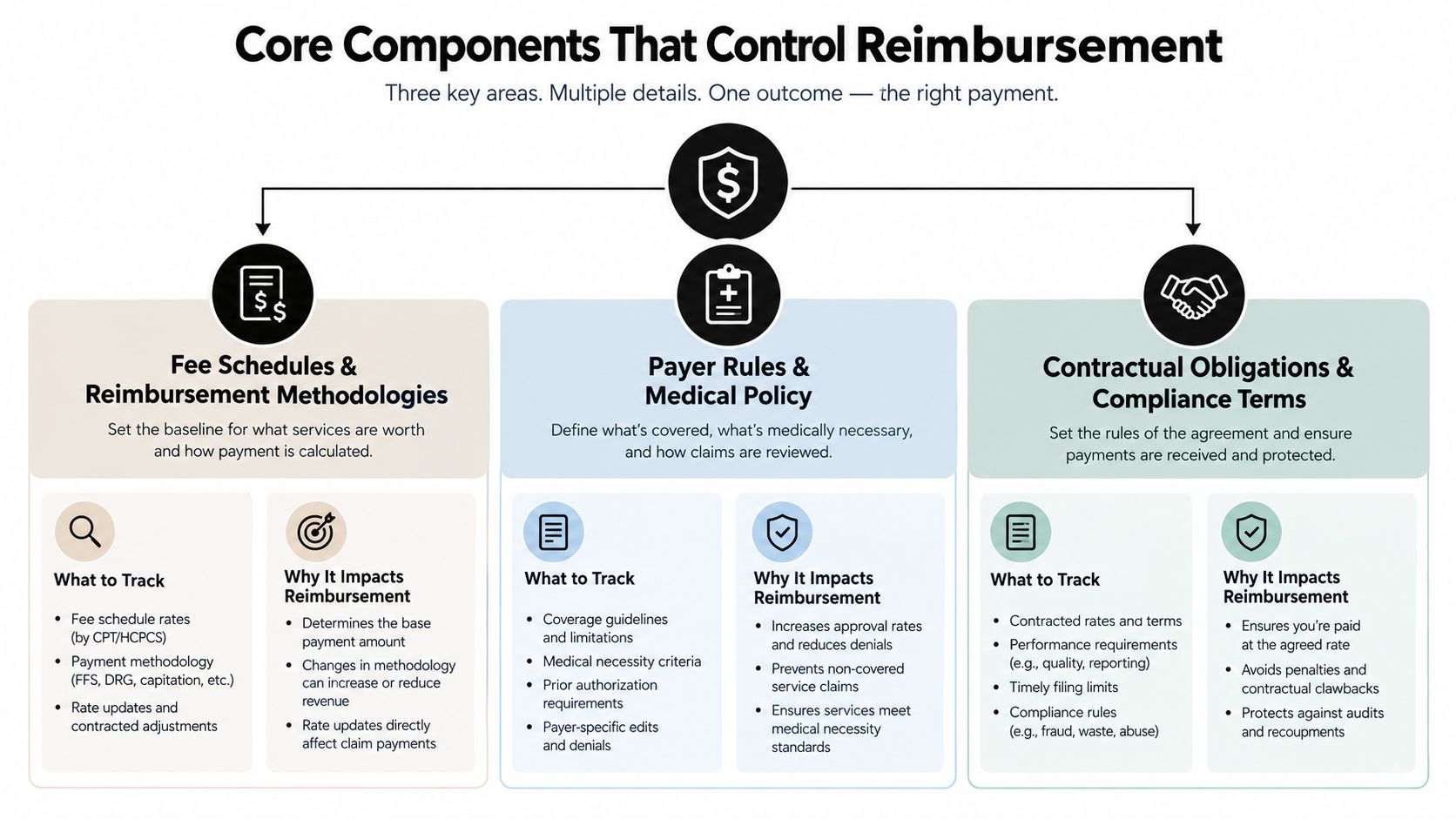
Think of a payer contract as the operating system for reimbursement. The fee schedule acts like the pricing engine. Payer rules determine how the engine handles authorization, medical policy, modifiers, and submission requirements. Contractual obligations define who may participate, what each party must do, and when those obligations take effect.
Saving a PDF preserves the operating system's source code, but it doesn't make the code usable by the claims team. Active management extracts the terms, labels them, assigns effective dates, connects them to providers and locations, and makes them searchable at the moment someone needs to price a claim or challenge a payment.
The lifecycle behind every agreement
A practical lifecycle has distinct stages:
- Intake and inventory: Collect the agreement, exhibits, fee schedules, amendments, payer correspondence, and related participation documents.
- Review and negotiation: Identify rate provisions, exclusions, obligations, renewal language, termination rights, dispute procedures, and implementation dependencies.
- Execution: Confirm that the final signed version is complete, authorized, and stored with a reliable effective date.
- Operationalization: Convert relevant terms into pricing, billing, credentialing, eligibility, authorization, and monitoring workflows.
- Performance monitoring: Compare payer behavior with contractual expectations and record exceptions.
- Renewal or termination: Use performance evidence, market conditions, and operational risk to guide the next decision.
Centralization matters because agreements contain data that teams need to retrieve without manually opening every document. Medallion's payer contract management overview describes the value of converting payer agreements into structured, searchable information, including rates, effective dates, filing limits, and other terms.
The difference between storage and management becomes clear during a payment variance. Storage answers, “Where is the document?” Management answers, “What should this claim have paid, which clause supports that expectation, who owns the correction, and what evidence should we retain?”
Core Components That Control Reimbursement
A complete contract record must describe more than the negotiated rate. It must explain the conditions under which the rate applies, the responsibilities that support payment, and the dates that determine which version governs a claim.
Fee schedules and reimbursement methodology
Start with the financial terms. Track the applicable fee schedule, reimbursement percentage or methodology, base rates, relative value references, per diem terms, case rates, bundled services, carve-outs, and out-of-network provisions where relevant. The record should identify the service codes, modifiers, provider types, locations, and effective periods attached to each rule.
A rate can look attractive in a negotiation summary and still produce weak reimbursement if the implementation team misses a carve-out or applies the wrong methodology. Contract management should therefore preserve both the legal language and the operational interpretation used by pricing and billing teams.
Payer rules and medical policy
Payer policies can determine whether a service is payable even when a fee schedule contains a rate. Authorization requirements, medical-necessity rules, documentation standards, modifier treatment, timely filing limits, and claim submission instructions belong in the operational record. A contract team doesn't need to replace clinical or coding leadership, but it must show where contractual terms intersect with those workflows.
Participation and credentialing obligations
Network status depends on more than signature. Track provider enrollment, credentialing, recredentialing, location participation, taxonomy, effective dates, delegated responsibilities, and notice requirements. A credentialing lapse can create payment risk, network confusion, and denials even when the underlying rate remains favorable.
Amendments and effective dates
An amendment should never sit beside the original agreement without a clear relationship between them. Record what changed, when it became effective, which providers and locations it affects, and whether downstream systems were updated. Effective-date discipline prevents teams from using a current rate for an older claim or an expired term for a new encounter.
Value-based obligations
Value-based terms may include quality measures, reporting responsibilities, attribution rules, shared savings provisions, episode definitions, risk corridors, and reconciliation procedures. The contract record should identify the data source, responsible owner, reporting cadence, and financial consequence of missing an obligation.
Contract drift occurs when the agreement, the operational workflow, and the payer's actual payment behavior no longer match.
Use this checklist when validating a contract record:
- Identity: Payer, product, legal entity, provider group, locations, and participating specialties.
- Money: Fee schedules, methodologies, carve-outs, exclusions, incentives, and reconciliation terms.
- Timing: Signature date, effective date, renewal date, termination notice period, and amendment history.
- Operations: Authorization, filing limits, credentialing, claims submission, documentation, and appeal requirements.
- Evidence: Signed documents, exhibits, payer notices, remittances, correspondence, and dispute support.
ICertis' healthcare payer contract materials identify the kinds of terms platforms are built to track, including fee-for-service rates, reimbursement schedules, participation requirements, credentialing obligations, amendments, and value-based care provisions. The important point isn't the number of fields in a repository. It's whether the record exposes drift early enough for the revenue cycle team to respond.
How Leading Teams Organize People Process and Technology
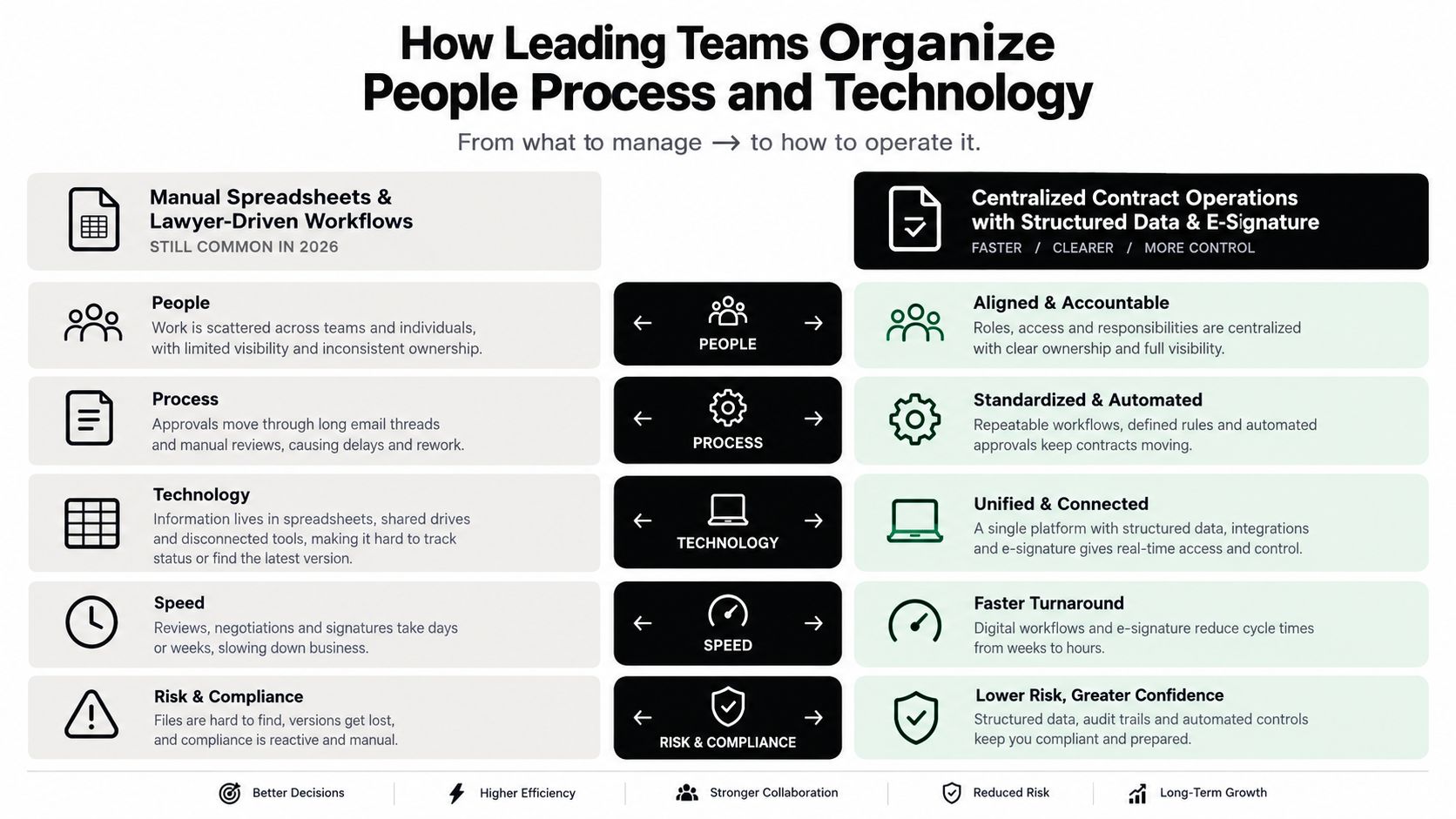
Manual workflows can work for a small, stable practice with limited payer variation. They become fragile when several locations, specialties, payer products, amendments, and billing systems interact. Spreadsheets may show that a contract exists, but they rarely provide a dependable connection between a clause and the remittance line that tests it.
Independent 2026 coverage reports that two-thirds of medical payers and all dental payers use spreadsheets and lawyers as primary contracting tools, while more than one quarter of providers still use spreadsheets for core contracting tasks, as described in the Health Management Institute coverage of payer and provider contracting. The same coverage says larger provider groups are only about ten percentage points more likely than smaller practices to use legal review, e-signature, and contract management software. The tooling gap therefore affects organizations of different sizes, not only enterprise health systems.
Three operating models
A centralized model places contract intake, abstraction, renewal control, payer correspondence, and performance monitoring with a dedicated team. It provides consistent definitions and stronger governance, but smaller organizations may not have enough volume to justify every role internally.
A hybrid model keeps negotiation, legal judgment, and market strategy with internal leaders while using a shared contract operations function for data structure, amendment control, and payment monitoring. This often fits specialty platforms that need local knowledge without duplicating administrative work across locations.
An outsourced model uses an external partner for selected activities such as fee schedule modeling, underpayment analysis, contract implementation, or dispute preparation. The provider still needs an internal owner who approves priorities, controls access, and makes business decisions.
What technology should actually do
Choose technology based on execution, not presentation. A useful platform should:
- Extract terms: Capture rates, dates, obligations, and exceptions from agreements and exhibits.
- Preserve relationships: Link amendments, fee schedules, providers, locations, and payer products.
- Support workflow: Route review, approval, signature, implementation, and renewal tasks.
- Connect payment data: Compare expected reimbursement with claims and remittance information.
- Create an audit trail: Show who changed a term, approved an interpretation, or resolved a variance.
- Surface risk: Flag missing documents, approaching deadlines, credentialing gaps, and unexplained payment patterns.
A tool that stores documents but leaves analysts to reconcile payment manually only moves the filing cabinet online. Teams evaluating broader workflow automation can also review healthcare workflow automation resources as part of their technology comparison.
The right model reduces execution latency, the time between agreeing to a term and using it correctly in the payment workflow. That latency is often the overlooked source of leakage. A rate doesn't protect cash until the right people and systems apply it.
Negotiation and Enforcement Strategies That Hold Payers Accountable
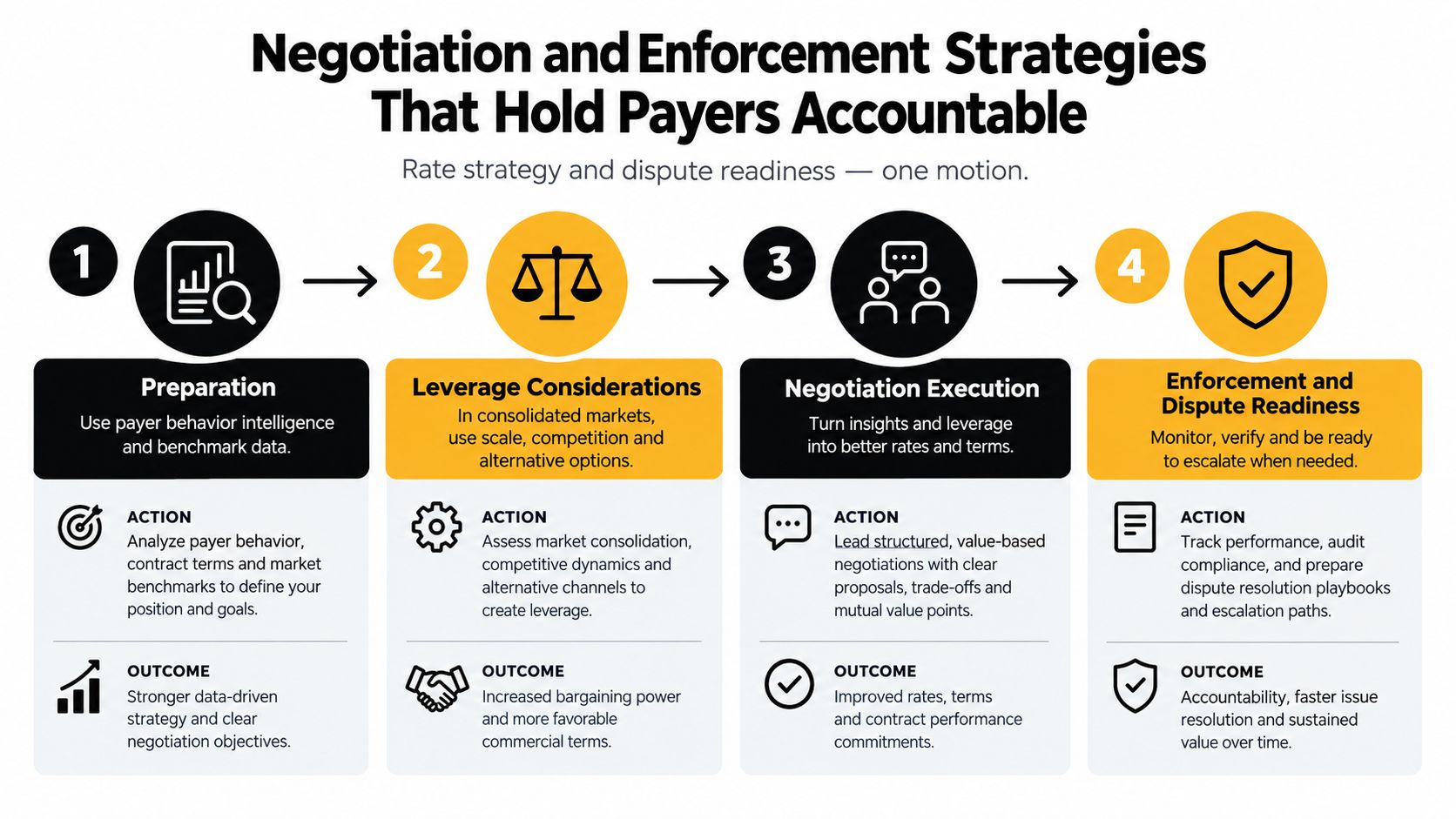
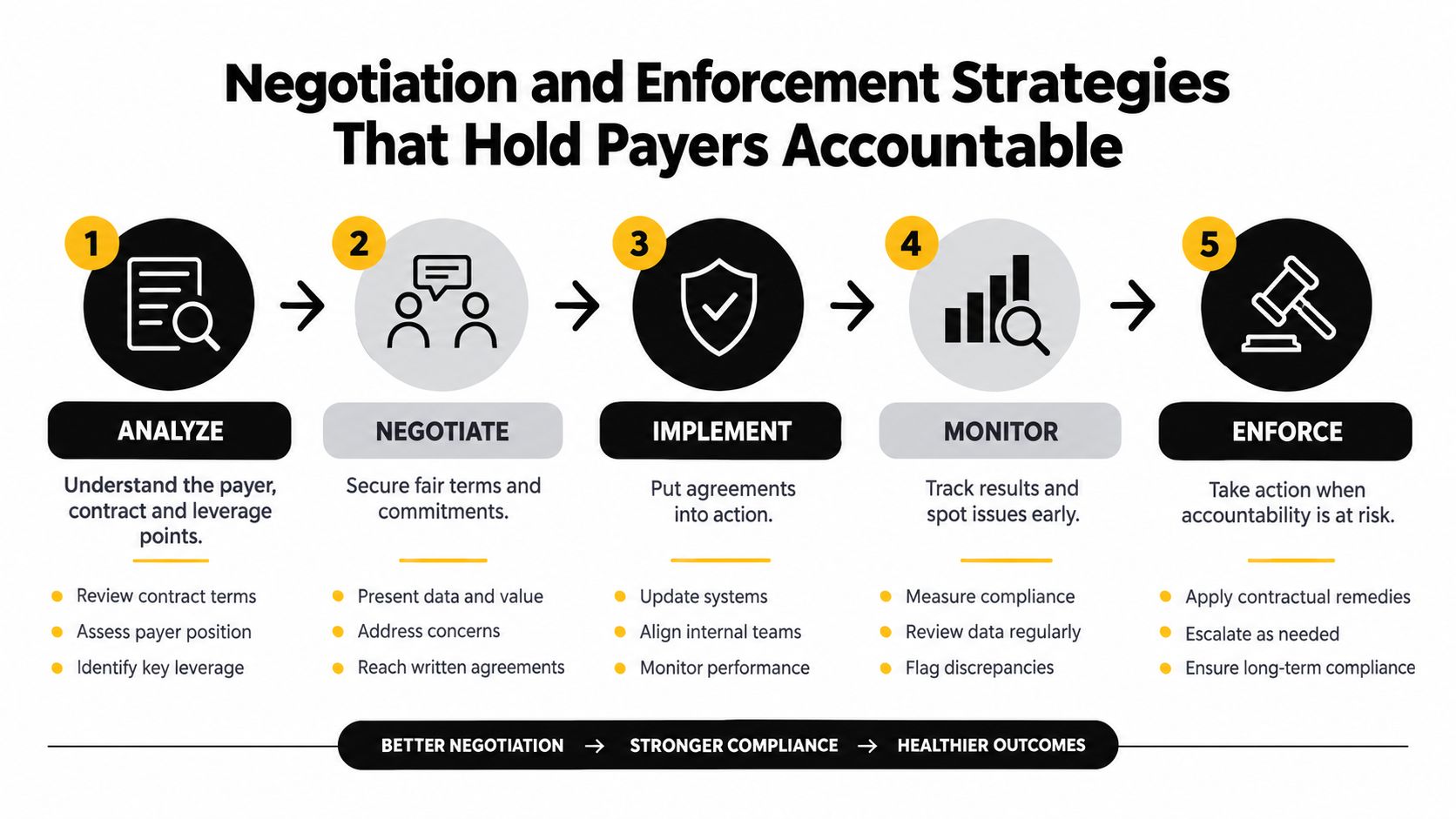
A payer contract can promise a strong rate and still produce weak payment. The difference appears in execution: claims are processed under the wrong product, an amendment never reaches billing, or a variance sits unresolved because no one preserved the evidence. Negotiation and enforcement therefore belong to one payment-control discipline. Negotiation sets the rule. Enforcement checks whether the rule reaches the remittance.
Prepare with payment intelligence
Before opening a negotiation, build a payer-specific view of actual performance. Review reimbursement by service, location, provider type, product, and payment methodology. Separate contractual underpayments from coding issues, authorization failures, eligibility problems, and documentation denials. This distinction prevents a team from demanding a rate change when the problem is a broken workflow.
A negotiation file should include:
- Current terms: The signed agreement, exhibits, amendments, and effective dates.
- Observed behavior: Payment variances, denial patterns, processing delays, and recurring payer explanations.
- Operational cost: Staff effort required to correct claims, appeal denials, and monitor compliance.
- Strategic priorities: Target rates, protected carve-outs, service lines needing support, and terms that create avoidable administrative work.
Consolidation changes negotiating power, but evidence still determines the strength of the position. Brown and Brown's provider contracting market coverage describes continued provider consolidation, growing interest in outcome-based and episode-focused contracting, and wide variation between commercial hospital and facility costs and Medicare. That situation makes site-of-care analysis, service-line economics, and measurable outcomes useful negotiation inputs.
Consider a specialty service with two locations. The payer applies the same fee schedule, but one location has a different participation status and a separate facility arrangement. Claims from that site are paid below expectation. A useful negotiation file does more than show the shortfall. It identifies the affected product, traces the applicable contract language, quantifies the correction effort, and proposes a term or implementation change that can be tested after signature.
Write terms that operations can enforce
A clause should translate into an operational action. Define the service, payment basis, exception, effective date, and evidence required to validate performance. If the term depends on a payer policy, record the policy version and assign an owner to review changes.
The amendment process matters as much as the original agreement. Require an implementation record stating what changed, which systems and teams need updates, who tested the change, and when monitoring begins. A rate increase that remains in a contract repository is not a payment improvement. It becomes one only when claims and remittances reflect it.
Build IDR readiness before a dispute
The No Surprises Act IDR pathway shows why enforcement capability affects negotiation posture. The IDR volumes and provider win rates cited earlier indicate that eligible disputes require a repeatable process, even though no prior result guarantees an individual outcome.
Dispute readiness begins before a disagreement:
- Submit clean claims: Preserve accurate eligibility, coding, service, provider, and location information.
- Capture the payment record: Retain the remittance, payer communications, and relevant claim history.
- Map the contract: Identify the agreed term, applicable exception, and effective period.
- Document the variance: State what the payer paid, what the contract or applicable rule supports, and why the difference matters.
- Protect deadlines: Assign ownership for appeals, notices, submissions, and evidence assembly.
- Track the result: Record the determination and apply the outcome to payer intelligence and future negotiations.
Federal IDR program data records more than 2.5 million disputes and nearly 2.2 million payment determinations in 2025. The operational lesson is direct: enforcement cannot depend on an individual remembering where a document was stored. Teams need connected records, assigned deadlines, and evidence that can be assembled without reconstructing the case from email.
For organizations assessing an integrated approach, RevGuard's payer contract management capability describes clause tracking, rate benchmarking, payer behavior monitoring, and support for enforceability. Use those capabilities as evaluation criteria alongside internal ownership, documented controls, and a clear path from contract term to payment review.
Connecting Contracts to RCM and Measuring What Matters
Contract data should enter the revenue cycle before the claim is submitted. Eligibility and registration teams need the correct payer product, provider, location, and participation status. Coding and billing teams need the applicable reimbursement methodology, authorization conditions, modifiers, and filing limits. Payment posting and follow-up teams need an expected amount against which the remittance can be tested.
That creates a chain of controls:
- Eligibility: Confirm that the patient, product, provider, and location align with participation terms.
- Charge capture and coding: Apply the service, modifier, and documentation rules tied to the agreement.
- Claim submission: Check filing limits, authorization requirements, and required claim elements.
- Remittance: Compare allowed and paid amounts with the contract's expected result.
- Denial prevention: Group exceptions by root cause, then fix the upstream workflow instead of repeatedly appealing symptoms.
- Post-pay audit: Search for patterns across payers, codes, locations, and effective periods.
The critical comparison is expected reimbursement versus actual reimbursement. If the contract record can't produce a defensible expectation, an underpayment can look like a normal payer variance. If it can, the variance becomes a work item with an owner, evidence, and a resolution path.
| Metric | What It Reveals | How to Use It |
|---|---|---|
| Contract compliance rate | Whether payer payments match applicable terms | Segment by payer, product, code, location, and effective period |
| Underpayment recovery rate | Whether identified variances become recovered cash | Review recovery by root cause and responsible workflow |
| Denial rate by payer and code | Where contract or payer rules are creating preventable failures | Prioritize coding, authorization, eligibility, or claim edits |
| Days in A/R | Whether payment friction is delaying cash after service | Compare delays with payer terms, disputes, and unresolved variances |
| Credentialing turnaround | How quickly provider and location requirements become active | Track dependencies that can interrupt network participation |
| Termination risk exposure | Which agreements or disputes could threaten access or reimbursement | Escalate renewal dates, notices, payer behavior, and concentration risk |
Leaders should avoid celebrating document counts as a primary result. A full repository is useful, but revenue protection is demonstrated through cleaner claims, faster variance identification, recovered underpayments, and fewer repeat failures.
For organizations that need reporting across complex payment workflows, healthcare revenue cycle analytics resources can help inform the evaluation of dashboards, payer trend analysis, and contract-linked performance monitoring.
Implementation Roadmap and Common Pitfalls to Avoid
Start with visibility, not automation theater. Inventory every payer agreement, exhibit, amendment, fee schedule, participation record, and termination notice. Assign each document to a payer, product, provider entity, location, specialty, effective period, and owner. Then identify the contracts that create the greatest payment or access risk.
Phase one centralizes the record
Create one controlled repository and a consistent data dictionary. Abstract the terms that affect payment and operations, including rates, methodologies, filing limits, credentialing requirements, amendments, and renewal dates. Resolve conflicts between versions before connecting the data to billing workflows.
Phase two connects terms to payment
Select a focused set of high-volume or high-risk payer arrangements. Map contract terms to expected reimbursement, remittance review, denial categories, and escalation rules. Give staff a clear process for documenting variances and preserving evidence for appeals or IDR.
Phase three establishes governance
Create recurring reviews with contracting, revenue cycle, credentialing, finance, compliance, and operational leaders. Use payer behavior, recovery outcomes, denial trends, and termination exposure to guide renewals and negotiations. Treat every amendment as an implementation event, not merely a signed document.
Avoid four predictable failures:
- PDF accumulation: A folder full of agreements doesn't create searchable payment logic.
- Amendment blindness: An unlinked amendment can make the active fee schedule impossible to determine.
- Departmental separation: Contracting, credentialing, and billing can each complete their own task while the claim still fails.
- One-time negotiation: A signed rate needs monitoring, validation, and enforcement throughout its term.
The operating principle is durable: rate strategy and dispute readiness belong in the same revenue protection system. Provider organizations that connect contract terms to remittance data can find leakage earlier, prevent repeat denials, and approach payer negotiations with evidence rather than assumptions.
RevGuard connects specialty revenue cycle management with payer contract oversight and Independent Dispute Resolution readiness, helping provider organizations link eligibility, coding, credentialing, claims, payment analysis, and enforcement workflows. Visit RevGuard to see how its contract and revenue protection approach can support cleaner payment execution and more organized dispute preparation.