

The American Hospital Association reported that Medicare and Medicaid underpayments totaled $100.4 billion in 2020, up from $75.8 billion in 2019. Medicare payments covered only 84 cents per dollar of hospital cost, while Medicaid covered 88 cents, and most hospitals received payments below cost from both programs. The Milliman analysis puts the problem in its proper context: medical underpayment recovery isn't a cleanup exercise for occasional billing mistakes. It's a revenue protection function addressing a structural gap between contracted reimbursement and cash received.
For specialty groups, the most expensive leakage often arrives on claims that appear fully paid. The remittance posts, the account closes, and nobody compares the paid amount with the line-level amount required by the payer contract. That gap is where disciplined recovery work starts.
The Six-Figure Leak Hiding in Plain Sight
A 14-physician orthopedic group once approached underpayment recovery with the usual assumption: if the payer had processed and paid a claim, the remaining contractual adjustment was probably correct. A review of routine commercial remittances proved otherwise. Across 18 months, seemingly settled 835 files contained a $740,000 underpayment distributed across ordinary procedures, modifiers, and payer plans.
The problem wasn't that the billing team had ignored claims. Staff had followed standard workflows, posted remittances, worked denials, and closed accounts. The missing control was an independent comparison between the expected allowed amount and the actual line-level payment.
The group also believed that a commercial leakage rate of 3% of gross revenue was part of doing business. Once payer contract terms were modeled against actual adjudication behavior, the gap surfaced at 7.4%. Those figures come from the representative scenario, not a universal benchmark. The operational lesson is universal, though: a paid claim can still be materially wrong.
Where a Six-Figure Underpayment Typically Hides
| Service Line | Claim Volume | Expected Allowed | Actual Paid | Variance | Variance % |
|---|---|---|---|---|---|
| Orthopedic evaluation and management | High | Contract rate | Reduced rate | Repeated shortfall | Material |
| Surgical procedures | Moderate | Contract rate plus modifiers | Bundled or edited payment | Repeated shortfall | Material |
| Imaging and ancillary services | Moderate | Separate contracted allowance | Partial bundled payment | Repeated shortfall | Material |
The table shows the pattern without pretending every provider has the same exposure. High-volume, routine services often hide more recoverable dollars than unusual claims because a small variance repeats across the book of business. A payer that consistently prices a procedure below the contracted rate can create a larger annual problem than a visible denial that staff already knows how to route.
Practical rule: A remittance tells you what the payer paid. It doesn't prove what the payer owed.
Recovered underpayments flow directly to operating margin because the provider doesn't need to generate another encounter to earn them. The work is in reconstructing the obligation, proving the variance, and collecting money already attached to services the group performed.
What Medical Underpayment Recovery Actually Means
Medical underpayment recovery is the structured process of identifying, validating, disputing, and collecting the difference between the reimbursement required by a payer contract and the amount deposited after adjudication. The claim isn't necessarily denied. In many cases, it was processed correctly enough to close, but the payment doesn't match the applicable fee schedule, modifier rule, carve-out, or contract provision.
That distinction matters because standard denial management often misses underpayments entirely. A denial is rejected or unpaid and usually enters a visible work queue. An underpayment can post as a normal transaction with a contractual adjustment, which makes it invisible unless the provider independently calculates the expected payment.
Four loss patterns deserve separate treatment
- Downcoding: The payer reimburses a lower-level CPT code than the provider submitted, often without a clinical explanation that supports the change.
- Bundling: The payer combines services that the contract or applicable billing rules treat as separately payable, including services supported by appropriate modifiers.
- Miscoding: An edit engine changes the payable interpretation of the submitted procedure, even though the coding team didn't make the original error.
- Unjustified edits: The payer applies an opaque processing rule that reduces or redirects payment without a clear contractual basis.
These categories require different evidence. A downcoding dispute needs the original code, clinical support, and the payer's adjustment reason. A bundling dispute needs the affected procedure lines, modifiers, and the applicable reimbursement language. A miscoding dispute requires a clean comparison between the submitted claim and the adjudicated result.
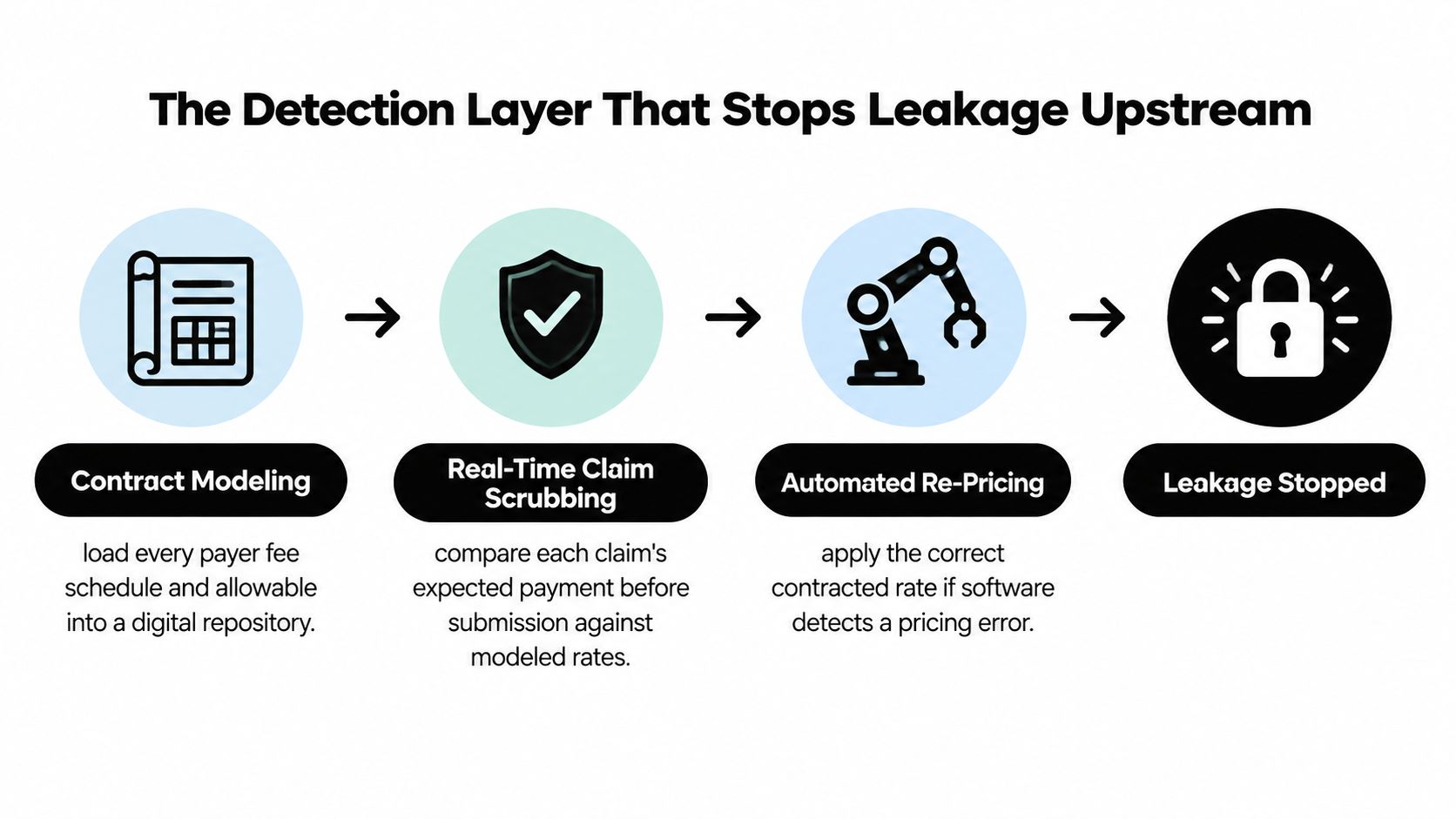
A useful recovery queue separates these issues from denials, patient balances, and accepted write-offs. The team should ask one direct question for every paid claim: did the payer pay the amount required under the contract for each billed line? If the answer isn't known, the account isn't fully reconciled.
Commercial payer underpayments are commonly estimated at 1% to 3% of net patient revenue annually, according to MD Clarity's healthcare underpayment guide. That range makes the issue recurring margin drag rather than an isolated exception. For a provider organization with $100 million in revenue, the same source's benchmark implies roughly $1 million to $3 million potentially at risk each year.
Why Payers Underpay in the First Place
Some shortfalls are genuine billing mistakes. A modifier may be missing, a charge may be entered incorrectly, or a coder may choose a code the documentation doesn't support. Those errors are real, but they shouldn't obscure the larger operational problem: a repeatable variance across a payer, procedure, location, or modifier pattern points to an adjudication or contract application issue, not a random staff mistake.
Payer systems create recurring leakage through several mechanisms. Downcoding can follow broad medical-necessity language in an edit engine. Bundling logic may disregard modifier-based unbundling rights written into the contract. Clearinghouse or payer edits can also re-map the submitted code in a way that isn't obvious until someone compares the claim with the remittance.
The four-artifact evidence packet
Every recoverable variance should be supported by four core records:
- The original claim, including billed codes, modifiers, units, diagnosis information, provider identity, and dates of service.
- The ERA or 835, including the paid amount and all CARC and RARC codes associated with the adjustment.
- The contract exhibit, including the relevant fee schedule, carve-out, modifier provision, or payment methodology.
- Clinical documentation, such as the operative report or progress note supporting the service and its level of complexity.
A fifth item makes the packet easier to review: a one-page variance summary showing the expected amount, actual payment, difference, and requested correction. Without the underlying four artifacts, the summary is only an allegation. With them, the provider can answer the payer's most common response, “paid per contract,” by identifying the exact provision and the exact line that contradicts the payment.
The distinction between a payer mistake and a provider mistake also affects prevention. If the contract supports separate payment but the claim lacked the required modifier, the RCM team needs a coding or workflow correction. If the modifier was present and the payer still bundled the line, the recovery team needs a contract-anchored dispute.
For a practical explanation of how contracted reimbursement differs from other payment concepts, review insurance allowed amounts in medical billing. The more precisely the organization defines the expected amount before filing, the less room it leaves for a payer to make a vague adjudication response sound conclusive.
The Detection Layer That Stops Leakage Upstream
Recovery after payment is valuable, but prevention preserves more cash and reduces the burden on follow-up staff. The strongest programs use a detection layer that evaluates the claim before submission, reconciles the payment after adjudication, and turns repeated variances into payer intelligence.
Contract modeling comes first
A rate engine should contain every relevant payer contract, fee schedule, carve-out, modifier rule, and effective date. Loading only a primary fee schedule isn't enough. Specialty groups frequently operate across plan types, locations, provider entities, and amendments, so the model must identify which contractual rule applies to each claim.
The core inputs are straightforward:
- Charge description master: The organization's service and pricing structure.
- Contract load: Payer-specific rates, provisions, and effective dates.
- ERA 835 data: Actual payment, adjustment, reason, and remark information.
- Claim detail: CPT or HCPCS codes, modifiers, units, provider, location, and date of service.
Reconcile at the line level
A claim total can look reasonable while one procedure line is underpaid and another is overpaid. Compare the expected allowed amount with the actual payment at the CPT, modifier, and unit level, then roll the findings up by payer, plan, provider, location, and service line.
The report should identify patterns such as a payer repeatedly reducing 99214 to 99213, or applying a bundling edit to a high-volume procedure. Those examples illustrate the type of pattern worth investigating. They aren't universal findings for every organization.
Run the variance process on a regular cadence, preferably soon after ERAs post. Commercial contracts often impose dispute windows ranging from 90 to 180 days, as described in the MD Clarity underpayment guide. Delayed detection leaves fewer viable claims, weaker records, and less time for escalation.
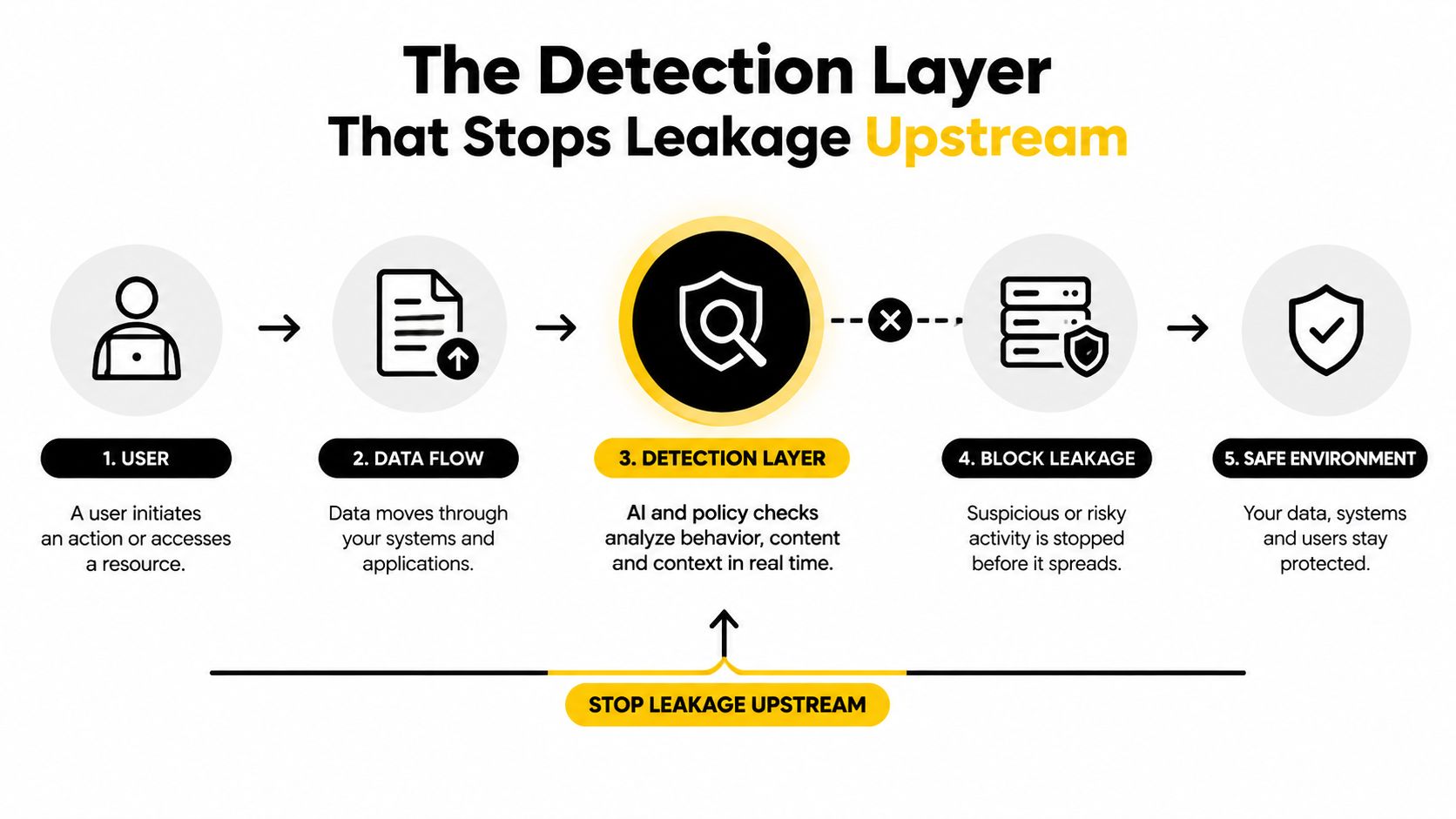
A useful dashboard doesn't merely show total underpayments. It shows which payer is creating the variance, which code is affected, which contract term controls, how old the claim is, and what action is pending. The EOB in medical billing can help teams understand the remittance information that feeds this reconciliation, but the EOB or ERA alone isn't an expected-payment model.
The Enforcement Layer That Pulls Revenue Back
Detection creates a work queue. Enforcement converts that queue into cash. A provider shouldn't send the same generic appeal for every variance because a fee schedule mismatch, a clinical downcode, and a modifier bundling dispute require different arguments and supporting records.
Use escalation deliberately
A practical escalation path has four levels:
- Written payment dispute: Identify the claim, CPT line, contract clause, expected amount, actual amount, and requested correction. Keep the request narrow enough for a payer analyst to validate.
- Formal appeal: Add clinical documentation, comparative charge or payment data, and the specific reason the payer's adjudication conflicts with the contract.
- Provider relations escalation: Send a quantified exposure summary to network management or a payer executive when the same issue appears across multiple claims.
- Independent Dispute Resolution: Use the No Surprises Act IDR process for eligible out-of-network disputes and qualifying disputes under applicable federal or state pathways.
The No Surprises Act IDR process isn't a substitute for eligibility screening. It requires a defensible dispute file, timely initiation, and compliance with the applicable portal and submission requirements.
Compare the channels before choosing one
| Channel | When to Use | Cycle Time | Evidence Required | Typical Yield |
|---|---|---|---|---|
| Written dispute | Clear contract variance on an individual claim | Depends on payer | Claim, ERA, contract excerpt, variance summary | Best for straightforward corrections |
| Formal appeal | Clinical or coding rationale is contested | Depends on payer | Appeal form, clinical record, coding support, payment comparison | Strong when the record is complete |
| Payer executive escalation | Repeat variance across a payer book | Depends on payer relationship | Pattern analysis, affected claims, contract language, exposure summary | Useful for systemic issues |
| NSA IDR | Eligible out-of-network or qualifying dispute | Governed by IDR rules | Complete claim and evidence packet, eligibility documentation | Driven by eligibility and evidence quality |
A dispute-ready packet should include the original claim, ERA with the adjustment reason, applicable contract excerpt, clinical note supporting medical necessity, and a one-page calculation. Teams should also validate provider taxonomy, filing timing, batching rules, signatures, and portal requirements before submission. Missing taxonomy, late batched disputes, or unsigned federal portal submissions can turn a strong payment argument into an ineligible filing.
Federal and industry data show why operational discipline matters. More than 300,000 surprise billing disputes were initiated from April 2022 through March 2023, while later federal reporting recorded more than 1.37 million disputes in the second half of 2025 alone, a 16% increase from the first half. Providers won 85% of the 1.15 million disputes that reached payment determinations in that later period, and awards exceeded the qualifying payment amount in 87% of determinations, according to Federal dispute reporting summarized by Fierce Healthcare. Those results don't guarantee an individual outcome. They do show that IDR has become a high-volume reimbursement channel requiring screening, documentation, and case management.
What Realistic Recovery ROI Looks Like
Provider leaders should pressure-test recovery projections against the verified commercial benchmark, not a vendor's most favorable anecdote. Commercial underpayments are commonly estimated at 1% to 3% of net patient revenue annually, according to MD Clarity. That gives a CFO a defensible starting point, while the actual opportunity still depends on specialty mix, payer contracts, coding quality, claim volume, and the age of the available accounts.
A $100 million provider organization could therefore have roughly $1 million to $3 million at risk annually under that benchmark. The estimate describes potential exposure, not guaranteed recovery. Some findings will be invalid after contract review, some claims will be outside the filing window, and some payers will correct issues without paying every historical variance.
Evaluate the program on net cash
A credible business case includes:
- Gross identified variance: What the reconciliation engine flags before validation.
- Validated recovery opportunity: What survives contract, coding, eligibility, and timely filing review.
- Collected cash: What the payer remits.
- Program cost: Software, analyst time, appeal preparation, legal support where applicable, and IDR administrative fees.
- Repeat leakage: Whether the payer continues creating the same variance after intervention.
High-volume commercial leakage can justify dedicated analytics even when the average claim variance looks small. The arithmetic changes with specialty economics, though. A group with a concentrated procedure mix may prioritize a few payer-CPT combinations, while a multisite organization may need broader contract normalization before it can trust the result.
The No Surprises Act data provides another ROI signal. The Congressional Budget Office's analysis reports 3.4 million disputes filed from 2022 through mid-2025, far above the initial CMS projection of roughly 22,000 disputes per year, with providers prevailing in more than 80% of cases. Volume alone doesn't make IDR profitable. Eligibility screening, evidence preparation, filing cost, and expected award must all be evaluated before a provider scales submissions.
A sustainable program is an operating function, not a one-time audit. Contract loads need maintenance, payer behavior needs monitoring, and recovered claims should feed corrections into coding, credentialing, charge capture, and future dispute packets.
Misconceptions That Keep Providers From Recovering
The first misconception is that ordinary appeals and EOB disputes are sufficient. They aren't designed to find every paid claim that violates a contract. If the system only tracks denials, it will miss the claims that closed with a payment and an incorrect contractual adjustment.
The fix is a separate variance workflow. It should compare expected and actual reimbursement, classify the reason, and route the claim according to the evidence needed. A payer can process a claim without generating a denial, so the absence of a denial doesn't establish that payment was correct.
Small variances still deserve a threshold
The second misconception is that individual shortfalls are too small to pursue. That may be true for a single claim after labor and filing costs are considered. It isn't necessarily true when the same difference repeats across a payer's book.
Commercial underpayments commonly represent 1% to 3% of net patient revenue, as reported by MD Clarity. The right response is not to chase every variance indiscriminately. Set a threshold, group related claims, and prioritize repeated patterns with a clear contract basis.
The third misconception treats IDR as a nuclear option. Eligible disputes have become a routine, high-volume enforcement channel. Federal reporting recorded nearly 1.4 million disputes initiated in the second half of 2025, with roughly 20% to 42% challenged as ineligible depending on the period, according to Healthcare Dive's CMS-based reporting.
That eligibility challenge rate is a warning, not an invitation to file everything. Providers need upstream coding, credentialing, taxonomy, and documentation controls so only qualifying disputes reach the portal. Recovery works best as a system with detection, validation, escalation, and prevention, not as a series of disconnected fights.
A 90-Day Provider Playbook for Medical Underpayment Recovery
A specialty group can launch a focused program without adding headcount by sequencing the work around existing RCM data. The first objective isn't to recover every dollar immediately. It's to establish a reliable baseline, prove the largest patterns, and create reusable evidence workflows.
Days 1 through 30 build the foundation
Pull a retrospective remittance dataset and organize it by payer, contract, CPT or HCPCS code, modifier, provider, location, and date of service. Load the applicable contracts and fee schedules into a model, then calculate expected reimbursement against actual payment. The first output should be a prioritized variance baseline, not a broad report full of unvalidated exceptions.
Assign ownership for contract interpretation, clinical validation, payer communication, and cash posting. If one person performs every step, the process will stall when a disputed line needs both coding review and contract analysis.
Days 31 through 60 make detection repeatable
Turn the baseline into a recurring line-level report. Rank payer-CPT combinations by exposure, then validate the highest-value patterns with the original claims, ERAs, contract provisions, and clinical records. Build a dispute packet template that preserves the calculation and evidence structure for future cases.
This is the point to evaluate technology. Contract modeling, ERA analytics, automated repricing, and payer scorecards can reduce spreadsheet work, but they don't replace contract judgment. RevGuard is one option that combines specialty-specific RCM, underpayment analysis, payer escalation, and NSA IDR workflows in a connected revenue protection model.
Days 61 through 90 enforce and govern
Escalate the oldest and highest-value validated buckets first. File IDR initiation notices only for qualifying disputes after confirming eligibility, taxonomy, timing, batching, and signature requirements. Compare collected cash with the original baseline, then separate recovered historical dollars from new leakage prevented.
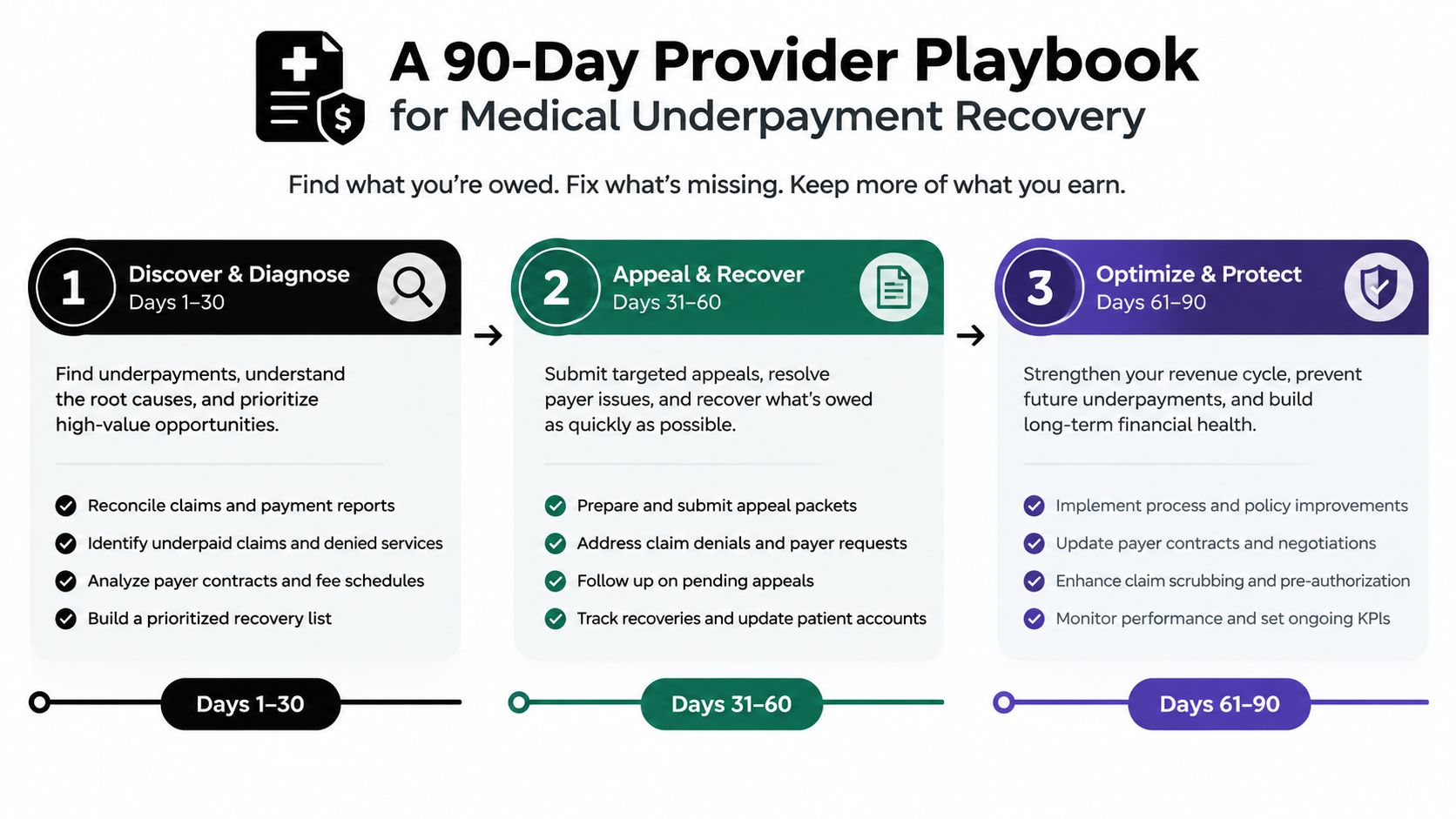
Keep the program alive with a weekly variance review, a monthly payer scorecard, and quarterly contract discussions triggered by repeat payment behavior. The scorecard should track identified variance, validated opportunity, submitted disputes, payer responses, collected cash, aging, and recurring root causes. That cadence turns recovery from a temporary project into a control over reimbursement value.
RevGuard connects specialty-specific RCM, contract-based underpayment analysis, payer escalation, and NSA IDR case preparation so provider groups can build cleaner, dispute-ready claims upstream. Visit RevGuard to evaluate a revenue protection workflow built around both detection and enforcement.