
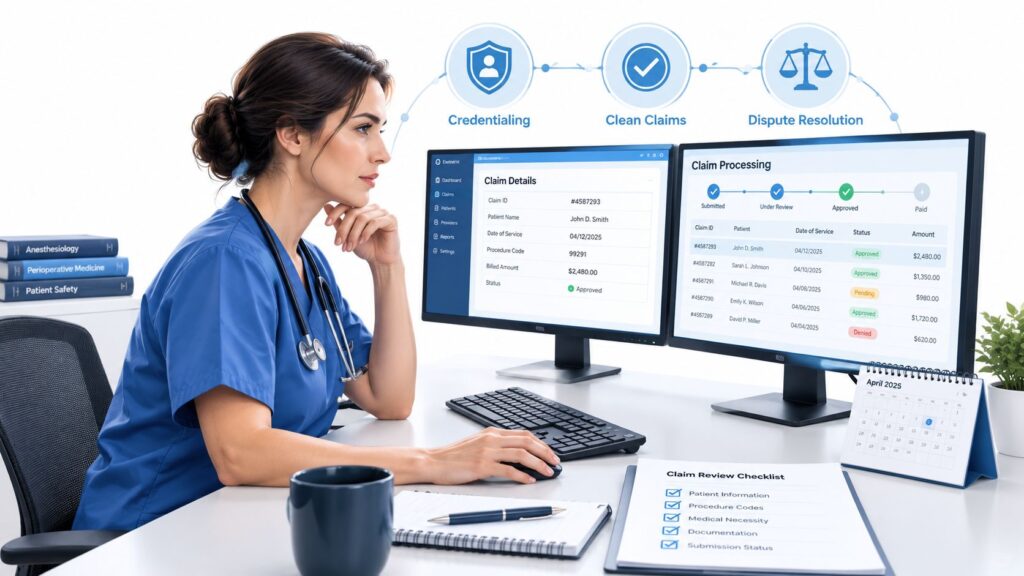
A patient arrives for a scheduled procedure at a hospital they deliberately chose because it's in network. The surgeon is in network. The facility is in network. Later, the anesthesia claim is processed as out of network, and the billing team is left explaining a problem created before the patient ever entered the operating room.
That scenario captures the operational challenge behind anesthesiologist surprise billing. Hospital-based anesthesia groups often work inside facilities with contracts they don't control, serve patients they may not have screened directly, and submit claims that can trigger both patient-protection rules and payer payment disputes. The solution isn't just to appeal harder after the explanation of benefits arrives. It's to connect credentialing, scheduling, eligibility, coding, clean-claim controls, negotiation, and independent dispute resolution into one revenue workflow.
Why Anesthesiologists Still Get Caught in Surprise Billing
A patient chooses an in-network hospital and an in-network surgeon. The anesthesia group may still hold a different payer status, and its professional claim is adjudicated separately. That mismatch can turn a routine episode of care into a patient complaint, a payment dispute, and avoidable work for the revenue cycle team.

The exposure is documented. A 2019 Health Affairs study of more than 3.9 million cases found out-of-network billing at in-network hospitals in 11.8% of anesthesiology cases, with mean out-of-network charges of $2,130 for anesthesiologists. Across anesthesiology, pathology, radiology, and assistant surgery, these hospital-based specialties billed out of network in about 10% of cases overall. The published study shows why facility participation cannot be used as a reliable proxy for anesthesia participation.
The revenue risk starts before billing
A reactive workflow begins after the record is already fragmented:
- Patient complaint: The patient receives a bill or explanation of benefits and asks the practice to intervene.
- Payer denial: The claim is rejected, downcoded, or priced below the group's expected amount.
- Appeal failure: Staff submit a generic reconsideration without the clinical, contractual, or market evidence needed to support payment.
- IDR scramble: Eligibility, notices, claim details, and payment history sit in separate systems, so the team has to reconstruct the encounter under a deadline.
Each delay increases labor and reduces control. Documentation that was easy to verify at scheduling becomes harder to retrieve after the case, while payer-specific patterns remain invisible unless the group records them consistently.
The No Surprises Act changed patient liability and payment procedures, yet it did not settle every dispute between providers and payers. Patient protections can coexist with contested reimbursement. Treating NSA compliance as a notice obligation alone leaves the payment workflow exposed.
Practical rule: Build every claim for review by a payer, an auditor, and an IDR entity. If the team cannot reconstruct the encounter quickly, the claim is not dispute-ready.
Upstream controls determine downstream options. Credentialing establishes participation by payer and facility. Scheduling identifies network risk before the case. Eligibility confirms plan and benefit details. Coding and documentation support the service performed. Billing preserves the evidence, while payer intelligence helps the group choose between negotiation, appeal, and escalation. That connection turns an underpayment into a recoverable dispute instead of a late discovery.
Preventing Surprise Bills Before the Case Starts
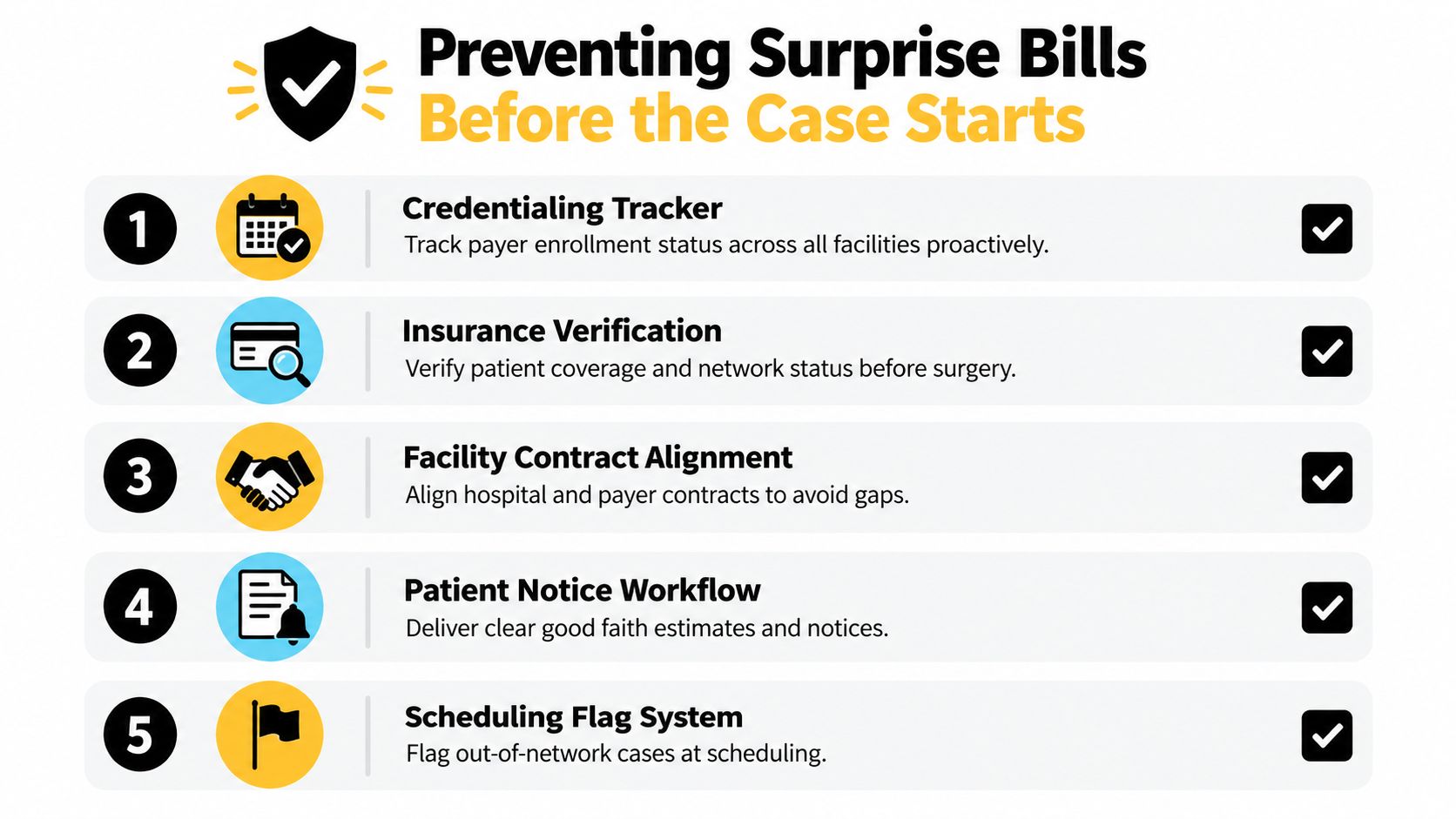
Prevention works when each handoff produces a usable record. Credentialing, scheduling, eligibility, and billing can't operate as separate queues that exchange incomplete notes. The group needs a shared workflow that identifies network risk before anesthesia is delivered.
Start with payer and facility visibility
Build a credentialing tracker that shows, for every clinician and location:
- Enrollment status: Record submitted, pending, approved, effective, terminated, or requiring revalidation.
- Effective dates: Store the actual participation date, not just a contract signature date.
- Facility alignment: Map each anesthesiologist to the hospitals, ASCs, and service locations where they work.
- Payer variation: Track commercial plans separately because participation can differ by product, state, and facility.
- Escalation owner: Assign one person to resolve missing enrollment data before scheduling treats the case as clear.
A spreadsheet can work for a small group if someone maintains it. Multi-site practices usually need a credentialing platform or a carefully governed practice-management workflow. The tool matters less than the control: no scheduler should have to guess whether a clinician is participating at a specific location.
Verify coverage at scheduling
The pre-service checklist should capture the patient's plan, member status, facility network position, anesthesia group participation, authorization requirements, and any notice or consent workflow that applies. Verification should occur early enough to resolve a mismatch, then be refreshed when the case changes or coverage information is updated.
Use a structured medical eligibility verification workflow that gives scheduling and billing the same source record. A phone confirmation without a reference number, timestamp, representative identifier, or benefit detail isn't a durable control. It may help the scheduler in the moment, but it won't give the billing team strong evidence later.
Coordinate the operating-room handoff
The facility and anesthesia group should agree on how out-of-network risks are identified and routed. That includes temporary coverage, locum clinicians, new payer products, add-on cases, emergency cases, and changes in the assigned anesthesiologist.
A useful escalation path looks like this:
- Scheduler flags the mismatch. The case record identifies the facility, payer product, and anesthesia participation issue.
- Front-office staff verify the patient record. They confirm coverage and document the applicable notice process.
- Credentialing or contracting reviews alternatives. The group checks whether another participating clinician or contracted arrangement is available.
- Clinical leadership decides on coverage. The decision accounts for patient care, staffing, and compliance rather than leaving the choice to billing.
- Billing receives the full pre-service record. The claim team knows what was verified and what exception occurred.
Emergency care and clinically necessary coverage won't always allow a different clinician or a new contract. That doesn't make prevention useless. It means the group should distinguish unavoidable clinical exceptions from preventable scheduling failures and preserve documentation for both.
Building Clean Dispute Ready Claims That Payers Cannot Downcode
A clean claim is more than a claim that clears a technical scrubber. For anesthesia, the record must connect the billed service to the clinical encounter, the anesthesia time, the provider's role, and the payer's adjudication logic. That same record becomes the foundation for an appeal, open negotiation, or IDR submission.
Make the anesthesia record internally consistent
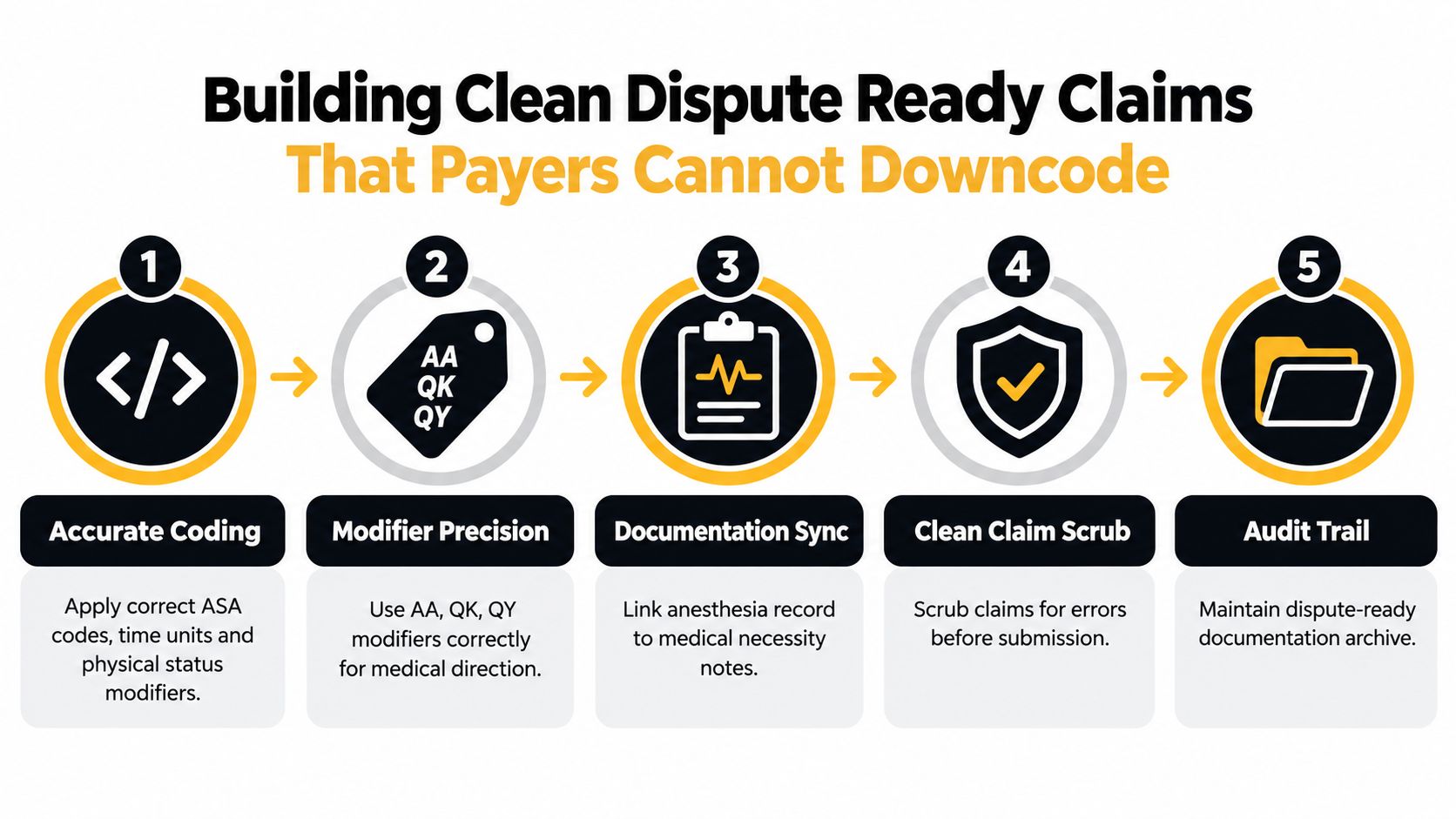
Before submission, reconcile the operative report, anesthesia record, claim form, and eligibility record. The team should confirm the procedure performed, the relevant anesthesia code, start and stop times, time units, physical status modifier, medical-direction circumstances, and provider identifiers.
Modifier precision deserves special attention. The anesthesia team should apply AA, QK, and QY modifiers according to the medical-direction arrangement and payer requirements. A modifier selected by habit can create an avoidable downcode or invite a medical-record request. The claim must describe what the anesthesiologist and care team did, not what a template assumes they did.
Build a QPA-aware evidence file
The qualifying payment amount is part of the payment conversation, but it shouldn't become the only fact in the record. The group should preserve the payer's payment detail, contract status, service location, plan information, claim history, and clinical characteristics that distinguish the case.
A practical evidence file may include:
- Encounter facts: Date, facility, procedure, provider, anesthesia start and stop times, and patient coverage.
- Clinical complexity: Acuity, physical status, unusual risk, emergency circumstances, or additional work supported by the record.
- Payment history: Remittance advice, denial reason, downcode explanation, and prior payer responses.
- Network evidence: Credentialing status and documented verification for the relevant facility and plan.
- Market context: Contract terms, comparable reimbursement information, and relevant payer behavior, when available.
- Administrative trail: Notices, correspondence, open-negotiation communications, and filing dates.
Don't use complexity as a slogan. Tie each factor to a document and explain why it affects the value of the service.
Add a pre-bill quality gate
A final scrub should ask whether the claim is payable, supportable, and recoverable if challenged. Check eligibility mismatches, authorization gaps, invalid modifiers, time-unit inconsistencies, duplicate submissions, missing medical-necessity support, and network-status exceptions.
A structured clean claim process helps separate errors that should be corrected before billing from disputes that require payer escalation. This distinction matters. Sending a preventable coding error into IDR wastes resources and can distract from legitimate underpayment cases.
Documentation should answer the payer's likely objection before the payer raises it.
The archive should be assembled at claim creation, not after a denial. That approach reduces rework, shortens the time needed to evaluate a dispute, and lets leaders measure which payer behaviors originate in data quality problems versus payment strategy.
Negotiating With Payers Without Trading Away Long Term Value
Payer negotiation is a portfolio decision, not an emotional response to one poor remittance. The group should compare the immediate value of a settlement with the effect that rate, contract language, and future payment history may have on later claims and disputes.
A low settlement can convert one receivable quickly while weakening the group's position for similar services. A hard escalation posture can preserve rate integrity but consume staff time and delay cash. The right move depends on network importance, case volume, payer conduct, contractual strength, and the quality of the evidence file.
Compare the available levers
Use contract and payment data to identify patterns. A single underpayment may reflect a coding issue. Repeated downcodes, inconsistent network treatment, or systematic reliance on a low payment benchmark may justify a broader negotiation or IDR strategy.
The group should prepare rate proposals with a clear explanation of the service, documented market context, the operational cost of participation, and the payer's history with comparable claims. Avoid presenting unsupported charges as the entire argument. Payers respond more constructively when the submission separates billed charges, expected contracted amounts, payment methodology, and the specific basis for the requested correction.
| Scenario | Best Move | Evidence to Prepare | Risk If You Wait |
|---|---|---|---|
| Isolated coding or documentation error | Correct and resubmit before escalating | Anesthesia record, corrected code, modifier rationale | A preventable error becomes a formal dispute |
| Repeated underpayment with a viable network relationship | Negotiate with a defined rate and language proposal | Remittance pattern, contract terms, facility volume, payer correspondence | The payer treats inconsistent payment as accepted practice |
| High-value or clinically complex claim with weak payment rationale | Hold the claim for evidence review, then negotiate or escalate | Clinical record, complexity narrative, payment detail, network proof | Staff file a thin case that overemphasizes charges |
| Persistent payer delay or downcode after a complete record | Escalate to IDR when eligible | Open-negotiation record, claim file, QPA response, market and clinical factors | Filing windows and cash-conversion opportunities narrow |
Protect future comparators
Groups should model how negotiated outcomes may influence future expectations. Accepting a rate that solves today's cash problem can create a reference point that the payer uses later. Conversely, refusing every settlement can leave aging receivables unresolved while the team spends its capacity on low-value cases.
The most useful payer scorecard tracks denial reason, payment variance, time to resolution, network status, open-negotiation behavior, and IDR outcome distribution. Review the scorecard by payer and market, not only across the entire book of business. Aggregate results can hide a facility where the payer's behavior is materially different.
Invoking IDR When Payers Delay Downcode or Underpay
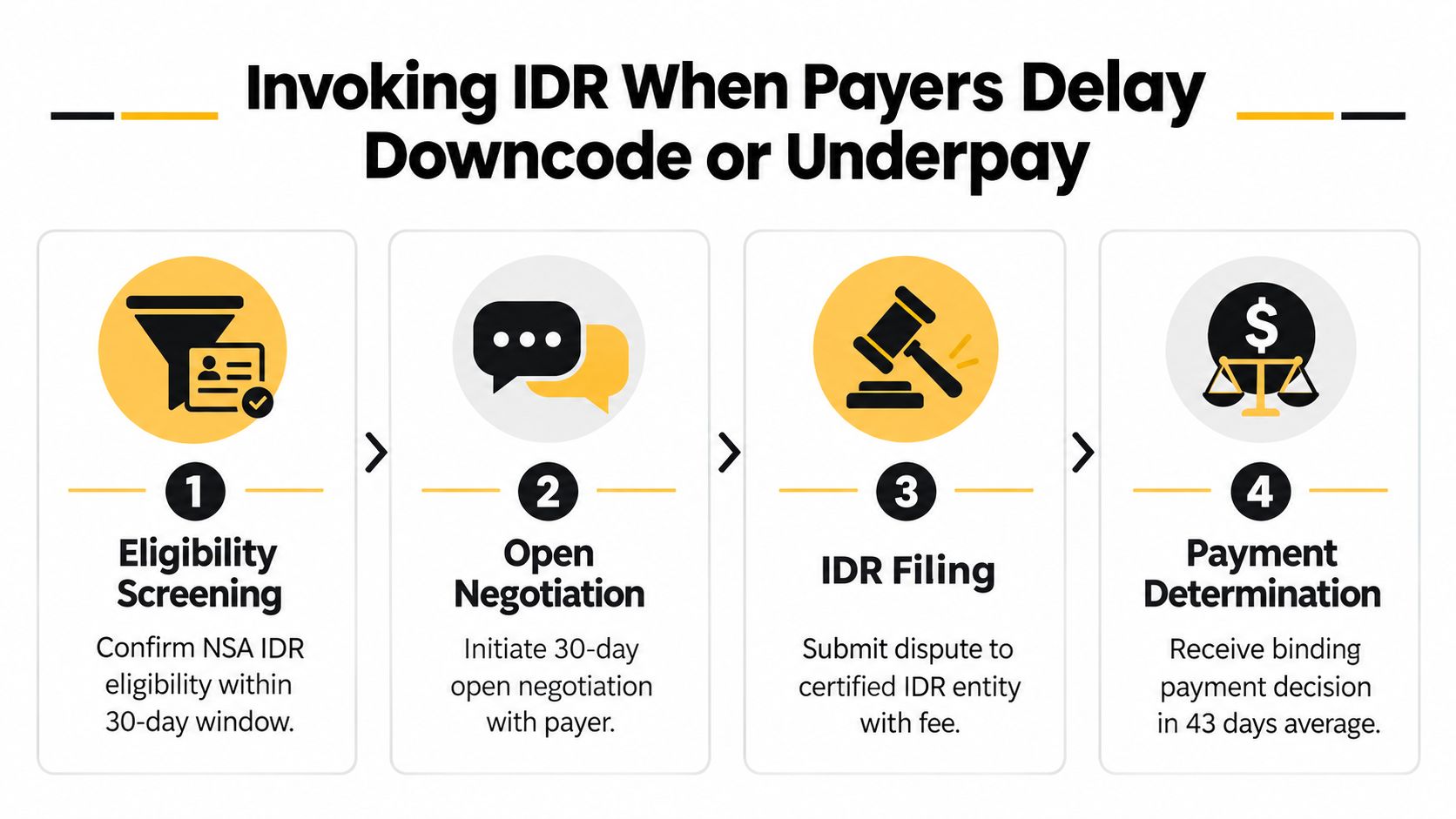
IDR works best as a controlled revenue-cycle process, not a last-minute legal project. Start with eligibility. Confirm that the claim falls within the applicable federal process, the payment dispute satisfies the relevant requirements, and the group preserved required notices and payer communications.
Use a defined sequence:
- Screen the claim. Verify the service, payer, facility, network status, payment, and potential NSA eligibility.
- Complete open negotiation. Initiate and document the required payer communication within the applicable window.
- Prepare the submission. Assemble the claim, remittance, QPA information, clinical facts, network evidence, and market factors.
- File and monitor. Submit to a certified IDR entity, track deadlines, answer requests, and enforce the resulting payment.
The No Surprises Act IDR process belongs in a case queue with an owner, due dates, status codes, evidence checklist, and expected financial value. An inbox cannot show filing capacity, aging, or collection risk.
Plan for volume, not occasional exceptions
Federal IDR activity has exceeded early expectations by a wide margin. CMS data summarized by Georgetown show that 3,324,051 disputes were filed between April 15, 2022 and May 2025, compared with federal projections of about 17,000 disputes annually. About 85% were closed as of May 2025, and providers won 85% of disputes in 2024. The reported CMS data and operational implications support capacity planning for documentation, filing, deadline monitoring, and payment follow-up.
Anesthesia remains a recurring dispute category. Congressional Research Service reporting identifies 8,059 anesthesia payment determinations through 2024, while the American Society of Anesthesiologists reported that IDR entities closed 134,036 disputes in the first six months of 2023. The CRS report supplies specialty-level context. These figures justify a standing workflow, with trained owners and payer-specific evidence standards, rather than occasional escalation.
Batching can improve control when claims share a payer, service type, facility, and relevant dispute characteristics. Each batch still needs a defensible rationale and claim-level facts. Grouping similar cases should reduce handling time, not erase clinical or payment differences.
Use distribution-aware forecasting
Award outcomes can be skewed. In an academic analysis of New Jersey's arbitration system, 1,695 resolved cases had a mean award of $7,222 and a median of $4,354. The CRS discussion of specialty and arbitration evidence shows why a mean alone can distort reserves and offer strategy. Review medians and percentile bands, then segment results by payer, facility, service, and case complexity.
The relationship to the QPA also affects planning. Median determinations reached 459% of the QPA in the fourth quarter of 2024, up from 327% in 2023, according to CMS data summarized in reporting on IDR costs and awards. A high multiple does not predict an individual case. It should, however, shape cash-conversion forecasts, offer preparation, and the decision to incur filing costs.
Upstream controls determine how much evidence reaches IDR. Credentialing records establish network status, scheduling and eligibility checks clarify the patient and facility context, and clean-claim engineering preserves time, modifier, coding, and authorization details. Those controls turn a disputed remittance into an organized record instead of a reconstruction exercise.
The economic effects of surprise-billing laws also include reimbursement and network pressure. An analysis of 2,713,913 anesthesia claims found that, after laws were enacted in California, Florida, and New York, out-of-network anesthesia prices at in-network facilities fell by $12.71 in California and $35.67 in Florida, while New York experienced a late-period decline of $41.28 by the fourth quarter of 2017. In-network anesthesia prices also fell in all three states. The economic analysis supports evaluating payer behavior, network participation, and documentation quality alongside the individual claim value.
Your Sustainable System to Guard Anesthesia Revenue at Scale
A durable anesthesia revenue program runs on a fixed rhythm. It doesn't depend on one experienced biller remembering which payer behaves badly or one physician finding a denial after the account has aged.
Use four operating reviews:
- Weekly credentialing and eligibility audit: Review upcoming cases, participation gaps, expiring enrollment, unresolved verifications, and facility changes.
- Pre-bill quality gate: Hold claims with coding, modifier, time, authorization, network, or documentation inconsistencies until an owner resolves them.
- Monthly payer scorecard: Rank payment variance, denial categories, response time, open-negotiation results, and unresolved balances by payer and location.
- Quarterly IDR batch review: Evaluate eligible underpayments, filing capacity, evidence quality, award distributions, collection status, and payer-specific strategy.
The KPIs should connect prevention to recovery. Track the rate of cases with verified network status, credentialing exceptions caught before service, clean-claim acceptance, first-pass payment accuracy, downcode frequency, days from remittance to escalation, open-negotiation resolution, IDR filing yield, award-to-payment time, and collected dollars after determination.
Avoid three common mistakes. Don't forecast from average awards when the distribution is skewed. Don't describe clinical complexity without linking it to records. Don't treat IDR as a rescue department disconnected from scheduling and billing.
The strongest model gives each team a shared data trail. Credentialing supplies participation evidence. Scheduling captures the patient and facility context. Clinical staff preserve the service record. Billing engineers the claim. Analytics identifies payer patterns, and the dispute team turns those patterns into negotiation and IDR decisions.
For multi-site groups, accountability should sit at both the central and local levels. A central revenue leader can standardize evidence, deadlines, and reporting. Facility-level managers can resolve coverage and staffing issues that a central team can't see. That division keeps the workflow consistent without pretending every market behaves the same way.
RevGuard is one option for groups that want specialty-focused RCM connected to NSA dispute management. Its model covers eligibility verification, credentialing, coding, payer negotiations, dispute preparation, filing, monitoring, and payment recovery, with dashboards for payer behavior and dispute status.
The next step is practical. Pull a sample of recent anesthesia underpayments, trace each account back to scheduling and eligibility, and classify the leakage as preventable, correctable, negotiable, or IDR-eligible. That exercise will show whether the group needs better upstream controls, stronger claim evidence, more disciplined payer negotiation, or a dedicated dispute queue.
If your anesthesia group is losing time and reimbursement to network mismatches, downcodes, or delayed payer payments, visit RevGuard to review an integrated RCM and IDR approach. Bring a representative set of claims and remittances, and use the review to identify the workflow changes that can prevent leakage before the case and recover eligible revenue afterward.