

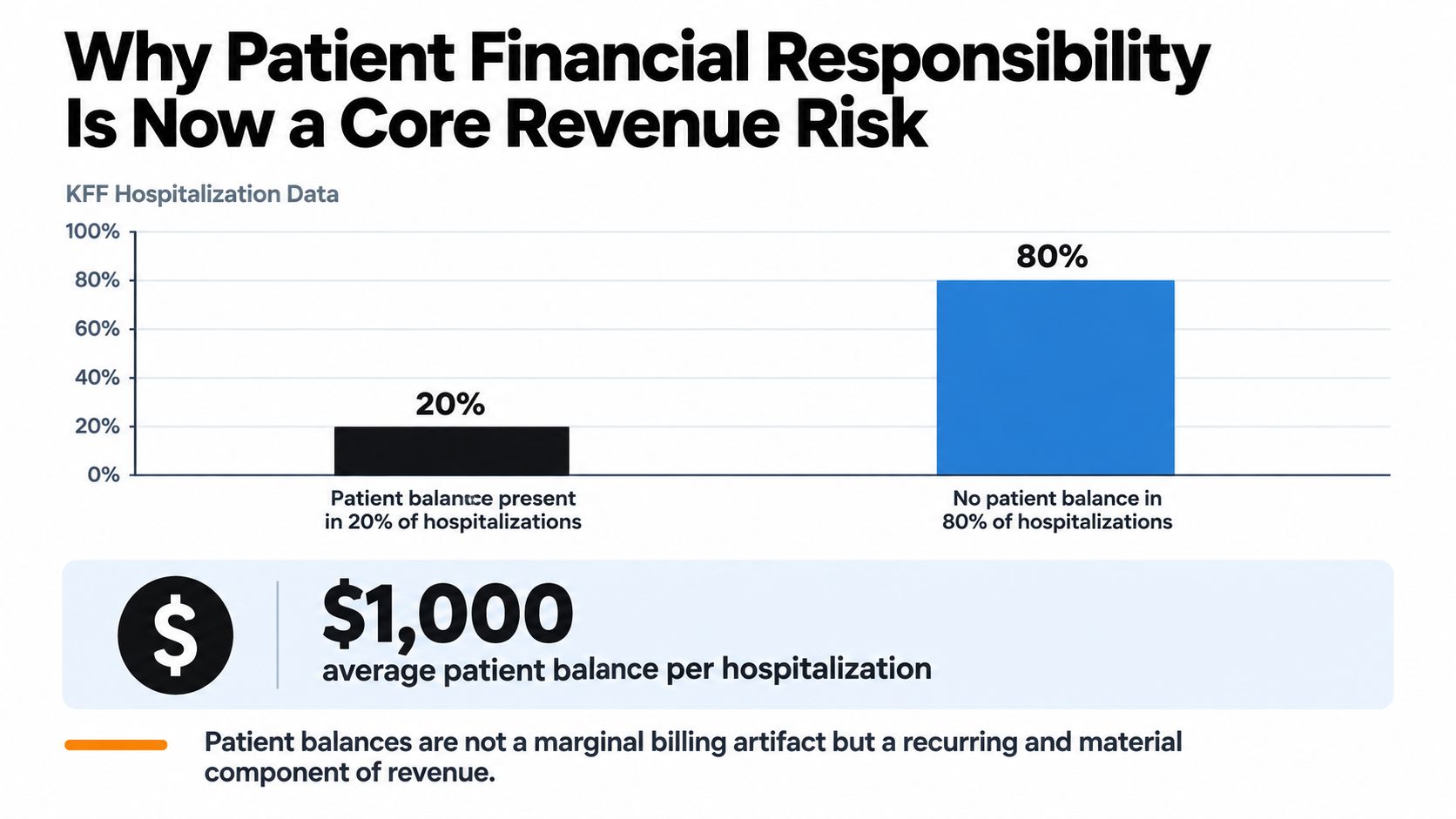
A hospital stay changes the financial equation for patients. In 2022, 50% of people in the United States who had a hospital stay incurred at least $1,000 in out-of-pocket health-care spending, compared with 19% of people who didn't have a hospital stay, according to KFF's analysis of hospital costs and medical debt. That gap makes patient financial responsibility more than a billing-office concern. For specialty practices, it's an upstream revenue control that starts with eligibility, benefits, network status, and service classification, then continues through adjudication, communication, and compliant collection.
Why Patient Financial Responsibility Is Now a Core Revenue Risk
Patient financial responsibility becomes a revenue risk before a statement reaches the patient. A missing secondary plan, outdated eligibility response, incorrect benefit interpretation, or unrecognized out-of-network clinician can turn a predictable account into delayed cash, avoidable rework, or a balance the practice should never assign to the patient.
The risk is higher for specialty practices tied to hospital outpatient departments, ambulatory surgery centers, imaging facilities, and emergency care. These encounters may involve multiple providers, facility charges, separate professional claims, authorization requirements, and plan rules that staff cannot safely infer from a member card. Treat each encounter as an upstream revenue-protection workflow, not a statement-generation task.
The KFF figures show why administrators should prioritize this work. Among people with a hospital stay in 2022, 23% paid more than $3,000 out of pocket, while 19% of people without a hospital stay incurred at least $1,000 in out-of-pocket spending, according to KFF's analysis of hospital-related out-of-pocket spending. These figures reflect responsibility after insurance payments, including deductibles, coinsurance, copayments, and uncovered balances. They also show why facility-based or intensive care can create substantial exposure for patients and collection risk for practices.
Treat the balance as a controlled output
A specialty practice should produce patient financial responsibility through a defined sequence. The amount should never be whatever remains after the payer processes a claim.
- Verify the account: Confirm demographics, active coverage, coordination of benefits, authorization, and the rendering provider's network status.
- Estimate the exposure: Apply the plan's allowed amount, accumulators, cost-share rules, and expected services.
- Classify liability: Separate legitimate patient responsibility from payer underpayment, denial, coding error, and legally protected balance billing.
- Collect appropriately: Request payment when the obligation is clear, provide compliant options when affordability is limited, and suspend billing when correction or dispute routing is required.
Operational rule: If your team cannot explain why the patient owes the balance, the account is not ready for collection.
PFR accuracy protects both sides of the ledger. It preserves legitimate revenue while preventing staff from pursuing amounts that belong with the payer. The priority is to connect eligibility, estimation, NSA classification, adjudication, and compliant collection in one workflow, with accountable handoffs from scheduling through final payment.
The Four Building Blocks of Patient Financial Responsibility
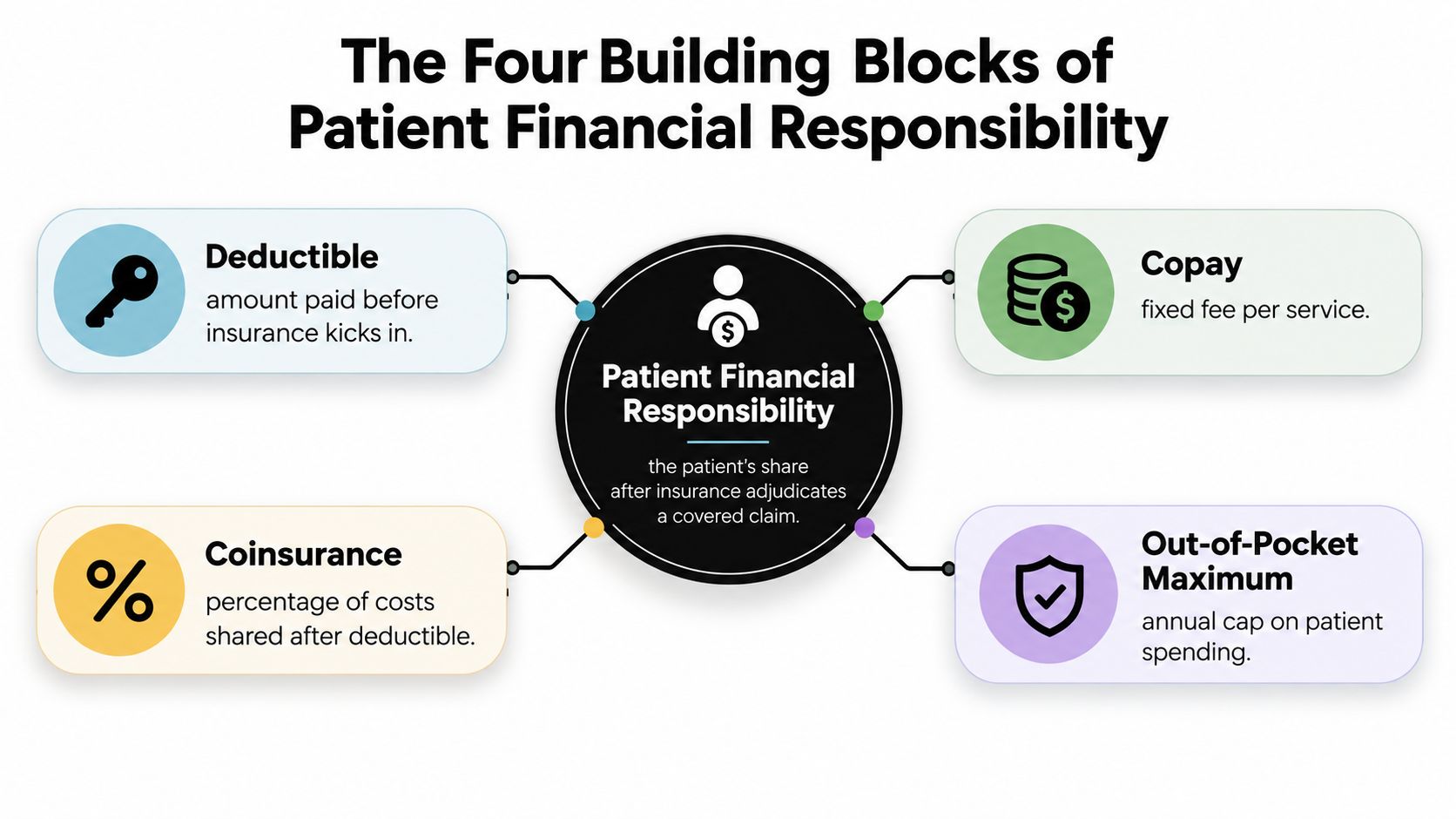
Patient financial responsibility is the portion of an adjudicated, covered claim assigned to the patient under the health plan. The amount usually reflects a combination of deductible, copay, coinsurance, and the patient's progress toward the out-of-pocket maximum. It can also include noncovered services or balances that require separate legal and contractual review.
Deductible
The deductible is the amount the patient must pay under the plan before the insurer begins contributing to applicable covered services. A remaining deductible isn't the same as the billed charge. The practice must apply the plan's allowed amount and confirm which services are subject to the deductible.
Copay
A copay is a fixed amount assigned to a service category. It may apply to an office visit, a specialist consultation, an imaging service, or another defined benefit. Staff shouldn't assume that one copay applies across every component of a complex encounter.
Coinsurance
Coinsurance is a percentage of the allowed amount that the patient owes after applicable deductible rules are applied. The percentage may differ by service type, network tier, site of care, or plan design. That's why a patient's previous balance isn't a reliable substitute for current benefit verification.
Out-of-pocket maximum
The out-of-pocket maximum limits the patient's responsibility for covered, in-network services during the plan period. It doesn't automatically erase noncovered services, excluded care, or prohibited balance bills. Staff must confirm whether the accumulator applies to the claim being estimated and whether the amount has been reached.
Consider an outpatient surgery at an in-network facility where an ancillary clinician participates out of network. The facility component may be processed under the patient's in-network benefits. The ancillary clinician's claim may require a separate network and surprise-billing analysis, particularly if the service falls within federal or state protections. The same encounter can therefore contain different liability categories, but staff must not collapse them into one patient balance.
A reliable taxonomy also improves statements. Each line should make clear whether it reflects a deductible, copay, coinsurance, noncovered service, or a balance awaiting correction. Without that distinction, patients challenge legitimate charges, and staff spend time defending statements that were never sufficiently explained.
How Deductibles, Copays, and Coinsurance Actually Calculate
The calculation starts with the allowed amount, not the provider's billed charge. The billed charge may establish the claim's submitted value, but the plan's contracted or otherwise applicable allowed amount is the basis for cost sharing in a typical in-network scenario.
A benefits team should reproduce the estimate from a defined set of inputs:
- Confirm the service, place of service, procedure code assumptions, and expected units.
- Verify active coverage and network participation for every relevant provider.
- Retrieve deductible, copay, coinsurance, and out-of-pocket accumulators.
- Apply the plan's rules to the expected allowed amount.
- Record assumptions and identify services that could change after coding or adjudication.
Here's a deliberately simple example. Assume an in-network outpatient service has a $2,000 allowed amount, the patient has $600 of deductible remaining, and the plan applies 20% coinsurance after the deductible. The plan pays the remaining covered amount after the deductible and coinsurance are applied. The exact result must still be checked against the plan's accumulator and benefit rules.
| Step | Amount | Patient Responsibility |
|---|---|---|
| Submitted charge | $2,500 | Not the cost-share basis |
| Contracted allowed amount | $2,000 | Cost-share basis |
| Remaining deductible applied | $600 | $600 |
| Amount remaining after deductible | $1,400 | Subject to coinsurance |
| Coinsurance at 20% | $280 | $280 |
| Estimated plan payment | $1,120 | $0 |
| Estimated patient share | $880 | $880 |
The patient estimate is therefore $880, assuming the service is covered, the provider is in network, no copay applies, the out-of-pocket maximum hasn't been reached, and no other claim changes the accumulator. Staff should document those assumptions instead of presenting the estimate as an unconditional invoice.
The explanation of benefits is the payer's adjudication record. It identifies the allowed amount, insurer payment, contractual adjustment, and patient responsibility. A practical guide to reading an EOB in medical billing can help teams distinguish those fields before they reconcile a statement.
The most common estimate failures come from missing inputs, not difficult arithmetic. A stale deductible balance, incorrect network status, or unrecognized service component can make a perfectly executed formula produce the wrong answer.
Where the No Surprises Act Changes What the Patient Actually Owes
The No Surprises Act sets a compliance boundary around patient financial responsibility. For most emergency services, and certain non-emergency services provided by out-of-network clinicians at in-network facilities, the plan must apply the patient's cost sharing at the applicable in-network level. That amount must also count toward the in-network deductible and out-of-pocket maximum. The CMS explanation of No Surprises Act patient rights outlines these protections. For a broader overview, use this summary of the No Surprises Act.
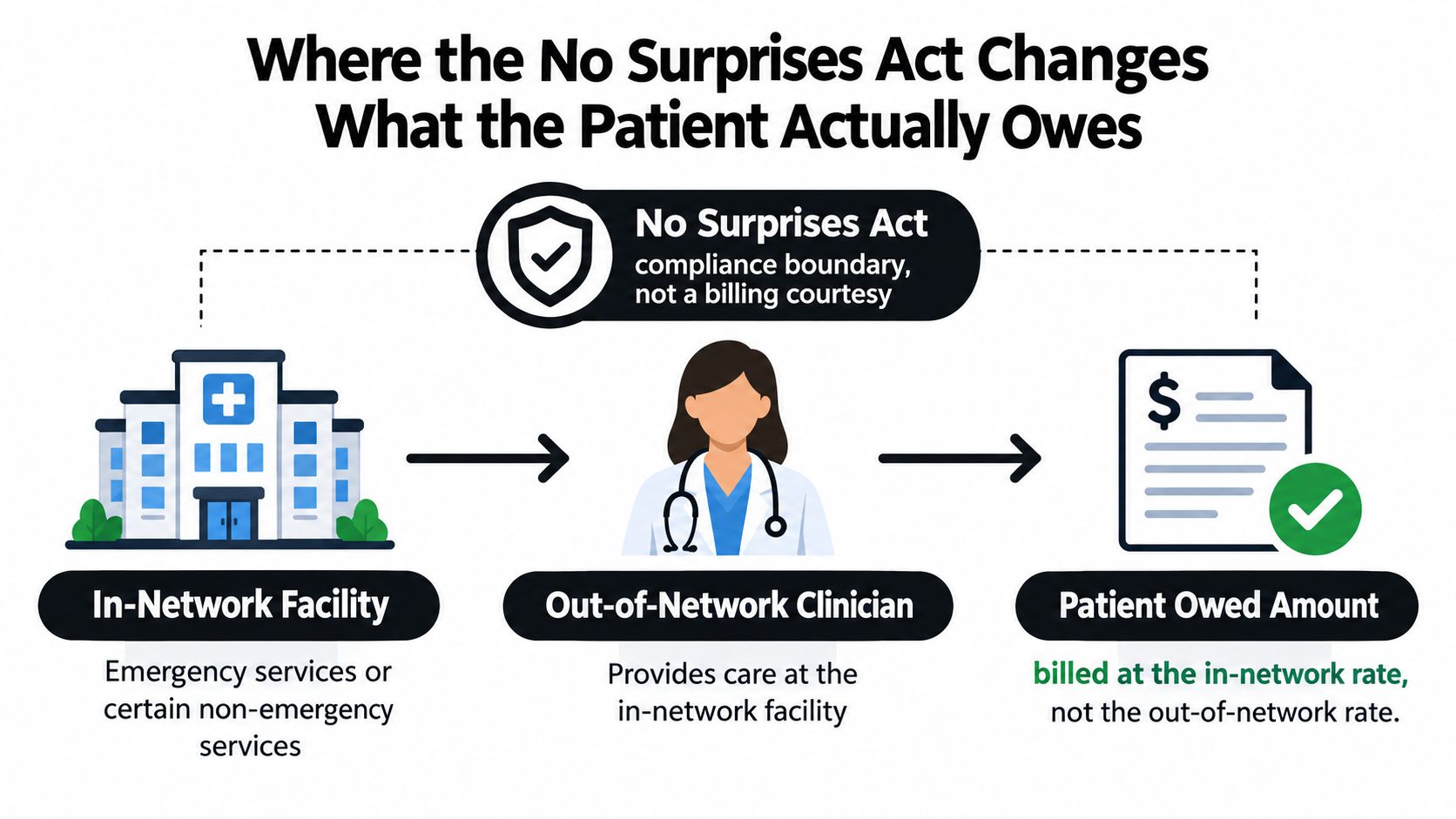
An out-of-network adjudication does not automatically make the patient responsible for the difference. A low payer payment, an out-of-network rate, or a disputed reimbursement amount may indicate payer liability instead. Billing that amount to the patient can create compliance exposure and weaken the practice's recovery position by sending a payer dispute to the wrong party.
Classify the account before releasing the statement
Use a documented review to determine whether the balance can be billed:
- Service type: Identify emergency services and protected non-emergency services.
- Facility network status: Confirm whether the service occurred at an in-network facility.
- Clinician status: Check network participation for the rendering and billing providers.
- Consent records: Verify valid consent where consent can affect the protection.
- State protections: Apply any broader requirements under state law.
- EOB comparison: Compare the adjudication with the applicable in-network cost-sharing calculation.
If the claim qualifies for protection, place the patient statement on hold. Resolve the reimbursement issue through payer negotiation or the federal Independent Dispute Resolution process. Do not shift the residual balance to the patient while that review is pending.
The financial result is clear. A protected balance may generate a short-term payment, but it also creates complaint risk, refund work, and compliance exposure. Correct classification preserves the patient relationship and keeps an underpayment available for recovery from the payer. That makes NSA review an upstream revenue-protection control, not a final billing courtesy.
Estimating and Collecting Patient Financial Responsibility Before the Statement
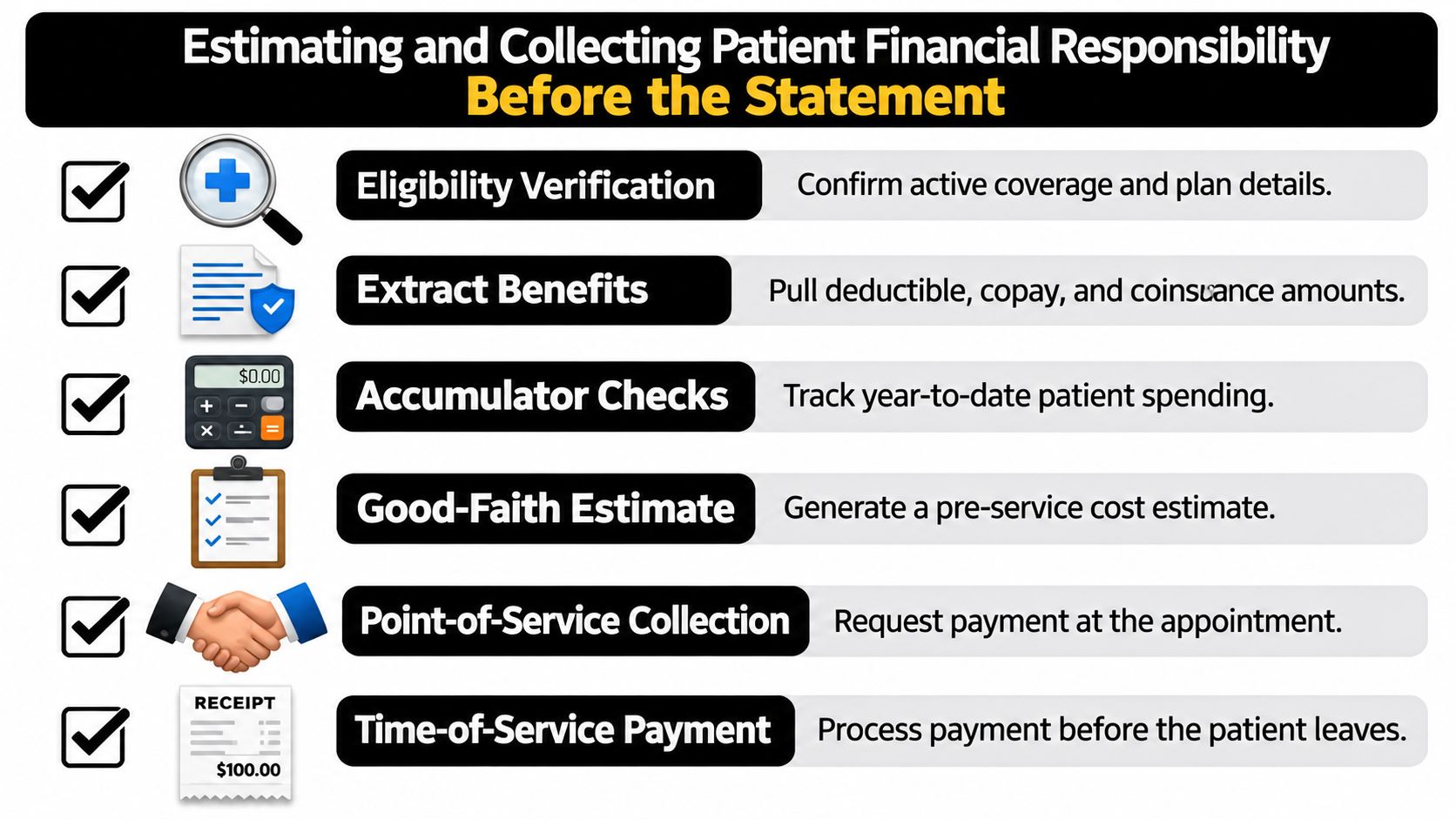
Pre-service collection works only when the estimate is built from verified data and followed by reconciliation. A patient access team shouldn't quote a balance from an old eligibility response or a general benefit summary. The workflow has to connect coverage, service details, accumulators, estimate assumptions, and payment options.
Run the front-end sequence
Start with eligibility. Confirm active coverage, member identity, effective dates, payer order, plan type, and network status. Flag inactive coverage, missing secondary coverage, and discrepancies before the appointment reaches the clinical schedule.
Extract the benefits. Capture deductible remaining, copay, coinsurance, out-of-pocket status, authorization requirements, and service-specific limitations. Record the source and timestamp of the response so staff know whether the information is current.
Model the encounter. Use expected procedure codes, units, place of service, contracted allowed amounts, facility participation, and provider participation. If the service mix is uncertain, present assumptions clearly and identify what could change the estimate.
Generate the estimate. Give the patient a written or electronic estimate that separates expected insurance payment from expected patient responsibility. Avoid language that makes an estimate sound like a final adjudicated balance.
Request payment appropriately. Offer point-of-service payment when the obligation is clear and the patient agrees. If the patient can't pay in full, present a compliant payment-plan or financial-assistance pathway rather than allowing the account to drift into unstructured follow-up.
Reconcile after adjudication. Compare the claim, EOB, estimate, and payment. Correct overestimates, issue refunds when required, and move underpayments, denials, and protected balances into the payer workflow.
The most important control is the handoff after adjudication. An estimate that was reasonable before service can become wrong because the payer applies a different code, denies a component, processes a provider as out of network, or applies cost sharing incorrectly. The practice needs a queue that identifies these exceptions before the statement engine releases them.
Policies for charging self-pay patients should also distinguish uninsured accounts from insured accounts with unresolved payer activity. Treating every unpaid balance as self-pay bypasses the verification work that protects both cash and compliance.
When the Bill Is Correct but the Patient Cannot Pay
A correct balance can still be unaffordable. In December 2025, 46.0% of U.S. working-age adults reported at least one health-care affordability problem, including difficulty paying medical bills, unmet care because of cost, or medical debt, according to the Urban Institute's 2025 analysis. Coverage confirms the payer arrangement. It does not confirm that the patient can pay safely or immediately.
The same analysis reported that 16.9% had difficulty paying medical bills, 34.9% had unmet care needs because of cost, and 29.4% had medical debt. Those figures describe financial pressure, not a reason to waive valid obligations without rules. They do show why repeated statements and escalating notices are an inadequate response.
Start every affordability conversation by validating the balance. A patient complaint may expose a billing error, unresolved payer activity, or a legitimate responsibility that needs a workable collection path.
Review these items before requesting payment:
- Compare the statement with the EOB: Confirm that the billed amount matches the payer's identified patient responsibility.
- Check coding and service details: Look for incorrect units, duplicate lines, changed procedure codes, or services the patient says were not performed.
- Review coordination of benefits: Determine whether another insurer should have processed the claim first.
- Test network and surprise-billing status: A protected out-of-network balance may belong in payer follow-up rather than patient collections.
- Explain the next action: Tell the patient whether the account is under review, qualifies for assistance, or is ready for a payment arrangement.
Operationalize financial assistance and payment plans with written eligibility rules, required documentation, installment terms, and missed-payment procedures. Apply them consistently and record the decision. Front-desk staff should use the approved workflow, not improvise discounts during a difficult conversation.
Keep clinical access separate from payment resolution. Route questions about urgency or treatment to clinical staff, while revenue cycle staff offer assistance or payment options without suggesting that the patient delay medically necessary care.
A patient who cannot pay today needs a verified balance, a realistic option, and a documented next step. Reissuing the same invoice is not a collection strategy.
Why Misclassifying PFR Is a Compliance and Revenue Risk
A patient balance can be accurate in the ledger and wrong in the workflow. Misclassifying payer liability as patient liability exposes the practice to surprise-billing violations, complaints, refunds, and avoidable write-offs. It also turns a recoverable payer underpayment into a harder patient-collection problem.
The first review question is direct: What caused the unpaid amount? A denial, downcoding, incorrect network processing, missing authorization, or contract payment below expectation does not, by itself, make the difference patient responsibility. The account needs a liability determination before anyone sends a statement.
Use two distinct routes. Deductibles, copays, coinsurance, and verified noncovered services may enter the patient financial responsibility workflow. Payer adjudication errors, contract variances, claim defects, and protected out-of-network processing require payer follow-up.
Route the account by cause
A practical control is a liability decision attached to the claim before statement release:
- Patient responsibility: Confirm the EOB-supported amount, issue a clear statement, explain the balance, and offer approved assistance or payment options.
- Payer responsibility: Correct the claim, appeal the denial, challenge the underpayment, or prepare the case for Independent Dispute Resolution when applicable.
- Protected account: Hold patient billing while staff review network status, applicable service protections, consent, and adjudication.
- Exception: Require a documented human review when the claim data, contract terms, and expected patient amount do not align.
Do not let the accounting system decide liability merely because an amount remains open. Configure edits that stop statement generation when the balance reflects a denial, coding discrepancy, network issue, authorization problem, or possible No Surprises Act protection. Assign ownership, a review deadline, and a documented outcome.
Independent Dispute Resolution requires controlled records. Preserve the claim, EOB, relevant contract terms, network facts, clinical documentation, and communication history. That evidence supports payer recovery without transferring a disputed amount to the patient first.
Patient protection and revenue protection depend on the same decision. Bill only the amount the patient legally and contractually owes. Sending a payer balance to the patient does not resolve the underpayment. It creates compliance exposure and often makes recovery less likely.
A Practical Roadmap From Estimate to Final Payment
The strongest workflow treats patient financial responsibility as a chain, not a collection of disconnected tasks. Each stage should produce the information required by the next one, with an exception route for accounts that need correction or payer escalation.
Build the sequence
- Pre-service verification: Confirm demographics, active coverage, payer order, network participation, authorization, and expected services.
- Cost estimation: Apply the allowed amount, benefit design, deductible, copay, coinsurance, and accumulator information. Save the assumptions.
- Patient communication: Explain the estimate in plain language, separate insurance payment from patient responsibility, and disclose that final adjudication controls.
- Point-of-service payment: Request payment when the estimate is supportable. Offer approved payment or assistance options when the patient can't pay in full.
- Clean claim submission: Submit accurate codes, provider information, modifiers, authorization data, and documentation.
- EOB reconciliation: Compare payer adjudication with the estimate and the practice's expected reimbursement.
- NSA classification: Review protected encounters before any statement, especially when an out-of-network clinician worked at an in-network facility.
- Statement release: Bill only the amount that is legally, contractually, and operationally assigned to the patient.
- Exception routing: Send denials, underpayments, coding errors, coordination issues, and protected balances to the correct payer-recovery queue.
- Final payment control: Post payments, resolve credits, issue refunds where required, and close the account only after the liability trail is complete.
A specialty practice can audit the workflow with a short control checklist:
- Is eligibility verified close enough to service to be useful?
- Can staff reproduce the estimate from documented inputs?
- Does the system distinguish patient cost share from payer underpayment?
- Are protected accounts stopped before statements?
- Does every disputed balance have an owner and deadline?
- Can patients see what the EOB says they owe and why?
- Are assistance and payment-plan rules applied consistently?
The practice that combines these controls protects cash without turning patients into substitutes for the payer. Patient financial responsibility is upstream revenue protection, and the same classification discipline that prevents prohibited billing also preserves recoverable reimbursement.
RevGuard connects specialty-specific revenue cycle management with enforcement-driven Independent Dispute Resolution under the No Surprises Act, helping practices separate legitimate patient responsibility from payer underpayments. Visit RevGuard to evaluate a workflow that links eligibility, clean claims, patient collections, payer negotiation, and dispute recovery.