
A facility claim can contain the right diagnosis, a valid CPT or HCPCS code, accurate units, and complete documentation, yet still fail at adjudication. The error may be a single revenue code that places the service in the wrong department, accommodation category, or facility context. By the time the denial reaches the billing team, the original charge-capture decision is often buried beneath edits, remittance codes, and payer correspondence.
That's why revenue code in medical billing deserves more attention than a quick field-level review. Revenue codes tell the payer what facility resource generated the charge and how the related procedure code should be interpreted. They don't replace clinical coding, but they give the clinical code its institutional context.
Why Revenue Codes Decide Claim Outcomes
A hospital submits an outpatient procedure with the correct CPT code, supported operative documentation, and accurate units. The claim still triggers an edit because the facility line points to a cost center that does not match where the service occurred.
The coding team may see a clean procedure line. The payer sees a revenue code suggesting another accommodation or ancillary setting. The dispute is therefore about claim context, not necessarily whether the procedure was performed. A revenue code can determine how the payer interprets the procedure, applies facility edits, and evaluates the related charge.

The hidden signal on each facility line
A revenue code does more than identify a department. It communicates the setting in which the facility is reporting the service and helps establish whether the claim line is internally consistent.
It identifies:
- The facility cost center: The charge may come from the emergency department, operating room, pharmacy, room-and-board area, or another ancillary service.
- The institutional setting: The line is presented as part of a hospital or other facility claim rather than a professional claim.
- The relationship to the procedure code: The CPT or HCPCS code should fit the facility resource represented by the revenue code.
- The payer's adjudication path: Contract rules, claim edits, accommodation logic, and documentation requirements may depend on that context.
CMS describes revenue codes as identifiers for the department, accommodation, or ancillary service associated with a facility charge. On the CMS-1450, commonly called the UB-04, they are reported in Form Locator 42, while the related amount is reported in the charge field. Providers must use the appropriate numeric revenue code to explain each charge in the claim's charge section. The CMS-1450 instructions define the structural role of this information.
Audit principle: If the revenue code is wrong, changing the CPT code may only polish the wrong claim context.
Why upstream accuracy matters
An underpayment often sends the billing team straight to contract pricing. That review can miss the actual defect. If the payer interpreted the service through the wrong revenue center, the variance began during claim construction, before the fee schedule was applied.
Review the facility line first. Confirm the department or accommodation, then verify that the procedure or supply code belongs with that revenue center. Check units, dates, bill type, charges, and documentation afterward. Only when those elements align should the team determine whether the payer applied the contract correctly.
This control also matters in a No Surprises Act IDR dispute. A defensible position depends on showing what service the facility delivered, in what setting, and how the claim represented that service. Accurate revenue-center selection can strengthen that context more effectively than changing a CPT code that was already clinically correct.
Revenue codes therefore function as a clinical-financial control. They do not guarantee payment, but a mismatched code can create underpayments, edits, and avoidable disputes by making an otherwise supported service difficult for the payer to interpret.
How Revenue Codes Work on the UB-04 Claim
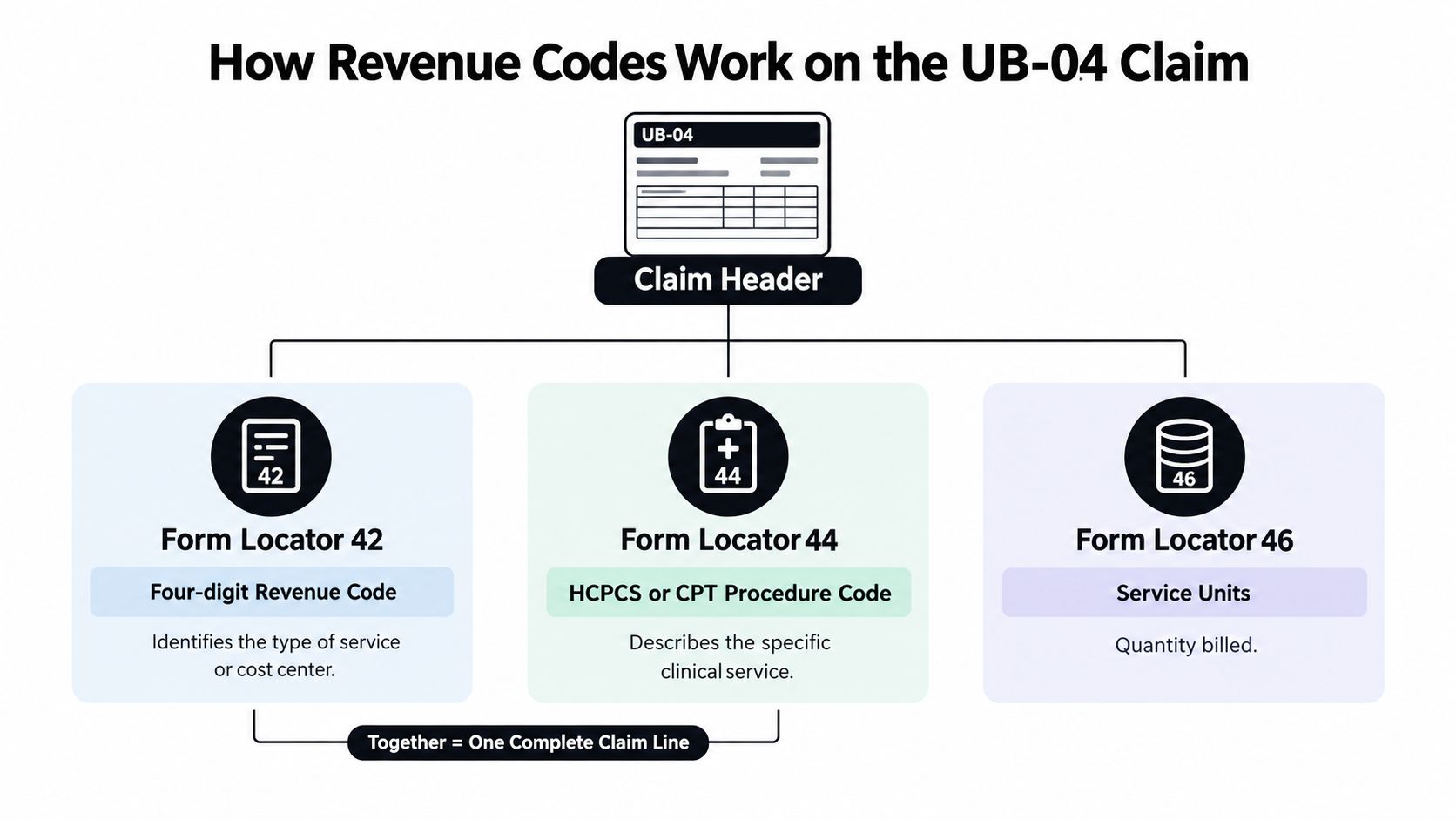
A hospital claim can contain a clinically correct procedure code and still present the service in the wrong facility context. On the UB-04, or CMS-1450, the revenue code in Form Locator 42 identifies the department, accommodation, or ancillary service associated with a charge. The charge field supplies the corresponding amount, connecting the facility setting to the billed line.
Read the line as a relationship
The revenue code supplies the facility-side context; the CPT or HCPCS code supplies the service-level detail. Units, dates, charges, and documentation must support the same story. A valid procedure code cannot correct an emergency-department service reported through an unrelated cost center.
Use this review sequence:
- Identify the facility resource. Determine whether the charge came from the emergency department, operating room, pharmacy, room-and-board area, radiology department, or another cost center.
- Select the applicable revenue code. Enter the four-digit code in Form Locator 42 under the applicable institutional billing specifications.
- Attach the clinical detail. Pair the revenue code with the appropriate CPT or HCPCS code when the claim requires that detail.
- Validate supporting fields. Check service units, dates, charges, bill type, and documentation before transmission.
- Apply payer-specific rules. Confirm that the pairing meets the contract and claim-edit requirements.
For example, an emergency-department revenue code establishes the service setting, while the associated procedure or supply code explains what the facility delivered. The same CPT or HCPCS code may require a different facility context when reported by another department. That relationship affects how the payer interprets the line and whether payment edits apply.
Why the field is structural
Form Locator 42 is part of the claim's charge-line structure. It gives the payer a coded explanation for each billed amount, rather than serving as optional narrative text. Teams reviewing what a UB-04 form contains can use that field relationship to trace a line from facility resource to charge.
Revenue-center information also appears in claims-analysis infrastructure. Linked NCHS-CMS files include as many as 45 revenue-center code, date, and related ANSI-code fields per record. The field therefore supports more than paper-form submission. It also enables structured review of where services occurred, how they were billed, and which related codes accompanied them.
Review the complete line before changing a CPT or HCPCS code. Confirm that the revenue center, service detail, units, dates, charges, bill type, and documentation describe one facility service. That check often prevents an avoidable downstream underpayment and gives a No Surprises Act IDR position clearer evidence of the setting and service being disputed.
Common Revenue Code Ranges by Service Line
Revenue codes are generally represented as four-digit categories. Their numeric groupings help organize accommodations, departments, and ancillary services, but the code itself remains part of a broader claim context. The same clinical specialty may generate different facility lines depending on the setting, bill type, service description, and payer requirements.
The following reference matrix offers a practical starting point for charge review:
| Revenue-code example or range | Typical facility function | Audit question |
|---|---|---|
| 0001 | Total charges | Does the total reconcile with the claim's charge lines? |
| 010x to 016x | Room-and-board and accommodation categories | Does the accommodation context match the facility stay and bill type? |
| 025x | Pharmacy services | Does the drug or pharmacy item belong to this facility cost center? |
| 027x | Medical and surgical supplies | Does the supply line include the required detail and units? |
| 036x | Operating-room services | Does the facility resource align with the procedure and operative record? |
| 045x | Emergency-room services | Does the service belong to the emergency department context? |
| 051x | Outpatient department services | Does the line reflect an outpatient facility department rather than another cost center? |
CMS's Medicare summary-statistics glossary uses 0450, 0451, 0452, 0456, and 0459 to define emergency-room care. Those examples show why a broad label such as “emergency” isn't enough for audit work. The reviewer must inspect the actual code and the claim context.
Use ranges as a screening tool
A revenue-code range is useful for identifying an obvious mismatch, but it doesn't replace payer policy or the official coding specifications. A procedure line placed in an emergency cluster deserves a different review from one placed in an operating-room cluster. A pharmacy line may require different supporting detail from a room-and-board line.
The National Uniform Billing Committee's history of standardization explains why these categories matter across institutional billing. The NUBC was formed to develop and maintain a uniform institutional billing form and standardized data set. The committee reports that 13 different uniform-bill designs were developed and discarded between 1968 and 1972 before national standardization progressed. The committee later accepted the UB-82 data set as a national uniform bill in 1982, and the standard evolved into today's UB-04. That history is documented by the National Uniform Billing Committee.
For daily work, start with the range, then verify the exact code, service description, bill type, and payer rule. Don't assume that a department's internal name maps cleanly to the revenue center used on the claim.
Operating Room Revenue Coding Explained
Operating-room lines create trouble when teams treat the revenue code as if it were the procedure itself. CMS identifies 0360 as the general classification for operating-room services and places specified inpatient procedure charges under that classification. The code establishes the facility setting and cost-center context. It doesn't independently describe the surgery.
An OR line therefore needs a coordinated review of the revenue code, procedure code, units, charge amount, dates of service, bill type, and operative documentation. A missing operative note may weaken the claim, but so can a line that places a documented operation in a facility context that doesn't fit the billed service.
Hospital and ASC logic aren't interchangeable
A hospital facility claim and an ASC facility claim can describe related surgical resources while following different billing workflows and payer rules. The revenue code represents facility resources. The surgeon's professional work and the anesthesiologist's professional work are represented through separate professional claim coding and contractual arrangements.
That distinction prevents a common review error. A professional claim can have an accurate procedure code while the facility claim still contains an invalid revenue-center pairing. Reviewing only the physician's coding won't resolve the facility-side defect.
For an ASC-specific operational perspective, billing teams can review billing for ambulatory surgery centers. The important control is to evaluate the facility claim on its own terms, then reconcile it with the professional claim and operative record.
A usable OR edit
An OR revenue-code edit should test several fields together:
- Revenue-center alignment: Confirm that 0360 fits the facility service represented by the line.
- Procedure-family consistency: Check whether the procedure code and description are compatible with an operating-room resource.
- Bill-type compatibility: Ensure the claim type supports the reported facility service.
- Date and unit integrity: Compare the dates and units with the operative documentation and charge-capture record.
- Documentation availability: Confirm that the operative note and supporting records can substantiate the billed line.
Practical rule: Revenue code 0360 supplies the operating-room context. The procedure code and medical record must supply the clinical explanation.
A mismatch can lead to a medical-record request, coding edit, downcoding, or denial even when the surgery occurred. That's why OR validation should happen before claim submission, not after the remittance identifies a problem.
Revenue Codes Versus Procedure Codes
A revenue code answers, “What facility department, accommodation, or ancillary cost center generated this charge?” A CPT or HCPCS code answers, “What specific service, supply, drug, or procedure was delivered?” These questions are related, but they aren't interchangeable.

CMS explains that the revenue code identifies the specific accommodation or ancillary charge and describes the capacity in which the related HCPCS code applies on an institutional claim. It also directs billers to ensure that the revenue code fits the bill type, follows HCPCS requirements, and appears in the correct claim sequence. The CMS training guidance on revenue centers frames the code as a provider-assigned cost center, such as radiology, emergency services, or pathology, rather than a universal reimbursement amount.
Why a valid procedure code can still fail
A clinically valid CPT or HCPCS code doesn't eliminate the need for context. The payer may expect that code to appear with a particular facility revenue center, bill type, place of service, unit structure, or claim sequence. If the relationship breaks, the payer may treat the line as inconsistent, incomplete, or subject to a different payment rule.
That creates a diagnostic trap. A billing team sees the correct procedure code and assumes the denial must reflect a pricing disagreement. The actual defect may be upstream. The claim told the payer that the procedure occurred in the wrong facility capacity.
A useful root-cause review separates the questions:
| Review question | What it tests |
|---|---|
| Was the procedure or supply code valid? | Clinical and service-level coding |
| Was the revenue code appropriate? | Facility department or accommodation context |
| Did the pairing meet payer rules? | Claim-edit and contract compatibility |
| Did the bill type support the line? | Institutional claim structure |
| Did units, dates, and documentation agree? | Internal claim consistency |
Revenue codes can therefore influence payment interpretation without being payment amounts themselves. When an underpayment follows a wrong revenue center, correcting the claim context may be more important than arguing over the fee calculation.
Building Revenue Code Edit Controls
Revenue-code accuracy improves when the billing system catches mismatches at charge capture. Remittance review is too late for the first line of defense. By then, staff must research the original order, department workflow, charge description master, claim image, payer response, and correction history.
Build the control around the service line, not around a generic list of “allowed” codes.
Start with a specialty-specific edit table
A useful edit table should contain the revenue code, related CPT or HCPCS families, facility department, bill type, expected units, date logic, documentation requirement, and payer exceptions. It should also identify whether the line needs accommodation-rate logic or supporting records.
The table can flag:
- Impossible pairings: A procedure or supply code appears with a revenue center that doesn't provide that service.
- Missing units: The revenue code requires quantity information, but the charge record is incomplete.
- Incompatible dates: The service date falls outside the department encounter or facility stay.
- Unsupported accommodation logic: The revenue code implies a room or accommodation charge without the required supporting context.
- Bill-type conflicts: The institutional claim type doesn't support the selected revenue center.
- Sequence errors: The code appears in a position that doesn't follow the applicable claim requirements.
The strongest tables are maintained jointly by coding, patient financial services, clinical operations, and payer-contract teams. A coder may know whether the line is clinically plausible, while a contract analyst knows how a payer adjudicates that facility context.
Put validation before transmission
Use the charge description master as the operational source for the initial mapping, then route exceptions to a human reviewer. Don't allow staff to bypass an edit just because the CPT or HCPCS code is valid. The exception should require a reason, supporting documentation, or payer-specific policy reference.
For high-risk departments, add a second review after the claim is assembled:
- Compare the department that generated the charge with the selected revenue code.
- Confirm that the procedure or supply code matches the facility resource.
- Reconcile units and service dates with the source record.
- Check bill type and payer rules.
- Save the final claim image and edit outcome.
RevGuard is one option for organizations seeking payer-aware claims workflows alongside broader healthcare revenue cycle management and dispute operations. Whatever tool a team uses, the control should produce an audit trail that explains why the revenue code was selected and who approved an exception.
Revenue Codes in No Surprises Act Disputes
A facility claim can contain the correct procedure code and still leave an IDR reviewer with the wrong service context. The revenue code identifies the facility department or ancillary setting behind the charge, helping establish what facility service was billed and in what institutional context. That foundation often matters more than another round of CPT edits when the dispute concerns an underpayment.
CMS reported that certified IDR entities issued payment determinations in 1,145,039 disputes during the second half of 2025, according to its Federal IDR supplemental background report. The determination centers on payment offers and supporting factors, while the claim history shows what service the parties are pricing. Teams preparing a federal case can review how the No Surprises Act IDR process works before assembling the dispute file.

Preserve the original claim story
A reviewer should be able to trace the facility service to the payment disagreement without reconstructing the claim from scattered records. Preserve:
- The original revenue-code selection: Show the facility department or ancillary context reported at submission.
- The linked procedure or supply code: Keep service-level detail connected to the revenue center.
- The place of service and bill type: Demonstrate how the claim identified the institutional setting.
- The payer response: Retain the initial payment, denial, downcode, or explanation of benefits.
- Corrected-claim history: Document what changed, why it changed, and how the payer responded.
- Negotiation records: Keep payment offers, counteroffers, and communications together.
- Clinical and operational support: Tie the billed service to the specialty, documentation, and market evidence.
A corrected claim may resolve a construction error, yet it can raise questions if the file gives no reason for the change. The reviewer may ask whether the original revenue center was wrong, whether the service changed, or whether the provider is advancing a new claim theory.
Use revenue codes as context, not pricing proof
Anesthesia, emergency, air ambulance, and facility-based specialty groups may maintain separate billing and dispute workflows. That separation can produce an IDR file with a developed pricing argument but weak evidence about the claim's facility context.
Connect the operational record to the dispute strategy. Explain what facility service the revenue code represents, why the linked clinical code belongs there, what the payer did with the claim, and why the payment remains inappropriate after correction or negotiation. The revenue code strengthens the factual foundation. Credible payment offers and supporting documentation carry the pricing argument.
Turning Revenue Code Accuracy Into Defended Revenue
Return to the opening scenario. The procedure code was correct, but the facility line placed the charge in the wrong cost-center context. A conventional review might focus on correcting the CPT, appealing the denial, or arguing that the payer underpaid the procedure.
A revenue-integrity review starts earlier. It asks which department generated the charge, which revenue code represents that department, whether the procedure code belongs with that revenue center, and whether the bill type and payer rules support the combination. Once the claim is corrected, the team can evaluate the remaining payment issue with a cleaner factual record.
Make the control operational
Hospitals, ASCs, specialty practices, and multi-state provider platforms can embed the process into daily RCM work:
- Audit the highest-risk lines first: Prioritize operating-room, emergency, radiology, anesthesia, pharmacy, and accommodation-related revenue centers.
- Validate at capture: Stop impossible revenue-code and CPT or HCPCS combinations before claim creation.
- Review exceptions by department: Make clinical operations accountable for recurring mapping problems.
- Track payer behavior separately: Distinguish construction errors from genuine underpayments and contractual disputes.
- Preserve dispute evidence: Store claim images, corrected claims, payer responses, documentation, and negotiation history in one record.
- Measure root causes: Report whether denials originate in charge mapping, missing detail, bill type, documentation, or payment application.
Revenue protection starts before the claim reaches the payer.
This workflow changes how teams prioritize their time. Instead of treating every denial as a separate event, they can identify the revenue-center mappings that repeatedly create ambiguity. Instead of treating every underpayment as a pricing problem, they can confirm that the claim first described the facility service correctly.
Revenue code accuracy won't eliminate payer edits. It does make the claim easier to interpret, the correction easier to defend, and the dispute record more coherent. For organizations managing complex facility and specialty billing, that's the difference between a claim that merely contains codes and one that communicates a defensible service story.
Review your highest-risk revenue codes, test their CPT and HCPCS pairings at charge capture, and preserve the claim-context evidence needed for payer appeals or IDR. RevGuard connects specialty-focused RCM workflows with dispute support to help providers identify revenue leakage upstream and prepare stronger payment cases downstream.