

The No Surprises Act prohibits balance billing for out-of-network emergency services and certain non-emergency services at in-network facilities, with independent dispute resolution available when providers and insurers can't agree on payment. The federal IDR system recorded 2,559,375 disputes in 2025, more than twelve times the 200,184 disputes recorded in 2022.
That scale changes how practice administrators should read no surprises act regulations. This isn't a narrow legal issue reserved for counsel after a disputed claim. It is an operating requirement that touches scheduling, eligibility, consent, coding, documentation, payer negotiation, arbitration, payment posting, and collections.
A provider can submit a strong case and still fail to convert the award into cash. The most reliable programs therefore treat compliance as a connected revenue cycle, not as a last-minute arbitration project.
How No Surprises Act Enforcement Scales in 2026
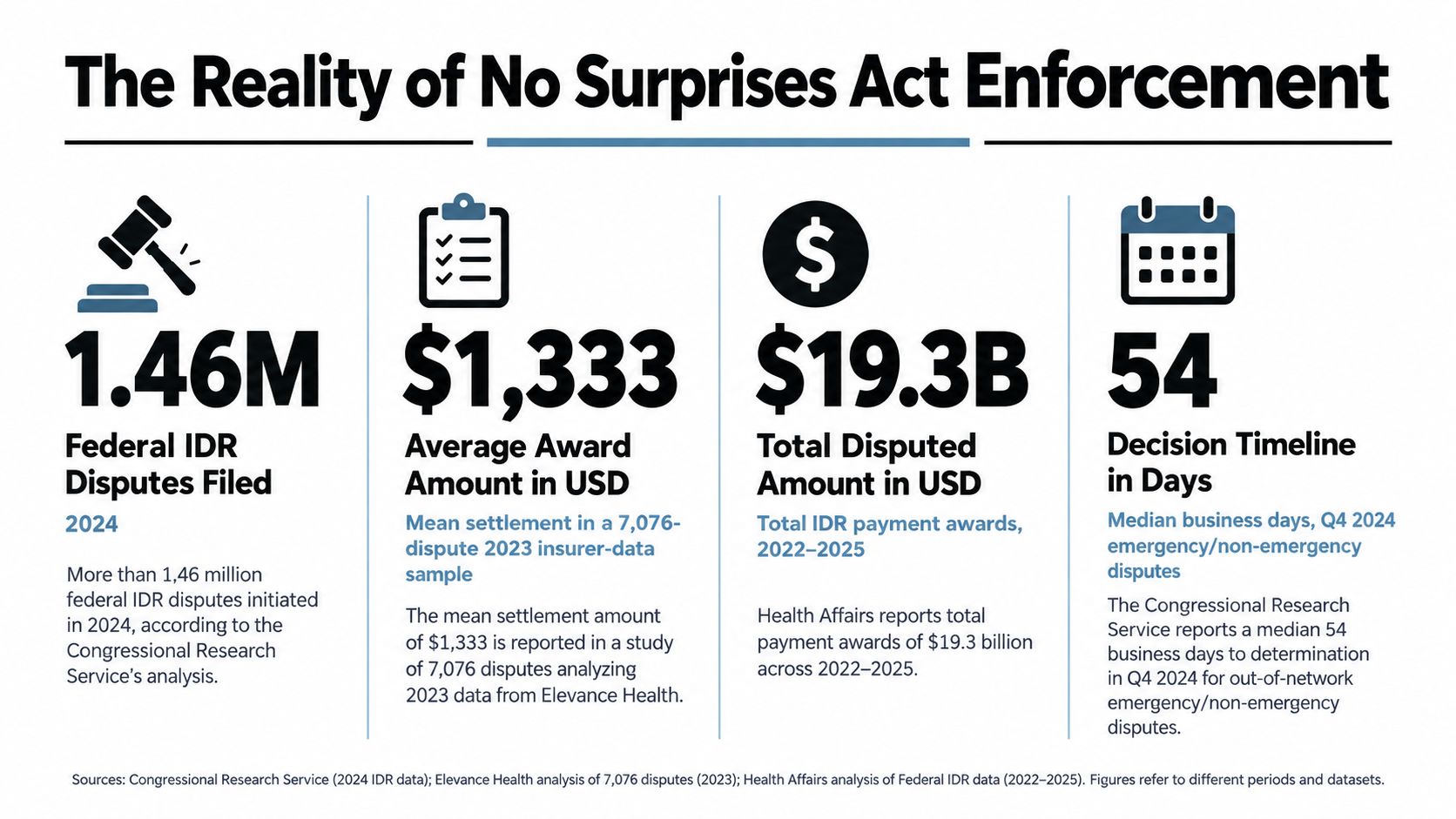
The federal IDR process now operates as a major reimbursement workflow. CMS reported 200,184 disputes in 2022, 679,317 in 2023, 1,463,868 in 2024, and 2,559,375 in 2025. That makes 2025 volume more than twelve times the 2022 level, despite a cooling-off period intended to encourage negotiation before arbitration. CMS federal IDR reporting documents how quickly the program became part of national reimbursement operations.
Early results also exposed the administrative burden. During the first year, parties submitted approximately 489,000 disputes, about 14 times the number federal agencies had projected for a full calendar year. By June 2023, approximately 61% remained unresolved, according to the Government Accountability Office's review of the federal IDR system. With roughly six in ten cases still open at that point, backlog management became a core operational skill.
Compliance is now an operating capacity issue
High volume changes the risk calculation for provider organizations. A practice that handles each dispute as an isolated billing exception will struggle with eligibility review, notice deadlines, evidence assembly, offer positioning, and follow-up. Clean upstream claims and complete records give the downstream team a stronger case, but winning arbitration still leaves collection work unfinished.
CMS reported that parties initiated 1,186,812 disputes during the first half of 2025, while certified IDR entities closed 1,349,343 disputes and rendered 1,082,247 payment determinations during that period. The CMS IDR reports hub illustrates the throughput pressure. At this scale, incomplete submissions and weak handoffs become direct revenue risks.
Practice leaders should assign ownership across the full case lifecycle:
- Eligibility screening: Confirm that the service, payer, provider, facility, and patient circumstances fit the federal or applicable state pathway.
- Deadline control: Record negotiation, initiation, response, and evidence deadlines in a case-management workflow.
- Evidence preservation: Retain the claim, remittance, coding record, authorization history, network information, and relevant clinical or service documentation.
- Payment tracking: Follow the matter after the determination, because an award is not collected revenue.
A useful compliance risk management framework should connect these controls across legal, billing, and collections teams. Practices relying on individual memory, shared spreadsheets, or incomplete claim notes remain exposed to preventable delays and missed recovery.
Practical rule: Treat every potentially eligible underpayment as a case when the claim is adjudicated, not when someone later decides to file arbitration.
Understanding the Balance Billing Ban
The balance billing ban protects the patient from being charged more than the applicable in-network cost-sharing amount in covered situations. The provider's dispute is with the health plan, not with the patient.
The clearest trigger is out-of-network emergency care. A patient generally can't be sent an unexpected out-of-network bill for emergency services because the treating clinician or facility wasn't contracted with the plan. Protection also applies to certain non-emergency services delivered by an out-of-network provider at an in-network facility, subject to the statute's conditions and notice-and-consent rules.

Separate patient responsibility from payer responsibility
Front-desk and billing staff need a clear decision path before a statement goes out:
- Identify the service setting. Determine whether the encounter involved emergency care, an in-network facility, or a planned service outside those protected circumstances.
- Confirm network and consent facts. Check the provider's status, the facility's status, and whether a valid notice and consent process applies.
- Apply the correct cost-sharing treatment. If the service is protected, bill the patient only for the permitted in-network cost-sharing amount.
- Route the payment dispute to the plan. If the payer's allowed amount is inadequate, pursue negotiation or IDR rather than shifting the disputed balance to the patient.
The qualifying payment amount, or QPA, can serve as an important reference point in the payment dispute. It isn't a license to balance bill, and it doesn't remove the need to evaluate eligibility, documentation, and the parties' submitted offers. Staff should use the QPA as part of the payer negotiation and evidence record while keeping patient statements separate from the provider's reimbursement strategy.
This distinction protects more than compliance status. A statement sent to the wrong patient can create avoidable complaints, refunds, account reversals, and reputational harm. Practices that document out-of-network benefits and protected-service decisions before billing are better positioned to pursue the plan without involving the patient in a dispute that belongs between the two parties.
Patient protection and payment recovery aren't competing goals. The practice should remove the prohibited balance from the patient account, then pursue the payer through the correct channel.
Navigating Good Faith Estimates for Self-Pay
Good Faith Estimates address a different operational problem. They apply to patients who are uninsured or who intend to pay for care themselves instead of submitting the service to a health plan. A self-pay workflow therefore shouldn't be confused with an out-of-network insurance dispute.
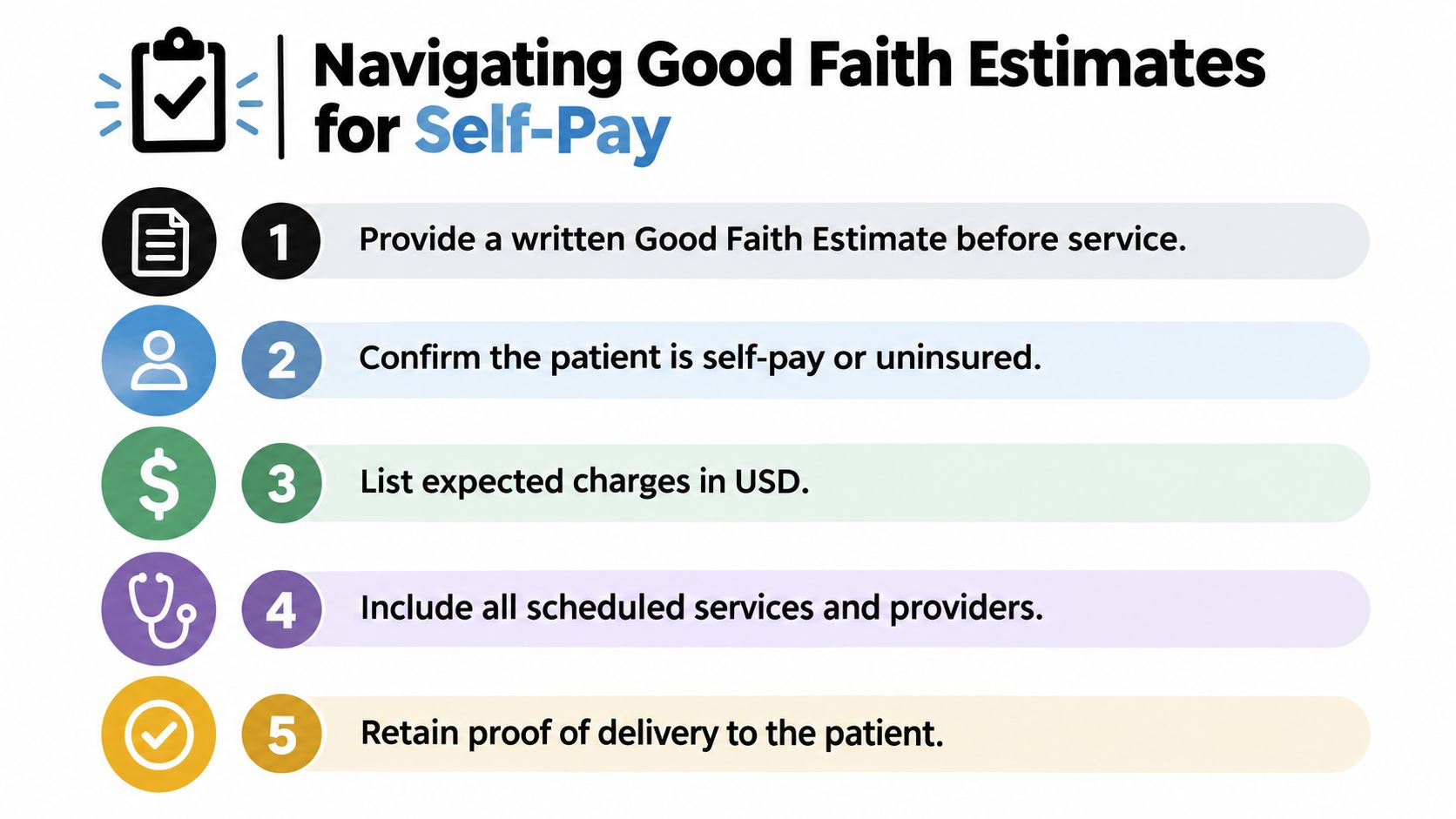
The estimate must be prepared before scheduled services and should give the patient a usable picture of expected charges. The document needs to identify the anticipated services and providers, state expected charges in U.S. dollars, and reflect known facility or related provider charges when they are part of the planned episode.
Build the estimate into scheduling
A reliable front-office process starts before the appointment is finalized. Staff should confirm the patient's insurance position, document whether the patient declined or won't use coverage, identify all known services, and store delivery evidence in the patient record.
The estimate should be treated as a living operational document when the planned service changes. If the practice adds a procedure, brings in another provider, changes the expected scope, or learns of a related facility charge, staff should update the estimate process and communicate the change rather than allowing the final bill to diverge without explanation.
A practical checklist looks like this:
- Confirm status: Record whether the patient is uninsured or intends to self-pay.
- Map the episode: Include scheduled services, expected providers, and known facility components.
- Calculate transparently: List anticipated charges in dollars and identify assumptions that could affect the final amount.
- Deliver and retain: Provide the written estimate through a documented channel and preserve proof of delivery.
- Reconcile changes: Compare the final account with the estimate before sending the bill.
Patients may use the federal patient-provider dispute process when the final bill is at least $400 higher than the Good Faith Estimate. That threshold makes estimate accuracy a daily control, not a courtesy document. The practice should maintain a review queue for material variances and follow the rules for charging self-pay patients before the account reaches patient collections.
The best workflow gives scheduling, clinical operations, and billing a shared source of truth. A document generated by one team and ignored by the next creates the same kind of downstream dispute that poor claim documentation creates with an insurer.
Inside the Independent Dispute Resolution Process
Federal IDR is a baseball-style arbitration process. Each party submits an offer and supporting information, and the certified IDR entity selects one offer rather than designing a compromise from scratch. That structure makes preparation decisive. The provider is not just proving that the payer's amount feels low. The provider is presenting a complete, eligible, well-supported offer that an arbitrator can select.
The workflow begins with the service and claim record, not the portal. Staff should first confirm that the dispute belongs in the federal process, identify the correct payer, verify the relevant protected service, and collect the adjudication details. If the matter remains unresolved after the applicable cooling-off period, the initiating party files through the federal process and the parties submit their offers and evidence according to the required timelines.
What the evidence must accomplish
A submission should answer three questions clearly:
- Why is the case eligible? Show the service context, network status, patient protection, and procedural history.
- Why is the provider's offer reasonable? Tie the amount to service complexity, specialty, expertise, acuity, market conditions, and the specific work performed where those factors are relevant and supportable.
- Why should the arbitrator reject the alternative? Address weaknesses in the opposing position without relying on unsupported generalizations.
Clean upstream data makes this possible. The case file should reconcile the claim form, remittance advice, procedure and diagnosis coding, place of service, provider credentials, facility relationship, authorization record, and correspondence. A coding mismatch that seemed minor during initial billing can become an eligibility or credibility problem in arbitration.
Provider wins don't remove submission risk
From January through June 2025, certified IDR entities issued 1,082,247 payment determinations, approximately 55% more than the 698,968 determinations recorded in the preceding six months. Providers, facilities, and air-ambulance providers prevailed in approximately 88% of those determinations, while health plans prevailed in about 12%, according to the CMS supplemental IDR background report.
Those results support serious IDR participation, but they don't justify indiscriminate filing. Emergency-department services represented 45% of determinations, and radiology represented 19%, which means workflows should account for specialty-specific documentation and valuation issues. Batched disputes represented approximately 31% of determinations, or 335,442 cases, making consistent service-family classification and coding integrity especially important.
A high provider win rate doesn't rescue an ineligible case, a late submission, a misidentified payer, or a record that contradicts itself. The correct objective is not maximum filing volume. It is a controlled process that selects viable cases, presents defensible offers, and tracks the outcome after the decision.
The Collection Gap, Winning vs. Getting Paid
An IDR determination establishes the selected out-of-network rate. It doesn't automatically place funds in the provider's bank account.
That distinction is where many programs stop too early. Staff celebrate the award, close the case in the arbitration tracker, and wait for the payer's remittance. If payment doesn't arrive, nobody has a defined owner, escalation clock, evidence package, or decision about whether the issue should move to a regulator, contractual remedy, or court.
The award needs a collection workflow
CMS describes the federal IDR process as a mechanism for determining the out-of-network rate. Legal analysis has also identified an unresolved enforcement limitation: the statute doesn't clearly give HHS authority to enforce individual awards or compel insurers to pay them on a particular timetable. The CMS IDR reports and policy resources provide the federal program context, but a provider still needs a practical post-award plan.
That plan should preserve:
- The determination: Store the written award, selected offer, dispute identifiers, and covered service lines.
- The payment obligation: Compare the award with the payer's explanation of benefits, remittance, and actual deposit.
- The nonpayment record: Document dates, missing amounts, correspondence, portal messages, calls, and payer explanations.
- The escalation route: Determine whether the next step is payer escalation, a state or federal regulator, contractual enforcement, or judicial relief.
- The pattern evidence: Track repeated delay, partial payment, misrouting, or nonpayment by payer, product, specialty, and service family.

Measure cash realization, not just case outcomes
A dashboard that reports filed cases, wins, and average offers can look healthy while unpaid awards accumulate. Practice administrators should reconcile each determination to the actual payment account and distinguish a fully paid award from a partial payment, a delayed payment, a denied adjustment, and an unresolved balance.
The evidence standard matters here. A payer may contend that it paid, applied the wrong claim, processed a different service line, or issued a remittance that doesn't match the decision. Without claim-level reconciliation, the practice can't show precisely what remains due.
A payment determination is a legal and operational milestone. It is not a collection receipt.
The strongest post-award process assigns an owner before filing. That owner monitors the expected payment, sends a documented demand or escalation when appropriate, preserves proof of nonpayment, and reports recurring payer behavior to leadership. This is the enforcement layer that converts arbitration activity into revenue protection.
Integrating Compliance into Revenue Cycle Management
No surprises act regulations work best when the practice treats them as controls across the revenue cycle. The claim that eventually reaches IDR begins with a patient encounter, a network determination, a service record, a code set, and a clean submission. If those upstream elements are incomplete, the arbitration team inherits a problem that documentation alone may not fix.
A specialty practice should map the workflow from scheduling through payment posting. At each handoff, identify the person responsible for making the next decision and the evidence that person must leave behind.
Start upstream
Eligibility verification should capture more than an active coverage response. Staff need the relevant payer, product, network position, facility relationship, authorization status, and service context. For emergency and facility-based specialty work, the record should make clear why the patient protection applies and which party is responsible for the reimbursement dispute.
Coding then translates the encounter into the claim that the payer will adjudicate. Procedure, diagnosis, modifier, place-of-service, provider, and facility data should agree across the clinical record, claim, remittance, and IDR file. A practice that corrects these inconsistencies only after a denial is already paying for preventable rework.
Use a controlled case pipeline
An effective program usually separates five decisions:
- Prevent: Apply network, consent, estimate, and patient-billing controls before service or statement generation.
- Submit: Send a complete claim with accurate coding and supporting records.
- Diagnose: Classify the payer response as eligibility failure, coding issue, administrative denial, valuation dispute, or payment execution problem.
- Pursue: Negotiate and file only disputes that meet the applicable requirements, with evidence assembled from the original claim record.
- Collect: Reconcile the determination to the remittance and escalate unpaid awards through a documented pathway.
This structure avoids a common mistake, treating every underpayment as an IDR case. Some matters need corrected claims, reconsideration, contract review, or patient-account correction. Others may be eligible for arbitration but lack the documentation needed to support a strong submission.
Make specialty differences visible
Emergency departments, radiology groups, anesthesiology practices, air-ambulance operators, and multi-state platforms don't share identical evidence needs. A radiology file may depend heavily on service-line grouping and facility context. An air-ambulance file may require a precise transport record and payer identification. Anesthesia and facility-based specialties need consistent linkage among the procedure, location, rendering provider, and protected patient encounter.
Use payer and specialty dashboards to identify recurring patterns:
- Eligibility failures: Wrong payer, wrong product, or an unsupported protected-service theory.
- Valuation failures: A viable case with weak offer support or incomplete service context.
- Administrative failures: Missed deadlines, missing forms, or inconsistent identifiers.
- Collection failures: An award issued but not matched to payment, partially paid, or left without escalation.
A platform such as RevGuard can connect specialty-specific RCM with NSA-compliant IDR strategy, evidence assembly, filing, enforcement, and collections. Whether a practice builds internally or uses a specialized partner, the operating requirement is the same: preserve dispute-ready evidence at claim submission and keep the case open until the corresponding revenue is fully collected.
Practice administrators should audit one complete service pathway, from eligibility verification to final payment, and then test every handoff for ownership, timing, documentation, and escalation. Visit RevGuard to evaluate a revenue protection workflow that links clean claims, IDR case management, post-determination enforcement, and collections. A focused review can show where your organization is losing value before arbitration, during submission, or after winning the award.