

41% of U.S. adults had current medical or dental debt, according to KFF's 2022 Health Care Debt Survey findings. That's not a reminder-frequency problem. It's a warning that patient payment collection must account for affordability, billing uncertainty, and the time between receiving care and understanding what's owed.
For specialty practices and ASCs, the practical question isn't which text message gets the most clicks. It's whether the practice has created a balance the patient can understand, verified that the patient does owe it, and offered a realistic route to resolution. Technology can support that process. It can't substitute for it.
Why Patient Payment Collection Is a Structural Problem
Providers collected only 24% of patient billings in a 2025 HFMA survey of more than 200 healthcare finance professionals, while outstanding payment-plan balances equaled twice annual payment-plan collections; the same HFMA discussion of front-end collections cites KFF's estimate that Americans owed at least $220 billion in medical debt. These findings describe more than weak follow-up. They describe receivables that providers haven't reliably converted into cash.
The working-capital problem is straightforward. A practice can report growing payment-plan enrollment while its unpaid balances continue accumulating. Leadership sees activity, but payroll and operating expenses require collected dollars, not signed agreements.
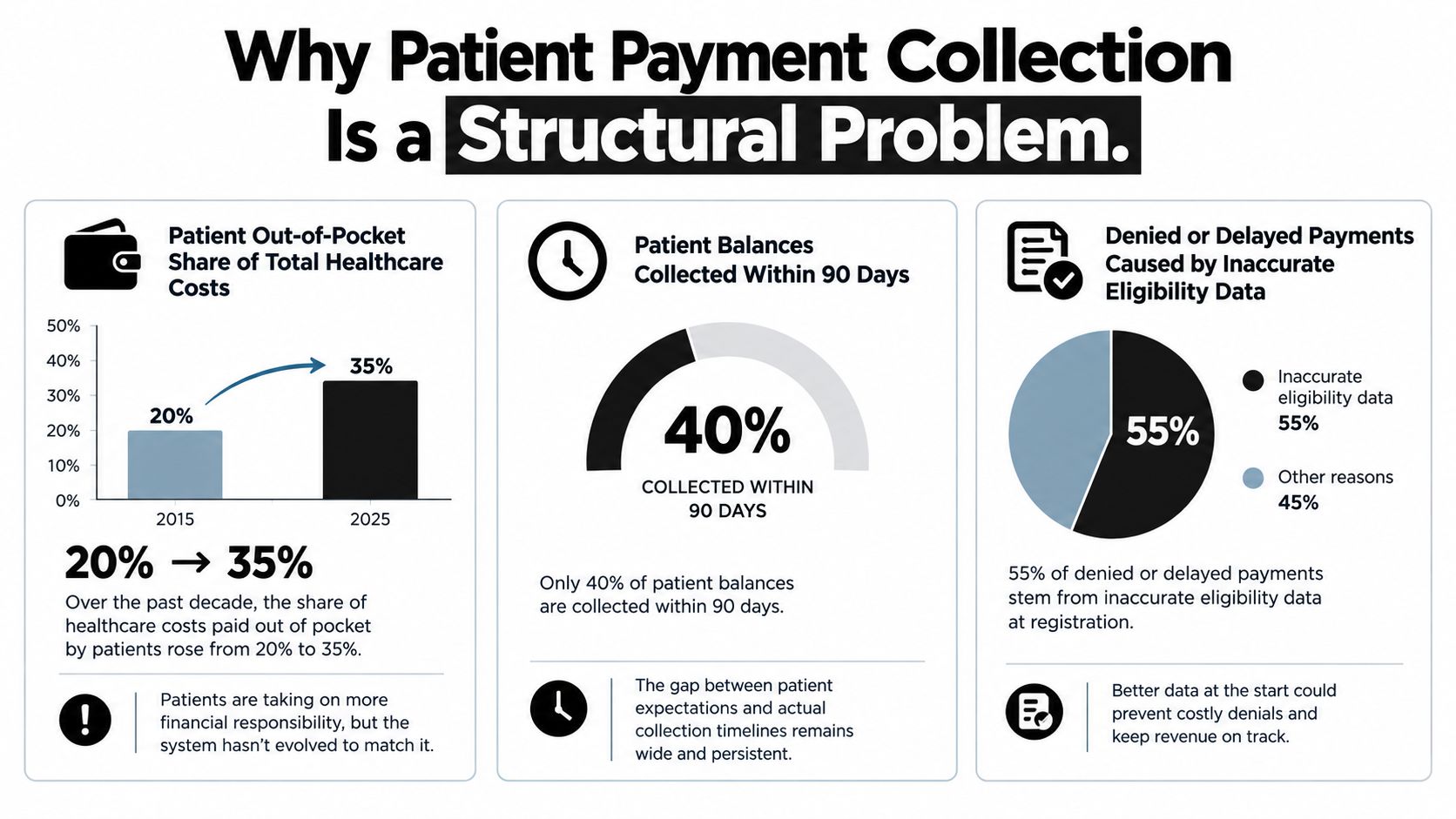
Treat the visual as a conceptual illustration, not a source of collection benchmarks. Use the cited findings for financial planning.
Separate the reasons an account remains unpaid
A useful operating definition of patient financial responsibility distinguishes a valid obligation from a number transferred into self-pay. The patient financial responsibility framework belongs upstream of collections, where staff establish what the patient owes and what still requires investigation.
Managers should separate unresolved accounts into actionable categories:
- Uncertain responsibility: Coverage, contractual adjustments, or adjudication need review before staff request payment.
- Unclear explanation: The patient doesn't understand the charge, the insurer's contribution, or the relationship between separate bills.
- Unaffordable obligation: The balance may be correct, but the requested payment exceeds the patient's available resources.
- Unresolved operational friction: The patient needs assistance, can't use the offered channel, or hasn't received a promised callback.
Those categories require different owners. Sending another statement to every account treats unlike problems as though they're interchangeable.
Leadership rule: Don't ask only how much patient A/R is outstanding. Ask how much is validated, affordable under the offered terms, disputed, and actively moving toward resolution.
A single enterprise collection rate can conceal those distinctions. Specialty leaders should examine balance bands, service settings, payer categories, and account age separately. The objective is a defensible cash forecast and a work queue that tells staff what to do next, not just a larger outreach campaign.
Front-End Workflow That Stops Bad Balances Before Service
Start the pre-service conversation with verified information, not a collection target. A registrar shouldn't have to defend an estimate built from an unresolved coverage record or explain a deposit that nobody can reconcile later.
The preferred sequence is eligibility, benefits detail, individualized estimate, assistance screening, then appropriate payment capture. Each handoff needs an exception path so staff know when to stop quoting and ask for help.
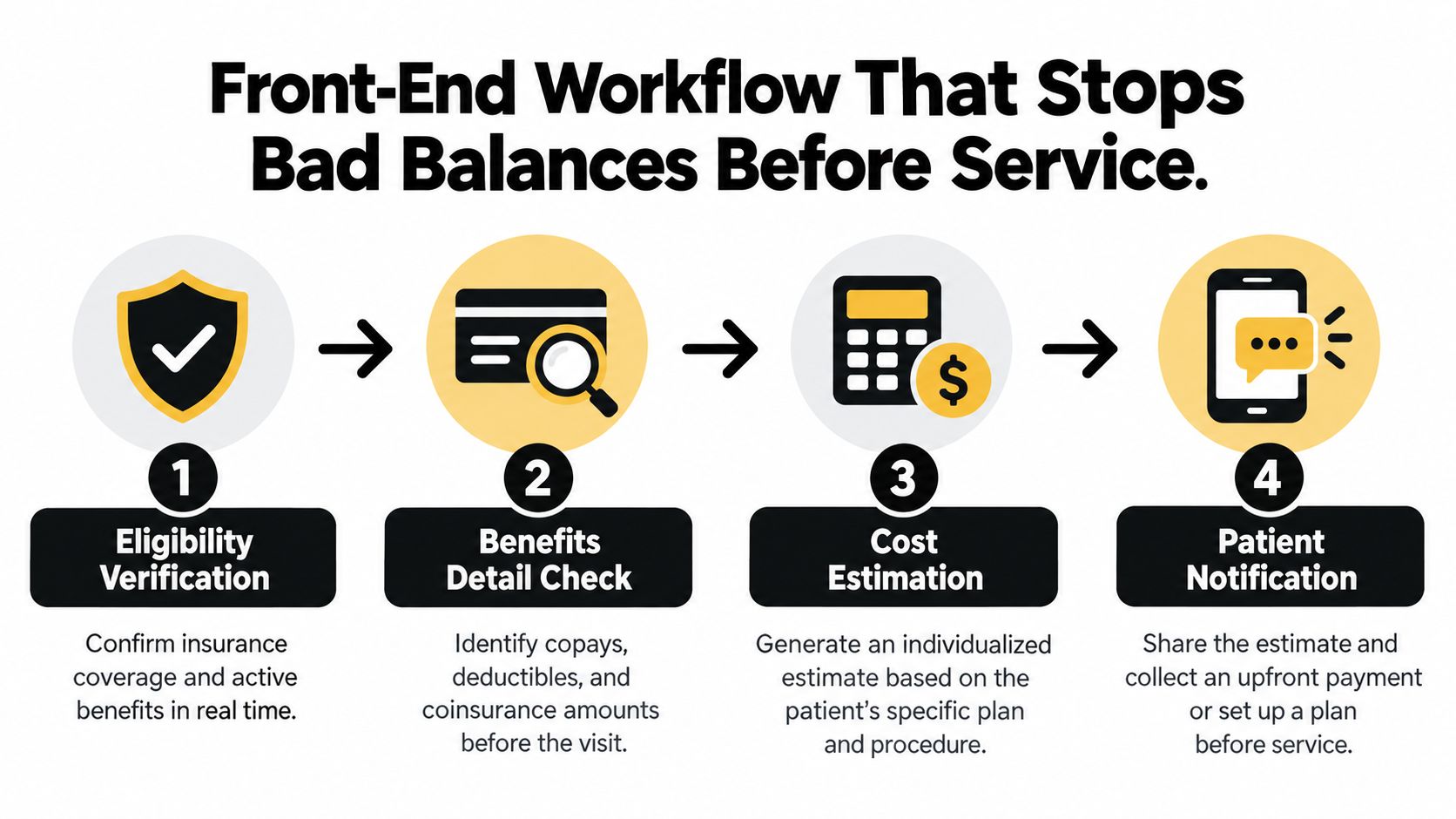
Establish the estimate before requesting money
Use medical eligibility verification to confirm the coverage information relevant to the scheduled service. Document the response and unresolved questions, rather than treating an active insurance card as proof that every benefit question is settled.
- Verify the service context: Match the patient, payer, planned procedure, location, and provider information used in the estimate. Route conflicting information to the verification team.
- Review benefits detail: Identify the applicable deductible, copayment, and coinsurance information. Record when the information was obtained and what assumptions remain.
- Build the estimate: Use the expected services and applicable contracted amounts. Identify separately billed services that your practice doesn't control instead of implying that its estimate covers the entire episode.
- Explain uncertainty: Tell the patient that the amount is an estimate and describe what could change after insurance processing.
A useful disclosure is direct: the estimate reflects the planned service and available benefit information, insurance will determine the final allocation, and any payment made now will be credited against the reconciled balance. Don't promise certainty the billing team can't support.
Test affordability before setting the collection amount
Patients shouldn't have to discover payment options by asking the right question. In the U.S. Bank Healthcare Payments Insight Report, 57% preferred a payment-plan offer before or at service, only 6.9% preferred calling to request one, and 51.4% selected plans for balances of at least $1,000.
Use balance thresholds and hardship indicators to trigger a financial conversation. A propensity-to-pay score can help prioritize staff work, but it shouldn't override a patient's explanation of financial difficulty or become an automatic barrier to care.
Screen for assistance under the organization's approved policy before proposing installments. Then agree on an appropriate upfront amount, document consent and terms, and provide a receipt.
The handoff to billing must carry the estimate version, payment received, assistance status, and unresolved questions. After adjudication, staff should apply the deposit before generating the remaining balance. Otherwise, the front desk's successful collection becomes the billing team's avoidable dispute.
Statements and Outreach That Patients Actually Respond To
Consider an illustrative orthopedic patient who receives an ASC statement and a separate anesthesia bill after a procedure. The ASC statement shows total charges prominently, while the anesthesia statement offers a balance without explaining insurance activity. The patient remembers paying at check-in and assumes someone has billed twice.
Neither account necessarily needs stronger language. Both need enough context for the patient to identify the service, understand the remaining obligation, and choose the next action.
Explain the balance before demanding payment
A generic statement emphasizes the amount due and payment deadline. A useful statement explains how staff arrived at that amount and makes questions as easy to submit as payments.
| Statement element | Confusing approach | Actionable approach |
|---|---|---|
| Provider identity | Unfamiliar billing entity alone | Billing entity plus a recognizable service description |
| Insurance activity | Several unexplained figures | Charges, adjustments, insurer payment, and remaining responsibility clearly separated |
| Previous payment | Deposit missing or buried | Prior payment visibly credited |
| Next action | Payment demand only | Payment, plan discussion, assistance, and dispute routes |
| Contact information | General office number | Billing contact with clear availability information |
Consolidate related balances where the billing structure permits it. When separate entities must issue separate statements, identify what each bill covers and avoid suggesting that your office can resolve another provider's charges.
Plain language matters most at the point of confusion. Replace an unexplained adjustment code with a description of the insurance adjustment, while retaining the itemized detail needed for reconciliation. The patient shouldn't need to understand revenue-cycle terminology to decide whether the bill looks correct.
A statement should answer what this bill covers, what insurance did, what the patient already paid, and what remains unresolved.
Let patient behavior determine the next contact
Start outreach after the balance is ready for patient billing. Offer digital delivery and payment without removing paper, telephone assistance, or an accessible route for patients who can't use the portal.
For the orthopedic account, a reminder can direct the patient to the statement showing the credited deposit. For the anesthesia account, staff may need to explain the separate professional service before discussing payment. These are illustrative workflows, not claims of measured conversion improvements.
A patient who disputes the balance should leave the routine reminder queue. A patient who requests payday-aligned installments should receive a plan conversation rather than repeated demands for immediate payment.
Test statement changes against first-statement payment, days to first payment, dispute volume, and staff handling effort. Message opens and payment-link clicks can help diagnose delivery, but they aren't cash recovery. Keep the version that produces clearer resolution without increasing complaints or unresolved callbacks.
Payment Plans Designed to Recover Cash, Not Just Enroll Patients
A signed payment agreement isn't evidence that the installments are affordable. If staff set terms primarily to satisfy an aging policy, they may enroll patients into arrangements that were unlikely to succeed from the start.
The 2025 HFMA findings on payment-plan design reported default rates above 20% for in-house plans longer than 12 months, while 28% of organizations capped plans at 12 months and 7% offered no in-house plans. That doesn't establish a universally optimal duration. It establishes the need to examine plan design and actual performance together.
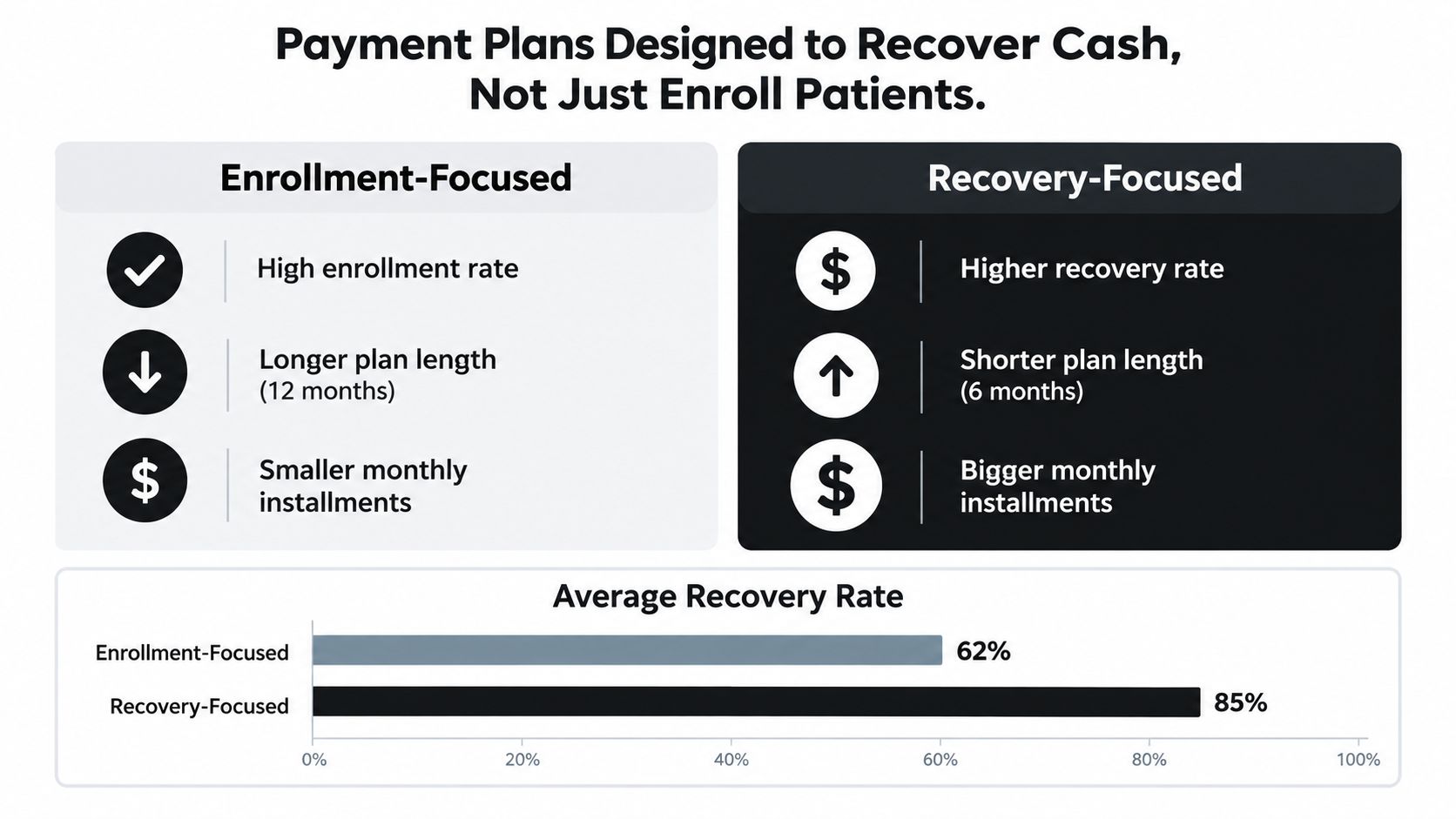
The graphic's numerical comparison isn't a validated recovery benchmark. Shorter terms and larger installments aren't automatically more effective; affordability and observed completion should determine policy.
Compare workable terms rather than default durations
The plan conversation should establish what the patient can sustain after assistance screening. Ask about a manageable installment, preferred payment timing, and whether income changes make a fixed schedule difficult.
| Design choice | Potential benefit | Trade-off to review |
|---|---|---|
| Shorter repayment period | Earlier expected cash | Installments may exceed available income |
| Longer repayment period | Lower scheduled installment | More exposure to changing circumstances and servicing effort |
| Automated payments | Less manual payment effort | Requires clear authorization and a response to failed transactions |
| Flexible due dates | Better alignment with income timing | Requires reliable scheduling and account documentation |
| Restructuring | Keeps a viable account in resolution | Changes the cash forecast and may extend servicing |
Don't choose a duration without checking the resulting installment. Don't assume a small monthly amount makes every balance sustainable, either. Financial assistance may be the appropriate resolution when repayment remains unrealistic.
Intervene before a plan becomes abandoned
Define early-warning events that trigger review:
- Missed installment: Ask whether the cause is technical, temporary, or an ongoing affordability problem.
- Changed payment method: Confirm whether the patient needs assistance rather than interpreting the change as deliberate avoidance.
- Repeated modification requests: Reassess the original affordability assumptions.
- New billing disagreement: Separate the disputed amount from the repayment discussion and investigate it.
Present the CFO with expected cash timing, servicing effort, completion behavior, and alternatives. Compare restructuring with escalation using the practice's own account history, not a vendor's enrollment dashboard.
Cash discipline: Reward completed, sustainable repayment and appropriate assistance resolution, not enrollment volume alone.
Escalation may be appropriate under approved policy after valid responsibility and available resolution options are established. It shouldn't be the automatic response to a plan whose original terms were plainly unworkable.
Choosing Patient Engagement Technology That Actually Helps
A text-to-pay demonstration usually begins with a clean balance and a patient ready to pay. A real specialty billing queue includes corrections, deposits, separate entities, assistance applications, and patients asking why insurance didn't cover the service.
Evaluate software against those exceptions. The tool must support the account's actual status, not just deliver a payment button.

Match the tool to the operational gap
| Tool type | Appropriate use | Demonstration question |
|---|---|---|
| Patient engagement platform | Estimate delivery, outreach coordination, two-way messaging | Can staff see replies and assign an accountable owner? |
| Text-to-pay | Convenient payment for validated balances | What happens when the balance changes after message delivery? |
| Interactive voice response | Telephone payment and routine account access | Can patients reach staff without restarting the interaction? |
| Patient portal | Statements, payment history, and account detail | Can a patient understand the balance without navigating unrelated clinical screens? |
| Plan-management system | Scheduling, authorization, exceptions, and completion tracking | How does a missed payment become a staffed review task? |
A broad platform may reduce the number of interfaces staff use, but it can also create a larger implementation burden. A focused payment tool may be easier to deploy, yet leave dispute management outside the system.
Use a medical collections software evaluation to connect buying criteria to workflow requirements. Feature breadth shouldn't outrank accurate balances, accessible patient support, and reliable posting.
Require an end-to-end account demonstration
Ask the vendor to process an illustrative account from estimate delivery through payment posting and a subsequent correction. Include an upfront deposit, a patient reply, a plan adjustment, and a billing hold.
- Reconciliation: Determine how electronic remittance advice, explanation-of-benefits information, and contractual adjustments reach the collection workflow.
- Compatibility: Confirm the role of the clearinghouse and practice management system rather than accepting a general claim of integration.
- Write-back: Verify where payments, reversals, plan terms, and dispute notes are stored.
- Suppression controls: Show that corrected, paid, or held accounts stop receiving inappropriate reminders.
- Reporting: Require account-level exports and segmentation that finance can reconcile to posted cash.
Assign staff ownership before launch. Registrars should know how to introduce the payment channel, billing staff should know where replies arrive, and supervisors should know how to inspect failed postings.
Pilot the workflow with a defined service group and review exceptions before expanding. Software is operationally live only when staff use it correctly and patients can complete the intended task without losing access to human assistance.
Scripts, Escalation, and Dispute Handoffs
Collection staff need permission to investigate, not just permission to negotiate. An unexpected balance, hardship disclosure, and possible surprise-billing issue shouldn't all end with the same request for a card number.
The stakes extend beyond A/R. Among adults with medical debt, 35.2% reported collection-agency contact, 21.7% reported a lowered credit score, and 4.7% reported a lawsuit, according to the Urban Institute's analysis of December 2025 survey data. Those are reported experiences, not a prediction of what will happen to a particular account.
Give staff usable language and routing authority
The following are suggested staff scripts, not quotations from patients or research.
- Unexpected balance: We can review how insurance processed the service and confirm that your earlier payment was applied. Tell me which part differs from what you expected.
- Possible surprise out-of-network charge: I'll route this for a coverage and billing-protection review before we ask you to resolve the disputed amount. We'll explain the result and the next step.
- Payment-plan request: Let's discuss an amount and payment date you can maintain. We'll also check whether assistance should be considered before setting terms.
- Financial hardship: You don't need to agree to an installment you can't afford. I can explain our assistance process and document what you need reviewed.
Route duplicate-payment concerns, conflicting insurance explanations, unresolved appeals, possible protected out-of-network charges, and hardship disclosures to trained staff. Log the reason, disputed amount, responsible owner, next action, and promised callback.
For anesthesia, radiology, emergency, and air ambulance accounts, ask the compliance team to assess applicable No Surprises Act protections before approving collection of a disputed out-of-network balance. Keep payer-payment disputes and any applicable IDR pathway separate from patient collection decisions. Don't treat a potential payer underpayment as permission to transfer the difference to the patient.
Measure resolution as well as receipts
Set an internal callback deadline that the team can meet, then monitor overdue commitments. During investigation, apply the appropriate billing hold and document who can release it.
Patient Collection KPI Dashboard
| KPI | What It Measures | Target Signal | Section Owner |
|---|---|---|---|
| Estimate accuracy | Estimate compared with finalized responsibility | Narrower unexplained variance | Patient access |
| Point-of-service capture | Appropriate upfront payments received | Better capture without access complaints | Front desk |
| First-statement payment rate | Payment after initial billing | Improving within comparable cohorts | Patient billing |
| Days to first payment | Time from finalized billing to receipt | Shorter without premature billing | Revenue-cycle operations |
| Plan completion | Agreements reaching resolution | More completion, fewer abandoned plans | Financial counseling |
| Corrected-balance rate | Accounts requiring balance correction | Fewer repeat upstream errors | Claims and coding |
| Bad-debt conversion | Collectible balances moving to bad debt | Declining within comparable cohorts | Finance |
| Complaint and dispute rate | Patient-reported problems | Fewer avoidable problems and faster closure | Patient billing supervisor |
Use qualitative target signals until the practice establishes credible baselines. A faster payment cycle isn't an improvement if staff achieve it by billing unresolved balances.
Implementation Checklist and How to Measure Progress
Begin with an account audit, not a software purchase. Select comparable service and payer cohorts, inspect the supporting records, and identify where responsibility, communication, affordability, or ownership broke down.
A useful external reference requires a clear denominator. The transaction benchmark reported by TechTarget found collection of approximately 47.8% of patient responsibility in 2022–2023, down from 54.8% in 2021, using nearly 3 million fully resolved commercially insured claims across more than 1,850 hospitals and 250,000 physicians. It isn't directly interchangeable with the earlier HFMA survey, and it shouldn't become an unadjusted target for a specialty practice.
Assign deliverables in operating order
Give managers a checklist with a named owner and acceptance criteria for every change:
- Baseline the current state: Reconcile posted cash, collectible responsibility, adjustments, refunds, holds, and unresolved accounts. Record where reporting definitions differ.
- Repair pre-service controls: Approve estimate assumptions, exception routing, assistance screening, and deposit handoffs.
- Test the statement: Ask someone unfamiliar with billing operations to explain the document and identify how to pay or ask a question.
- Review plan policy: Compare offered terms with completion behavior and document restructuring authority.
- Validate technology controls: Confirm posting, replies, suppression, and reporting before increasing automated outreach.
- Audit dispute ownership: Check whether staff can identify the responsible reviewer and whether promised callbacks take place.
Don't expand a pilot just because messages were delivered successfully. Review the accounts that didn't resolve and decide whether the cause was patient behavior, incorrect data, unsuitable terms, or a broken handoff.
Make progress visible without overstating it
Use weekly cohort reporting to compare cash realization, resolution time, plan completion, reversals, and complaints. Keep service mix and account maturity visible so managers don't mistake a different population for an operational improvement.
Review corrected balances alongside collections. An apparent drop in patient receivables may represent appropriate correction or assistance rather than cash, and finance should be able to distinguish those outcomes.
Specialty leaders need one accountable revenue lifecycle, not separate teams optimizing statements, payer disputes, and patient receipts in isolation. The practical test is whether each unresolved account has a valid balance, an appropriate resolution path, and someone responsible for moving it forward.
RevGuard offers patient collections and self-pay recovery services, including statement strategy, patient billing support, payment-plan and hardship workflows, and insurance-balance resolution. Visit RevGuard to discuss how your specialty practice or ASC can connect those workflows with upstream revenue-cycle controls and appropriate payer-dispute handling.