

Revenue cycle management (RCM) is the end-to-end financial workflow that converts a patient encounter into collected, accurately posted revenue. It isn't just back-office billing: the cycle starts with coverage and authorization decisions before care, and continues through documentation, coding, payment reconciliation, and collection.
An ambulatory surgery center can deliver the right procedure, submit a claim, and receive a payment that doesn't match its contract. Staff may then spend months tracing the difference, only to discover that a documentation detail or payer rule affected the allowed amount. The billing office sees the last part of the problem, but the cause may have begun before the patient arrived.
That's why it helps to think of RCM as a closed-loop revenue control system, not a one-way path from treatment to billing. Teams need to prevent defects before service, identify them during claim preparation, and use payment and denial outcomes to improve upstream decisions.
The Basic Definition of Revenue Cycle Management
Revenue cycle management is the coordinated workflow that moves a healthcare encounter from registration and eligibility verification through coding, claim submission, payment posting, denial resolution, patient billing, and final collection. Its modern foundation was established by HIPAA in 1996, which set national standards for administrative transactions such as eligibility inquiries, health claims, claim status, and payment and remittance advice (HHS overview of HIPAA electronic transaction standards).
The common misconception is that RCM begins when someone submits a bill. In practice, it starts earlier. A scheduler may need to confirm coverage; a specialist may need prior authorization; a credentialing team may need to ensure the provider is enrolled with the payer. These decisions affect whether the eventual claim is payable, even though they happen before coding or billing.
A useful mental model is a relay. Each team receives information from the previous stage and must pass accurate, complete information forward. If the baton is dropped at eligibility, authorization, documentation, or coding, the billing team may inherit a defect it can't fix by resubmitting the claim.
A cycle, not a one-way pipeline
A linear diagram suggests that the work ends when payment arrives. A control-system view adds the feedback loop: payment variances, denials, and patient-balance issues should guide changes to scheduling, authorization checks, documentation, coding, and payer workflows.
For example, if an anesthesia claim is repeatedly challenged because required time information is missing, the solution may be a documentation prompt or a workflow adjustment during care, not another round of appeals. If an ASC finds that a particular payer's authorization requirements are often misunderstood, the practice can update its pre-service verification process.
RCM carries financial weight at every handoff. Strong teams don't just ask, “Did we submit the claim?” They ask whether the service was authorized, supported by the record, coded correctly, adjudicated as expected, and reconciled to the amount received.
How RCM Evolved From Paper Billing to Data-Driven Revenue Control
RCM has shifted from fragmented manual transactions toward standardized electronic workflows. HIPAA's transaction standards helped establish common formats for administrative exchanges, but electronic submission alone doesn't guarantee a clean claim or correct payment. Teams still need to verify that information is accurate, that payer requirements are met, and that exceptions reach someone who can resolve them.
The transition is substantial. In 2021, 97% of U.S. medical claims were submitted electronically, yet moving the remaining submissions to fully electronic processes could still save an estimated $1.9 billion annually. Roughly nine out of ten eligibility verifications were also conducted electronically (CAQH Index reporting covered by Chief Healthcare Executive).

Automation has made routine exchanges faster, but it hasn't removed the need for operational follow-through. Prior authorization is a clear example: a manually completed authorization took about 20 minutes, compared with 12 minutes through a payer portal and nine minutes electronically. Those differences matter only if the practice submits the right request, monitors the response, and connects the authorization to the correct encounter. The same principle applies to claim status. Electronic processes can reduce manual handling, but an unresolved status inquiry still leaves staff without a clear next action.
Why this matters for specialty practices
For anesthesia, radiology, and air ambulance providers, a case can depend on multiple connected records: the patient's coverage, the authorization decision, the rendering provider's enrollment, the clinical documentation, and payer-specific claim rules. If one link is missing or inconsistent, electronic submission may transmit the defect more efficiently.
The practical shift is from treating RCM as clerical data entry to managing data quality and exceptions across the encounter. Electronic workflows create a foundation. Revenue control comes from validating information at the right stage, routing exceptions to the responsible team, and learning from payment results.
The Main Stages of the Revenue Cycle
The cycle is often grouped into front-end, mid-cycle, and back-end work. These labels are useful, but each stage depends on the accuracy of the one before it.
At the front end, staff register the patient, verify eligibility and benefits, check authorization requirements, confirm financial responsibility, and make sure providers are credentialed and enrolled as needed. A radiology team, for example, may need to confirm that the patient's plan is active and that the ordered imaging service meets the payer's authorization rules. A stale credential can also prevent payment even when the claim itself is otherwise complete.
In the mid-cycle, clinicians document the service, coders assign applicable ICD-10-CM, CPT, or HCPCS codes, and billing staff capture charges, create claims, and validate edits before submission. If an anesthesia record doesn't support the reported time, the claim may be challenged or reimbursed at a lower level. If an orthopedic procedure is documented without the detail needed to support the code, a claim can face a coding or medical-necessity issue.
At the back end, teams submit claims, monitor adjudication, process remittances, post payments, reconcile expected and actual reimbursement, appeal appropriate denials, and bill patients for valid balances. Payment posting isn't just bookkeeping. Without accurate reconciliation, an underpayment can look like a completed claim, and the practice may miss an opportunity to investigate.
| Stage | Key activity | Common failure mode | Financial consequence |
|---|---|---|---|
| Front end | Registration, eligibility, authorization, and credentialing | Incorrect coverage, missing authorization, or outdated enrollment | Delayed payment, denial, or lost reimbursement |
| Mid-cycle | Documentation, coding, charge capture, and claim creation | Unsupported code or incomplete clinical detail | Claim edits, downcoding, or medical-necessity challenge |
| Back end | Remittance, follow-up, denial work, reconciliation, and patient billing | Unworked status, inaccurate posting, or unexplained variance | Longer collection time or missed recovery |
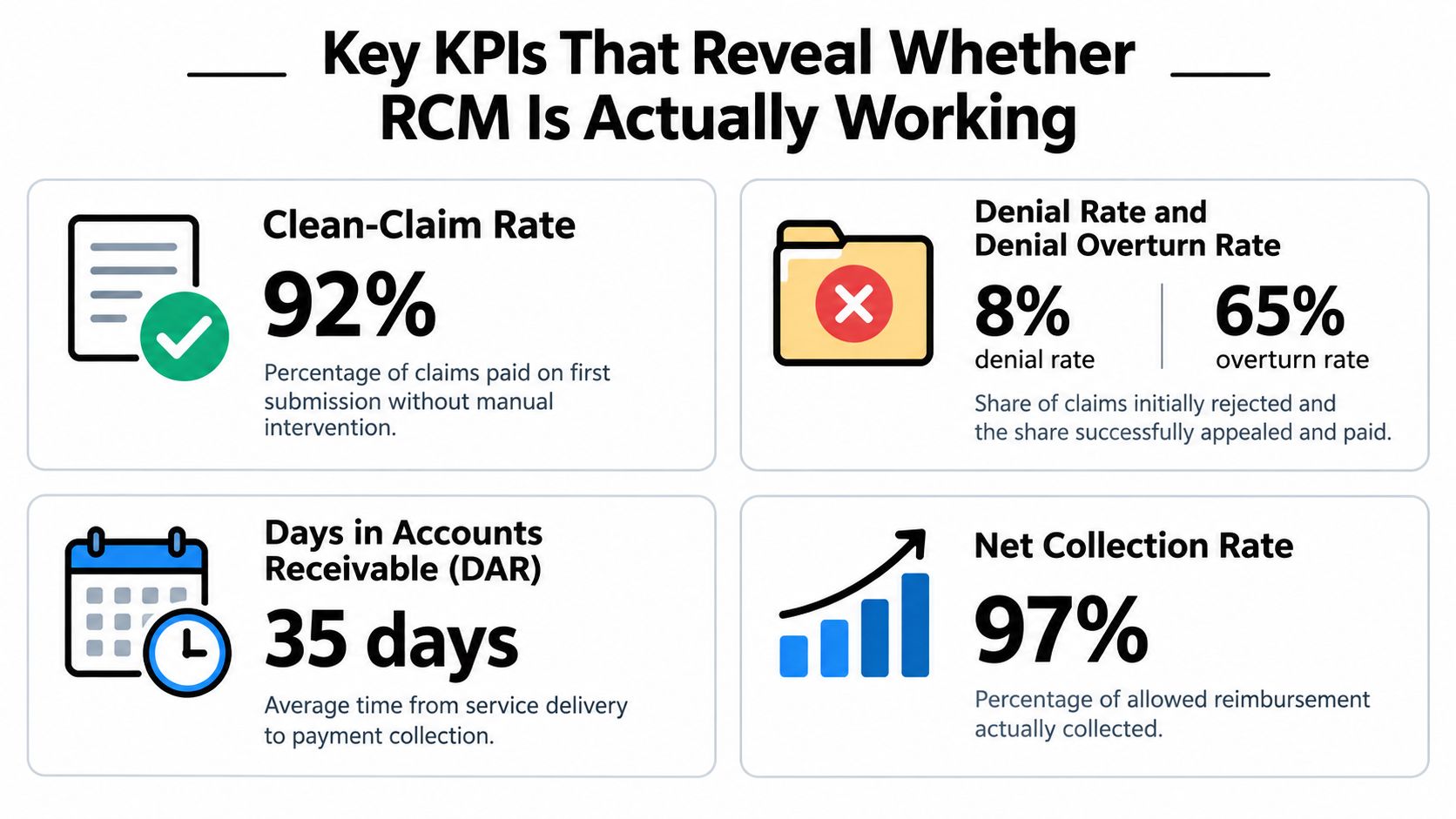
The graphic presents sample KPI values. Treat those as illustrative, not as verified benchmarks. A practice should set targets using its own payer mix, specialties, contracts, and operating context.
Key KPIs That Reveal Whether RCM Is Actually Working
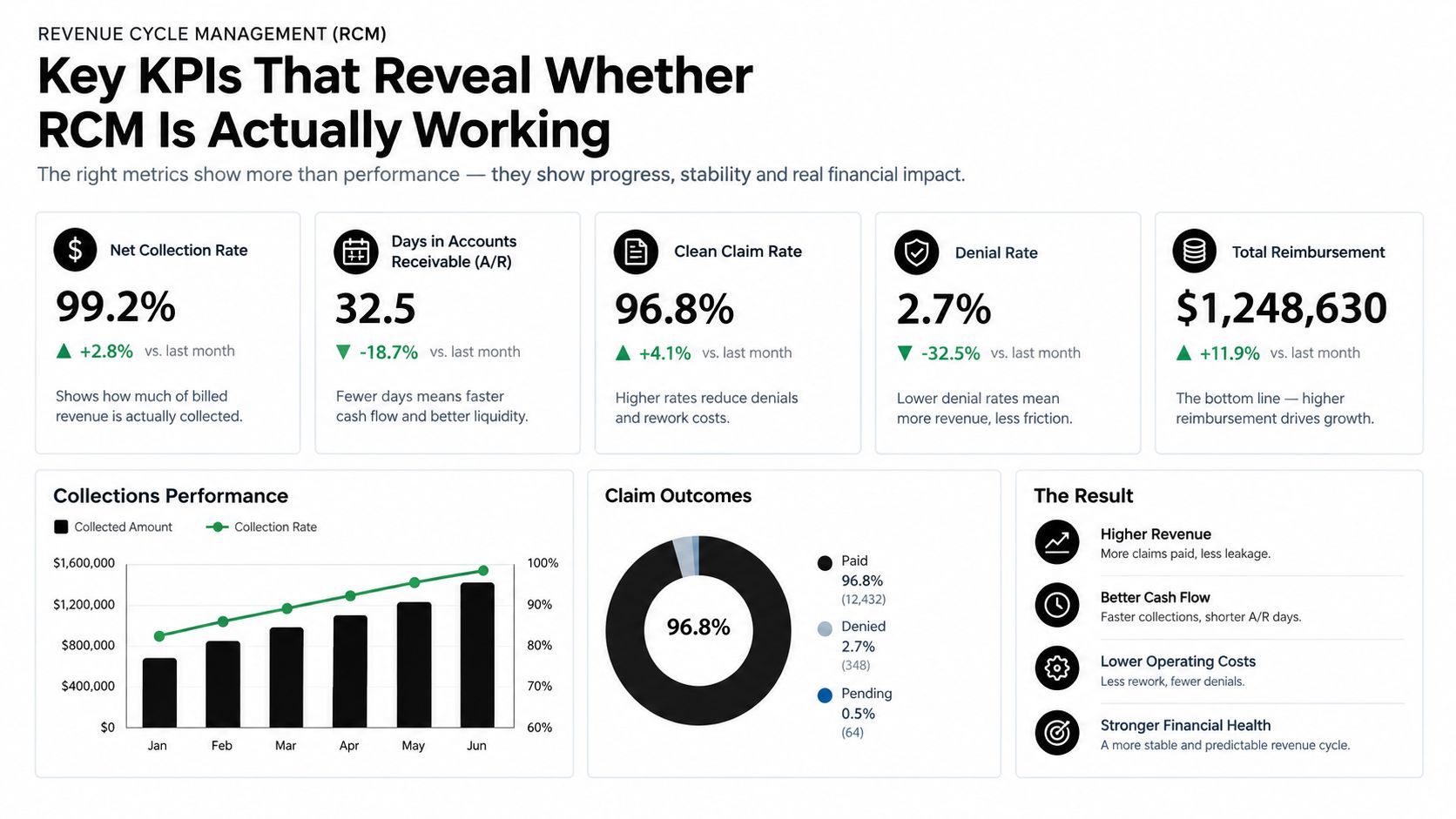
A dashboard is useful only when a metric points to an action. Clean-claim rate shows how often claims pass initial edits without avoidable correction. If it falls, examine registration accuracy, authorization handoffs, coding edits, and documentation completeness rather than asking the billing team to work faster.
Denial rate measures how often claims are denied, while denial overturn rate tracks the share of appealed denials that are reversed. Read them together. A high overturn rate may show that the practice can build strong appeals, but it can also signal that preventable errors are reaching payers in the first place. For practical definitions and ways to interpret common measures, see this guide to revenue cycle management metrics.
Days in accounts receivable helps show how long revenue remains uncollected after service. Rising A/R can reflect slow status follow-up, payer delays, unresolved authorization questions, or posting problems. Segment the measure by payer, specialty, service location, and aging category so a blended average doesn't hide a specific bottleneck.
Net collection rate compares collected reimbursement with the amount the practice expects to collect under its allowed contractual terms. It helps distinguish billed charges from collectible revenue. A charge can be high while actual collections remain weak if the claim was denied, underpaid, or never followed through.
Connect the metric to the cause
Track authorization success to test front-end processes, and underpayment recovery to test remittance review and escalation. Review aging buckets to identify claims that need a status check, an appeal, a patient statement, or a contract-aware payment review. These are not interchangeable problems, so a single “collections” metric won't explain what staff should do next.
Denials also consume resources and delay working capital. Hospitals spent nearly $18 billion overturning claims denials in 2025 and approximately $43 billion attempting to collect payments insurers owed for care already delivered. A cited Health Affairs analysis found that Medicare Advantage plans denied about 17% of initial claim submissions, while 57% of denials were eventually overturned (American Hospital Association overview of the cost of caring).
Practical rule: Use leading indicators, such as eligibility and authorization performance, to prevent defects. Use lagging indicators, such as net collections and A/R aging, to find where earlier controls failed.
A weekly review should connect each outlier to a named owner and next step. If authorization success slips, review the pre-service process. If underpayment recovery is weak, examine remittance analysis and payer follow-up. If denials recur for the same reason, feed that pattern back into scheduling, documentation, coding, or payer-specific guidance.
Where Revenue Leaks Before the Claim Is Even Submitted
The linear model puts too much attention on what happens after a claim leaves the practice. Many expensive failures begin earlier, when coverage, authorization, documentation, or coding requirements aren't aligned with the planned service.
In 2025, 37% of healthcare organizations reported that clinical-documentation and coding discrepancies negatively affected finances by at least $1 million, while only 9% were very confident they captured all entitled revenue. Two out of five organizations still handled denials retrospectively, even though medical necessity and prior authorization were identified as the most common denial causes (HFMA report on automation and revenue integrity).
That creates a practical challenge for specialty practices. An authorization may be obtained for a planned service, but the final documentation may not support the billed code. A patient's benefits may be checked, but the information may not be connected to the encounter. A claim may be coded correctly, yet a provider's credentialing or payer enrollment status may not support payment. These are different root causes, and each calls for a different fix.
Replace rework with a feedback loop
A back-end denial vendor can help with appeals, but it can't independently correct a scheduling workflow that repeatedly misses authorization or a clinical process that leaves required details out of the record. Retrospective recovery matters, but it shouldn't be the only control.
Build a root-cause review that connects denial reason and payment variance to the relevant payer, specialty, site, service, and workflow step. Then assign an upstream owner: scheduling for coverage and authorization, clinical leaders for documentation, coding for code selection, and credentialing teams for provider enrollment. Practices reviewing these handoffs can use a defined provider credentialing process to make enrollment responsibilities visible.
Revenue protection starts before a claim exists. A denial queue can recover some value, but prevention requires changing the work that produced the denial.
This is why gross charges and total claims submitted don't tell the whole story. A useful RCM system measures whether each step produces a complete, defensible claim, and whether downstream outcomes change the way the practice operates.
When an Unpaid Claim Becomes an IDR Dispute
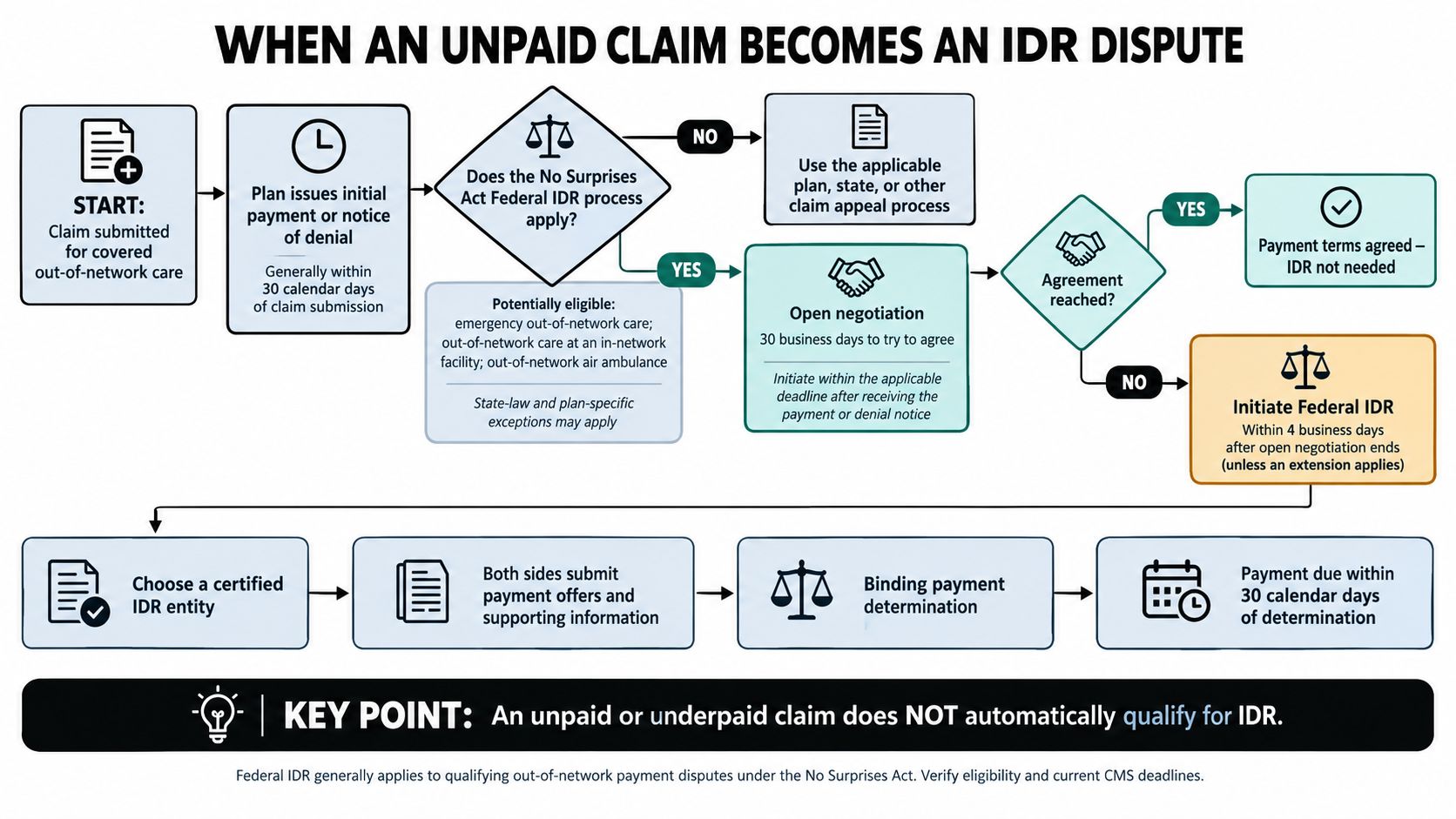
Not every unpaid claim belongs in the same work queue. A routine claim correction, a clinical denial appeal, an unexplained payment variance, and a potential No Surprises Act dispute each require different evidence and handling. Treating them all as ordinary accounts receivable can cause a practice to miss an appropriate escalation path.
For eligible out-of-network disputes covered by the No Surprises Act, the federal Independent Dispute Resolution (IDR) process may provide a separate route after the required steps. The first question isn't how large the balance is. The team needs to determine whether the service and dispute qualify, whether the payer response has reached the relevant stage, and whether required deadlines and negotiation steps have been met.
Make the claim dispute-ready upstream
A dispute file is stronger when the practice preserved the records needed to explain what happened. Keep authorization and clinical documentation tied to the encounter, maintain the relevant payer communications, document good-faith negotiation, and track filing deadlines. Assemble evidence that supports the appropriate out-of-network rate rather than relying on billed charges alone.
CMS reported that certified IDR entities issued payment determinations in 1,082,247 disputes during the first half of 2025. By the end of 2025, 98% of disputes submitted since the program began had either been resolved or were less than 30 business days old (CMS federal IDR supplemental background). Those figures show why practices should treat IDR readiness as part of operational revenue management, not as an unusual legal afterthought.
Before moving a claim toward IDR, confirm that it's potentially eligible, that ordinary correction or appeal routes have been distinguished from the dispute, and that the practice can support its position with organized records. A guide to the No Surprises Act IDR process can help teams understand the escalation pathway, but each case still requires careful review of its facts and applicable requirements.
How Integrated RCM and IDR Improve Specialty Provider Outcomes
An integrated model prepares claims before submission, appeals denials with evidence, checks remittances against expected payment, and evaluates eligible disputes for IDR when a payer delays, downcodes, or underpays. The point is not to send every unpaid balance to arbitration. It's to route each issue to the right process while preserving the records needed for escalation.
This approach is especially relevant to IONM, air ambulance, anesthesia, orthopedics, cardiology, dermatology, gastroenterology, oncology, and radiology. Each specialty has its own documentation, coding, credentialing, and payer requirements, so generic claim handling may miss the specific detail that supports reimbursement.
A practice manager should be able to trace a payment problem backward: Was the patient's coverage verified? Was authorization obtained? Does the clinical record support the code? Was the provider properly enrolled? Does the remittance match the contract? If the payment remains disputed, is there an appropriate escalation route?
When those questions are connected, teams can reduce preventable denials, improve follow-up, identify underpayments, and make more informed decisions about dispute readiness. The result is a revenue process that learns from each encounter instead of treating every claim as an isolated billing task.
The RCM Model in Practice and a Short Maturity Checklist
RCM works best as a closed-loop control system: front-end decisions shape claim quality, payment results reveal defects, and teams use those findings to change upstream processes. IDR is a potential extension of that lifecycle, not a substitute for clean claims or timely appeals.
Use this checklist to assess your operation:
- Before service: Can staff verify coverage, authorization, and provider enrollment?
- During care: Does documentation support the service and coding?
- After submission: Are denials and payment variances classified by root cause?
- On the dashboard: Do leaders review clean claims, denial patterns, A/R aging, and net collections?
- At escalation: Can the team identify when an eligible issue needs appeal, underpayment review, or IDR evaluation?
Pick one recurring denial or payment variance and trace it back to the workflow that produced it. Assign an owner, change the relevant control, and review whether the pattern improves.
RevGuard provides specialty-focused RCM services that connect eligibility, coding, credentialing, claim follow-up, payment reconciliation, and denial management with No Surprises Act IDR support when appropriate. If your team needs to identify where revenue is leaking and strengthen its end-to-end process, visit RevGuard.