CPT 52204 is the base code for cystourethroscopy with bladder and/or urethral biopsy, reported as one unit per session regardless of how many specimens are taken. Additional specimen containers don't create additional billable units.
The harder question is whether biopsy is the service you should report at all. A physician may obtain tissue during a diagnostic biopsy, while treating a lesion, or while resecting a tumor elsewhere in the bladder. Those cases can follow different coding paths, and the operative note must establish which path applies.
For anyone selecting a
cystoscopy with bladder biopsy CPT code, the most useful starting point isn't the pathology requisition. It's the surgeon's description of the intervention, its location, and its purpose.
Cystoscopy with Bladder Biopsy CPT Codes at a Glance
Cystourethroscopy with biopsy includes passage of the cystoscope through the urethra, inspection of the prostatic urethra when applicable, the bladder interior and ureteral openings, and tissue sampling through the scope. The examination and sampling belong to the operative service, not to separate claim lines because the note describes them separately.
The
Medicare NCCI Policy Manual for 2026 states that CPT
52204 includes all biopsies performed during the procedure and “shall be reported with one unit of service.” That instruction applies whether the physician samples a single suspicious area or obtains specimens from several locations.
Match the intervention before selecting the code
Use the following table as an orientation tool, not a substitute for the full CPT descriptors. Find the intervention in the operative report first, then verify the corresponding descriptor and applicable edits.
CPT codes for cystoscopy with bladder biopsy and related procedures
Code
Descriptor (summary)
Use when
Units and bundling
52204
Cystourethroscopy with biopsy, one or more specimens
Biopsy of bladder and/or urethra, any number of specimens
1 unit per session
52000
Cystourethroscopy, diagnostic
Inspection only, no tissue sampled
Bundled into 52204 on the same date, not billed separately
52224
Cystourethroscopy with fulguration or treatment of minor lesion(s)
Treatment of a lesion rather than biopsy alone
Separate analysis required; check current descriptor
52234
Cystourethroscopy with fulguration or resection of small bladder tumor(s)
Small tumor with documented size
Separate analysis; biopsy of the same lesion generally not unbundled
52235
Cystourethroscopy with fulguration or resection of medium bladder tumor(s)
Medium tumor with documented size
Separate analysis; verify current size threshold
52240
Cystourethroscopy with fulguration or resection of large bladder tumor(s)
Large tumor with documented size
Separate analysis; verify current size threshold
For the diagnostic examination,
Pabau's cystoscopy coding guidance identifies
52000 as bundled into 52204 when biopsy is performed on the same date. Don't add a diagnostic scope line merely because the physician inspected the bladder before obtaining tissue.
The remaining treatment-code summaries identify comparison candidates. They don't establish that a treatment code is appropriate without the operative details needed to support it.
Practical rule: Count specimens for documentation and pathology reconciliation. Select procedure units from the code's reporting instructions.
Before finalizing a claim, check the current CPT book for full descriptors, size thresholds, and reporting instructions. Don't assume that a familiar code summary remains sufficient from year to year.
The trigger for moving away from the biopsy-only pathway is
documented lesion treatment or resection, not the number of specimens and not a malignant pathology result by itself.
How to Pick the Right Code from the Operative Note
Read the operative narrative before accepting the procedure title. A title such as bladder biopsy may be accurate shorthand, but it doesn't resolve whether the physician also destroyed or resected the sampled lesion.
AAPC's guidance on distinguishing cystourethroscopy procedures makes the central distinction: code selection follows the intervention and documented tumor dimensions, while bleeding control confined to the biopsy site is included in the biopsy service.
Follow the operative sequence
Confirm the examination documented. Identify the inspected anatomy, including the urethra, prostatic urethra when applicable, bladder interior, and ureteral openings. If the narrative describes a limited examination or an inability to complete the intended procedure, don't substitute a completed-service template.
Locate the tissue-sampling statement. Look for an action such as cold cup tissue sampling through the cystoscope, with the sampled site named. If sampling is the only intervention beyond inspection, the biopsy pathway is generally appropriate.
Separate hemostasis from lesion treatment. Determine whether cautery controlled bleeding at the biopsy bed or intentionally treated a lesion. The instrument alone doesn't settle the question, because its purpose matters.
Find the treatment dimensions and location. For a size-based treatment code, the note must supply the lesion dimensions needed to support the category. A pathology specimen measurement isn't a reliable substitute for the physician's operative description of the treated tumor.
Identify any independently evaluated site. If the physician treated a tumor and sampled another area, look for separate locations, appearances, and diagnostic purposes. Separate containers help connect the records, but they don't independently establish a separately reportable procedure.
Confirm the operative verb. The final selection should be supported by wording that identifies sampling, fulguration, destruction, or resection. Don't infer transurethral tumor resection solely because pathology identifies carcinoma.
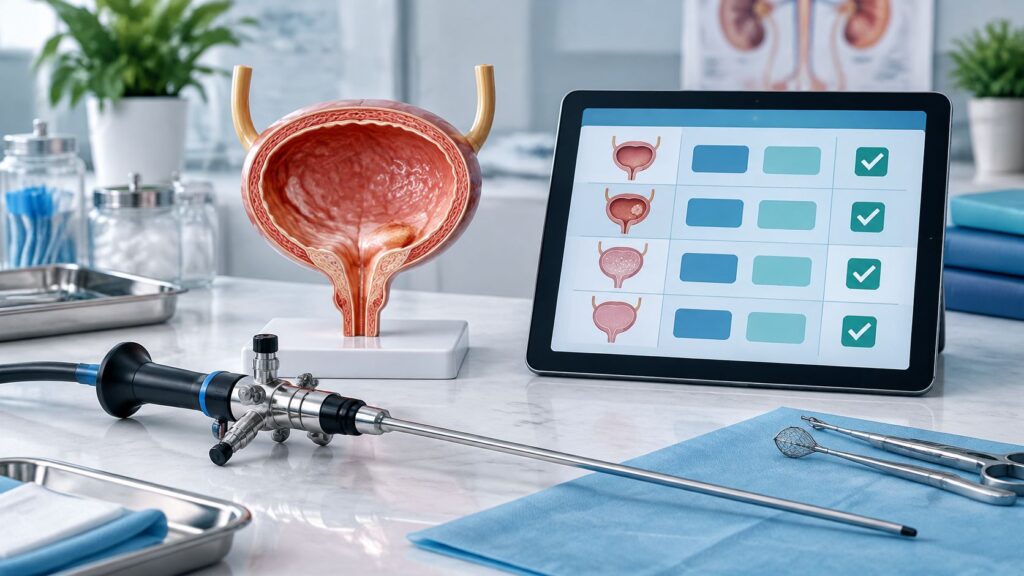
The visual below helps organize the initial examination and sampling review. If the note also documents treatment, continue the analysis rather than stopping at the biopsy branch.
Resolve ambiguity before release
Say the physician documents cold cup sampling of an erythematous patch, followed by cautery solely for bleeding at that sampling bed. That description supports a different analysis from a note documenting tissue sampling followed by deliberate destruction of the visible lesion.
If the narrative says only biopsy and fulguration, send a
neutral clarification query. Ask what was treated, where it was treated, and whether the fulguration controlled bleeding or destroyed the lesion.
The outcome should be a defensible primary procedure selection supported by a specific operative sentence. If that sentence is missing, a code lookup won't repair the documentation gap.
Documentation Elements Every Biopsy Note Needs
A usable biopsy note lets an auditor connect the
clinical reason, anatomic site, intervention, and specimen without guessing. A long note can still fail that test if it contains copied examination findings but no site-specific account of what the physician sampled.
Build the template around clinical details rather than billing prompts. RevGuard's guidance on
medical record documentation provides a broader framework for keeping the record complete and internally consistent.
A site-to-specimen checklist
Lesion location. Name each sampled area, such as the trigone, dome, lateral wall, or urethra, and match the specimen label to that location. This answers the claim question: where was the tissue obtained?
Approximate lesion size. Record dimensions in centimeters when relevant, particularly when the physician treats a lesion under a size-based procedure category. The question is whether the operative record supports the treatment category, not whether the laboratory later measured a tissue fragment.
Appearance of the site. Describe normal mucosa sampled for mapping, an erythematous patch, a papillary lesion, or another distinct finding. This explains why the physician selected that area and whether it differed from a treated tumor.
Biopsy method. Specify cold cup forceps or the actual sampling technique used. The claim reviewer needs to distinguish tissue sampling from a resection described only as removal.
Treatment at the sampled site. Document fulguration, laser treatment, or resection, and state whether any cautery was limited to hemostasis. This resolves what the physician did after obtaining tissue.
Specimen handling. Record the specimens obtained and whether they were submitted separately with site-specific labels. A container list should reconcile with the operative narrative rather than introduce unexplained sites.
Clinical indication. Connect gross hematuria, abnormal cytology, surveillance findings, or another documented indication to the decision to biopsy. A generic statement of medical necessity is less useful than a clear clinical explanation.
The checklist graphic captures the core elements needed to connect sampling with the pathology submission.
Make the records reconcile
Consider a hypothetical record with separately labeled trigone and left-dome containers. If the operative note describes both sites and their purposes, the coder can trace each specimen through the record.
Unlabeled containers accompanied by a statement that random biopsies were obtained leave a different problem. The coder can't reliably connect the pathology findings to the sampled anatomy or establish why a site was diagnostically distinct.
Can every specimen be matched to a documented site and purpose?
Use that question before releasing the claim. Clarifications should preserve the actual clinical facts, not add a distinction solely because a payer edit requires one.
Modifiers and Bundling Rules for Biopsy and Treatment Codes
A modifier doesn't turn an included service into an independent procedure. Before adding one, establish that the physician performed a distinct service and that the current edit and payer policy permit separate reporting.
AAPC's procedure guidance for cystourethroscopy with biopsy highlights the documentation-dependent distinction between a diagnostic biopsy and tissue sampling performed as part of lesion treatment. A separate mucosal mapping biopsy can present a different coding question from biopsy and fulguration of the same lesion.
Diagnostic inspection followed by biopsy
When the physician inspects the bladder and then obtains tissue during the same operative service, inspection is part of performing the biopsy. Separate headings in the note, separate equipment entries, or a diagnostic finding don't establish an independent diagnostic scope service.
The appropriate response to an edit isn't to add a distinct-procedure modifier automatically. First determine whether there was another encounter or independent service, then review the applicable reporting rules. A routine examination leading directly to biopsy doesn't establish that exception.
Sampling and treating the same lesion
Say a physician samples a papillary lesion and then destroys that lesion. The tissue acquisition may be integral to the treatment, so separately reporting biopsy requires more than a pathology submission.
Contrast that with sampling a suspicious patch and using cautery only to stop bleeding at the biopsy bed. That isn't automatically lesion destruction. The narrative must explain the purpose of cautery so the coder doesn't either overcode treatment or unbundle tissue sampling.
Modifier test: If the operative note can't explain the independent clinical purpose of the additional service, a modifier won't supply that explanation.
Mapping away from a treated tumor
Consider a hypothetical case involving tumor resection in the lateral wall and diagnostic mapping of normal-appearing mucosa elsewhere. Separate reporting may be supportable when the note identifies the treated tumor, the independently sampled region, and the reason for sampling it.
The strongest documentation distinguishes:
Anatomy. Identify the treated and sampled regions clearly enough to establish their relationship.
Purpose. Explain why the additional biopsy answered a diagnostic question beyond the tumor treatment.
Technique. Describe what the physician did at each site rather than using a combined procedure label.
Specimen correlation. Link the separately submitted tissue to the corresponding operative findings.
Where the edit permits a modifier and the payer accepts it, a distinct-service modifier such as
XS or
59 may be appropriate. Verify the modifier's definition, the edit's modifier eligibility, and the payer's requirements before submission. Different locations alone aren't a blanket authorization to override bundling.
Build the claim after the edit review
Run the proposed code combination through current NCCI edits and the payer's published policy. Record the edit reviewed, its effective period, and the documentation supporting any permitted exception.
This approach takes more effort than automatically appending a modifier, but it produces a claim that can be explained on review. If the service is integral, omit the additional line; if it's distinct but the note is unclear, clarify the record before billing.
ICD-10-CM Pairings When Pathology Is Pending
The procedure and the diagnosis become known on different timelines. The physician can complete a biopsy before anyone knows whether the specimen represents malignancy, inflammation, or another condition.
AAPC's guidance on neoplasm coding after confirmed pathology supports choosing the diagnosis from the clinical information available at coding time. Suspicion alone shouldn't become a confirmed cancer diagnosis on an outpatient claim.
Preserve the indication without overstating certainty
Use the documented symptom, finding, or surveillance context when a definitive diagnosis isn't established. Don't select a malignancy diagnosis merely because the surgeon described a suspicious lesion or ordered a biopsy to rule out cancer.
ICD-10-CM pairings by clinical indication at the time of coding
Clinical indication at coding
Use when
Gross hematuria, workup pending
Blood in urine is the reason for the procedure and pathology is pending; select the documented gross-hematuria diagnosis
Hematuria, cause not established
The finding is nonspecific and no further detail is documented; use the supported unspecified-hematuria diagnosis
Abnormal urine or bladder cytology
Cytology prompted the biopsy but no tissue diagnosis exists yet; verify the diagnosis entry specific to the documented specimen and finding
Suspected cancer, not confirmed
Report the established symptom or finding rather than treating suspected outpatient malignancy as confirmed
Confirmed bladder carcinoma
Pathology confirms malignancy and claim timing allows the diagnosis; select the supported site-specific malignant-neoplasm diagnosis
Surveillance after completed treatment
No active tumor is being treated; evaluate follow-up and personal-history coding under the applicable guidelines
Confirm the exact diagnosis code in the
year-of-service ICD-10-CM index and tabular list. Don't assume that a general abnormal-cytology description is interchangeable with the entry for a urinary specimen.
The distinction matters because the diagnosis communicates what is established, not what the physician fears. A payer's preference for a particular diagnosis doesn't justify documenting a disease that hasn't been confirmed.
Coordinate professional, facility, and pathology claims
The professional claim may be ready before the pathology report, while another claim may be prepared after the final diagnosis is available. Apply the rules for the claim type and setting rather than forcing every claim to carry identical diagnoses.
Before release, determine:
What was known. Review the indication, findings, and available final diagnosis.
What the setting permits. Apply the relevant outpatient or other setting-specific diagnosis rules.
What needs confirmation. Resolve conflicting sites, uncertain diagnostic language, or discrepancies between the physician's assessment and pathology.
What the payer requires. Check submission and correction policies without allowing reimbursement concerns to replace coding accuracy.
RevGuard's
ICD-10 coding guidelines resource can support a consistent diagnosis-review workflow.
Once malignancy is established, use the documented anatomic specificity the classification supports. Don't invent laterality or a more precise site than the record establishes. Likewise, don't use a surveillance history pathway when the encounter involves active tumor evaluation or treatment that requires different reporting.
Medicare Rates and Payer Variations to Check
PayerPrice lists the 2025 Medicare national-average payment for CPT 52204 at approximately
$343.20 in the non-facility setting and
$136.18 in the facility setting. These are historical national benchmarks, not current-year payment guarantees or estimates of the patient's entire episode of care.
The setting distinction matters because the physician's non-facility payment includes practice-expense resources associated with furnishing the service in an office-type setting. In a facility, the physician payment reflects the professional service, while the facility's services follow a separate billing pathway.
The comparison below illustrates the setting difference.
Use the correct payment baseline
52204 payment baseline by setting and payer checks
Setting
2025 Medicare national average
Typical place of service
Action
Non-facility
$343.20
Office or other non-facility setting
Use as the historical baseline and confirm the current-year fee schedule
Facility
$136.18
Hospital outpatient department or ambulatory surgery center
Confirm the facility claim is separate from the professional claim
Commercial or Medicaid contract
Use the applicable contracted fee schedule
Contract-approved office, hospital outpatient department, or surgery center
Check unit, frequency, bundling, and modifier rules in the contract
Medicare locality adjustments and the applicable fee-schedule year affect the amount used for an individual claim. Commercial and Medicaid reimbursement must be evaluated under the relevant contract or program rules, not extrapolated from a Medicare national average.
Don't choose the setting to obtain the higher listed professional payment. Clinical appropriateness comes first, and the reimbursement comparison must account for who supplies the resources and which entity bills them.
Verify rules before estimating collections
Use a pre-submission checklist that separates coding from contract interpretation:
Place of service. Match the claim to where the physician performed the procedure.
Fee schedule. Retrieve the applicable year, locality, and contracted allowance.
Payment edits. Review bundling, frequency limits, modifier acceptance, and coverage requirements.
Rule provenance. Record the policy version and effective date used for the decision.
If software supports these checks, evaluate whether it exposes the applicable policy and routes exceptions to a reviewer. AmasaTech's resource on
choosing AI tools for clinical workflows is useful context for assessing workflow fit, rather than assuming automation can independently resolve documentation-dependent coding.
Keep the audit trail with the claim. An expected-payment calculation is more useful when staff can explain the setting, contract, and edits behind it.
Denial Causes and How to Appeal Them
Not every denied cystoscopy claim deserves an appeal. If the submitted claim contains an identifiable coding error, defending it adds work without making the reporting correct.
Start by comparing the denial reason with the actual operative record. The payer's explanation identifies the disputed issue, but it doesn't establish whether the payer or the practice applied the rule correctly.
Correct errors instead of defending them
Denial issue
Direct response
Diagnostic examination billed separately from the biopsy service
Remove the included service and submit the appropriate corrected claim
Treatment and biopsy reported for the same lesion without a distinct-service basis
Reassess the combination and remove unsupported unbundling
Biopsy units reflect specimen containers
Correct the units to the procedure's reporting rule
Cancer reported before confirmation
Replace the unsupported diagnosis with the established indication, following claim-correction rules
Specimens can't be matched to locations
Reconcile the operative and pathology records; obtain a compliant clarification if the clinician can establish the facts
Procedure code conflicts with operative technique
Recode from the documented intervention or query genuine ambiguity
A documentation addendum must clarify what occurred, not create a separately billable service after denial. Preserve the original entry and follow the organization's amendment policy for authorship, date, and explanation.
If the record doesn't support the additional service, don't ask the physician to insert modifier-oriented language. The appropriate resolution may be a corrected claim rather than a revised narrative.
Contest a supported claim with a focused packet
For a defensible claim, assemble the operative note, relevant pathology report, original claim, denial notice, and payer edit or coverage reference. Explain exactly which fact supports the disputed procedure, diagnosis, or permitted distinct-service exception.
Appeal the payer's disputed conclusion, not the entire clinical encounter.
A medical-necessity appeal should connect the documented indication and findings to the service performed. A bundling appeal should identify the independent service and the applicable exception, rather than relying on separate pathology containers alone.
Use the payer's required channel and filing deadline. RevGuard's
appeal process steps offer a framework for organizing submission, evidence, and follow-up.
Finally, record the denial's root cause and disposition. Distinguish template defects, code-selection errors, unsupported modifiers, and payer misapplication so the practice fixes the right problem instead of repeatedly resubmitting similar claims.
Confirm Your Cystoscopy Coding Before the Claim Goes Out
A clean claim requires agreement between the clinical narrative, procedure selection, diagnosis, and payer rules. A correct code entered into an inconsistent record still leaves the practice with a claim it may struggle to defend.
Automation can help organize review tasks, but it shouldn't manufacture missing anatomy, treatment intent, or diagnostic certainty. Cleffex Digital ltd.’s discussion of
medical billing automation solutions provides context for evaluating administrative tools while retaining human review for documentation-dependent decisions.
Ask the release questions
Biopsy or treatment? Does the operative narrative establish the intervention performed?
Site and purpose? Can each specimen be matched to the documented anatomy and reason for sampling?
Diagnosis at coding time? Does the claim reflect established clinical information rather than an unconfirmed assumption?
Bundling and modifiers? Does the note support every additional service under the payer's current rules?
Treat an unresolved answer as a reason to review the claim, not as an invitation to choose the code most likely to pass an edit. Passing an automated check isn't the same as having a defensible record.
Make the review practical
At RevGuard, our medical coding services include
CPT, ICD-10, and HCPCS coding, specialty-specific claim review, documentation compliance audits, denial root-cause analysis, and provider documentation education. A focused coding review can compare cystoscopy claims with the operative note, pathology record, and applicable payer edits, then identify whether the correction belongs in coding, documentation, or the submission workflow.
Before finalizing any claim, verify the current CPT, ICD-10-CM, and NCCI references for the year of service. Keep the supporting rule and the clinical rationale accessible to whoever must answer a payer's question.
RevGuard offers specialty-specific coding review and documentation audits to help practices identify unsupported cystoscopy codes, unit errors, and bundling problems before submission. Visit
RevGuard to schedule a coding review or request a billing assessment focused on your bladder biopsy claims and related denials.