
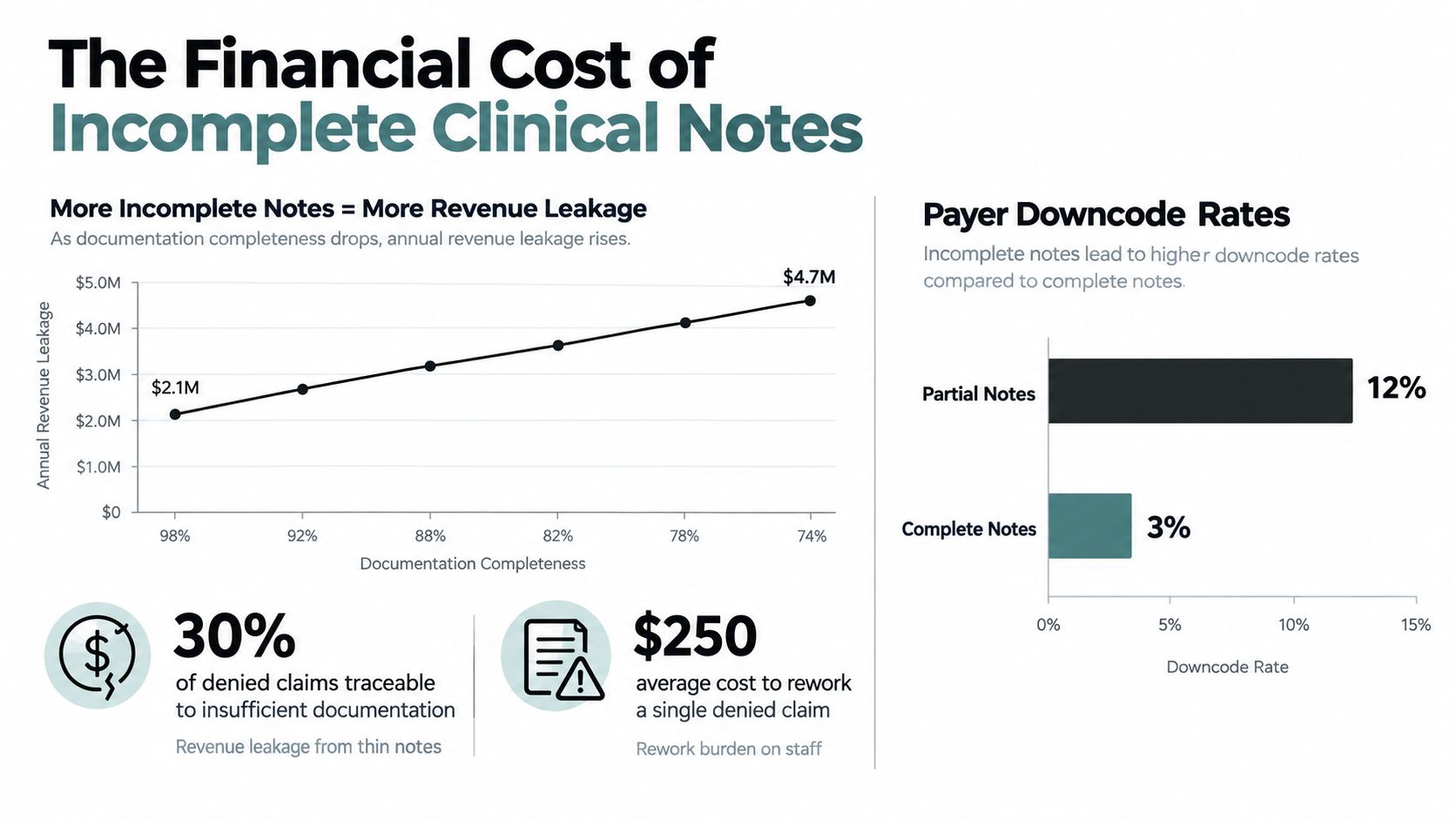
Clinical documentation audits increased by 100%, while missing details on diagnoses, specificity, and treatment paths were associated with a 51% increase in clinical denials over three years. The same industry reporting found that 58% of professional billing audits failed because diagnoses were documented but not billed (For The Record's 2025 reporting). Those figures change the question practice leaders should ask. The issue isn't whether a note exists. It's whether the note can support the code, withstand payer scrutiny, explain the clinical decision, and give an IDR team usable evidence when reimbursement is challenged.
Medical record documentation is often treated as a compliance task completed after patient care. In specialty medicine, that's too narrow. A well-engineered note is a clinical record, coding foundation, revenue control, and legal exhibit at the same time. A thin note leaves each downstream team to infer what happened. Payers rarely infer in the provider's favor.
The Financial Cost of Incomplete Clinical Notes
A claim can fail even when the care was appropriate. The diagnosis may appear in the chart without the specificity needed for coding. The procedure may be recorded without the indication, acuity, findings, or treatment path that explains its necessity. The clinician may have considered a serious alternative diagnosis but never documented why it was ruled out or why reassessment was required.
Each omission creates room for a payer to interpret the encounter conservatively. That can lead to a downcode, a medical-necessity question, a request for records, a denial, or an underpayment that requires staff time to challenge. The clinical team may remember the reasoning, but memory isn't an evidence packet. The signed record is what the billing, appeals, compliance, and IDR teams can use.
Financial rule: If a reviewer must reconstruct the clinical story from scattered fragments, the practice has already surrendered control of the claim narrative.
The 2025 reporting on clinical denials connects missing diagnosis detail, insufficient specificity, and unclear treatment paths with payer audit and denial activity (the documented audit and denial findings). That relationship is operationally important. A denial isn't always caused by an incorrect code. It can result from a correct service whose supporting record doesn't make the level of care obvious to someone outside the encounter.
Why specificity matters after the visit
A diagnosis list is not the same as clinical reasoning. “Pain,” “mass,” or “abnormal imaging” may be accurate descriptions, but they don't necessarily explain the physician's assessment, the risks considered, the service performed, or the next action. A dispute-ready note connects the patient's condition to the work performed.
That connection should answer practical reviewer questions:
- What changed: Describe the symptom, finding, instability, progression, or test result that drove the encounter.
- What was considered: Record relevant differential diagnoses and the evidence supporting or weakening each possibility.
- Why the service was necessary: Tie the examination, test, procedure, monitoring, transport, or treatment to the patient's documented condition.
- What happens next: State reassessment criteria, follow-up responsibility, medication changes, and escalation instructions.
These elements also protect against revenue leakage caused by diagnosis capture failures. If the clinician documents a condition but the billing workflow doesn't identify and report it, the practice may underbill despite delivering and recording the care. If the note supports a higher-complexity service but leaves out the reasoning, the payer can challenge the code without disputing the underlying care.
The note as an IDR asset
No Surprises Act Independent Dispute Resolution adds another reason to write for downstream evidence use. An arbitrator needs a coherent record of the service, the patient's circumstances, the provider's work, and the factors that make the billed amount reasonable. A generic note forces the RCM team to assemble context from multiple systems. A structured note gives that team a stronger starting point.
The practical shift is simple. Stop asking whether the note satisfies a minimum documentation checklist. Ask whether an unfamiliar reviewer could understand the encounter, validate the service, and follow the reasoning without contacting the clinician. If the answer is no, the practice has a documentation problem with financial and legal consequences.
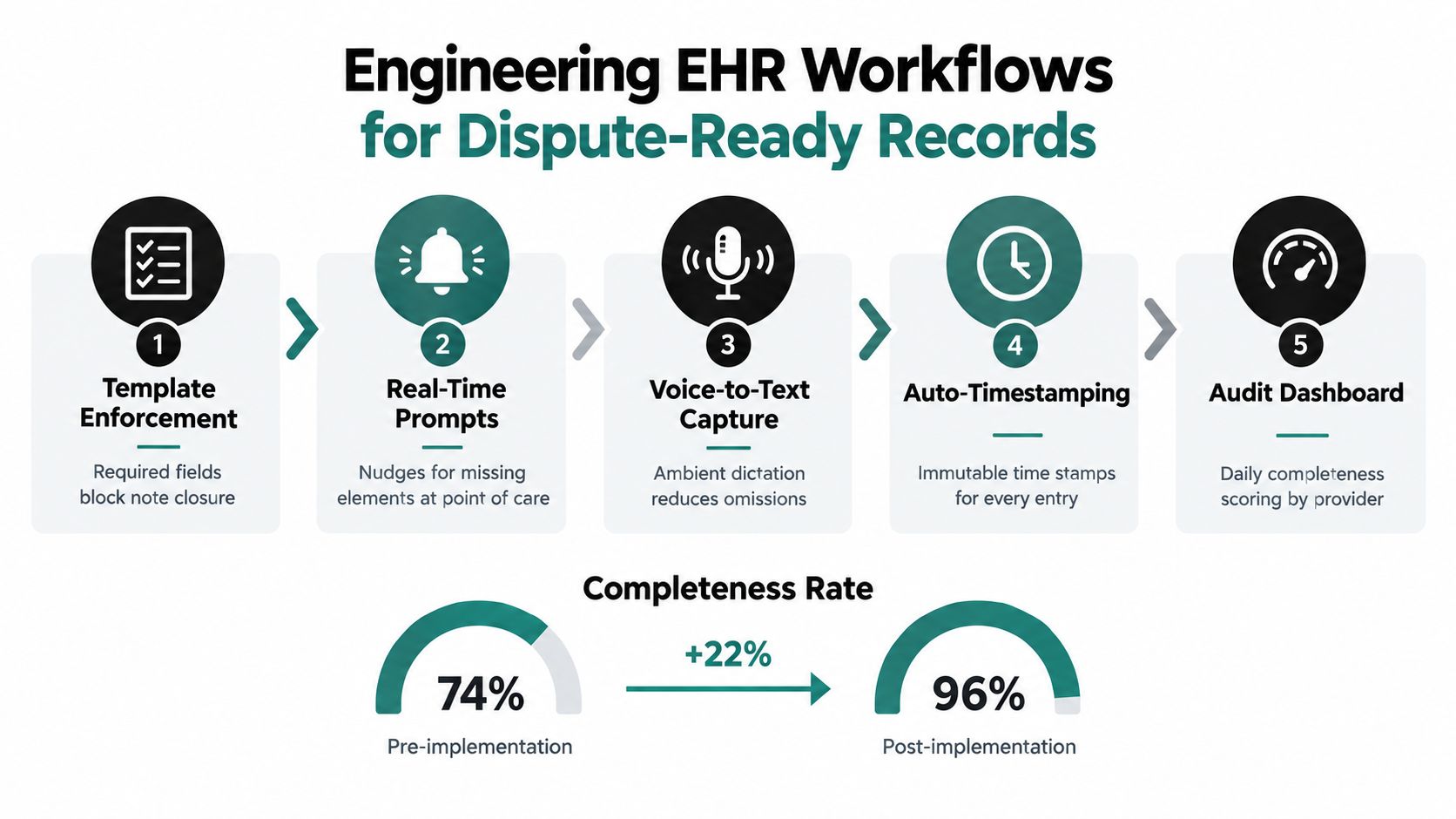
Engineering EHR Workflows for Dispute-Ready Records
EHR configuration should prevent predictable omissions without turning every encounter into a click-heavy form. The right design separates information that must be structured for coding and audit from information that requires narrative clinical judgment. Required fields should enforce the first category. Templates, voice capture, and prompts should make the second category easier to express.
The historical development of structured medical record documentation supports this approach. The review of the medical record's history describes early case histories and the later development of organized records for patient care, research, teaching, and operations. It also identifies 1968, when Lawrence Weed introduced the Problem-Oriented Medical Record, with SOAP, Subjective, Objective, Assessment, and Plan, becoming a foundational format for organizing encounters.
Configure the template around decisions
Start with a specialty-specific note map, not a universal template. For each high-risk service, identify the facts a reviewer must see:
- Trigger the encounter: Capture the complaint, referral question, change in condition, abnormal finding, or procedural indication.
- Show the evidence: Include relevant examination findings, test results, imaging interpretation, monitoring data, and prior treatment response.
- Record the reasoning: Make the assessment explain what the clinician believes, what remains uncertain, and why the chosen intervention is appropriate.
- Tie action to necessity: Document why the procedure, test, medication, transport, or monitoring was required for this patient.
- Close the loop: State follow-up, reassessment, pending results, responsible clinician, and escalation criteria.
Use mandatory fields only where an omission creates a material coding, safety, or dispute risk. A required field for “medical necessity” that accepts meaningless text doesn't improve the record. A prompt asking, “What finding required this service today?” is more useful because it directs the clinician toward a defensible explanation.
Prioritize omission controls
A 2020 VA health-system study identified 636 documentation errors across 36 physicians. 90% of notes contained at least one error, and omissions represented 71.5% of errors, compared with 28.5% for commission errors (the VA study of recorded clinical encounters). The configuration implication is clear. Practices should prioritize missing information before trying to police every wording variation.
Build alerts for absent exam elements, missing assessment rationale, incomplete medication or problem-list updates, and missing follow-up ownership. Keep prompts close to the point of care. A reminder shown days later during billing review is less effective than a focused nudge when the clinician is already documenting the encounter.
The digital transition created extensible data collection through forms and required text fields, but the same design can interrupt workflow (the review of electronic health record documentation). That trade-off needs active management. Test templates with physicians, remove fields that don't affect care or claim support, and use conditional logic so a proceduralist doesn't see prompts designed for an unrelated specialty.
Treat speech recognition as a draft
Speech recognition can reduce typing, but it doesn't remove review responsibility. A 2018 analysis found a 7.4% error rate in speech-recognition output before review, falling to 0.4% after transcriptionist review and 0.3% in the physician-signed version (the analysis of dictated clinical documents). The study also found that 15.8% to 26.9% of errors involved clinical information.
Configure a two-step verification process for high-stakes notes. The first review should catch patient identifiers, laterality, medications, test results, negations, and anatomy. The physician's final review should confirm that the assessment, rationale, and plan accurately reflect the encounter. Voice-to-text is a capture tool, not a finished medical record.
For practices evaluating workflow automation, healthcare workflow automation can be considered alongside native EHR rules, transcription review, coding edits, and manual quality checks. The selection criterion shouldn't be novelty. It should be whether the workflow catches missing evidence before claim submission while preserving the clinician's actual reasoning.
Specialty-Specific Documentation Scenarios and Fixes
Generic templates fail when the service's value depends on context. An anesthesia note, an orthopedic procedure note, an oncology investigation, and an air ambulance record each need a different explanation of acuity and necessity. The common standard is not identical wording. It's a record that makes the clinical decision understandable.
Consider intraoperative neuromonitoring. A weak record might say that monitoring was performed during surgery and that signals were stable. That establishes activity, but it may not explain why monitoring was necessary, what risks were present, which modalities were used, what the baseline showed, how the team interpreted changes, or how communication affected intraoperative decisions.
A stronger record connects the service to the procedure and patient risk. It identifies the operative context, the neurological structures or functions at risk, the baseline assessment, relevant changes, the timing of alerts, the interpretation of those changes, and communications with the surgeon. If no clinically meaningful change occurred, the note can still explain what was monitored and why continuous surveillance was required.
Anesthesia and procedural care
Anesthesia documentation should distinguish routine presence from the complexity of the patient's management. The record should make clear the patient's relevant conditions, airway or physiologic concerns, risk assessment, medication decisions, monitoring, interventions, and response. A phrase such as “managed appropriately” is difficult for a payer or arbitrator to evaluate. A concise description of the problem, action, and response is much stronger.
Orthopedic records face a similar issue when a procedure follows failed conservative care or complex imaging findings. The note should connect the functional limitation and objective findings to the selected intervention. It should also capture alternatives considered, the patient's response to prior treatment, the technical work performed, and the factors affecting complexity or risk.
The difference isn't verbosity. It's specificity tied to a decision. A long copied-forward history can create noise while a short, current assessment explains the service effectively.
Air ambulance and emergency transport
Transport records must establish why the patient required that level of service rather than ordinary transportation. The clinician should document the patient's condition at the time of transport, the risk associated with delay or alternative transport, the destination rationale, the monitoring or treatment required en route, and any change in status.
“Transferred for higher level of care” may be directionally correct, but it leaves key questions unanswered. What capability was unavailable at the originating site? What would have happened if transport were delayed? Which interventions or monitoring made the transport medically necessary? Who accepted the patient, and what clinical information supported the destination?
These details also help the RCM team distinguish a clinical necessity argument from a generic transport description. The note should be contemporaneous, internally consistent, and aligned with the transport record, dispatch information, and receiving-facility documentation.
Oncology and fragmented investigations
A 2026 review of cancer-investigation records in Stockholm found that 32% of records had at least one documentation shortcoming. The most common issue, affecting 21%, was unclear reasoning behind possible diagnoses, and fragmented care across providers made follow-up and reassessment harder (the review of documentation gaps in possible cancer investigations).
Oncology documentation therefore needs more than a list of abnormal findings. It should state the differential diagnosis, the evidence prompting investigation, the significance of each result, the reason for the next test or referral, and who owns follow-up. If a concerning possibility is not supported, document why. If uncertainty remains, document the reassessment trigger and timeframe.
Practical rule: Every unresolved diagnostic concern needs an owner, a next action, and a reason that another clinician can understand.
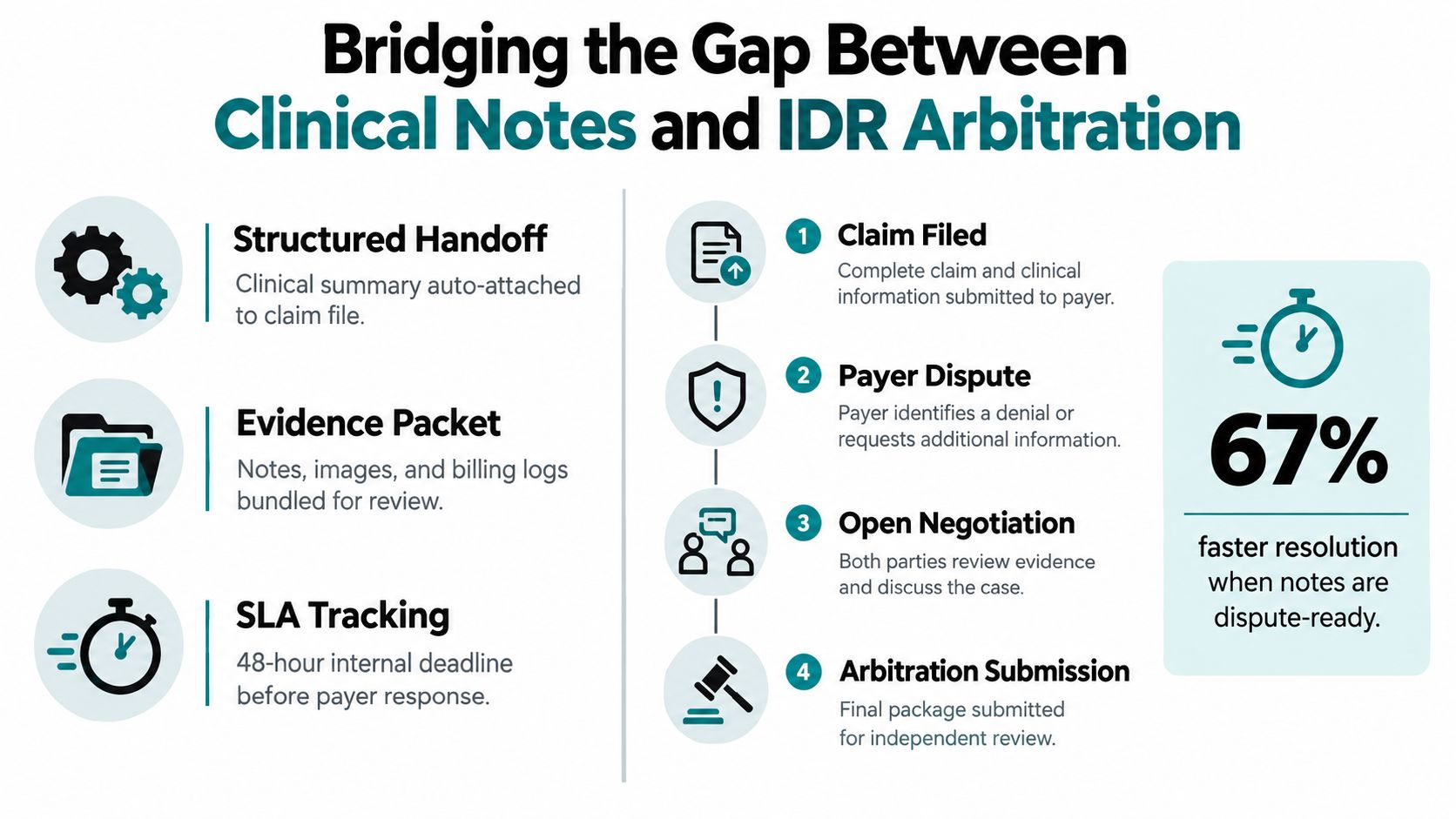
Bridging the Gap Between Clinical Notes and IDR Arbitration
The clinical note and the IDR submission shouldn't be treated as unrelated documents. The note establishes what happened and why. The RCM and IDR teams then organize that evidence around the claim, the payer response, the service's complexity, and the applicable dispute requirements.
A dispute-ready workflow begins before the payer underpays. The claim file should allow a reviewer to retrieve the signed note, relevant reports, procedure details, coding history, payment information, and communications without searching across disconnected folders. The clinical summary should identify the facts that support the billed service rather than forcing an analyst to read every page for the central argument.
Build the evidence around the service
For each disputed claim, the handoff should answer four questions:
- What service occurred: Identify the billed service and the clinical event it represents.
- Why it was needed: Pull the documented condition, risk, findings, and decision rationale that establish medical necessity.
- Why the work was complex: Highlight acuity, specialized expertise, technical demands, unusual circumstances, or additional management documented in the record.
- What the payer misunderstood: Map the denial, downcode, or underpayment rationale to the exact evidence that addresses it.
This structure supports an effective QPA rebuttal without asking clinicians to write legal arguments in the chart. The physician documents the clinical facts. The RCM and IDR teams translate those facts into a claim and arbitration narrative.
Make the record easy to audit
A strong packet has a clear index and consistent chronology. It separates the core clinical note from supporting images, monitoring reports, operative records, coding edits, remittance details, and payer correspondence. It also preserves the signed version and identifies any legitimate addendum by author, date, and reason.
The organization should set an internal deadline before the payer's response window creates pressure. That deadline gives the team time to identify missing evidence, request clarification through compliant processes, and decide whether negotiation or arbitration is appropriate. It also exposes recurring documentation defects that should be corrected upstream.
The No Surprises Act IDR workflow should connect clinical evidence, claim status, payer behavior, and case deadlines in one operational process. The objective isn't to add paperwork to every encounter. It's to make the existing record usable when a payer challenges the value or necessity of the service.
Write for an unfamiliar reviewer
An arbitrator may not know the specialty's normal workflow or the patient's history beyond the submitted record. Avoid relying on local shorthand, undocumented assumptions, or a diagnosis code that appears without an explanation. A short clinical summary can identify the encounter's central facts, but it must point back to the signed documentation rather than introduce new facts after the event.
The most persuasive records are internally consistent. The diagnosis, procedure, acuity, findings, treatment path, and billed service tell the same story. If they don't, the payer has an opening to argue that the claim is unsupported.
Auditing Documentation Quality and Tracking KPIs
A documentation audit program should measure failure modes, not just completion rates. A note can be signed on time and still omit the reasoning needed for coding, medical necessity, or dispute review. Practice leaders should track whether the record contains the evidence a downstream reviewer needs.
Begin with a baseline review by specialty, provider, service type, and payer. Separate omissions from incorrect statements. Then connect each defect to its operational consequence, such as a coding query, delayed claim, denial, appeal, downcode, or IDR evidence gap.
Use a focused scorecard
| Failure mode | Review question | Operational response |
|---|---|---|
| Missing indication | Does the note explain why the service was necessary? | Add a point-of-care prompt tied to the procedure or test |
| Unclear reasoning | Can another reviewer follow the assessment and differential? | Provide specialty examples and require a concise rationale |
| Incomplete follow-up | Is the next action and responsible party documented? | Add a closing workflow check |
| Speech-recognition error | Were identifiers, negations, laterality, and results verified? | Require structured review before signature |
| Diagnosis not billed | Does the coding workflow capture documented conditions? | Compare signed notes with claim diagnosis fields |
The speech-recognition benchmark is especially useful for process design. The 2018 dictated-document analysis found errors falling from 7.4% before review to 0.4% after transcriptionist review and 0.3% in the final physician-signed version. It also found that 15.8% to 26.9% of errors involved clinical information. Track pre-review defects, reviewer corrections, physician changes, and final-note defects separately. A single aggregate score hides where the control is working or failing.
Pair quality metrics with financial metrics
Clinical leaders need actionable feedback, while finance leaders need evidence of revenue impact. Use both perspectives:
- Omission rate: Count absent findings, rationale, medication updates, and follow-up elements by note type.
- Query rate: Track how often coders or billers must seek clarification before submission.
- Denial linkage: Categorize denials caused by missing specificity, unsupported medical necessity, absent treatment path, or diagnosis capture.
- Correction rate: Compare speech-recognition corrections and late addenda by provider and specialty.
- Recovery value: Record payments recovered after corrected claims, appeals, negotiations, or IDR, without treating recovery as proof that a documentation change was clinically appropriate.
Reviews should occur both before billing and after payment. Pre-bill checks prevent avoidable defects from entering the payer workflow. Post-bill reviews reveal which issues were missed and whether payer behavior is exposing a recurring weakness. Feedback works best when it shows the exact missing element and a practical replacement, not when it labels a clinician as noncompliant.
A structured medical record audit program can sit alongside internal coding audits, payer-specific edits, and physician education. The important design choice is to route findings back to the template, prompt, training, or handoff that allowed the defect.
Building a Sustainable Documentation Culture
Technology won't fix a documentation program that clinicians experience as disconnected from patient care. Physicians are more likely to use structured workflows when required fields reflect real clinical decisions, prompts appear at useful moments, and leaders remove redundant documentation instead of adding layers to it.
The practice should define a small number of essential documentation behaviors for each high-risk specialty. Those behaviors might include documenting the indication before a procedure, recording the reasoning behind an unresolved diagnosis, verifying dictated content before signature, or assigning ownership for follow-up. The standard should be observable in the chart and tied to a clear operational reason.
Start where financial risk is concentrated
A phased rollout is more practical than a practice-wide template replacement. Begin with specialties, services, and payer relationships that produce the most denials, downcodes, delayed payments, or IDR disputes. Review a representative sample, identify the omissions that matter most, and redesign the workflow with the clinicians who perform the work.
Then run the revised process long enough to identify friction. Remove prompts that generate meaningless text. Keep controls that prevent material omissions. Give physicians examples from their own specialty, showing how a concise assessment can support the service without turning the note into a copied block of boilerplate.
Connect clinical and revenue teams
RCM staff should explain which missing facts prevent them from defending a claim. Clinicians should explain which fields interrupt care or encourage inaccurate copy-forward. That exchange creates better templates than either group can design alone.
Leaders should also distinguish a documentation defect from intentional misconduct or poor clinical judgment. A missing field may reflect a badly designed workflow, a speech-recognition error, unclear ownership, or a template that hides the assessment. Treating every issue as an individual failure discourages reporting and drives workarounds.
Long-term standard: The record should be accurate enough for care, specific enough for coding, organized enough for audit, and persuasive enough for dispute resolution.
Practice leaders can take three immediate actions. Select the highest-risk service line, audit the exact omissions that cause financial friction, and redesign its note around clinical reasoning and claim support. Next, connect the signed record to the billing and IDR evidence workflow. Finally, review the results with clinicians and adjust the system based on observed defects rather than assumptions.
Medical record documentation becomes a revenue protection asset when the organization designs it deliberately. The goal isn't longer notes. It's reliable evidence that explains the care, supports the code, protects the patient record, and gives the practice a credible position when a payer delays or reduces payment.
RevGuard combines specialty-focused revenue cycle management with No Surprises Act IDR support, helping provider organizations identify documentation gaps, organize claim evidence, and pursue underpayments. Visit RevGuard to evaluate a workflow for making your clinical records more complete, auditable, and dispute-ready.