

A claim denial doesn't always mean the service was wrong, the documentation was weak, or the provider missed a billing rule. Specialty practices lose revenue through three distinct failures: a clean claim rejected despite supportable coverage, a preventable workflow error, and a payer-driven underpayment disguised as routine adjudication. Treating all three the same wastes appeal capacity and delays cash.
The scale makes that distinction operationally important. In 2024, insurers selling qualified health plans through HealthCare.gov processed about 496 million claims, denying 19% of in-network claims and 37% of out-of-network claims, according to KFF's analysis of ACA Marketplace claims. The seven claim denial scenarios below connect the trigger to payer behavior, financial exposure, specialty-specific examples, upstream controls, and the right RevGuard RCM or IDR response. The examples span anesthesia, IONM, air ambulance, orthopedics, cardiology, dermatology, and gastroenterology, without assuming that every denial belongs in an appeal.
1. Medical Necessity Denials
Medical necessity denials begin when a payer decides that the service, procedure, intensity, or frequency doesn't satisfy its coverage policy or clinical criteria. The provider may have delivered appropriate care, yet the claim reaches retrospective utilization review without enough visible evidence to explain why that decision was reasonable for this patient.
An orthopedic MRI can be denied when the record doesn't show the payer's expected preceding evaluation. Anesthesia claims may face scrutiny over concurrent services or complex cases. A gastroenterology practice may encounter a screening colonoscopy denial tied to frequency, while a cardiology group may need to defend PET imaging or advanced echocardiography with a clear clinical indication.
The payer's behavior matters. A denial letter often cites a policy criterion, but the operational question is whether the chart contains the facts needed to test that criterion. If the rationale appears only during an appeal, the provider has already created avoidable friction.
Practical rule: The clinical reason for a high-risk service belongs in the record before adjudication, not in a rushed appeal after payment fails.
Build the evidence before the claim
Use specialty-specific documentation templates that capture symptoms, prior findings, failed treatments, risk factors, functional impact, and the decision logic behind the service. Map payer criteria to the relevant workflow, then train clinicians and authorization staff on the differences. A generic medical necessity paragraph won't reliably support an orthopedic MRI and a cardiology PET scan.
Medical necessity documentation guidance can support a more structured approach to clinical rationale, authorization verification, and appeal preparation. Peer-to-peer review should also have a defined owner, deadline, and escalation path. It works best before service delivery when the payer permits review, not as a substitute for missing clinical documentation.
Remediation is appropriate when the record supports the service and the payer applied its criteria incorrectly. IDR is generally not the first response to a pure medical necessity denial. Escalation becomes more relevant when the dispute concerns reimbursement for an otherwise covered service, contract interpretation, or an underpayment after the clinical issue has been resolved.

2. Coding and Billing Accuracy Denials
Coding denials are often the most preventable claim denial scenarios because the failure occurs before transmission. The payer sees an invalid modifier, an incompatible code combination, an unbundled service, or a billing pattern that conflicts with the contract and rejects the claim without weighing the underlying clinical work.
Anesthesia teams may submit incorrect time-unit modifiers. IONM groups can run into bundling or unbundling edits when monitoring codes interact with the primary procedure. Orthopedic practices need precise bilateral modifiers, air ambulance providers must capture origin and destination details correctly, and dermatology claims can fail when lesion quantities don't match the procedure coding.
These errors create two forms of exposure. The first is a delayed or lost payment. The second is repeated rework, especially when the same edit affects a high-volume code family and staff correct claims one by one without fixing the rule that caused the error.
Make coding controls specialty-specific
A scrubber is useful only when its rules reflect payer behavior and the provider's service mix. Maintain a centralized modifier library, but pair it with payer-specific billing guides for the codes that generate the most volume. Review claims before transmission, then compare adjudication results with the edits your system predicted.
A practical control set includes:
- Payer rule sets: Configure claim scrubbing for modifier, bundling, and code-pair edits that apply to each contract.
- Specialty audits: Sample anesthesia, IONM, orthopedic, air ambulance, and dermatology claims separately rather than blending them into one audit population.
- Review checkpoints: Require a final coding review for unusual combinations, bilateral procedures, high-complexity services, and corrected claims.
- Feedback loops: Send recurring payer edits back to coders and clinicians so the correction changes future documentation and code selection.
The coding compliance resource is relevant when a provider needs to formalize these controls. Remediate a coding denial through corrected submission or appeal when the coding is supportable. Don't send a coding error to IDR. IDR is designed for a payment dispute, not for defending a modifier the provider should have fixed before the claim left the billing system.

3. Out-of-Network and Credentialing Denials
A provider can deliver covered care, submit an accurate claim, and still lose payment because the payer doesn't recognize the individual, facility, location, or service relationship as in-network. Credentialing denials are administrative on the surface, but they can create patient communication problems, balance-billing concerns, and serious cash exposure for multi-state specialty platforms.
Consider an air ambulance provider whose facility-level participation record is incomplete. An orthopedic surgeon's credentialing status may lapse during the year. An ASC may recognize the facility but not the anesthesiologist as separately credentialed. A consultant may be referred into the case without confirming network participation, while a multi-state group may have a payer relationship in one state but a credentialing gap in another.
The payer typically adjudicates against its enrollment file, not the provider's internal assumption. A contract, application, or prior paid claim may help establish the facts, but none replaces a current, documented participation record.
Treat credentialing as a claim control
Centralize payer, provider, facility, state, effective date, approval date, and renewal information. Set alerts before expiration, retain every application and approval communication, and verify participation at high-volume locations on a recurring schedule. New-hire checklists should distinguish payer enrollment from facility privileges and service-area certifications.
The strongest remediation package usually includes the provider's enrollment evidence, effective dates, the applicable contract, facility participation records, and a clear explanation of the mismatch. Patient-facing teams also need a consistent script. They shouldn't promise in-network treatment until the relevant provider and location records have been verified.
IDR isn't the appropriate response to a genuine credentialing lapse. Correct the enrollment problem, resubmit where permitted, and review affected claims for timely filing risk. Escalation may be justified when the provider was properly credentialed, the payer's directory or adjudication file was wrong, or the payer applies an out-of-network rate despite documented participation. That is a payer-record or payment dispute, not merely a registration error.
4. Duplicate Claim and Bundling Denials
Duplicate and bundling edits test whether the payer's claim logic matches the services as performed. The denial may identify an identical submission, a global package conflict, or a component that the payer believes is already included in another payment. Specialty practices with procedural packages face the greatest operational complexity because a single encounter can contain multiple related services.
An anesthesia department may see a duplicate base-unit billing on the same date of service. Orthopedic claims can trigger edits when component procedures fall inside a global package. A gastroenterologist may bill a biopsy separately when the payer treats it as included in the procedure. Cardiology claims can fail when echo components are submitted apart from the global code, and air ambulance claims may duplicate mileage on an interfacility transfer.
The first task is classification. A true duplicate should be corrected or withdrawn. A payer-specific bundling rule that contradicts the contract or misreads a documented exception requires evidence and a different response.
Separate standard edits from disputed bundles
Before submission, match patient, date of service, rendering provider, procedure code, units, and claim frequency. For resubmissions, compare the original claim and corrected claim so staff don't unintentionally create a second bill. Maintain component mappings by CPT family and specialty, then document exceptions negotiated with individual payers.
Monthly reviews should focus on patterns, not isolated transactions:
- Duplicate batches: Examine corrected and resubmitted claims for repeated identifiers and unchanged service lines.
- Bundle definitions: Compare payer edits with contract language, fee schedules, and documented exceptions.
- Specialty patterns: Review gastroenterology, cardiology, orthopedic, anesthesia, and air ambulance edits separately.
- Dispute evidence: Preserve operative notes, procedure details, claim history, and payer correspondence in one record.
Remediation is the right path for a genuine duplicate or standard bundling error. Appeal when the service is separately payable under the applicable agreement or when the payer applied the wrong package definition. IDR should be reserved for a supportable payment dispute after the claim's coding and service relationship are clear. Sending every bundling edit to escalation only increases cost and obscures the payer patterns that should be fixed upstream.
5. Downcoding and Unbilled Service Denials
Downcoding often hides inside a partial payment. The payer doesn't reject the entire claim. Instead, it changes a submitted code to a lower-value code, removes complexity, or pays only the portion it recognizes. Providers that track only full denials can miss this leakage completely.
An anesthesia claim may be reduced to base units without accepted complexity indicators. A cardiology encounter can move from a higher-level E/M code to a lower one. A gastroenterology polypectomy may be paid as a diagnostic colonoscopy, while an orthopedic surgery claim is reduced from a major procedure to a minor one. Dermatology practices may see a surgical dermatology service treated as a lower-level medical service.
The payer's explanation and the remittance must be compared with what the provider submitted. A denial-management queue alone won't catch unbilled services, because the claim may show as paid. The financial exposure is the difference between the documented service and the adjudicated result, plus any related contract or policy issue.
Audit the paid claim, not just the denied claim
Create exception reports that compare submitted codes, paid codes, units, modifiers, and allowed amounts by payer and code family. Review high-volume services regularly and investigate outliers against the clinical record. Capture time, complexity indicators, procedure components, and other facts that support the original code before challenging the payer.
Underpayment deserves escalation only after the provider proves what was billed, what was paid, and why the difference violates the applicable payment terms.
A downcode supported by the payer's policy may require documentation improvement or coding correction. A downcode that ignores the record should receive a targeted appeal with the relevant clinical and billing evidence. If the payer continues to pay below the contract or applicable dispute framework, IDR may be appropriate. That decision should follow a financial and evidentiary review, not a blanket rule based on the presence of a reduced payment.
RevGuard's denial management services can be considered where an organization needs denial root-cause analysis connected to registration, coding, documentation, and submission timing. The useful measure isn't the number of appeals filed. It's whether the process distinguishes recoverable underpayments from claims that need upstream correction.
6. Authorization and Pre-Authorization Denials
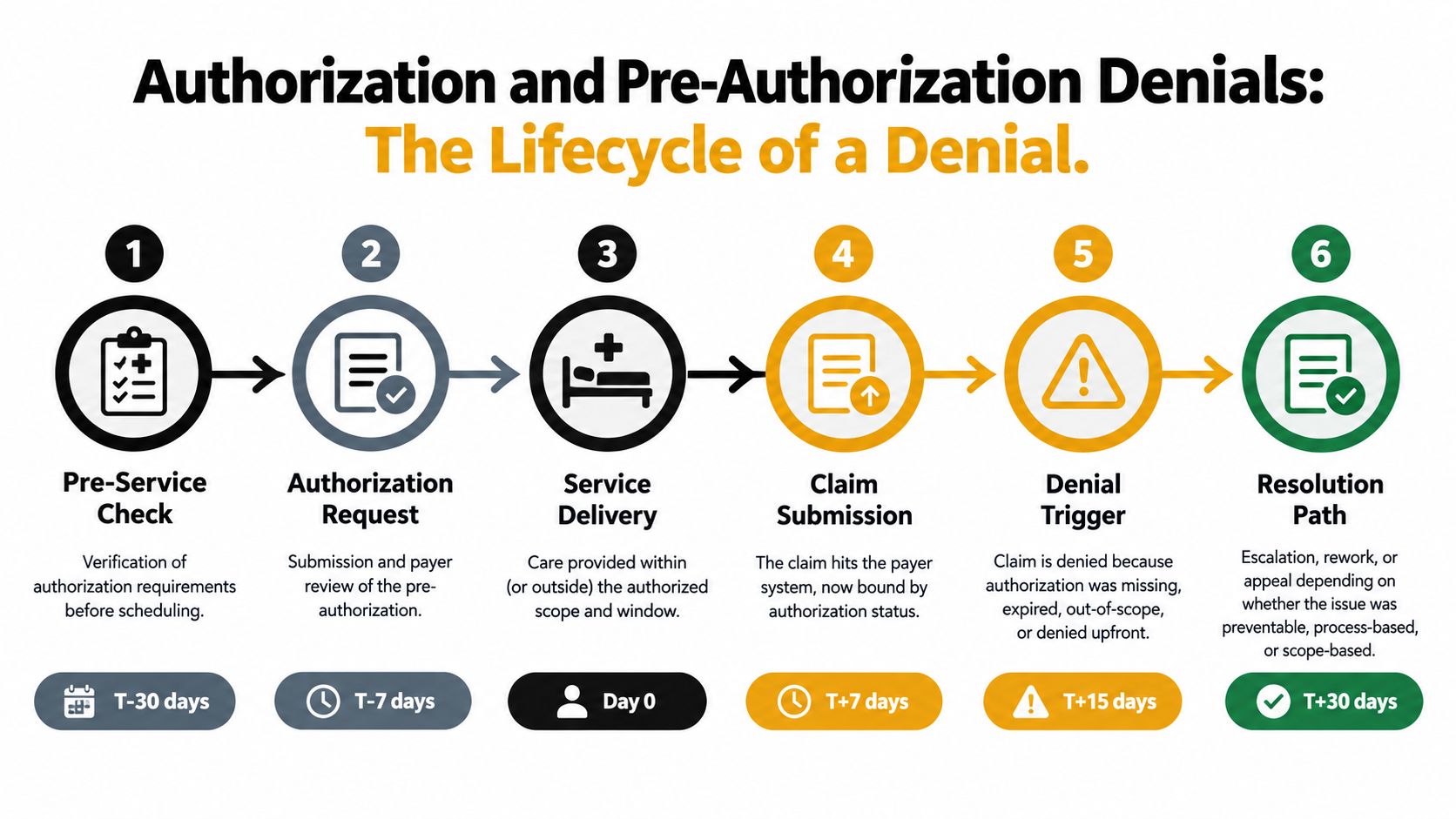
Authorization failures occur before, during, and after service delivery. The payer may require approval that was never obtained, reject an authorization request, find that the approval expired, or determine that the delivered service exceeded the approved scope. By the time the claim denies, scheduling, clinical, and billing teams may each believe another department owned the requirement.
Orthopedic physical therapy can be denied without the required authorization. Cardiology imaging may fall outside an expired approval. Anesthesia can be challenged when the procedure performed differs from the authorized scope. Gastroenterology claims may exceed an approved frequency, and an air ambulance claim may lack authorization for the specific service type.
The operational risk comes from treating authorization as a document rather than a controlled workflow. An approval number isn't enough. Staff must know the approved code, date range, units, site, provider, and service limitations.
Verify scope, not just approval status
Build a payer matrix by CPT code, specialty, site of service, and authorization pathway. Integrate status checks into scheduling, track expiration dates, and require staff to resolve mismatches before the appointment whenever possible. Emergency services need a separate retrospective-justification process because the point-of-service workflow may not permit ordinary pre-authorization.
Useful controls include:
- Scope confirmation: Record approved services, units, dates, locations, and providers, not just the authorization number.
- Expiration alerts: Notify scheduling and authorization teams before an approval ends.
- Exception ownership: Assign a named person to resolve a denied or incomplete authorization before service.
- Evidence retention: Store requests, payer responses, clinical notes, and peer-to-peer outcomes together.
Prior authorization denial support can help organize criterion-based packets, appeals, and escalation timelines. Remediation is appropriate when authorization existed, the payer misread its scope, or the provider can establish a valid emergency exception. If approval was never obtained for a non-emergency service, IDR generally won't cure the process failure. Escalation belongs to a later payment dispute, not to a missing prerequisite.
7. Eligibility, Timely Filing, and Retroactive Policy Denials
Eligibility, filing deadlines, and retroactive policy changes belong in one operational category because each can invalidate a claim after the clinical work is complete. The trigger may be inactive coverage on the date of service, a missed submission deadline after rework, an excluded benefit, or a payer decision that changes reimbursement treatment after earlier approval.
A patient may appear covered at scheduling but have a termination date that includes the date of service. An air ambulance claim may face a benefit exclusion. A claim initially denied for another reason can become untimely after repeated correction cycles. A payer may recoup a previously approved code after changing its interpretation, leaving the provider to prove what was known and approved at the time.
Payer behavior is especially important in retroactive cases. Preserve the eligibility response, authorization, policy bulletin, payment history, and correspondence. Without a dated evidence trail, staff may know the claim was previously accepted but struggle to show why the later denial or recoupment is inconsistent.
Put deadlines and policy changes on the same dashboard
Verify active status, effective dates, termination dates, benefit limitations, and plan information at scheduling and before service where appropriate. Automate claim submission queues with countdown alerts, and maintain a payer and state matrix for filing and appeal deadlines. Monitor payer bulletins and route material changes to coding, authorization, contracting, and clinical leadership.
A timely filing denial caused by provider delay may have limited recovery options. A denial caused by a payer's misdirected response, incorrect eligibility file, or documented timely submission warrants a focused appeal. Retroactive recoupment can justify escalation when the provider relied on an approval, contract term, or established payment position and the payer now seeks to reverse it without a supportable basis.
Don't use IDR to compensate for weak deadline management. Use it when the record shows a genuine payment or policy dispute, then pair the case with a prevention change so the same failure doesn't recur.
7-Point Claim Denial Comparison
| Item | Implementation complexity | Resource requirements | Expected outcomes | Ideal use cases | Key advantages |
|---|---|---|---|---|---|
| Medical Necessity Denials | High, requires clinical review and peer-to-peer escalation | Robust clinical documentation capture, specialty clinicians, peer-review workflows, pre-auth integration | Appeals often succeed with strong records; time-consuming resolution, possible IDR wins | High-cost or guideline-driven procedures; specialties with retrospective utilization management | Evidence-based appeals, preventable via pre-authorization, strong IDR when documented |
| Coding and Billing Accuracy Denials | Medium, rule-based but requires ongoing updates | Skilled coders, claim-scrubbing tools, payer-specific rule sets, continuous training | High prevention rate; quick resolution after correction; limited arbitration if error is genuine | High-volume practices, modifier-sensitive specialties (anesthesia, IONM) | Objective fixes, fast resubmission, high preventability |
| Out-of-Network and Credentialing Denials | Medium–High, coordinated across payers/states | Credentialing team, centralized tracking dashboard, renewals, payer communications | Often resolvable by correcting credentials; may cause balance billing; strong arbitration if credentialing valid at DOS | Multi-state platforms, specialty consultants, air ambulance services | Preventable with centralized tracking, clear contractual pathways, strong IDR when evidence shows validity at DOS |
| Duplicate Claim and Bundling Denials | Low–Medium, logic-driven deduplication and bundling checks | RCM integration, deduplication logic, payer-specific bundle definitions, specialty rule library | Objective resolution once duplicate/bundle identified; typically quick correction, limited arbitration | Procedural specialties with global packages (surgery, anesthesia, GI) | Easily preventable, clear correction path, reduced resubmission friction |
| Downcoding and Unbilled Service Denials | High, requires analytics to detect systematic underpayment | Claim-level analytics, statistical models, detailed documentation, regular audits | Strong arbitration potential when patterns established; recovers underpayment but needs evidence | Practices facing recurring underpayments or multi-claim downgrades | Detectable via analytics, NSA-favored arbitration for patterns, protects revenue when proven |
| Authorization and Pre-Authorization Denials | Medium, workflow and real-time checks required | Authorization verification tools, scheduling integration, renewal tracking, escalation protocols | Highly preventable; reductions in denials and scheduling disruptions when enforced; weak arbitration for lack of auth | Services routinely requiring prior approval (advanced imaging, PT, certain procedures) | Prevents operational friction, clear resubmission path, improves care planning |
| Eligibility, Timely Filing, and Retroactive Policy Denials | Medium–High, real-time checks plus policy monitoring | Real-time eligibility verification, payer intelligence, automated submission scheduling, timely-filing matrix | Eligibility/timely filings often non-arbitrable and unrecoverable if late; retroactive policy changes can be arbitrated with evidence | Multi-payer environments, high-risk codes prone to policy changes, organizations with many out-of-network exposures | Preventable with real-time checks, early warning on policy changes, reduces recoupment risk when tracked proactively |
Turn Denial Patterns Into Revenue Controls
The most effective denial program doesn't begin with an appeal queue. It begins by separating preventable failures, recoverable claim errors, and payer-driven underpayments. Eligibility, authorization, credentialing, coding, and bundling problems belong upstream. They need verification, documentation, payer-specific rules, ownership, and deadline controls before the claim reaches adjudication.
The second action is to audit what the payer did. Review remittance data for downcoding, missing components, recurring edits, unexplained reductions, and payer-specific patterns. A practice that measures only denied claims will miss paid-but-underpaid services. A practice that tracks only recovery dollars may also miss the operational cause, allowing the same registration, authorization, or coding error to produce another wave of denials.
The third action is to reserve IDR for disputes that can be proved. IDR shouldn't be a fallback for a missing authorization, an expired credential, an incorrect modifier, or a genuine duplicate. It can be appropriate when the provider has a clean, dispute-ready claim and the payer underpays, misapplies contract or policy terms, or refuses to recognize evidence supporting the billed service.
A specialty-specific denial matrix makes those decisions visible. Track the cause, payer behavior, financial exposure, specialty, owner, filing or appeal deadline, required documentation, remediation status, and escalation path. An anesthesia matrix won't look like an air ambulance matrix, and a gastroenterology matrix should distinguish procedure bundling from screening-frequency disputes. The categories need to reflect how each specialty earns and loses revenue.
RevGuard offers an integrated model that connects specialty RCM, payer intelligence, denial analytics, targeted appeals, and NSA-compliant IDR workflows. That connection matters because prevention and recovery depend on the same evidence trail. Clean eligibility and credentialing records support claims, adjudication analytics identify underpayments, and documented payer behavior helps determine whether remediation or escalation is justified.
Start with the denial records already in your system. Group them by trigger, payer, specialty, and payment outcome, then assign one upstream control and one recovery path to each recurring pattern. That process turns claim denial scenarios from a retrospective billing problem into a revenue-control program.
RevGuard combines specialty-specific RCM, denial prevention, payer analytics, and NSA-compliant IDR support to connect clean claims with evidence-based recovery. Visit RevGuard to see how its workflows can help your organization address eligibility, authorization, coding, underpayment, and escalation decisions in one revenue lifecycle.