

Most advice about healthcare revenue integrity starts in the wrong place. It tells specialty practice leaders to improve charge capture, educate coders, and work denials faster. Those activities matter, but they don't explain why a claim that was coded correctly can still be underpaid, why a paid account can still contain leakage, or why a reimbursement dispute may require enforcement rather than another follow-up call.
Revenue integrity is no longer a narrow back-office coding function. It is a margin-defense system that starts before the encounter is billed and continues until the payer has paid the amount the provider can support. That system must prevent defects upstream, detect payment variance after adjudication, and preserve the evidence needed to challenge payer behavior through negotiation or No Surprises Act arbitration.
Redefining Healthcare Revenue Integrity
The old model separates clinical documentation, coding, billing, denial management, contract analysis, and dispute resolution into different departments. Each team completes its assigned task, then passes the account downstream. That structure creates blind spots because no single owner can see how an eligibility error, a missing modifier, a payer policy, and a final underpayment connect across the full claim lifecycle.
A modern definition is more practical: revenue integrity means making sure the service delivered, the documentation created, the code submitted, the contract applied, and the payment received all describe the same economic event. It includes compliance, but compliance alone isn't enough. A claim can be compliant and still fail to produce the reimbursement the contract or applicable federal process supports.
The back office is only one control point
Charge capture remains important. Documentation gaps, coding drift, incorrect modifiers, and missed authorizations can all cause avoidable rework. Yet a program that stops at clean claim submission measures only the beginning of financial performance.
The more complete operating question is:
- Before billing: Did the practice verify eligibility, authorization, network status, and service requirements?
- At claim creation: Does the claim accurately represent the documented service and payer-specific rules?
- After submission: Did the payer adjudicate the claim according to policy and contract terms?
- After payment: Does the remittance match the expected reimbursement, including contracted rates and applicable dispute rights?
This broader view changes the role of denial management. Denials aren't just accounts to resubmit. They're signals that a process, payer rule, documentation habit, or financial control needs attention. The same applies to underpayments, including those hidden in accounts that appear resolved.
For practice leaders who need the broader operating context, this overview of RCM in medical billing helps distinguish the revenue cycle from the integrity controls embedded within it. RCM moves the account through the system. Revenue integrity tests whether each handoff protects the value of the care provided.
Practical rule: If the team that submits a claim never sees how the payer ultimately paid it, the organization doesn't have a closed revenue-integrity loop.
The No Surprises Act makes that loop more consequential. Federal independent dispute resolution is now a major structural feature of healthcare reimbursement. CMS recorded 394,140 disputes initiated in July 2026, compared with 318,421 in June 2026, while certified entities closed 371,715 disputes in July. Across the longer period, disputes increased from 200,112 between April 15 and December 31, 2022, to 679,156 in 2023 and 1,463,872 in 2024, according to CMS independent dispute resolution reports. The message for specialty groups is clear. Payment enforcement can't remain an afterthought.
Core Components of the Revenue Lifecycle
A reliable revenue-integrity program follows the claim in sequence, but it doesn't manage each stage in isolation. The front end supplies facts that the coding team needs. Coding and clinical documentation create the evidence that billing submits. Payment posting supplies the variance data that reveals payer behavior. Dispute teams use the original claim, contract terms, remittance, and clinical record to decide whether escalation is justified.
Start with patient access
Eligibility verification is more than confirming that a member exists. Staff should validate coverage for the date and service, identify authorization requirements, confirm the rendering and billing provider relationship, and record network information that may later affect reimbursement or dispute eligibility. A specialty practice that skips these checks can produce a technically clean claim that fails for reasons no coder can repair.
Patient access also affects the financial conversation with the patient. Clear estimates, accurate responsibility assignment, and compliant communications reduce avoidable confusion, while a clean registration record gives downstream teams a dependable foundation.
Build claims from clinical truth
Clinical documentation integrity and coding must work together. Coders need enough detail to select the supported service, diagnosis, modifier, and units. Providers need a practical query process that clarifies missing information without steering documentation toward an unsupported result.
A useful pre-bill edit library combines general coding controls with payer-centric rules. One payer may require a specific authorization relationship, another may apply a distinct modifier policy, and a third may use a narrow medical-necessity rule. Rules should be tied to specialty, service line, payer, and place of service rather than applied as a generic checklist.
Validate before submission
Pre-bill claim validation should test the fields most likely to create a preventable failure:
- Identity and coverage: Match patient, subscriber, payer, and dates of service.
- Clinical support: Confirm that documentation supports the billed service and diagnosis.
- Technical integrity: Check codes, modifiers, units, formatting, and claim relationships.
- Payer requirements: Test authorization, referral, medical necessity, and timely filing conditions.
- Expected reimbursement: Compare the claim against contract logic where the data is available.
The purpose isn't to add friction to billing. It is to catch defects while the people who can correct them still have access to the chart, scheduling record, and authorization trail.
Finish with enforcement
Payment posting should compare actual reimbursement with expected reimbursement, not merely close the account. When a payer disputes or underpays a qualifying out-of-network service, negotiation and Independent Dispute Resolution under the No Surprises Act can become part of the recovery path. The upstream work determines whether the downstream case is credible. A complete record of the service, provider status, documentation, billed amount, payment, and payer communications gives the enforcement team something stronger than an assertion that the payment feels low.
This is the central operating insight: prevention and enforcement are complementary controls. Prevention reduces avoidable defects. Enforcement protects the claims that remain exposed to payer disagreement.
The Financial Case for Upstream Prevention
Post-denial appeals are necessary, but they are an expensive place to begin. Once a claim denies, staff must interpret the reason, retrieve records, correct the issue where permitted, prepare an appeal, monitor the deadline, and reconcile the result. That effort can recover money, but it also consumes clinical, coding, and administrative capacity that could have prevented the defect.
Benchmark material cited by MDaudit indicates that resolving billing and coding accuracy issues can retain 15% to 25% of overall revenue, and it reports that average hospital inpatient charge denials reached $5,810 in 2022, a 9.5% year-over-year increase. Those figures appear in the MDaudit benchmark report. The practical implication is not that every organization will achieve the same result. It is that a defect attached to a high-value claim deserves prevention controls before it enters adjudication.
Prevention protects more than the billed amount
A documentation gap can cause an unsupported code. A modifier error can change how a payer bundles services. A medical-necessity mismatch can trigger a denial even when the procedure was clinically appropriate. Each problem creates two exposures:
- Reimbursement exposure: The provider may receive less than the supported amount or nothing at all.
- Operational exposure: Staff must spend time researching, correcting, appealing, and tracking the account.
Pre-bill validation addresses both. A rules engine can flag a missing authorization before submission. A coding edit can identify a modifier combination for review. A documentation work queue can route a query to the responsible provider while the encounter remains recent.
Choose prevention over indiscriminate staffing
Adding appeal staff often feels more tangible than redesigning upstream workflows. It can increase the number of accounts touched, but it won't necessarily reduce recurring defects. If the same payer-specific issue appears on every claim from a service line, working each denial independently creates a recurring labor bill without correcting the source.
A stronger investment sequence is:
- Find the recurring defect: Segment denials by payer, reason, provider, and service.
- Measure its economic exposure: Look at dollars as well as account volume.
- Place an edit upstream: Add a validation rule, documentation prompt, authorization control, or coder review.
- Audit the result: Confirm that the edit prevents the intended defect without creating inappropriate billing behavior.
- Retire ineffective controls: Remove edits that produce noise, delay clean claims, or lack a defensible rationale.
Upstream prevention shouldn't mean refusing every claim that carries uncertainty. It means applying the right level of review to the right risk. High-value, high-complexity services deserve more precise controls than routine claims, and payer-specific edits should be governed so they don't become undocumented tribal knowledge.
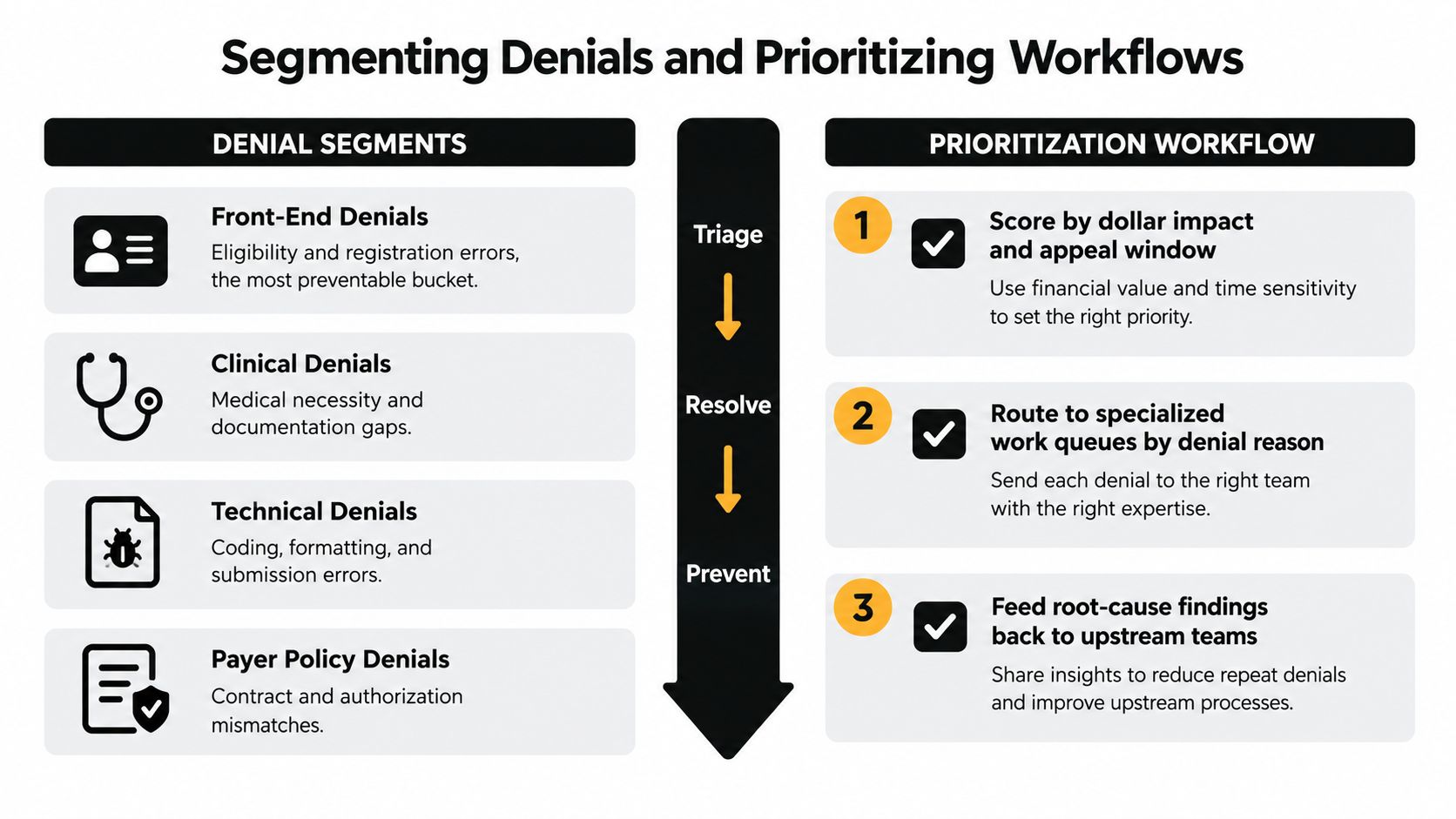
Segmenting Denials and Prioritizing Workflows
A single denial queue hides the difference between a correctable registration issue, a clinically complex appeal, a low-dollar technical error, and a payer policy dispute. Chronological worklists reward arrival time, not financial value. They also make it difficult for leaders to identify which upstream team owns the recurring failure.
HFMA recommends tracking initial denial rate by both volume and dollars, along with denial write-offs as a percentage of net patient service revenue, time from denial to appeal, time to resolution, and overturn rate. Its guidance on denial metrics and revenue-cycle benchmarking provides the foundation for a more useful operating scorecard.
Create meaningful segments
Start with categories that determine the likely remedy and owner:
- Front-end denials: Eligibility, registration, authorization, and referral issues. Route these to patient access and authorization specialists, then convert recurring patterns into scheduling or verification edits.
- Clinical denials: Medical necessity and documentation gaps. Route them to clinical reviewers, CDI staff, and the provider when clarification is appropriate.
- Technical denials: Coding, formatting, modifier, bundling, and submission defects. Route them to specialized coding or claims-quality work queues.
- Payer policy denials: Contract interpretation, coverage policy, network status, and payment disputes. Route them to payer specialists with access to contracts, remittances, and escalation history.
Don't assume the first denial code tells the whole story. Review the remittance language, claim history, clinical record, payer policy, and previous outcomes before selecting the remedy.
Use economic triage
Revenue cycle leaders identified difficulty prioritizing denials by revenue benefit as the top barrier to improving recovery, reported by 37.6% of respondents. Technology gaps followed at 26.4%, and lack of clinical support at 17.6%, according to the ACDIS report on commercial denials. That finding should change how managers design work queues. The problem isn't solved by adding a larger undifferentiated backlog.
Score each account using practical criteria:
- Dollar impact: Prioritize material expected recovery over raw account count.
- Appeal window: Move time-sensitive cases ahead of claims with more flexibility.
- Probability of recovery: Give weight to documentation strength, contract support, and prior payer outcomes.
- Strategic value: Escalate patterns that affect a service line or expose a repeat payer behavior.
- Resource requirement: Match complex cases with staff who can resolve them without repeated handoffs.
Operational insight: A low-volume denial pattern can deserve more attention than a high-volume pattern when it affects a valuable service line or reveals a systemic payer issue.
Use dashboards to show the queue's economic composition, not just its count. A manager should be able to see which payer and reason codes consume the most dollars, which appeals are approaching deadlines, and which service lines generate preventable work. A well-designed denial-management process then feeds root-cause findings back to registration, clinical documentation, coding, and contracting teams.
Specialty-Specific Revenue Integrity Applications
Revenue integrity controls fail when leaders apply a generic edit library to every specialty. The claim risks are different, the clinical evidence is different, and the payer's reimbursement logic may depend on details that a general billing team doesn't routinely review.
Air ambulance and anesthesia
Air ambulance providers face a difficult combination of high-acuity services, out-of-network reimbursement disputes, transport documentation, and payer scrutiny. The record must support the circumstances of the transport, the service performed, the medical necessity, and the provider's role. When a payment dispute qualifies for the federal process, the team needs an organized case file rather than a bare claim form.
Anesthesia presents a different problem. Time documentation, start and stop details, modifiers, concurrency, qualifying circumstances, and the relationship to the surgical service can all affect claim support. A pre-bill review should connect the anesthesia record to the procedure record and test payer-specific requirements before submission. A denial team that only checks the remittance won't fix a documentation habit that begins in the operating room.
Orthopedics and ambulatory surgery
An orthopedic ASC may need controls around implants, laterality, procedure combinations, global surgical rules, modifiers, and site-of-service reimbursement. The financial risk often sits in the relationship between the operative note, implant record, charge capture, and payer policy. A general edit may identify a code conflict, but a specialty-aware reviewer can determine whether the issue reflects a true coding problem, a missing clinical detail, or a payer rule that needs escalation.
Oncology and other complex services
Oncology teams manage recurring treatment patterns, drug administration documentation, diagnosis specificity, authorization requirements, and medically necessary services that may span multiple encounters. The control environment should reconcile the treatment record, drug or service units, authorization, and claim before billing. If a payer repeatedly applies an inconsistent policy, the practice should preserve the pattern and evaluate whether negotiation or formal dispute is more appropriate than isolated resubmissions.
The same principle applies to cardiology, gastroenterology, dermatology, radiology, and intraoperative monitoring. Specialty specificity isn't a luxury. It determines whether the organization can distinguish a correctable defect from a defensible payer position.
A useful design test is simple. Ask whether the person building the edit understands the clinical workflow, documentation standard, code relationship, contract rule, and likely appeal evidence. If the answer is no, the edit may generate activity without protecting reimbursement.
Detecting Silent Underpayments and Zero-Balance Leakage
A traditional RCM dashboard often treats payment posting as the finish line. It reports claims billed, payments received, open accounts, denials, and aging. Those measures are useful, but they can miss a claim that has a zero balance because the system posted the payer's payment and closed the account, even though the payment was below the amount supported by the contract or applicable reimbursement process.
That is the underpayment blind spot. A paid claim can be financially unresolved.
A 2025 benchmark reported that hospitals lost more than $48 billion in net revenue in 2025, compared with $38.6 billion in 2024, because underpayments remained hidden in zero-balance accounts. A separate 2025 analysis found that more than 32% of medical claims were underpaid, representing over $5 billion in uncollected reimbursements. These figures come from FinThrive's analysis of zero-balance leakage. They show why denial rate alone is an incomplete measure of revenue performance.
Compare the dashboards
| Traditional view | Revenue-integrity view |
|---|---|
| Was a payment posted? | Did the payment match the expected amount? |
| Is the account balance zero? | Does the remittance reconcile to contract and claim terms? |
| How many denials remain open? | Which payer, code, service, and policy produce payment variance? |
| Was the claim closed? | Is there a viable recovery or escalation path? |
The second view requires contract modeling, remittance interpretation, claim-level comparison, and payer-behavior analysis. It may also require normalizing data across practice-management systems, clearinghouses, payer portals, and arbitration records. Spreadsheets can support a narrow audit, but they become unreliable when contract terms, code-level reimbursement, modifiers, carve-outs, and service-line rules change across payers.
Build a recovery control
Start with a defined expected-payment model. For each selected service, capture the payer, contract or applicable benchmark, code, modifiers, units, place of service, and relevant claim conditions. Compare that expectation with the remittance, then classify the variance as a correct payment, an explainable adjustment, a coding issue, or a potential underpayment.
The recovery workflow should preserve evidence and rank cases economically. It should also distinguish an isolated posting discrepancy from a recurring payer pattern. Groups evaluating medical underpayment recovery should ask whether the process can analyze zero-balance accounts, explain the variance, document the contractual basis, and route qualified cases to negotiation or enforcement.
A zero balance is an accounting status, not proof that reimbursement was correct.
Building a Unified Revenue Protection Strategy
A unified strategy gives one operating model responsibility for the claim from construction through final payment enforcement. That doesn't mean every task belongs to one person or department. It means the data, controls, ownership, and KPIs connect across the lifecycle instead of ending when the claim leaves the billing queue.
Put one logic chain behind the work
Begin with a baseline review of claim defects, denial dollars, payment variance, appeal outcomes, and payer-specific patterns. Don't select technology before identifying the decisions the team needs to make. A rules engine that creates alerts without clear ownership can increase queue volume while leaving the underlying problem untouched.
Then establish shared measures:
- Prevention: Defect rate, clean-claim performance, authorization completion, and documentation exceptions.
- Recovery: Denial dollars worked, appeal turnaround, overturn rate, and recovered reimbursement.
- Payment accuracy: Expected-to-actual variance, zero-balance exceptions, and payer-specific underpayment patterns.
- Enforcement: Qualified disputes, evidence completeness, negotiation outcomes, arbitration status, and collected proceeds.
- Governance: Edit accuracy, compliance review, false-positive rates, and recurring root causes.
The team that engineers the initial claim should have access to downstream results. If an arbitration file repeatedly exposes a missing record or a payer-specific interpretation, that finding belongs in the upstream control library. If a pre-bill edit prevents a recurring defect, the organization should verify that it improves payment integrity without delaying appropriate claims.
Treat IDR as a control, not a rescue desk
The No Surprises Act process shouldn't be used to compensate for weak eligibility, coding, or documentation practices. It is an enforcement path for qualifying disputes, not a substitute for accurate billing. But omitting it from the revenue-integrity design leaves a significant part of the reimbursement lifecycle unmanaged.
Organizations should define who decides whether a case qualifies, who assembles evidence, who manages deadlines, who handles payer communications, and who reconciles the final result. They should also preserve the connection between the original claim and the dispute record so leaders can identify payer behavior by specialty and service line.
Technology can support this model, but governance determines whether it works. Choose tools that expose payer rules, support claim-level audit trails, reconcile expected and actual payment, and route work according to financial priority. A specialized partner such as RevGuard can combine specialty-specific RCM, payer-aware claim construction, underpayment recovery, KPI reporting, and No Surprises Act IDR case management within that broader operating model.
Healthcare revenue integrity succeeds when prevention and enforcement share the same facts. Review the full claim lifecycle, identify where your practice loses value after payment as well as before it, and assign clear owners for each control. Then visit RevGuard to discuss how its RCM and IDR services can help your organization prevent defects upstream and pursue qualified underpayments downstream.