

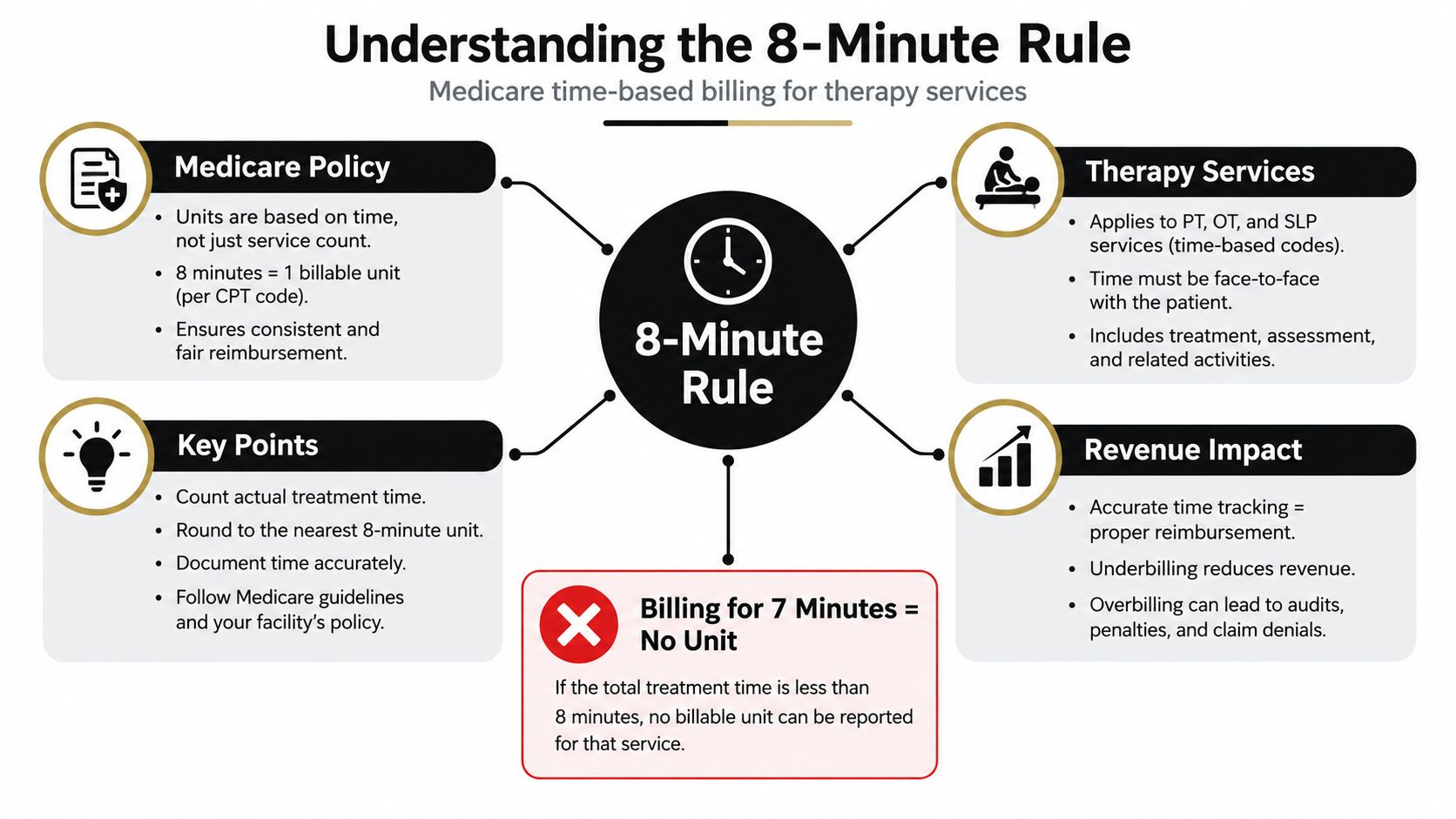
The 8-minute rule is a CMS threshold where you must provide at least 8 minutes of a timed service to bill one 15-minute unit. A service performed for less than 8 minutes can't be billed as a unit under this Medicare standard.
A therapist finishes a busy outpatient session, sees 7 minutes recorded for manual treatment, and assumes the system will round the time up. The claim goes out with a unit attached. Later, the clinic manager is left explaining a denial, reconciling the note with the claim, and determining whether the error affected other encounters.
That situation is common because the 8 minute Medicare rule sounds like a rounding convention. It isn't. It is a CMS method for converting documented, direct treatment time into billable units for timed outpatient therapy services under Medicare Part B. The risk is especially serious for organizations that manage both therapy and anesthesia-related workflows, because a familiar time-based process from one specialty can be applied incorrectly to another.
Understanding the Core Concept
A therapist provides a short intervention and documents 7 minutes. The billing team sees that the service was clinically appropriate and assumes a partial unit can be rounded into a billable unit. Under CMS's Medicare Part B therapy standard, that assumption is wrong. No claim should be billed when the service is performed for less than 8 minutes, and at least 8 minutes of direct, one-on-one treatment is required to bill one 15-minute unit, as described in CMS therapy services guidance.
The threshold is not a rounding shortcut
The word “midpoint” creates much of the confusion. CMS uses midpoint logic to establish the boundaries for 15-minute units, but the practical instruction for staff is simpler: count the actual qualifying minutes, then apply the applicable band. Don't turn 7 minutes into 8, and don't treat a planned treatment duration as proof that the service was delivered for that duration.
The rule applies to timed outpatient therapy services under Medicare Part B. The relevant time is direct, one-on-one treatment. It isn't a general permission to bill any clinical activity that occurred during the patient's visit. A schedule entry, an appointment length, or a time spent preparing the room doesn't establish billable treatment time by itself.
That distinction matters because a clinic can have a medically necessary visit and still submit an unsupported unit. Medical necessity and time compliance work together. The record must support what service was performed, that it was skilled and direct, and how much qualifying time the provider delivered.
Practical rule: Never ask whether a short service “feels close enough” to a unit. Ask whether the documented qualifying time reaches the CMS threshold.
Why the first unit matters
The first unit has a hard floor. If a single timed service lasts less than 8 minutes, it doesn't become billable because the provider intended to continue, because the appointment was longer, or because the difference seems minor. This is why a clean claim depends on both accurate coding and complete supporting documentation. Clinics can review their broader claim preparation practices through resources on what makes a clean claim.
The same principle protects against overbilling. A provider can't bill a full 15-minute unit merely because the code is defined in 15-minute increments. The code's unit description and the CMS threshold are connected, but they aren't interchangeable with scheduled time.
For managers, the operational message is direct:
- Record delivered time: Use the time the clinician spent providing the qualifying service.
- Separate service types: Keep timed treatment distinct from activities that don't qualify for the same calculation.
- Check the threshold: Treat less than 8 minutes as non-billable for a standalone timed unit under this rule.
- Reconcile before submission: Make sure the units on the claim match the total supported minutes.
Anesthesia and IONM leaders should be particularly careful here. The verified CMS material cited for this rule addresses timed outpatient therapy services. It doesn't establish that every anesthesia or intraoperative neurophysiological monitoring service follows the therapy 8-minute method. A similar time-based workflow isn't enough to transfer the rule. The team must confirm the governing code, payer instruction, and specialty-specific requirements before using this calculation outside the therapy context.
How the Minute Bands Work
CMS converts total qualifying timed minutes into units through fixed bands. The core bands are 8 through 22 minutes for 1 unit, 23 through 37 minutes for 2 units, and 38 through 52 minutes for 3 units, as set out in the CMS outpatient rehabilitation booklet.
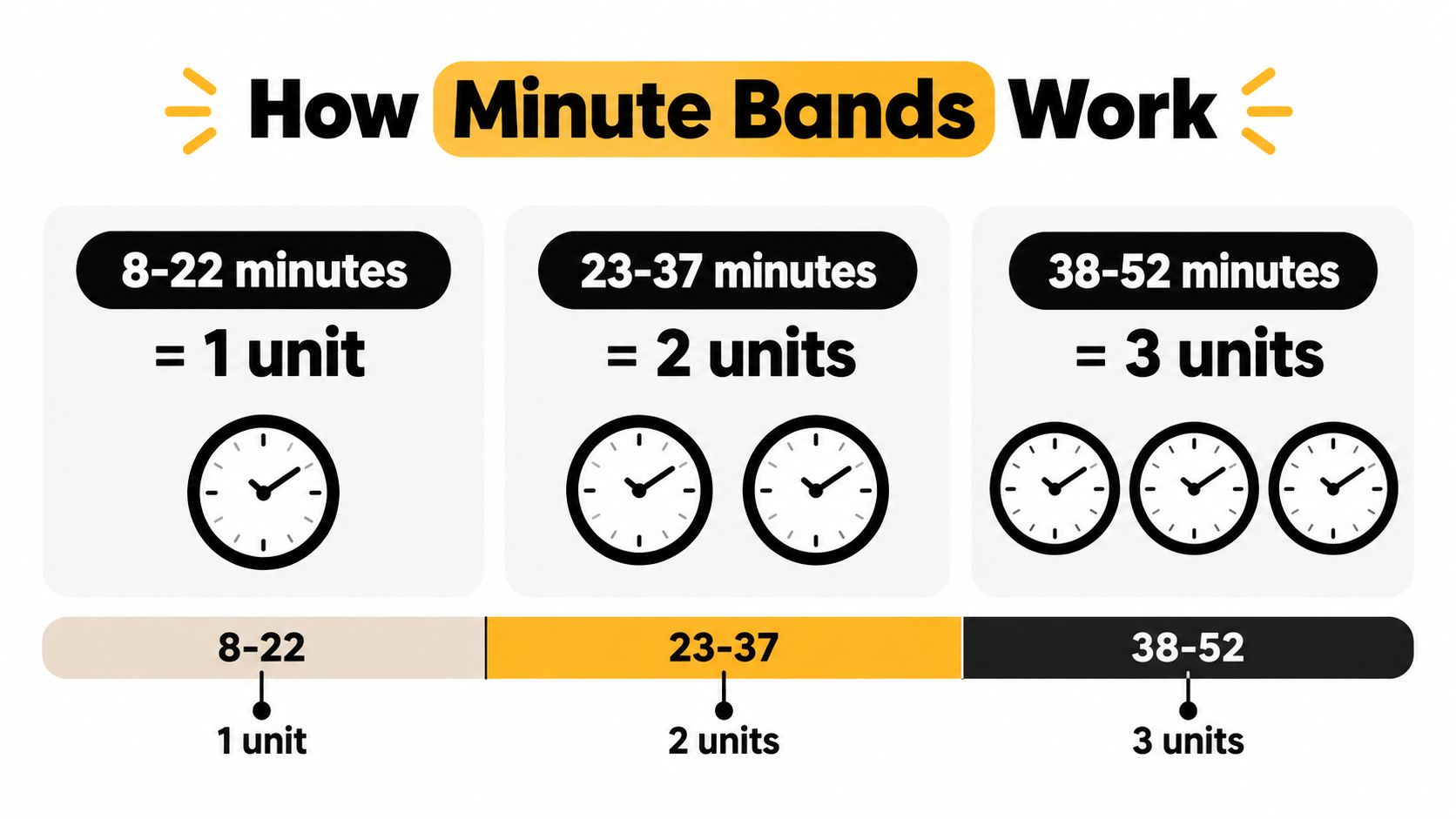
Read the bands as boundaries
| Total qualifying timed minutes | Billable units |
|---|---|
| 8 through 22 | 1 |
| 23 through 37 | 2 |
| 38 through 52 | 3 |
The boundary is where many claims fail. A session at the upper end of the first band still supports only 1 unit. The next unit becomes available only when the total reaches the next band. A small interruption, an early patient departure, or an unrecorded pause can therefore change the payable result.
The calculation should use the total qualifying timed minutes for the day, rather than averaging time across the codes. Suppose a therapist provides two timed services during one session. The billing team shouldn't decide units by looking at each code in isolation and then adding assumptions about partial time. First establish the qualifying total, then identify the band, and finally assign the supported units to the services documented.
A simple calculation sequence
Use a consistent workflow at charge capture:
- Identify the timed services. Confirm which services are subject to the timed-unit calculation.
- Verify direct treatment time. Remove time that doesn't represent qualifying treatment.
- Add the documented minutes. Use the total supported time for the session.
- Locate the band. Match the total to the applicable CMS range.
- Assign the units carefully. Make sure the record supports the specific services reported.
This method prevents a common error: calculating an average duration per code and then rounding each code independently. CMS's framework converts treatment time through fixed minute bands. It isn't simple hour-based math, and it isn't a license to create a unit for every short contact.
Why small changes affect claims
A schedule may appear stable while the claim result changes. A patient arrives late, a clinician pauses treatment to address a safety issue, or a procedure ends earlier than planned. Each event can reduce the total minutes that support the claim. If the reduction moves the encounter into a lower band, the units must follow the lower band.
The reverse is also true. Properly recorded qualifying treatment can show that a session crossed a billing boundary that the original charge entry missed. Accurate time capture protects against both overbilling and underbilling. The objective isn't to push every encounter into a higher band. It's to submit the units that the record supports.
CMS's guidance also illustrates why separate short treatments can't be treated as separate full units. Its examples use midpoint logic and show that four distinct 8-minute treatments total 32 minutes but support 2 billable units, not four, under the rule. The example makes the central point clear: units follow the total minute bands, not the number of interventions performed.
For a clinic manager, the best control is a charge workflow that displays the total timed minutes beside the proposed units. The clinician documents the care. The billing system applies the bands. A reviewer resolves exceptions before the claim leaves the organization.
Documentation and Coding Essentials
Correct arithmetic can't rescue an incomplete record. An auditor needs to see what the provider did, when the provider did it, and why the service was medically necessary. A note that says “therapy provided” or “approximately 20 minutes” leaves too much uncertainty around the billed unit.
Build the record in sequence
The strongest documentation follows the encounter rather than reconstructing it later.
- Name the intervention: Identify the timed service and describe the skilled work performed.
- Capture start and stop times: Record when the service began and ended, not just an estimated duration.
- Separate services: If the clinician performed more than one timed service, document each service distinctly.
- Record interruptions: Note pauses, transitions, safety events, or circumstances that affected treatment time.
- Describe the patient's response: Explain how the patient tolerated the intervention and how the response informed care.
- Connect care to the plan: Show why the service was appropriate for the patient's condition and treatment goals.
A record should allow a reviewer to trace the path from treatment to time to units. If the claim reports multiple timed services but the note contains only one undifferentiated total, the reviewer may not be able to determine whether the coding is supported.
The direct, one-on-one requirement also deserves careful attention. A clinician's presence in the treatment area doesn't automatically make every activity direct treatment. The note should distinguish active skilled care from setup, administrative work, or time when the patient wasn't receiving the reported intervention.
Documentation is more than a time log
Time answers one question: how long was the qualifying service delivered? It doesn't answer whether the service was skilled, appropriate, and medically necessary. A defensible note addresses both dimensions without padding the record with irrelevant detail.
For example, the clinician can describe the intervention, the patient's performance, the cues or assistance provided, and the response that shaped the next part of treatment. The language should reflect the actual encounter. Templates can support consistency, but they shouldn't populate minutes or services that weren't delivered.
A precise timestamp with no clinical explanation is incomplete. A detailed clinical narrative with no reliable time record is also incomplete.
Managers should audit the handoff between clinical documentation and coding. Common control questions include:
- Does the billed unit match the total documented qualifying time?
- Do start and stop entries make chronological sense?
- Are interruptions reflected in the time calculation?
- Does each billed service appear in the treatment note?
- Does the record establish direct, one-on-one care?
- Can a second reviewer understand the calculation without asking the treating provider to reconstruct it?
These checks should be built into daily operations, not reserved for a payer review. A clinic can also formalize its standards using a medical record documentation resource, then train clinicians and billers on the same definitions.
Keep specialty boundaries visible
Therapy documentation and anesthesia documentation may both contain time entries, but that doesn't make them interchangeable. A therapy note supporting the CMS 8-minute method can't be used as a template for an anesthesia or IONM claim without confirming that the relevant service follows the same rule. Specialty teams should maintain separate coding guidance, examples, and review criteria.
Specialty-Specific Applications
The most dangerous mistake for a multi-specialty organization is treating the 8-minute rule as a universal time-billing rule. CMS's verified guidance establishes it for timed outpatient therapy services under Medicare Part B. It doesn't, by itself, establish the same calculation for anesthesia services or intraoperative neurophysiological monitoring.
Physical and occupational therapy
For PT and OT teams, the operational model is clear. The provider documents direct, one-on-one timed treatment, combines the qualifying minutes for the relevant session, and applies the CMS bands. The claim must reflect what the record supports, including the distinction between services performed by the therapist and services furnished by an assistant when the applicable coding and modifier requirements call for that distinction.
The midpoint logic explains why a clinician can deliver several separate interventions without receiving one unit for each intervention. CMS examples show that a therapist may bill one unit when the qualifying treatment reaches the threshold, while four distinct treatments of 8 minutes each total 32 minutes and support only two units under the total-time method. The example is documented in CMS billing examples for therapy services.
The compliance question for PT and OT is therefore not merely, “How many codes did we perform?” It is, “What total qualifying time did we deliver, and does the record support the units assigned across those codes?”
Anesthesia and IONM
Anesthesia and IONM teams need a different first question: Does this service fall under the CMS therapy rule? If the answer hasn't been established through the applicable code and payer guidance, the team shouldn't import the therapy calculation because the service also happens to be measured in minutes.
A safe specialty workflow separates three issues:
| Review question | Therapy workflow | Anesthesia or IONM workflow |
|---|---|---|
| Governing rule | CMS timed therapy methodology when applicable | Confirm the service-specific payer and coding methodology |
| Time evidence | Direct treatment time and treatment intervals | Service-specific records, roles, intervals, and required attestations |
| Unit logic | Apply the CMS minute bands | Don't assume therapy bands apply |
| Escalation | Review unusual totals or documentation gaps | Route uncertain coding to specialty compliance review |
For IONM, the record may involve intraoperative events, monitoring responsibilities, interpretation, and communication. Those elements require documentation appropriate to the service and the payer. They shouldn't be forced into a therapy-style unit calculation merely because the case includes time stamps.
Anesthesia providers face the same boundary problem. A time-based anesthesia claim has its own coding framework, and the therapy 8-minute threshold shouldn't be used as a substitute for that framework. A billing team that supports both service lines should make the distinction visible in the charge workflow, training materials, and claim edits.
Specialty safeguard: Similar terminology doesn't create identical billing rules. Confirm the rule before calculating the unit.
The practical benefit of this separation is fewer cross-specialty errors. Therapy staff get precise CMS minute-band guidance. Anesthesia and IONM staff get service-specific coding controls. Managers can still use shared principles, such as accurate time capture and audit-ready records, without treating the underlying billing methodologies as the same.
Audit Risks and Compliance Strategies
Time-based billing creates a narrow margin for documentation errors. A claim can be clinically reasonable yet still fail because the recorded minutes don't support the units submitted. The most exposed patterns are inconsistent time entries, unsupported rounding, unexplained interruptions, and claims that repeatedly sit at the upper edge of a band without corresponding clinical detail.
Find the failure before the payer does
A useful internal review compares three records:
- The clinical note, including the services, intervals, interruptions, and patient response.
- The charge entry, including the codes and units selected.
- The submitted claim, including the final line items and any applicable modifiers.
Differences between those records should produce an exception, not an automatic claim. A billing analyst can return the account to the clinical team for clarification while the encounter is still fresh. That process is more reliable than asking a provider to remember the details after a payer requests records.
A regular audit sample should include both straightforward encounters and complicated sessions with multiple timed services. Reviewing only clean, single-service examples won't reveal how the system handles combined time, interrupted treatment, or competing code lines.
Four controls that reduce avoidable exposure
- Accurate time documentation: Require start and stop entries that reflect delivered treatment, not planned duration.
- Correct band application: Use the CMS minute bands without rounding a service below the threshold into a unit.
- Medical record support: Link every reported service to skilled care and patient-specific necessity.
- Internal review: Track recurring exceptions by provider, location, code family, and workflow step.
The infographic's “round to nearest 8 minutes” wording should be handled carefully in staff education. CMS's rule isn't permission to round arbitrary time upward. The safe interpretation is to apply the threshold and bands to actual qualifying minutes. If a local tool uses shorthand language, compliance leaders should clarify that the record, not the label in the tool, controls the claim.
Use analytics as a review signal
A dashboard can help managers identify claims that deserve human review. Useful signals include a mismatch between note time and charge time, repeated corrections, missing stop times, or an unusual concentration of claims at a band boundary. Analytics should flag risk, not decide that a provider committed an error. The reviewer still needs to examine the record and the applicable coding rule.
Training also needs to be role-specific. Clinicians need to know how to document time and interruptions. Coders need to know how to apply the bands. Managers need to know how exceptions move through the organization. Anesthesia and IONM teams need separate guidance so that therapy rules aren't copied into unrelated service lines.
For organizations building a formal review program, medical coding audit support can sit alongside internal controls. The operational goal is straightforward: catch unsupported units before submission, correct recurring workflow defects, and preserve a clear record of how the organization reached each billing decision.
Conclusion and Key Takeaways
A clinic manager doesn't need a complicated formula to control the 8-minute rule. The manager needs a reliable chain from delivered care to documented minutes to submitted units. The first question is whether the service is a CMS timed outpatient therapy service under Medicare Part B. If it is, the team must apply the threshold and bands accurately. If it isn't, the team must stop and confirm the applicable specialty and payer methodology.
The practical lessons are clear:
- Less than 8 minutes isn't a billable standalone unit under the CMS therapy standard.
- 8 through 22 minutes supports 1 unit, 23 through 37 supports 2 units, and 38 through 52 supports 3 units, according to CMS guidance.
- Total qualifying timed minutes matter. Don't calculate units by averaging treatment or treating every intervention as an automatic unit.
- Documentation must support the calculation. Record the service, the time, the direct care, interruptions, medical necessity, and patient response.
- Therapy and anesthesia workflows must remain distinct. Don't apply the therapy rule to anesthesia or IONM without confirming that the service and payer require it.
The strongest compliance programs make the correct action the easy action. They give clinicians practical time-capture tools, give coders clear band logic, and give managers exception reports that identify unsupported claims before they become denials or audit findings. That approach protects both reimbursement accuracy and the integrity of the medical record.
RevGuard combines specialty-focused revenue cycle management with dispute-ready claim workflows, helping provider organizations address coding accuracy, denials, payer underpayments, and revenue leakage. Visit RevGuard to review how its services can support stronger billing controls for therapy, anesthesia, IONM, and other complex specialties.