

Up to 19% of in-network claims and 37% of out-of-network claims are denied, so the claim life cycle now requires aggressive post-adjudication enforcement. A claim isn't finished when it leaves the clearinghouse, or even when the payer issues its first decision.
That reality changes how revenue cycle teams should work. Clean submission still matters, but it's only the opening move in a longer process that includes eligibility checks, coding validation, adjudication, denial analysis, appeals, underpayment recovery, and, when appropriate, Independent Dispute Resolution. The organizations that protect reimbursement treat every claim as a documented financial position that may need to withstand payer review.
The modern claim life cycle therefore has two connected architectures. The first prevents avoidable defects before submission. The second preserves evidence and deadlines so the organization can challenge an incorrect payment decision after adjudication. Coding quality belongs in both.
The Broken Claim Life Cycle Reality
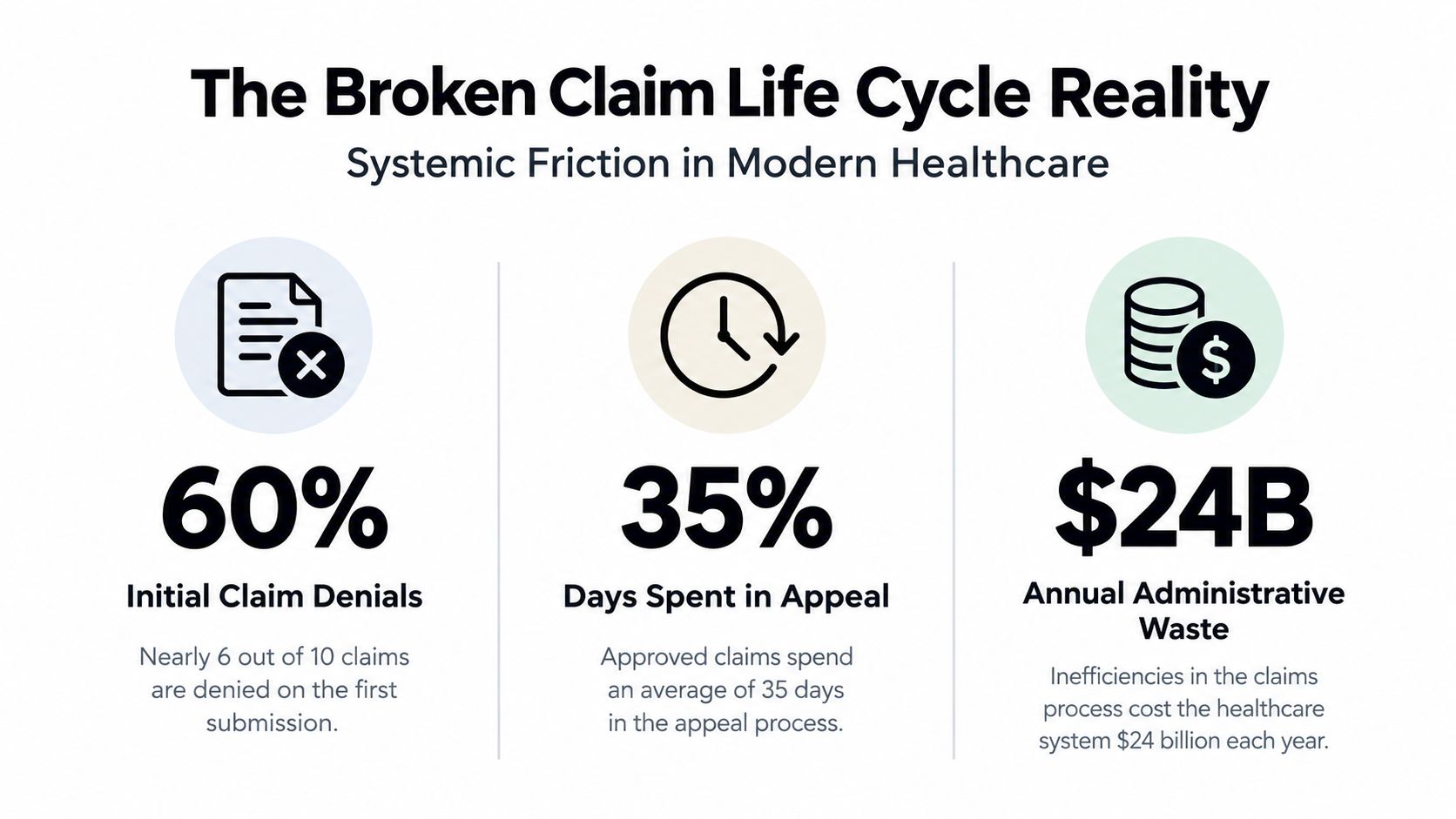
The old operating assumption was simple: capture the charge, submit a clean claim, post the payment, and close the account. That sequence still describes the intended flow, but it doesn't describe what many provider organizations manage every day. In the ACA Marketplace market, insurers reported receiving about 496 million claims in 2024, including roughly 451 million in-network claims. About 85 million in-network claims were ultimately denied, producing a 19% in-network denial rate, while the out-of-network denial rate reached 37%, according to KFF's analysis of 2024 ACA Marketplace claims.
A specialty practice can do everything it considers operationally correct and still receive a denial. The payer may apply a coverage rule that wasn't visible at scheduling, reject a modifier combination, question the relationship between diagnosis and procedure codes, or request documentation after the claim has already entered adjudication. The billing team then has to determine whether the account needs a corrected claim, a reconsideration, a formal appeal, a negotiation, or a dispute pathway.
Why submission is no longer the finish line
KFF found that denial rates in the ACA Marketplace were similar in 2024 and 2023. That persistence matters. A stable denial problem isn't a temporary disruption that can be solved by telling staff to work faster. It points to recurring payer rules, recurring data defects, and recurring weaknesses in follow-up.
The claim life cycle now looks more like a controlled escalation path:
- Prevent: Validate eligibility, benefits, coding, documentation, and claim structure before transmission.
- Diagnose: Read the remittance and denial reason at the level of the payer rule, not just the broad category.
- Recover: Correct preventable defects, appeal defensible denials, and pursue underpayments.
- Enforce: Use formal dispute resolution when the payment issue meets the applicable requirements and the evidence supports the case.
- Learn: Feed payer behavior and denial patterns back into registration, coding, contracting, and documentation workflows.
A flowchart can help teams visualize these handoffs, but the process only works when ownership is explicit. The person posting the remittance can't be expected to build an arbitration record without access to clinical documentation, contracts, eligibility history, and payment data. Teams that want a broader visual model can review this healthcare revenue cycle management flowchart.
Practical rule: Treat the first payer decision as a checkpoint, not an automatic conclusion.
The practical consequence is uncomfortable but useful. A clean claim is a claim that passed the organization's controls. It isn't proof that the payer's later decision is correct. Revenue protection starts when teams preserve enough evidence to test that decision.
Building a Dispute-Ready Foundation
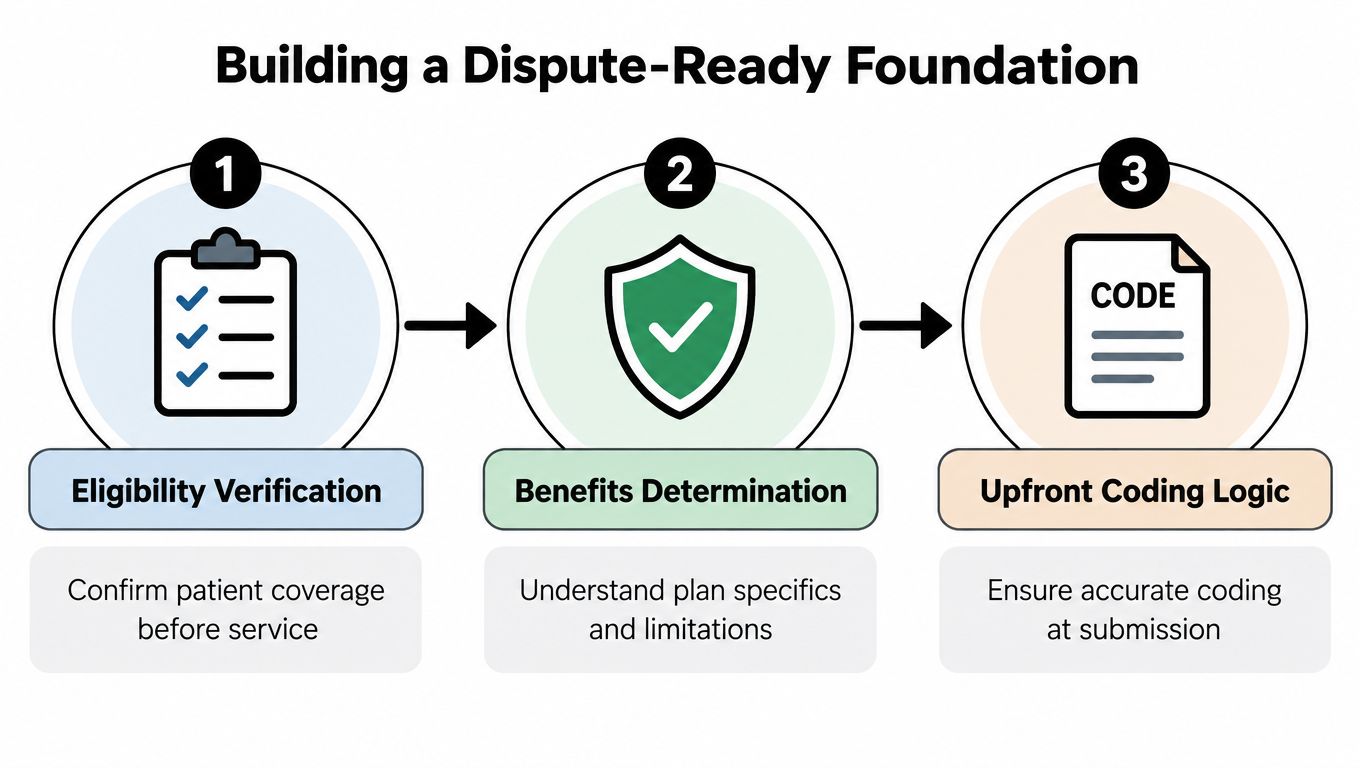
A dispute-ready claim begins before the patient encounter is coded. Eligibility verification establishes whether the member has active coverage for the service date. Benefits determination adds the details that eligibility alone can't provide, including applicable limitations, authorization requirements, network status, and patient responsibility rules. Upfront coding logic then connects the documented service to the codes and claim elements the payer expects to receive.
Build controls around the actual failure points
Technical implementations commonly use pre-edits and front-end edits to validate required fields, code pairs, date logic, and NPI validity before a claim reaches payer adjudication. The purpose isn't to make the claim look tidy. It's to catch structural, syntactical, and semantic defects while the organization can still correct them without entering a payer appeal queue, as described in this analysis of healthcare claim life cycle implementation.
A practical control set should answer specific questions:
- Eligibility: Was coverage verified for the correct patient and date of service?
- Benefits: Does the service require authorization, referral, or a particular billing pathway?
- Identity: Do the billing, rendering, and facility identifiers match the enrolled provider record?
- Dates: Are admission, discharge, service, and claim dates logically consistent?
- Coding: Do diagnosis, procedure, modifier, place-of-service, and units tell one coherent story?
- Documentation: Can the organization retrieve the note, order, report, or other record that supports the billed service?
The best edit is the one that prevents a known failure without blocking a valid claim. Overly broad edits create their own cost because staff spend time clearing false positives, and legitimate claims can be delayed by unnecessary manual review. Every edit should therefore have an owner, a reason, and a review process when payer policy changes.
Preserve evidence while the facts are fresh
A dispute-ready workflow also stores the inputs behind the claim. Keep the eligibility response, authorization information, clinical documentation, coding rationale, payer correspondence, remittance details, and payment calculation together or make them retrievable through a common account record. That evidence lets an appeal writer explain not only what was billed, but why the service met the applicable requirements.
Many organizations separate coding from enforcement too sharply. A coder may identify an accurate code, while an appeals specialist later struggles to prove the code's relationship to the documentation. The stronger model carries the reasoning forward, so the same clinical and coding facts support both first-pass submission and post-adjudication review.
Navigating Submission and Adjudication Hurdles
Once internal edits are complete, the clearinghouse and payer validate the transmission, required fields, identifiers, and file structure. A clearinghouse rejection differs from a denial after adjudication. The claim may never reach the payer's benefit and payment logic, so the response usually involves correcting a technical or administrative defect rather than arguing medical necessity.
After acceptance, the payer applies coverage rules, pricing logic, coding policy, and documentation requirements. Review may be automated, manual, or split across several checks. The important operational question is not whether the claim was denied, but where the claim failed and what evidence the payer used to make the decision. Teams that understand the payer's decision path can preserve a record that supports both an appeal and, when appropriate, later Independent Dispute Resolution.
Separate the denial families
Industry guidance commonly separates denials into administrative, clinical, and technical categories. This claims denial guidance connects technical denials with formatting, incomplete fields, modifier use, and automated system edits.
Use each category to direct the response:
- Administrative denials: Investigate eligibility, authorization, referral status, subscriber data, timely filing, and coordination of benefits. Correcting a demographic field will not resolve a medical necessity denial.
- Clinical denials: Compare the payer's policy rationale with the clinical record, order, operative report, progress notes, and documented medical necessity. Address the specific coverage logic applied.
- Technical denials: Check format, required segments, code validity, modifiers, NPI data, duplicate indicators, and date relationships. Correct the source defect, then determine whether resubmission or appeal is appropriate.
A denial code starts the investigation. It does not identify the root cause.
Record the denial at the claim-line level when possible, link it to the payer's exact message, and assign an action with a deadline. Broad labels such as “payer issue” hide recurring failures. Detailed categories show whether the organization needs better registration questions, a coding edit, stronger documentation, payer education, or an escalation strategy. Teams seeking a fuller explanation of payer-side review can consult this claim adjudication process guide.
The Power of Strategic Appeals
A denial closes the payer's first review, but it doesn't necessarily settle the financial question. In a 2024 hospital and plan analysis reported by STAT News, nearly 15% of submitted claims were initially denied, and 51.7% of denied claims were eventually overturned and paid. Private payers overturned denials at 54.3%, while Medicare and Medicaid overturned them at 47.9%.
Those figures don't mean every denial deserves an appeal. They show why automatic write-offs are poor revenue policy. A denial review should distinguish between a claim that needs a simple correction, a claim that needs a structured appeal, and a claim where the available evidence can't support further pursuit.
Match the response to the defect
A strong appeal process starts with triage. Confirm the denial reason, filing deadline, payer instructions, claim history, and amount at risk. Then compare the payer's stated rationale with the original claim and supporting documentation. If the claim contains a genuine coding or demographic error, correcting the source may be more effective than sending a narrative appeal that leaves the defect intact.
For defensible denials, the appeal should make the reviewer's job easy:
- State the decision being challenged.
- Identify the payer rule or rationale cited in the remittance.
- Point to the exact clinical, coding, eligibility, or authorization evidence.
- Explain why that evidence satisfies the applicable requirement.
- Request a specific correction, such as reprocessing and payment.
- Include the claim history and relevant correspondence.
The appeal team should also track outcomes by payer, denial reason, specialty, code family, and documentation type. That feedback belongs upstream. If the same technical error repeatedly appears after a new payer edit, the fix is not another appeal packet. It's a revised pre-submission control.
Persistence needs discipline
Consumers appealed only about 1% of denied in-network claims in 2023, while insurers upheld 56% of those appeals, according to KFF's Marketplace analysis. That consumer behavior isn't a direct measure of provider performance, but it illustrates the broader problem: a denial can become final because the affected party doesn't pursue the available review path.
The right lesson isn't to appeal everything. It's to make appeals selective, evidence-based, deadline-controlled, and connected to payment reconciliation. A successful appeal isn't complete until the payer posts the corrected payment and the team verifies that the remittance matches the expected amount.
Mastering Independent Dispute Resolution
The No Surprises Act created a standardized federal pathway for certain out-of-network payment disputes through Independent Dispute Resolution, or IDR. The law took effect on January 1, 2022, and places IDR after the initial claim submission, adjudication, and payment stages. That sequence makes the post-adjudication record critical. A provider can't replace a weak claim history with a persuasive closing argument at the end.
IDR readiness starts with eligibility screening. The organization must determine whether the dispute falls within the applicable federal process, whether required notices and payment information are present, and whether the matter belongs in another state or contractual pathway. Filing an ineligible case wastes time and can obscure the cases that have a sound recovery basis.
Build the record before the dispute
The case file should allow an independent reviewer to follow the financial and clinical logic without reconstructing the account from disconnected systems. That generally means organizing:
- The original claim and corrected claim history.
- Eligibility, network, authorization, and notice records.
- The initial payment or denial and the payment calculation.
- Clinical documentation supporting the service.
- Coding and billing detail.
- Payer communications and negotiation history.
- Evidence relevant to the applicable IDR criteria.
This is not a request to overwhelm the reviewer with every document available. It's a requirement to present relevant evidence in a clear sequence. An arbitration packet should answer what happened, what was paid, why the payment is disputed, why the service and circumstances support the requested amount, and why the case is eligible for the process.
Volume changes the operating model
Federal data show that about 1.4 million disputes were filed in the second half of 2025, up 16% from the first half. Providers prevailed in about 85% of determinations, and about 62% of decisions were reached within 30 business days in late 2025, according to Healthcare Dive's report on No Surprises Act disputes.
Those figures make IDR more than a rare legal escalation. They also don't justify assuming that every dispute will resolve quickly or favorably. A separate Niskanen Center analysis of No Surprises Act arbitration reported more than 2.5 million disputes initiated in 2025, with total payouts approaching $15 billion, while Georgetown analysis cited in the report placed cumulative IDR volume at about 4.8 million cases by the end of 2025.
The operating lesson is structural. As dispute volume grows, teams need eligibility controls, evidence templates, deadline management, payer-behavior intelligence, and payment enforcement after a decision. Faster processing doesn't remove problems such as late IDR payments, QPA non-compliance, or missing initial payment and denial notices. A dispute-ready claim life cycle manages those compliance details from the start.
Organizations evaluating an integrated No Surprises Act IDR workflow should ask how it connects to coding, documentation, remittance data, negotiations, filing, and post-decision enforcement. IDR can't operate as an isolated legal inbox.
Engineering Long-Term Revenue Integrity
A reactive revenue cycle waits for the remittance, assigns a denial, and writes off whatever doesn't move through the queue. A proactive model connects the claim's origin to its final payment outcome. The first model is easier to describe, but it leaves preventable defects upstream and underpayments downstream. The second requires more coordination, yet it gives leaders a clearer view of where reimbursement value is being lost.
The comparison is practical:
| Reactive approach | Revenue integrity approach |
|---|---|
| Corrects claims after payer rejection | Prevents known defects with targeted edits |
| Measures denial volume alone | Connects denials to root cause, payer, code, and workflow |
| Treats appeals as a separate queue | Preserves evidence for appeals during claim creation |
| Writes off unresolved underpayments | Screens eligible disputes and enforces valid recovery |
| Closes accounts after posting | Reconciles expected payment against actual payment |
Make feedback operational
The strongest programs hold a regular review of denial patterns, appeal outcomes, payer responses, coding changes, and IDR decisions. Each finding should produce an owner and a workflow change. That might mean a registration prompt, a payer-specific edit, a documentation query, a revised appeal template, or a rule for escalating underpayments.
RevGuard is one example of a healthcare revenue protection firm that combines specialty-specific Revenue Cycle Management with enforcement-driven IDR, covering workflows from eligibility and coding through denials, appeals, payment reconciliation, and dispute support. The broader principle applies whether an organization builds internally or uses an outside partner: RCM and IDR should share data, evidence, and accountability.
The claim life cycle becomes predictable when teams stop measuring only what was submitted and start measuring what was ultimately collectible. That requires clean inputs, disciplined adjudication follow-up, selective appeals, eligibility screening, complete dispute files, and confirmed payment after resolution. A payer decision can end one stage, but revenue integrity ends only when the organization has received and reconciled the money it can legitimately recover.
If payer denials, underpayments, or delayed disputes are creating leakage, visit RevGuard to assess a connected RCM and IDR workflow. Bring your denial patterns, payment data, and specialty requirements, and use that review to identify which upstream controls and downstream enforcement steps deserve attention first.