

The most common advice about a revenue cycle management healthcare flowchart is also the least useful: draw a straight line from scheduling to payment, then assign each department a box. That model describes administrative sequence, but it doesn't describe how specialty practices collect revenue.
A claim can leave the billing office clean, return with a denial, receive a partial payment, or require an out-of-network dispute. Each outcome should change what happens upstream. A workable flowchart therefore needs more than registration, coding, submission, and collections. It needs feedback loops, financial triage, payer-specific controls, and an escalation path for recoverable underpayments.
Why Linear Revenue Cycle Maps Fail Modern Practices
A linear map assumes that each stage finishes before the next one begins. Registration hands off to coding, coding hands off to billing, billing hands off to payment posting, and the process ends when the payer responds. That sequence is easy to explain and difficult to operate because payer behavior rarely follows it.
Denials have become a structural operating issue. KFF reported that HealthCare.gov insurers denied 86 million in-network claims in 2023, producing an average in-network denial rate of 20%, while the out-of-network rate reached 36%. In 2024, insurers reported an average in-network denial rate of 19% and a combined average denial rate of 20%. The same reporting found substantial variation among insurers and states, with in-network denial rates ranging from 1% to 54% in 2023 and 3% to 36% in 2024. Those figures are detailed in KFF's analysis of claims denials and appeals.
A simple flowchart treats that variation as an exception. A stronger one treats it as a design requirement. The payer, specialty, service setting, authorization status, documentation quality, and expected allowed amount should influence the route a claim takes after adjudication.
The cost of treating denials as an endpoint
Recent hospital denial data reinforce the problem. In 2025, initial denial rates rose to 11.6% from 11.4% in 2024, while final denial rates increased to 2.7% from 2.5%. Hospitals lost more than $48 billion to claims denials and uncollected bills, according to RevCycleManagement's report on hospital denial losses.
A linear workflow typically sends every denial to the same queue. That approach mixes registration errors with medical-necessity disputes, authorization failures, coding edits, and payer underpayments. Staff then work claims in arrival order instead of prioritizing by recoverable value, appeal deadline, clinical complexity, or repeatability of the root cause.
Practical rule: A denial isn't merely a claim to fix. It's evidence that a control point upstream either failed or wasn't strong enough.
What a closed-loop map changes
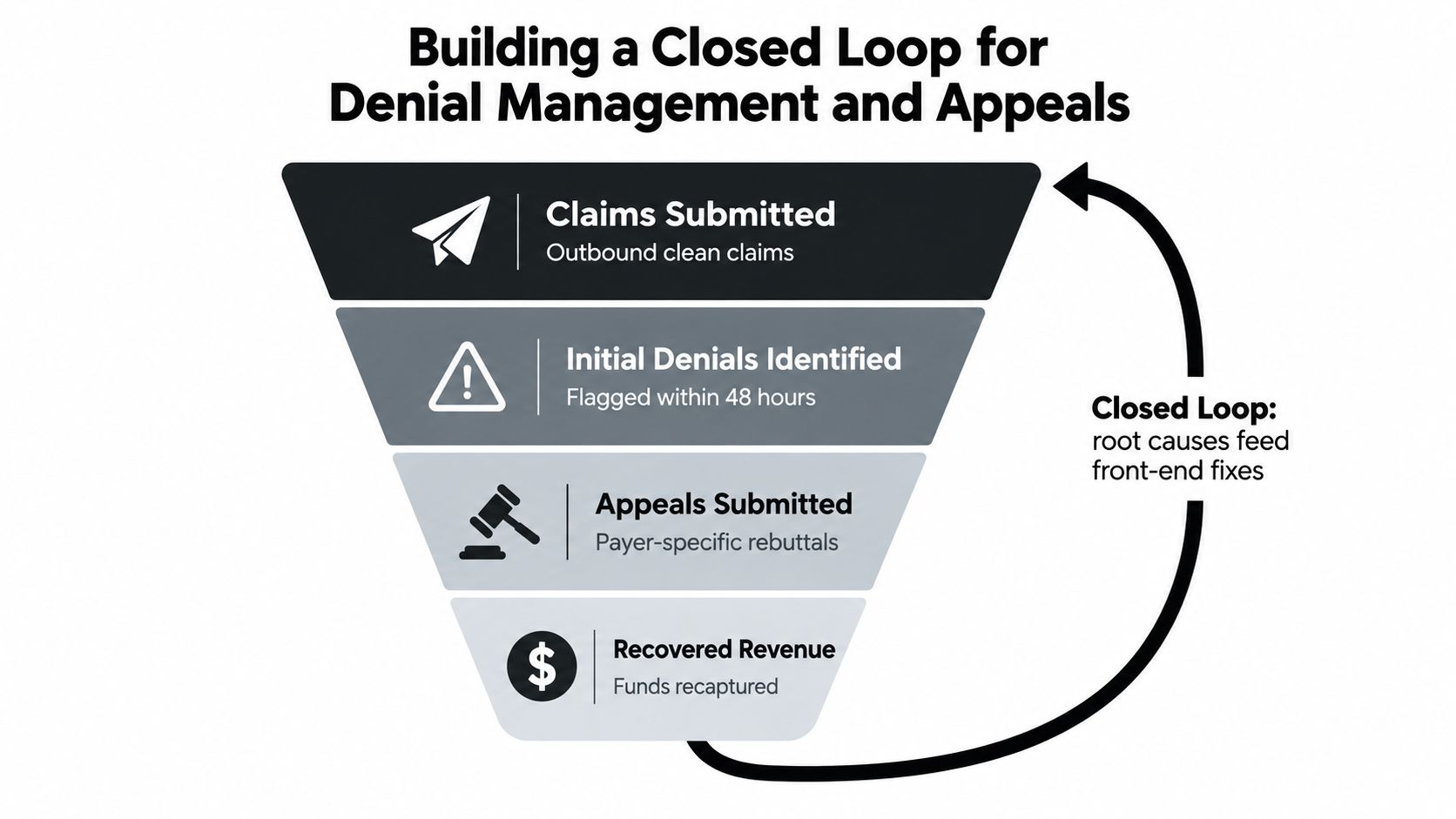
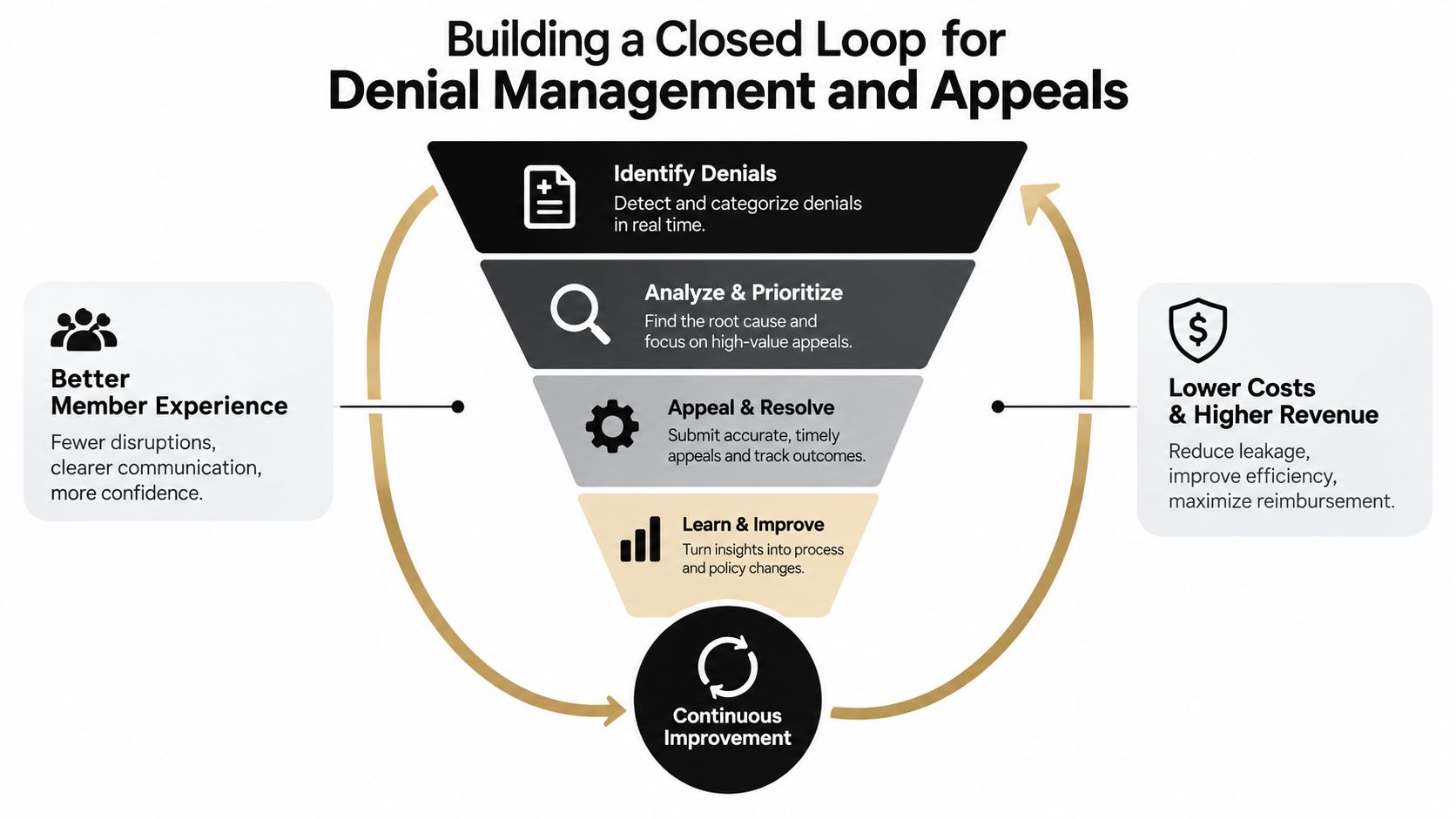
A closed-loop model adds a return path from payment posting and denial management to the front end. If a payer repeatedly rejects a procedure because authorization data is missing, the scheduling workflow needs a new hard stop. If a payer downcodes a specialty service, the coding and documentation review needs to change. If a payer underpays an eligible out-of-network claim, the claim should enter a recovery pathway rather than disappear into ordinary follow-up.
The flowchart should answer three operational questions:
- What happened? Identify the exact adjudication result, reason code, payment variance, or patient responsibility.
- What should happen next? Route the account to correction, appeal, contractual underpayment review, patient billing, or dispute resolution.
- What must change upstream? Assign the root cause to registration, eligibility, authorization, documentation, coding, charge capture, or payer strategy.
That structure turns the flowchart from a static diagram into a management system. It protects cash by making every downstream failure useful to the next claim.
Engineering the Front End for Clean Claim Submission
Revenue protection starts before the encounter. The front end determines whether the claim contains the right patient, payer, provider, authorization, and service data when it reaches the clearinghouse. A missing field at registration can become an eligibility rejection, an authorization denial, a coding dispute, or a patient balance that staff must chase later.
The workflow should begin with scheduling and pre-registration, followed by eligibility and benefits verification. Prior authorization belongs in the same control sequence, not in a separate department that discovers missing approval after the procedure. Published RCM guidance describes the standard progression from scheduling and registration through insurance verification, authorization, documentation, coding, claim submission, payment posting, denial management, and patient collections. The revenue cycle management workflow guidance from Umbrex also identifies clean-claim performance of 95% or higher as a benchmark, with 98% often described as a strong target and denial rates around 5% to 10% as typical.
Put hard stops where errors begin
A hard stop should prevent the next stage from proceeding when a required condition isn't satisfied. It shouldn't be a vague reminder in a work queue.
Use the following controls:
- Registration validation: Confirm legal name, date of birth, member identification, group details, address, and guarantor information before the appointment is finalized. Small demographic discrepancies can prevent payer matching.
- Eligibility confirmation: Verify active coverage, benefit limitations, network status, referral requirements, and patient responsibility for the planned service. Save the verification result in a location the billing team can retrieve.
- Authorization control: Require an authorization number, approved service, effective dates, units, provider, and facility details when the payer requires prior approval. A number alone isn't enough if it doesn't match the actual service.
- Documentation readiness: Confirm that the clinical record supports the service, diagnosis, medical necessity, and modifiers expected during coding. Don't wait for a denial to discover that the note is incomplete.
- Charge capture review: Reconcile the scheduled service, performed service, provider, units, and supplies before coding. Unbilled or mismatched charges should be identified here.
- Claim scrubbing: Run payer and clearinghouse edits before submission. Claims that pass without manual intervention should be monitored as clean claims, not assumed to be perfect.
The order matters because each control uses information created by the preceding step. Coding can't correct an incorrect member ID, and a clean claim edit can't establish authorization that was never obtained.
Design the queue around prevention
Front-end teams need visibility into what happens after submission. If registration staff only see appointment volume, they won't know that one payer is rejecting claims because of subscriber mismatches. If coders only see edits, they won't know that a particular authorization template consistently fails adjudication.
A useful dashboard connects front-end actions to downstream outcomes. Track clean-claim rate, rejection reason, denial reason, payer, location, rendering provider, procedure family, and authorization status. Then assign recurring patterns to an owner who can change the process, retrain staff, or update system rules.
For a practical explanation of the first-pass claim concept, link the workflow to clean claim fundamentals. The important point is operational: clean claims aren't created by billing alone. They result from coordinated scheduling, verification, authorization, clinical documentation, charge capture, and coding.
Navigating Payer Adjudication and Payment Posting
Submission isn't the finish line. It begins the adjudication stage, where the payer applies eligibility rules, contract terms, medical policies, edits, bundling logic, and patient responsibility calculations. The revenue cycle management healthcare flowchart should show what the practice expects to receive and how the team will compare that expectation with the remittance.
The first handoff is from claim acceptance to adjudication monitoring. A clearinghouse acceptance confirms that the transaction entered the payer channel, not that the payer agrees with the claim. Staff should distinguish clearinghouse rejection, payer denial, pending status, partial payment, zero payment, and contractual adjustment.
Make remittance data actionable
Electronic remittance advice contains more than a payment amount. It can reveal adjustment codes, denial codes, reason codes, patient responsibility, remark codes, and payer decisions that require follow-up. Payment posting should apply the remittance to the correct account, reconcile the deposit, and create an exception when the result differs from the expected reimbursement.
Common exceptions include:
- Unexpected zero payment: Route to denial or adjudication review rather than posting the balance automatically to the patient.
- Partial payment: Compare the payer result with the contracted or expected amount before accepting the adjustment.
- Silent downcode: Flag a service that was paid at a lower level than the submitted service, especially in high-acuity specialties.
- Incorrect patient responsibility: Prevent unsupported balances from moving directly into patient collections.
- Unmatched remittance: Resolve unapplied cash promptly so the practice's account balances remain accurate.
The payment posting team should have access to fee schedules, contract terms, payer rules, and the original clinical and authorization records. Without those references, staff can post accurately from an accounting perspective while still accepting an incorrect reimbursement decision.
Separate posting from acceptance
A posted payment is an accounting event. It isn't proof that the payer paid correctly. The flowchart should branch after posting into at least three paths: paid as expected, denied or rejected, and paid below expectation.
That third path is where many practices lose revenue. A claim can avoid a formal denial yet still produce a contractual underpayment. If the workflow only counts denials, it misses money that requires recovery. Remittance processing guidance can help teams think about this stage as reconciliation and exception management rather than data entry.
Use a dollar-weighted review, particularly for anesthesia, orthopedics, radiology, air ambulance, and other services with high claim values. Claim counts can make a low-value payer issue look urgent while hiding a smaller number of high-value underpayments. The correct workflow prioritizes financial exposure, filing deadlines, clinical documentation, and the likelihood of recovery.
Building a Closed Loop for Denial Management and Appeals
A denial queue is not a denial-management strategy. A queue tells staff where to find work. It doesn't tell them which claims deserve immediate attention, whether an appeal is viable, or how the same denial will be prevented next week.
The American Hospital Association cited research showing that hospitals and health systems spent an estimated $19.7 billion in 2022 trying to overturn denied claims, while nearly 15% of claims submitted to private payers were initially denied. The same AHA analysis of payer denial tactics reported that 54.3% of denied claims were ultimately overturned after multiple appeals. Those findings support a disciplined appeal function, but they also show why practices need to reduce avoidable denials before they reach that stage.
Build branches, not one appeal bucket
The first denial action should be reason-code triage. Assign the denial to a category with a defined next step:
- Registration or eligibility: Correct demographic or coverage data, verify the payer response, and resubmit when appropriate.
- Authorization or referral: Check whether approval existed, whether the approved details match the service, and whether the issue requires a payer reconsideration.
- Coding or billing edit: Review the code combination, modifier, units, documentation, and payer-specific edit before correction.
- Medical necessity: Assemble the clinical record, order, diagnosis support, and payer policy relevant to the service.
- Timely filing or administrative issue: Confirm submission history, proof of transmission, payer receipt, and any applicable exception.
- Underpayment: Compare the remittance with the expected reimbursement and route the account to contractual recovery or dispute analysis.
The route should also include an appeal deadline, owner, evidence checklist, and escalation rule. A claim that sits untouched while staff work easier accounts may become unrecoverable even when the original denial was wrong.
Measure the denial by financial impact
Count-based denial rates are useful for operational monitoring, but they don't show the full exposure. HFMA-oriented denial guidance emphasizes measuring initial denials by claim dollars, not only by claim count. A single high-value denial can matter more than numerous low-value accounts, particularly in specialties such as anesthesia, orthopedics, radiology, and air ambulance.
Track the following at the same time:
- Dollar-weighted initial denial: Shows the financial value entering the denial process.
- Reason-code concentration: Identifies repeatable upstream failure points.
- Appeal submission and overturn status: Shows whether staff are pursuing viable recovery.
- Time to resolution: Exposes aging work and deadline risk.
- Payer and specialty patterns: Reveals whether the issue is local, systemic, or contract-specific.
Return findings to the front end
Every recurring denial needs a named destination upstream. An eligibility denial should modify verification rules. An authorization denial should change scheduling requirements. A documentation denial should reach providers and coding leadership. A payer-specific edit should become a scrubber rule when the pattern is stable.
The appeal is the recovery action. The root-cause correction is the revenue-cycle improvement.
A closed-loop meeting doesn't need to become a large committee. A focused review of the highest-dollar and most repetitive denial categories is enough to assign corrective action. The important feature is accountability. Someone must own the change, test whether it reduced repeat denials, and update the flowchart when the payer or service changes.
Integrating Independent Dispute Resolution into the Workflow
For certain out-of-network services protected by the No Surprises Act, standard billing and appeals aren't the only downstream options. A modern flowchart needs a decision point that asks whether the claim belongs in an Independent Dispute Resolution pathway.
CMS reported more than 5.86 million total closed disputes through May 31, 2026, and 240,579 disputes closed in September 2025 alone under the federal IDR process. The figures are published in CMS resources on Independent Dispute Resolution reports. The scale makes IDR a material operational function, not a specialist task to consider only after ordinary follow-up has failed.
Decide early whether a claim is IDR-ready
The decision shouldn't begin months after payment posting. At intake and claim creation, preserve the information that may later support a dispute:
- Network and service context: Record the provider's network status, facility relationship, service type, and applicable No Surprises Act pathway.
- Clinical necessity: Retain the record supporting why the service was performed, including relevant orders, notes, and encounter details.
- Claim and remittance history: Preserve the submitted claim, payer response, payment, adjustment codes, and correspondence.
- Contract and payment comparison: Document the expected reimbursement, actual payment, and reason the variance may be recoverable.
- Filing and negotiation dates: Track required notices, open negotiation activity, response deadlines, and escalation eligibility.
This evidence shouldn't be assembled from scattered systems after a deadline appears. The upstream workflow should create a dispute-ready file as part of ordinary documentation and payment reconciliation.
Use payer behavior to prioritize escalation
Not every underpayment has the same recovery value or operational cost. A specialty practice should analyze payer behavior by service line, facility, plan, geography, and adjudication outcome. Repeated low payments, recurring downcodes, delayed responses, and denials that survive ordinary appeals can indicate that the claim needs a different strategy.
The flowchart can route accounts according to practical criteria:
- Confirm that the service and dispute type fit the applicable process.
- Complete required billing and negotiation steps.
- Compare expected and actual payment.
- Assemble the evidence record while the encounter details remain accessible.
- Escalate eligible claims through the appropriate IDR process.
- Record the outcome and feed payer-specific lessons back into contracting, documentation, and claim preparation.
This approach connects operations with enforcement. It also prevents the common mistake of treating post-adjudication recovery as unrelated legal work. For a concise explanation of the process, see No Surprises Act Independent Dispute Resolution.
Protect the evidence before the dispute
A dispute pathway is only as strong as its record. If the practice can't show the service performed, the clinical circumstances, the provider's role, the claim submitted, and the payer's payment decision, escalation becomes harder to manage. Specialty providers should therefore make document preservation a front-end requirement, not a back-office scramble.
The best IDR workflow doesn't replace clean claims. It uses clean, well-documented claims as the foundation for negotiation and dispute recovery, then returns outcomes to the broader revenue cycle.
Comparing Linear Billing to Enforcement-Driven RCM
Traditional billing is optimized for movement. The account passes from one department to another, and staff close the work item when the payer responds or the patient receives a statement. That model can function for straightforward claims, but it leaves little room for underpayment analysis, payer-specific escalation, or structured dispute resolution.
Enforcement-driven RCM adds a financial decision layer after adjudication. The team asks whether the claim was paid correctly, whether the payer's decision can be challenged, and whether the account contains evidence for an appeal, contractual recovery, or IDR. The operational trade-off is clear: this model requires stronger data, tighter ownership, and more deliberate review. In return, it prevents the practice from treating an initial payer decision as the final value of the service.
| Workflow Feature | Traditional Linear Billing | Enforcement-Driven RCM |
|---|---|---|
| Front-end controls | Collect registration and insurance data, then move the account forward | Use eligibility, authorization, documentation, and coding hard stops before service and submission |
| Claim submission | Submit claims and monitor basic acceptance | Submit scrubbed claims with payer-specific edits and dispute-ready documentation |
| Payment posting | Post the remittance and apply contractual adjustments | Reconcile payment against expected reimbursement and flag underpayments |
| Denial handling | Place denials in a general appeal queue | Triage by reason, dollars, deadline, clinical evidence, and recovery path |
| Payer behavior | Treat each account as an individual transaction | Analyze recurring payer, specialty, location, and service-line patterns |
| Out-of-network recovery | Continue ordinary follow-up or write off the balance | Route eligible claims into negotiation and IDR workflows |
| Feedback loop | Report production and collections totals | Feed denial and underpayment findings into registration, authorization, coding, and contracting |
| Management objective | Close accounts efficiently | Protect the full reimbursement value of each service |
The distinction matters most for high-acuity specialties. Anesthesia, orthopedics, radiology, and air ambulance claims can carry substantial financial exposure, complex documentation, and payer-specific adjudication behavior. A practice that accepts the first remittance without comparison may have an efficient posting department and a weak recovery program.
Operational test: If your flowchart ends at “payment posted,” it describes accounting. If it continues through variance review, denial recovery, and feedback, it describes revenue protection.
Auditing Your Flowchart for Revenue Leakage
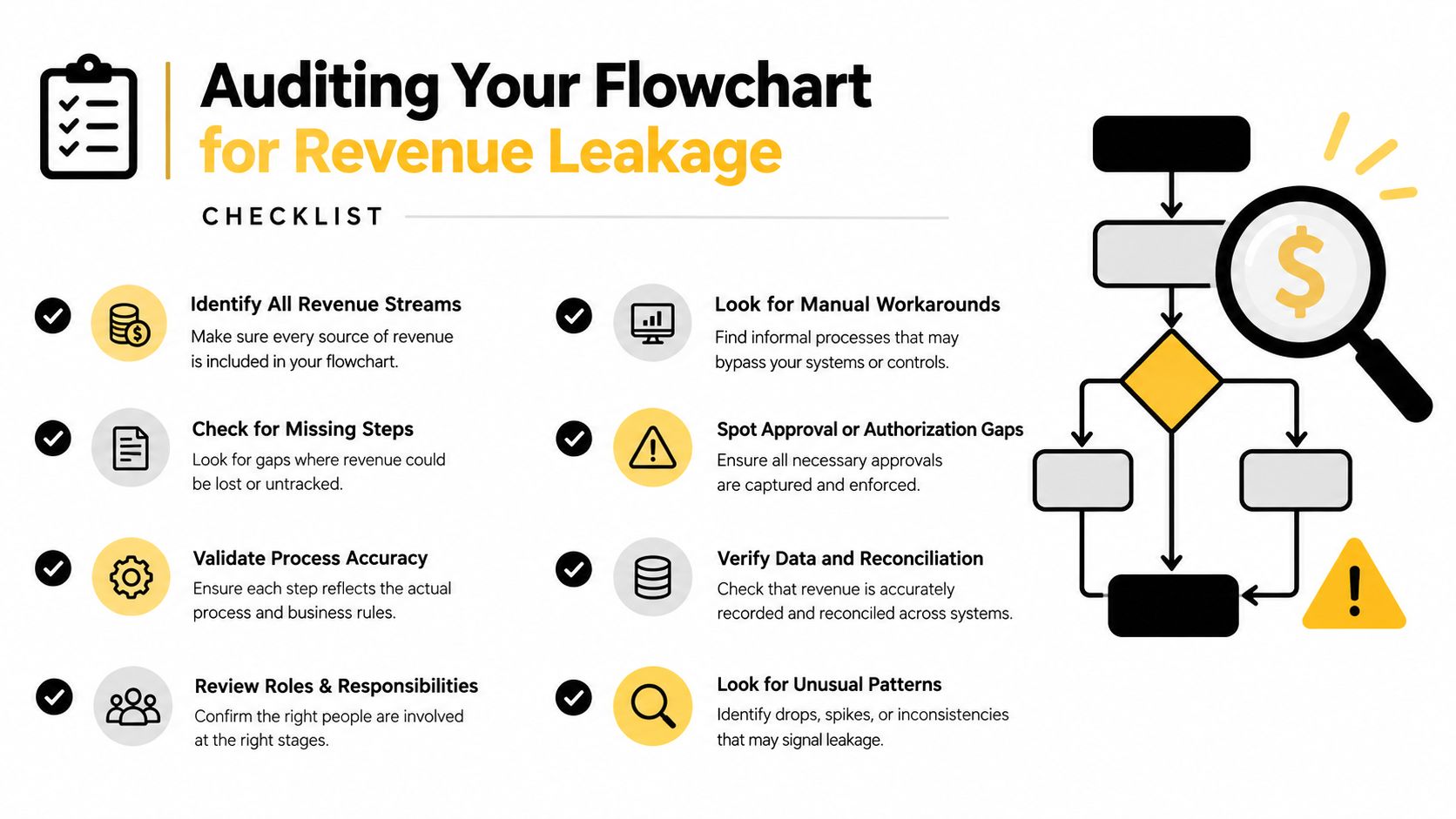
A flowchart should be tested against actual accounts, not admired as a process document. Select claims from scheduling, clean submission, denial, payment, patient billing, and underpayment categories. Trace each one from the first data entry through the final disposition, then record where information was missing, duplicated, delayed, or assigned without an owner.
Start with the front end. Confirm that staff can show eligibility evidence, authorization details, provider information, clinical documentation, and charge capture for the services reviewed. Check whether the system blocks incomplete accounts or merely warns users while allowing them to proceed.
Audit each handoff
Use the following questions during a workflow review:
- Scheduling to registration: Can the team identify the correct patient, guarantor, payer, and service before the appointment?
- Registration to eligibility: Does verification capture active coverage, network status, benefits, and restrictions in a retrievable record?
- Eligibility to authorization: Does the workflow distinguish services that need approval from services that don't?
- Encounter to coding: Does documentation support the billed service, diagnosis, units, and modifiers?
- Coding to submission: Do edits catch payer-specific problems before the claim reaches the clearinghouse?
- Remittance to posting: Does the team compare payment with expected reimbursement before closing the account?
- Denial to appeal: Is there a reason-specific route, deadline, owner, and evidence standard?
- Underpayment to recovery: Does the system identify variance without requiring a formal denial?
- Dispute outcome to prevention: Does the result update payer rules, documentation guidance, or contracting decisions?
Measure what exposes leakage
Use clean-claim performance as a front-end control, but don't stop there. Track denial rates by reason, payer, specialty, provider, location, and claim dollars. Review time to resolution and the age of unresolved accounts. A flowchart that produces reports only on total collections won't show where revenue is being lost.
For the back end, measure appeal volume, appeal outcomes, underpayment recovery, and the proportion of accounts routed to the correct escalation path. When reviewing IDR activity, separate eligible cases from cases rejected for documentation, timing, or process reasons. That distinction tells you whether the issue is payer behavior or internal readiness.
Turn the audit into a recurring control
Assign an owner to every material leakage category. Set a review cadence that fits claim volume and operational risk, then require each owner to document the corrective action, affected workflow step, and validation result. Update the flowchart when a payer rule, service line, system edit, or dispute requirement changes.
The right question isn't whether the diagram looks complete. Ask whether a staff member can follow it under pressure, whether the system prevents predictable mistakes, and whether every denial or underpayment produces a useful upstream correction. That's how a revenue cycle management healthcare flowchart becomes a working control system instead of a poster on a wall.
RevGuard combines healthcare RCM with enforcement-driven IDR, covering eligibility, claim creation, payment reconciliation, denial management, underpayment recovery, and KPI reporting. Visit RevGuard to evaluate how a closed-loop workflow can protect specialty revenue from front-end leakage through payer dispute resolution.