
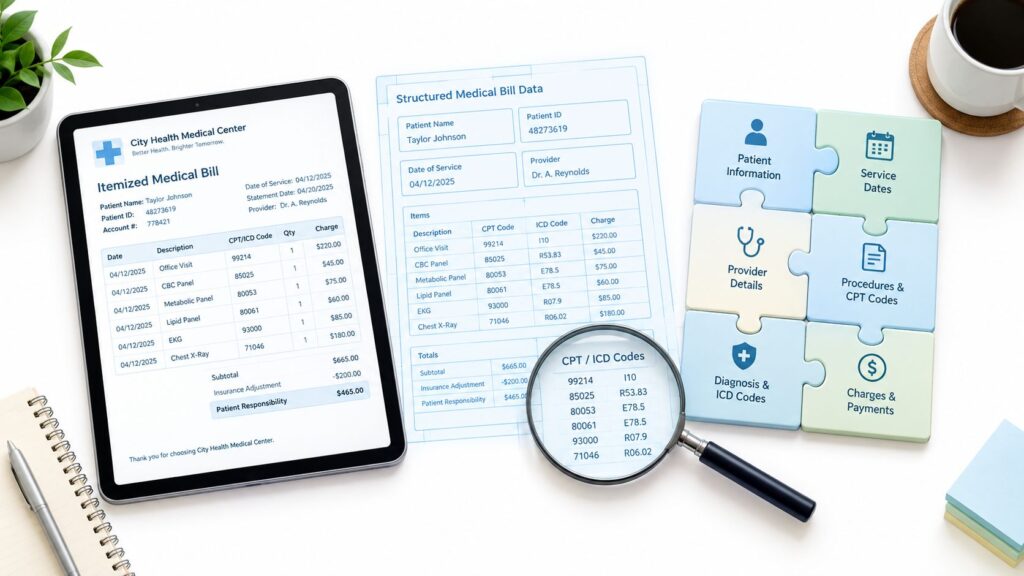
Most advice about the format of medical bills starts with the patient: define the abbreviations, explain the balance, and make the statement easier to read. That advice is useful, but incomplete. For a specialty practice, a medical bill isn't merely an invoice. It's the visible output of a much larger data chain involving registration, coding, charge entry, claims transmission, payer adjudication, remittance, appeals, and, when necessary, Independent Dispute Resolution.
A clean-looking statement can still support a weak claim. If dates, identifiers, codes, billed amounts, adjustments, and payer decisions don't align, the provider may face rework, delayed remittance, denial, or an IDR submission that can't clearly establish what was billed and why. The practical standard is higher than readability: every field should be traceable, internally consistent, and defensible.
Why Bill Format is a Compliance and Revenue Issue
A patient may see a medical bill as a request for payment. An RCM team should see it as a controlled record of services, financial responsibility, and claim history. That distinction changes how the team designs the document. A summary total might be acceptable for basic communication, but it doesn't give a billing specialist, payer, auditor, or IDR entity enough detail to test the underlying transaction.
The problem affects patients too. A CMS guide to reading medical bills cites a 2026 survey in which 32% of Americans didn't understand the charges on their last medical bill. Confusion at the patient level often signals a deeper data problem. If the statement doesn't distinguish billed charges, allowed amounts, payments, adjustments, and remaining responsibility, staff must reconstruct the account manually when a patient, payer, or attorney challenges it.
The bill is a data-quality document
The format determines whether the account can be reconciled across systems. A patient control number should connect the provider's account to the claim, remittance advice, correspondence, and follow-up activity. Dates of service should agree with the claim and clinical record. Line items should preserve the relationship between the procedure, modifier, diagnosis support, units, charge, and payer response.
A poorly structured bill creates several failure points:
- Claim ambiguity: The payer can't reliably match the service, provider, location, or billing period.
- Manual rework: Staff spend time comparing disconnected statements, claim records, and remittance details.
- Weak appeals: The provider can assert that payment was inadequate, but can't present a clean line-by-line record.
- IDR exposure: The evidence package lacks a clear bridge between the service rendered, the billed amount, and the payment dispute.
Operational rule: If a reviewer has to infer how the statement connects to the claim, the format isn't dispute-ready.
Readability and rigor must coexist
Patient-friendly design and operational precision aren't competing goals. The same statement can use plain descriptions while retaining claim identifiers, service dates, codes, payer adjudication details, and account traceability. The trade-off appears when a team replaces detail with a single balance. That may reduce visual complexity, but it also hides the information needed to find duplicate entries, reconcile an explanation of benefits, or defend an underpayment.
The right question isn't, “Does the patient understand the total?” It's, “Can every stakeholder follow the transaction from service to final balance without guessing?”
Standardized Claim Forms and Field-Level Accuracy
U.S. medical billing rests on two standardized paper claim formats. The CMS-1500 is used by non-institutional providers and suppliers for professional billing, while the UB-04, also called CMS-1450, is used by hospitals and other institutional providers. CMS identifies the electronic equivalents as 837P for professional claims and 837I for institutional claims in its guidance on the CMS-1500 claim form.
These forms aren't interchangeable templates. They represent different billing contexts, data structures, and adjudication expectations. A physician group submitting professional services needs a line-level structure built around provider, patient, diagnosis, procedure, modifier, units, and charge information. A facility claim must also communicate institutional details such as the type of bill, statement period, revenue information, and patient control number.
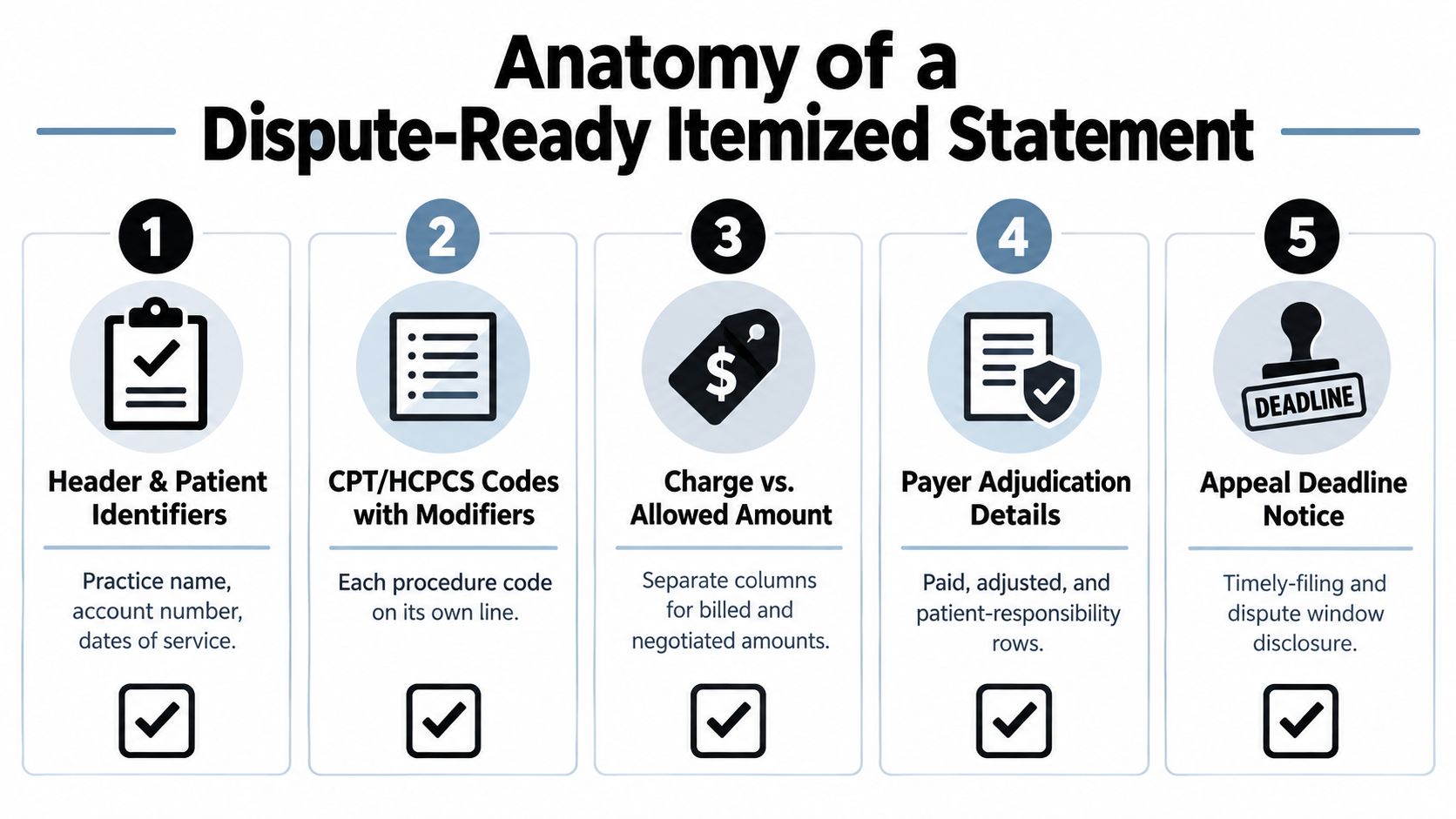
Why UB-04 fields affect payment
The UB-04's fixed locators are designed to remove ambiguity. Provider information, patient identifiers, the patient control number, type of bill, and statement-covered period each occupy defined fields. CMS describes the UB-04 as a uniform institutional provider bill suitable for multiple third-party payers in its claims processing manual.
The form's technical rules have direct operational consequences. The type-of-bill field requires a three-digit code plus a frequency digit, and the statement-covered period must use beginning and ending service dates in MMDDYY format, as described in UB-04 claim instructions from ForwardHealth. A missing frequency indicator or inconsistent date range can cause the claim to enter rework rather than adjudication.
The patient control number deserves the same attention. It should remain stable across the statement, claim record, remittance, appeal file, and account notes. Without that identifier, staff may be able to locate the account, but they lose a reliable key for proving that separate documents describe the same transaction.
Professional claims require the same discipline
The CMS-1500 is shorter than a facility claim, but “shorter” doesn't mean simple. A professional billing workflow still needs to validate the rendering provider, billing entity, place of service, dates, diagnosis pointers, procedure codes, modifiers, units, and charges. A patient-facing statement should preserve enough of that structure to let the account team reconcile it with the submitted claim.
For practices that still treat claim formatting as a back-office concern, the CMS-1500 form guide is a useful reference point. The practical lesson is straightforward: standardization only works when the source data is complete before the form or transaction is created.
Anatomy of a Dispute-Ready Itemized Statement
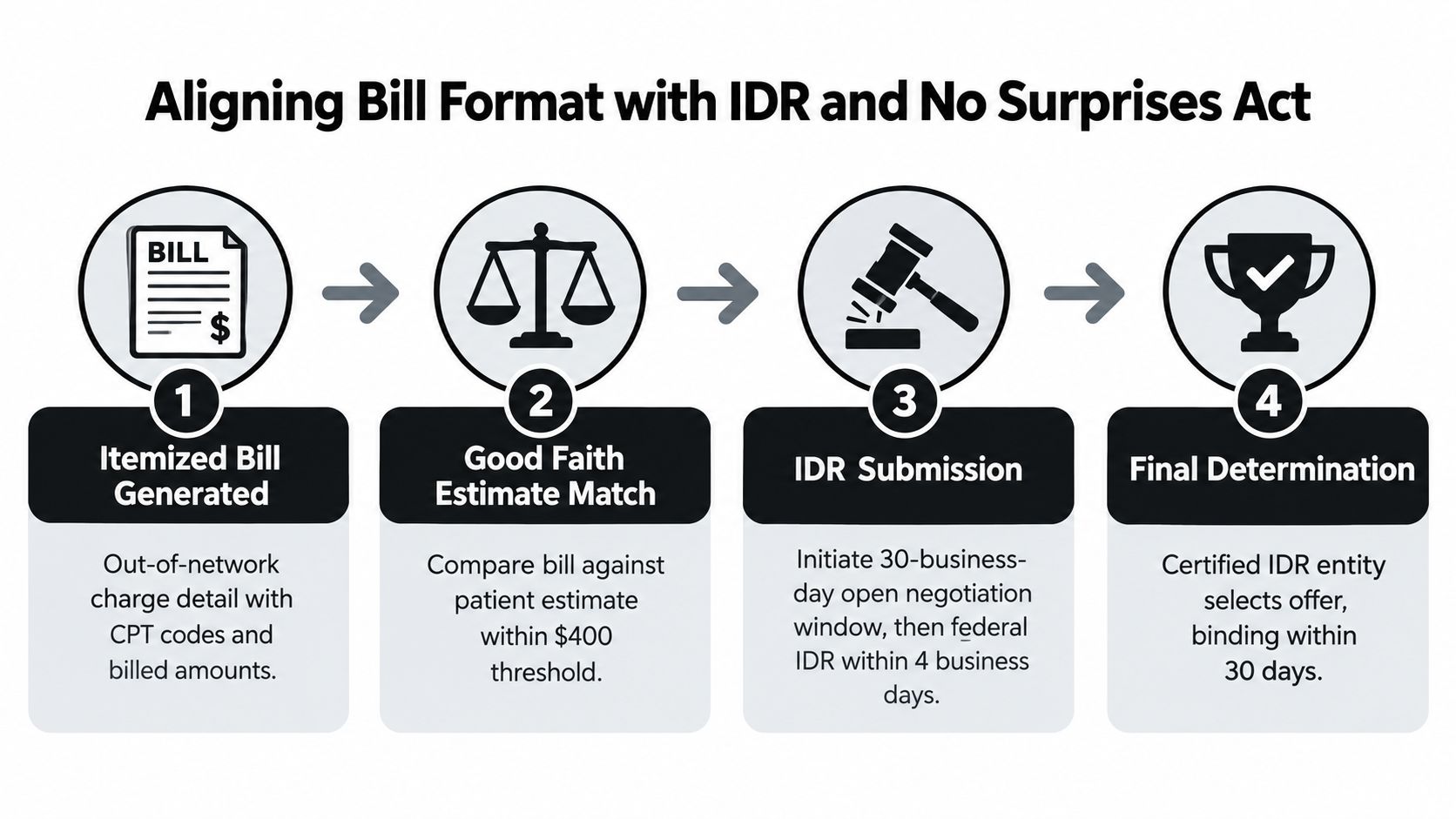
A dispute-ready statement starts with identity, not the balance. The header should identify the provider or facility, patient, account number, statement date, payer, and dates of service. If the patient received care from multiple entities or at multiple sites, the document should make the responsible billing entity and service location unmistakable.
A lump-sum line such as “specialty services” doesn't give a reviewer enough information to validate the charge. An itemized structure should show each service separately, with a description that a patient can understand and a code that a payer or billing specialist can reconcile.
Use these components as the minimum design standard:
- Header and patient identifiers: Include the provider name and address, patient identity, account number, statement date, and relevant service dates.
- Line-level service detail: Put each procedure, supply, or facility charge on its own line. Include the applicable CPT or HCPCS code, modifier, service date, units, and description.
- Financial separation: Show billed charges separately from allowed amounts, payments, adjustments, and patient responsibility. Never force the reader to derive these values from one net balance.
- Adjudication history: Identify payer payments, contractual adjustments, denial or remark information, and the remaining balance. The statement should agree with the remittance advice.
- Dispute information: Display the contact route for questions and any relevant appeal, timely-filing, or dispute-window instructions maintained by the billing operation.
Make reconciliation possible
The statement should be designed for comparison, not just reading. A patient or staff member should be able to place it beside the explanation of benefits and answer practical questions: Does every service date match? Does each claim line appear? Was the payer payment posted to the right account? Is the patient balance the result of an adjustment, a denial, or an unprocessed claim?
The format also needs a versioning rule. If a claim is corrected, reprocessed, appealed, or paid after the original statement, retain the prior transaction history and identify the current balance clearly. Overwriting the old version may make the account look clean, but it weakens the audit trail.
Why summary statements fail under scrutiny
Summary bills save space, but they transfer work to the person who needs clarity. Patients request itemization manually. Billing staff pull claim images and remittance records. Counsel or an IDR specialist then has to assemble evidence from several systems. That workflow increases the chance that a line, modifier, adjustment, or date will be omitted.
A stronger statement doesn't need to display every internal note. It does need to preserve the fields that establish who billed, what was billed, when it was billed, how the payer responded, and what remains unresolved.
Electronic Transaction Sets and Machine-Readable Rules
A readable bill can still carry unusable claim data. Paper forms show the claim visually, while electronic transactions give clearinghouses and payers the structured fields they process. Under HIPAA, ANSI X12 837 transaction sets form the core of electronic billing. CMS identifies the 837P for professional claims and the 837I for institutional claims. Its Medicare billing guidance also notes that Medicare claim size was extended to 450 lines, allowing more detailed service data.
For specialty practices, that distinction affects denials and dispute preparation. A PDF may look accurate while the underlying 837 contains an invalid loop, missing qualifier, mismatched provider identifier, or unsupported diagnosis-to-procedure relationship. The reverse can also occur: a technically accepted transaction may generate a patient statement that hides the adjudication result. RCM controls must test both layers.
Paper versus electronic formats
| Format | Strength | Operational risk |
|---|---|---|
| CMS-1500 | Familiar professional claim layout | Manual entry and visual review can miss data relationships |
| UB-04 | Standardized institutional fields and locators | Incorrect type-of-bill, dates, or facility data can interrupt adjudication |
| 837P | Machine-readable professional claim transaction | Segment, qualifier, and loop errors can cause clearinghouse rejection |
| 837I | Machine-readable institutional claim transaction | Complex facility data requires consistent source-system mapping |
The 837 is not a digital image of a paper form. Structured segments and loops define relationships among providers, diagnoses, procedures, charges, and encounters. A clearinghouse can test syntax and selected business rules, but it cannot correct an incorrect charge, date, modifier, or provider relationship. Those controls belong in the practice management and clinical systems before submission. Teams reviewing electronic claim submission guidance can use it to assess clearinghouse edits and standard X12 transactions within the billing workflow.
Transparency changes the definition of format
Price transparency requirements also push providers toward precise templates and machine-readable disclosures. The Frontiers in Health Services analysis describes hospitals being pushed to disclose charge information in a more precise template. That pressure makes field definitions, identifiers, and naming conventions operational controls rather than presentation choices.
The same logic applies across a chargemaster, negotiated-rate file, claim, remittance, patient statement, and IDR evidence package. Consistent identifiers let staff compare records, trace discrepancies, and support the billed amount without rebuilding the case manually.
A patient-facing PDF still has a legitimate role. It should be generated from controlled source data, alongside the 837 transaction, reconciliation view, and dispute exhibit. One source model reduces rekeying and makes differences between submitted, adjudicated, and billed amounts easier to investigate. That improves claim validity before submission and gives reviewers a clearer record when the amount reaches dispute.
Aligning Bill Format with IDR and No Surprises Act
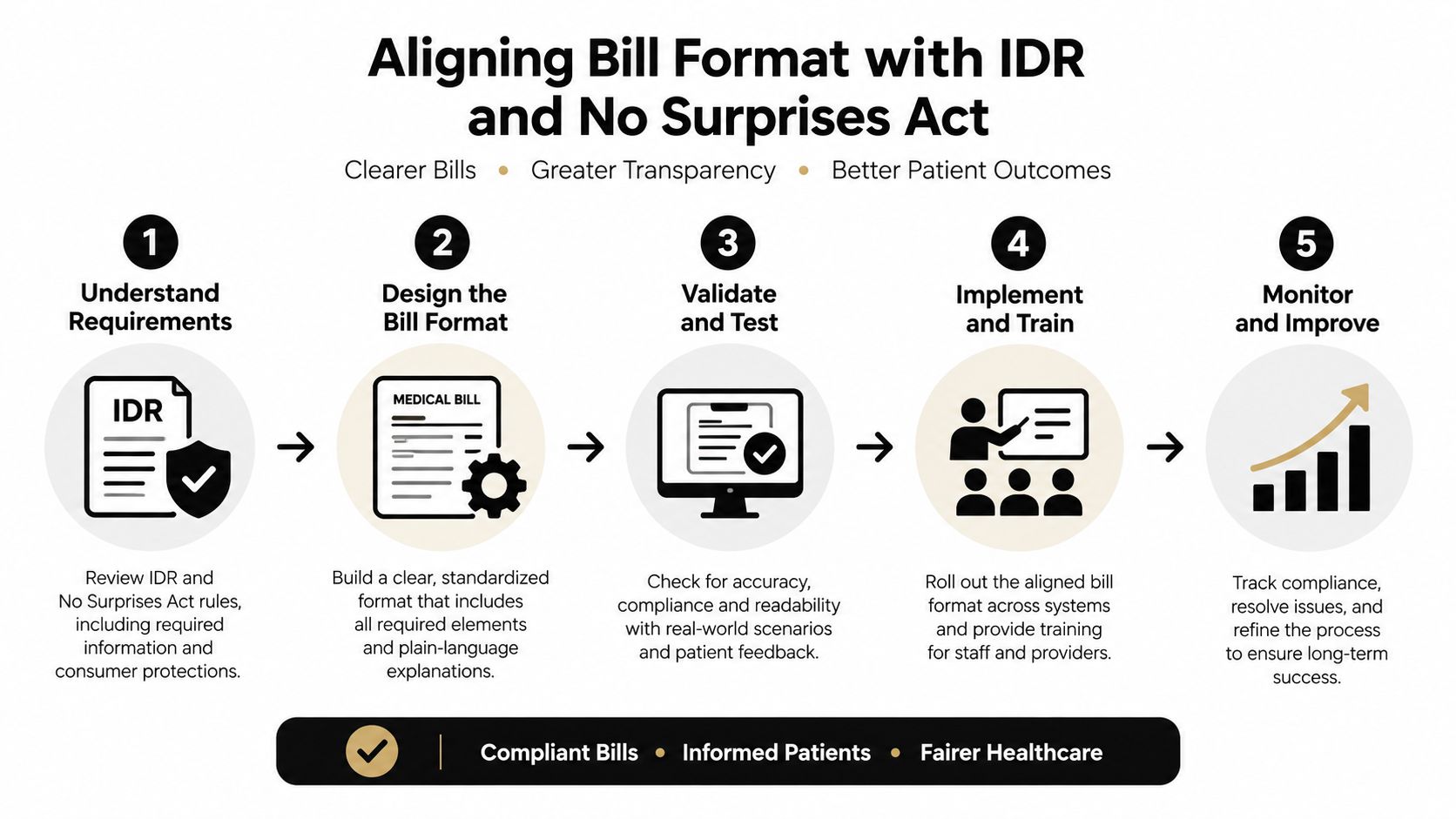
IDR reviewers do not reward a provider for submitting more pages. They need a coherent record that connects the service, billed amount, payer response, provider position, and requested resolution. For regulatory background, see RevGuard's No Surprises Act summary.
That makes the medical bill a primary exhibit, not a patient-facing afterthought. The statement should match the claim lines and remittance, while supporting records explain circumstances the statement cannot establish alone. A mismatch between the itemized bill and insurer data gives the payer grounds to question whether the requested amount is adequately supported.
Build the evidence chain upstream
A dispute-ready file starts with controls applied during charge capture and claim preparation:
- Service identity: Confirm the date, location, provider, procedure, units, and applicable modifiers.
- Charge identity: Tie every billed amount to a specific line and source record.
- Payer response: Preserve the allowed amount, payment, adjustment, denial, or underpayment rationale.
- Provider position: Explain why the disputed amount remains due and identify the applicable contract or regulatory context.
- Submission integrity: Keep the statement, claim, remittance, correspondence, and appeal history connected through account and claim identifiers.
These controls support ordinary claim validity and give the IDR reviewer a traceable record. They do not guarantee a favorable determination. They reduce avoidable uncertainty by showing which source supports each amount and how the payer's response relates to the disputed balance.
Don't confuse transparency with comparability
More disclosed charge data does not automatically make reimbursement disputes easier. Standardized fields help parties compare records, yet contract terms, service mixes, prices, and geographic conditions can still limit comparability. The operational lesson is direct: disclosure has value only when the underlying data is precise enough to validate and defend.
For specialty practices, the IDR process therefore begins at charge capture. Waiting for a payer underpayment may expose missing detail that cannot be reconstructed cleanly. A structured bill gives the dispute team a stable financial record, while clinical and contractual documentation supplies the context. Consistent formatting also helps reviewers distinguish a supported charge from a data discrepancy.
Common Formatting Errors and RCM Audit Checklist
Formatting defects are operational defects. A missing patient control number, an incorrect frequency digit, or a statement period that does not match the services can cause automated edits, obscure claim history, and weaken an IDR record. A readable patient statement is useful, but the higher priority is consistent data across every billing output.
CMS describes the UB-04 as a form organized around fixed locators and coded fields. Its claims processing guidance also identifies inconsistent field completion as a source of rework, delayed remittance, and denial. The practical rule is simple: validate the source fields before they populate the claim, statement, or dispute file.
Audit before transmission
A pre-submission audit should follow the data path rather than inspect fields in isolation. Review the complete account record and compare each output to its source.
- Confirm identity. Match the patient name, date of birth, account number, payer, billing entity, rendering provider, and facility.
- Validate service dates. Compare the statement-covered period, individual service dates, admission and discharge information where applicable, and the clinical record.
- Review bill type. Confirm the three-digit type-of-bill code and frequency digit match the claim's purpose and billing workflow.
- Reconcile line items. Check CPT or HCPCS codes, modifiers, diagnosis pointers, units, applicable revenue codes, and billed charges.
- Test financial logic. Verify that billed charges, payments, adjustments, allowed amounts, and patient responsibility produce the correct balance.
- Compare outputs. Ensure the patient statement, claim image, electronic transaction, and internal account record describe the same services and financial activity.
| Error Type | Adjudication Impact | Required Correction |
|---|---|---|
| Incorrect type-of-bill code | The payer may read the claim as the wrong transaction or frequency | Validate the bill type against the claim purpose and facility workflow |
| Mismatched statement-covered period | Services may fall outside the reported billing window, prompting rework or denial | Reconcile beginning and ending dates with the account and clinical record |
| Missing patient control number | Staff may lose traceability across the claim, remittance, and follow-up | Assign the identifier and carry it through every related document |
| Misaligned CPT or HCPCS modifiers | The payer may apply incorrect pricing or coverage logic | Compare codes and modifiers with the coding record and payer rules |
| Unreconciled payment or adjustment | The statement may show the wrong balance and weaken an appeal | Tie each financial action to the remittance and update the account history |
| Summary-only service description | Reviewers cannot verify the disputed line or compare it with payer data | Add itemized descriptions, codes, dates, units, and charges |
Turn the checklist into a control
The audit should produce an exception queue, not only a pass or fail result. Route identity issues to registration, procedure and modifier issues to coding, missing or duplicate lines to charge entry, and payment or adjustment mismatches to cash posting. Require correction before transmission when an error can affect claim validity or the evidence needed for a later dispute.
Track recurring exceptions by specialty and payer. Anesthesia may expose modifier and time-unit issues. Gastroenterology may expose procedure bundling and facility-professional alignment problems. The pattern varies, but the control remains consistent: correct the source field, document the resolution, and stop the same defect from populating every downstream record.
Building a Proactive Revenue Protection Strategy
Treating the bill format as a final administrative output guarantees that upstream defects will surface late. By the time a payer denies or underpays, the account may have passed through registration, coding, charge capture, clearinghouse edits, payment posting, patient billing, and appeal handling. Each handoff creates another opportunity for the source data to diverge.
A proactive strategy links the entire revenue lifecycle. The practice defines required fields at charge entry, validates the claim before submission, generates a patient statement from the same controlled data, reconciles the remittance at line level, and preserves the evidence needed for an appeal or IDR case.
Make format ownership explicit
Revenue protection needs named owners and measurable controls:
- Front-end teams maintain patient, payer, provider, and location accuracy.
- Coders and clinical reviewers validate services, diagnoses, modifiers, and documentation support.
- Charge-entry teams confirm units, descriptions, charges, and account assignment.
- Clearinghouse staff monitor transaction edits and rejection patterns.
- Payment-posting teams reconcile allowed amounts, payments, adjustments, and denials.
- Appeals and IDR teams convert the complete account history into a coherent dispute record.
The best workflow isn't the one with the most manual review. It's the one that catches high-impact errors at the earliest point, keeps data consistent across outputs, and preserves a clear audit trail when a payer challenges reimbursement.
Specialty practices, hospitals, ASCs, air ambulance providers, and multi-state platforms should evaluate the format of medical bills as part of their revenue architecture. A patient statement, an 837 transaction, a remittance record, and an IDR submission should be different views of the same controlled facts, not separate documents assembled from competing versions of the account.
RevGuard provides specialty-focused RCM support covering charge entry, clean claim submission, clearinghouse management, payment workflows, and enforcement-driven IDR under the No Surprises Act. If your team needs to connect bill formatting with denial prevention and dispute recovery, visit RevGuard to evaluate a structured revenue protection workflow.