

Medical insurance claim denial is not a rare inconvenience, it's a routine payment problem. In ACA Marketplace plans, insurers denied 20% of in-network claims in 2023 and 20% again in 2024, which means roughly 1 in 5 claims never made it to payment.
That scale changes the question. The issue isn't whether denials happen, it's where they start, how much of them are preventable, and which ones are worth fighting after the fact.
The Reality of Claim Denial Rates
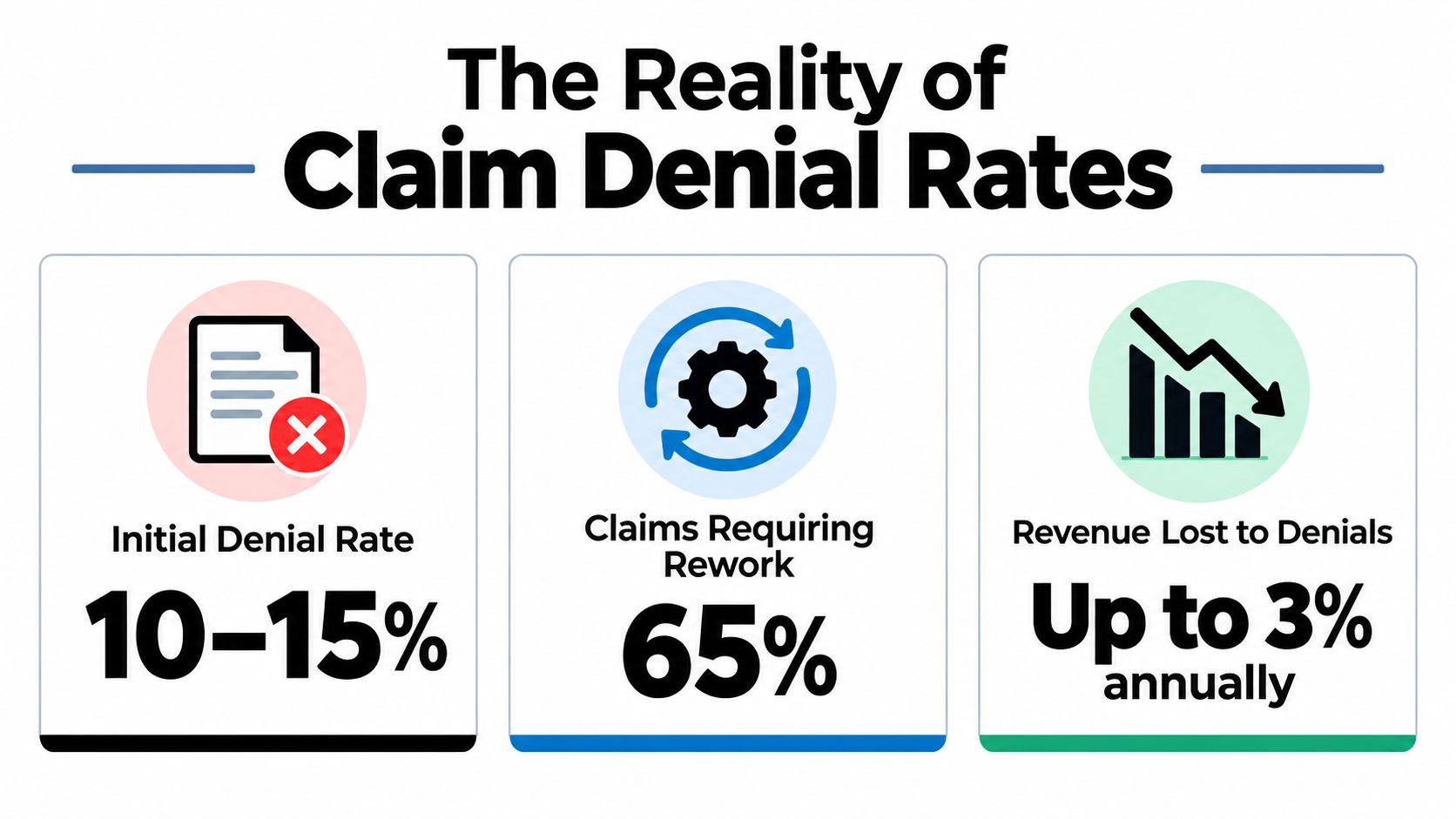
The denial problem is large before a provider opens an appeal. In ACA Marketplace plans, insurers denied 20% of in-network claims in 2023 and 20% again in 2024, while out-of-network denials reached 36% in 2023, as detailed in the prior section. The figures describe a payment process with frequent rejection, not an occasional billing exception.
Denial is a system, not a surprise
Treating denial as an edge case produces a weak response. Payers require providers to establish eligibility, authorization, medical necessity, and coding compliance before payment is released. That makes medical insurance claim denial a revenue cycle issue, with consequences that begin during scheduling and claim construction rather than in the appeal queue.
Denial rates also vary by payer, service line, and claim type. A specialty group that labels denials random will spend staff time on isolated corrections. A group that maps recurring patterns can identify the intake, prior authorization, documentation, or claim-design defect creating delayed cash.
The operational threshold for escalation is recurrence. Once the same denial reason appears repeatedly in reporting, treating each claim as an individual appeal problem hides the process failure. The team should assign the reason to an upstream control, measure whether that control prevents resubmission defects, and reserve appeals for denials that remain disputable after the claim was built correctly.
That approach changes the central question. Instead of asking only how to overturn a rejected claim, revenue cycle leaders ask which scheduling, authorization, coding, or payer-routing decision made it vulnerable. Prevention reduces the number of claims entering the denial workflow, while targeted appeals address the exceptions that still require payer review.
Why Claims Get Denied
Denials cluster around workflow failures before they become payer decisions. A peer-reviewed analysis reported that registration and eligibility issues account for about 18% to 29% of denials, prior authorization for 13% to 42%, and medical necessity for only 6% to 14% (ASHEcon newsletter). The distribution identifies where reimbursement is most exposed: intake, coverage verification, authorization, and claim construction.
Administrative problems dominate the front end
An early scheduling or registration error can follow a claim through the entire billing cycle. Eligibility mistakes, incomplete documentation, inaccurate demographics, and claim edits that conflict with payer rules create defects before submission. They also recur until someone changes the workflow. Repeated denials therefore point less to the final biller's work than to a control that allowed the same defect through.
Claim design matters as much as appeal preparation. The service must be routed to the correct payer, supported by the appropriate documentation, and coded in a way that matches the payer's requirements. A clean claim prevents rework before it enters accounts receivable.
Appeals have a narrower role than many teams assume. If medical necessity disputes represent a smaller share of denials than registration, eligibility, and authorization problems, stronger appeal letters cannot correct the larger process failure. Reviewing the claim before submission usually produces more value than improving the argument after rejection.
Prior authorization sits in the middle of the damage
Prior authorization connects clinical intent with payment approval. It can stop reimbursement before care is delivered when the request is incomplete, the code set conflicts with payer policy, or the record does not support the planned service.
For specialty practices, coordination is often the deciding factor. Anesthesia, radiology, surgery, and air ambulance teams may have clinical justification while still lacking an approved authorization tied to the correct provider, location, procedure, or date of service. The defect is then embedded in the claim before it reaches the payer. Authorization performance metrics and prevention controls are addressed in Upstream Prevention Strategies.
Denials are often a workflow audit in disguise. The payer is reacting to what the provider failed to prove.
The strongest prevention programs identify the point where information was lost or mismatched, then correct that step before submission. Appeals remain necessary for disputed decisions, but upstream controls determine how many claims require them.
The Downstream Impact on Revenue

A denied claim is never just a lost line item. It creates rework, adds touches to accounts receivable, and slows the rhythm of cash collection. Once a claim is rejected, staff have to investigate the reason, correct the defect, gather documents, and decide whether the denial is worth appealing.
The hidden cost is staff time
The financial loss shows up in more than one place. Every denial pulls someone out of normal billing flow and into exception handling. That means more touches per claim, more delayed resolution, and less predictable cash forecasting. For a specialty group with high-acuity volume, that disruption compounds quickly because the same teams often handle authorizations, coding review, documentation chase, and payer follow-up.
A high denial rate also signals operational weakness. If the same kinds of claims keep bouncing back, the practice is paying twice, once in lost or delayed reimbursement and again in labor spent fixing avoidable problems. That's why denial rates should be read as a quality signal, not just a billing metric.
Specialty and facility settings feel the pressure sooner
The more complex the service, the more expensive each denial becomes to manage. High-acuity services depend on clean eligibility, correct modifiers, the right referral or authorization path, and documentation that matches payer logic. When one of those pieces is missing, the denial is often expensive to reverse and slow to resolve.
That creates an important revenue cycle insight. The practices most likely to experience major denial pain are often the ones least able to absorb it through volume. A smaller number of failed claims can produce a disproportionate operational burden when the billing team is already balancing complex cases and time-sensitive follow-up.
Operational rule: if a denial can be prevented before submission, it's usually cheaper to prevent it than to repair it.
That's why denial management shouldn't be measured only by overturned claims. It should also be measured by how many denials never happened in the first place.
Upstream Prevention Strategies
Prior authorization alone creates a measurable denial exposure. Standard authorization denials occur at 12% in Medicare Advantage, 14% in Medicaid managed care, and 18% in ACA Marketplace plans, according to KFF prior authorization metrics. Those figures make authorization a revenue-cycle control point, not a clerical task. A missing reference number or incorrect code set can compromise the claim before submission.
The same logic applies to the rest of the front end. Eligibility should be verified at scheduling and checked again at registration. Coverage changes, plan-routing errors, and benefit limits can turn an otherwise valid service into a preventable rejection. The workflow should confirm member details, verify service coverage, and flag payer-specific requirements before care occurs.
Authorization capture belongs inside clinical and scheduling workflows. Staff need a reliable record of the approval, its reference number, the covered service, and any limits attached to it. That information must remain connected to the claim through billing.
Claim design is the next control. Demographics, subscriber relationships, place of service, modifiers, and diagnosis-to-procedure alignment should match both the record and payer rules. Small data defects may seem harmless internally, but they can produce an immediate payer exception.
Use claim edits as a last checkpoint
Claim scrubbing should identify payer-specific edits, incomplete documentation, and incompatible code combinations before transmission. The objective is to keep preventable rework out of the denial queue, not just to produce cleaner-looking claims.
Pre-submission target: Aim for an edit-pass rate above 95%. Anything below that signals a workflow gap, not bad luck.
For organizations formalizing these controls, RevGuard's claim denial prevention approach describes an upstream model built around coverage verification, billing alignment, and documentation discipline.
Prevention changes where labor is spent. Instead of assigning staff to repair avoidable errors after adjudication, the practice directs effort toward accurate eligibility, complete authorization records, and claims designed to pass payer rules on the first submission. Some denials will remain. The financial objective is to reserve downstream work for exceptions that could not have been removed upstream.
Navigating the Appeals Process
When a denial lands, the appeal is still a real recovery path. A claim denied by a payer is not always a final answer, and the overturn data shows that persistence can pay off. One study of safety-net and non-safety-net providers reported overturned-denial rates of 46.4% to 60.8% depending on payer and service type (peer-reviewed study).
The first move is matching the denial to the evidence
A strong appeal starts with the reason code, not with a generic cover letter. If the denial came from missing documentation, the response should attach the exact chart notes, orders, or authorization proof the payer says it needs. If the issue is coding or eligibility, the appeal should correct the claim history and show where the payer's decision conflicts with the record.
That sounds basic, but it's where many teams lose their edge. A vague appeal asks the payer to do the work. A specific appeal makes the payer confront the exact failure point and the corrected evidence.
Target the denials that are worth the effort
Not every denial deserves the same level of labor. The overturn data suggests that success varies by payer and service type, which means appeal strategy should be selective. If a team treats every denial as equal, it wastes time on low-yield cases and misses the ones with the highest recovery probability.
That's where structured follow-up matters. RevGuard's appeal process steps reflect the practical logic of organized appeals, track the denial, assemble the support, submit on time, and monitor outcome patterns. Even if a practice manages appeals in-house, the discipline is the same.
Persistence changes the economics
Many organizations under-appeal because the process feels slow or uncertain. The problem with that instinct is that it assumes the denial is final just because it arrived. The evidence says otherwise. Denials can be overturned at meaningful rates when the supporting record is strong and the payer's logic is challenged correctly.
The smartest appeal teams don't just ask whether a claim can be won. They ask whether the cost of appealing is justified by the likelihood of reversal. That shifts appeals from a reflex into a portfolio decision.
Leveraging Independent Dispute Resolution
Independent Dispute Resolution, or IDR, gives providers a separate path when traditional billing dispute channels don't settle the issue. Under the No Surprises Act, IDR is most relevant for certain out-of-network disputes and surprise billing scenarios, where payer and provider can't agree on payment.
IDR is different from an internal appeal
An internal appeal asks the insurer to reconsider its own decision. IDR introduces a neutral third party. That difference matters because the decision-maker is no longer the payer that denied the claim in the first place. For providers facing repeated out-of-network underpayment or delayed payment issues, that neutral review can change the balance of power.
The process typically begins with open negotiation. If that fails, the dispute moves into the certified IDR pathway, where both sides submit their positions and a neutral entity evaluates the offers before issuing a binding determination. That structure is especially relevant for specialty providers and air ambulance services, where the pricing and coverage disputes can be more complex than a standard in-network denial.
Use the right forum for the right dispute
IDR isn't a substitute for clean claims or internal appeals. It works best when the case fits the statute and the documentation supports the amount in dispute. Traditional appeals are still the right tool for many in-network denials, especially when the issue is eligibility, authorization, or missing documentation.
IDR becomes valuable when the dispute is less about whether a service happened and more about what the payer should pay for it. That's a different question, and it needs a different mechanism.
Why specialists should pay attention
Complex specialties often get caught in the gap between policy language and operational reality. A claim may be technically correct and still face resistance because the payer doesn't want to pay the billed amount. IDR gives those providers a formal channel to push back without relying only on the insurer's own review process.
If the denial is really a payment dispute, don't treat it like a clerical error. Put it in the right forum.
For organizations that need to manage both denials and out-of-network dispute resolution, RevGuard's IDR capability connects the revenue cycle to enforcement-driven dispute work in one operational model.
Using Analytics to Drive Results
Denial performance improves when teams stop looking at claims one by one and start reading the pattern. Analytics turns denial management into a control system. It shows which payers deny most often, which service lines get hit, which reason codes repeat, and which appeals recover revenue.
Measure the right things
A useful dashboard starts with denial rate by payer and denial reason. Add appeal success rate, turnaround time, and the share of denials that trace back to eligibility, authorization, documentation, or coding. Those metrics show whether the problem is front-end registration, payer policy mismatch, or post-submission follow-up.
The point isn't to collect more data for its own sake. It's to identify the exact place where workflow breaks down. If one payer rejects the same claim type again and again, that's a contract or policy issue. If one service line generates repeated missing-documentation denials, that's a process issue. The answers are different, so the fixes have to be different too.
Turn denial history into workflow changes
Analytics should feed action, not just reporting. If a denial reason keeps appearing, the billing team should adjust the claim edit logic, the scheduling checklist, or the authorization workflow. If appeals are successful for a certain denial type, the team should prioritize those cases earlier.
That's the core revenue cycle advantage of data. It lets leaders move from reactive cleanup to proactive correction. Over time, that reduces preventable denials and improves the recoverability of the ones that still slip through.
For teams building that kind of visibility, RevGuard's healthcare revenue cycle analytics is one example of how denial data can be organized into payer behavior trends, KPI tracking, and workflow intelligence.
The actual win is not a prettier report. It's a tighter feedback loop between intake, authorization, coding, appeal, and payment.
If denials are draining revenue in your practice, start by mapping where they begin, not just where they end. RevGuard helps provider groups connect prevention, appeals, and dispute resolution into one revenue protection workflow, so the same denial doesn't keep costing you twice. Visit RevGuard to see how a more disciplined denial strategy can protect cash flow and reduce avoidable rework.