

A clean-claim rate below 90% is widely characterized as weak, while high-performing practices commonly target 95% or higher, and some benchmarks describe 98% as best-in-class. Yet that metric can still flatter an operation: a claim may pass front-end edits and later lose revenue through medical necessity disputes, bundling, eligibility problems, or underpayment. Industry benchmark guidance makes the operational point clearly: clean claims medical billing is a revenue-cycle control, not merely a coding score.
What Counts as a Clean Claim and Why the Metric Matters in 2026
A clean claim is accepted on its first submission without a technical error, rejection, or request for missing information. The standard calculation is:
Clean claim rate = number of clean claims ÷ total claims submitted × 100
The metric measures first-pass acceptance, not whether the payer ultimately paid the correct amount. A claim may pass front-end edits and still face a medical-necessity denial, coverage dispute, authorization challenge, bundling edit, or contract interpretation issue. A practical explanation of the metric makes that distinction clear. Billing leaders should therefore review remittance data before treating a high percentage as evidence of a healthy revenue cycle.
A technically accepted claim can still leak revenue. In anesthesia, IONM, and ASC billing, the exposure may involve a modifier conflict, unsupported units, a payer-specific medical-necessity weakness, or an underpayment that appears only after adjudication. The front end should be designed to anticipate those disputes, not only to satisfy the clearinghouse.
Operational rule: A clean claim records first-pass acceptance. It does not prove that the payer paid correctly.
Use the rate as an early warning signal
Benchmark guidance has historically placed acceptable performance in a broad range, with stronger operations pursuing higher results. The benchmark source explains why practices use the measure as a front-end revenue-cycle indicator. The useful question is not whether a team reached a target. It is which defects remain hidden after acceptance and whether they produce rework, denials, or payment disputes.
Track the rate by payer, specialty, location, rendering provider, and procedure family. Review those results alongside denial reason codes, appeal outcomes, and underpayment findings. A payer that accepts nearly every claim but routinely underpays a high-value procedure is not producing healthy revenue. The same applies when a claim is technically clean but lacks the authorization record or clinical support needed for an appeal or an IDR case.
| Reported Clean Claim Rate | Typical Net Revenue Leakage | Hidden Cause |
|---|---|---|
| High | Can remain material | Downstream underpayment, bundling, or medical-necessity dispute |
| Moderate | Visible rework and delayed payment | Eligibility, authorization, coding, or documentation defects |
| Low | Heavy correction workload | Weak upstream controls and payer-specific formatting failures |
Clean claims medical billing should therefore include dispute readiness. Preserve the authorization response, clinical documentation, provider status, operative details, and payer-specific rationale before submission. For anesthesia and IONM, retain the service facts that support units, modifiers, and medical necessity. For ASCs, confirm that the submitted claim matches the authorized and performed procedure. These controls prevent avoidable denials and give the billing team a defensible record when the payer accepts the claim but pays incorrectly.
The Five Front-End Gates That Decide First-Pass Yield
A claim doesn't become clean because one scrubber gives it a green status. It passes through five gates, and each gate catches a different class of failure.
Gate one is eligibility
Verify coverage when the service is scheduled and again at registration or check-in when the timing or payer rules make that necessary. For ASCs and hospital outpatient departments, the workflow should capture the response, not just record that somebody “checked eligibility.” Store coverage dates, benefit limitations, payer identifiers, and the transaction result where billing staff can retrieve them.
Teams that need a defined workflow can use medical eligibility verification as the upstream control. Automation should handle routine lookups and flag discrepancies. A human still needs to resolve changed coverage, coordination-of-benefits conflicts, and ambiguous benefit responses.
Gate two is authorization
Authorization belongs in the EHR or practice-management workflow, not on a loose paper note. Tie the authorization to the scheduled procedure, payer, provider, facility, service dates, units, and diagnosis. For an ASC, an authorization that exists but doesn't match the performed procedure is operationally equivalent to missing authorization.
Gate three is coding
Use the scrubber for code validity, diagnosis-to-procedure relationships, CCI and NCCI edits, MUEs, global-period conflicts, and modifier combinations. Registration staff shouldn't be expected to reason through anesthesia concurrency or surgical bundling while checking a patient in.
For anesthesia, review time units, medical-direction circumstances, and concurrent case logic. For IONM, confirm the ordering physician's NPI and the relationship between the surgical record, interpretation, and billed service.
Gate four is credentialing
A current provider record is a payment control. Reconcile NPI, taxonomy, payer enrollment, location, group affiliation, and effective dates against the claims build. A service can be coded correctly and still fail because the payer doesn't recognize the rendering provider in that setting.
Gate five is documentation
Documentation must support what was performed and why it was necessary. In an ASC, that includes the operative record and device or implant detail where relevant. In IONM, the record must support the monitoring service and interpretation. Humans should review clinical ambiguity. Automation should identify missing fields, mismatched dates, and absent attachments before release.
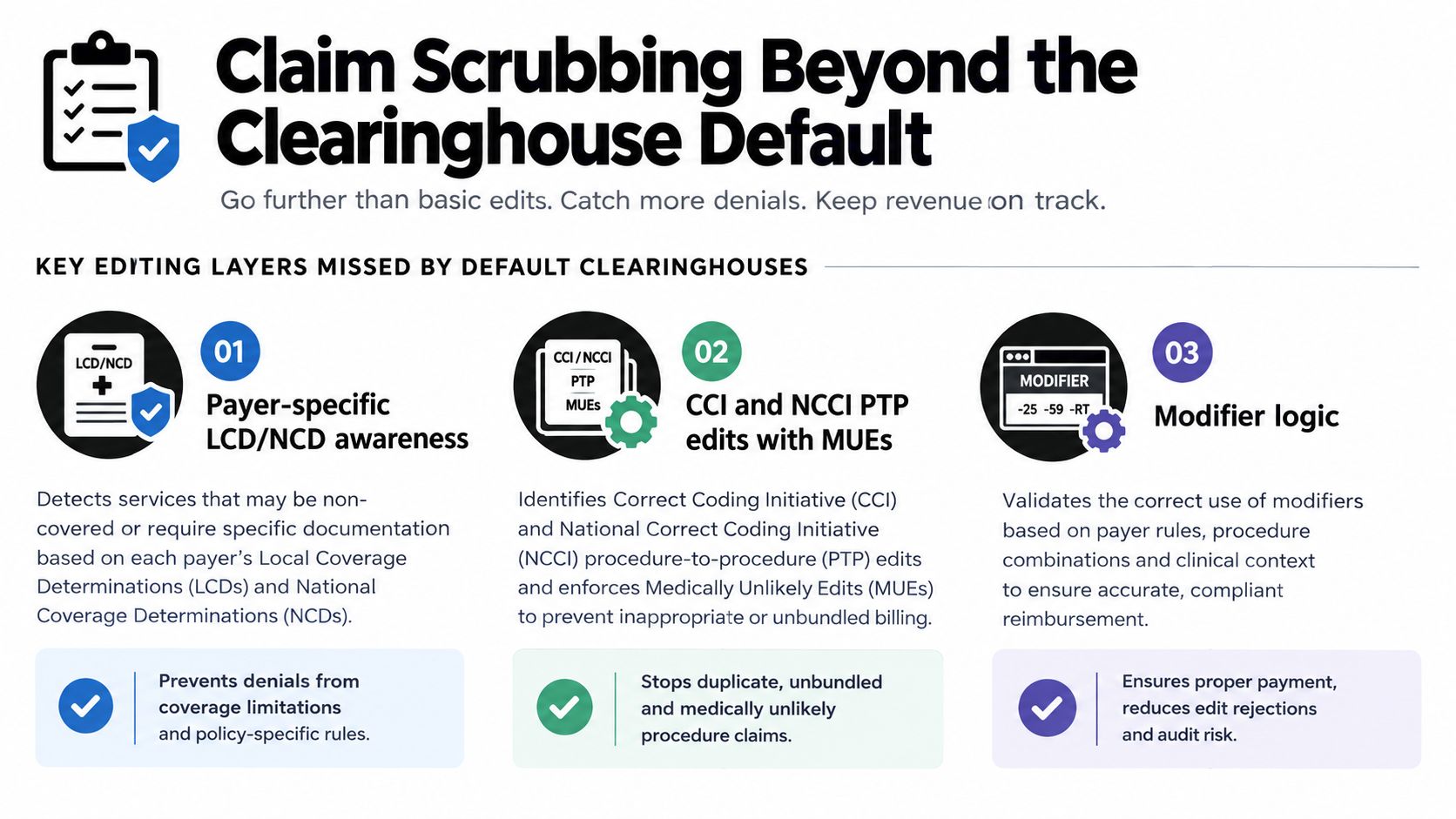
Claim Scrubbing Beyond the Clearinghouse Default
A clean claim can still lose revenue after transmission. A clearinghouse is useful, but its default edits usually focus on whether the claim is structurally transmissible, as explained in clearinghouse in medical billing. Specialty groups need a second layer that anticipates payer objections, preserves supporting evidence, and identifies payment errors that may later qualify for IDR review.
Build payer awareness into the edit library
Configure edits for payer-specific LCD and NCD expectations, diagnosis-to-procedure relationships, frequency limits, authorization conditions, and documentation requirements. Basic syntax validation will not catch a coverage-policy conflict or an absent clinical element. Those gaps commonly surface as frequency, medical-necessity, or documentation denials.
CCI and NCCI PTP edits, including MUE logic, belong in the editing layer. Modifier logic needs the same discipline. Review -59, -X{EPSU}, -25, -22, and -23 against the operative or clinical record and the payer's policy. A modifier added only to force a line through an edit may produce a technically accepted claim that remains indefensible in an appeal or IDR case.
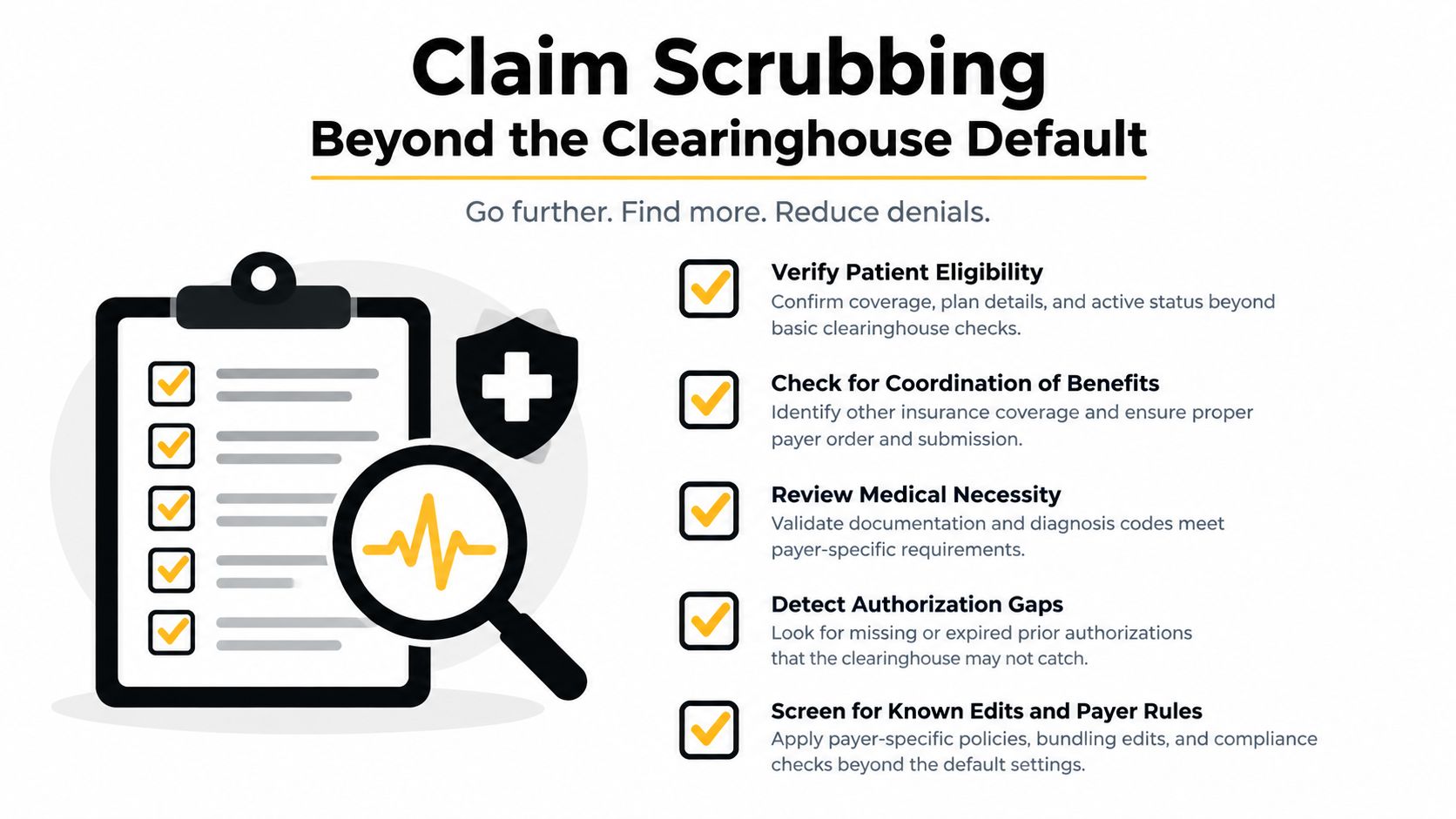
Configure edits around the specialty
For anesthesia, derive time units from documented start and stop times, then test qualifying circumstance codes and medical-direction relationships. Syntax checks alone will not expose an unsupported time pattern or a concurrency conflict.
Orthopedic claims need payer-aware review of anatomic modifiers and global-period conflicts. GI infusion billing requires attention to the EI modifier trap, which can make a complete-looking claim inconsistent with payer rules. Imaging groups should validate the technical and professional split, including TC and PC logic, provider role, place of service, and enrollment.
ASCs face a related risk. Place of service 24 may be accurate, yet it does not establish authorization, coverage, or facility-payment treatment. Scrubbing must test the expected relationship among the facility, surgeon, anesthesiologist, diagnosis, procedure, and payer contract.
Treat the scrubber as a maintained product
Assign an owner to each rule. Record the payer, edit, specialty affected, required evidence, release decision, and later denial or payment behavior. Overly aggressive rules create manual work. Permissive rules send preventable disputes downstream and leave weak evidence for underpayment challenges.
A scrubber should ask more than “Can this claim transmit?” It should ask, “What objection is this payer likely to raise, and have we preserved the evidence to answer it?”
AI Edit Engines Versus Human QA Layers
No single editing layer handles the full claim lifecycle. Clearinghouse rules, AI-assisted engines, and human review each solve a different problem.
Clearinghouse rules are strong at format validation, required fields, code structure, and transmission readiness. They're weak at payer nuance, clinical context, unusual CPT relationships, and the difference between a technically valid modifier and a defensible modifier.
AI edit engines can prioritize work by historical denial patterns, detect unusual combinations, and surface modifier or documentation risks. They're valuable for volume triage. They can also misread novel CPT pairings or recommend a pattern that doesn't fit the clinical record, so I won't let an AI engine make the final decision on a complex, high-value claim without human review.
Human QA is slower and more expensive per claim, but it remains essential where the claim requires reasoning. That includes anesthesia time and medical direction, device-heavy ASC claims, IONM interpretation, air-ambulance documentation, and unusual surgical combinations.
| Specialty / Claim Tier | Clearinghouse Rules | AI Edit Engine | Human QA | Recommended Cadence |
|---|---|---|---|---|
| Primary care, routine claims | Required-field and format edits | Risk triage and recurring denial detection | Spot checks | Sampled review |
| Anesthesia, routine cases | Code, time-field, and format edits | Modifier and payer-pattern flags | Review exceptions and high-value cases | Every exception |
| ASC, device-heavy claims | Structure and line validation | Procedure, device, and payer-risk prioritization | Validate documentation and payment logic | High-value claims before release |
| IONM and complex specialty claims | Basic claim integrity | Historical denial and anomaly detection | Clinical and coding validation | Pre-submission review |
| Air ambulance and other high-value claims | Transmission and completeness | Evidence-risk prioritization | Full documentation and dispute-readiness review | Every material claim |
For low-dollar, predictable work, AI plus targeted human sampling is usually practical. For high-dollar anesthesia, orthopedics, IONM, and air ambulance, use a layered model: automation for volume, certified coders for the highest-value or highest-risk claims, and a denial analyst who closes the loop on every meaningful write-off.
The costed decision is not merely software versus staff. It's cheap automation with expensive downstream leakage versus a controlled review model that reserves human time for claims where payer behavior and clinical nuance justify it.
Reading Denial Reason Codes Like a Payer Behavior Map
Denial codes are not just accounting labels. They show which gate failed and how a payer is interpreting the claim.
Consider a representative IONM claim. The payer returns PR-204, indicating a non-covered service. The coding may be accurate, but the underlying problem can be a credentialing or benefit-coverage gap. The upstream fix is to confirm provider status and coverage before service. The recovery path is a benefit and credentialing review, followed by an appeal supported by the payer response and clinical record.
A different payer returns CO-97, indicating that the service is included in another service. That points toward a bundling dispute. The team should inspect the operative relationship, modifier support, distinct-service documentation, and applicable payer policy. If the service is separately reportable, the appeal needs evidence, not a generic statement that the code was correct.
CO-16 commonly surfaces missing or invalid information. In an ASC or air-ambulance workflow, it may expose documentation that authorization or pre-service review should have caught. The correction isn't always “rebill with the same data.” It may require the missing report, transport record, physician order, or medical-necessity support.
Turn codes into payer fingerprints
Build a heat map by payer, specialty, location, procedure family, and denial code. Then assign each dominant code to an operational owner:
- Eligibility owner: Coverage, coordination, and patient identity mismatches.
- Authorization owner: Missing, expired, or mismatched approvals.
- Coding owner: Modifiers, bundling, units, and diagnosis relationships.
- Credentialing owner: Provider enrollment, taxonomy, and facility alignment.
- Appeals owner: Clinical evidence, contract interpretation, and payer response.
A representative $14K IONM claim recovered after a clinical review appeal illustrates why code-level analysis matters. The recovery didn't come from resubmitting a cleaner demographic record. It came from assembling the clinical documentation, linking the service to the procedure, and addressing the payer's medical-necessity position directly. The case should then produce a new pre-submission edit and evidence checklist, not just a successful posting entry.
Pairing Clean-Claim Rate With Downstream Dispute Outcomes
A clean-claim rate can look strong while payment performance remains weak. First-pass acceptance measures whether a claim cleared initial edits, not whether the payer applied the contract correctly, paid the expected amount, or created an IDR-eligible underpayment. The clean-claim benchmark discussion is useful as a quality reference, but the financial view must continue through adjudication and recovery.
Track first-pass yield, denial reason, appeal overturn rate, days to resolution, adjusted collections, and IDR-eligible underpayments. A claim may be technically clean and still fail because of eligibility, authorization, medical necessity, payer-specific bundling, or payment methodology, as explained in this medical billing denial analysis.
Give the CFO a dashboard tied to recoverable revenue
Separate defects that block submission from losses identified after adjudication. The dashboard should also show whether an appeal produced cash, not merely whether the payer issued an overturn decision.
| Metric | What It Measures | Target Benchmark | Action Trigger |
|---|---|---|---|
| Clean-claim rate | First-pass technical acceptance | Use the selected specialty baseline | Investigate when performance falls below baseline |
| Denial rate | Claims denied after submission | Set a payer and specialty baseline | Route by payer and reason |
| Denial reason mix | Root-cause concentration | No universal target | Assign an operational owner to recurring codes |
| Appeal overturn rate | Strength of dispute handling | Establish an internal baseline | Escalate weak evidence or payer-specific patterns |
| Days to resolution | Operational recovery speed | Establish by payer and dispute type | Escalate aging cases |
| IDR-eligible underpayments | Payment variance that may qualify for federal dispute resolution | Track every potentially eligible case | Refer when standard payer appeal will not protect the balance |
For anesthesia, ASC, and IONM groups, add procedure family and rendering provider to the dashboard. A single aggregate rate can hide recurring modifier, authorization, facility alignment, or payment errors affecting one service line.
Refer cases for specialized support when the payment error may qualify for federal IDR, the payer's underpayment pattern recurs, and the evidence package establishes the service, coverage, and payment basis. Insurance claim dispute support should sit beside the standard denial workflow, with clear ownership for records, deadlines, and escalation.
The CFO-level question is direct: what entered cleanly, what paid correctly, what was denied, what was overturned, what remains unpaid, and which control changes the next claim. A technically clean claim is only successful when it also survives payer logic and produces the expected collectible revenue.
Your 30-Day Clean Claims Improvement Plan
Run this as an operations sprint, not a software project. The objective is to find the few upstream defects creating the most rework, then install controls that billing staff can maintain.
Week one establishes the baseline
Pull recent claim activity by payer, specialty, location, and procedure family. Separate front-end rejections from post-adjudication denials, then classify the leading reasons into eligibility, authorization, coding, credentialing, documentation, and payment disputes.
Do not average everything into one enterprise number. Anesthesia and IONM can have very different failure patterns from primary care, and an ASC's facility workflow can fail at a different gate from its surgeons' professional claims.
Week two observes the work
Shadow scheduling, registration, coding, charge capture, credentialing, and payment posting. For each high-frequency denial, identify the last person who could have prevented it and the data they needed.
Create a simple evidence trail for authorization responses, eligibility checks, provider enrollment status, operative documentation, and payer correspondence. If staff can't retrieve the proof quickly, the claim isn't dispute-ready even when its fields are complete.
Week three installs focused controls
Configure payer-specific edits for the top three denial reasons from the baseline. Add the credentialing-to-claims handoff checklist, then test the rules against real anesthesia, ASC, IONM, or imaging examples before turning them on broadly.
Assign a named owner to each rule. Measure false positives as well as prevented defects, because an edit that blocks valid claims without a clear release path will shift work rather than improve yield.
Week four closes the loop
Deploy a dashboard pairing clean-claim rate with denial reason, appeal overturn rate, days to resolution, and IDR-eligible underpayments. Hold a weekly 20-minute denials standup with one decision per recurring root cause.
Bring this seven-item checklist to the meeting:
- Eligibility depth: Did the team verify coverage and resolve conflicts?
- Authorization capture: Is approval stored against the performed service?
- Code and modifier review: Do the combinations match documentation and payer logic?
- Credentialing sync: Are provider and facility records current?
- Scrubber ownership: Who maintains each payer-specific edit?
- Denial assignment: Does every major code have an accountable owner?
- Appeal deadlines: Are standard appeals and IDR timelines tracked?
A disciplined clean-claims medical billing program doesn't promise that every claim will be paid without challenge. It ensures that preventable defects are stopped upstream and that legitimate claims carry the evidence needed for recovery downstream.
RevGuard connects specialty-specific RCM controls with dispute-ready workflows, including eligibility, coding, credentialing, payer-aware claim validation, and support for underpayment and denial disputes. Visit RevGuard to evaluate how your anesthesia, ASC, IONM, or other specialty operation can pair cleaner submissions with stronger recovery processes.