

The denial arrives after the procedure, when everyone assumes the account is finished. A billing coordinator opens the EOB and sees CO-50, followed by N-10, on a high-value outpatient claim. The payer isn't saying the service didn't occur. It's saying the episode didn't satisfy the coverage standard used to decide whether the payer would reimburse it.
That distinction changes the response. A claim denied as not medically necessary isn't a paperwork problem that can be solved by attaching the entire chart and hoping a reviewer finds the answer. It's a revenue-cycle failure that may have started with order entry, coding, authorization, scheduling, or incomplete clinical documentation, then surfaced downstream as a denial and potentially an appeal or dispute.
When a Medical Necessity Denial Lands on Your Desk
The coordinator has a $24,000 outpatient spinal cord stimulator claim from a major commercial payer. The EOB shows CO-50, a denial associated with medical necessity, and N-10, which points to a missing or incomplete explanation code. The first instinct is to call the payer, fax the operative report, and ask for reconsideration.
That instinct wastes time. CO-50 doesn't mean the physician lacked clinical judgment, and it doesn't automatically mean the service was excluded from the plan. It means the payer applied a coverage or clinical rule and concluded that the billed service, as submitted for this episode, didn't meet that rule. The actual basis may be a payer medical policy, clinical criteria, documentation requirement, coding problem, or a mismatch between the authorization and the service performed.
A medical-necessity denial also differs from an administrative denial. No authorization, invalid member status, duplicate billing, incorrect provider enrollment, and non-covered benefits each require a different remedy. Sending more clinical records to resolve a missing authorization won't fix the account. Likewise, correcting an authorization won't overcome a policy exclusion.
Practical rule: Treat the denial code as the starting signal, not the diagnosis.
The first working days should be triage. Pull the EOB, denial letter, claim form, authorization record, plan policy, clinical criteria, and relevant chart documents. Confirm the appeal deadline, identify the payer's stated yardstick, and determine whether the payer reviewed the claim before or after service. ACFAS guidance on medical-necessity appeals recommends requesting the written payment policy and claim file because the reviewer's criteria and documentation standard determine how the appeal should be built.
The structural response has four parts:
- Diagnose the trigger: Determine whether the failure came from coding, coverage criteria, payer policy, authorization, or documentation.
- Build a criterion-based packet: Answer the rule the payer applied, not merely the diagnosis on the claim.
- Escalate on a fixed timeline: Assign ownership for internal review, physician discussion, external review, and any eligible dispute pathway.
- Close the upstream defect: Feed the denial reason back to clinicians, coders, authorization staff, and scheduling.
The 1993 GAO benchmark shows that denial pressure isn't new. In Medicare Part B, carriers denied 112 million claims in whole or in part, representing 19% of processed claims and $17 billion in denied claims, or 18% of billed charges. Services deemed not medically necessary accounted for about 9% of the dollar amount denied. Those figures come from the GAO analysis of Medicare Part B claims denials, and they establish that medical-necessity denials have long been a material adjudication issue.
Diagnosing Why the Payer Said No
A fast diagnosis prevents the appeals team from treating every denial as a clinical writing exercise. Use the denial language, claim data, policy, and chart together. The objective is to identify the root cause before anyone drafts a letter.
Path one, coding mismatch
Look for phrases such as “insufficient diagnosis,” “does not support the procedure,” or “documentation does not establish the condition.” The claim may contain an unspecified ICD-10 code, omit a relevant secondary diagnosis, or report CPT lines that don't present the service as one coherent episode.
The next step is a coding audit against the clinical record. Ask the coder to compare the diagnosis hierarchy, modifiers, units, and procedure relationship with the operative note and assessment. Don't add a diagnosis because it would support payment. The correction must reflect what the clinician documented and what coding rules permit.
Path two, LCD or NCD criteria gap
A denial that cites an LCD, NCD, coverage article, indication, limitation, or exclusion points to a rule-based coverage gap. The service may be clinically reasonable but still fail a specific coverage condition, such as a required symptom profile, failed conservative treatment, severity threshold, setting requirement, or documented exclusion.
Pull the exact policy version in effect on the date of service. Build a criterion matrix and mark each requirement as satisfied, unsupported, or contradicted. If the chart lacks evidence, determine whether an authentic contemporaneous record exists. Don't backfill facts into a retrospective narrative.
Path three, payer policy drift
Commercial payers may apply internal medical policies that differ from Medicare coverage rules or impose a narrower clinical threshold. The denial letter may reference a payer policy number, proprietary criteria, “investigational” language, or a required alternative treatment.
Compare the plan language with the payer's medical policy and the clinical evidence. A treating physician's opinion matters, but it won't answer a contractual requirement by itself. The appeal should show why the patient-specific facts satisfy the payer's own rule, or why the reviewer misapplied it.
Path four, authorization failure
Signals include “no prior authorization,” “authorization not valid for billed service,” “date mismatch,” or an authorization number tied to another procedure, site, or provider. Check the authorization request, approval letter, approved CPT and diagnosis codes, service date, location, units, and rendering provider.
A denial can have two layers. The authorization might exist but fail to match the claim, or the authorization might have been granted under a narrower clinical description than the service delivered. Record both issues separately so the appeal doesn't obscure an administrative defect with clinical narrative.
Use the medical-necessity documentation workflow to organize the diagnosis, severity, patient-specific rationale, criteria, and supporting records. A disciplined review should take less than thirty minutes per claim when the source documents are available.
Building an Appeal That Actually Reverses
A strong appeal makes the reviewer's decision easy to change. It doesn't bury the relevant evidence in an unindexed chart. It identifies the rule, maps the facts to each requirement, corrects the claim if necessary, and preserves proof that the payer received the submission.
Start with a cover letter containing patient identifiers, claim and denial references, dates of service, billed lines, and the requested remedy. The clinical rationale should be short enough to read quickly but precise enough to direct the review. Cite the exact LCD, NCD, plan provision, or payer policy section at issue.
For an advanced imaging denial, useful language might read:
“The denial states that the requested imaging does not meet the plan's medical-necessity criteria because the record does not document progressive neurological findings and failure of conservative treatment. The attached history and physical at page 4 documents progressive weakness, the imaging order at page 7 identifies the affected region, and the treatment history at pages 9 through 11 records unsuccessful conservative management. We request reversal because the submitted record addresses each criterion cited in the denial.”
That language works better than “the MRI was medically necessary because the patient was in pain.” It answers the payer's stated objection and gives the reviewer page-level directions.
The six elements of a defensible packet
- Decision and policy map: Include the denial, EOB, policy version, and a criterion-by-criterion response.
- Clinical record: Attach the history and physical, operative note, progress notes, imaging, labs, prior treatment history, and discharge information that support the disputed service.
- Physician narrative: Have the treating clinician answer every cited criterion, including why a lower-intensity or alternative service wasn't appropriate for this patient.
- Evidence file: Add peer-reviewed literature or specialty guidance when the payer disputes accepted practice or labels the service investigational.
- Corrected billing support: Include an itemized bill and corrected claim information when diagnosis selection, modifiers, units, or procedure reporting contributed to the denial.
- Submission control: Log the delivery method, recipient, date, confirmation number, appeal level, deadline, and assigned owner.
| Packet Element | Reviewer Criterion Addressed | Chart Location |
|---|---|---|
| Policy and criteria map | Exact coverage requirement cited in the denial | Cover letter and policy excerpt |
| History and physical | Symptoms, severity, examination, and failed alternatives | H&P assessment and plan |
| Operative or procedure note | Service performed, indication, setting, and findings | Operative report |
| Imaging and laboratory evidence | Objective findings supporting the intervention | Report and result pages |
| Physician narrative | Patient-specific rationale for each disputed criterion | Signed medical-necessity letter |
| Coding correction | Diagnosis and procedure relationship | Corrected claim and itemized bill |
| Submission log | Timeliness and receipt | Appeal tracking record |
Keep the packet proportionate. More pages don't equal more support. A reviewer needs a clear index, labeled exhibits, and a direct answer to the denial. If the payer relied on a policy that wasn't provided, request the policy and claim file in writing, then document that request in the appeal.
Deadlines depend on the plan and pathway. ERISA plan language, ACA fully insured requirements, Medicare Advantage rules, and state external-review procedures can change what evidence may be submitted and when. Appeal process guidance should be used alongside the actual plan documents and denial notice, not instead of them.
Escalating When the First Appeal Fails
A first-level rejection isn't a reason to resend the same packet. It's evidence about what the payer still believes is missing, unsupported, or outside the applicable coverage rule. Read the adverse determination for the next review level, filing window, and language that establishes eligibility for external review.
Use the payer's recognized ladder
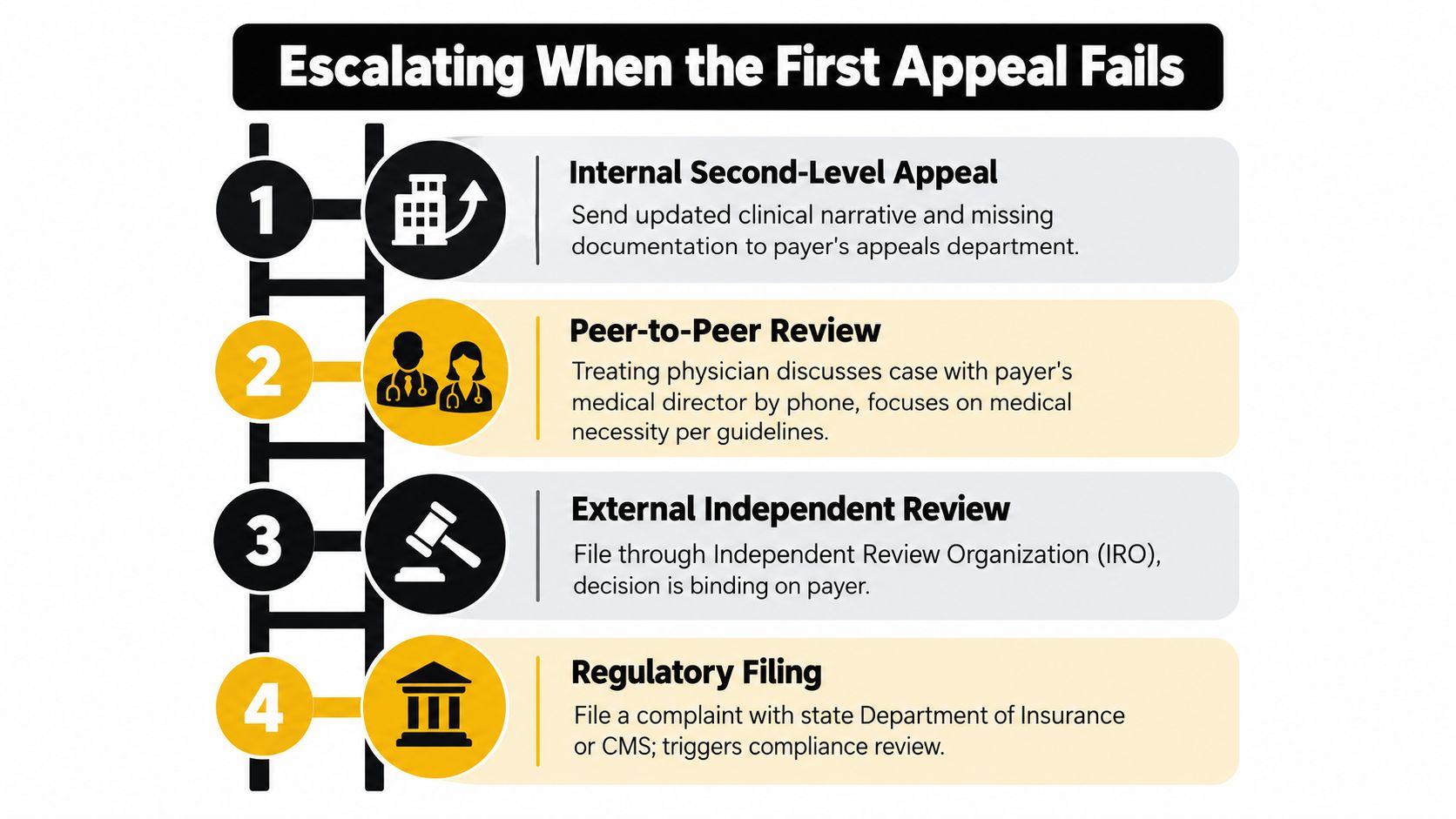
Internal second-level appeal comes first when the plan permits or requires another internal review. The appeals department should receive an updated clinical narrative, missing chart evidence, policy analysis, and any corrected claim material. The person who owns the account should also identify exactly what changed from the first submission.
Peer-to-peer review is different from a billing call. The treating physician or an appropriately qualified clinician should speak directly with the payer's medical director and focus on the policy criteria. The discussion should address patient-specific findings, treatment history, urgency, setting, and the reason the requested service was appropriate. Some plans don't offer peer-to-peer review at every stage, so confirm availability rather than assuming it exists.
External independent review may become available after an internal adverse determination. Look for language stating that the denial is based on medical necessity, experimental or investigational treatment, or clinical appropriateness and that external review rights apply. The filing entity, deadline, and required form vary by plan type and state.
No Surprises Act or Federal IDR is a separate pathway, not a substitute for a clinical appeal. Eligibility depends on the service, parties, claim status, and statutory requirements. A medical-necessity denial may also be ineligible for IDR if the dispute doesn't concern an NSA-covered payment issue.
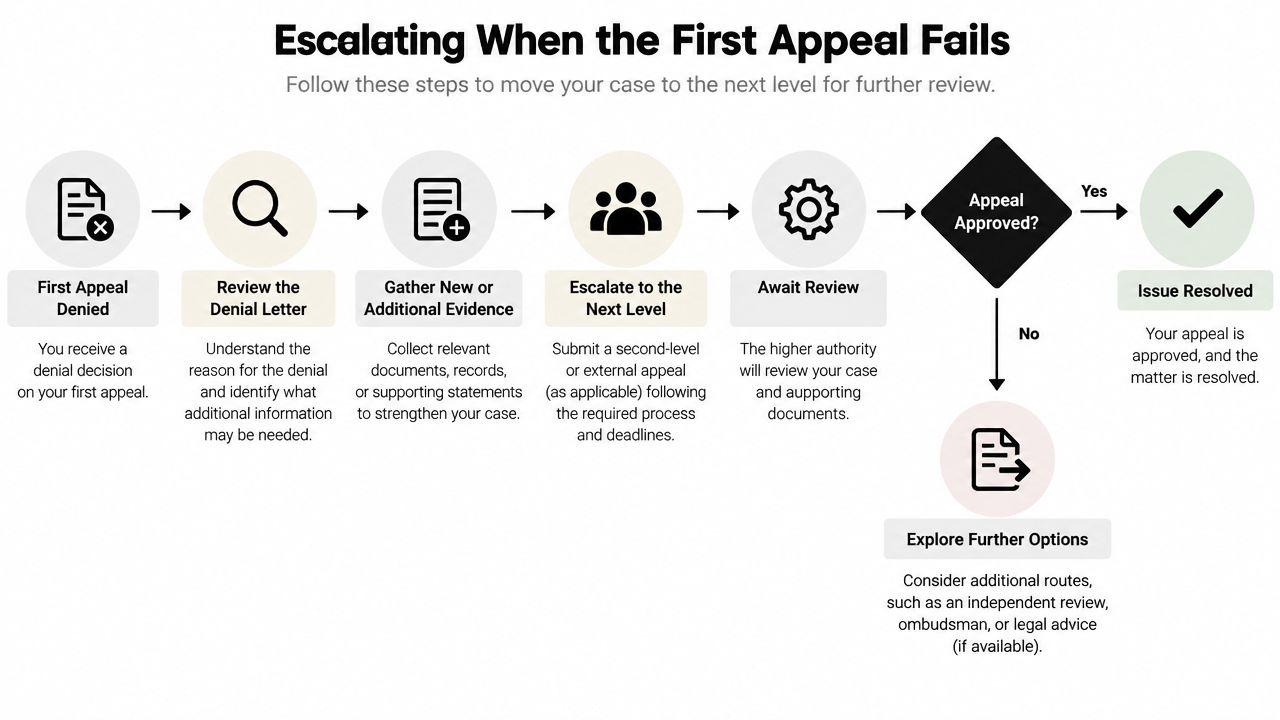
The practical mistake is assigning escalation to whoever handled the first appeal. Internal appeals need payer-policy and clinical expertise. Peer-to-peer needs physician preparation. External review needs a complete administrative record. IDR needs eligibility screening, evidence selection, filing discipline, and enforcement follow-through.
Filing windows can range from 30 to 180 days, depending on the plan type and governing rules. Don't rely on a generic calendar. Use the denial notice, plan document, contract, and applicable regulator instructions to establish the controlling date.
Commercial, ERISA, ACA fully insured, and Medicare Advantage pathways don't behave identically. ERISA plans often make the administrative record especially important. ACA plans may limit peer-to-peer access. Medicare Advantage appeals follow their own organization-determination and reconsideration structure. Document the route before you submit, because a procedurally perfect packet sent to the wrong entity is still late or ineffective.
Stopping the Next Denial Before It Happens
Appeals recover isolated accounts. Prevention changes the operating system. If the same procedure, diagnosis pattern, or payer policy produces recurring medical-necessity denials, the organization is paying staff to repair a defect that should have been caught before scheduling or claim release.
The strongest prevention programs use three checkpoints.
First, the documentation template should force the ordering or treating clinician to record the medical-necessity facts that reviewers use. That may include the diagnosis, severity, objective findings, prior treatment, response to alternatives, functional impact, risk, and why the requested setting or service is appropriate. A template shouldn't generate boilerplate. It should expose missing clinical facts before the patient reaches the procedure.
Second, coding review should flag unspecified ICD-10 codes, missing secondary diagnoses, incompatible procedure and diagnosis combinations, units, modifiers, and site inconsistencies. The coder should send targeted feedback to the clinician rather than changing documentation that doesn't support the code.
Third, authorization staff should verify more than an authorization number. They should confirm the payer's medical policy, LCD or NCD applicability, approved procedure and diagnosis lines, service date, location, units, rendering provider, and any required clinical attachments.
The useful prevention metric is pre-bill denial risk, not just the post-payment denial count.
Clinical decision support at order entry can surface policy requirements while the clinician still has access to the patient record. The operational metric to watch is the pre-bill denial rate, segmented by payer, location, specialty, procedure, diagnosis, and denial reason. A low aggregate rate can hide a recurring problem in one service line.
| Checkpoint | Denial Category Prevented | Avg. Rework Hours Saved | Implementation Cost |
|---|---|---|---|
| Documentation template | Thin clinical rationale | Qualitatively lower rework | Template design and clinician training |
| Coding checkpoint | Diagnosis and procedure mismatch | Qualitatively lower correction volume | Coder review and edit configuration |
| Authorization checkpoint | Missing or mismatched authorization | Qualitatively lower appeal volume | Policy maintenance and scheduling controls |
| Order-entry decision support | Coverage criteria gap | Qualitatively lower retrospective review | Build, integration, and clinical governance |
The trade-off is real. Prevention infrastructure costs money, requires policy maintenance, and can slow an order when the workflow is poorly designed. It makes economic sense when denial volume and claim complexity justify the controls. Smaller practices may begin with a manual high-risk work queue rather than buying a broad platform, then expand once recurring denial categories are visible.
Connecting Clean Claims to NSA IDR Enforcement
The downstream dispute process cannot repair weak upstream evidence. A provider may have a legitimate payment dispute, but an arbitrator or reviewer can only weigh the documentation, coding, contract material, and clinical support that the organization preserved and submitted.
The No Surprises Act IDR process has its own eligibility and timing requirements. Following Cigna v. U.S. Department of Health and Human Services, a Tenth Circuit decision from 2024, operational guidance has emphasized batched disputes and a 30-business-day process clock. The described eligibility conditions include an initiated denial exceeding $500 after 30 days of payer inaction, as summarized in RevGuard's No Surprises Act IDR guidance. Those requirements must be checked against the current regulations and the facts of the account before filing.
Medical necessity still matters inside that machinery, but it doesn't convert every denied claim into an IDR case. The service must fall within the statute's scope, the dispute must concern the appropriate payment issue, and the parties must satisfy the procedural prerequisites. A denial that lost an internal appeal may remain commercially recoverable, yet an IDR entity won't supply missing chart evidence or reconstruct a flawed coding history.
The operational implication is simple: build every high-risk claim as though another reviewer will examine it later. Preserve the policy version, authorization communications, clinical criteria, coding rationale, itemized bill, denial history, appeal submissions, and receipt confirmations. That record helps the internal appeals team, the physician in peer-to-peer review, the external reviewer, and any eligible IDR process.
Clean claims and dispute-ready claims overlap, but they aren't identical. A clean claim can pass initial adjudication. A dispute-ready claim can also explain why the service met the applicable rule when a payer challenges it. That distinction reduces the cost of recovery because staff aren't rebuilding the case months after the clinical encounter.
Your 30 60 90 Denial Recovery Plan
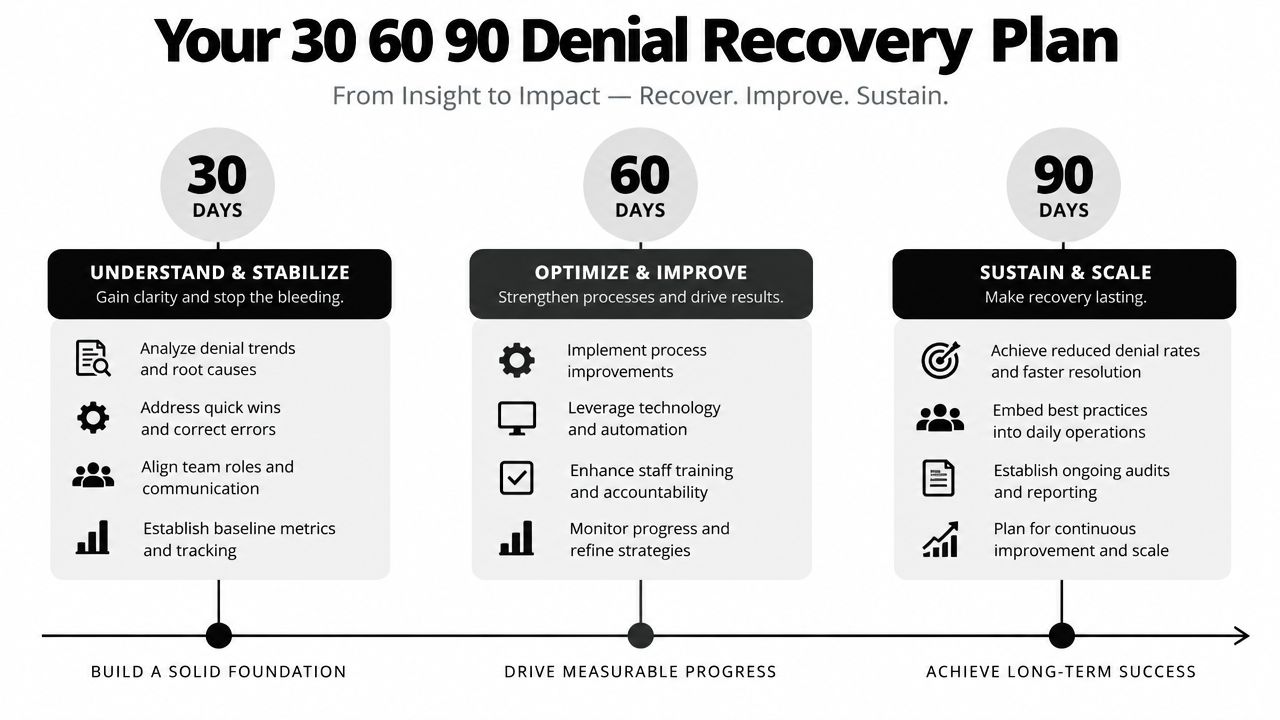
Start Monday with a defined work queue, not a general instruction to “watch denials.” Assign one owner for data extraction, one for clinical review, one for coding analysis, and one for payer escalation. If the practice is small, one person can hold multiple roles, but each decision still needs an accountable name.
Days 1 through 30, establish the baseline
Pull all medical-necessity denials from the prior 90 days. Categorize each account as an LCD or NCD gap, payer-policy mismatch, authorization failure, thin documentation, coding error, or another verified category. Record billed amount, allowed amount if available, denial date, appeal deadline, payer, specialty, procedure, and current status.
Rank causes by net dollar exposure, not by claim count alone. A frequent low-value denial may consume less cash than a recurring high-value specialty procedure. Review a sample from each category and identify the earliest upstream point where staff could have detected the problem.
Days 31 through 60, fix the largest leakage point
Deploy the intervention that matches the biggest exposure. That may be a documentation template, a scheduling authorization checkpoint, a coding edit, or a coder-to-clinician feedback loop. Write the required evidence into the workflow, then train the people who create or verify it.
Keep the appeal operation running while prevention changes go live. Otherwise, the organization may reduce future denials while allowing existing reimbursement to age past its appeal deadline.
Days 61 through 90, validate the system
Measure reversal rate, average days to overturn, authorization denial rate, and the clean-claim-rate shift. Review whether the same payer language continues to appear after the intervention. Run at least one peer-to-peer review and one external review when the plan and case support those routes, then document what each reviewer required.
After the first cycle, hold a standing monthly medical-necessity review. Bring together RCM, coding, authorization, scheduling, clinical leadership, and contracting. Review new payer policies, overturned and unoverturned appeals, documentation defects, and claims approaching escalation deadlines.
The aim isn't to appeal every denial. It's to separate reversible denials from unsupported or excluded claims, recover the accounts with a defensible path, and remove the upstream conditions that keep creating them.
RevGuard connects specialty-specific RCM with enforcement-driven IDR support, helping provider organizations build clean, dispute-ready claims and manage medical-necessity denials from documentation and coding through appeal and payment recovery. Visit RevGuard to review how its workflows and payer-behavior analytics can fit your denial recovery operation.