

The most popular advice about credentialing for Medicare is also the most dangerous: submit the application early, then wait for approval. That approach treats enrollment as a form you send rather than an identity record Medicare uses to determine whether a provider can bill. In 2026, that distinction matters because CMS is rebuilding PECOS around real-time validation, federal database cross-checks, mandatory CMS Identity & Access multi-factor authentication, and phased migration through the end of the year, as described in its provider enrollment certification roadmap.
For a revenue cycle director, the practical conclusion is straightforward. A provider can be clinically ready, scheduled, and seeing Medicare beneficiaries, yet still create reimbursement risk if the NPI, legal entity, ownership information, location, access credentials, or revalidation status doesn't align. The work belongs in the same operating discipline as claims, eligibility, and cash posting, not in an inbox owned by whoever has time to complete a form.
The New Reality of Medicare Enrollment in 2026
Credentialing isn't just administrative paperwork anymore. PECOS is Medicare's electronic system of record for enrollment, and the platform's redesign makes identity, access, and data consistency part of the billing control environment. CMS says the rebuilt system will use real-time validation and cross-check information against federal databases, while requiring CMS Identity & Access multi-factor authentication during the transition through the end of 2026, according to the CMS roadmap for provider enrollment and certification.
That changes how managers should define a “clean” enrollment file. A clean file isn't merely complete because every field contains text. It must use the correct legal name, connect the right NPI to the right organization or individual, disclose ownership and reassignment details accurately, and remain accessible to the people responsible for responding to Medicare Administrative Contractor, or MAC, requests.
Why old shortcuts fail
Many teams still divide the work into two disconnected tasks. An administrator enters the application, while billing staff deal with whatever happens after approval. That separation breaks down when a validation check identifies an inconsistency that originated in NPPES, a location record, an ownership document, or an access profile.
The operational risk is especially pronounced in multi-specialty groups. Each clinician, group, facility, billing entity, and state location can create a relationship that must remain coherent across enrollment records. A spreadsheet that only tracks submission dates won't reveal whether the underlying identity data changed or whether the person responsible for the account can still authenticate.
Practical rule: Treat every PECOS action as a controlled change to a revenue-enabling identity record.
The new environment also raises the cost of slow internal handoffs. CMS states that providers should respond to MAC requests within 30 days, so an unanswered message isn't a minor administrative delay. It can become a break in the enrollment workflow, particularly when the request requires a document, signature, clarification, or correction from another department.
The right operating model
Assign a named owner for each enrollment record, a backup owner, and an escalation path to compliance or revenue cycle leadership. Review access before a staff member leaves, document who can submit or modify applications, and keep evidence of every response and status change.
The teams that adapt well won't necessarily be the ones with the most staff. They'll be the ones that stop measuring credentialing by “application submitted” and start measuring it by accurate data, controlled access, timely responses, and active billing privileges.
Prerequisites and Pre-Enrollment Preparation
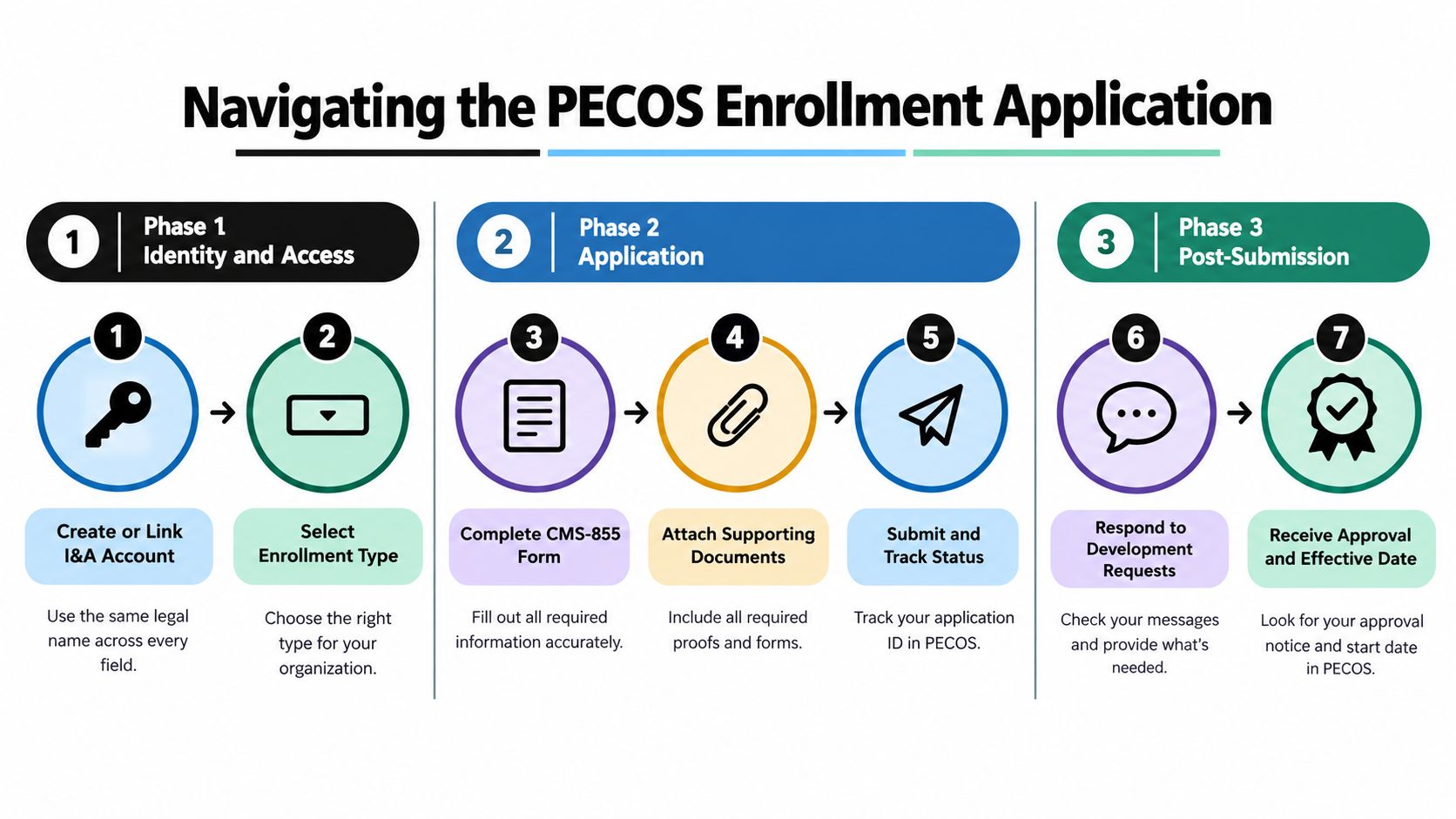
The cleanest PECOS application starts before anyone opens PECOS. Begin with a source-of-truth review that compares the provider's legal documents, tax information, NPI record, practice locations, ownership details, and internal enrollment records. CMS specifically instructs providers to keep information accurate in both NPPES and PECOS, and warns that an inactive PECOS application can be automatically deleted, as explained on its PECOS enrollment and renewal page.
That warning changes the preparation standard. Don't use the application itself as a place to discover basic identity information. Resolve discrepancies first, then enter the application with a controlled data set.
Build the identity file first
Use a practical pre-enrollment checklist:
- Confirm I&A access: Verify that the responsible user can authenticate through CMS Identity & Access and has the permissions needed for the provider or organization.
- Match the NPI record: Compare the NPI record with the legal name, entity type, taxonomy, correspondence information, and practice details you intend to submit.
- Validate the billing structure: Identify whether the application concerns an individual provider, a group, a facility, a reassignment, an initial enrollment, or a revalidation.
- Collect supporting evidence: Assemble licenses, ownership documents, practice-location records, signatures, and any other documents the selected application requires.
- Create a response folder: Keep submitted materials, confirmation details, correspondence, and later MAC requests together so another trained employee can take over without reconstructing the file.
The objective isn't to create paperwork for its own sake. It is to ensure that every system presents the same provider identity. CMS uses the Medicare Provider-Supplier Enrollment dataset to track enrollment and revalidation status, so consistency has operational value beyond the application screen.
Protect the draft from inactivity
A draft application needs an owner and a follow-up date. If the team cannot explain who is monitoring it, what remains outstanding, and how a MAC will contact the organization, the file isn't under control.
Don't let an external credentialing vendor become the only person who knows the account, the status, or the response history. Whether the work stays internal or is supported by a healthcare credentialing workflow, the practice should retain visibility into access, source documents, submitted data, and outstanding requests.
Before submission, perform a second-person review. Have the reviewer compare names character by character, inspect addresses and NPIs, verify signatures, and confirm that uploaded files are legible and associated with the correct enrollment action. This review is slower than clicking submit, but it is faster than restarting a file after an avoidable inconsistency.
Navigating the PECOS Enrollment Application
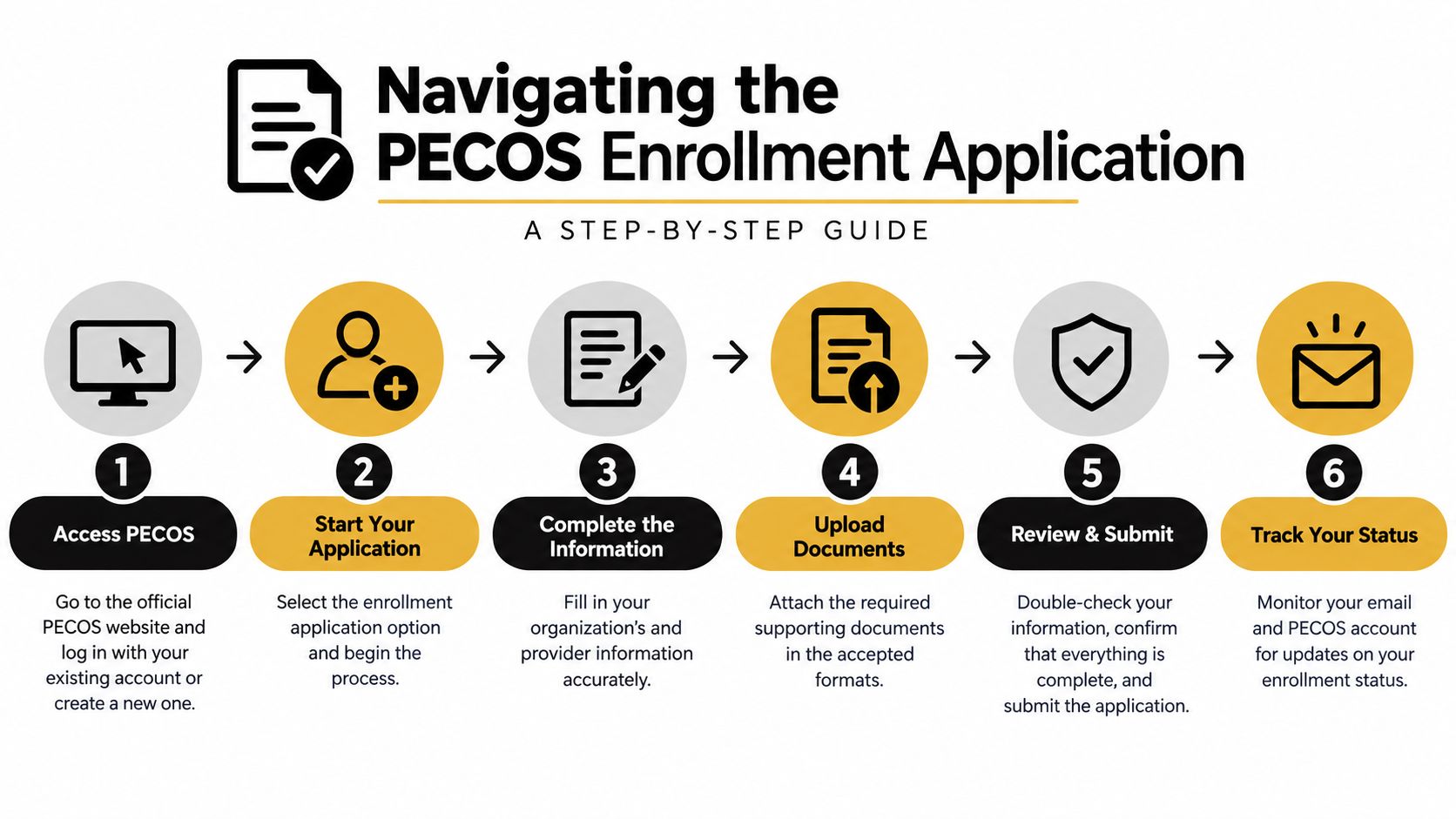
PECOS should be approached as a controlled workflow, not a single online form. Medicare enrollment is operationalized through PECOS, the electronic system of record for Medicare enrollment, and CMS lists the 2026 Medicare enrollment application fee as $750 in its PECOS fact sheet. Confirm whether the fee applies to the provider or supplier action being filed and account for it in the enrollment calendar rather than discovering it at the final step.
Start by selecting the correct action. An initial enrollment, revalidation, reassignment, change of ownership, and change of information can require different choices and supporting evidence. Selecting the wrong action creates a clean-looking application that still fails to solve the underlying billing problem.
Follow the logic of the file
The application usually becomes difficult where the organization has complexity. Individual providers, group practices, facilities, ownership structures, reassigned billing rights, and multiple locations all require the same facts to remain aligned.
Use this sequence as an operating model:
- Authenticate the account. Confirm that the correct person has CMS Identity & Access credentials and multi-factor authentication enabled for the action.
- Choose the enrollment action. Identify whether you're filing initial enrollment, revalidation, reassignment, or a change that affects an existing record.
- Enter provider and organization data. Use the legal name and identifiers exactly as they appear in the verified source records.
- Complete ownership and affiliation disclosures. Don't treat chain or ownership fields as optional narrative. They establish who controls or participates in the enrolled entity.
- Upload supporting documents. Use clear, current files and retain copies of everything submitted.
- Review and submit. Check the application for NPI, name, address, signature, and location consistency before finalizing.
- Track correspondence and status. Record the submission details, monitor PECOS, and route every MAC request to an accountable owner.
Large groups should avoid a single shared inbox with no routing rules. A better approach ties each application to a provider identifier, legal entity, state, MAC, action type, owner, backup, submitted materials, and next follow-up. That structure lets revenue cycle leaders identify which providers are approved, which are pending, and which records could affect planned billing.
Separate completion from approval
Submitting an application doesn't mean the provider is ready to bill. The MAC may request clarification or more documentation, and the organization must answer through the appropriate channel while preserving an audit trail. A status dashboard should distinguish draft, submitted, development, approved, rejected, and active billing states, rather than placing every record in a vague “in progress” bucket.
Automation can help with ownership, reminders, document control, and exception reporting, but it shouldn't replace human review of legal identity and enrollment relationships. Practices evaluating provider credentialing software should ask whether the system preserves source data, supports role-based accountability, and makes exceptions visible to revenue cycle leadership.
Processing Timelines and Avoiding MAC Rejections
A submitted application enters an adjudication process, and the quality of the file determines whether the MAC can move it forward without development. A common benchmark is 15 to 85 calendar days for clean PECOS submissions and 30 to 100 days for paper applications, with site visits or fingerprinting potentially extending processing, according to this Medicare credentialing and enrollment guide. Another expert summary in that source places average Medicare credentialing at 60 to 90 days, depending on MAC workload and application completeness.
Those ranges are planning inputs, not promises. A file with missing signatures, inconsistent names, or conflicting addresses can spend time moving backward instead of progressing through review.
Where applications lose time
The most common failure pattern is inconsistency between records. A provider's legal name may differ from the NPI record, a practice address may use a different format, or the application may identify a billing relationship that supporting documents don't substantiate. Under PECOS 2.0, real-time validation and federal database cross-checks make these gaps harder to overlook.
A historical HHS Office of Inspector General review illustrates why precision deserves management attention. The review found inaccurate data in 48% of NPPES records and 58% of PECOS records, with inconsistencies between the databases in 97% of records, as documented in the OIG report on Medicare enrollment data accuracy. The finding is historical, but the operational lesson remains relevant: enrollment data quality is a control issue, not a clerical preference.
| Submission Type | Expected Timeline | Common Delay Triggers |
|---|---|---|
| Clean PECOS submission | 15 to 85 calendar days | Incomplete information, mismatched identifiers, unclear supporting documents |
| Paper application | 30 to 100 days | Manual handling, missing signatures, address discrepancies |
| Application requiring additional checks | Longer than the standard range | Site visits, fingerprinting, MAC development requests |
Manage MAC correspondence like a denial
Create a daily work queue for MAC correspondence. Route requests to the person who owns the source document, set an internal deadline before the CMS deadline, and record the response date and evidence submitted. CMS expects providers to respond to MAC requests within 30 days, so waiting for a weekly administrative meeting is a poor control.
A MAC request isn't an interruption to the credentialing process. It is part of the process, and the response clock starts when the request arrives.
Don't rely on a portal status alone. Check correspondence channels, preserve confirmation receipts, and escalate stalled applications through documented contacts. If a provider's planned start date is approaching, tell scheduling, contracting, billing, and finance what is approved, what remains pending, and what services shouldn't be billed until the enrollment status supports them.
Specialty Considerations and Revalidation Cycles
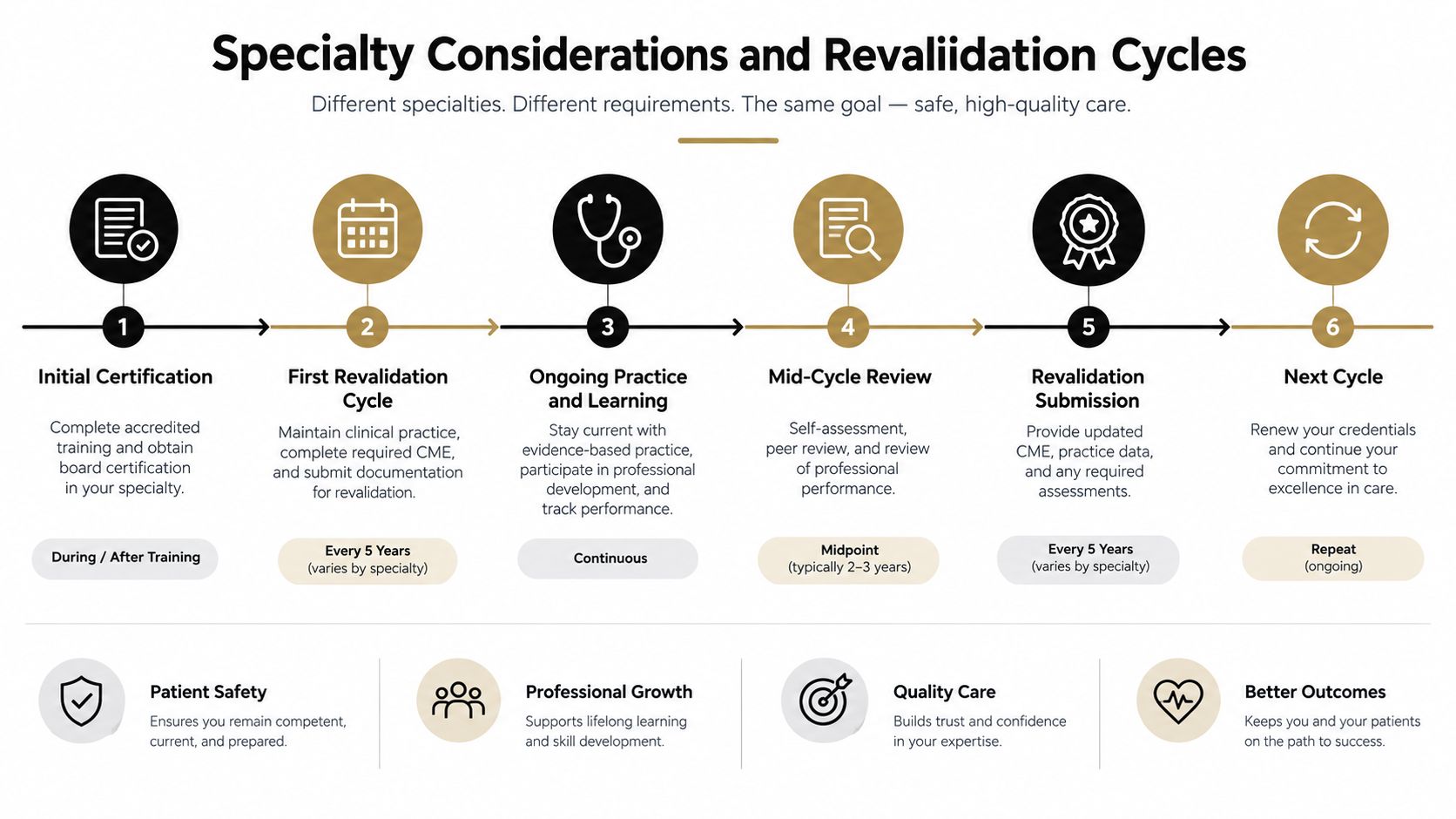
Medicare billing privileges require maintenance. CMS generally requires revalidation every 5 years for most providers and every 3 years for DMEPOS suppliers, with due dates posted 6 to 7 months in advance and notices sent approximately 3 to 4 months before the deadline, according to the CMS PECOS fact sheet. Those intervals turn credentialing into a recurring compliance cycle.
The cycle becomes harder to manage when a platform operates across states, specialties, facilities, and billing entities. A group may have clinicians entering and leaving, locations changing, ownership structures evolving, and supplier records subject to a different revalidation cadence. One calendar for the entire organization hides those differences.
Build the tracker around action, not dates
A useful revalidation tracker should show:
- Enrollment identity: Provider or supplier name, NPI, legal entity, billing entity, location, and MAC.
- Cycle type: Standard provider revalidation, DMEPOS revalidation, or another applicable enrollment action.
- Due-date evidence: The CMS-posted date, notice received, assigned owner, and internal review date.
- Change triggers: New location, ownership change, reassignment, legal-name change, or other event requiring an update before the ordinary cycle.
- Billing status: Active, under review, pending response, or at risk of deactivation.
Don't wait for the notice to start gathering documents. Use the posted due date to work backward, validate NPPES and PECOS information, confirm I&A access, and review the last submitted application for changes.
Specialty complexity needs separate controls
An anesthesia group, oncology practice, air ambulance provider, imaging center, and DMEPOS supplier may share a credentialing platform, but they don't share the same operational risk. Each service line should identify which providers, locations, entities, and enrollment relationships must be active before claims can be released.
Revalidation also deserves a finance-facing escalation rule. If a deadline approaches without a complete submission or a response remains outstanding, revenue cycle leadership should know before claims fail. The purpose of the tracker isn't to report administrative activity. It's to prevent a lapse in billing authority from reaching the claim file.
Integrating Credentialing with Revenue Protection
Credentialing belongs upstream in revenue protection because claim quality begins with provider identity. If the enrollment record doesn't support the provider, entity, location, or billing relationship on the claim, downstream teams may spend time correcting denials that originated before the patient was ever scheduled.
The timing alone justifies a formal launch plan. Average Medicare credentialing takes 60 to 90 days, and the practical recommendation is to begin enrollment 4 to 6 months before planned billing, as summarized in this Medicare credentialing timeline guide. The additional lead time gives the organization room to resolve data discrepancies, answer MAC requests, and verify that the approved record supports the intended billing arrangement.
Connect enrollment data to claims controls
A mature workflow links credentialing status to scheduling and claim release. Before a new provider begins Medicare services, verify the applicable enrollment action, effective status, location, reassignment, and billing entity. When a clinician moves, joins a new group, or begins working at another site, trigger a controlled review instead of assuming the old record remains sufficient.
Track revenue-facing measures such as:
- claims held because enrollment isn't active or verified;
- denials associated with provider, entity, or location mismatch;
- days between a MAC request and the documented response;
- open revalidation actions by billing entity;
- unresolved enrollment exceptions affecting scheduled services.
These measures help finance and operations see credentialing as a balance-sheet protection activity. They also create a useful handoff to payer disputes. A claim with accurate enrollment, service, coding, and contract evidence is easier to investigate and defend than a claim assembled from disconnected systems.
Don't confuse credentialing with payer recovery
IDR, payer negotiation, and collections can't repair a provider record that was never correctly enrolled. Underpayment work is most productive when the organization has already controlled the upstream facts and can distinguish an enrollment denial from a coding issue, eligibility issue, contract issue, or payment variance.
For specialty practices and multi-state platforms, a structured provider credentialing process can connect initial enrollment, recredentialing, government payer enrollment, group and facility enrollment, NPI validation, and roster maintenance to the broader revenue cycle. The right model may be internal ownership, specialized software, outside support, or a combination. The essential requirement is visibility, accountability, and evidence.
Credentialing for Medicare should therefore have a place in the same operating meeting as denials and cash collections. When leaders monitor identity data, access, deadlines, and claim impact together, they can stop treating enrollment failures as isolated administrative errors and start preventing avoidable revenue leakage.
RevGuard connects healthcare credentialing, payer enrollment, revenue cycle management, and enforcement-focused recovery workflows for provider organizations. If your team needs tighter control over PECOS data, revalidation, claim readiness, and payer underpayments, visit RevGuard to discuss the workflow with its specialists.