

A denial rate of 20% across all claims was reported for insurers offering qualified health plans on HealthCare.gov in 2024, with 19% of in-network claims and 37% of out-of-network claims denied. KFF's analysis of 2024 claims denials makes the operational point clear: denials aren't isolated billing mistakes. They're a recurring feature of payer behavior that can disrupt cash flow, consume staff capacity, and hide preventable failures in registration, authorization, coding, and documentation.
A workable denial management process therefore can't begin with an appeal letter. It has to begin before the patient arrives, continue through claim submission and adjudication, and end with a documented prevention action. Specialty practices that treat denials as a collection of individual tasks will keep reworking the same errors. Practices that treat them as revenue leakage signals can correct the source, recover eligible payment, and build claims that are easier to defend when payers delay, downcode, or deny them.
The True Scale of the Denial Problem
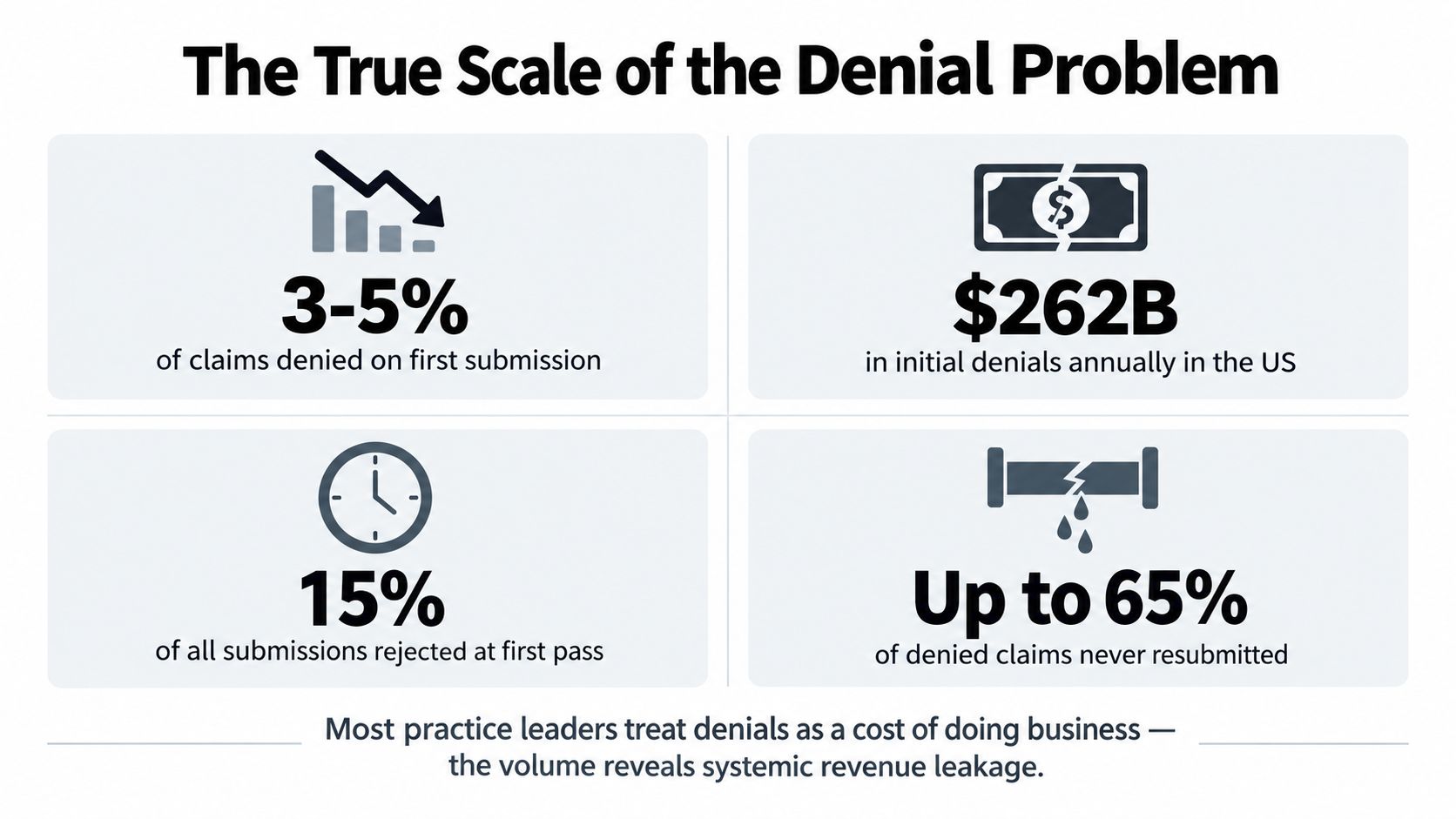
Insurers on HealthCare.gov denied about 85 million in-network claims in 2024, compared with 44 million out-of-network claims. The combined denial rate was 20%, and the prior year showed a similar pattern, with 20% of in-network claims and 36% of out-of-network claims denied, according to this KFF claims denial analysis. The payer, specialty, service line, and contract still determine the work required. The operating conclusion is clear: a denial queue is part of the revenue cycle, not an exception queue.
Why reactive recovery underperforms
A reactive model begins after the payer identifies a defect. Staff interpret the denial code, locate records, correct the claim or draft an appeal, then work against the payer's deadline. That approach can recover valid claims, yet it leaves the originating failure untouched. The same registration, authorization, coding, or documentation defect can continue entering the queue.
Classification determines whether the response fits the risk. An eligibility denial may need correction at intake. A missing modifier usually belongs with coding. A downcoded specialty service may require contract review, clinical records, and escalation through the No Surprises Act (NSA) independent dispute resolution (IDR) process when the dispute qualifies. Routing every case through one appeal workflow wastes staff time and delays higher-value recoveries.
Practical rule: Measure denials as dollars at risk and operational causes. A recurring low-dollar error can deserve more attention than a large isolated dispute when it contaminates submissions from an entire department.
Denial management is revenue recovery
Recovery remains a direct cash-flow function. The team must identify claims that can be corrected, appealed, negotiated, or escalated, then preserve the documentation and deadlines needed to support each path. A claim should not be abandoned merely because the first payer response requires additional work.
That discipline changes how leaders staff and govern denial management. The function belongs in discussions about front-end quality, coding accuracy, payer behavior, clinical documentation, contract enforcement, accounts receivable, and NSA/IDR readiness. It also requires feedback upstream. Each resolved denial should produce a prevention action, such as a registration control, coding edit, authorization rule, documentation prompt, or payer-specific escalation trigger.
The right question for a specialty practice is, “What allowed this claim to fail, and what must change so the next clinically identical claim is clean and defensible?” Appeal templates have a place, but they cannot compensate for unreliable inputs or a failure to escalate contract and payment disputes.
For a practical comparison of payer-specific patterns, review this health insurance claim denial rate resource. Leaders should examine denial volume by payer, provider, procedure, location, denial code, and failure stage. That view shows where prevention will protect the most revenue and where a payer dispute warrants structured escalation rather than another routine follow-up.
Upstream Data Quality and Payer Automation
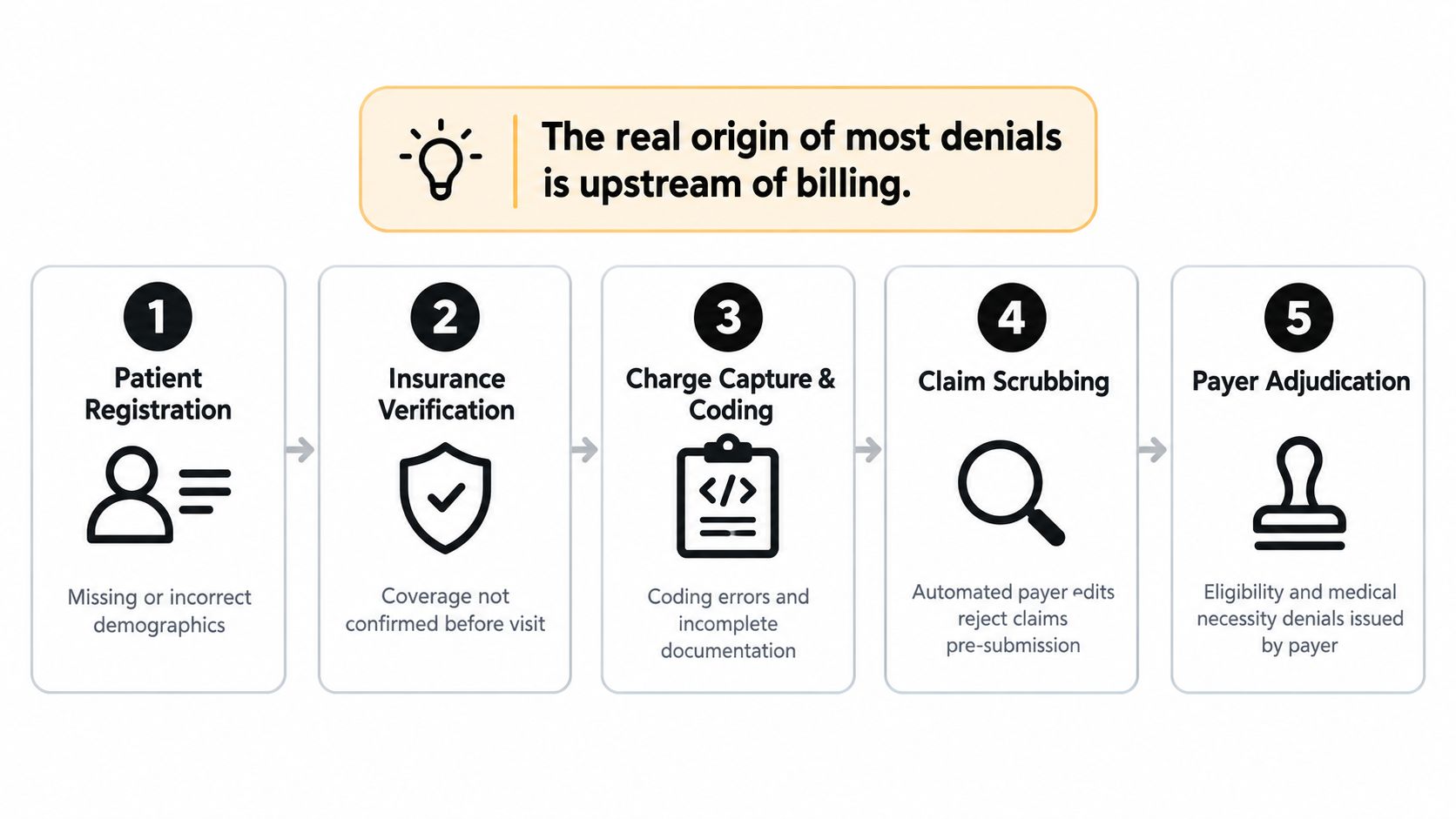
Most denial reviews start in billing because that's where the rejection becomes visible. That doesn't mean billing created the problem. In many specialty practices, the failure begins with a misspelled name, an outdated member ID, an unverified benefit, an authorization attached to the wrong service, or documentation that never reaches the coding team.
A 2025 provider survey found that 68% of revenue-cycle leaders said clean claims were harder to submit than a year earlier, and 50% identified missing or inaccurate data as the top denial driver, according to Experian Health's State of Claims 2025 survey. Those findings point directly to patient access and clinical workflow. If intake data is unreliable, a technically perfect claim can still fail adjudication.
Build controls where the error starts
The most effective front-end controls are specific and owned. Don't give a general instruction to “verify insurance.” Define what staff must verify, where the result is recorded, and what happens when the result is incomplete.
- Registration integrity: Match the patient's legal name, date of birth, address, subscriber details, and member identifier against the payer response. Don't rely on a scanned card alone.
- Eligibility and benefits: Confirm active coverage, service benefits, network status, exclusions, and patient responsibility before the encounter whenever the payer supports electronic verification.
- Authorization matching: Tie the authorization to the correct payer, patient, facility, rendering provider, procedure, date range, and units or services. An authorization that exists but doesn't match the claim won't protect reimbursement.
- Clinical documentation readiness: Give clinicians and coders a clear view of the documentation needed for the service. A missing operative detail or incomplete diagnosis linkage can turn an appropriate service into a preventable dispute.
- Pre-submission edits: Use claim scrubbing to identify demographic, coding, modifier, payer, and attachment defects before transmission. Route exceptions to a person who can resolve them rather than allowing an automatic release.
healthcare workflow automation can support, rather than replace, staff judgment. Automation is useful for repetitive verification, data matching, work-queue assignment, and edit detection. It shouldn't make opaque clinical decisions or conceal why a claim was held.
Prior authorization isn't a complete defense
Payer automation has changed the timing of denials. HFMA reported that initial denials were about 11.65% through November 2025, prior-authorization and precertification denials reached 1.56%, and some denials occurred within seconds of submission. The same HFMA report on automated denial activity found that 90% of denials were reworked with at least some human review.
That combination creates a poor trade-off. Payers can make rapid algorithmic decisions, while providers use people to investigate, correct, document, and appeal each result. Prior authorization can establish that a service passed an earlier review, but it doesn't guarantee payment if the submitted claim contains conflicting data, the payer applies a different edit, or the authorization isn't properly connected to the billed service.
A sound denial management process keeps an audit trail from intake through submission. Store the eligibility response, authorization details, clinical support, coding rationale, claim edits, and payer correspondence in a retrievable record. When a preauthorized service is denied, the team can then demonstrate exactly what was approved, what was delivered, what was billed, and where the payer's decision diverged.
Triage and Root-Cause Classification
Speed matters after a denial arrives, but speed without classification creates expensive motion. The first person who opens the account should capture the denial as structured data, not just add a free-text note. At minimum, the record should identify the payer, patient account, claim and service dates, denial code, billed and expected amounts, affected line, submission history, authorization status, owner, deadline, and next action.
AHIMA describes the core workflow as logging and responding to denials, understanding root causes, and creating an action plan to prevent recurrence in its denial management guidance for medical practices. That sequence prevents the common failure of treating resolution as the endpoint. Payment is an outcome. The management process isn't complete until the organization knows why the claim failed and who must change the upstream step.
Classify before assigning
Use categories that lead to a decision. A practice can tailor the labels to its specialties, but the categories should separate administrative defects, coding and technical issues, clinical disputes, authorization failures, and payment disagreements. Each category should have a defined owner and evidence checklist.
- Administrative and eligibility: Patient access or billing validates demographic and coverage data, corrects the claim when appropriate, and determines whether the error affects other open accounts.
- Authorization and referral: The authorization or utilization team compares the payer approval with the billed service and assembles proof of approval, referral, medical order, and service delivery.
- Coding and documentation: Coding reviews the code, modifier, diagnosis linkage, operative report, and payer policy. The team should correct the claim only when the record supports the correction.
- Clinical and medical necessity: A clinical reviewer or physician advisor evaluates the payer's rationale, identifies the relevant record, and prepares a clinically coherent response rather than a generic billing explanation.
- Underpayment and downcoding: Contracting, billing, or a specialized dispute team compares the payment with contract terms, state and federal requirements, the service delivered, and the supporting documentation.
A routing matrix keeps these decisions consistent:
| Denial Category | Common Root Cause | Resolution Workflow | Target Turnaround |
|---|---|---|---|
| Administrative and eligibility | Incorrect demographics, inactive coverage, wrong payer, or subscriber mismatch | Validate source data, correct the account, resubmit when permitted, and check related encounters | Same business day for straightforward corrections |
| Authorization and referral | Missing approval, mismatched authorization, expired referral, or service variance | Reconcile approval against the claim and record, obtain missing evidence, then submit a correction or appeal | Immediate review because payer deadlines may be short |
| Coding and technical | Invalid code combination, modifier issue, missing attachment, duplicate, or transmission edit | Coding review, claim correction, scrubber validation, and resubmission with an audit note | Prioritize before the filing or appeal window closes |
| Clinical and medical necessity | Payer disputes the indication, level of service, or supporting documentation | Clinical review, physician input, record assembly, and level-appropriate appeal | Route promptly to preserve clinical reviewer capacity |
| Underpayment and downcoding | Payment doesn't reflect the contracted or legally applicable reimbursement basis | Contract comparison, payer inquiry, reconsideration, and eligible escalation | Prioritize by dollar exposure and dispute deadlines |
Rank recovery value and recurrence risk
Dollar value is only one triage factor. Add deadline proximity, probability of overturn, clinical complexity, payer history, and recurrence frequency. A claim with a strong record and a filing deadline approaching may outrank a larger claim that lacks medical support. A recurring registration defect may warrant a prevention project even when individual accounts aren't large.
Use daily work queues for urgent deadlines and high-confidence corrections. Review unresolved patterns with front-end, coding, clinical, and payer-relations leaders on a regular cadence. The output should be an action plan with a named owner, a change to the workflow, a way to test the change, and a date for reviewing whether the denial pattern changed.
Appeals Workflow and NSA IDR Escalation
An appeal is a controlled evidence package, not a longer version of a complaint letter. The strongest submissions answer the denial reason directly, establish what service occurred, connect the service to the patient's condition, and show why the payer's decision conflicts with the record, authorization, contract, or applicable requirements.
Start by preserving the original claim and denial. Then assemble the clinical record, authorization, eligibility result, coding audit, operative or procedure note, relevant payer policy, contract language where appropriate, and a concise chronology. Someone who wasn't involved in the original claim should be able to understand the case without searching across disconnected systems.
Make the standard appeal disciplined
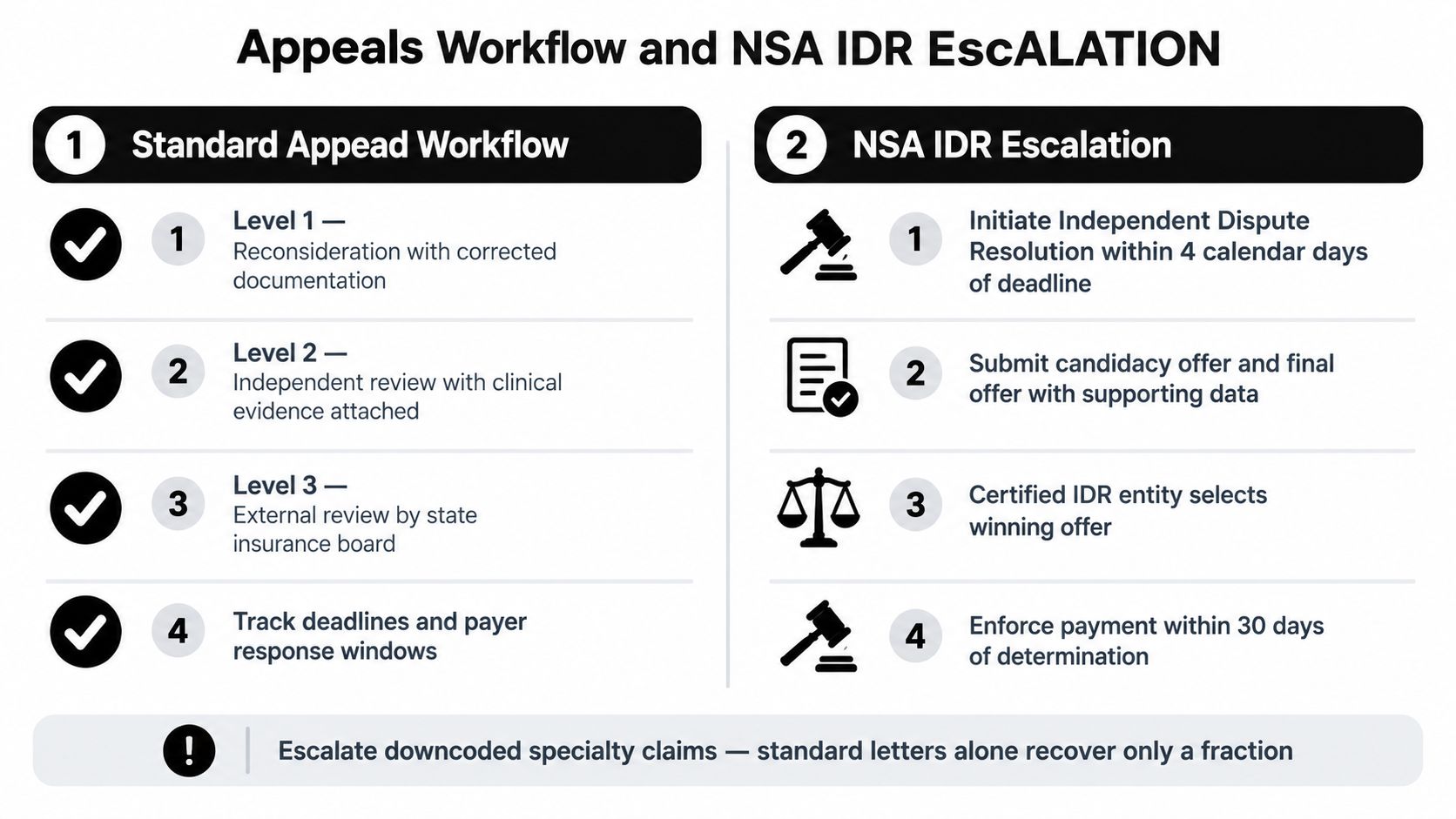
A practical appeal workflow has clear gates:
- Confirm the denial: Verify that the payer processed the correct claim, line, provider, date, authorization, and diagnosis. Don't appeal a system mismatch without correcting the underlying record.
- Select the remedy: Decide whether the case needs a corrected claim, reconsideration, formal appeal, peer review, contract inquiry, or another route. Sending the wrong remedy can waste the available response window.
- Build the evidence: Lead with the denial reason, then answer it with the strongest clinical, administrative, and contractual evidence. Remove irrelevant records that make the reviewer hunt for the point.
- Submit and monitor: Record the submission channel, date, confirmation, payer reference number, expected response window, and next escalation date. Assign one owner for follow-up.
- Close the loop: Record payment, partial payment, final denial, or escalation decision. Feed the root cause into prevention and update payer-specific guidance when the result reveals a pattern.
A generic template may help staff maintain consistency, but it won't compensate for missing evidence or a claim that was never eligible for the requested remedy. Specialty practices should also separate clinical appeals from underpayment disputes. The former asks whether the service was covered and supported. The latter asks whether the payer paid the correct amount for a service that was delivered and adjudicated.
Know when the dispute needs IDR
The No Surprises Act creates a distinct path for eligible out-of-network payment disputes. It isn't a universal replacement for payer appeals, and a practice shouldn't send every denial into arbitration. The team must first confirm eligibility, required negotiation steps, applicable notices, filing windows, patient protections, and the evidence required by the current process.
IDR becomes strategically relevant when an eligible out-of-network or specialty claim remains underpaid after the required payer interaction, especially when the payer's payment doesn't reflect the service, circumstances, or available supporting factors. The file should include the offer history, service details, payer response, relevant contract or benchmark information, clinical complexity, and proof that procedural requirements were met. A weak record doesn't become strong because it reaches arbitration.
The No Surprises Act IDR resource is useful for separating ordinary claim correction from an enforcement-oriented dispute strategy. The key management decision is whether continued correspondence is likely to change the outcome or whether the organization should preserve its rights and move to the appropriate escalation path.
A payer delay is a workflow event. Record it, assign it, and decide what procedural deadline follows. Don't let repeated status calls substitute for a documented escalation decision.
The financial case for disciplined recovery is substantial. Premier reported that insurers process about 3 billion medical claims annually and that approximately 70% of denials are overturned and paid, as summarized by the American Hospital Association's payer denial analysis. Not every claim is recoverable, but abandoning claims without a reasoned triage decision leaves potential revenue unexplored.
Technology Integration and KPI Tracking
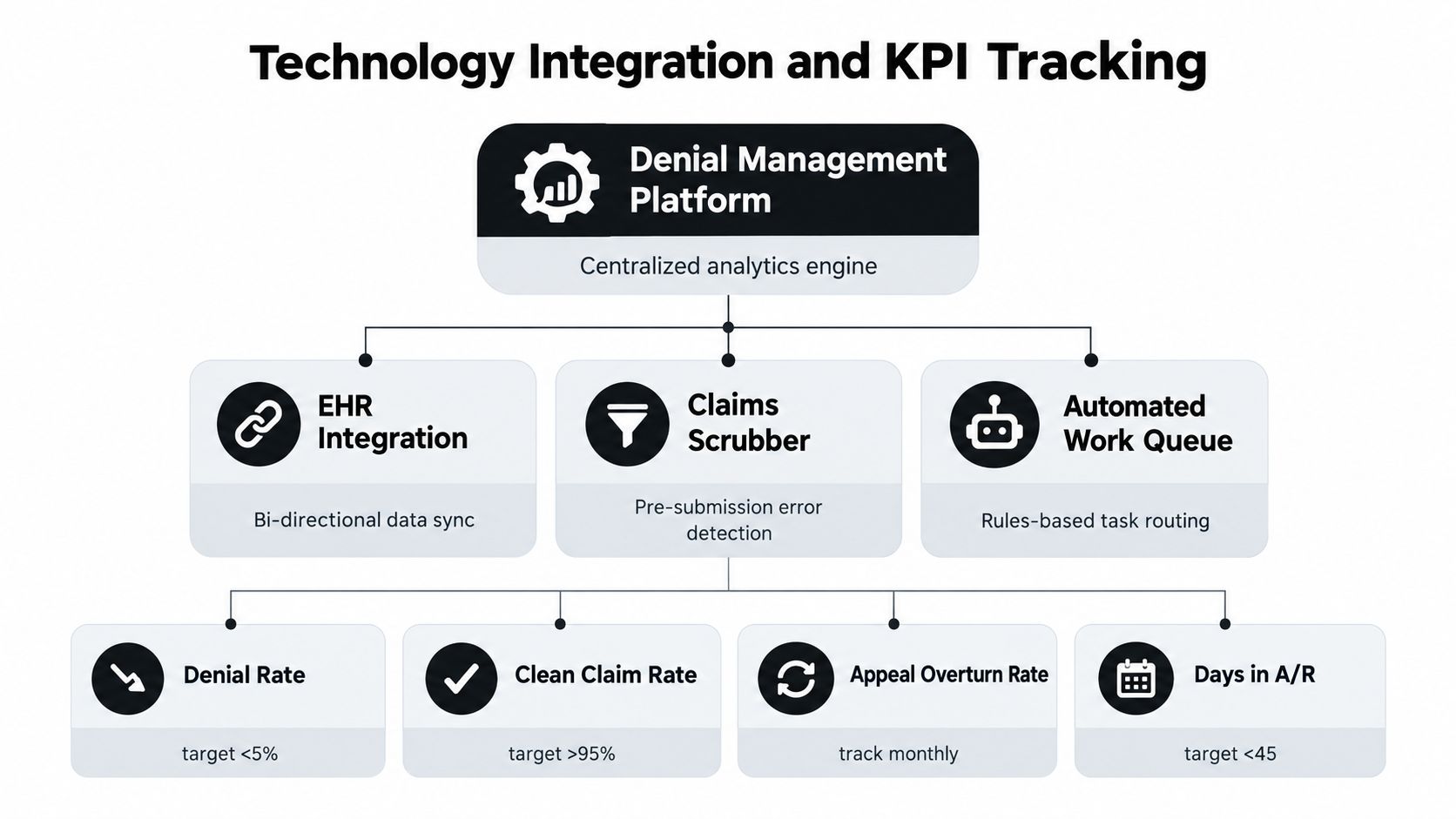
A denial management platform should make the right work visible, not merely move tasks between folders. The essential capability is a connected record that links the original encounter, claim edits, payer response, denial category, evidence, appeal activity, payment result, and prevention action.
Start with the systems already carrying the relevant data. An EHR or practice management system provides encounter and clinical context. A clearinghouse supplies submission and response files. Eligibility and authorization tools provide front-end evidence. A claims scrubber identifies defects before submission. The denial layer should unify these signals so staff don't reconstruct the story manually.
Track measures that drive decisions
HFMA recommends measuring initial denial rate, time from initial denial to appeal, time from initial denial to resolution, and the percentage of denials overturned. Those measures appear in HFMA's claim integrity and denial metrics guidance. Use them as operating controls, not decorative dashboard figures.
Segment every KPI by payer, specialty, location, provider, procedure family, denial category, and submission stage. An overall rate can remain stable while one payer begins denying a specific service line. A strong overturn rate can conceal excessive time spent on low-value cases. A fast appeal time can still produce poor results if the evidence package is incomplete.
A useful operating dashboard answers practical questions:
- Where are claims failing? Separate front-end, coding, scrubber, adjudication, and post-payment disputes.
- What is recoverable? Show open dollars by denial category, age, payer, deadline, and estimated recovery potential.
- What is recurring? Rank root causes by frequency and financial exposure, then assign prevention owners.
- Which payers require intervention? Compare response behavior, denial reasons, underpayment patterns, and overturn outcomes.
- What is stuck? Surface cases with no owner, missing evidence, approaching deadlines, or repeated payer follow-up.
Match technology to human judgment
Automation should handle deterministic tasks. It can import remittance data, group denial codes, create work queues, flag missing documentation, calculate deadline reminders, and route cases based on payer or service line. It shouldn't decide medical necessity, invent an appeal argument, or submit a corrected claim without a controlled review.
Staffing should mirror the denial lifecycle. Patient access owns registration and eligibility defects. Authorization staff own approval integrity. Coders and clinical reviewers handle documentation and medical disputes. Appeals specialists manage evidence and payer deadlines. Contracting or IDR specialists evaluate eligible underpayments and escalation. A manager owns governance, root-cause reporting, and prevention priorities.
Management test: If a dashboard shows a denial rate but can't show the affected workflow step and accountable owner, it isn't yet a prevention tool.
Use weekly operational reviews for deadlines and high-value inventory. Use a broader recurring review for payer trends, recurring defects, and changes to training or system edits. The objective isn't to make staff work every denial faster. It's to reduce avoidable volume, protect high-value claims, and ensure that complex disputes reach people with the right authority and evidence.
Building a Proactive Revenue Protection Model
A mature denial management process connects two loops. The first loop prevents failure before submission through accurate registration, verified coverage, authorization control, documentation, coding, and claim edits. The second loop recovers and enforces payment after adjudication through structured appeals, underpayment review, and eligible NSA IDR escalation.
The loops need a shared data model. If the appeals team can't see the authorization response, the intake team can't see why the claim failed, and leaders can't connect a payer pattern to a contract or service line, the organization will keep treating symptoms separately. Each resolved case should update payer rules, staff guidance, clinical documentation requirements, coding edits, or escalation criteria.
Make prevention accountable
Assign an owner to each recurring root cause. A missing demographic field belongs with registration leadership. A repeated authorization mismatch belongs with access or utilization management. A documentation gap belongs with clinical and coding leadership. A payment variance belongs with contracting or the dispute function. Revenue-cycle leadership should track whether the assigned change was implemented and whether the related denial pattern improved.
The best model also distinguishes correction from enforcement. Correct a claim when the data is wrong. Appeal when the payer has denied a supported service through an ordinary review path. Escalate when an eligible underpayment or out-of-network dispute requires a formal mechanism and the evidence supports pursuing it. Mixing these routes creates avoidable delay and weakens accountability.
For specialty practices, hospitals, ASCs, and multi-state platforms, this structure protects more than individual accounts. It creates payer intelligence, strengthens documentation discipline, gives executives a clearer view of cash-flow risk, and turns denied claims into evidence for better operational and contracting decisions. The sustainable advantage doesn't come from writing more letters. It comes from submitting cleaner claims, preserving evidence, and acting decisively when payer behavior requires escalation.
RevGuard combines specialty-specific revenue cycle management with No Surprises Act IDR support, including denial triage, appeal workflows, payer-outcome tracking, and eligible dispute escalation. Visit RevGuard to evaluate how an integrated prevention and enforcement model can help your practice close upstream data gaps and protect recoverable reimbursement downstream.