

In 2024, disputing parties initiated more than 1.46 million federal Independent Dispute Resolution cases, compared with 679,156 in 2023, while certified IDR entities closed 1,371,862 disputes. The process grew by approximately 440% in closed cases, showing that post-adjudication reimbursement disputes have become a core hospital cash-flow function, not an unusual exception. Federal IDR data summarized by the Congressional Research Service makes the lesson clear: revenue cycle management for hospitals must continue after claim submission, payment posting, and even the initial denial decision.
A hospital can submit technically clean claims and still lose money through incomplete eligibility work, weak documentation, contract underpayments, missed appeal deadlines, and patient balances that never receive an appropriate collection strategy. The operating model that works is connected from scheduling through final payment. Every upstream decision either protects or limits downstream recovery.
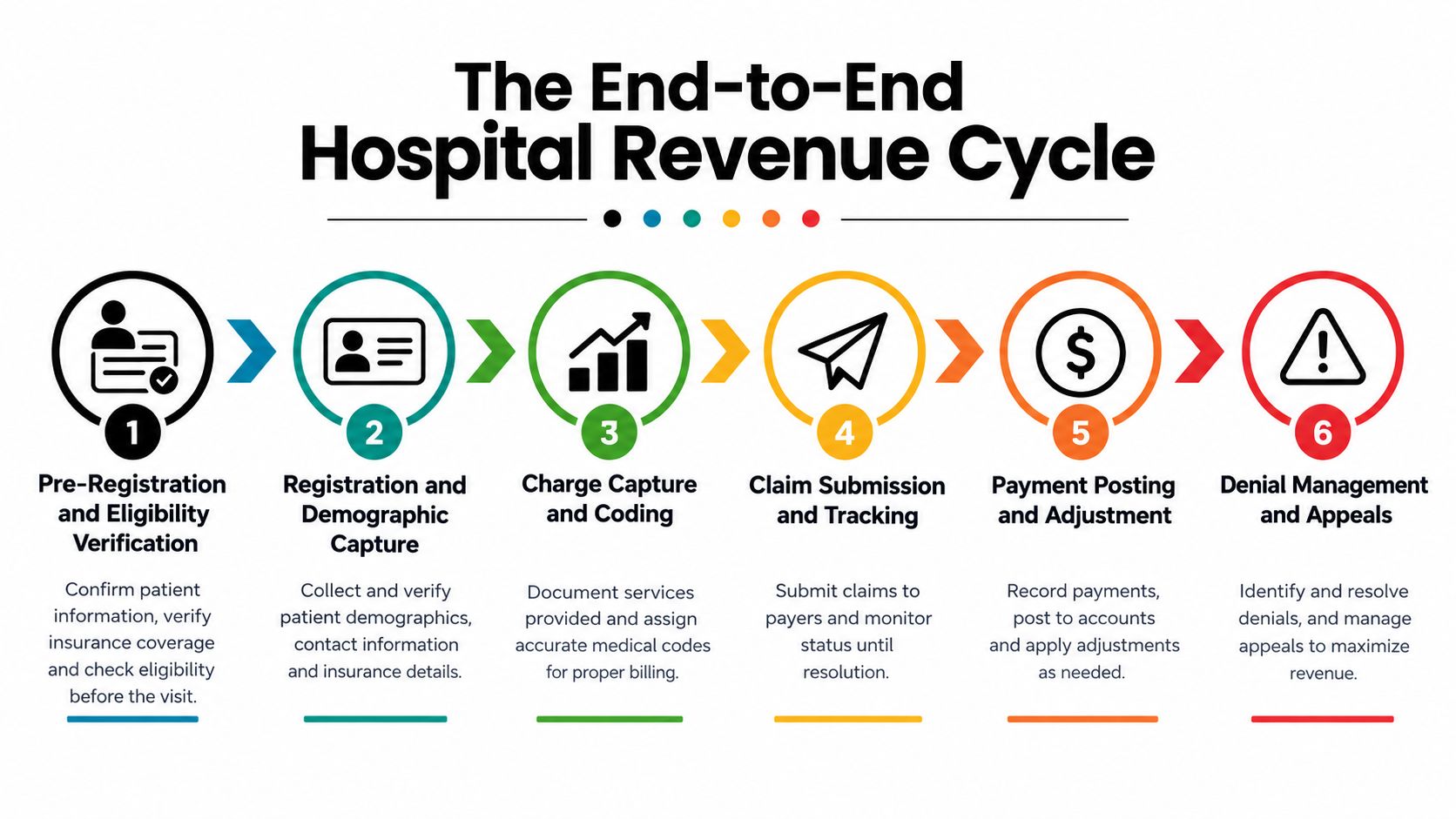
The End-to-End Hospital Revenue Cycle
A CFO staring at a denial rate near 12% and days in A/R above 60 doesn't have a billing problem alone. That dashboard reflects failures distributed across access, clinical documentation, coding, utilization review, payer follow-up, and patient financial services. The right response is to map the entire revenue cycle before assigning blame to the denial team.
The process begins before the patient arrives. Pre-registration and eligibility verification should confirm demographics, coverage status, coordination of benefits, referral requirements, and financial responsibility. Registration then validates the patient identity, guarantor, payer sequence, and encounter details. In the emergency department, staff must capture accurate information under pressure without allowing speed to replace verification.
Authorization and medical-necessity controls follow. Scheduling, utilization review, and clinical teams need a shared view of authorization requirements for inpatient services, observation, advanced imaging, procedures, and post-stabilization care. If the organization doesn't establish the right status or obtain the right authorization, billing staff can't repair the problem after discharge.
The handoffs that decide cash
Charge capture and coding convert clinical activity into billable services. Teams reconcile charges against the medical record, assign CPT and HCPCS codes for professional services, use ICD-10-PCS where applicable for inpatient procedures, and validate the resulting DRG. Observation versus admitted status deserves special attention because the classification affects utilization review, coding, claim construction, and payer adjudication.
Claim scrubbing checks edits, code combinations, payer rules, medical-necessity support, provider identifiers, and required documentation before submission. After the payer responds, payment posting must distinguish contractual adjustments from avoidable reductions, denials, and unexplained variances. A post-and-go process hides recoverable dollars.
Secondary billing and patient responsibility follow-up complete the ordinary cycle. Staff should send valid secondary claims, explain balances clearly, offer appropriate financial assistance or payment arrangements, and route unresolved payer balances to follow-up rather than allowing zero-balance accounts to escape review. A practical hospital revenue cycle management flowchart helps leaders test whether each handoff has an owner, a control, and an escalation path.
Practical rule: A claim isn't finished when the payer posts a payment. It's finished when the hospital has verified that the payment matches the contract, the documentation supports the service, and every recoverable balance has an assigned next action.
Where Hospital Revenue Leaks Start
Most leakage begins before the payer issues a remit. Four failure points need separate owners because each creates different rework and requires a different control. Front-end hygiene also determines whether the hospital can defend payment after adjudication, including contract underpayments and cases that may qualify for IDR.
Eligibility and coverage discovery fail when staff use an outdated response, miss coordination-of-benefits information, or register the wrong payer sequence. Check Medicare Secondary Payer indicators, active or inactive coverage, and guarantor data at scheduling and again when the encounter changes. Rising eligibility rejections, retroactive coverage changes, and manual corrections after discharge signal that the control is failing.
Authorization and medical necessity break when scheduling, utilization review, and clinical departments rely on different status information. Inpatient stays, observation services, extensions, and post-stabilization care require documented decisions that remain visible to coding and billing. Monitor utilization review holds, repeated clinical-record requests, and claims leaving the hospital without a clear authorization reference. Missing evidence can weaken both initial adjudication and later payment challenges.
Coding leakage appears through unspecified diagnosis codes, unsupported severity, missing procedure detail, incorrect modifiers, DRG downgrades, and HCPCS edits for drugs or supplies. Review recurring variance by service line, coder, physician, and payer. Timely filing is another preventable loss. A clinically correct, contractually payable claim can become unrecoverable if no work queue connects aging A/R with each payer's filing and appeal calendar.
Post-adjudication review belongs in the same control framework. Payment posting should compare remittance results with contract terms, identify unexplained reductions, and route underpayments to a documented recovery path. Front-end errors can also limit the records available for contract disputes or IDR eligibility, so recovery teams need access to registration, authorization, coding, and clinical evidence.
| Failure Point | Typical Denial Share | Top Denial Codes | Early Warning Signal |
|---|---|---|---|
| Eligibility and coverage | Material and recurring in high-volume access areas | Coverage inactive, payer sequence, coordination of benefits | Manual eligibility corrections and retroactive coverage changes |
| Authorization and medical necessity | Concentrated in scheduled procedures, observation, and inpatient care | Authorization absent, authorization exceeded, medical necessity not established | Utilization review holds and repeated clinical-record requests |
| Coding and documentation | Concentrated in complex inpatient and specialty services | Invalid code combination, unsupported diagnosis, DRG or modifier dispute | Repeated coder queries, payer-specific downcoding, service-line variance |
| Timely filing | Severe when work queues do not track payer deadlines | Filing limit exceeded, late corrected claim, late appeal | Aged claims without a documented next action |
Denials should be ranked by dollars, preventability, labor, and recurrence. Leaders should ask which upstream defect created each denial, whether the same defect is still entering the system, and whether related underpayments are reaching recovery review.
The KPIs That Actually Predict Hospital Cash
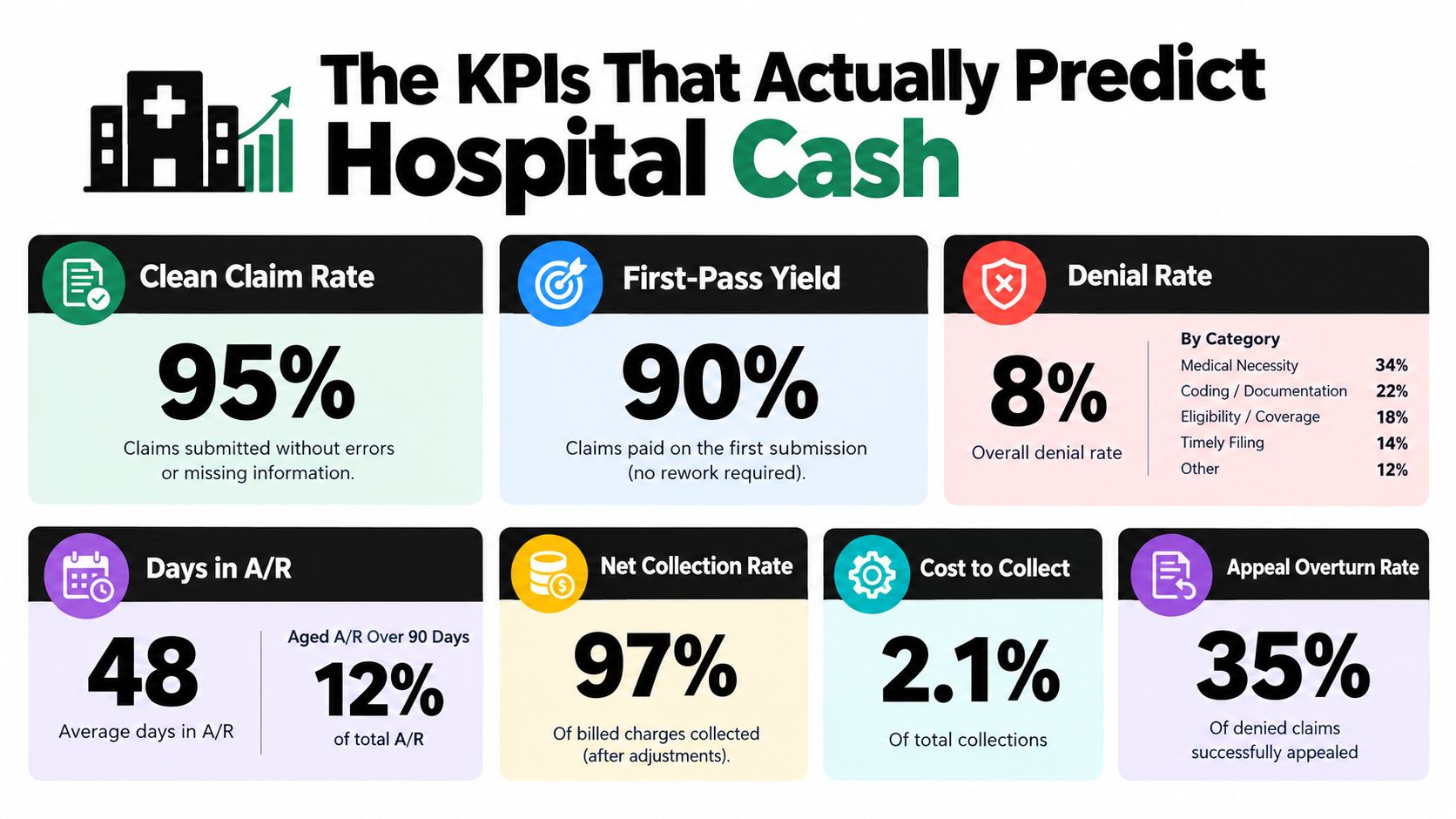
A useful RCM dashboard doesn't display isolated percentages for decoration. It shows whether the hospital is preventing defects, converting claims into payments, resolving exceptions, and collecting the remaining balance without excessive labor.
Clean claim rate measures the quality of claims at submission. First-pass yield goes further by showing how much revenue clears adjudication without rework. A strong first-pass result paired with a large aged A/R balance usually points to weak posting, reconciliation, or follow-up rather than a front-end claim defect.
Read the metrics as a system
Track denial rate by payer, category, service line, preventability, and dollars at risk. A total denial rate can improve while high-value inpatient or specialty denials worsen. Pair it with denial days in A/R, appeal overturn rate, and recovered net revenue to distinguish a small administrative issue from a major cash problem.
Days in A/R and aged A/R beyond 90 days show how quickly the organization converts earned revenue into cash. Net collection rate reveals whether the hospital ultimately collects what it expects after contractual adjustments. Cost to collect keeps leaders from approving a recovery program that consumes more labor than it returns.
The appeal overturn rate is both a recovery measure and a diagnostic signal. A high rate may indicate that preventable coding or documentation defects are reaching the payer. A low rate may show weak clinical support, poor appeal selection, or a payer policy that requires contractual escalation instead of repeated standard appeals.
Build a decision dashboard
Organize the dashboard into four views:
- Prevention: Clean claim rate, first-pass yield, eligibility exceptions, authorization defects, and documentation holds.
- Recovery: Denial dollars, appeal overturn rate, underpayment variance, and recovered net revenue.
- Velocity: Days in A/R, aged A/R, billing lag, payment-posting lag, and denial days in A/R.
- Efficiency: Cost to collect, work queue volume, touches per account, and resolution time.
Use RCM performance benchmarking to compare trends and prioritize defects. The benchmark isn't the strategy. The strategy is deciding which defect to remove first and assigning a person who can prove that the change improved cash.
Optimization Levers Across Process, People, and Technology
Hospitals often buy technology before fixing the workflow. That reverses the order of operations. Process first, people second, technology third is the sequence that produces durable improvement because software can accelerate a bad decision just as efficiently as a good one.
Process controls belong upstream
Start with financial clearance. Put eligibility verification, insurance discovery, authorization checks, and propensity-to-pay screening into scheduling and pre-service workflows. Build hard stops for missing information, but give staff a clear escalation route for urgent and emergency encounters.
Standardize the handoff from access to clinical documentation, from documentation to coding, and from coding to billing. Each team needs a documented service-level agreement, required fields, exception ownership, and an escalation clock. Add ABN workflows where applicable, reconcile charges against clinical records, and require pre-bill documentation validation for high-risk services.
People need ownership, not more queues
Create a dedicated denial function with clinical, coding, and payer expertise. Assign payer-specific owners so staff learn each contract's rules instead of treating every denial as a generic follow-up task. Train access staff to interpret eligibility and authorization responses, explain financial responsibility, and recognize when a case needs utilization review.
| Lever | Layer | Typical Impact | Time to Cash |
|---|---|---|---|
| Eligibility and authorization edits at scheduling | Process | Prevents avoidable downstream rework | Fast |
| Standardized access-to-coding handoffs | Process | Reduces missing data and unresolved exceptions | Fast to medium |
| Dedicated clinical denial queue | People | Improves appeal quality and prioritization | Medium |
| Payer-specific ownership | People | Builds repeatable contract and policy knowledge | Medium |
| Automated eligibility checks | Technology | Removes repetitive verification work | Fast |
| Configured claim scrubber rules | Technology | Flags recurring claim defects before submission | Fast to medium |
| Status-check automation and variance analytics | Technology | Increases follow-up capacity and identifies payment anomalies | Medium |
Technology should remove manual work and strengthen feedback loops. Use automated eligibility checks at every meaningful encounter, configure claim scrubbers around the hospital's actual denial reasons, automate status checks where payer access permits, and connect analytics to the originating department. A report that says radiology claims are underpaid is useful. A workflow that identifies the scheduling, coding, contract, and payer rule behind the variance is operationally useful.
Denial Management as a Prevention and Recovery System
Denial management should produce two results: fewer defects entering the cycle and more cash recovered from defects that remain. Treat it as an operating system, not a queue. Front-end registration, authorization, documentation, and coding hygiene determine whether a claim survives adjudication and whether the hospital has the evidence to challenge a denial or underpayment later.
Build a root-cause taxonomy mapped to CARC and RARC codes. Keep it practical. Four categories support clear decisions:
- Eligibility: Coverage, payer sequence, coordination of benefits, and demographic defects.
- Authorization: Missing, expired, exceeded, or mismatched authorization.
- Coding and medical necessity: Diagnosis support, procedure logic, documentation, modifiers, and clinical criteria.
- Payer policy and payment disputes: Contract interpretation, bundling, downcoding, and reimbursement variance.
Assign two owners to every reason. The prevention owner changes the upstream registration, authorization, documentation, or coding rule. The recovery owner chooses among correction, resubmission, appeal, negotiation, contractual escalation, and write-off. This division stops denial staff from repeatedly repairing the same defect without changing the process that creates it.
Use an appeal decision tree
Do not appeal every denial. Rank accounts by dollar value, clinical defensibility, documentation completeness, payer behavior, filing window, and prior overturn history. A well-supported claim with a meaningful balance and a payer pattern of overturning similar decisions deserves priority. A low-value claim with weak documentation may need correction or write-off.
Track overturn rates by payer, reason, service line, and appeal owner. Also record whether each recurring denial triggered an edit, training change, documentation query, or contract escalation. The management test is simple: did the organization remove the cause?
Front-end controls must preserve the fields needed for downstream recovery. Authorization details, service facts, contract context, and clinical documentation can determine both appeal strength and eligibility for later dispute routes, including IDR where applicable. Post-adjudication revenue belongs in the same operating model as prevention.
Appeals recover money today. Upstream edits protect every comparable claim tomorrow.
Use a shared denial workbench, such as a healthcare denial-management workflow, after defining the taxonomy, ownership model, and escalation rules. The tool should expose root causes and next actions, not become another place to record unresolved work.
Underpayment Recovery and the IDR Option
Hospitals that treat denials as the entire leakage problem will miss cleanly adjudicated claims that paid below the expected amount. Underpayment recovery belongs inside RCM, alongside eligibility, coding, billing, payment posting, and appeals. A zero balance doesn't prove that the payer paid correctly.
Reconcile expected reimbursement against actual payment at the contract-line level. Claim-level review alone can hide a payment variance in a bundled service, a procedure line, a specialty carve-out, or an incorrectly applied adjustment. Screen every paid account for contract variance signals before routing it permanently to patient balance, bad debt, or closure.
The next action depends on the dispute. A contracted underpayment typically follows the agreement's reconsideration, appeal, or dispute mechanism. A specified out-of-network emergency, nonemergency, or air-ambulance claim may qualify for the federal No Surprises Act IDR process. Those routes aren't interchangeable, and the wrong route wastes staff time and can create avoidable fees.
Make IDR readiness a front-end discipline
Before filing, confirm:
- Jurisdiction: The service and payer relationship fall within the federal process.
- Eligibility: The claim meets the statutory scope and timing requirements.
- Payment basis: The qualifying payment amount and payer offer are documented.
- Evidence: The claim, records, service details, contract context, and supporting rationale are complete.
- Decision ownership: One accountable leader determines whether the case goes to ordinary appeal, negotiation, contractual escalation, or IDR.
The federal process shows why this screening matters. Approximately 19% of disputes closed in 2024 were found ineligible, and parties paid approximately $718 million in IDR-related fees that year, including fees to certified IDR entities and administrative fees to the federal government, according to the Congressional Research Service's IDR analysis. An unprepared filing isn't a harmless experiment.
Create a contract-versus-claim variance report, an IDR checklist, and a payer escalation matrix. Front-end accuracy matters because the evidence available at adjudication determines how defensible the later recovery action will be.
In-House Versus Outsourced Hospital RCM
The right operating model depends on complexity, not ideology. A large academic system may need direct control over payer strategy, coding governance, and service-line priorities. A community hospital may want to own patient access while bringing in specialized support for denials, underpayments, or IDR. A smaller facility may struggle to recruit and retain certified coders, clinical appeal staff, and analysts who understand complex payer rules.
| Dimension | In-House | Hybrid | Fully Outsourced |
|---|---|---|---|
| Cost structure | Fixed staffing and management burden | Shared internal and external operating costs | Vendor fees and transition costs |
| Workflow control | Highest direct control | Internal leaders retain priority-setting authority | Control depends on governance and contract terms |
| Specialty expertise | Strong when the hospital has a mature team | Adds targeted expertise where gaps exist | Broad expertise may be available, but must be validated |
| IDR capability | Depends on dedicated internal analysts | Specialized external support can handle complex disputes | Vendor must demonstrate evidence, filing, and enforcement competence |
| Scalability | Slower during volume or staffing swings | Flexible for selected functions | Usually flexible, subject to service levels |
| Best fit | Complex systems with established payer strategy | Hospitals owning access while outsourcing specialized recovery | Facilities unable to staff core RCM capabilities reliably |
Decide by operational evidence
Choose in-house when the hospital has experienced coding leadership, payer-contract expertise, stable staffing, and the volume to justify dedicated recovery functions. This model supports close clinical integration, but it fails when leaders can't fill specialized roles or when follow-up work competes with daily billing.
The hybrid model is often the most practical starting point. Keep registration, financial counseling, clinical relationships, and policy decisions internal. Outsource a defined back-end function, such as denial appeals, contract variance analysis, or IDR preparation, with clear data access, service levels, and recovery accountability.
Fully outsourced RCM can fit critical-access and mid-size hospitals that lack the staffing depth to manage coding, follow-up, and specialty disputes. It requires a rigorous contract. Require transparent work queues, payer-level reporting, audit rights, documentation standards, patient-collection safeguards, and a clear definition of recovered net revenue.
A decision scorecard should examine denial causes, A/R aging, available coder capacity, specialty mix, prior dispute activity, leadership bandwidth, and the hospital's ability to govern a vendor. The lowest quoted fee isn't the lowest total cost if it leaves contract underpayments and clinical denials untouched.
A 90-Day Roadmap to Stronger Hospital RCM
A hospital doesn't need a sprawling transformation program to start improving cash. It needs a sequence that prevents urgent denial work from crowding out structural recovery.
Days 1 through 30
Pull the top denial reasons by dollars, payer, service line, and preventability. Hold daily denial huddles with access, utilization review, coding, clinical documentation, and billing representatives. At the same time, automate eligibility and authorization checks at scheduling and assign every aged A/R account a next action, owner, and deadline.
Don't start with every denial category. Select the defects that combine meaningful dollars with a realistic upstream fix. Create a short executive view showing what entered the queue, what was resolved, what was recovered, and what rule changed.
Days 31 through 60
Rebuild the coder workflow around timely clinical documentation queries and clear escalation for unresolved records. Establish a dedicated clinical denial appeal queue, with selection criteria based on defensibility and value. Reconcile expected and actual reimbursement for the highest-volume payers, then take the largest recurring contract variances into payer discussions.
Use the hospital's existing KPI history and relevant MGMA benchmarking resources carefully. Benchmarking can expose an outlier, but local root-cause analysis determines the action.
Days 61 through 90
Screen qualifying disputes for IDR, complete the evidence checklist, and file the first appropriate cases only when jurisdiction and documentation are confirmed. Formalize a payer escalation matrix that distinguishes correction, appeal, contractual dispute, negotiation, IDR, and write-off. Document the RCM playbook so new staff follow the same controls.
At the end of the first quarter, put three measures in the board packet: preventable denial dollars, aged A/R with an assigned next action, and recovered underpayment revenue. Those measures connect prevention, velocity, and post-adjudication recovery. They also make it difficult to claim progress based only on activity.
RevGuard offers hospital RCM support across eligibility, coding logic, payer rules, denial prevention, underpayment detection, and reimbursement strategy, with IDR workflows for qualifying disputes. If your hospital needs to connect front-end claim quality with contract recovery, review the approach and contact RevGuard to discuss the gaps in your current revenue cycle.