
The most common advice about medical coding errors is to retrain the coder and move on. That advice is incomplete. A coder can follow the guidelines, select a clinically plausible code, and still submit a claim that cannot withstand payer scrutiny because the clinical record never established medical necessity, linkage, or the required level of specificity.
The financial problem starts before coding and often ends long after adjudication. Documentation gaps, delayed chart completion, EHR field restrictions, payer-specific edits, and weak appeal evidence can turn a single ambiguity into a denial, a downcode, a payment delay, or an audit exposure. Practice owners should stop treating coding as an isolated back-office task and start managing the claim defensibility chain, from the first clinical note through final payment or dispute resolution.
Understanding the True Cost of Medical Coding Errors
Medical coding is the financial translation of clinical care. It converts what happened to the patient into diagnosis codes, procedure codes, modifiers, and claim lines that a payer uses to determine coverage and reimbursement. When that translation is incomplete, the payer doesn't see the full clinical work, even when the provider delivered it.
The popular “careless coder” explanation misses the larger risk. Coding defects often reflect a breakdown between the provider, the documentation workflow, the EHR, the coding team, the clearinghouse, and the payer's policy logic. A technically correct code may still fail if the record doesn't support medical necessity or explain why a procedure was performed.
The benchmark is broader than coding alone
Medicare's Error Rate Testing program evaluates whether Fee-for-Service claims comply with coverage, coding, and billing rules. In the 2020 measurement year, Medicare FFS had an estimated improper-payment rate of 6.3%, representing approximately $25.74 billion in improperly paid claims, while incorrect coding accounted for 10.9% of the FFS error rate, according to CMS's CERT improper-payment fact sheet.
Those figures don't mean every improper payment resulted from a coder selecting the wrong code. They show why coding belongs inside a wider financial-control framework. A claim can fail because a diagnosis is unsupported, a secondary condition is omitted, a modifier conflicts with the payer's policy, or the submitted data doesn't preserve the clinical complexity documented in the chart.
Practical rule: Don't ask only whether the code is technically valid. Ask whether the complete claim can prove why the service was necessary, correctly performed, correctly reported, and payable under the applicable policy.
A broken chain creates multiple losses
The first loss may be an underpayment caused by missing specificity or an unreported comorbidity. The next may be a denial that consumes staff time, delays cash, and requires chart retrieval. If the practice corrects the code without fixing the documentation workflow, the same defect will reappear in future claims.
Unsupported coding creates a different exposure. A provider may receive payment initially, then face a payer review that questions the diagnosis, procedure linkage, or medical necessity. The practice must then produce evidence, explain its coding, and potentially return funds. A technically defensible claim is therefore more than a clean code set. It's a claim supported by a traceable record.
Practice leaders should measure coding accuracy alongside documentation completeness, denial causes, payer behavior, and appeal readiness. That shift moves the conversation away from blame and toward control design. The objective isn't to make coders work faster. It's to ensure that every billed line has a defensible clinical and administrative foundation.
Root Causes Behind Persistent Coding Inaccuracies
Medical coding errors rarely begin at the moment a coder opens the claim. They usually begin when a provider documents a condition vaguely, completes the note after the encounter, leaves a required field blank, or relies on an EHR workflow that cannot preserve the full code set.
A UK national audit reviewed 8,990 care episodes and found that common admission and discharge-data errors were associated with poor source documentation and failure to capture information in real time, leaving system defaults in place, as documented in the UK national audit of clinical coding quality. The finding matters because defaults can look complete inside a system while remaining clinically inadequate for payment.
Documentation fails before the coding desk
Incomplete notes force coders into one of three poor choices. They can assign a less specific code, query the provider, or make an assumption that the record doesn't support. The first choice may reduce reimbursement or weaken medical-necessity logic. The second delays the claim. The third creates compliance risk.
Secondary-condition capture deserves separate attention. A provider may document a chronic condition in one part of the chart but fail to connect it to the encounter, or the coder may overlook it because the problem list isn't current. The result is an incomplete representation of patient complexity and resource use.
Organizations should also distinguish between incorrect diagnoses and missed diagnoses. They require different interventions. Incorrect diagnoses may point to interpretation, sequencing, or code-selection problems. Missed diagnoses often point to provider education, chart structure, or a workflow that doesn't surface relevant conditions at the right time.
Technology can remove specificity
EHR and billing interfaces create another failure point. A system may restrict the number of diagnosis or procedure fields, reject a fifth-digit code, truncate a code during transmission, or mishandle fields that require a particular relationship between diagnosis and procedure. A coder can make the right selection and still see that specificity disappear downstream.
That makes a practical ICD-10 coding guidelines reference useful only when the surrounding workflow preserves what the guidelines require. The organization also needs clearinghouse edits, payer-specific validation, and monitoring of rejected or altered data by specialty and provider.
AI adds speed but not automatic reliability. A language model can suggest a code, yet it may infer a diagnosis, use unsupported specificity, apply an unsuitable modifier, or rely on stale problem-list information. A safer design treats AI as a reference layer. The system should retrieve chart evidence, identify the coding rule, show its confidence, and route ambiguous cases to a qualified human reviewer.
The control point is upstream. Fix the note template, query process, interface, and validation logic, and the coding team has a stronger claim to work with. Retrain coders without repairing those conditions, and the organization will keep correcting symptoms.
Downstream Impacts on Revenue and Compliance
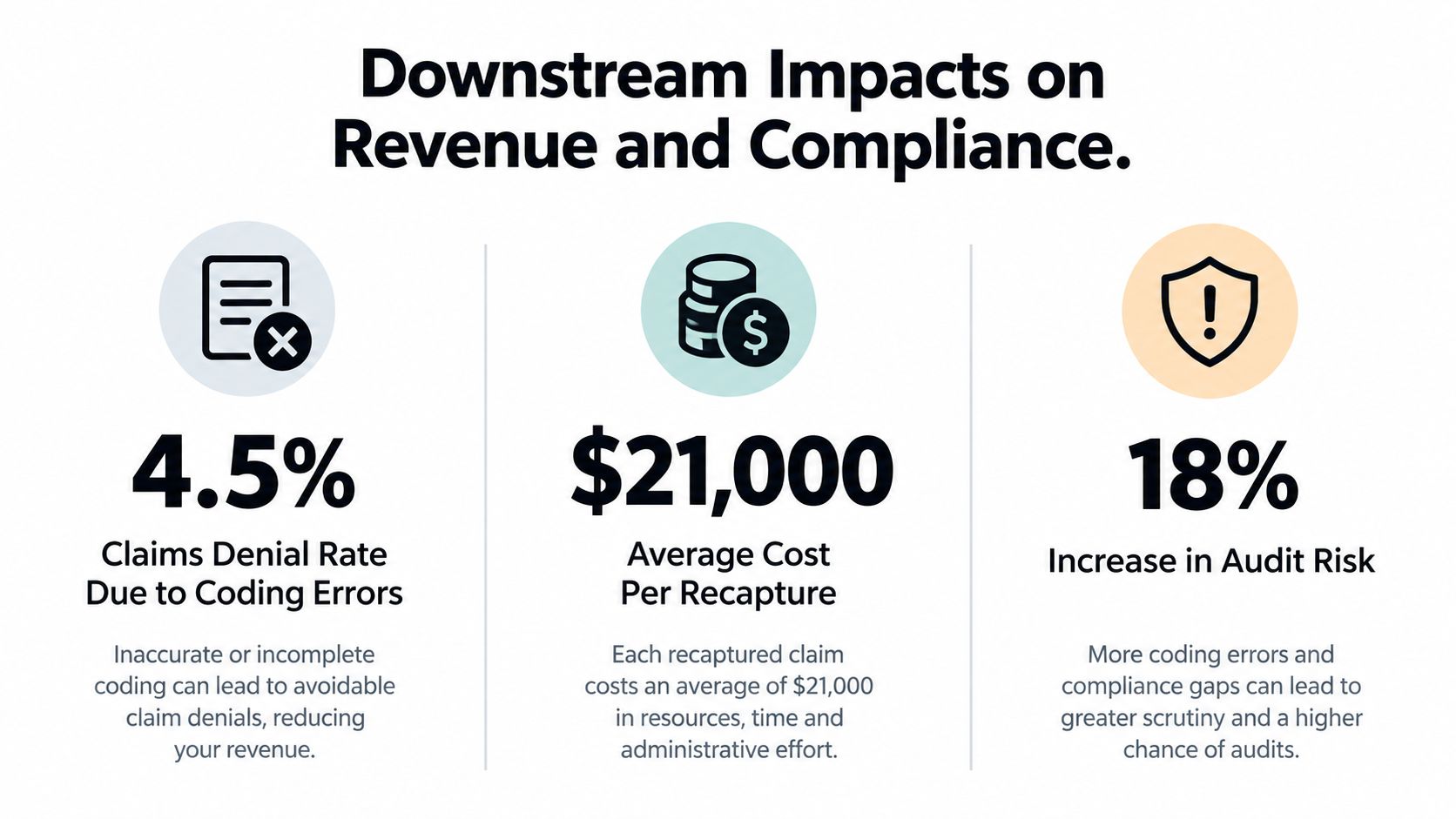
A coding defect can change more than the amount paid on one line. Diagnosis codes influence medical-necessity adjudication, grouping logic, severity adjustment, and the payer's reimbursement decision. Omitting a supported secondary condition may suppress the apparent acuity of the encounter. Reporting an unsupported condition may invite a denial, recoupment, or audit question.
The financial effect also depends on timing. A claim held for clarification delays payment. A claim denied after submission requires staff to retrieve records, interpret the payer's reason, correct or defend the claim, and track the response. A claim that reaches an external review adds another layer of evidence management.
Payer pressure is changing the economics
Coding-related denials in hospital outpatient settings increased 26% year over year in 2025, following a reported 126% increase from 2023 to 2024, while external-payer audit exposure rose 30%, according to the 2025 payer and denial benchmark report. These figures describe a payer environment in which late-stage correction is becoming less dependable as a revenue strategy.
Payers increasingly use automated edits to test diagnosis-to-procedure relationships, medical necessity, modifiers, eligibility, authorization, and site-of-service rules. Automation can identify patterns quickly, but it doesn't always explain the clinical context that supports a claim. A practice that submits a technically correct code without preserving that context may still face a denial.
The right response isn't to add more manual rework after adjudication. It's to move validation earlier and maintain an evidence trail that supports both payment and appeal.
Compliance and revenue cannot be separated
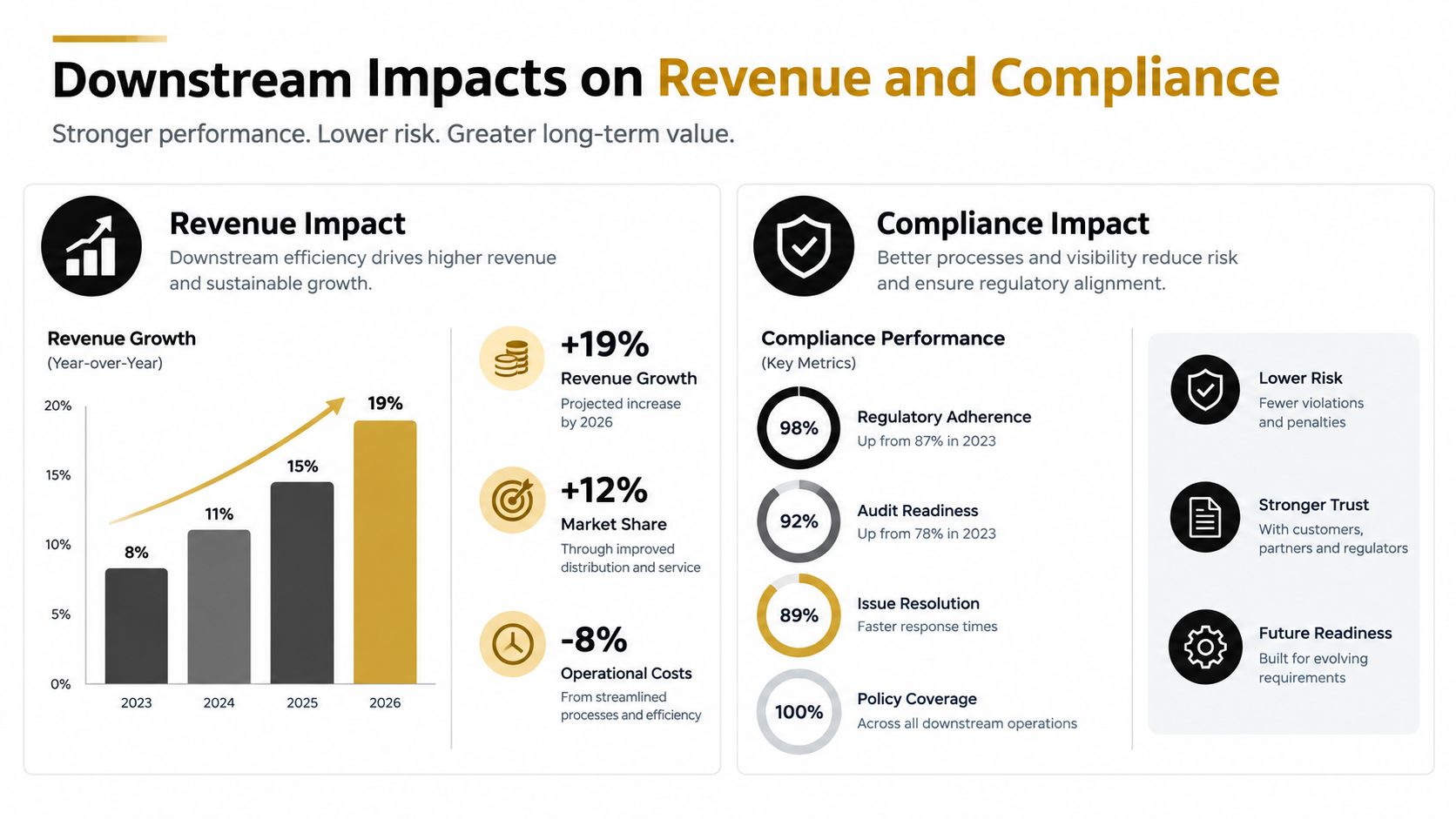
Practice owners sometimes view undercoding as a revenue problem and unsupported coding as a compliance problem. In reality, both arise from the same data-integrity failure. An omitted diagnosis can reduce payment and distort risk reporting. An unsupported diagnosis can increase payment temporarily while creating repayment exposure later.
A disciplined revenue cycle assigns each defect to a root cause:
- Documentation gap: The provider didn't establish the condition, service, or medical necessity clearly enough.
- Coding interpretation issue: The record supports the service, but the code selection or sequencing is wrong.
- System constraint: The EHR, clearinghouse, or claim interface removed required specificity.
- Payer-policy conflict: The code is valid, but the payer applies a rule that requires additional evidence, authorization, or a different reporting structure.
- Appeal failure: The organization had support but didn't preserve or present it effectively.
The clinical documentation improvement resource should be treated as part of revenue integrity, not merely an education initiative. Provider queries, note templates, and feedback must connect directly to denial patterns and payment outcomes. Otherwise, education remains detached from the defects that cost the practice money.
Specialty-Specific Coding Vulnerabilities
Generic edits catch obvious omissions. They don't reliably resolve the specialty-specific interactions that determine whether a claim is payable. The risk changes with the service, the documentation style, the payer contract, and the evidence needed to establish medical necessity.
Consider anesthesia. A claim may depend on documented time, the relationship between the anesthesiologist and other clinicians, medical-direction requirements, modifiers, and the payer's interpretation of those facts. A time entry that appears complete may not align with the operative record. A modifier may be valid under one policy and challenged under another. The coding review must compare the anesthesia record, procedure documentation, provider roles, and payer edits rather than treating each field as an independent checkbox.

The same code can carry different risk
In orthopedics, laterality is a basic but consequential control. The operative note, imaging, diagnosis, and procedure line should agree on the side treated. Distinct procedural service modifiers also require documentation that establishes separate work, not multiple entries on the same claim.
Emergency services face a different combination of pressure. Clinicians document under time constraints, while payers scrutinize medical necessity, acuity, diagnosis specificity, and the relationship between the service and the final disposition. A vague note can leave the coder with too little support, even when the clinical decision-making was appropriate.
Air ambulance providers must defend medical necessity, transport circumstances, origin and destination, and the clinical reason ordinary transport wasn't suitable. Site-of-service and payer requirements add further complexity. Under the No Surprises Act, the dispute process also makes evidence preservation important because the organization may need to demonstrate why the billed service and amount were justified.
Build controls around the encounter
A specialty edit should ask questions that reflect how the service is paid:
- Does the documentation establish the procedure, diagnosis, laterality, and encounter details?
- Does the diagnosis support the procedure under the applicable payer policy?
- Are modifiers supported by distinct work, provider roles, or service circumstances?
- Do the note, claim, authorization, and eligibility records describe the same encounter?
- Could an external reviewer understand the claim without asking the practice to reconstruct it?
A generic “code review complete” status answers none of these questions. Specialty validation should instead connect the clinical note to the billed line and flag the exact evidence gap. That approach reduces false confidence and helps leaders identify whether the core problem is physician documentation, coder training, payer logic, or system design.
Audit Workflows and Prevention Best Practices
Effective audits start with a risk hypothesis, not a random claim sample. If denials cluster around missing secondary diagnoses, test missed-condition capture. If orthopedic claims generate laterality or modifier disputes, compare the operative note, diagnosis, and claim line. If anesthesia claims stall because of time or provider-role documentation, target those fields directly.
The pre-bill layer should serve as a clinical and financial checkpoint, not a final clerical glance.
Design the pre-bill queue
Use edits tied directly to payment and claim defensibility:
- Validate diagnosis specificity. Check laterality, encounter details, anatomic site, and other required elements against the clinical record.
- Test diagnosis-to-procedure linkage. Confirm that the documented condition supports the service under the applicable payer policy.
- Review secondary-condition capture. Identify documented comorbidities and complications that meet reporting requirements, while excluding unsupported conditions.
- Reconcile modifiers. Compare modifiers with operative, anesthesia, or progress-note evidence and payer rules.
- Route ambiguity for clarification. Send a compliant provider query when the record does not establish the required fact. Do not assign a probable code to keep the claim moving.
Each edit should display the supporting evidence and the specific gap. The reviewer needs to distinguish a missing note from a conflicting field, unsupported diagnosis, or payer-specific rule. Without that context, the queue creates interruptions instead of controlling claims. It also gives RCM and IDR teams a clearer record if a payer later challenges the billed service.
Make retrospective audits selective
Retrospective review remains necessary because pre-bill controls will not catch every interpretation issue. A structured approach to medical coding audits helps determine which claims to sample and why. Stratify samples by specialty, provider, payer, service type, denial reason, and financial or compliance risk. High-risk services may include anesthesia, emergency care, oncology, cardiology, and surgery, where a small documentation omission can change payment classification.
A 2024 clinical-coding study found that retrospective recoding reduced documented cash-claim value from SAR 42,333 to SAR 29,406, attributing approximately SAR 12,927 to inaccurate coding, as reported in the peer-reviewed clinical-coding study. The practical lesson is not to recode every claim manually. It is to find where documentation gaps, coder interpretation, or system rules allowed unsupported or incomplete coding to pass.
Track findings by cause, not only by error count. A provider education issue needs a different response from an EHR limitation. A payer-policy mismatch may require contract review or an appeal strategy. If queries repeatedly resolve the same ambiguity, redesign the note template and address the upstream documentation failure. That closes the defensibility chain rather than correcting isolated claims after payment is already at risk.
Tracking KPIs and Mitigating Leakage with Integrated RCM
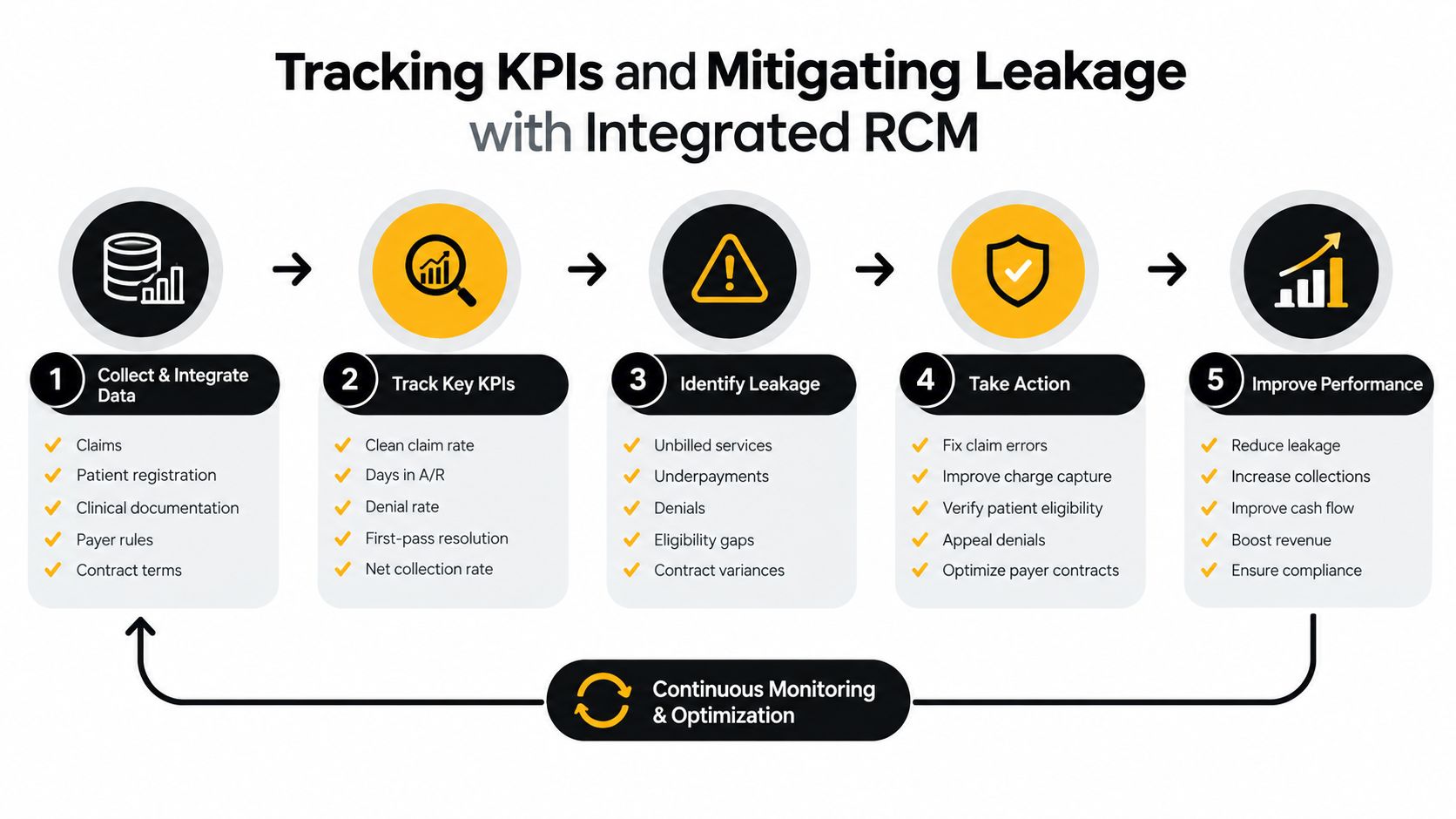
A denial rate is an outcome, not a diagnosis. It tells leadership that payment failed, but not whether the cause was documentation, coding, eligibility, authorization, payer policy, or an ineffective appeal. Revenue-cycle dashboards become useful only when they connect the denial to the encounter, provider, specialty, payer, and evidence that should have prevented it.
Track coding-denial rates by specialty and provider, but pair them with operational measures. Monitor documentation holds, time from encounter to completed note, query volume and resolution, clean-claim performance, appeal success, underpayment patterns, and accounts receivable associated with documentation-related delays. These measures show whether the organization is correcting the source or merely processing the aftermath.
Connect claim evidence to dispute action
RCM and Independent Dispute Resolution should not operate as separate departments with separate evidence standards. The coding team creates the clinical and billing record. The RCM team manages submission and follow-up. The IDR function needs the same record, organized so it can demonstrate what was performed, why it was necessary, how it was coded, and why the payer's payment or denial was inconsistent with the claim.
That connection matters when a payer delays, downcodes, or underpays a technically defensible claim. The practice needs more than a corrected claim. It needs the original documentation, coding rationale, payer correspondence, contract or policy context, and a clear account of the amount in dispute.
Operational test: If the appeal team must rebuild the claim's story from disconnected systems, the revenue cycle isn't preserving evidence early enough.
A platform such as RevGuard combines specialty-specific RCM workflows with IDR support, including coding review, documentation audits, denial root-cause analysis, payer-behavior intelligence, and dispute evidence preparation. It can be evaluated alongside internal controls or other revenue-integrity tools based on whether it connects upstream claim quality with downstream recovery work.
The most important KPI is therefore not speed alone. Measure whether the organization submits claims that are complete, defensible, and recoverable when payer behavior conflicts with the clinical record.
Building a Defensible Revenue Cycle Strategy
Medical coding errors are persistent because the conditions that create them are persistent. Providers document under pressure, EHRs impose constraints, coders interpret incomplete records, payers apply policy edits, and appeal teams often receive fragmented evidence after the denial has already occurred.
A defensible strategy changes the order of operations. Capture clinical details in real time, preserve code specificity across interfaces, query ambiguity before submission, audit high-risk specialties, and connect every denial to a root cause. Provider education should respond to actual documentation defects, not generic reminders.
The practice should also align coding controls with payer behavior. A claim that passes an internal code check may still need stronger medical-necessity evidence, authorization support, modifier documentation, or dispute preparation. Revenue protection works best when RCM and IDR share the same encounter-level record and the same definition of a defensible claim.
Practice owners should audit the full chain, from note creation to final payment. The goal isn't fewer coding mistakes. It's a revenue cycle that can explain, support, and enforce the value of every legitimate service.
RevGuard helps specialty practices connect coding review, documentation compliance, denial analysis, payer intelligence, and Independent Dispute Resolution into one revenue-protection workflow. Visit RevGuard to assess where medical coding errors and weak claim evidence are creating preventable leakage in your organization.