

Specialty operators still treat a payment dispute like a one-off appeal. Under the No Surprises Act, volume says otherwise. Federal independent dispute resolution now behaves like a production line for out-of-network cash, and a large share of files never reach a price comparison at all.
That is the problem arbitration explained has to solve for a reimbursement lead. The hearing is the last step. Eligibility, a single offer, fees, and upstream claim quality decide whether filing is worth the labor.
Why Arbitration Explained Matters for Provider Payment
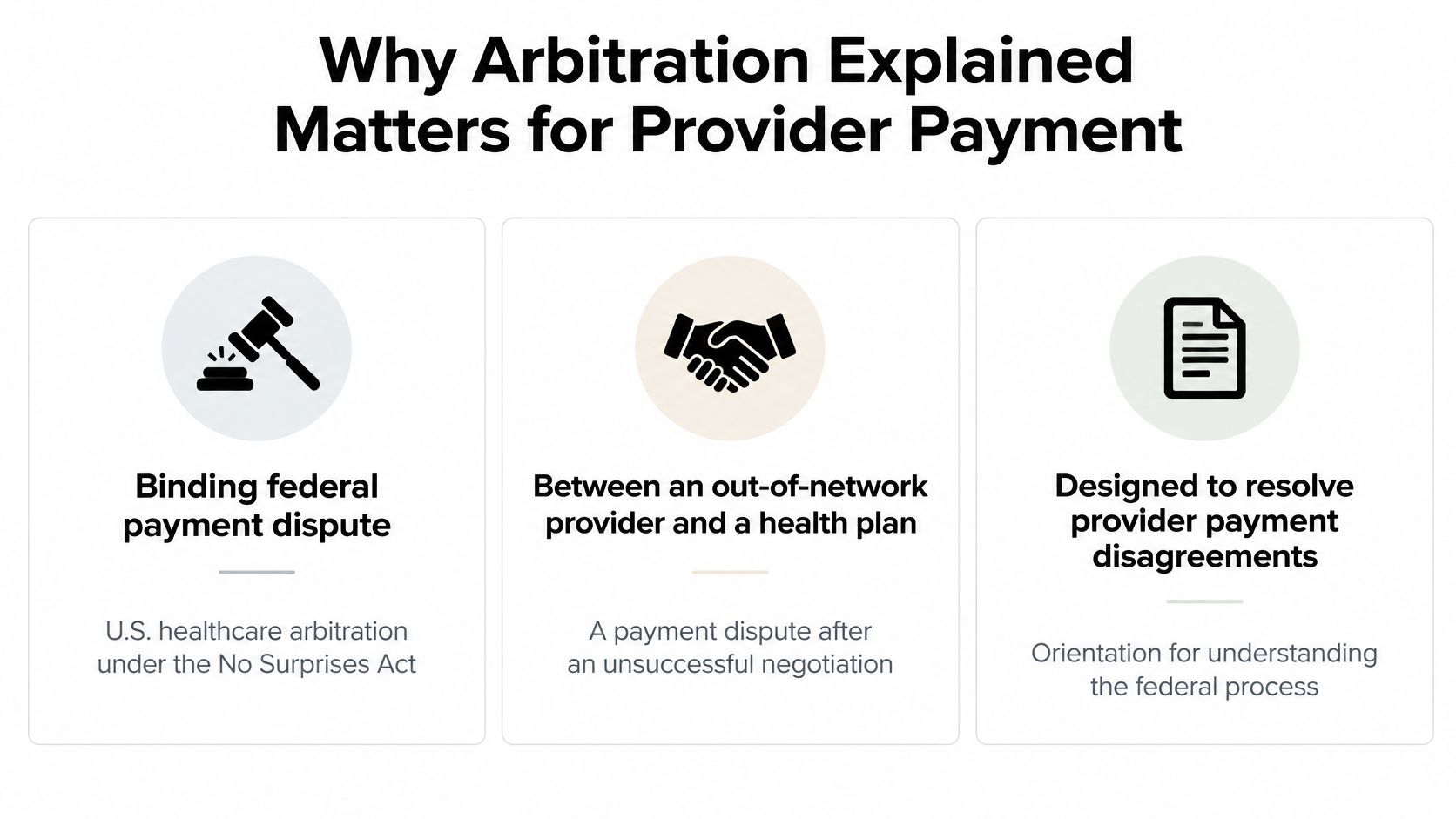
Healthcare arbitration under the No Surprises Act is a binding federal process. It resolves payment disputes between an out-of-network provider or facility and a health plan when negotiation does not settle the amount. The process became operational in 2022. Certified independent dispute resolution (IDR) entities select one party's final payment offer. They do not invent a compromise figure.
The 2024 scale is what should reframe the work. Parties initiated more than 1.46 million federal IDR disputes, and IDR entities closed over 1.37 million. More than 1.33 million closed disputes involved out-of-network emergency or nonemergency services, and 41,338 involved out-of-network air ambulance services. Nearly 1.048 million closed disputes resulted in payment determinations, more than three-quarters of the total. The 2024 close volume was almost 4.5 times the number of disputes closed in 2023, according to a Congressional Research Service review of federal IDR.
Just under one-fifth of closed disputes, 262,441 cases or about 19%, were ineligible for the federal process. A determination and collected dollars are different events. An ineligible file burns the same analyst time as a competitive one and never gets its offer compared.
What the volume is telling operators
Emergency, radiology, and air-ambulance claims sit at the center of that mix. Specialty documentation matters because those services carry the acuity, site, and contracting facts an entity can weigh. A generic facility appeal letter does not carry them.
Operating distinction: Eligibility, a complete submission, and evidence tied to complexity and market conditions decide whether a dispute reaches a payment determination. Reaching that stage is not the same as a positive net recovery.
This account stays on the federal provider-plan payment dispute. It doesn't cover state surprise-billing programs or patient balance disputes. The decisions ahead are operating decisions: which lines qualify, which single offer is more likely to be selected, and which wins still lose money.
How Federal IDR Picks One Payment Offer
NSA arbitration isn't a court trial, and it isn't a split-the-difference negotiation. After an unsuccessful open-negotiation period, either party may start federal IDR. Each side submits one payment offer and the support for it. A certified IDR entity must select one of those offers.
The GAO review of early federal disputes reported nearly 490,000 disputes submitted from April 2022 through June 2023, with approximately 61% still unresolved as of June 2023. That unresolved share is an operations fact. If your team can't see status, you can't tell which offers are actually in front of an entity.
Final offer, the way baseball does it
Picture baseball salary arbitration. The club names a figure. The player names a figure. The arbitrator picks one of those two. A clever midpoint that nobody submitted isn't on the table.
The safer number is the one the entity is more likely to select, not the number that felt fair in a phone negotiation. Teams that anchor an offer to "something in the middle" are arguing for a result the process can't produce.
What the entity is allowed to weigh
The statute points the arbitrator at the plan's median in-network rate for the service and the geographic area. Operators usually discuss that benchmark as the qualifying payment amount. How that rate is built, and where it misleads a charge, is covered in this qualifying payment amount overview.
Permitted credibility factors sit beside that median:
- Provider experience: training, specialty credentials, and the mix of cases the group performs.
- Market share: how much of the local service the group or the plan represents.
- Service complexity and patient acuity: what the chart shows, not what the charge assumes.
- Prior contracting history: whether these parties had a rate, a termination, or a pattern of underpayment.
Weak coding, missing acuity, the wrong place of service, or a benchmark from the wrong market can sink a charge that looked reasonable on a fee schedule. The entity is choosing between two complete offers. Support that doesn't map to an allowed factor makes the other number the easier pick. Deadline control and case-status tracking sit in the same workflow, because a file you can't locate isn't a file you can defend.
When Eligibility Ends a Dispute Before Price
A strong price story is not enough. In the first half of 2025, disputing parties initiated 1,186,812 federal IDR disputes, a 39% increase over the previous six months, while certified IDR entities issued determinations in 1,082,247 disputes. Those counts are in the CMS federal IDR background for the first half of 2025.
Georgetown researchers, reported in that same background, found that payers challenged eligibility in roughly 41% of 2025 disputes and that IDR entities ruled 18% ineligible. They also found that 22% of determinations in the first half of 2025 were default decisions, because only one party submitted an offer and paid the required fees.
Three endings, three different fixes
Ineligible or dismissed. Batching, a skipped open-negotiation step, a missed filing window, a coverage rule, or a documentation error stopped the case before the merits. The fix is the intake record. Rewriting the dollar figure does nothing.
Default. One party submitted an offer and paid the fees. The other didn't. A default can put the provider's number in place, but it isn't evidence that the clinical argument won. Log it apart from a contested win, and watch whether that payer starts participating again.
Contested loss on the merits. Both offers were in the comparison, and the entity selected the plan's number. Here the offer and the credibility factors are the problem. The intake checklist already did its job.
An administrative dismissal and an adverse payment determination need different owners. Claims operations owns the first. Offer strategy owns the second.
What to ask before anyone argues price
Which services qualify for this federal path, and which belong somewhere else? How do batching, the open-negotiation record, filing windows, payer-specific coverage rules, and code errors change eligibility? What does it mean when a payer never shows up?
Air ambulance, hospital emergency lines, and nonemergency specialty services don't share one checklist. Treat a non-participating payer as its own outcome, not as a silent endorsement of your charge. As volume grows faster than most compliance teams, the groups that separate these three endings will stop spending attorney time on files that were never going to be heard.
Building the Offer and the Evidence Packet
The certified entity sees two numbers and the support for each. Your packet has to make one offer more credible than the other under the median in-network rate and the allowed factors. That work starts before negotiation, while the chart and the claim still match.
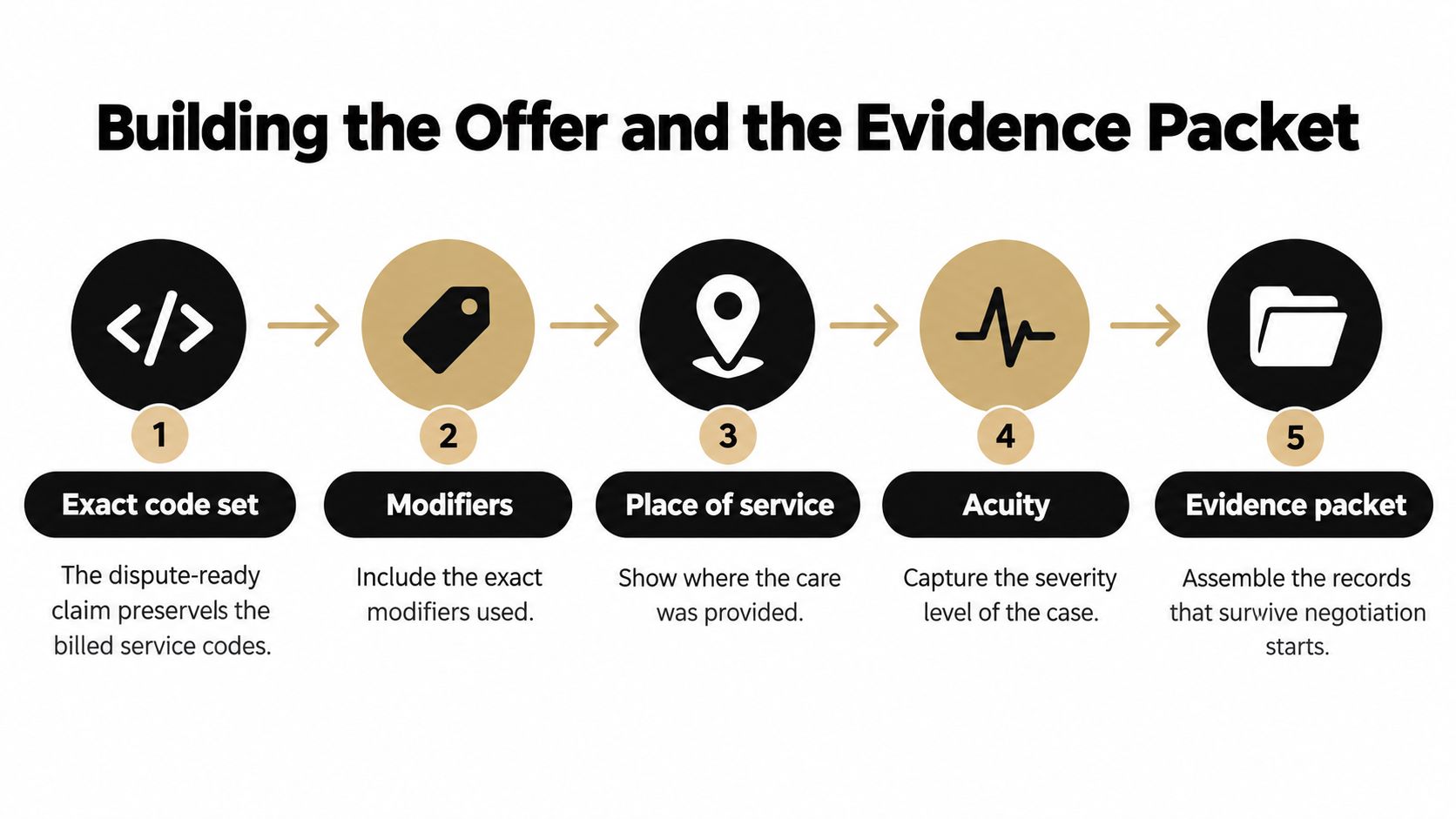
A dispute-ready claim preserves the exact code set, modifiers, place of service, acuity indicators, specialty credentials, service intensity, and the payer-specific reimbursement context. Lose any of those and you are asking the entity to prefer a number you can't explain.
A sequence that keeps the file comparable
- Confirm the service is in scope. If it isn't a federal IDR service, stop. Don't draft a number for a dispute you can't file.
- Finish open negotiation. Keep the dates, the offer you made, and the plan's response. That record is part of the file.
- Choose the batch on purpose. Like services can travel together. Unlike sites, modifiers, or acuities should not.
- Submit one offer and pay the required fees. There is no backup figure held in reserve.
- Attach only mapped evidence. Each exhibit should point at experience, market share, complexity, acuity, or contracting history. A worked layout of that mapping is in this proof-of-evidence example.
Gaps that make a fair charge look sloppy
Downcoding that doesn't match the acuity note tells the reader the chart and the claim disagree. A geographic benchmark from the wrong market makes the median comparison look careless. A missing contracting history leaves a permitted factor blank while the plan fills it. A compromise number that neither side would defend isn't anchored to the statutory starting point or to a factor, so it is the easiest offer to pass over.
Timelines belong in the evidence strategy. A late or incomplete submission never reaches the comparison, so the quality of the clinical story never gets tested. Put an owner on the clock the same way you put an owner on the code.
Fees Win Rates and the Net Recovery Test
Case volume no longer fits a one-off legal review. CMS reported that certified IDR entities issued 698,968 payment determinations in the second half of 2024, a 101% increase over the 348,607 determinations issued in the first half. Those counts are in the CMS federal IDR background for late 2024.
IDR entities charge regulated fees inside CMS-established ranges. Georgetown's analysis of federal public-use data, summarized in that release, identifies $200–$840 for a single dispute and $268–$1,173 for a batched dispute. CMS data in the same background show providers won 85% of line-item claims decided in 2024, up from 81% in 2023. A high win rate doesn't make every line economic. A low-dollar win can still lose money after fees, labor, documentation, and collection delay.
What to estimate before you commit
Expected incremental recovery comes first. Then the probability the entity selects your offer, the filing and administrative cost, staff time to build the packet, and the chance a batching or eligibility defect dismisses the case before any comparison. If incremental dollars don't clear that stack, don't file.
Run four controls beside the rest of your medical billing metrics: a minimum recovery threshold, specialty offer benchmarks, payer-level win rates, and a reconciliation that ties the selected offer to the remittance and the cash posted. A determination that never hits the bank account is not a recovery.
IDR cost and filing decision checks
| Decision item | Single dispute | Batched dispute | What to estimate |
|---|---|---|---|
| Entity fee exposure | $200–$840 | $268–$1,173 | Whether the fee alone eats the incremental dollars |
| Offer quality | One number, one service story | One approach across like lines | Probability your offer is the one selected |
| Defect risk | A single eligibility miss kills the case | One bad line can sink the batch | Chance of dismissal before a comparison |
| Cash timing | Labor plus collection delay on one claim | Same delay spread over the batch | Net recovery after time, not the gross award |
A win percentage is a gross statistic. Net recovery is the only figure that belongs in a cash forecast.
Specialty Cases and Choosing an IDR Model
Federal IDR entities resolved 8,338,286 disputed line items between the first quarter of 2023 and the fourth quarter of 2025, according to a Harvard analysis of CMS public-use data. Georgetown's early 2025 review, discussed in that analysis, found that providers and facilities initiated 99.9% of disputes and that providers won 88% of determinations. A substantial share of those determinations were defaults rather than fully contested decisions.
"Providers win about 88%, so arbitration is an obvious revenue strategy" is too simple. The results mostly describe organizations that already file at volume. They don't tell you whether your specialty, your payers, or your cost to build a clean file look like theirs. They also don't say whether frequent filing changes network talks or premiums. A favorable result can still sit on top of coding, credentialing, or documentation failures that make the next cohort ineligible.

Same selection rule, different failure modes
An anesthesia or emergency medicine line usually turns on acuity and service intensity. If the chart reads as routine and the offer assumes a rescue, the median in-network rate is the easier selection.
A radiology study or an ASC imaging case fails more often on batching and place of service. Ten similar studies can be a sensible batch. Ten studies with different sites and modifiers are an eligibility problem wearing a high charge.
Air ambulance uses the same final-offer rule and a thinner set of codes. The support that matters is clinical urgency, transport context, and prior contracting behavior, not a facility chargemaster page.
Two operating models
Reactive outside counsel. Lawyers receive the file after the denial. They can write a disciplined offer. They can't recreate eligibility, coding, or credentialing that was never captured.
Revenue cycle linked to IDR. Eligibility, coding, and the packet exist before negotiation starts. One version of that model is RevGuard, a healthcare revenue protection firm that runs specialty-specific revenue cycle management from eligibility, coding, and credentialing through negotiations and collections, then uses an IDR workflow to assemble NSA-compliant evidence, file and enforce cases, and track payer behavior. The work covers groups, ASCs, hospitals, and multi-state platforms in specialties such as anesthesia, orthopedics, intraoperative neuromonitoring, and air ambulance.
Choose the model that matches how early the claim is clean. A loud win rate doesn't make that choice for you.
Put Dispute-Ready Claims Ahead of the Filing
A leader can inspect this month's book without restating the statute. Mark which out-of-network lines are eligible. Note which open-negotiation clocks are already running. Check whether the code, modifier, place of service, and acuity can support one offer. Then ask whether expected recovery clears fees and labor. If it doesn't, stop spending time on that line.
Three piles, not one project
Never file. The service is out of scope, the batch won't hold, or the dollars can't clear cost. Close these so they stop consuming analyst hours.
Correct before they can compete. The line might qualify, but downcoding, a thin acuity note, a wrong site, or a missing contract history would make your offer the weaker one. Send these back to coding and credentialing before anyone drafts a number.
Ready for a single offer. Scope is clean, negotiation is documented, and every exhibit maps to a permitted factor. Only this pile should move toward filing.
Don't merge the piles into one "arbitration project." A dismissal, a default, and a merits loss still need different owners, and mixing them hides which fix changes cash.
Score one cohort, then assign the work
Pick a recent underpaid specialty cohort. Score each line on eligibility risk, evidence gaps, and net recovery. Only after that score should you decide whether the work stays with internal staff, goes to outside counsel, or moves to an integrated revenue-cycle and IDR partner.
Fix the claim before an arbitrator ever sees two numbers. That is how you protect reimbursement.
RevGuard links specialty revenue cycle management with No Surprises Act IDR, so eligibility, coding, and the evidence packet exist before a dispute is filed. When a payer underpays a line that can clear fees, the same workflow builds the offer, files the case, and tracks what the payer pays. See how that model fits your specialty book at RevGuard.