

A clinician can be licensed, hired, and ready to take cases, yet still be nonpayable on day one. That gap is where hospital credentialing requirements stop being paperwork and start controlling revenue. More than half of hospitals, health systems, and provider groups have reported losses or delays tied to credentialing bottlenecks, and the cost shows up per provider, per day, while enrollment and privileging catch up.
Treat credentialing as a linked control system, not a single application. One file has to satisfy the medical staff office, the governing body, the payer enrollment team, and the billing system at the same time. When those records don't align on specialty, location, effective date, or approved privileges, scheduling moves ahead of authorization and claims move ahead of payment readiness. The sections below give credentialing, compliance, and RCM teams a shared reference for what to verify, what to retain, and when to reverify it.
What Hospital Credentialing Requirements Cover
Credentialing verifies a practitioner's qualifications. Privileging determines which procedures and services that practitioner may perform at a specific facility. Payer enrollment is a third process, and it determines whether a payer will recognize and pay that practitioner for care at a specific location under a specific taxonomy and effective date.
Teams get into trouble when they treat those three decisions as one approval. A verified license doesn't grant a procedure privilege, and a granted privilege doesn't create payer participation. Each decision has its own reviewer, evidence standard, and expiration logic, even though all three draw on much of the same source data.

Where the Requirement Set Came From
Hospital credentialing in the United States developed from early twentieth-century efforts to establish minimum competency standards for physicians practicing in hospitals. The American College of Surgeons began formalizing hospital standards in the 1910s and published its first standards manual in 1926, which was 18 pages long. The Joint Commission's predecessor, the Joint Commission on Accreditation of Hospitals, was established in 1951, and its 1953 standards manual required physician-credentialing committees and privileges matched to individual abilities.
That early framework still shapes file design today. Facility access depends on documented, independently verified qualifications and a privilege scope aligned with demonstrated clinical capability. It doesn't rest on holding an unrestricted license alone.
What Modern Reviews Actually Examine
Modern hospital reviews examine licensure, education, training, experience, current competence, and professional performance. They don't rely on employment status or board certification alone. The Joint Commission doesn't make specialty board certification universally mandatory, although a hospital may use it as one indicator of competence alongside training records, practice data, and peer input.
That distinction matters in committee. A board-certified practitioner can still lack documented competence for a newly requested, high-risk procedure. Conversely, a practitioner without that certification may present other evidence that satisfies the hospital's criteria, depending on the privilege requested and the bylaws in force.
Practical rule: If a file can't show who verified a qualification, who approved the privilege, and when that approval expires, it's not complete, no matter how many documents it contains.
Use this reference by function. Compliance leads can work from the workflow, verification, and recredentialing sections. RCM analysts should focus on the links between approved privileges, enrollment status, and claim readiness. Practice administrators can go straight to the checklist and use it as the intake standard for every new file.
Initial Credentialing Requirements and Workflow
Initial credentialing works when every stage produces a named piece of evidence and a named approver. It fails when intake collects documents without mapping them to the privilege decision that follows. Build the workflow backward from the governing body's approval, then require each earlier step to supply what that approval needs.
Under 42 CFR §482.22 for Medicare-participating hospitals, a hospital must maintain an organized medical staff operating under governing-body-approved bylaws. The medical staff periodically appraises members, examines candidates' credentials, recommends appointments to the governing body, and maintains explicit criteria and procedures for granting individual clinical privileges. That's the governance spine. Everything else is evidence feeding it.
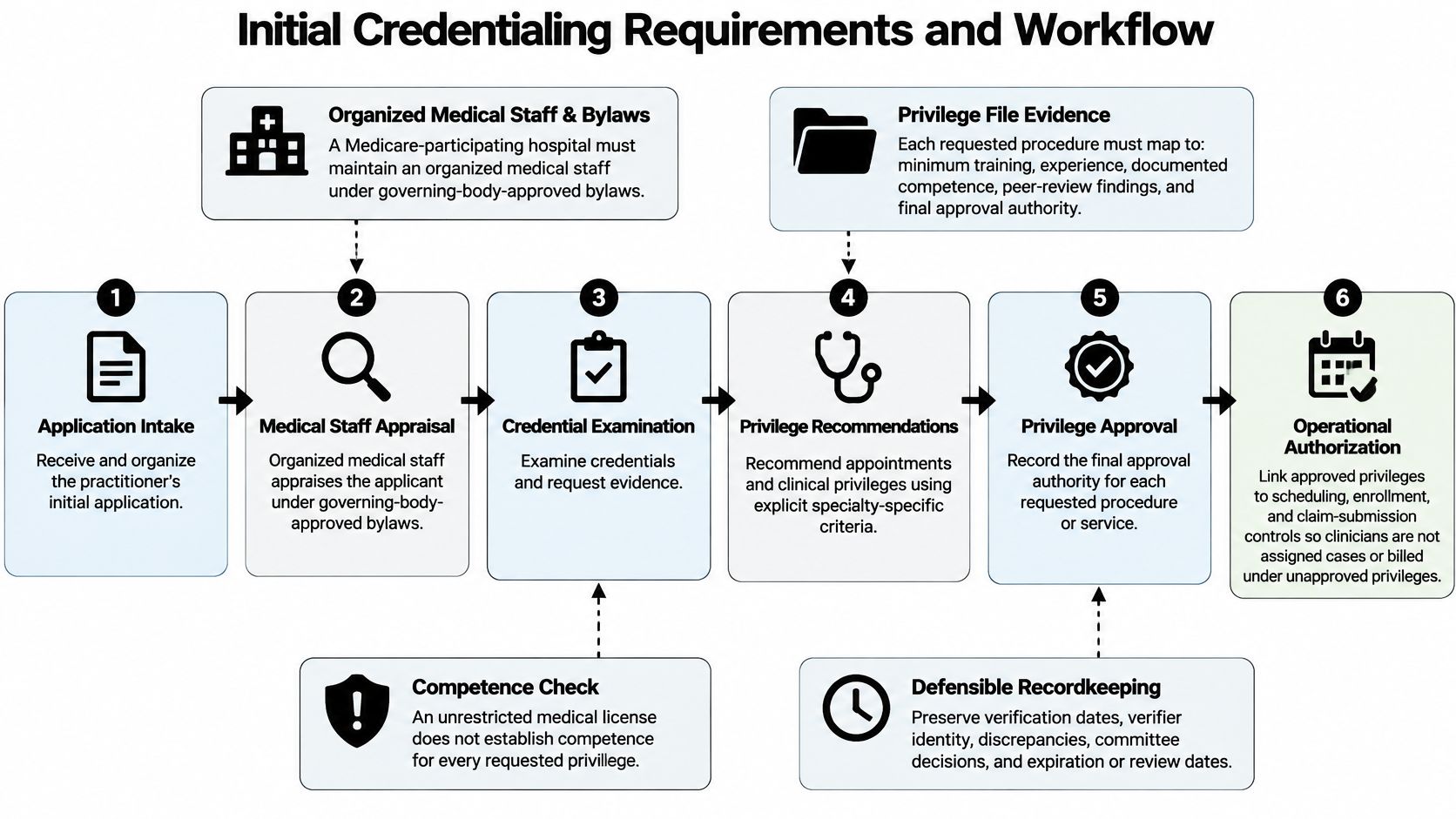
The Six Stages and What Each Must Produce
- Application intake: Confirm applicant identity, capture the requested appointment category and privilege list, and log every attestation and disclosure. Incomplete privilege requests shouldn't advance, because reviewers can't assess competence against an undefined scope.
- Medical staff appraisal: The organized medical staff reviews the applicant under the bylaws. This stage should produce a documented appraisal, not an informal conversation that nobody can reconstruct during survey.
- Credential examination: Verify current licensure or certification, relevant training, professional practice data, and peer or faculty recommendations. Record discrepancies as they appear rather than resolving them off the record.
- Privilege recommendation: Map each requested procedure or service to specialty-specific eligibility criteria, minimum training and experience, documented competence, and peer-review findings. Recommended, modified, and denied privileges should each be explicit.
- Governing body approval: Record the final approval authority, approval date, approved scope, and expiration or review date for every privilege. A committee recommendation isn't the same as final authorization.
- Operational authorization: Push the approved scope into scheduling, enrollment, charge capture, and claim-submission controls. This is the step most workflows skip, and it's the step that prevents unapproved work from being scheduled or billed.
Why Privilege Mapping Can't Be Generic
An unrestricted medical license does not establish competence for every requested privilege. Joint Commission criteria call for evidence that the practitioner can physically perform the requested privileges, available professional practice data from organizations where the practitioner holds privileges, and peer or faculty recommendations. For procedure-intensive specialties such as anesthesia, orthopedics, or interventional services, the file should connect the specific procedure to training, case experience, and current competence evidence.
Generic attestation language won't carry that burden. If a privilege requires defined training, the file should identify where that training is verified. If it requires recent experience, the file should show the source of that experience data. Reviewers shouldn't have to infer eligibility from a curriculum vitae.
What a Defensible File Preserves
Retain applicant identity verification, source records, verification dates, verifier identity, discrepancies, committee decisions, approval dates, privilege expiration or review dates, and escalation evidence. Those fields turn a folder of PDFs into an auditable decision trail. They also give RCM a reliable effective date, which is the date that should drive first schedulable and first billable activity.
Groups that need support building this sequence can review what a structured medical credentialing service typically handles at intake, verification, and follow-up. Whether the work stays in-house or not, the standard doesn't change. No clinician should be assigned cases or billed under privileges, locations, or specialties that haven't been approved.
Required Documents and Primary-Source Verification
A complete file is organized by what each document proves, not by the order in which the practitioner happened to upload it. Group the record so a reviewer, surveyor, or payer auditor can answer a question in one pass. Can this person practice here, do this work, under this coverage, starting on this date?

Document Categories Every File Should Cover
- Identity: Government identification and the identity verification record that ties the application to the individual who will practice.
- Licensure and registrations: License number and status for every relevant jurisdiction, plus controlled-substance or federal registrations where applicable to the requested privileges.
- Education and postgraduate training: Medical or professional education, residency, fellowship, and other training relied on for privilege eligibility.
- Board certification: Certification status where the hospital uses it as a competence indicator or where a privilege criterion requires it.
- Work history: Practice history with gaps and discrepancies identified and resolved in writing, not left for the committee to guess at.
- Professional liability and claims history: Claims information and current malpractice coverage, including carrier and coverage dates.
- Sanctions and exclusions: Adverse actions, sanctions, exclusions, complaints, and quality issues that require review or escalation.
- Competency and privilege-specific experience: Peer or faculty recommendations, professional practice data, performance review material, and evidence tied to each requested procedure or service.
Collecting a document isn't the same as verifying it. A practitioner-supplied copy can start the file, but it can't finish it. The hospital still has to confirm the qualification independently and record how it did so.
What Primary-Source Verification Requires
Primary-source verification, or PSV, makes the hospital, not the practitioner, responsible for confirming reported qualifications with the original issuing source or an approved agent. Joint Commission guidance on verifying licensure and training through primary sources covers verification at initial granting, renewal, and revision of privileges, as well as at license expiration, together with relevant training and current competence.
Acceptable methods can include direct correspondence, documented telephone verification, secure electronic communication from the original source, or a compliant credentials verification organization. The method matters less than the record it leaves. Every verification entry should identify what was verified, when, by whom, and the result.
A screenshot with no date, no verifier name, and no source identification is evidence of effort. It isn't yet evidence of verification.
NCQA-style programs likewise describe primary-source, recognized-source, or contracted-agent verification and expect monitoring of sanctions, complaints, and quality issues between recredentialing cycles. Build that expectation into the workflow from the start. A file that was clean at appointment can develop a reportable issue long before its next scheduled review.
Build the Credential Matrix
Maintain a credential matrix for every practitioner and jurisdiction. At minimum, track license number and status, registrations, board certification, education and postgraduate training, work history, liability claims, sanctions and exclusions, malpractice coverage, competency evidence, and privilege-specific experience. Add the verification source, verification date, verifier, next review date, and enrollment status for each row.
Make the matrix location-specific and service-specific. State scope-of-practice rules and payer participation requirements can differ, so a single global status field will hide exactly the mismatches that cause denials. A practitioner may be cleared for one facility and service line while still pending at another.
Automated expiry alerts should trigger before licenses, certifications, insurance, or privileges lapse. Adverse findings shouldn't approve or block activity without review. Route them through an exception queue for committee review, with the disposition recorded in the file. That routing protects patients, and it also protects the claim record, because auditable evidence stays available for enrollment, billing, payer audits, accreditation surveys, and payment disputes.
Recredentialing Cycles and Ongoing Monitoring
Recredentialing is a reassessment of authority, not a request to resubmit the original application with fresher signatures. The question changes after initial appointment. It's no longer whether the practitioner appeared qualified at entry. It's whether current evidence still supports the specific categories of care the practitioner is authorized to provide.
Current Joint Commission standards require review of licensure, relevant training or experience, and competence at least every 24 months, as described in medical literature on the 24-month recredentialing cycle. Hospitals must maintain evidence supporting the practitioner's authority to provide specific categories of care, and organized medical staffs remain responsible for ongoing evaluation of competency and for defining the scope of privileges.

What the Recredentialing File Must Show
At renewal, verify current licensure again and review relevant training or experience against the privileges being renewed. Add organizational performance review material, peer-review findings, professional practice data, and any adverse-action, complaint, or quality information that emerged during the cycle. The committee should be able to see whether actual practice still matches the approved scope.
Pay attention to drift. Practitioners add techniques, drop procedures, change locations, and shift case mix over time. If the privilege list on file no longer matches the work being scheduled, renewal is the point to correct it formally. Carrying an outdated scope forward creates both a governance problem and a billing problem.
Monitoring Between Cycles
The 24-month date is the outer boundary, not the only control point. Licenses expire on their own schedules, and verification is also required at license expiration, renewal, and revision of privileges. Certifications, malpractice coverage, and registrations can lapse mid-cycle. Sanctions, complaints, and quality issues can arise at any time and shouldn't wait for the next scheduled review to surface.
Build one calendar that layers every date by practitioner:
- License and registration expirations: Trigger re-verification before expiry, with enough lead time to resolve a renewal problem before scheduled cases are affected.
- Certification and insurance renewals: Confirm continued status and coverage, then file the new evidence against the privileges that depend on it.
- Privilege review dates: Start the full reassessment early enough for committee review and governing body action before the current approval expires.
- Event-driven checks: Run sanctions, complaints, and quality monitoring between cycles, and escalate findings through the exception process rather than holding them for renewal.
Why Lapses Travel Beyond the Medical Staff Office
Missing or outdated records can affect accreditation readiness and participation in major payer programs, not just clinical authorization. Federal Medicare participation rules make hospital governing bodies responsible for overall operations, governance, and the medical staff, and Medicare Conditions of Participation set minimum health and safety requirements for participating providers. The 1965 Social Security Amendments allowed hospitals accredited by the Joint Commission's predecessor to be deemed compliant with most Medicare hospital Conditions of Participation, which linked accreditation and credentialing systems directly to Medicare eligibility.
Operationally, treat an approaching expiration as a scheduling and revenue event. Notify scheduling and RCM before authority lapses, hold new case assignment where approval won't be renewed in time, and confirm that claim controls reflect the renewed effective dates. A lapse discovered after care is delivered is far harder to fix than a lapse prevented by a shared calendar.
State and Facility Variations in Requirements
The same practitioner can be fully credentialed at one facility and incomplete at another across town. That isn't inconsistency for its own sake. It's the predictable result of state law, facility bylaws, service-line resources, and privilege criteria layering on top of a common federal and accreditation foundation.
What Changes From Place to Place
State scope-of-practice rules define what a license category may do in that jurisdiction. Facility bylaws then define what the hospital will permit, which can be narrower than state law allows. Service-line capability matters too, because a hospital shouldn't grant a privilege it can't support with appropriate staff, equipment, coverage, and peer review.
Compare two common situations. A specialty group expanding into a second state may find that licensure, registration, and payer enrollment timelines all differ for practitioners who are already privileged at home. An ambulatory surgery center may require a tighter, procedure-specific file than a hospital requires for the same surgeon, because the approved procedure list and transfer arrangements are different. In both cases, copying the original file forward without a location review leaves gaps.
For Medicare participation specifically, groups should align facility requirements with the enrollment obligations described in credentialing for Medicare, because a governing body's privilege decision and a payer's participation decision can move on separate tracks. Track them separately in the matrix, even when the same documents support both.
Telemedicine and Delegated Review
Telemedicine adds a distinct governance layer. CMS requires a hospital governing body to grant privileges to telemedicine practitioners before they provide services, and privileges must reflect the services delivered through telecommunications. A hospital may, in some circumstances, rely on a distant-site hospital's credentialing and privileging decisions if specific written-agreement safeguards are met, as explained in CMS guidance on telemedicine credentialing and privileging reliance.
Delegation reduces duplication. It doesn't eliminate hospital responsibility. The burden shifts toward governance, documentation, and auditability. The relying hospital should be able to produce the written agreement, the distant site's assurances, the list of privileges granted in reliance on that review, and evidence of governing body oversight.
Accountability test: If a surveyor asks who remains responsible for a delegated privilege decision, the file should answer before anyone has to explain.
Making the Matrix Location and Service Specific
For every practitioner and service, map the credentialing entity, privileging entity, state-law constraints, delegated-review agreement, primary-source verification file, expiration date, and payer enrollment status. That single view prevents the most expensive assumption in multi-state operations, which is treating approval at the flagship facility as approval everywhere. It's especially important for cross-facility coverage, telehealth panels, and multi-state specialty platforms, where one practitioner may hold several different scopes at once.
Common Credentialing Deficiencies and How to Fix Them
Most stalled files don't fail on obscure regulatory questions. They fail on dates, names, mismatched scopes, and verification entries that can't be audited. Diagnose deficiencies by where they arise in the workflow, because the correction at intake is different from the correction at committee.
Intake and Verification Deficiencies
Expired or unmatched licenses usually trace back to a matrix that tracks one jurisdiction well and others loosely. The fix is a jurisdiction-by-jurisdiction license record with status, expiration, and re-verification date, checked before scheduling begins in that state. Don't let a practitioner-supplied wallet card substitute for a fresh source check.
Verification records without a date or verifier identity are the next recurring problem. The symptom is a file full of source printouts that nobody can attest to. Correct it by standardizing the verification log so every entry captures the item, source, method, date, verifier, and result. Backfill what's missing by re-verifying, not by annotating old printouts from memory.
Unresolved work-history discrepancies stall committees because reviewers won't recommend privileges around an unexplained gap. Route discrepancies back to the applicant promptly, document the explanation, and verify it where a source exists. A short, resolved note in the file is better than a silent gap that resurfaces at every renewal.
Privilege and Committee Deficiencies
Privilege requests that don't map to documented competence are the most consequential deficiency in procedure-intensive specialties. The root cause is usually a generic privilege form detached from specialty-specific criteria. Fix the form first. Then require each requested procedure to cite its training, experience, and competence evidence before the file reaches committee.
Missing peer or faculty recommendations often reflect late requests rather than unwilling references. Request them at intake, track them as blocking items, and escalate early. The same applies to professional practice data from other organizations where the practitioner holds privileges. Committees shouldn't be asked to approve first and receive performance data later.
Adverse findings handled informally create survey and legal exposure. A sanction, complaint, or quality issue should enter an exception queue, receive committee review, and leave a recorded disposition. Holding a file or approving it without documentation removes the evidence that the organization exercised judgment.
How a Credentialing Defect Becomes a Claim Defect
A clinician can be clinically approved yet still nonpayable when payer enrollment, location, taxonomy, or effective dates don't align with the credentialing record. That mismatch typically appears downstream as held claims, credentialing-related denials, or services billed under a location or specialty that wasn't approved. RCM then treats it as a billing defect, when the root cause sits in the credential file.
Close the loop with a repeatable correction process. Log every deficiency by category, assign an owner and due date, and feed denial data back to the credentialing team by defect type. When the same mismatch appears twice, fix the intake form, the matrix field, or the system interface that produced it. One-off corrections clear a file. Process corrections clear the queue.
Quick-Reference Credentialing Checklist and Template
Use the table below as the working standard for a complete file. Each row names the requirement category, the evidence to collect, the event that triggers re-verification, and the record to retain. Copy it into your tracking system and make it the single reference shared by credentialing and RCM staff.
Hospital Credentialing Requirements Quick Reference
| Requirement Category | Verification Source or Evidence | Re-Verification Trigger | Record to Retain |
|---|---|---|---|
| Identity | Government identification checked against the application | Initial appointment, legal name change | Identity verification record with date and verifier |
| Licensure | State licensing board or approved agent | Initial granting, renewal, privilege revision, license expiration | License number, status, verification date, verifier, result |
| Registrations | Controlled-substance or federal registration source, where applicable | Renewal, expiration, new jurisdiction or privilege | Registration number, status, expiration, verification log entry |
| Education and Training | Issuing institution, training program, or approved agent | Initial appointment, new privilege relying on added training | Primary-source verification record for each credential relied on |
| Board Certification | Certifying board or recognized source | Certification renewal or expiration, privilege criteria change | Certification status, dates, verification entry |
| Work History | Application, prior organizations, discrepancy follow-up | Initial appointment, recredentialing, unresolved gap | Work history with gaps explained and resolution documented |
| Liability and Claims | Carrier evidence and claims history disclosures | Policy renewal, new claim, recredentialing | Coverage dates, carrier, claims summary, committee disposition |
| Sanctions and Exclusions | Sanction, exclusion, complaint, and quality monitoring sources | Between-cycle monitoring, recredentialing, adverse event | Search result, date, reviewer, escalation and disposition record |
| Competence Evidence | Peer or faculty recommendations, practice data, performance review | Privilege renewal, new procedure request, quality concern | Recommendations, practice data, peer-review findings |
| Privilege Scope | Specialty-specific criteria mapped to each requested service | Initial granting, revision, renewal at least every 24 months | Approved privilege list, approval authority, approval and review dates |
| Payer Enrollment Status | Payer enrollment record by location, taxonomy, and effective date | New location, payer, taxonomy, or group change | Enrollment status, effective date, location and specialty alignment |
How to Read a Row
A row is complete only when all four columns are populated. Evidence without a re-verification trigger goes stale. A trigger without a retained record produces work nobody can audit. If any column is blank for an active practitioner, treat the row as an open deficiency and assign it an owner.
At the 24-month recredentialing point, re-check licensure, relevant training or experience, competence evidence, performance material, and the full privilege scope. At license expiration, re-verify licensure even if the broader recredentialing date is months away. Those are separate triggers, and collapsing them into one date is how mid-cycle lapses happen.
Turn the Table Into a Credential Matrix Template
Create one matrix record per practitioner, jurisdiction, facility, and service. Add fields for credentialing entity, privileging entity, delegated-review agreement where one exists, verification source, verifier, expiration date, next review date, and payer enrollment status. That structure lets a credentialing manager and an RCM analyst read the same row and reach the same conclusion about readiness.
In audits, the most commonly missing items are the unglamorous ones, verification dates, verifier identity, discrepancy resolutions, and privilege review dates. Prioritize those fields when you clean up existing files. They're fast to standardize, and they're the first things a surveyor or payer auditor asks the file to prove.
Choosing a Credentialing Model and Your Next Step
There's no universally right operating model. There's a right model for your provider volume, your state and facility footprint, and your payer exposure. Choose based on where files stall, not on which model sounds most efficient in the abstract.
Three Models and Their Trade-Offs
In-house review keeps governance, committee relationships, and file knowledge inside the organization. It works well at manageable volume with stable staffing. It strains when application accuracy checks and payer follow-up remain manual processes carried by a small team that's also handling reappointments and survey preparation.
Delegated review under written agreements reduces duplicate verification across facilities, which is valuable for telemedicine and cross-facility coverage. The trade-off is governance load. The relying hospital keeps accountability, so agreement management, distant-site assurances, and audit evidence have to be maintained with the same discipline as an internal file.
Outsourced credentialing support shifts collection, verification follow-up, and deadline tracking to a dedicated team or platform while the hospital retains appointment and privileging authority. Groups evaluating tooling can compare capabilities against what's described for provider credentialing software, including how a system handles expiry alerts, exception queues, and enrollment status by location. RevGuard, a healthcare revenue protection firm, manages credentialing alongside revenue cycle management and Independent Dispute Resolution under the No Surprises Act, which connects clean credentialing data to claim readiness and downstream recovery.
Price the Delay Before You Decide
Credentialing delay isn't only an administrative inconvenience. Survey evidence indicates that 69% of organizations reported losing approximately $1,000 to $5,000 per provider per day from payer-enrollment delays, and about one in five organizations able to quantify losses reported annual losses above $1 million, according to survey reporting on revenue losses from credentialing delays. Workforce strain compounds the risk, since turnover, burnout, and open credentialing roles weaken the very controls that prevent those losses.
Build your own leakage model rather than borrowing an industry average. Track days from hire or contract execution to first payable service, claims held because enrollment is pending, retroactive-enrollment success, denial rates by credentialing defect, and recovered cash after correction. Break each measure down by provider, payer, location, specialty, and effective date. That view tells you whether you need more staff, better tooling, delegated arrangements, or outside support, and it tells you where.
Start this week with one concrete step. Pull a sample of active provider files, audit each against the checklist in this guide, and measure days from contract execution to first payable service for your most recent hires. The gaps you find will name your model for you.
RevGuard manages credentialing as part of the full revenue lifecycle, connecting verified provider data to payer enrollment, clean claim submission, and Independent Dispute Resolution when payers underpay. If your audit sample shows stalled files, mismatched effective dates, or providers who are clinically ready but not yet payable, visit RevGuard to see how credentialing, RCM, and dispute enforcement work as one control system.