

Nearly 70% of initially denied private-payer claims were eventually overturned and paid, according to CMS independent dispute resolution reports. That recovery gap makes prevention only part of denial management. Teams also need to separate correctable claim defects from payer decisions that warrant an appeal or, when eligible, escalation through the No Surprises Act's independent dispute resolution process.
A denial is not automatically a final loss, and an authorization number does not guarantee payment. Effective follow-up matches each denial to the right action: correct the claim, submit supporting documentation, challenge the payer's decision, or stop work when the expected recovery does not justify the effort.
Why Claim Denials Matter More Than Ever
In 2023, insurers denied 20% of in-network claims, roughly 86 million claims, and 36% of out-of-network claims in federal marketplace plans. In-network denial rates ranged from 1% to 54% by insurer, according to KFF's review of marketplace claims and appeals. That spread makes payer-level reporting more useful than an organization-wide average, which can hide concentrated problems in a specialty or service line.
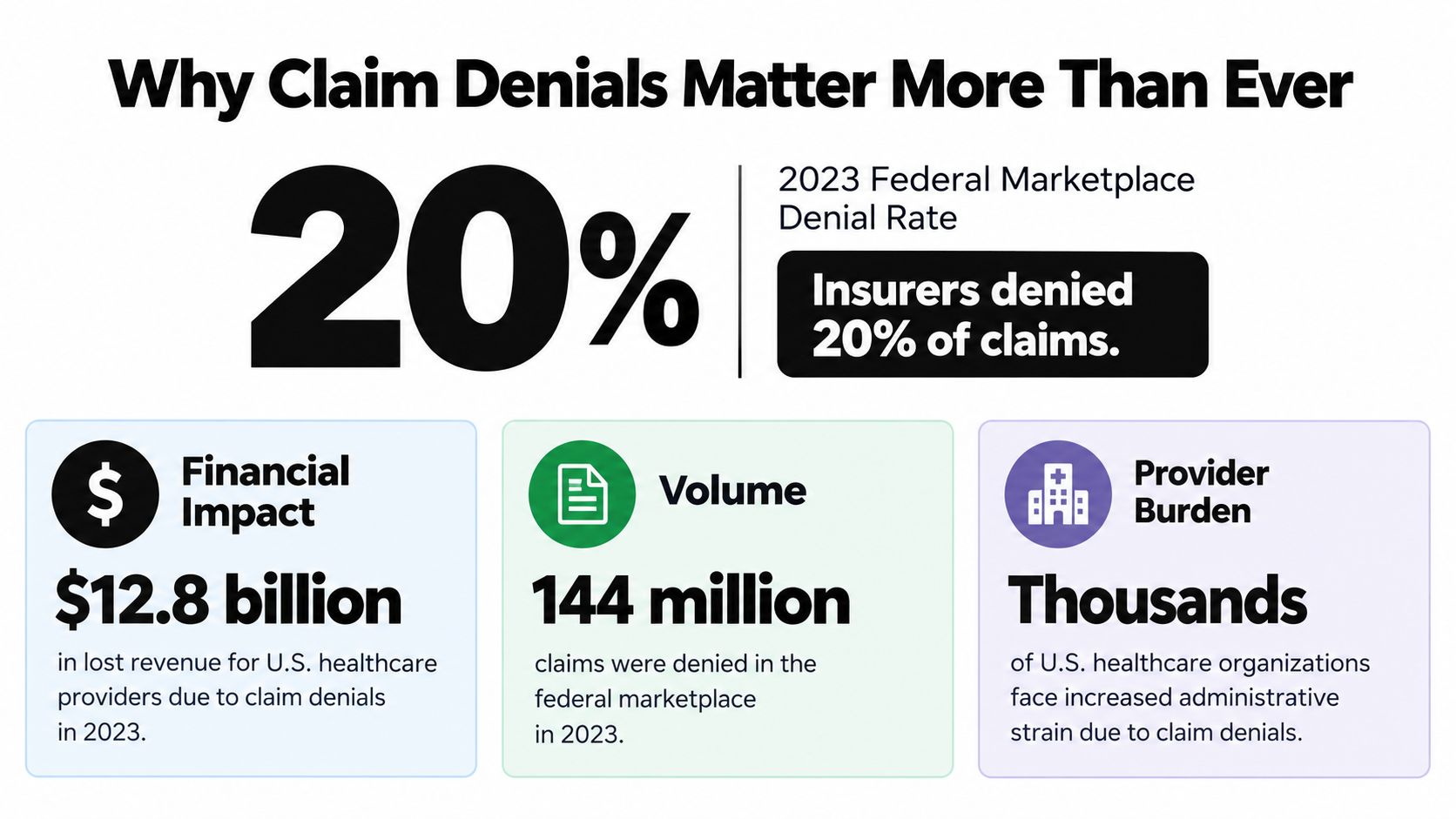
Every denial creates work and delays resolution of the balance. Staff must identify the issue, find records, correct or challenge the claim, and track the payer's response. Some denials are fixable, some call for an appeal, and others may not justify further effort.
A hospital revenue-cycle review by HFMA reported that care denials increased between 2022 and 2023 by an average of 20.2% for commercial claims and 55.7% for Medicare Advantage claims. Its survey of nearly 800 hospitals also found $6.4 billion in delayed or unpaid claims at least six months old. Aging balances tie up working capital and staff capacity.
Operational reality: A denial rate is a starting signal, not a diagnosis. Teams need to identify the payer, reason, and workflow stage, then assign the response with the best chance of recovery.
Denials need ownership across the revenue cycle because causes and remedies cross departments. Registration can correct a demographic mismatch; clinical teams may need to supply missing documentation; payer disputes may require escalation. The goal is to prevent avoidable denials, recover valid claims, and build evidence when payer behavior repeatedly blocks payment.
Understanding Claim Denial Types and Codes
A denial code gives the billing team a place to start, but it doesn't always tell the whole story. Payers may group different issues under broad categories, and a code that appears straightforward can still require staff to check the contract, clinical record, authorization, or claim history before choosing a response.
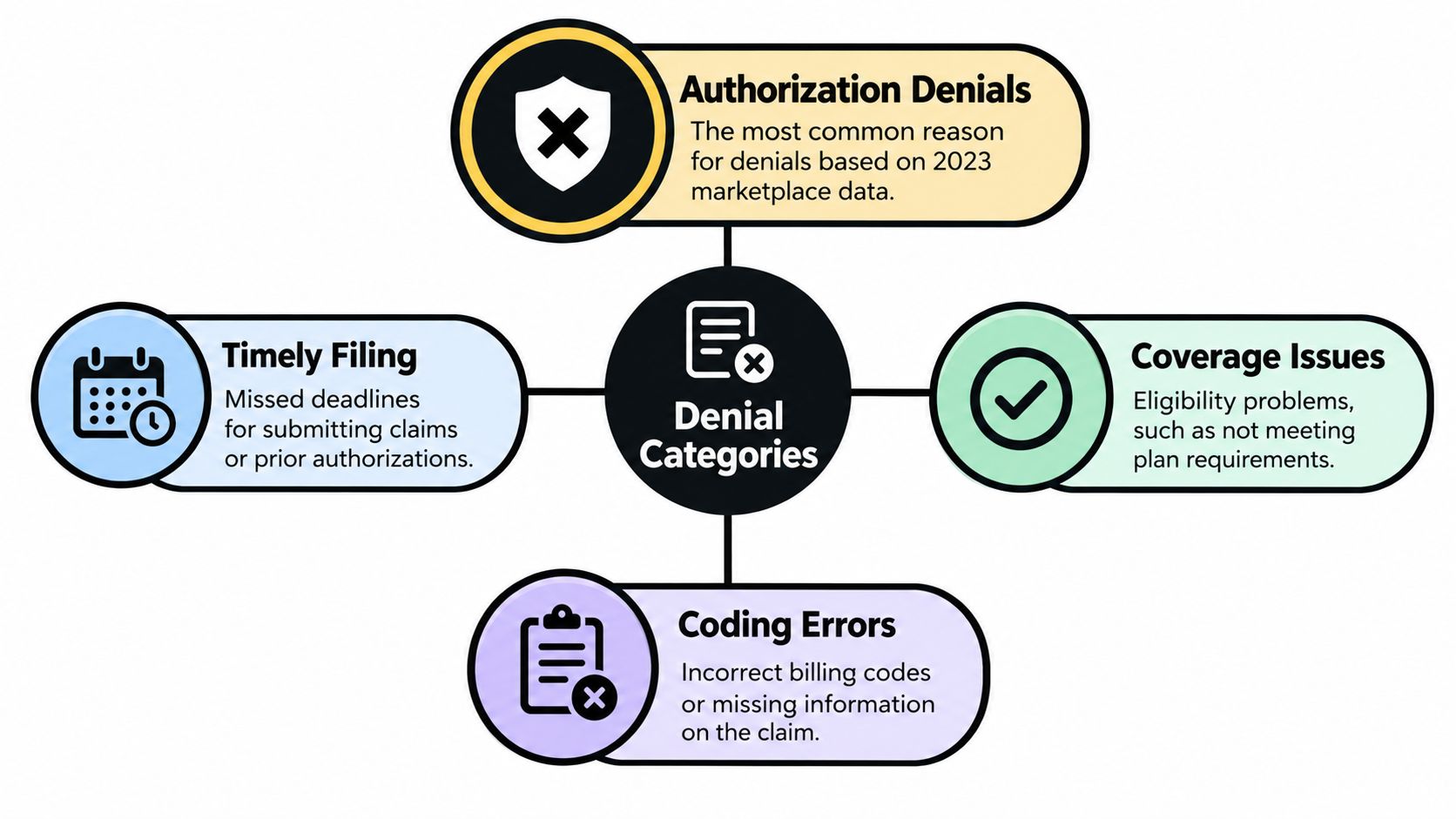
The marketplace data discussed above show a broad mix of reported reasons. The largest category was “other,” at 34%, followed by administrative issues at 18%, excluded services at 16%, and benefit-limit exceedances at 12%. Missing prior authorization or referral accounted for 9%, while medical-necessity determinations accounted for 6%. The broad “other” category limits how precisely the distribution can explain every denial, but the breakdown makes one point clear: clinical disputes aren't the only source of denied claims.
Sort the reason before choosing a remedy
Operationally, classify denials by the work needed to resolve them, not just by the payer's label:
- Correctable data defects: A demographic mismatch, missing field, or inaccurate member detail may call for a correction and resubmission.
- Documentation gaps: The claim may need records that support the service, code, or medical necessity. A corrected data field won't supply missing clinical evidence.
- Coding disputes: A code, modifier, or billed level may need review against the documentation and payer rules. Teams should determine whether the code is wrong or the payer's interpretation is disputed.
- Coverage or authorization issues: Check the benefit, referral, authorization terms, and service details. An authorization issue may be a mismatch between what was approved and what was billed.
- Potential payer-processing errors: If the claim appears to meet requirements, compare the adjudication against the submitted evidence and applicable plan terms before deciding whether to appeal.
A generic “denial” work queue tends to blur these distinctions. Staff can waste time appealing a simple demographic error or resubmitting a claim when the payer has made an adverse coverage determination that requires a formal challenge.
A useful denial taxonomy therefore links each reason to an owner, a next action, and a way to confirm resolution. Keep the payer's original code and description, but add an internal category that reflects the actual root cause. That makes the work queue more useful and helps managers tell a recurring front-end defect from a payer-specific pattern.
Root Causes Across the Revenue Cycle
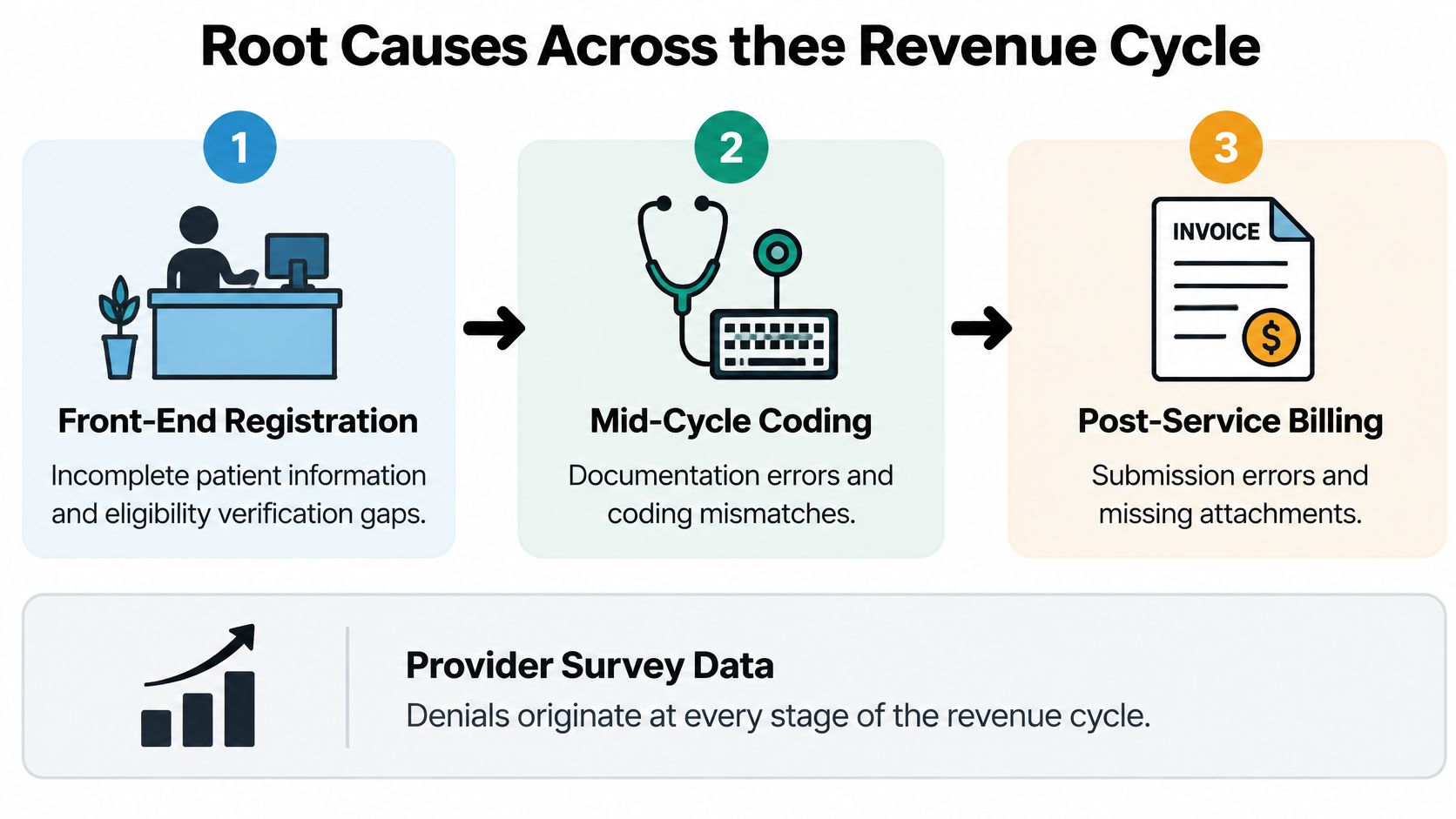
Denials rarely begin at the clearinghouse. In Experian Health's provider survey, 50% of providers identified missing or inaccurate claim data as a leading contributor, followed by authorization problems at 35% and inaccurate or incomplete registration data at 32%. Each cause sits at a different handoff: intake, authorization management, charge capture, coding, and billing. Treating them as one problem guarantees the fix lands in the wrong place.
Front end and authorization
Registration staff establish the patient, coverage, and payer details the claim depends on. Get the member or plan information wrong, and downstream teams submit a technically complete claim that still fails to match the payer's records. Eligibility checks help, but only when they reflect the date of service and the coverage tied to the planned service.
Authorization needs its own control. The same survey found nearly 15% of private-payer claims were initially denied, including claims that carried prior authorization. An approval confirms a service was authorized in principle. It does not confirm the delivered service, billed codes, location, and dates match what was approved. Teams should retain the approval details and reconcile them against the final claim before submission.
Credentialing can also determine whether a payer recognizes the provider as payable at all. Practices reviewing that handoff can use this guide to the provider credentialing process as a reference for the operational steps involved.
Coding and documentation
Front-end verification will not catch a claim that lacks support in the clinical record. CMS's 2024 Medicare Fee-for-Service data show a 10.3% improper-payment rate for E/M codes, and within those improper payments incorrect coding accounted for 49.1%, insufficient documentation for 34.1%, and absent documentation for 13.1%, according to CMS's E/M compliance guidance.
Those are distinct failure modes. A code can be wrong in a complete chart; a correct code can still sit on thin documentation. Route coding questions to coding staff and documentation gaps back to the clinical workflow, and tie billed levels to the documented service elements.
Mapping denials to the stage that produced them does more than guide rework. Most appealed denials are overturned, as the recovery data covered earlier shows, so a cause label that ends at "correct and resubmit" sends recoverable claims back through the wrong queue. In practice that misrouting is common: staff rework a clean claim that needed a formal appeal while a registration defect sits in the dispute pile. A claim that met every documented requirement and was still denied is a payer-behavior problem, and it belongs on the appeal and escalation track, including IDR where the No Surprises Act applies. Prevention shrinks the defect share. Recovery requires the dispute path.
Prevention Strategies That Stop Denials Early
Prevention works best when it follows the claim from registration through submission. A broad “check everything” rule usually produces alert fatigue. A targeted edit, tied to a known failure mode and an accountable team, is more likely to catch a defect without slowing every claim.
Build edits around documented risk
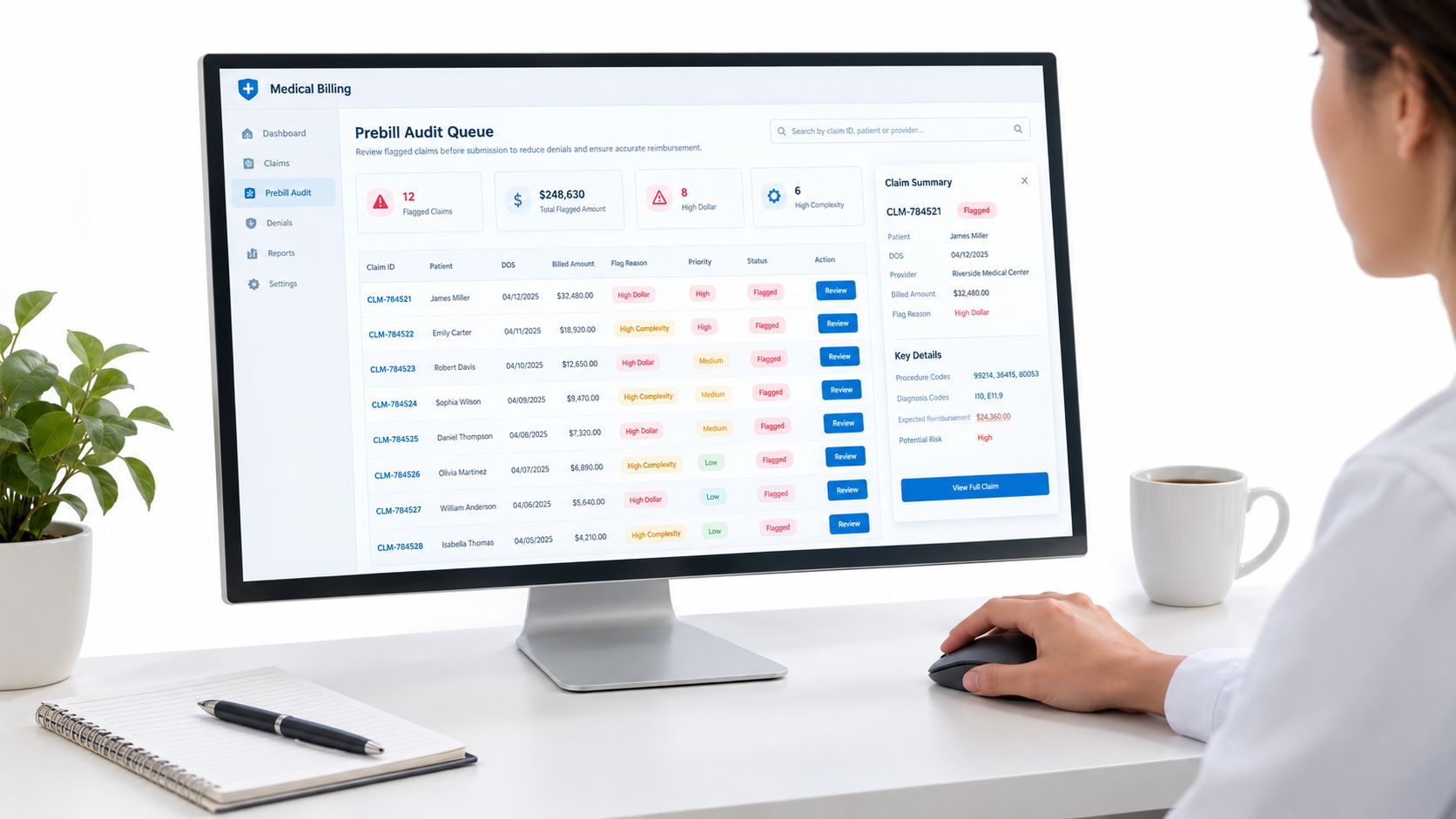
Start with a prebill audit queue for services that are high-dollar, complex, or repeatedly downcoded. The aim isn't to manually inspect every claim. It's to focus review where the value of a potential correction is likely to justify the staff time.
For high-volume E/M services, map the billed code to the documentation elements that support it. Configure claim edits to flag missing documentation, mismatched codes, or missing modifiers before submission. Then monitor results by provider, payer, code family, and missing documentation element. If coding errors fall but documentation gaps don't, a single aggregate clean-claim measure may hide that difference.
Practical rule: Don't send a claim back to the same team with a generic “fix denial” instruction. State whether the issue is the code, the evidence, the authorization, or the payer's processing.
Reconcile authorization to the delivered service
Keep a machine-readable evidence bundle linked to each claim. It should include authorization identifiers, eligibility responses, referral requirements, relevant clinical notes, procedure or operative documentation, codes, modifiers, and payer correspondence. Before billing, compare the approval terms with the service delivered, billed codes, site of care, and covered date range.
That reconciliation matters when the plan approved a service but the final claim differs in a material detail. It also gives appeal staff the original evidence without requiring them to reconstruct the case from scattered portals, inboxes, and chart attachments.
The economics matter too. Independent provider survey data indicate that nearly 70% of private-payer initial denials were eventually overturned, while organizations reported an average administrative cost of $80.16 per Medicare Advantage denial and $57.23 across private insurance types, according to the payment delays and denials data submitted to CMS. Those costs argue for automation and clear routing, not indiscriminate manual review. A practice may use its existing billing system, clearinghouse edits, or a specialized service such as RevGuard's denial management workflows, provided the process preserves claim-level evidence and tracks outcomes.
Appeals, Escalation, and the No Surprises Act
A denial should lead to a decision, not an automatic appeal. Marketplace consumers appealed only about 1% of denied in-network claims, and insurers upheld 56% of those appealed decisions. Meanwhile, the recovery data discussed earlier show that many initially denied claims can still be overturned. The operational challenge is to find the cases where the record supports recovery and choose the right route.
Choose correction, appeal, or escalation
Use a consistent triage:
- Correct and resubmit when the payer identifies a fixable claim-data defect, such as a missing or inaccurate field. Confirm that the payer accepts a corrected claim and follow its submission requirements.
- Appeal when the payer's decision conflicts with the authorization, submitted documentation, coding support, or applicable coverage terms. Build the case around the specific denial rationale and attach evidence that directly addresses it.
- Escalate when the issue concerns payer processing, repeated underpayment, or a dispute that may qualify for a formal external pathway. Document prior contacts, payment calculations, correspondence, and the claim record.
For the appeal itself, preserve the original remittance advice, claim version, authorization record, relevant clinical documentation, and payer communications. State what decision is being challenged and why the evidence supports payment. A general appeal letter that repeats the clinical story without answering the denial reason is less useful than a focused response.
The appeal process steps for medical claims can help teams organize their internal workflow. That process should assign an owner and a follow-up point, so a submitted appeal doesn't disappear into a payer portal without a status check.
Know what IDR can and can't do
The No Surprises Act's Independent Dispute Resolution process is a formal mechanism for eligible payment disputes, including certain out-of-network disputes. It isn't a substitute for routine claim correction or every internal appeal, and eligibility depends on the circumstances of the dispute. Teams should confirm that the claim and parties qualify before investing in case preparation.
When IDR may apply, assemble a clear record of the service, claim, payment or offer history, and supporting information relevant to the dispute. Track the case through filing, decision, and enforcement. Then compare the expected recovery with the staff and process costs of pursuing it. A payer with a repeated pattern of low initial payments may merit escalation; a small, easily corrected data defect usually doesn't belong in arbitration.
KPIs and Analytics to Track Denial Leakage
A single denial rate hides more than it reveals. Coding accuracy can improve while documentation failures keep generating write-offs, and the blended number barely moves. The metrics that matter tie dollars at risk to the operational reason they sit at risk.
As noted earlier, hospital denial rates climbed from 10.2% in 2021 to 11% in 2022, and denied balances keep aging while they wait for action. Each week of delay adds follow-up touches to claims that may still be recoverable. Because the large majority of appealed denials are overturned, a point covered earlier in this article, aging denied receivables are often recoverable cash rather than lost revenue. Your reporting should treat them accordingly.
| Metric | What It Measures | Why It Matters |
|---|---|---|
| Denial rate by payer | Denied claims or denied allowed amount, segmented by payer | Identifies payer-specific patterns hidden by an overall rate |
| Denial rate by provider and code family | Denials associated with clinicians, service types, or billed code groups | Helps distinguish training needs from payer or workflow issues |
| Denial reason mix | Distribution of denials across data, authorization, coding, documentation, coverage, and processing categories | Shows which corrective action should take priority |
| First-pass resolution | Claims paid or resolved without repeated correction or appeal | Indicates whether front-end controls and edits are catching defects |
| Aging denied receivables | The time denied balances remain unresolved | Shows exposure to delayed cash and stalled follow-up |
| Appeal recovery yield | Recovered payment compared with the cost of pursuing appeals | Helps teams choose which cases and payer patterns warrant escalation |
| Escalation yield by pathway | Recovery from internal appeals versus formal dispute channels such as IDR, relative to case cost | Separates fixable defects from payer behavior that justifies escalation |
| Rework cost by category | Staff effort and expense associated with each denial type | Reveals where automation or process changes can reduce avoidable work |
Cut these numbers by specialty and workflow stage, not just by payer. An anesthesia denial pattern usually reflects different authorization and documentation problems than one in imaging or orthopedics.
The reason-mix report deserves particular attention. Split your categories into defects your side created, such as eligibility misses and coding errors, and payer behavior, such as recurring medical-necessity denials or low initial payments from one plan. The first group points to upstream fixes. The second points to escalation economics, including whether IDR filings recover enough to justify their preparation cost.
A team can organize these measures through a denial management analytics framework. Whatever the system, it should preserve the thread from original claim to denial reason, action taken, outcome, and staff hours consumed. That thread turns recovery yield into a management tool rather than a retrospective report, and every metric should connect to an owner who can verify the fix moved the right category.
Building a Closed-Loop Denial Management Model
Treating denials as isolated billing mistakes leaves the same defects in place. A closed-loop model connects eligibility, authorization, coding, documentation, adjudication, appeal outcomes, and payer payment behavior. Each denial should teach the organization something it can use to prevent a repeat or recover a valid payment.
Start by routing work into distinct paths: preventable prebill defects go to the team responsible for the upstream process; payer-processing errors receive targeted correction or escalation; medically disputable decisions go to staff who can assemble and defend the clinical record. Feed the outcome back into edits, training, and payer-specific guidance. That's how a resolved claim becomes an operational improvement rather than a one-time win.
Internal teams are well positioned to manage familiar, repeatable claim corrections. Complex specialties and variable payer requirements may call for more dedicated expertise, especially when underpayments and formal disputes demand coordinated evidence, negotiation, and follow-through. The choice should reflect the organization's claim mix, available staff, and ability to track outcomes, not a blanket assumption that every denial belongs in-house or should be outsourced.
Prevention remains essential, but it can't be the whole strategy. Build a workflow that prevents known defects, triages the denials that still arrive, and escalates the payment disputes worth pursuing. RevGuard combines specialty-specific revenue cycle management with No Surprises Act IDR support, including claim preparation, evidence assembly, dispute filing, and payment recovery. If your organization needs a clearer path from denial to resolution, visit RevGuard to review how its services fit your revenue cycle.