

You're staring at a statement after an emergency visit. The hospital was in network, the clinician apparently wasn't, and the balance doesn't match anything your plan booklet described. You call billing and someone says you can negotiate. That single word can mean a discount conversation, a contract dispute, a formal appeal, or federal arbitration, and picking the wrong one wastes time while deadlines run.
What Bill Negotiation Actually Means Today
Start with the plain version. Bill negotiation is the structured process of challenging, discussing, and resolving the amount owed for medical services rather than accepting the first charge or reimbursement decision. It isn't asking for a favor. It's how the parties decide a defensible payment when the billed charge, the insurer's offer, and the expected market rate don't agree.
That gap isn't imaginary. Billed prices sit far above what payers allow, which is why the first number on a statement rarely ends the conversation. A negotiator's job is to close the distance between those numbers with evidence, not persistence alone.
Three Situations, One Word
Consider how different the same term looks depending on who owes money. A self-pay patient asks a practice to reduce a balance she owes directly. A specialty group tells a payer its payment fell below the contract. An out-of-network emergency provider and a health plan, unable to agree, hand the decision to a neutral arbitrator. All three call it negotiation.
The first question isn't how much you can get. It's which conversation you're actually in.
The bill negotiation meaning matters because each version runs on different rules. Patient conversations turn on financial need, prompt payment, and practice policy. Provider and payer conversations turn on contract language, coding accuracy, and comparable allowed amounts. Arbitration turns on a statutory record and a final offer that a neutral entity can select.
Why the Definition Has Teeth
Negotiation works when it converts a complaint into a quantified counteroffer. That means identifying a specific defect, such as an incorrect downcode, a missing modifier, or payment below the contractual allowance, and pricing the correction. A vague request to pay more, or charge less, gives the other side nothing defensible to approve.
That's why experienced revenue-cycle staff treat negotiation as a financial, contractual, and regulatory process at once. The financial part asks what's recoverable. The contractual part asks what was promised. The regulatory part asks which remedy the law allows for this claim, in this setting, with this network status.
If you remember one thing, remember this. Bill negotiation means replacing an unsupported number with a supported one. Who must support it, and to whom, changes with your seat at the table. The sections ahead separate those seats so you can tell whether you need an itemized bill, a corrected claim, an appeal, or a formal dispute filing.
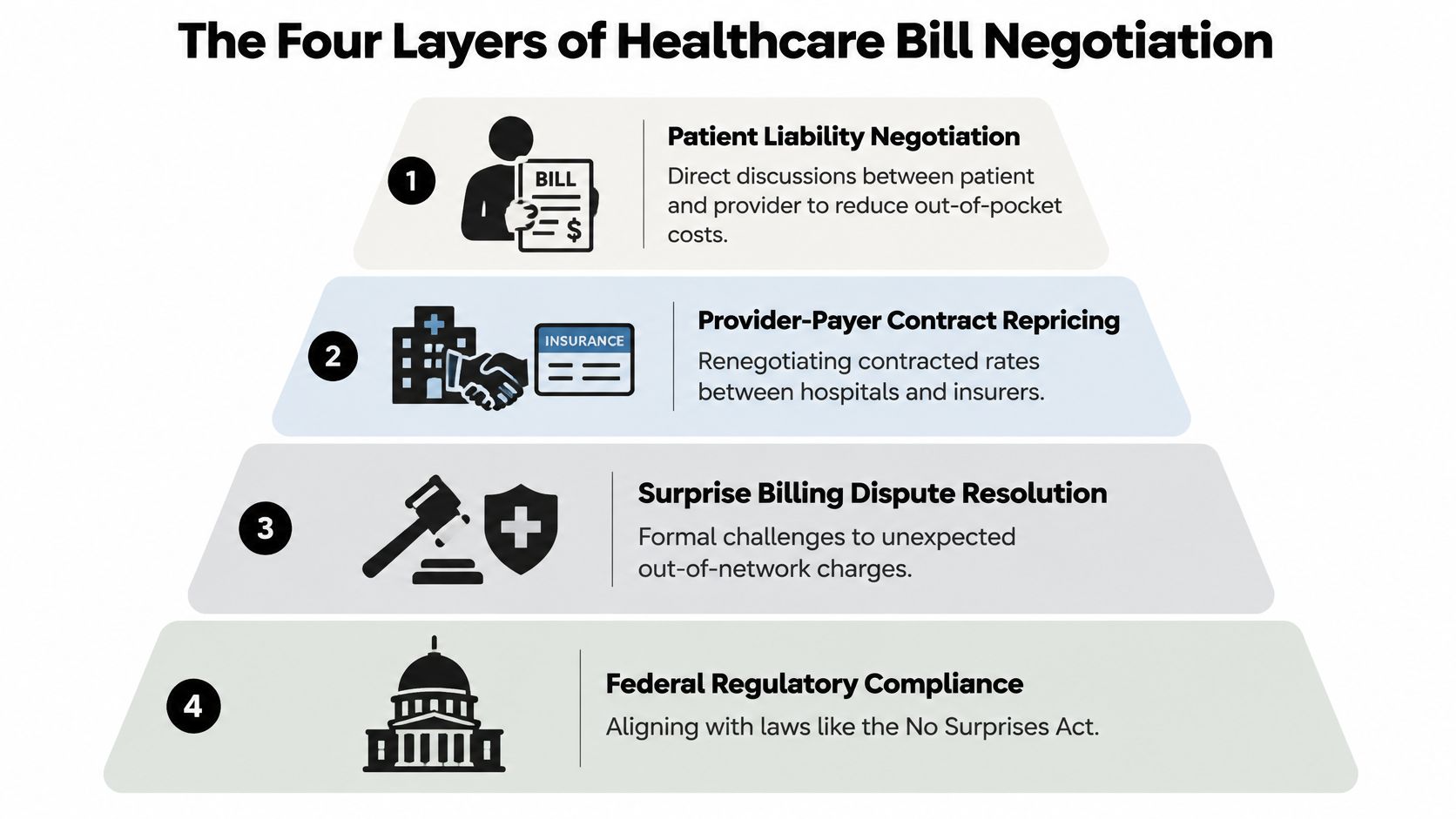
The Four Layers of Healthcare Bill Negotiation
Think in layers, not steps. Layers can stack on the same encounter, so a patient can negotiate cost sharing while the provider separately disputes the payer's payment for the same visit. Confusion starts when people treat one layer's tactics as if they worked in another.
Layer One and Layer Two
Patient liability negotiation sits closest to the person holding the statement. The patient and provider discuss the out-of-pocket balance, using an itemized bill, proof of hardship, or a financial assistance application. The realistic outcomes are a reduced balance, a payment plan, or a corrected charge.
Provider-payer contract repricing operates above individual claims. Practices and plans revisit contracted rates, fee schedules, and terms that will govern future encounters, which is the territory covered by structured healthcare payer contract negotiations. Evidence here looks like comparable allowed amounts, service complexity, and market circumstances rather than one patient's hardship.
The economics explain why this layer exists. A World Health Organization analysis found average negotiated inpatient prices of approximately $14,020, while full hospital charges were about 207% of negotiated prices and Medicare payments were about 45% of negotiated prices, as detailed in the WHO analysis of how U.S. prices are determined. List price, negotiated price, and public benchmarks aren't the same number.
Layer Three and Layer Four
Claims-level appeal narrows the focus to a single adjudicated claim. The provider argues the payer processed it wrong, pointing to authorization records, CPT and HCPCS accuracy, modifiers, units, medical necessity, or bundling edits. The outcome sought is reprocessing at the correct allowance.
- Reconsideration: Ask the payer to review a specific processing error.
- Formal appeal: Escalate with clinical records when reprocessing fails.
- Contract enforcement: Invoke the agreement when payment breaches its terms.
Statutory arbitration is the top layer, reserved for eligible out-of-network disputes where direct negotiation has failed. A certified neutral entity decides, and the patient generally isn't the one arguing. Each layer demands different evidence, so identifying yours tells you what to gather before you make a single call.
Why Negotiation Became a Federal-Scale Process
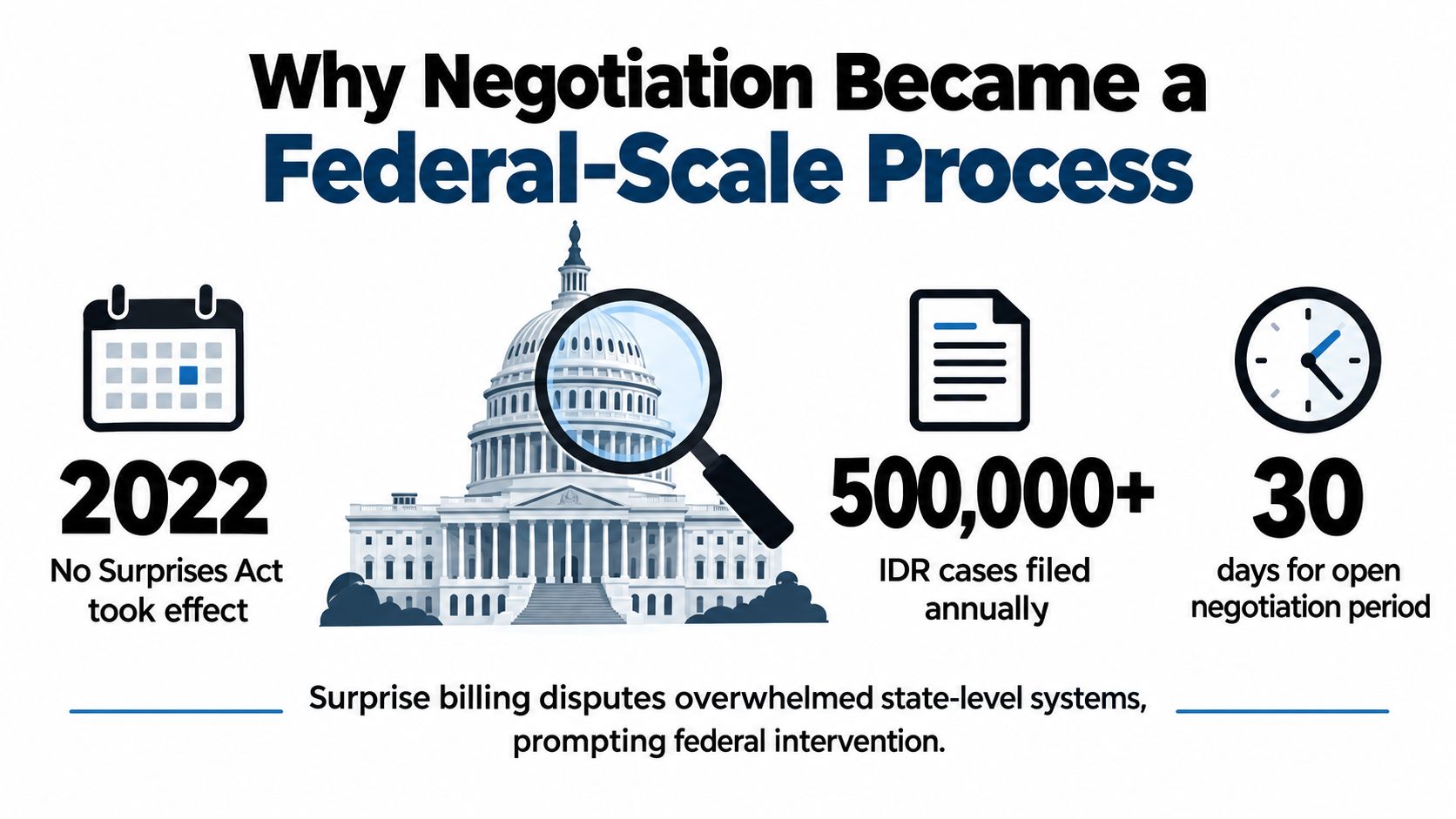
Bill negotiation used to be mostly phone work. Federal law turned part of it into a formal adjudication system, and the reason was scale. Surprise billing wasn't rare enough for ad hoc fixes.
The Problem That Forced Intervention
A Kaiser Family Foundation analysis found that approximately one in five insured adults experienced an unexpected out-of-network medical bill during the preceding two years, and about 18% of emergency-room visits resulted in at least one surprise bill, with rates varying substantially by state, according to KFF statistics on surprise medical billing. Emergency care exposed the flaw clearly. Patients choose a facility, not every clinician who treats them there.
Congress responded with the No Surprises Act, enacted in 2020 with key protections effective January 1, 2022. The law generally restricts surprise out-of-network billing for emergency services and certain services at in-network facilities. In practice, it moved the argument. Patients stepped out of the middle, and payers and providers inherited the dispute.
What Happened to Volume
The filings show how large that inherited argument became. Parties initiated 200,112 federal disputes in 2022, then 679,156 in 2023, then more than 1.46 million in 2024, as summarized in the Congressional Research Service report on federal IDR activity. Nearly 1.42 million disputes, about 97%, concerned out-of-network emergency or nonemergency services, while 44,238, about 3%, involved air ambulance services.
Practical rule: When a process generates millions of formal filings, informality stops being a strategy.
Entities closed more than 1.37 million disputes in 2024, yet roughly 262,441 cases, or 19%, were found ineligible for the federal process. That ineligibility figure carries the lesson for specialty practices and hospitals. Eligibility, documentation, coding, and compliance decide whether negotiation can proceed at all, long before anyone argues price.
Who Sits at the Table in Each Negotiation Type
Your role determines your remedy. A patient can't file the provider's arbitration case, and a provider can't negotiate away a patient's lawful cost sharing by calling the payer. Naming your seat is the first real decision in any negotiation.
What Each Party Controls
The patient controls personal information, hardship documentation, and the decision to request itemization or assistance. The provider controls the clinical record, the coding, and the decision to appeal or escalate. The payer controls adjudication, contract interpretation, and its own offer. The arbitrator controls only the final selection between submitted offers in eligible disputes.
Power follows that control. Patients hold power when a charge is wrong or assistance policy applies. Providers hold power when documentation proves complexity the payment ignored. Payers hold power when the claim itself doesn't support what was billed. Nobody holds power through volume of phone calls.
| Negotiation Layer | Primary Initiator | Key Evidence | Likely Outcome |
|---|---|---|---|
| Patient liability | Patient | Itemized bill, hardship records | Reduced balance or payment plan |
| Contract repricing | Provider or payer | Comparable allowed amounts, terms | Revised rates for future claims |
| Claims-level appeal | Provider billing staff | Coding, authorization, records | Reprocessed claim |
| Statutory arbitration | Provider or plan | Acuity, specialty, prior payments | Binding selection of one offer |
Where Readers Misidentify Themselves
Insured patients often assume they're negotiating when they're protected. Under the No Surprises Act, the patient is generally shielded from the disputed out-of-network balance while provider and plan resolve reimbursement. Chasing a discount on a balance you don't lawfully owe misdirects your effort.
Providers make the mirror-image mistake. Revenue-cycle staff sometimes pursue the patient for amounts that belong in a payer dispute, or pursue a payer discount conversation when the claim needs correction first. Match the counterparty to the layer. If the money problem sits between you and the plan, the patient isn't your negotiating partner, and your documentation should be built for the audience that will decide.
How Open Negotiation and IDR Escalation Actually Work
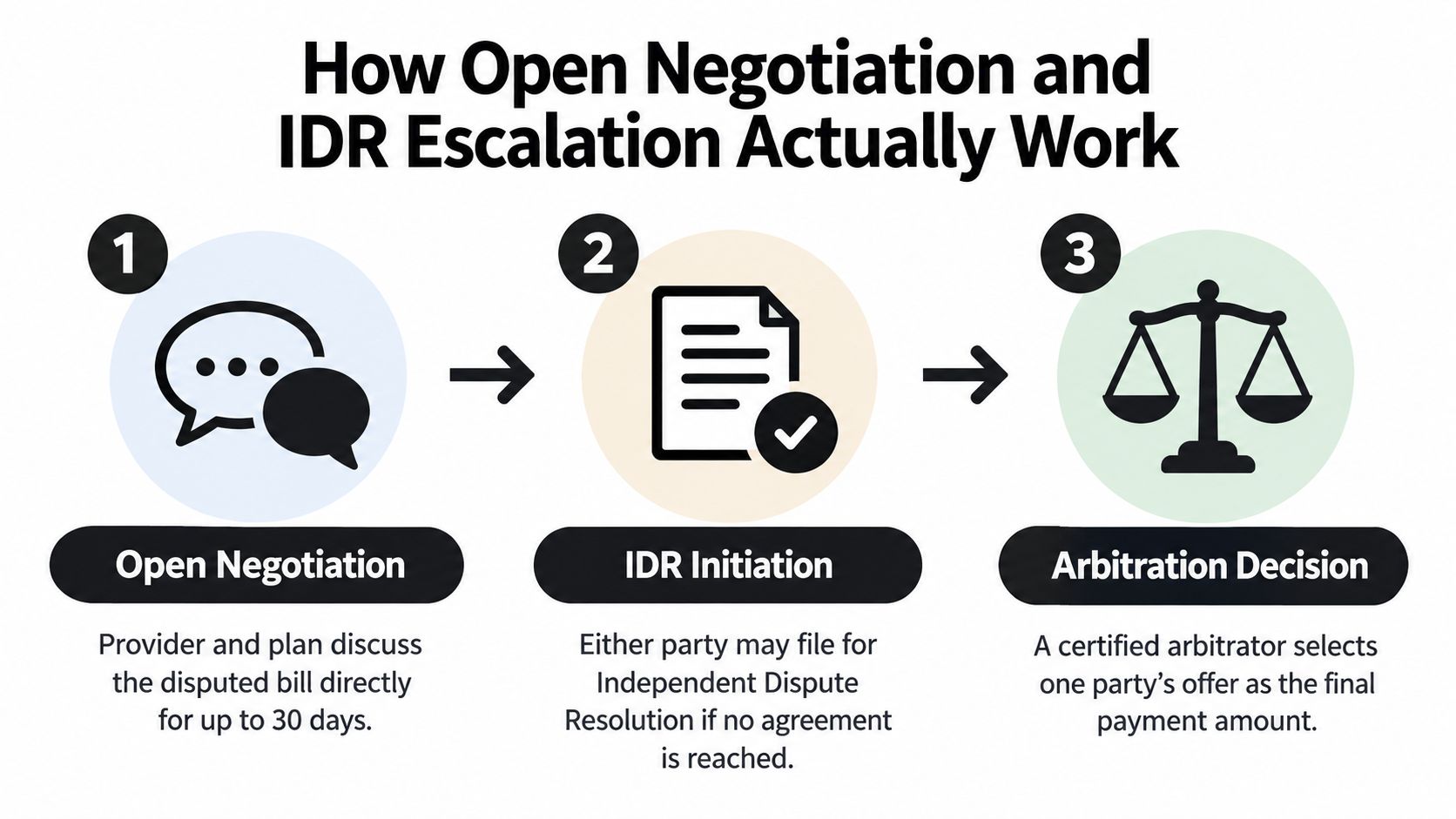
For eligible out-of-network emergency, air ambulance, and certain nonemergency services, escalation follows a defined path. You can't skip to the end because the earlier stage creates the record the later stage depends on.
Step One Open Negotiation
The provider and plan first negotiate directly during an open negotiation period. Each side states a payment position and tests whether the gap can close without a third party. Treat this stage as evidence building, not warmup. Preserve payer correspondence, coding support, and the clinical record showing what the encounter involved.
Calculate your position before you state it. Confirm eligibility, authorization, network status, modifier accuracy, and the applicable fee schedule. An offer built on an unaudited claim invites the other side to attack the claim instead of the price.
Step Two Independent Dispute Resolution
If direct negotiation fails, either party may initiate federal Independent Dispute Resolution, the process explained in this guide to the No Surprises Act IDR process. A certified entity doesn't split the difference or invent a compromise. It selects one party's final offer, which makes the credibility of your number the whole contest.
Support that offer with the factors the record is meant to carry:
- Service acuity and complexity: What made this encounter harder than the typical case.
- Provider specialty, training, and experience: Who delivered the care and why that matters clinically.
- Market circumstances and prior comparable payments: What similar services have been paid.
Avoid anchoring the offer to the original billed charge alone. A chargemaster figure proves only what you asked, not what the service warrants.
What the Outcomes Show
Results from the first half of 2023 show why record quality matters. IDR entities closed 134,036 disputes and issued payment determinations in 83,868 cases, approximately 63% of closed disputes, and providers prevailed in 77% of 78,111 out-of-network emergency and nonemergency cases where a determination was made, with roughly 82% of determinations exceeding the insurer's qualified payment amount, per the Congressional Research Service summary of CMS IDR data.
A strong win rate doesn't make every case worth filing. It makes well-documented cases worth filing.
Run the economics before escalating. Estimate expected recovery, subtract filing and administrative costs, and escalate only where the evidentiary record supports a credible final offer. Volume keeps climbing too. Parties initiated 1,186,812 federal IDR disputes from January through June 2025, 39% more than in the final six months of 2024, according to the CMS Independent Dispute Resolution reports. Backlogs reward clean, complete submissions.
Common Misconceptions That Cost Recoverable Revenue
Most consumer advice frames negotiation as calling a hospital and asking for a discount. That framing damages provider revenue when billing teams import it into payer disputes. Haggling isn't the skill. Remedy selection is.

Misconceptions Worth Dropping
Every underpayment deserves a discount request. No. A downcoded claim needs coding correction and clinical support, not a smaller ask. Accepting a reduced figure on a wrongly processed claim converts a fixable error into permanent leakage.
The chargemaster price makes a strong final offer. It doesn't. Arbitrators weigh acuity, specialty, complexity, and comparable payments. A list price with no supporting record asks the decision maker to trust the very number under dispute.
- Modifiers are minor details: A missing or wrong modifier can misprice the entire claim before negotiation begins.
- Bundling edits are payer inventions: Some are legitimate, some are misapplied, and you can't tell without auditing the claim.
- Air ambulance runs on separate logic: Eligible air ambulance disputes belong in the same federal framework as other covered out-of-network services.
The Eligibility Trap
Teams also assume a sympathetic case qualifies for federal dispute resolution. It doesn't. Eligible parties must first use the open negotiation period, and the claim must fit the federal process. Skipping stages or filing ineligible cases burns fees and staff time while the recoverable claim ages.
Clean claims change outcomes more than aggressive calls do. When clinical and coding evidence removes ambiguity, the payer or arbitrator faces a clear choice between two numbers, one of which is documented. Replace the question of how low the bill can go with a better one. Which remedy is lawful, on time, and well evidenced for this specific case?
Matching the Negotiation Type to Your Situation
Triage starts with the symptom, not the tactic. Read your statement or remit, name the layer, then choose the remedy that layer allows. If you're deciding how to dispute a medical bill, that ordering keeps you from filing the right argument in the wrong forum.
A Quick Triage
- Self-pay balance you owe: Request itemization, check financial assistance, then discuss reduction or payment terms.
- In-network denial or downcode: Audit coding and authorization, submit a corrected claim or claims-level appeal.
- Out-of-network emergency underpayment: Protect the patient, open negotiation with the plan, and prepare the arbitration record.
- Air ambulance underpayment: Follow the same eligible dispute path, with documentation built for transport complexity.
- Pattern of below-contract payments: Stop chasing claims one by one and enforce or renegotiate the contract.
Each path carries different deadlines, evidence, and return on effort. Specialty practices, ambulatory surgery centers, hospitals, and air ambulance operators all use the phrase bill negotiation, but they're rarely running the same play. Your next action should follow from your layer, not from generic advice written for someone else's seat.
Questions Readers Ask After Learning the Meaning
Is arbitration worth it for smaller balances? Sometimes not. Compare expected recovery against filing and administrative costs first, and escalate only when the documented offer clears that math.
Can a self-pay patient negotiate without insurance involved? Yes, directly with the provider. That conversation sits in the patient liability layer, so itemization, assistance eligibility, and payment ability carry the weight.
What should providers preserve before open negotiation closes? Payer correspondence, coding evidence, authorization records, and the clinical documentation supporting acuity and complexity. Rebuilding that record later is harder than keeping it.
Who decides if we can't agree? In eligible federal disputes, a certified entity selects one final offer. It doesn't craft a middle number.
If your team is losing recoverable revenue to underpayments, downcodes, or stalled out-of-network disputes, RevGuard can audit your claims, build dispute-ready documentation, and carry eligible cases through open negotiation and IDR. Visit the site to request a review of your current negotiation workflow and see where revenue is leaking.