

U.S. healthcare administrative work costs approximately $440 billion annually, according to Chief Healthcare Executive's summary of the CAQH findings. That's the right lens for choosing billing services for physicians. You're not buying claim submission. You're buying control over the labor, denials, underpayments, and delays that sit between a completed encounter and final payment. Judge every vendor on net recovery and payer behavior, not on how many claims, calls, or reports they produce.
What Physician Billing Services Cover, Stage by Stage
Think of billing as a relay race. The clinician delivers the care and hands the baton to the billing team, which carries the encounter through coding, payer review, and cash collection. Excellent care doesn't protect revenue if eligibility, documentation, or follow-up drops the baton.

Eight stages, eight ways to leak money
| Stage | What happens | Typical failure if unmanaged |
|---|---|---|
| Eligibility and authorization | Verify coverage and prior authorization before the visit | Denials for missing authorization or inactive coverage |
| Charge entry and coding | Convert the encounter into CPT and ICD-10 codes with modifiers | Under-coding, mis-coding and modifier errors |
| Clean claim submission | Send the claim electronically through a clearinghouse | Front-end rejections and avoidable delays |
| Payment posting and reconciliation | Record payments and contractual adjustments against each claim | Underpayments hidden inside unexplained variances |
| Denial management and appeals | Work denials and file appeals within payer deadlines | Lost revenue from missed appeal windows |
| Accounts receivable follow-up | Track aging claims and escalate stalled ones | Rising days in A/R and cash-flow strain |
| Patient collections | Send statements, set payment plans and resolve balances | Patient balances left uncollected or confused |
| Underpayment recovery and IDR | Identify underpaid claims and dispute them where eligible | Recoverable gaps never pursued |
A vendor may cover all eight stages or only a few. Don't rely on a marketing page. Require the contract to name each stage, its owner, its turnaround standard, and the handoff back to your practice. Our billing services include charge entry and clean claim submission, payment posting and reconciliation, and denial management and appeals, which maps to the middle of the table where claim quality and payer responses meet.
Why small gains matter
The revenue base is enormous. National health expenditures for physician and clinical services reached $978.0 billion in 2023, and CMS subsequently reported that physician and clinical-services spending rose another 8.1% to $1,109.7 billion in 2024, figures summarized in the 2024 CAQH Index Report. At practice level, that means a modest improvement in first-pass acceptance or payment speed can move more cash than a small reduction in the vendor's fee.
For a clear breakdown of how these stages fit together, see what RCM means in medical billing. Then complete a simple exercise before interviewing vendors. List each stage, mark whether your practice or a vendor owns it today, and circle the stage where money most often disappears.
Start with the leak: If you can't name the stage causing the largest dollar loss, you can't write a useful vendor scope.
What Billing Services Cost and Which Model Fits
Price the incentive, not just the invoice. Each model rewards a different behavior, and the wrong incentive can cost more than a higher headline rate.
| Model | How it is charged | Typical range | Best fit | Watch for |
|---|---|---|---|---|
| Percentage of collections | Share of cash actually collected | About 4% to 9% of collections | Low-volume groups that want cost tied to results | Pressure to chase patient balances hard |
| Per-claim fee | Flat fee for each claim submitted | About $3 to $8 per claim | Stable, high-volume groups with clean payer mix | Fees on resubmitted and denied claims |
| Flat monthly retainer | Fixed monthly fee set by volume and staffing | A quoted fixed monthly amount in the contract | Practices that want predictable monthly costs | Thin staffing hidden behind a fixed price |
| Hybrid | Base fee plus percentage or per-claim charge | Quoted base fee plus the stated variable rate | Groups with mixed volume and frequent denials | Stacked fees that exceed either pure model |
| Project fees for add-on work | Per case or per project for IDR, credentialing or contract work | Quoted per case or per project before work starts | Practices with a known backlog or dispute set | Costs outside the monthly invoice |
What each model encourages
Percentage of collections aligns the vendor with cash collected, which is useful when your main problem is unworked A/R or weak follow-up. It can also encourage aggressive patient collections or heavy focus on easy dollars. Ask whether the percentage applies to payer payments, patient payments, refunds, and recovered old balances.
Per-claim pricing is easy to forecast, but it rewards claim volume. If denial rework and resubmissions are billable, your cost rises when performance falls. Require a definition of a billable claim and a cap or exclusion for vendor-caused resubmissions.
A flat retainer gives budget certainty. Its risk is invisible capacity. Ask how many staff hours, which roles, and what claim volume the retainer supports, plus what happens when volume exceeds that level. A hybrid can balance predictability and accountability, but model the combined fee at low, expected, and high collections so stacked charges don't unexpectedly beat both pure models.
Project fees fit defined work such as an IDR batch or credentialing backlog. Get the unit price, filing costs, evidence work, and stopping rule in writing before anyone opens a case.
Specialty, payer mix, average claim value, and denial complexity change the actual price. Convert every quote into net cost after denials, rework, patient-collection effort, and delayed cash. We specialize in medical billing and Revenue Cycle Management, and all of our services are outlined in the client's contract. Clients agree to the payment terms in their service agreement, and timely payments ensure uninterrupted service, so payment timing belongs in the comparison too.
Ask every vendor to price the same month of 500 claims, including a denial-heavy scenario, on one sheet. Vendors that resist a common test usually rely on incomparable quotes.
Specialty Billing Needs That Change the Work
A generic claim follows a generic path. A specialty claim often doesn't. The rule that changes units, modifiers, site of service, or claim ownership also changes staffing, edits, documentation, and follow-up.
| Specialty | Billing issue that changes the work | What the partner must know |
|---|---|---|
| Anesthesia | Time-based units plus base units and medical-direction modifiers | Anesthesia time rules and modifier logic for each payer |
| IONM (intraoperative neuromonitoring) | Often billed by a separate group from the surgeon | Who bills, which codes apply and each payer's supervision rules |
| Orthopedics and spine | Global surgical periods and implant or supply billing | Global period tracking and implant documentation standards |
| Gastroenterology | Facility and professional split on endoscopy, many bundled add-on codes | NCCI edits and separate facility and professional claims |
| Radiology | Technical and professional component split | Modifier handling for each payer and split-billing rules |
| Dermatology | Medical versus cosmetic visits and layered surgical codes | Medical-necessity documentation to prevent cosmetic denials |
| Ambulatory surgery centers | Facility fee and professional fee on separate claims | Facility rate schedules and multi-claim tracking per case |
| Air ambulance | Mileage, service level and out-of-network status | IDR eligibility, mileage records and clinical documentation |
Follow the handoffs
Anesthesia billing breaks when start and stop times, base units, physical status, and medical-direction facts don't agree. IONM creates a different problem. The surgeon, monitoring clinician, and billing group may be separate, so the vendor must know who owns the charge, which supervision rule applies, and what evidence supports the service.
Orthopedic and spine claims need global-period controls and implant records that match the operative note. Gastroenterology and radiology require clean separation between facility, technical, and professional components. Dermatology depends on documentation that separates medically necessary care from cosmetic services. ASC cases need linked tracking across facility and professional claims, while air ambulance claims need mileage, service level, and out-of-network records preserved from the start.
Our RCM services are listed for air ambulance services, ambulatory surgery centers, anesthesia practices, cardiology practices, dermatology practices, diagnostic imaging providers, gastroenterology practices, hospice and palliative care providers, internal medicine practices, mental health practices, IONM, oncology practices, ophthalmology practices, orthopedic and spine surgery, pain management practices, podiatry practices, plastic surgery practices, urgent care centers, and trauma, critical care, and post-acute care practices. You can review the full range through our medical billing specialties page.
Don't accept a specialty list as proof. Pick the claim type with the most rules in your practice and make the vendor walk it from charge entry to final payment, naming the edit, record, owner, and escalation point at each handoff.
How IDR Connects Clean Claims to Arbitration Wins
An arbitration case is only as strong as the claim file built before the dispute.
Treat IDR readiness like a pilot's pre-flight check. The checklist works because it's completed before takeoff. A crash investigation can explain missing records, but it can't recreate decisions, notices, and timelines that nobody captured when the claim was active.
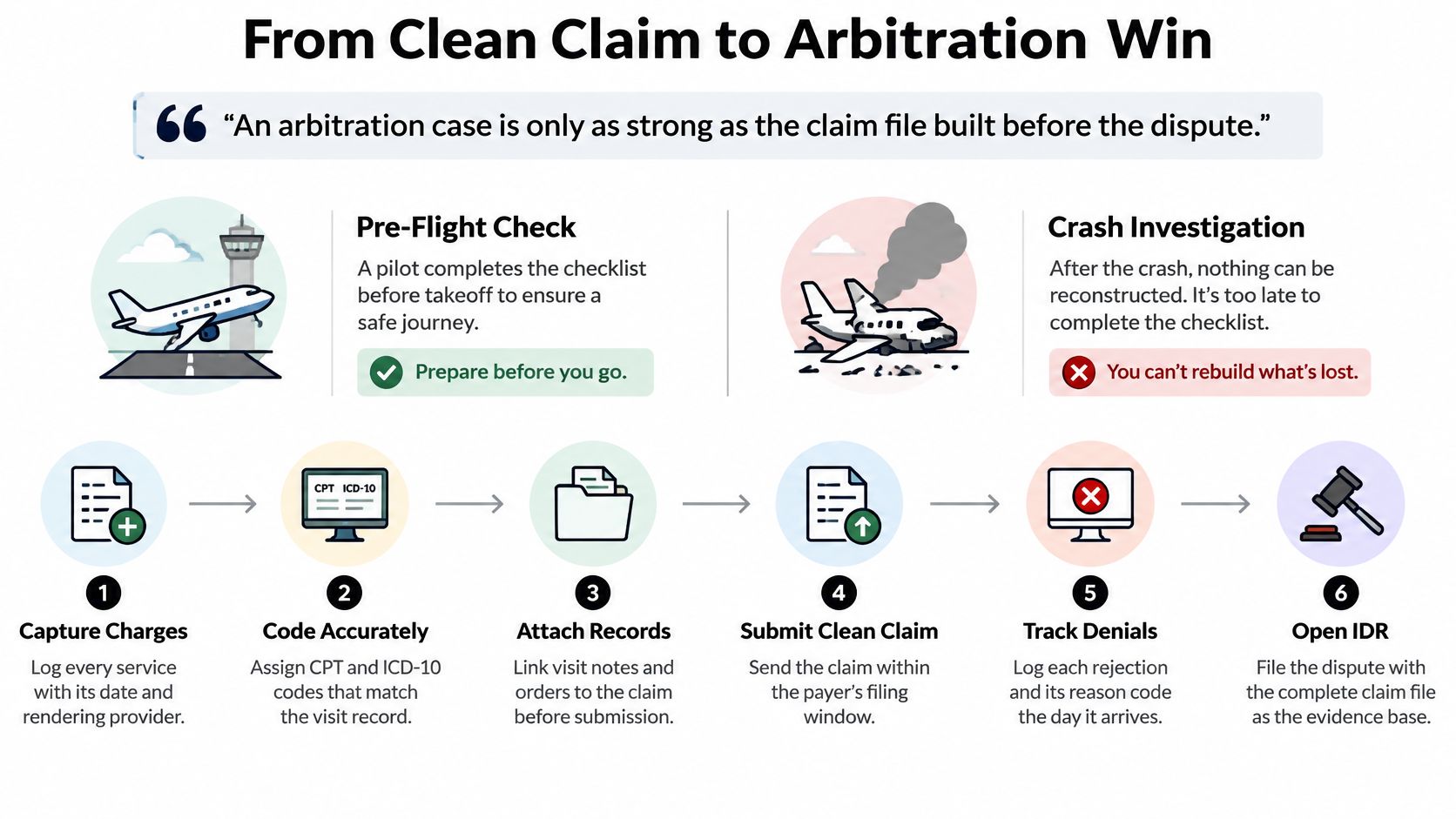
The Congressional Research Service report on federal IDR states that in 2024, more than 1.46 million federal IDR disputes were initiated, while IDR entities closed more than 1.37 million. Nearly 1.048 million closed disputes resulted in payment determinations, and approximately 19% were found ineligible. That ineligible share is the warning. A practice can spend staff time and filing money on a dispute that never reaches a payment decision.
Six stages from claim to filing decision
- Screen federal IDR eligibility: Classify the service, specialty, payer, and out-of-network status before building the case.
- Verify coding and modifiers: Confirm that the submitted codes and modifiers match the clinical record and the original claim.
- Track payer correspondence and deadlines: Preserve initial payment, denial or underpayment notices, negotiation records, and every controlling date.
- Compare the qualifying payment amount with market data: Document how the payer's amount compares with relevant contract and market benchmarks.
- Assemble the evidence file: Add provider credentials, acuity or complexity documentation, coding support, and the negotiation timeline in a structured case file.
- Decide whether to file: File only when expected net recovery remains positive after fees, labor, delay, and collection risk.
Our IDR engine is built for high-risk, high-impact reimbursement disputes where underpayment is systemic and compliance alone does not produce outcomes. We structure evidence, benchmark offers, and build narrative positioning to withstand arbitrator scrutiny and maximize reimbursement potential.
The billing lesson is direct. Eligibility screening is the first money-saving step, and clean upstream work determines whether downstream evidence is reproducible. If coding, correspondence, or negotiation dates live in scattered inboxes, the arbitration team starts with a weak file no matter how strong the clinical case feels.
Break-Even Math for Practices
A favorable IDR award isn't the same as positive net recovery. Subtract staff labor, filing costs, delay, and collection risk from the amount you expect to recover, then see what's left.
CMS reported in its federal IDR supplemental background data for the second half of 2025 that disputing parties initiated 1,372,563 federal IDR disputes, a 16% increase over the first half, while certified IDR entities issued determinations in 1,145,039 disputes. Providers won 85% of those determinations, and awards exceeded the qualifying payment amount in 87% of cases. That 85% is the aggregate win share across all filed disputes. It is not a promise for any individual claim, and using it as your own estimate will flatter weak cases.
Use a conservative formula
Expected recovery equals the underpayment gap multiplied by your estimated chance of winning. Subtract staff hours at a loaded hourly rate, then subtract the filing fee. The result must stay positive after you discount for months of delay and the risk that collecting the award takes more work.
The federal IDR filing fee is set each year and must be subtracted from the net figures below. The table is a hypothetical worked example. It assumes a 50% illustrative win rate, two staff hours at a loaded $75 per hour for a single claim, and six staff hours for the ten-claim batch. It shows net before the filing fee.
| Scenario | Net before fee |
|---|---|
| Small underpayment, $120 gap | -$90 |
| Mid-range claim, $800 gap | $250 |
| High-value claim, $3,000 gap | $1,350 |
| Very high-value claim, $10,000 gap | $4,850 |
| Ten-claim batch, ten $800 gaps | $3,550 |
The small claim loses money before the fee even enters the calculation. That is the line most practices miss: gap size, not effort, decides whether filing pays.
Batching can change the answer because evidence screening and preparation spread across similar claims, but only when the claims genuinely belong together and each one passes eligibility screening. Bundling weak or unrelated claims doesn't create value. It multiplies weak economics.
Set the win-rate estimate from your own payer and specialty history, not the national aggregate. Separate emergency, radiology, anesthesia, air ambulance, and other service types if payment patterns differ, because a payer that settles anesthesia disputes quickly may drag out air ambulance cases for months. Then track outcomes against your net collection rate so recovered dollars are measured against the revenue that should have been collected, not just gross charges.
Filing rule: Rebuild the table with your current filing fee, loaded hourly cost, expected delay, and claim-specific win estimate. If the remainder isn't clearly positive, don't file on optimism.
Red Flags That Predict a Poor Billing Partner
Vendors look strong in demos because demos show activity. Ask questions that expose incentives, payer intelligence, and exit risk.
- Percentage fee with no volume floor: Ask for the net fee after denials on a sample month, separated between payer and patient collections.
- Reports limited to clean-claim rate: Ask for denial root-cause recurrence by payer. Activity reports can hide repeated payer behavior.
- No IDR eligibility screening: Ask how claims are screened before filing and who pays when a case is found ineligible.
- Generic workflows across specialties: Ask for a walkthrough of your highest-rule claim type, including edits, records, and owner at each handoff.
- No access to raw claim data: Ask who owns the data after termination, what export format you'll receive, and how quickly it will be delivered.
- Guaranteed payment without listed exclusions: Ask what is excluded, which payer actions void the promise, and where those terms appear in the contract.
Becker's ASC Review coverage of recent prior-authorization findings reports that 75% of physicians reported prior-authorization denials increasing over five years, 67% believed appeals would not succeed based on past experience, and 55% lacked sufficient staff time or resources to appeal. A vendor that reports only clean claims hasn't shown it can change those outcomes.
Our billing services provide clients with higher net collections, lower AR days, fewer avoidable denials, and transparent performance reporting. We also offer Comparative Billing Reports on each provider to identify level-of-service trends and outliers that may cause an audit flag with government and commercial payors. Cut any vendor that can't show recurring denial causes and what changed because of them.
Confirm the Vendor Scorecard Before You Sign
Copy this scorecard into your evaluation sheet and require evidence for every item.
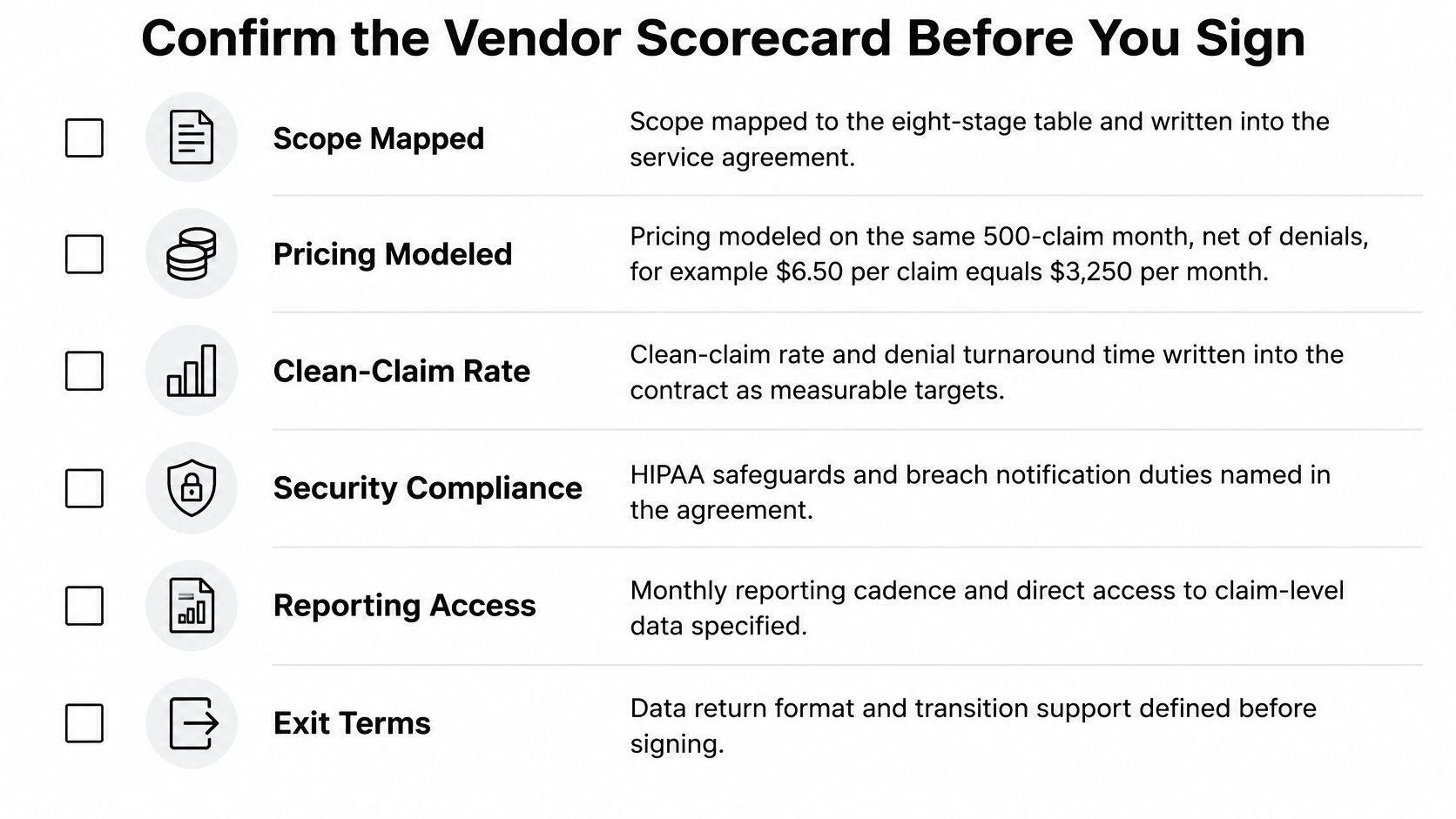
- Scope mapped: Each of the eight stages is assigned to your practice or the vendor and written into the service agreement.
- Pricing modeled: Every model is priced on the same 500-claim month, net of denials, resubmissions, and project fees.
- Specialty workflow proven: The vendor walks your highest-rule claim from charge entry to final payment without generic answers.
- Payer-behavior reporting: Reports show denial root-cause recurrence, appeal overturn rate, dollars recovered per staff hour, payer-specific underpayment variance, and days from service to final payment.
- IDR readiness documented: You see the eligibility screen, evidence checklist, deadline controls, and a sample case file.
- Data ownership and exit rights: The contract states who owns claim-level data, the export format, delivery deadline, and transition support.
- Payment handling confirmed: Payment information is processed through PCI-compliant systems, and payment terms are clear.
For multi-state platforms, add an eighth check. Confirm that state-level rules, payer contracts, and dispute pathways are handled separately for each state rather than through one national workflow.
Prospective clients can request a billing assessment from RevGuard. If your main question involves underpaid or out-of-network claims, you can schedule a 20-minute OON revenue review and test representative claims against the break-even math before committing to a filing program.
Bring one month of claims, your top denial reasons, and a small set of suspected underpayments, and we'll map them against the eight billing stages, the pricing test, and IDR break-even thresholds. Visit RevGuard to request a billing assessment or book a 20-minute OON revenue review and see where recoverable revenue is leaking.