

CAQH's September 2019 survey of 1,240 U.S. physician practices found that practices using one credentialing platform spent $818.14 less per month on credentialing workflows than practices using multiple methods. That gap reframes healthcare credentialing software as more than a place to store licenses and forms. For practice leaders, the decisive question is whether the system prevents avoidable claim problems by keeping provider qualifications, payer enrollment, practice locations, and effective dates aligned.
A useful platform should give staff one verified provider record to maintain, then help them reconcile it with each payer's actual status. If it only makes document collection faster, it may still leave the practice exposed to enrollment delays, directory mismatches, and denials.
What Healthcare Credentialing Software Does for a Practice
Think of healthcare credentialing software as a master file cabinet: every payer draws from one verified provider file instead of receiving its own photocopy. The platform keeps a structured provider profile and sends the appropriate information to payers, hospitals, CAQH, and online directories. The profile should preserve the source and status of each field, not just hold scanned documents.
Credentialing and enrollment are related, but they aren't the same job. Credentialing verifies a provider's qualifications, such as education, licensure, training, and professional standing. Enrollment connects that verified provider to a payer network and a billing relationship, including the effective date that determines when claims can be paid.
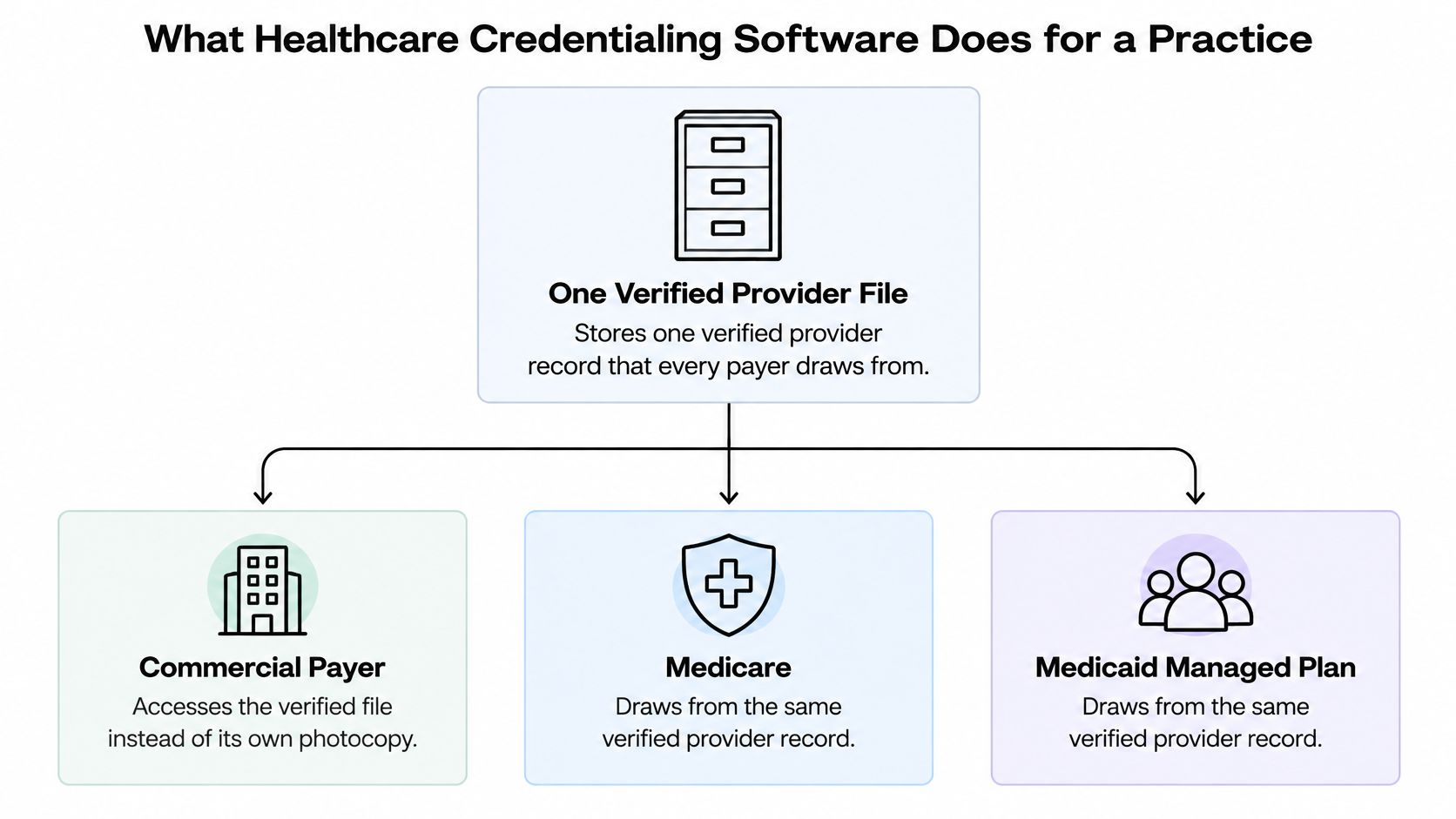
Five functions that replace fragmented work
Provider enrollment: The platform routes applications from a master profile, reducing repeated entry into separate payer portals. Staff still need to confirm payer-specific requirements and monitor each application's status.
Primary-source verification: A sound system helps verify licenses, board status, education, and sanctions against issuing or recognized sources. That replaces many calls, faxes, and manually assembled forms, while preserving evidence of what was checked and when.
CAQH and payer roster management: The platform helps keep provider information and attestations current, and organizes payer rosters and contact workflows. CAQH re-attestation is commonly triggered every 120 days, so the system should prepare the profile and alert the right person rather than assume an old attestation remains valid.
Expiration tracking: Set alerts ahead of license, DEA registration, malpractice, and hospital privilege expirations. A schedule such as 90, 60, and 30 days before expiration gives staff time to act and avoids relying on a calendar controlled by one employee.
Audit history: Each field should show its source, reviewer or system action, timestamp, and change history. This replaces scattered email threads and unlabeled PDFs with evidence staff can retrieve for payer or regulatory review.
Practical rule: Treat the provider profile as a controlled record, not a folder of attachments. When an address, specialty, or license changes, the system should show what changed and which downstream payer records still need confirmation.
A practice can use the provider credentialing process guide to map its current handoffs before evaluating platforms. The software's value comes from reusing verified data and catching changes, not merely storing files.
What Manual Credentialing Costs a Practice Each Year
The monthly gap is $818.14, or approximately $9,818 a year, between practices using multiple methods and those using one credentialing platform, according to the CAQH September 2019 survey of 1,240 U.S. physician practices. In that survey, practices using multiple methods spent an average of $2,068 per month responding to health-plan credentialing requests. Practices using one platform spent $1,249.86 per month, a 40% reduction in administrative cost.
Use that comparison as a starting point, not a promised savings figure. The survey is historical, and your practice's current costs depend on provider volume, payer mix, staff responsibilities, and how much work is duplicated across portals, spreadsheets, email, and paper forms.
Build your own baseline
Count the staff hours spent on credentialing work over a representative period, including data collection, application preparation, follow-up, corrections, and roster updates. Multiply those hours by the loaded hourly labor cost, then compare the result with the full platform cost, including implementation and any ongoing services your team needs.
For example, a system may reduce data re-entry but still leave staff doing payer follow-up or resolving inconsistent records. If those tasks aren't included in your baseline, a simple before-and-after comparison will overstate the savings. Track the hours and work types separately so you can see whether the platform removes work or merely moves it into an exception queue.
CAQH estimated that urban practices could reduce costs by 39% and rural practices by 75% through a single credentialing information-exchange platform. It also estimated that adoption could save U.S. physician practices $2.26 billion annually, according to the same CAQH credentialing brief. The difference by setting matters: a rural practice with limited administrative coverage may benefit more from centralized workflows than a larger organization with specialized staff.
Those figures concern repeated data collection and submission. They don't quantify denials, delayed revenue, or the cost of claims billed before a payer's effective date. Measure those financial outcomes separately before deciding whether a platform's full operating cost is justified.
Compliance and Security Requirements to Verify
Credentialing must run as a continuous, evidence-driven process with scheduled review after the initial application. NCQA's framework covers primary-source or recognized-source verification, credentialing and recredentialing workflows, protection of credential data, and ongoing monitoring of sanctions and complaints. A platform should help staff apply those controls consistently, with configurable rules for state, specialty, and payer requirements.
The NCQA provider-network standards frame credentialing as a way to strengthen data integrity and support payer and delegation expectations. Each provider record functions as a claim-prevention control: identity and core qualifications connect to evidence, review activity, and expiration dates, and every enrollment effective date traces back to a verified source.
Verification elements, sources, and refresh triggers
| Element | Primary source | Refresh trigger |
|---|---|---|
| NPI | NPPES registry | Change of practice address or taxonomy |
| State medical license | State licensing board | Renewal date or any board action |
| DEA registration | DEA registration records | Renewal or new practice location |
| Board certification | ABMS member board verification | Recertification cycle |
| Education and training | Issuing school or residency program | Initial credentialing or new training |
| Malpractice coverage | Carrier certificate of insurance | Policy renewal or limit change |
| Hospital privileges | Hospital medical staff office | Privilege change or renewal |
| Sanctions and exclusions | OIG exclusion list, SAM, and NPDB query | Recurring screening and each recredentialing |
Make the trigger explicit for each item. Schedule OIG and SAM screening to recur, since a one-time check at hire leaves the interval between recredentialing cycles uncovered. Include NPDB queries at initial credentialing and recredentialing. When a source reports a change or two records conflict, the system should hold the existing value and queue the case for review. Silent overwrites are how a wrong address or a lapsed license reaches a claim.
Provider directories are often out of date, and a stale practice address can misrepresent where a provider practices and complicate enrollment or claims. Treat every location change as a timed task that ends with payer confirmation, and track how often your staff catches a mismatch before a payer does. That exception count tells you whether the platform's monitoring really works.
Security controls to confirm
Ask vendors to demonstrate role-based access, encryption for stored and transmitted data, electronic attestations, immutable audit logs, and exportable audit packages. Confirm that your team can see who changed a field, when it changed, what evidence supported it, and whether a payer received the update. A practical test is to ask for the full change history on one provider's practice address. If the vendor produces that report in minutes, the audit trail works. If it requires a support ticket, expect the same delay during a payment dispute.
Every field should retain its source authority, verification date, expiration date, and reviewer or system action. If a vendor can show only a document upload timestamp, it hasn't shown a defensible verification record.
Linking Credentialing Records to Denials, Payments and IDR
A cardiologist moves to a new practice location. The practice updates its internal record, but the payer still has the old site on file. Claims from the new location go out under an address or rendering-provider combination the payer hasn't recognized, and the practice receives denials or a payment reduction. The failure isn't just a missing document. It's a gap between provider data and the payer's confirmed enrollment status.
The HHS Medicaid managed-care directory guidance requires electronic provider directories to be updated at least quarterly beginning July 1, 2025. That maintenance obligation makes reconciliation more important, not less. A payer's directory, enrollment file, eligibility response, and claims system can each hold different versions of a provider's status.
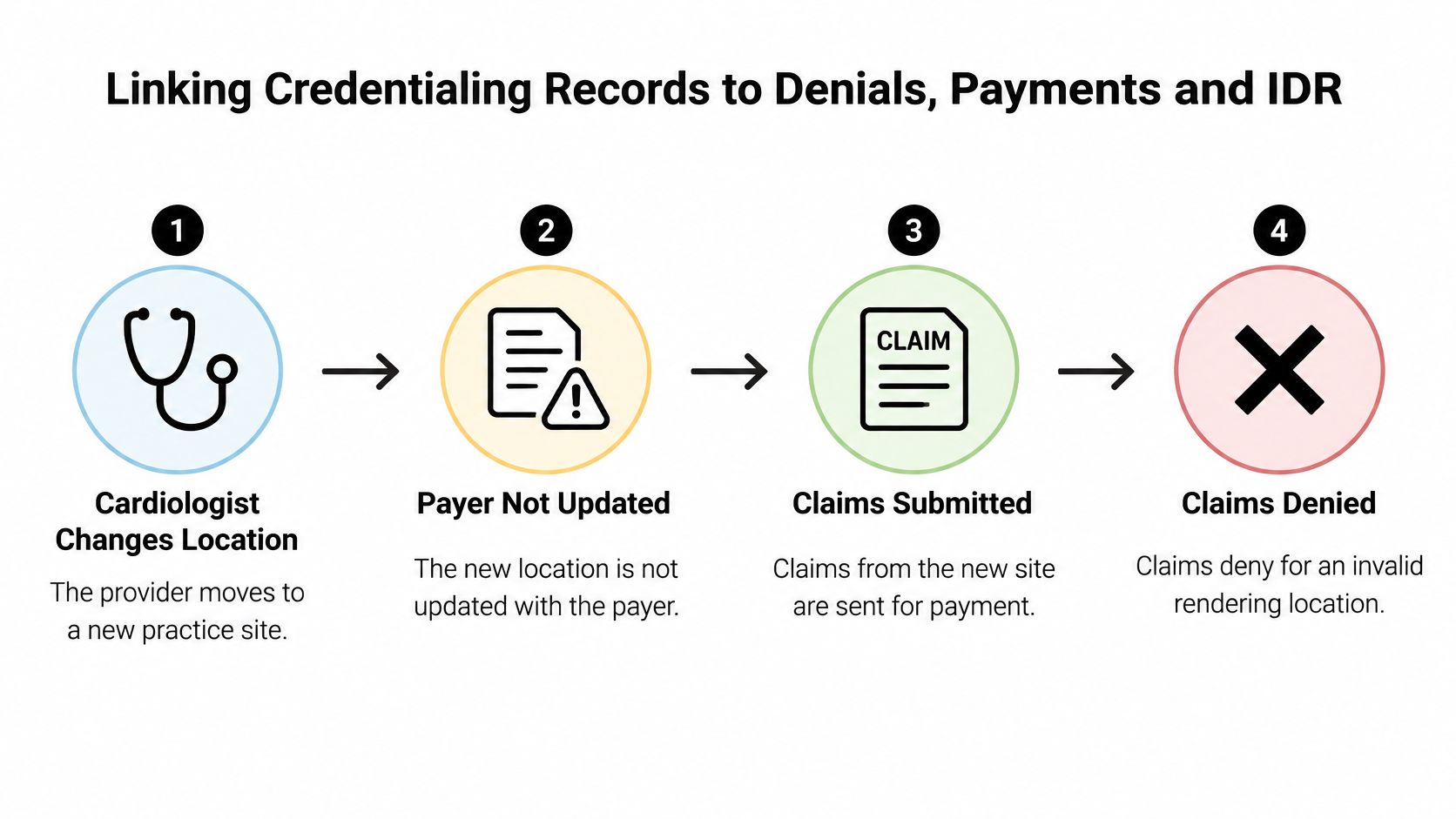
Follow the data through the revenue cycle
The master provider record changes. Staff record the cardiologist's new location, taxonomy, and relevant supporting evidence.
Payer enrollment is updated. The payer-specific transaction must carry the correct location and an effective date confirmed by the payer, not merely an internal target date.
Directory and eligibility data are reconciled. The practice checks that the payer's directory and eligibility records reflect the correct site and participation status.
Claims use the verified provider details. Billing staff submit under the provider, location, and effective period that the payer has accepted.
A denial or downcode is investigated. The team ties the outcome to the claim, payer response, enrollment record, directory status, and source evidence. For broader denial patterns, compare the findings against health insurance claim denial rates.
An evidence packet supports an IDR case if underpayment remains. If a claim is eligible for dispute and payment remains unresolved, the practice needs a traceable record of the service, provider status, claim history, payer response, and relevant supporting documentation.
A single source of truth isn't enough. The master file is only the starting point; the practice must reconcile it against each payer's acknowledged status and effective date. The HHS Medicaid guidance also notes that broad participation in data-sharing systems doesn't guarantee that payer records reflect current specialties, sites, affiliations, or participation dates.
For specialty groups, provider location, rendering identity, supervision relationships, and network status can determine whether a claim is payable. RevGuard connects credentialing and enrollment work with revenue-cycle management and IDR, applying the same upstream-to-downstream logic: support clean claims before submission and preserve evidence for disputes when payers delay, downcode, or underpay.
Selection Criteria and Pre-Signing Pitfalls
Choose a platform for your provider volume, payer count, state footprint, and required integrations, not for the length of its feature list. Start with the architecture test: the vendor should keep a canonical provider master record separate from payer-specific transactions, preserve field-level provenance and version history, send only validated and authorized attributes through APIs or controlled feeds, and reconcile payer acknowledgments against the master record.
The CAQH comments on provider-data exchange.pdf) describe centralized entry, updates, and attestations as a way to support enrollment, primary-source verification, credentialing, and directories. Centralization can reduce duplicate entry, but a buyer should still confirm that each submission carries validated data and that payer responses are reconciled. Track completeness, freshness, match rate, exception rate, and time to resolution after launch.
Selection criteria by buyer type
| Criterion | Specialty practice | Health system | Multi-state platform |
|---|---|---|---|
| Payers to manage | Under 20 payers | 50 or more payers | 100 or more payers across states |
| Providers credentialed | Dozens | Hundreds of medical staff | Thousands across sites |
| State rule configuration | One state | Several states | Per-state and per-specialty rules |
| Data architecture | Clean master record linked to CAQH | Master record synced with HR and medical staff office | Canonical master record with payer-specific reconciliation |
| Integrations | PM system and CAQH | EHR, HR, and privileging system | APIs and a data warehouse |
| Accreditation and audit | NCQA-aligned workflows | NCQA-aligned medical staff workflows | NCQA-aligned workflows with delegation audit packages |
NCQA readiness matters differently by buyer. A specialty group facing payer delegation audits needs clear evidence and reliable exception handling; a health system also needs its medical staff workflows and privilege records to fit the platform. Multi-state organizations need configurable rules that don't flatten state and specialty differences into a single checklist.
Beware of buying on onboarding speed alone. Faster intake can still leave staff correcting mismatched specialties, taxonomies, addresses, and effective dates. In a 2024 Black Book Research survey of 1,710 health systems, payers, and physician executives, 71% of surveyed organizations using provider-data credentialing methods reported significant challenges navigating the evolving regulatory environment.
Before signing, ask how the vendor queues exceptions, what human review applies to high-risk changes, how spreadsheet data will be migrated, and what happens to your provider data if you leave. Request a sample audit package, the exception-rule list, the payer roster for your top payers, and a pilot plan with defined success measures. If you're evaluating a partner that links credentialing with RCM and IDR, apply the same evidence and integration tests.
Implementation Checklist and Timeline
Before implementation begins, inventory every payer, state, and specialty; export current provider files; identify conflicting values across systems; assign a data owner to each provider; confirm which payers require portal versus API submission; and name the person responsible for exceptions. Without those decisions, a vendor may configure the platform around inconsistent records and make existing errors easier to repeat.
Data cleanup commonly creates the longest implementation risk. Teams must reconcile specialty, taxonomy, practice address, and effective-date values across HR, credentialing files, payer rosters, and billing systems. Don't approve a migration just because the files loaded. Sample the records, resolve conflicts, and document which source governs each field.

Implementation phases and typical durations
| Phase | Typical duration | Output that signals completion |
|---|---|---|
| Discovery and payer inventory | 2 to 3 weeks | Payer, state, and specialty list with owners |
| Data cleanup and master record | 3 to 6 weeks | One reconciled profile per provider |
| Configuration and verification rules | 2 to 4 weeks | State and specialty rules tested |
| Pilot with one specialty | About 4 weeks | Baseline exception rate and touchless completion |
| Payer submission waves | 6 to 12 weeks | Enrollment effective dates confirmed by payer |
| Steady-state monitoring | Ongoing | Monthly KPI review in place |
Use the pilot to test one specialty's real workflow, not a polished demonstration path. Measure touchless completion and exception rate, review the errors that remain, and only expand when staff can explain how the system handles each exception. Payer submission waves need room for payer processing and acknowledgement; an internal “submitted” status isn't the same as a confirmed effective date.
A mid-size group should plan for a rollout that typically takes four to seven months. The overall duration depends on data quality, integrations, and payer processing, so keep implementation owners accountable for evidence of completion rather than calendar milestones alone.
Go live only when pilot providers have no unresolved data conflicts, expiration alerts are working, payer acknowledgments can be tracked, and leadership has approved a monthly KPI review. Steady-state monitoring starts after go-live and continues for the life of the platform.
Metrics and ROI Examples to Track
Credentialing teams face a capacity problem, not just a speed problem. In a 2025 survey of enrollment and credentialing teams, 51% experienced turnover, 56% felt understaffed, 65% still manually verified application accuracy, and 63% manually followed up with payers. Nearly 47% didn't know the dollar amount lost because of slow enrollment workflows. Those findings make a case for measuring exception handling and financial outcomes, not merely how quickly applications enter the system.
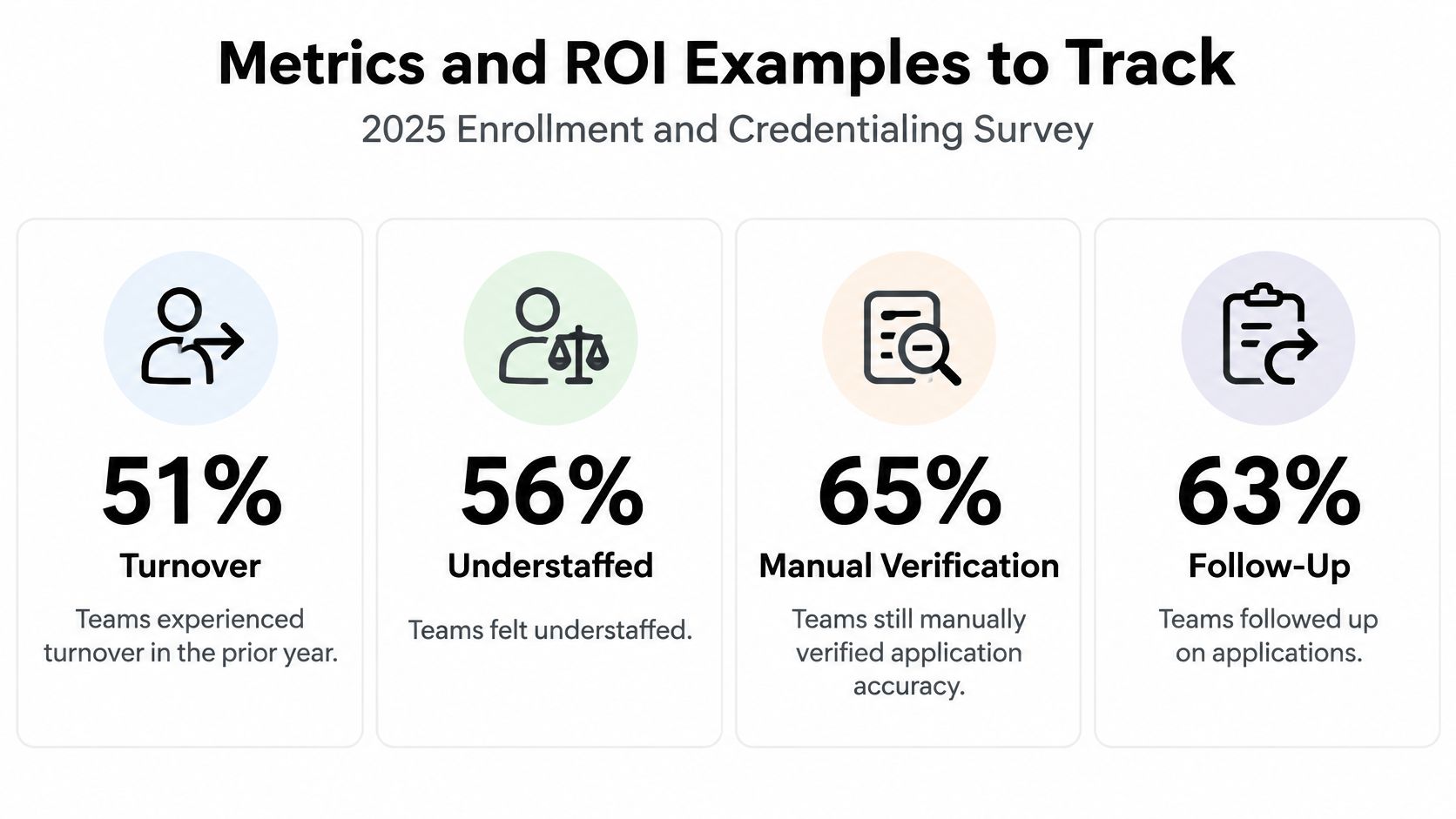
Track these measures with consistent definitions:
- Touchless completion: The share of records finished without manual intervention. A higher rate is useful only if quality checks show that those records are accurate.
- Exception rate: The share of submissions requiring human correction or review. Break it down by payer, data field, and exception reason.
- Aging by payer: The time applications and unresolved exceptions remain open with each payer. Escalate stalled files before the delay affects billing.
- Preventable claim leakage: Claims affected by missing or mismatched provider, location, taxonomy, or effective-date data.
- Time from approval to payable status: The interval between payer approval and the point when claims can be submitted and paid correctly.
Illustrative KPI changes for a 10-provider group
These values are an example, not a benchmark. Set your own baseline before rollout and compare it with the same definitions after the platform has been in use.
| KPI | Baseline example | After six months example | Change |
|---|---|---|---|
| Days from approval to payable status | 75 days | 45 days | 30 days faster |
| Manual payer follow-ups per month | 120 | 40 | 80 fewer |
| Submission exception rate | 18% | 8% | 10 points lower |
| Touchless completion | 35% | 65% | 30 points higher |
| Enrollment-related denials per month | 12 | 3 | 9 fewer |
For that illustrative group, 9 fewer enrollment-related denials per month × an assumed $180 rework cost each = $1,620 per month in avoided rework. That's a scenario calculation, not a forecast. Replace the assumed cost and denial counts with your practice's actual labor and claims data, and track reimbursement impact separately from staff time.
Automate expiration alerts, data reuse, status tracking, and document routing. Keep a person responsible for interpreting sanctions, reviewing work-history gaps and specialty-specific privileges, and resolving conflicting primary-source information. A system that reports a high touchless rate but hides its exceptions isn't controlling risk. Use revenue cycle management metrics to align credentialing measures with operational and financial outcomes.
Frequently Asked Questions About Credentialing Software
Does credentialing software replace CAQH re-attestation?
No. The platform can track the 120-day attestation cycle, prepare the profile, and alert staff, but the provider still needs to review and attest to the information personally. Assign an owner to confirm completion rather than treating an alert as proof of attestation.
Does it replace credentialing staff?
No. It shifts work from document handling toward exception review and payer follow-up. Keep a named credentialing owner who can approve high-risk changes, resolve queued conflicts, and track whether routine administrative hours are falling.
What happens when primary sources conflict?
The system shouldn't overwrite one value with another without notice. It should preserve both values with their source authority and dates, route the discrepancy to an exception queue, and require human review before using the disputed field in a payer submission.
Can a payer ignore a submission?
Yes. Reconcile each payer acknowledgment against the provider record, monitor application aging by payer, and escalate any submission without a confirmed effective date before the next claim cycle. A submission timestamp doesn't prove the payer has activated the provider.
RevGuard connects credentialing and payer enrollment with revenue-cycle management and IDR, including provider-data validation and evidence workflows for payer disputes. If your team is seeing enrollment-related denials or unresolved underpayments, visit RevGuard to discuss how those processes could fit your specialty and payer mix.