

You pull the monthly aging run, sort descending by balance, and your eye goes straight to the oldest bucket. That reaction is normal. It's also where a lot of billing teams lose the plot.
In specialty practices, hospitals, ASCs, and emergency groups, an aging report rarely means one thing. Some balances are old because the practice missed something controllable. Others are old because a payer slowed payment, downcoded, asked for records, or turned an underpayment into a dispute. If you treat every aged balance as the same problem, your team works hard and still doesn't change cash performance.
The useful move is simpler. Read accounts receivable aging as a diagnostic. Separate internal leakage from external friction. Then assign each balance to the right lane before another month passes and collectability drops further.
The Aging Report Is a Diagnostic, Not a Spreadsheet
A billing manager can stare at an aging schedule and see a mess. An analyst sees a pattern.
An accounts receivable aging report groups unpaid balances by how long they've been outstanding, usually in buckets such as current, 1 to 30, 31 to 60, 61 to 90, and 90+ days past due. That structure is standard enough that major platforms such as NetSuite include dedicated aging reports built around those periods, which tells you how universal the method has become across finance and healthcare operations (NetSuite aging report documentation).
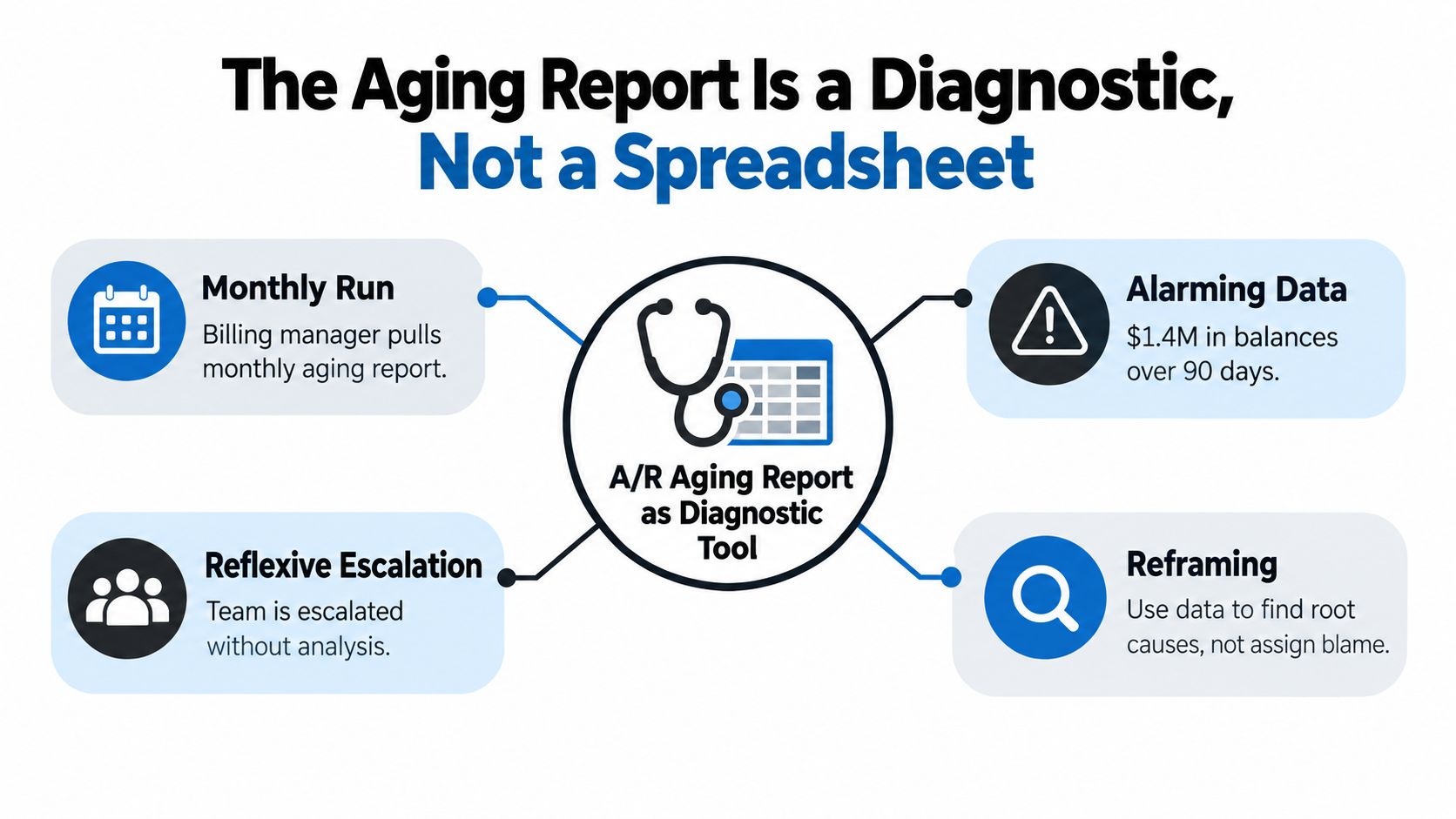
Four questions the report answers
A good aging run answers four operational questions fast:
How much is exposed
Total outstanding A/R tells you the size of the issue, but not its cause.
How old the exposure is
Age tells you urgency. Older balances are harder to recover.
Who owes it
Payer, patient, employer plan, workers' comp carrier, and attorney-driven balances age differently.
Where it came from
Service line matters. Orthopedic surgery, anesthesia, ED visits, imaging, and dermatology don't age for the same reasons.
What billing managers should stop doing
Teams often use the report as a monthly blame document. They escalate collectors, ask for more calls, and push staff to “work old A/R.” That usually mixes together clean claims still moving normally, denials that need rework, underpayments that need escalation, and disputes that belong in a formal track.
Practical rule: If a bucket doesn't trigger a different workflow, the report is just a ledger export.
What to do instead
Map the buckets to action tiers:
- Current and early aging: Validate claim acceptance, posting lag, and missing documentation.
- Mid-aging: Review denial codes, underpayments, payer edits, and follow-up discipline.
- Late aging: Decide whether the balance is still collectible through standard follow-up or needs formal dispute handling.
- Very old balances: Separate true dead debt from balances that stayed open because no one assigned ownership.
That's the point most miss. Aging isn't only about time. It's about identifying whether the practice created the delay, or whether the payer did.
What Accounts Receivable Aging Actually Measures
A billing manager runs month-end aging for two orthopedic locations under the same tax ID. One looks stable. The other looks late across every bucket. After a closer review, the difference is not collector effort or payer mix. One location ages from service date. The other ages from claim submission. Before anyone works the balances, the report definition has to be fixed.
At a technical level, accounts receivable aging measures the elapsed time between when a balance is recorded in A/R and the date the report is generated. What counts as the start date varies by system. Common options include service date, claim submission date, first bill date, and, for patient balances, statement date. That setup decision affects how you interpret every bucket.
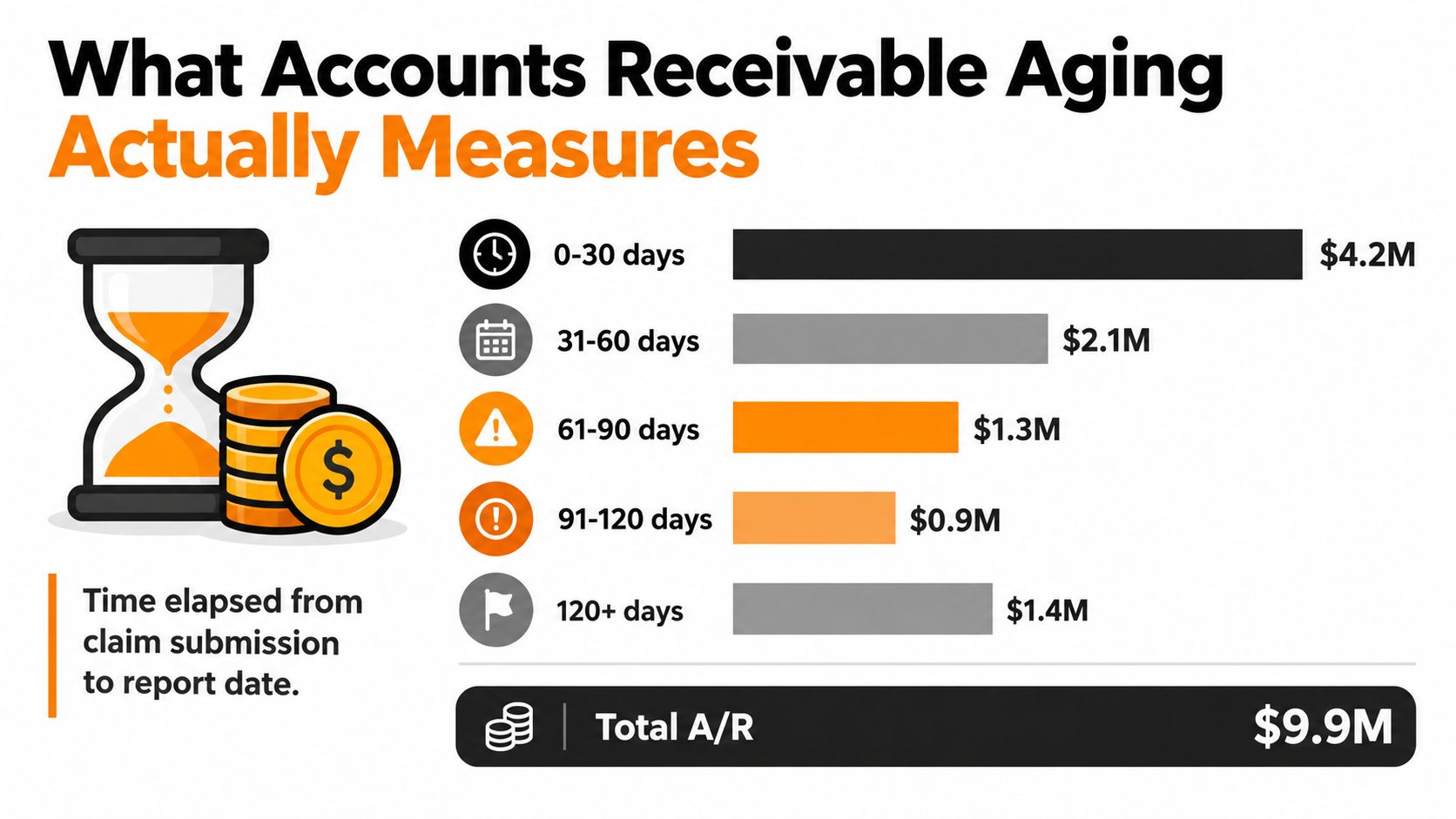
Aging from service date captures front-end and charge-entry lag. Aging from claim submission removes that delay from view and isolates what happened after the claim left your shop. Neither is wrong. But mixing definitions across entities, payers, or balance classes makes trend analysis unreliable and can hide internal leakage that is still controllable.
The standard bucket logic
Most reports group balances into time bands such as:
- Current
- 1 to 30 days past due
- 31 to 60
- 61 to 90
- 91 to 120
- 120+
Those buckets matter only if they are segmented well enough to support action. A single aging view that combines primary insurance, secondary insurance, patient responsibility, and disputed underpayments answers almost nothing. Insurance balances aging at 45 days often reflect claim status, edits, or denial rework. Patient balances aging at 45 days usually reflect statement timing, bad addresses, or payment-plan design. Underpaid out-of-network claims may belong in an escalation or IDR track rather than ordinary follow-up.
That is why experienced revenue-cycle teams read aging in layers, not totals.
What the report is actually quantifying
An aging report measures three things at once: time outstanding, probability of recovery, and likely source of delay. Time is obvious. Recoverability is the part teams often miss. As balances move into older buckets, the expected yield from routine follow-up usually declines while the labor required to collect rises.
The report also shows whether the delay is more likely internal or external. A spike in 31 to 60 days can point to slow claim submission, posting backlog, or unresolved edits. A concentration in 91+ tied to specific commercial payers often signals payer friction, underpayment disputes, or denials that need a separate appeal path. In specialty and emergency billing, that distinction matters because some old balances are not dead debt. They are unresolved reimbursement disputes sitting in the wrong queue.
Configuration choices that change the story
Before you trust the numbers, confirm four settings:
- Aging basis: service date, claim date, bill date, or statement date
- Balance type: insurance, patient, self-pay, or all combined
- Credit handling: whether unapplied cash and credit balances offset open A/R
- Bucket ownership: whether disputed claims and underpayments remain in standard aging
A clean interpretation usually requires pairing aging with adjacent operating measures. A 60-day balance means little by itself. It becomes useful when compared with claim acceptance rates, denial categories, payment variance, posting lag, and payer turnaround. Teams that review aging alongside a defined set of revenue cycle management metrics can separate balances that need staff correction from balances that need payer escalation.
A 45-day claim can be perfectly normal, untouched after a denial, or underpaid against contract terms. Aging measures the age of the dollars. Management has to identify the reason they stayed open.
Healthy Benchmarks for Specialty Practices and Hospitals
A 14% 90+ bucket can mean two very different things. In one orthopedic group, it reflected a charge lag and a payment-posting backlog that the billing manager could reduce within 30 days. In one hospital-based specialty service, the same percentage was tied to a small set of commercial payers with repeated underpayment disputes and slow reconsideration cycles. The benchmark looked identical. The action plan was not.
That is why benchmark ranges work best as screening thresholds, not report cards. Aging helps separate balances your team can fix through cleaner intake, faster claim release, and tighter follow-up from balances stalled by payer behavior, contract variance, or unresolved disputes.
A practical starting point is portfolio shape. Healthy books usually keep the large majority of A/R in current and 0 to 30 day balances, while older buckets stay contained rather than creeping across 31 to 60, 61 to 90, and 90+ at the same time (A/R benchmark summary). If the past-due share keeps rising for more than one reporting cycle, treat it as a workflow signal and identify whether the aging sits in front-end errors, claim edits, denials, or payer-specific delays.
A/R Aging Benchmarks Specialty vs. General Business
| Metric | Specialty Practice | Hospital Outpatient | General Business |
|---|---|---|---|
| Current or under 30 days | Should hold the clear majority of open A/R | Often lower because of claim complexity and payer mix | Often tracked against broad commercial collection targets |
| 60+ day bucket | Needs close review by payer, denial reason, and financial class | Usually runs older than physician groups | Older balances may be more tolerated than in medical billing |
| Past-due share overall | A sustained increase usually points to process leakage or unresolved payer friction | Often reflects a mix of internal delays and payer turnaround | Often used as a general collections efficiency measure |
| 90+ day balances | Should be segmented into collectible, disputed, and likely write-off inventory | Can include a larger share of underpaid or appealed claims | Often viewed mainly through bad-debt risk |
Why healthcare needs tighter reading
Healthcare aging deteriorates differently from standard trade receivables. An old claim may still be active, but its recovery odds change sharply once it sits in denial, documentation, or underpayment status without a named owner. Gross A/R can look acceptable while economically weak balances accumulate underneath.
Primary industry benchmarks support using tighter specialty-specific thresholds. HFMA's MAP Keys framework and MGMA benchmarking are more useful here than broad business averages because they reflect healthcare claim cycles, denial rework, and payer contracting realities. MGMA reporting has shown that multispecialty practices carry a meaningful share of receivables beyond 120 days, which is precisely why analysts should not stop at total A/R or days in A/R. They should isolate what portion of the old inventory is controllable internal leakage versus payer-driven friction.
That distinction matters in specialty and hospital outpatient settings. A 90+ balance caused by missing prior authorization belongs in an operational correction queue. A 90+ balance tied to a documented underpayment or out-of-network reimbursement dispute belongs in an escalation and IDR workflow, where the goal is recovery, not passive aging toward write-off.
The takeaway for specialty operators
Use benchmarks to trigger investigation, not to reassure yourself.
If your aging looks only slightly worse than a broad commercial target, that can still be a problem in emergency medicine, anesthesia, orthopedics, ASC, and other specialty models where margin depends on disciplined follow-up and fast dispute routing. The strongest billing teams compare aging by payer, place of service, and denial category, then split old balances into two groups. One group can be reduced through internal process changes by Friday. The other requires payer escalation, underpayment review, or IDR to convert aged balances into recoverable revenue.
How to Read an A/R Aging Report Step by Step
A useful aging review starts at the top, then gets narrower. Don't begin with line-item history. Start with the snapshot.
Read the header before the detail
Look at three things first:
- Total A/R: This tells you the size of the receivables base.
- Share in older buckets: This shows whether aging is concentrated or broadly distributed.
- Period-over-period movement: This distinguishes a spike from a trend.
If the top of the report worsened but cash didn't collapse, you may have a posting issue. If both worsened together, the practice likely has a production-to-cash problem that's spreading across the cycle.
Compare the distribution, not just the total
The distribution matters more than the headline number because it tells you where balances are getting stuck.
| Bucket | Healthy % Range | Common Diagnostic Signal |
|---|---|---|
| Current and under 30 days | Near the healthy portfolio benchmark | Normal processing, or hidden front-end lag if the system ages from submission date |
| 31 to 60 days | Should not swell unexpectedly | Follow-up gaps, first-pass denial rework, payer response delay |
| 61 to 90 days | Should stay limited | Denials aging without ownership, underpayments not escalated |
| 90+ days | Needs active review | Higher loss risk, stale follow-up, payer disputes, dead inventory |
A top-heavy 31 to 60 bucket suggests something different from a swollen 90+ bucket. The first often means claims are entering the cycle poorly or first-touch follow-up is inconsistent. The second usually means old balances lack a decision path.
Split by payer and service line
After the distribution, segment the report by payer class. Commercial, Medicare, Medicaid, workers' comp, auto, and self-pay all age for different reasons. Then split by service line or CPT family. That's where patterns surface.
A group may think it has a general A/R problem when it really has one concentrated issue, such as modifier-sensitive encounters, implant billing, observation claims, or emergency services under review.
The fastest aging memo is one page long. It names the payer classes driving the oldest balances, the service categories involved, and the next action owner.
Add a short trend view
Use prior cycles to tell whether you're looking at an event or a system problem. A single month can reflect a clearinghouse interruption, a payer edit, or delayed posting. Repeated drift points to a workflow failure or a payer pattern.
Don't overbuild this. Billing managers need an action note they can use this week, not a presentation no one reopens.
Why Aging Spikes in Specialty and Emergency Billing
Specialty and emergency aging usually looks older for a reason. The mistake is assuming all old balances come from weak internal execution.
Some do. Many don't.
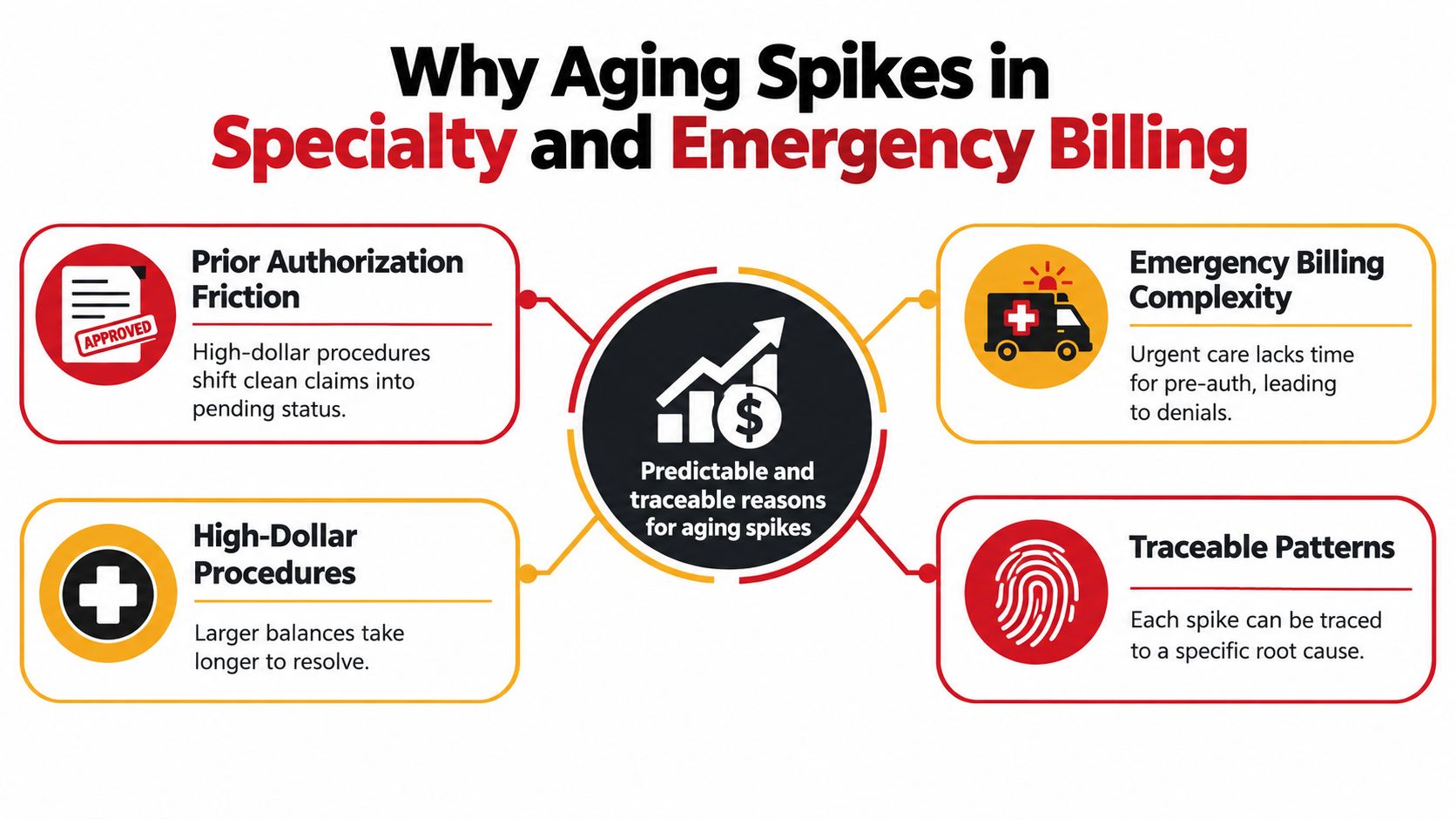
The internal causes teams can control
Aging often starts with ordinary operational misses:
- Charge lag: Encounters sit before coding or submission.
- Registration defects: Demographic or eligibility errors trigger avoidable rework.
- Weak denial ownership: Claims get touched, but not resolved.
- Posting gaps: Underpayments stay hidden because no one compares paid amounts against expected reimbursement.
These are controllable. They require process discipline, not payer reform.
The external friction teams must identify
Specialty billing also runs into structural delay. High-acuity and high-dollar claims invite more review. Emergency and observation claims can trigger medical-necessity scrutiny. Procedure-heavy specialties often deal with authorization disputes, coding edits, downcoding, and partial payment tactics that make a claim look merely “aged” when it's contested.
That distinction matters because the corrective action is different. A collector can't call a downcoded claim into full payment if no one has quantified the variance and assigned a dispute track.
Why old A/R isn't always the same kind of bad
Healthcare benchmarking has become more nuanced. HFMA-based thinking still emphasizes keeping 90+ day A/R low, but a 2025 to 2026 benchmark summary reported median hospital A/R days at 54.9 in 2024, improving only to 52.6 in 2025 across more than 2,300 hospitals and 350,000 physicians. The same summary noted an independent 2026 analysis saying AR days rose 2.2% year over year and 5.4% in 2024 versus 2023 (healthcare A/R benchmark analysis).
The implication isn't that old A/R is harmless. It's that some organizations are carrying older curves because payers are slower and more adversarial, not because staff failed.
A swollen late bucket can reflect two different realities. One is leakage. The other is unresolved reimbursement friction. Your workflow has to tell those apart.
A Prioritized Workflow to Reduce Days in A/R
The order of work matters more than the volume of work. Teams lose ground when they attack every aged balance with the same script.
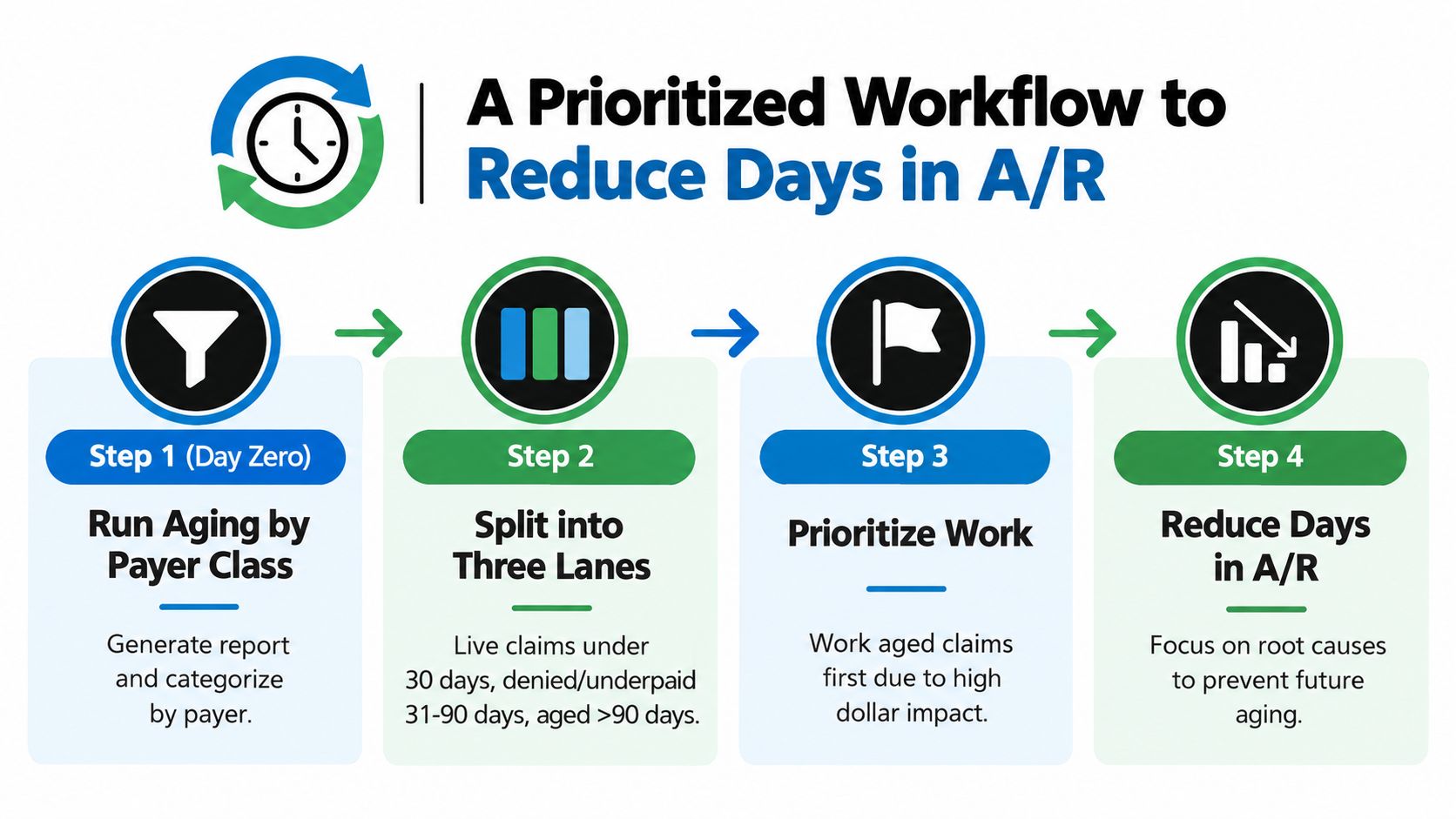
Build three lanes on day zero
Run aging by payer class, then divide the inventory into three queues:
Fresh claims under 30 days
These need confirmation that they were accepted cleanly and are moving normally.
Denied or underpaid claims in mid-aging
A lot of recoverable cash sits here. It needs rework, repricing, and disciplined follow-up.
Balances already in late aging
These require a decision, not endless touches. Keep, escalate, dispute, or close.
Work the queue in sequence
The best weekly cadence usually looks like this:
First pass
Fix rejections, missing data, and front-end claim defects before they age into something harder.
Second pass
Attack denial categories and underpayments by exposure. Start where the dollars and recurrence are concentrated.
Third pass
Escalate balances that need payer follow-up with documentation, call references, and reimbursement support.
Final pass
Move claims that won't resolve through routine channels into formal dispute or other designated escalation.
Assign owners, not just statuses
“Worked” is not a resolution state. Every aged balance needs an owner and a next event date. If no one owns the claim, it will keep aging while the report creates a false sense of control.
That's where tooling matters. Some groups use PM work queues, some use spreadsheets, some use payer portals plus claim notes, and some use integrated vendors. For organizations that need combined aging visibility and follow-up operations, accounts receivable management support can centralize payer- and bucket-level work into a single process.
The operating discipline that actually lowers aging
Use a simple rule set:
- Don't let fresh defects turn into old A/R
- Don't let underpayments sit unpriced
- Don't let late balances remain unassigned
- Don't let the team confuse touch volume with resolution
This is why sequencing beats effort. A team can be busy all month and still allow recoverable claims to drift into low-probability aging.
How Integrated RCM and IDR Recover Aged Underpayments
Aging turns into write-offs when the workflow ends at follow-up. In many specialties, that's the break point.
Revenue cycle management can identify a balance as denied, underpaid, or stalled. But if the organization has no enforcement path for claims that won't resolve through ordinary payer contact, the report becomes a list of slowly dying receivables.
Where the handoff usually fails
Most disconnected workflows break in predictable places:
- The billing team identifies an underpayment but doesn't have current contract logic attached.
- A collector logs calls, but no one converts the payment variance into a formal dispute package.
- Supporting documentation sits in one system while payer correspondence sits in another.
- Filing and escalation windows pass because staff treat every claim as routine follow-up.
That's why integrated RCM and IDR matters. The point isn't to dispute everything. The point is to recognize when a balance has moved out of standard collection and into reimbursement enforcement.
What the integrated loop looks like
A disciplined setup does three things:
Flags the claim correctly inside the revenue cycle workflow
Denials, downcodes, and underpayments are identified as reimbursement exceptions, not generic old A/R.
Pushes eligible balances into a dispute-ready queue
Documentation, payment variance, coding support, and payer history move with the claim.
Feeds outcomes back into future claim strategy
If one payer repeatedly edits a service line the same way, the front end should see it before the next cycle repeats the loss.
A lot of specialty groups still manage this with fragmented notes and manual rekeying. That's costly because delay is part of the payer strategy in many markets. If your team identifies the problem but can't route it into action quickly, aging keeps advancing.
One option in that category is medical underpayment recovery, where underpaid claims are moved from ordinary A/R follow-up into a structured recovery track instead of sitting in unresolved aging.
If a balance older than 60 days has no assigned resolution track, it's usually on its way to becoming an operational write-off, even if it still appears collectible on paper.
Your Monthly A/R Aging Playbook and KPIs to Track
You don't need new software to run a better monthly cadence. You need consistency and ownership.
Start with one recurring operating rhythm. Pull aging by payer and by service family. Review the oldest categories for root cause, not just collector notes. Then separate balances into controllable leakage versus payer-driven friction and send each group into the right queue.
The monthly playbook
Use this schedule:
- By Tuesday close: Pull the aging report by payer class and service line.
- By Wednesday: Identify which late balances come from front-end defects, denial rework, underpayments, or unresolved disputes.
- By Thursday: Log root-cause tags and assign owners.
- By Friday: Refresh the escalation and dispute queue for balances that won't resolve through ordinary follow-up.
- Next Monday morning: Deliver a one-page scorecard to the practice administrator or revenue leader.
The KPIs worth tracking
Focus on direction and accountability:
Days in A/R
Owner: revenue-cycle lead. Watch for sustained drift, especially if late buckets thicken at the same time.
Clean claim performance
Owner: front-end and coding leadership. If this worsens, the aging curve usually follows.
Net collection performance
Owner: finance and billing leadership. This tells you whether old balances are becoming real cash.
Initial denial trend
Owner: denial team or billing manager. Rising denials push avoidable volume into mid-aging.
Share of very old A/R
Owner: A/R follow-up lead. This helps distinguish neglected inventory from actively managed balances.
Cash conversion on worked accounts
Owner: operations manager. If staff touches accounts without cash movement, the workflow needs redesign.
The practical weekly question
Ask one thing every week: which aged balances are old because we failed, and which are old because the payer resisted?
That question changes behavior. It prevents teams from burying payer friction inside generic A/R. It also prevents leaders from blaming staff for balances that need contract modeling, underpayment analysis, or formal dispute escalation.
Aging is useful when it drives a decision by Friday. If it only creates anxiety, the process is incomplete.
RevGuard integrates specialty-specific RCM with IDR workflows so aged balances don't stall at routine follow-up when they need underpayment analysis, dispute preparation, and payer enforcement. If your aging report is mixing operational leakage with payer-driven delay, visit RevGuard to see how a connected workflow can turn that report into a recovery plan.