

A denied claim can look like a small administrative interruption, but the scale tells a different story. In U.S. healthcare billing, denial rates reached 11.8% in 2024, compared with 10.2% in 2020, and initially denied claims have been framed at roughly $262 billion annually. One benchmark also found that insurers offering ACA marketplace plans denied 19% of in-network claims and 37% of out-of-network claims in 2024. (Medical billing denial statistics)
For a specialty practice, the problem often starts with a claim that appears clean. Weeks later, the payer returns it because the authorization does not match the billed service, the registration data is incomplete, or the documentation doesn't support the code. Staff then pause current work to investigate an old account, correct the defect, prepare an appeal, and wait again for payment.
Denial management in medical billing controls that entire chain. It begins before submission with clean-claim engineering, continues through payer adjudication and structured follow-up, and can extend to Independent Dispute Resolution, or IDR, when an eligible out-of-network payment dispute requires formal enforcement. The objective isn't to appeal harder. It's to prevent repeat defects, recover valid revenue, and turn payer behavior into better operating rules.
Introduction to Denial Management That Protects Revenue
For specialty practices, a claim can contain the correct patient, provider, and procedure details yet still fail at adjudication. An anesthesia claim, for example, may be denied because the authorization covers the facility encounter but not the anesthesia service, or because documentation does not meet a specialty-specific payer rule.
One account is a task. A repeated pattern is a control problem. If the same authorization mismatch affects several anesthesiologists or locations, billers keep repairing claims while intake continues creating new defects. The queue grows because the process, not one employee, needs correction.
Benchmarks have reported about 8% of physician-practice claims denied on first submission, about 12% average hospital denial rates, and roughly 84% of denials as potentially avoidable. Registration and eligibility have been associated with 24% of avoidable denials, while 44% occur at the front end. (Denial management benchmarks)
Practical rule: Treat every recurring denial as evidence about a workflow, not merely as a task for an individual biller.
A denial management program connects prevention with recovery:
- Prevention: Verify eligibility, capture accurate demographics, match authorizations to services, apply payer-specific edits, and confirm that documentation supports the intended claim before submission.
- Recovery: Triage denials, correct or appeal them within payer deadlines, assemble supporting evidence, monitor outcomes, and escalate eligible underpayments or out-of-network disputes through the appropriate process.
Recovery remains valuable because roughly 70% of denied claims can be overturned when appealed. (Medical billing denial statistics) Yet an appeal cannot restore the staff time, delayed cash, or operational capacity consumed by a preventable error. Prevention keeps avoidable claims out of the work queue. Recovery turns valid denied or underpaid claims into payment and sends the underlying cause back to the upstream workflow.
The same system must reflect the specialty. An ASC may need scheduling, eligibility, authorization, coding, and billing controls to agree before submission. Air ambulance and emergency services may also need to preserve the facts required to support an out-of-network payment dispute and, when eligible, Independent Dispute Resolution, or IDR. Revenue protection therefore follows the claim from intake through final payment, with specialty-specific causes and measurable controls at each point.
How the Denial Management Lifecycle Really Works
A claim moves through a controlled cycle, from clinical documentation to payment or recovery. Each checkpoint either prevents a defect from reaching the payer or creates evidence for resolving it. This makes denial management a prevention-to-recovery system, not an appeals task performed after revenue is already at risk.
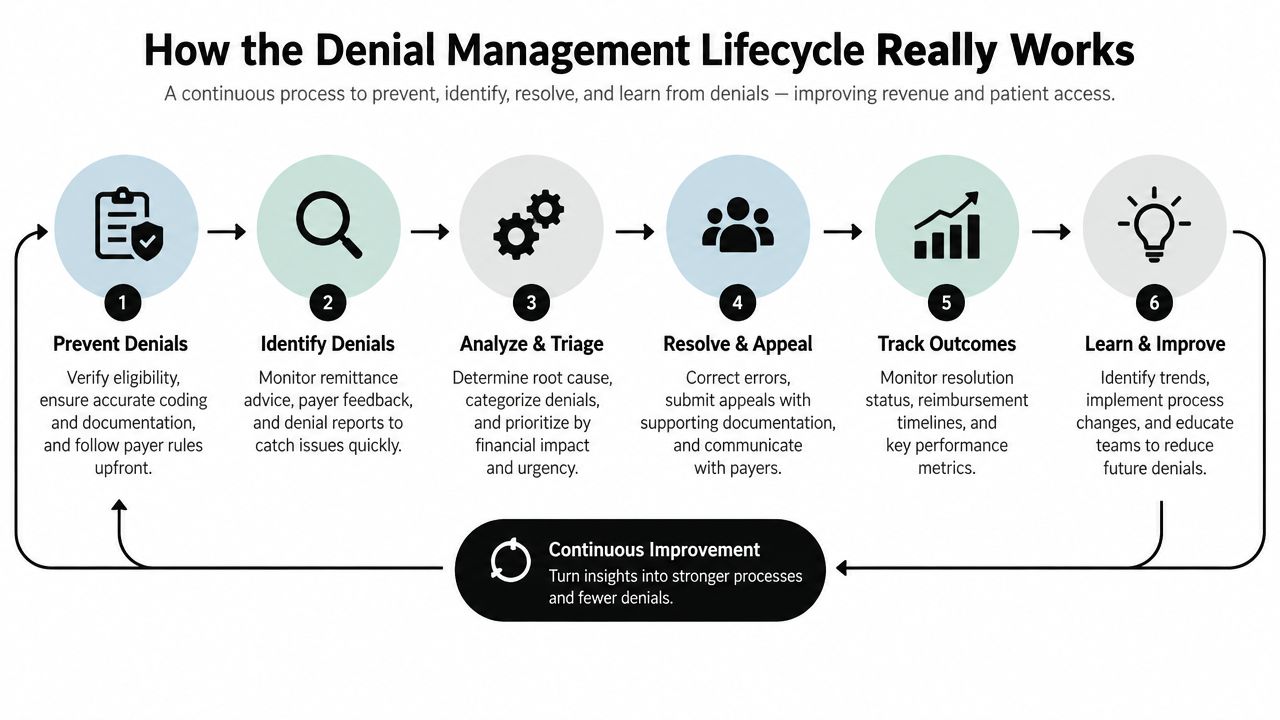
The six checkpoints
Capture the encounter. Record patient identity, coverage, provider, service, diagnosis, documentation, and authorization details. A registration or clinical-record error can travel through coding, submission, and adjudication.
Engineer the claim. Coding teams, billing staff, and automated edits check whether the claim matches payer requirements. Eligibility, registration, authorization, coding, and documentation checks function like quality controls on a production line.
Submit and measure the first result. The initial denial rate shows how often claims fail at first submission. A high rate points to defects entering the process before payer review and helps leaders prioritize upstream controls.
Identify the primary cause. The primary denial rate isolates the main reason for denial instead of counting each later handling step as a separate failure. Leaders can then distinguish one underlying defect from repeated work on the same account.
Resolve the account. The appropriate path may include correction and resubmission, reconsideration, a formal appeal, medical records, or another payer-defined process. A soft denial may respond to corrected data, while a hard denial may require evidence, policy analysis, or a coverage-based decision. For eligible out-of-network disputes, the workflow may also include Independent Dispute Resolution, or IDR, with the records and payment information needed for enforcement.
Measure the final outcome. Denial write-offs show the portion that does not become payment. Time from denial to appeal and time from denial to resolution indicate whether weak evidence, slow routing, missed deadlines, or payer delay is limiting recovery.
HFMA's standardization work distinguishes initial denial rate, primary denial rate, denial write-offs, and time from denial to appeal or resolution. Using these measures separately prevents leaders from treating submission failure, root cause, financial loss, and workflow speed as the same KPI. (Optum's 2024 Denials Index for Providers)
Why classification changes the response
An avoidable denial usually reflects a correctable process defect, such as invalid eligibility information or missing authorization. An unavoidable denial may arise from payer policy, a coverage limitation, or a clinical adjudication decision, so prevention and recovery require different actions.
Overturn potential adds a financial filter. A denial supported by strong documentation and a clear payer-rule mismatch deserves timely evidence assembly and escalation. An account with little supporting evidence may call for a different economic decision. Classification therefore connects specialty-specific root causes to the right prevention control, recovery route, and performance measure.
Common Denial Reasons by Specialty and Front End Failures
A denial code is a symptom, not a diagnosis. The same code can point to different operational failures across specialties. A radiology group may have an authorization that does not match the study performed. An IONM practice may need stronger connections among provider credentials, operative documentation, and billed services. Dermatology may face coding or medical-necessity gaps, while air ambulance providers must address coverage, network, and emergency-service requirements.
The front end functions like claim engineering. If eligibility, registration, authorization, or service coverage is wrong before submission, the billing team inherits a defect that an appeal may not fully repair. Recent claims data identified missing or inaccurate data as the top denial driver at 50%, authorization issues at 35%, and incomplete or inaccurate patient registration data at 32%. (Experian Health's State of Claims survey findings)
| Denial Category | Share of Denials | Most Affected Specialties |
|---|---|---|
| Missing or inaccurate data | 50% | All specialties, especially multi-site groups and high-volume practices |
| Authorization mismatch or failure | 35% | Orthopedics, radiology, gastroenterology, oncology, and outpatient procedures |
| Incomplete or inaccurate registration data | 32% | Emergency services, air ambulance, hospital-based specialties, and ASC encounters |
| Coding or documentation gap | Not specified in the verified data | Dermatology, anesthesia, oncology, IONM, and services requiring detailed clinical support |
| Coverage or service-not-covered issue | Not specified in the verified data | Emergency, out-of-network, imaging, and procedure-based specialties |
These categories overlap, so their percentages should not be added together. One claim may contain inaccurate demographic information and an authorization mismatch. Denial records should therefore retain the primary cause, contributing cause, payer, location, provider, and service line. That structure supports both upstream prevention and downstream recovery, including evidence assembly or payer escalation when an appeal is justified.
Specialty patterns worth testing
- Anesthesia: Confirm that the authorization and facility encounter support the anesthesia service, provider, date, and procedure. Documentation should support reported time and medical direction or supervision facts where applicable.
- Orthopedics and gastroenterology: Match authorization details to the exact procedure, site, date, and rendering provider. A broad authorization may not cover every service performed.
- Radiology: Validate the ordered study, performed study, diagnosis, location, and payer requirement before billing. Imaging denials often reveal a break between scheduling and coding.
- Dermatology and oncology: Compare documentation and medical necessity with the billed service. Downcoding or noncovered-service decisions may require clinical evidence rather than a demographic correction.
- IONM and air ambulance: Preserve records establishing who performed the service, why it was necessary, the circumstances of the encounter, and its relationship to the underlying episode of care.
Review denial inventory by specialty, payer, location, and workflow owner. The useful question is not only which denial code appears most often. It is which upstream event created the denial, whether the defect can be prevented, and which recovery path applies when prevention failed.
Root Cause Analysis and Prevention Workflows That Stop Repeat Denials
A denial inventory becomes useful only when it leads to a process change. Start with the denial record, but don't stop at the remittance code. The code describes the payer's response. Root-cause analysis explains what the organization must change.
A repeatable root-cause method
Categorize the denial. Assign a primary category such as eligibility, registration, authorization, coding, documentation, coverage, timely filing, or payer processing. Add secondary fields for specialty, payer, site, provider, procedure, and work queue.
Quantify the pattern. Look for concentration by payer and workflow. A small number of recurring edits may explain a large share of rework, while a broad distribution may point to inconsistent training or missing system controls.
Trace ownership. Ask which team could have prevented the defect. Registration owns demographic accuracy. Scheduling may own authorization capture. Clinical staff may own documentation. Coding owns code selection and modifier logic. The denial team owns timely triage and evidence assembly, but it shouldn't absorb every upstream failure.
Fix the earliest controllable step. Convert the finding into an edit, checklist, required field, payer rule, or escalation trigger. Then monitor whether the same denial returns.
Prevention controls that belong upstream
Real-time eligibility verification should occur before the encounter whenever possible and again when coverage details change. The workflow should capture active coverage, effective dates, payer identity, patient demographics, and service-not-covered conditions rather than treating eligibility as a one-time checkbox.
Authorization matching needs more than an approval number. The system should compare the authorized service with the scheduled and billed service, including the provider, location, date, procedure, and relevant diagnosis. Claim scrubbing can then test for conflicts that remain after scheduling and coding.
The strongest denial edit is the one that stops a claim before staff must explain the same mistake to a payer.
Documentation controls should reflect specialty risk. An IONM group may need a documentation checklist tied to operative details and provider roles. An oncology practice may need a medical-necessity review for diagnosis and treatment documentation. A radiology group may need order and performed-service validation. The workflow should be specific enough that staff know what to correct, not merely that a claim is “high risk.”
For medical record review and documentation controls, practices can also examine medical record audit workflows as part of a broader prevention program. The objective is to turn individual findings into durable controls across locations.
Finally, close the loop. When an appeal overturns a denial, ask whether the payer rule was misunderstood, whether the claim lacked evidence, or whether the payer made an adjudication error. When a denial becomes a write-off, determine whether an earlier edit could have prevented it. That feedback makes denial management a learning system instead of a permanent queue.
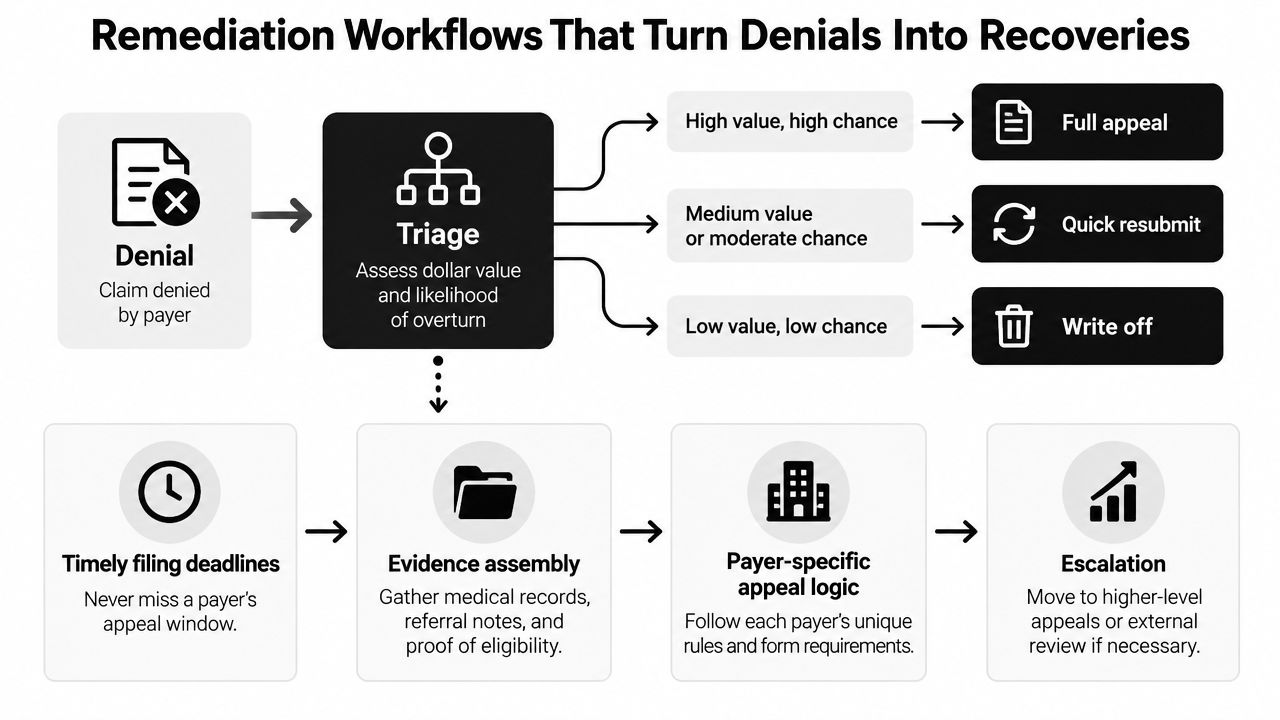
Remediation Workflows That Turn Denials Into Recoveries
Prevention reduces new denials. Remediation handles the accounts already damaged by one. These functions should share data, but they shouldn't be confused. A claim that needs a corrected demographic field should not enter the same queue as a medically complex appeal requiring records, physician input, and payer-specific forms.
Triage before staff invest time
Begin with three questions:
- What caused the denial? Separate correctable data defects, authorization problems, coding issues, documentation gaps, coverage decisions, and payer processing errors.
- What evidence exists? Check the claim, remittance, authorization record, eligibility response, medical record, referral, operative note, and payer correspondence.
- What action has the strongest expected return? Choose corrected resubmission, quick resubmission with a missing attachment, reconsideration, formal appeal, escalation, or compliant write-off.
A high-value claim with strong evidence should move quickly to a complete appeal. A low-value claim with weak overturn potential may not justify extensive manual work. A medium-complexity account may respond to a focused correction and resubmission. The decision must remain consistent with payer rules, contractual obligations, patient protections, and internal compliance standards.
Protect the appeal window
Timely filing deadlines are operational guardrails, not administrative details. Assign ownership when the denial arrives, record the payer deadline, and create escalation alerts before the deadline becomes urgent. A queue that tracks only dollar value can still lose recoverable revenue if the appeal window expires.
Evidence assembly should follow the denial reason. Eligibility disputes need proof of coverage and corrected demographic information. Authorization disputes need the approval, service details, scheduling record, and correspondence showing alignment. Clinical or coding disputes may require medical records, referral notes, operative reports, and a concise explanation of why the billed service is supported.
Payer-specific appeal logic matters because forms, submission channels, documentation requirements, and reconsideration steps vary. Staff should use a controlled payer matrix rather than rely on memory or an old template.
Escalate underpayment and downcoding disputes
A denial isn't always a complete refusal to pay. An out-of-network emergency or specialty claim may receive a payment that is materially below the provider's expected reimbursement, or the payer may downcode the service. Those accounts require payment variance analysis, contract and regulatory review, and evidence that supports the service and circumstances.
When an eligible dispute falls within the No Surprises Act process, IDR can provide a formal route for resolving qualifying out-of-network payment disputes. Emergency providers, air ambulance groups, and certain specialty practices should preserve the facts that support the dispute and meet the applicable process requirements. A disciplined medical underpayment recovery process connects payment analysis, evidence, filing, and enforcement instead of treating underpayment as an ordinary denial.
The practical standard is disciplined execution. Appeal when the record supports recovery, correct and resubmit when the defect is administrative, escalate when the dispute belongs in a formal review path, and document the reason when the organization closes the account.
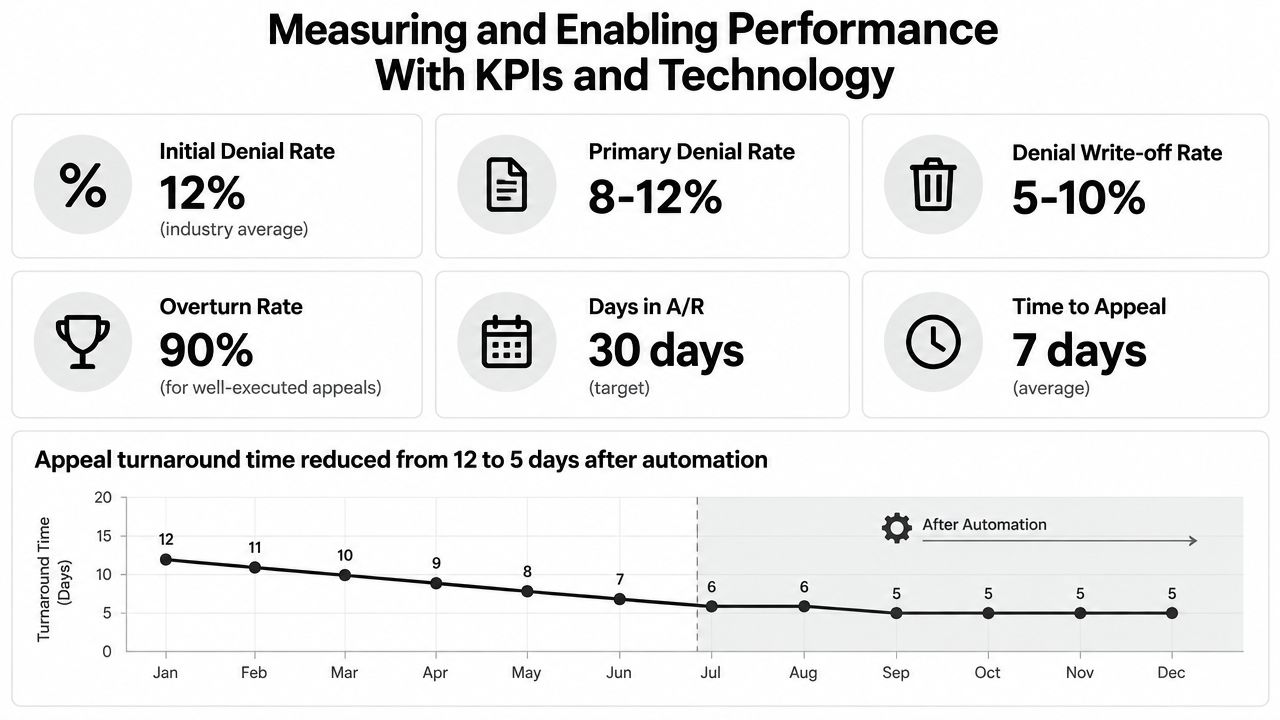
Measuring and Enabling Performance With KPIs and Technology
Leaders can't improve denial management by watching a single rate. A practice may reduce its initial denial rate while allowing unresolved accounts to age, or increase overturns while creating excessive manual labor. The dashboard must show where the claim is failing and whether the response produces cash.
Read the metrics as a connected system
Track the initial denial rate to understand first-pass performance. Track the primary denial rate to identify the dominant underlying cause. Monitor the denial write-off rate to see how much billed value ends without recovery. Pair those measures with overturn rate, time to appeal, time from denial to resolution, days in accounts receivable, and clean-claim rate.
The relationships matter more than any isolated result. A rising initial denial rate usually creates more rework and can extend accounts-receivable days. A stable denial rate with falling overturns may indicate weaker evidence assembly or changing payer rules. A strong overturn rate with a growing backlog may signal that the team is selecting good accounts but lacks enough capacity or automation to process them on time.
MGMA reported an 8% first-submission denial rate for single-specialty physician practices in a 2023 benchmark. Other national hospital benchmarks cited in the same verified data cluster near 11.4% to 11.6% initial denial rates and 2.5% to 2.7% final denial rates. (MGMA's denial benchmark guidance) These figures shouldn't become universal targets because specialty mix, payer composition, and claim complexity differ. They do show why leaders need to distinguish first-pass leakage from final write-off.
Put technology behind the work
A useful denial platform should connect the claim, remittance, payer rule, account history, correction, appeal, evidence, owner, deadline, and outcome. A dashboard that only displays denial counts leaves staff to reconstruct the story manually.
Automation can support several decisions:
- Front-end validation: Flag missing or inconsistent registration, eligibility, and authorization data before submission.
- Payer intelligence: Surface recurring payer edits by specialty, service, location, and code combination.
- Work routing: Send high-priority accounts to the right specialist based on value, cause, deadline, and overturn potential.
- Appeal orchestration: Track evidence, forms, submission dates, follow-up, and escalation status.
- Feedback loops: Convert recurring denial findings into claim-scrubber edits, training updates, and scheduling controls.
Teams can use analytics tools within their practice-management or clearinghouse environment, payer-rule libraries, automated eligibility services, and workflow platforms. RevGuard is one option that combines specialty-focused RCM workflows, denial tracking, payer-behavior intelligence, and IDR support. Leaders evaluating tools should ask whether the system identifies root causes, assigns corrective action, preserves evidence, and shows outcomes by payer and specialty.
A practical weekly review should focus on newly denied claims, aging appeal tasks, top root causes, high-value unresolved accounts, repeat payer patterns, and prevention edits awaiting deployment. For a broader framework, review these revenue cycle management metrics and map them to the organization's own service lines.
Building an Integrated RCM and IDR System for Long Term Results
Denial management works best as a connected operating model rather than a department at the end of the revenue cycle. Registration, scheduling, clinical documentation, coding, billing, payment posting, denial follow-up, contracting, and dispute resolution all influence the final amount collected.
The upstream side creates a dispute-ready claim. That means accurate patient and coverage information, aligned authorization, defensible coding, complete documentation, correct provider and location data, and a record of payer communications. Those controls reduce avoidable denials and create stronger evidence when the payer later disputes the service or payment.
The downstream side turns that evidence into action. Staff correct claims that contain fixable defects, appeal denials that have support, and identify underpayments or downcoding that require contractual, regulatory, or IDR analysis. In eligible No Surprises Act disputes, the organization must follow the applicable IDR requirements and maintain a disciplined record of the service, payment, offer, evidence, and filing process.
The connection runs both ways. If IDR cases repeatedly expose a payer's interpretation of a code, documentation requirement, or payment methodology, that intelligence should return to coding edits, documentation training, scheduling rules, and negotiation strategy. If front-end data improves, downstream appeals can focus on complex decisions rather than preventable administrative errors.
Provider groups, ASCs, hospitals, and multi-state platforms can operationalize this model by:
- Establishing one denial taxonomy across sites and specialties.
- Assigning a named owner to each root-cause category.
- Reviewing payer and specialty trends on a consistent cadence.
- Separating correction, appeal, write-off, and IDR queues.
- Measuring both prevention performance and recovered revenue.
- Auditing compliance with payer and IDR deadlines.
The strategic shift is from “How do we work this denial?” to “Which control failed, what recovery path fits, and how do we prevent the pattern from returning?” Denials and underpayments are systemic revenue risks. Organizations that connect clean-claim engineering with enforcement-ready recovery can protect reimbursement more consistently and make operational decisions with clearer evidence.
RevGuard connects specialty-specific revenue cycle management with denial prevention, recovery workflows, payer-behavior intelligence, and enforcement-driven IDR support. Visit RevGuard to evaluate how your organization can identify repeat denial causes, strengthen dispute-ready claims, and recover revenue across complex specialties.