

Emergency services account for the core volume of the No Surprises Act's federal arbitration system. More than 1.46 million federal IDR disputes had been initiated by 2024, and nearly 97% involved out-of-network emergency or nonemergency services, compared with about 3% involving air ambulance services (Congressional Research Service analysis). That changes the management question for emergency groups. The No Surprises Act is no longer mainly a patient-billing rule. It's a reimbursement operating system, and providers that don't build claims, documentation, and payer analytics around it will lose money after the patient has already left the department.
What the No Surprises Act Actually Changes for Emergency Care
Emergency medicine reimbursement now depends on how quickly a provider identifies protected care, documents the payment position, and prepares for possible arbitration. A Level 3 trauma activation may require immediate evaluation, imaging, stabilization, and specialist input while the on-call cardiologist remains out of network. If the patient lacks insurance, registration cannot rely on a standard commercial eligibility workflow or assume the payer will resolve the bill later.
Under the No Surprises Act, emergency care must be treated as protected care when federal protections apply. An out-of-network provider generally cannot transfer the unpaid balance to the patient beyond the applicable in-network cost-sharing amount. The payment dispute belongs with the health plan. The federal IDR process became operational on April 15, 2022, giving eligible payer-provider disputes a formal path through arbitration (Congressional Research Service report).
The reimbursement workflow has moved upstream
The qualifying payment amount, or QPA, gives the plan's benchmark for the service and geographic market. It matters, but it does not automatically cap reimbursement. Providers can submit evidence for a different payment, including the circumstances of care, provider expertise, service complexity, and market conditions. Because the arbitrator selects one party's offer, a poorly supported initial position can weaken the entire case.
Revenue-cycle teams once concentrated on patient statements, out-of-network collections, and balance-billing controls. Those controls remain necessary, but they no longer determine the full financial result. Emergency groups must identify protected claims, verify the payer's payment, preserve negotiation records, and decide promptly whether the variance justifies an IDR filing.
Use this No Surprises Act summary for providers as a policy reference. Then build the operating process separately. Leadership should connect registration, coding, billing, payment-variance review, and IDR submission so evidence does not disappear between departments.
Volume changes the management problem
The federal system now functions as a high-volume arbitration channel rather than an occasional appeal route. Congressional analysis reports more than 2.3 million disputes initiated from April 15, 2022 through 2024, with emergency services representing over 50% of determinations in 2023 and roughly 45% in 2024 (Congressional Research Service analysis).
That volume makes case-by-case heroics an expensive strategy. Emergency groups that perform well standardize evidence packets, track payer behavior, and send clinical review only to disputes where the record can materially affect the outcome. The practical shift is clear: reimbursement performance is built before arbitration, not argued into existence after a denial.
Defining Emergency Services and Post-Stabilization Coverage
The statute's emergency-services protection isn't limited to the most dramatic trauma cases. The relevant question is whether the patient sought care for symptoms that a prudent layperson could reasonably believe required immediate medical attention, not whether the final diagnosis turned out to be minor. A high-level emergency department evaluation and management code can still fall within the protected pathway when the presenting symptoms and clinical record support emergency evaluation.
That distinction matters for Level 4 and Level 5 E/M services. Coding alone doesn't establish coverage, but neither does a payer's later assertion that the patient wasn't sufficiently sick. The record should connect the presenting complaint, medical decision-making, testing, treatment, reassessment, and disposition. A payer that reduces a Level 5 service to a lower level without addressing that clinical chain has created a payment issue, not automatically defeated the emergency claim.
Scope questions that create avoidable disputes
Observation status creates another recurring problem. A patient may enter through the emergency department, remain under evaluation, and later convert to observation or inpatient status. The revenue-cycle team should separate the protected emergency encounter from later services and document exactly when the patient was stabilized, what care continued, and whether the later service was clinically and administratively distinct.
Post-stabilization care requires the same discipline. Emergency protections can continue when the patient needs additional care connected to the emergency condition, but the provider must examine the transfer, discharge, network availability, and consent facts rather than treating every later service as automatically protected. Stabilization isn't a billing timestamp. It's a clinical and operational determination that should be visible in the record.
On-call specialists also need a coverage map. A cardiologist, anesthesiologist, radiologist, or other professional may participate in care initiated through an emergency encounter. Ancillary services such as laboratory testing, imaging, and anesthesia should be reviewed in relation to the underlying encounter, the facility setting, the provider's role, and the applicable plan rules.
| Service Type | Covered Under NSA | Key Condition |
|---|---|---|
| Emergency department evaluation | Generally, when the prudent layperson standard supports emergency care | The presenting condition and clinical record must support the emergency nature of the encounter |
| On-call specialist services | Potentially, when connected to protected emergency care | Document the specialist's role, timing, medical necessity, and relationship to stabilization |
| Imaging and laboratory services | Often connected to the underlying emergency encounter | Preserve the order, result, interpretation, and clinical rationale |
| Observation after ED evaluation | Depends on the facts and service transition | Identify when emergency care ended and observation began |
| Post-stabilization treatment | Fact-specific | Review transfer options, network status, notice, consent, and continuing medical necessity |
| Air ambulance transport | Covered under the federal protections when applicable | Treat transport, medical necessity, and payment components as a separate compliance track |
The practical audit question is simple: Can an outside reviewer understand why the service was emergency care, when stabilization occurred, and why each related professional or ancillary service was necessary? If not, the claim is vulnerable even when the patient protection itself should apply.
Patient Protections Emergency Providers Must Operationalize
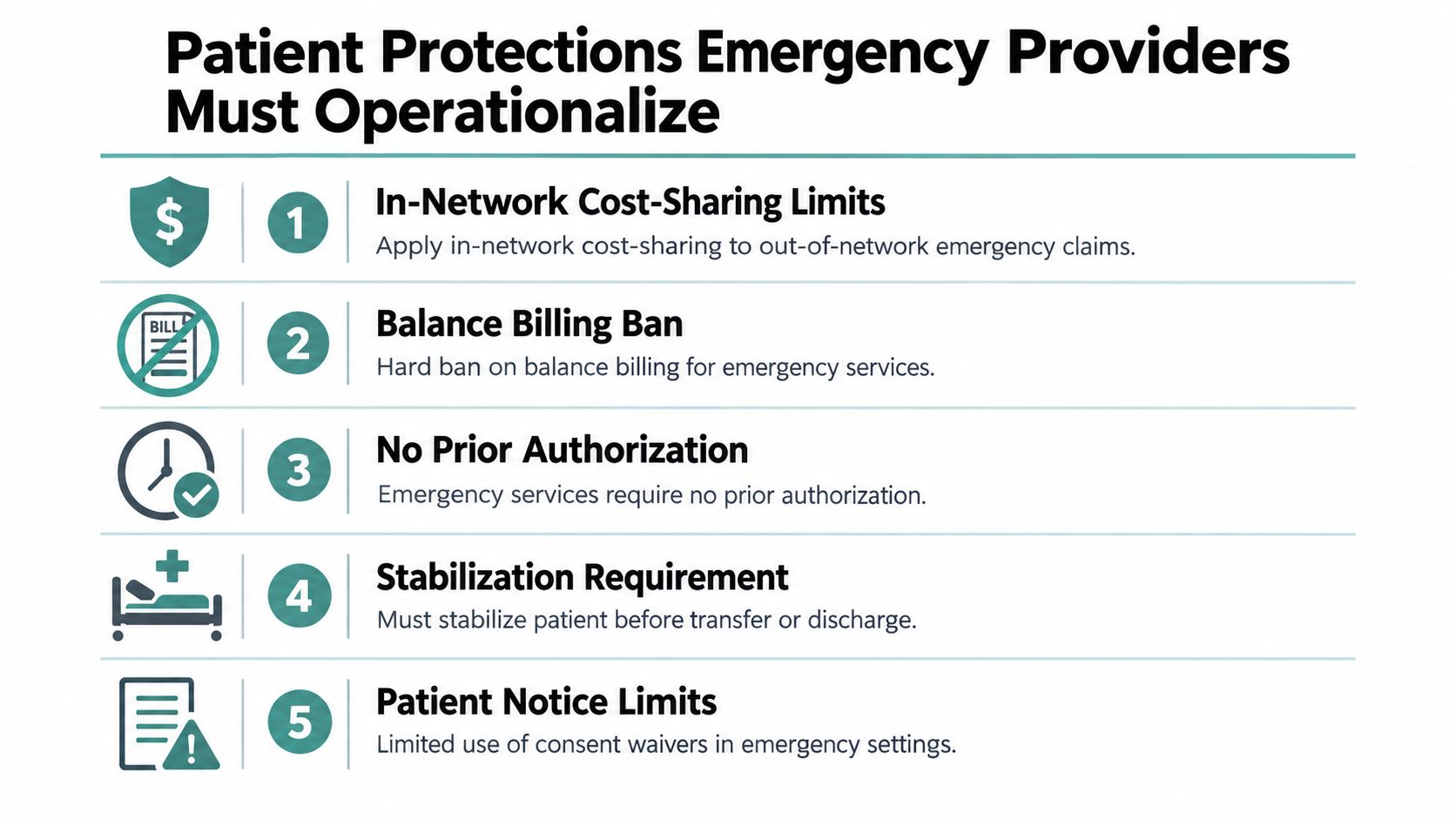
Patient protections become compliance failures when they exist only in a policy binder. Emergency providers need to translate them into registration scripts, claim edits, payer reconciliations, and statement controls.
Build the controls into the encounter
In-network cost sharing comes first. When the federal protections apply, the patient's emergency claim should process using the applicable in-network cost-sharing rules, even when the treating provider is out of network. Your billing system should compare the payer's Explanation of Benefits against the patient responsibility expected under the plan, not just post the payer's calculation without review.
Balance billing is not a recovery strategy. The patient statement must not add provider charges above the permitted cost-sharing amount for protected emergency services. Suppress automated statement logic that treats every out-of-network balance as collectible. A compliant statement should identify the patient responsibility clearly and route questionable balances to internal review before release.
The QPA is a payment reference, not a patient liability. Registration staff should never describe the QPA as the amount the patient owes. It belongs in the payer-provider payment analysis, while the patient-facing workflow focuses on lawful cost sharing and accurate benefit application.
Emergency care doesn't wait for prior authorization. Payers can request information after the encounter, but registration teams shouldn't delay medically necessary emergency evaluation while seeking advance approval. The claim record must still carry the clinical and coding support needed for later medical-necessity review.
Good Faith Estimate obligations require a separate uninsured workflow. Uninsured and self-pay patients need clear information about expected charges when the law requires an estimate. Emergency presentations often make advance estimates impractical, so teams should define how registration, financial counseling, and billing handle estimates for scheduled or foreseeable services without turning the emergency department into a collection checkpoint.
Give staff usable language
Front-desk staff should use plain language: “We'll verify your information, but emergency treatment won't be delayed for payment or network questions. Your insurer should apply the required in-network cost-sharing rules when the federal protections cover this service.”
If the patient asks why a specialist is out of network, staff shouldn't speculate about final payment. They should explain that the provider and health plan resolve the reimbursement issue under the applicable process, while the patient receives the protected cost-sharing treatment.
The Explanation of Benefits should be reviewed for network classification, deductible and coinsurance application, patient responsibility, and any denial or reduction codes. When the payer applies out-of-network cost sharing or misstates the patient balance, the billing team should contact the plan, document the correction request, and hold the statement until the account is accurate.
Operational rule: Patient protection is complete only when the claim, EOB, statement, and account balance all tell the same story.
How Federal IDR Works for Emergency Claim Disputes
Federal IDR is a structured payment dispute process, not a conventional appeal. The provider and payer first enter the required negotiation stage. If they don't reach agreement, the eligible party submits the dispute to a certified IDR entity, and each side presents an offer with supporting evidence. The arbitrator selects one offer.
The process rewards preparation before filing. A provider that submits a clean claim, preserves the initial payment or denial, identifies the relevant QPA, and builds a consistent evidence record is in a much stronger position than one that begins assembling facts after the filing window opens.
What the outcome data tell emergency groups
A peer-reviewed analysis of 2023 emergency-medicine IDR outcomes found providers won 86% of cases for moderate-to-severe emergency department evaluation and management services. The study reported a mean arbitrated payment of 2.7 times the QPA, while the mean QPA itself was 2.4 times Medicare payment (Health Affairs Scholar analysis).
Those results don't mean every claim deserves a large award. They do show that the QPA shouldn't end the analysis. Providers need to explain why their offer fits the service, the local market, the physician's qualifications, the patient's acuity, and the operational resources required to deliver emergency care.
Evidence that tends to matter includes:
- Clinical complexity: Tie the presenting condition, interventions, monitoring, and disposition to the billed service.
- Provider expertise: Document relevant training, certifications, experience, and the role played in the encounter.
- Market context: Submit credible geographic and contracting evidence rather than unsupported assertions about what the market “should” pay.
- Operational resources: Explain staffing, readiness, specialty coverage, and facility obligations when those facts directly support the offer.
- Claim integrity: Make the CPT, ICD, modifiers, place of service, and provider identity consistent across the claim and dispute packet.
The arbitrator isn't looking for a longer narrative. They're looking for evidence that supports the provider's selected offer and addresses the payer's likely counterargument.
Eligibility, batching, and timing
Teams must monitor the initial payment or denial date, the open negotiation activity, and the applicable filing deadline. Claims can be batched only when the services and dispute characteristics satisfy the current federal rules. Do not create a batch solely because the payer and provider are the same. An invalid batch can waste administrative effort and jeopardize otherwise eligible claims.
Administrative fees and portal requirements have changed over time, so the team should verify the current amount, filing form, and batching rules before submission. A static spreadsheet is not sufficient for a process that has evolved since launch.
| IDR Element | Emergency Services Requirement | Operational Impact |
|---|---|---|
| Initial payment or denial | Preserve the payer's response and relevant claim data | Starts the tracking workflow and supports the negotiation record |
| Open negotiation | Complete the required payer-provider negotiation step | Record dates, offers, responses, and unresolved issues |
| Eligibility review | Confirm the service, payer, provider, and dispute type qualify | Prevents avoidable portal rejection |
| Evidence packet | Submit QPA analysis and case-specific supporting evidence | Connects the offer to clinical, market, and operational facts |
| Batching | Group only claims permitted under current IDR rules | Requires claim-level controls and batch validation |
| Arbitrator decision | The selected offer becomes the dispute outcome | Post-decision posting and reconciliation must be prompt |
A practical federal IDR process guide can help standardize the workflow, but leadership still needs ownership at the claim level. The revenue-cycle director should know which payer behavior is generating eligible disputes, which claims are aging toward the deadline, and whether the group has enough evidence capacity to file responsibly.
The Hidden Pressure Point and Payment Compression
The biggest mistake I see is treating the No Surprises Act as a statement-compliance project. Patient protection is mandatory, but the deeper financial threat is what happens before the patient ever sees a bill. Payers can anchor payment to the QPA, reduce the coded service, bundle separately reported work, or issue a vague explanation that leaves the provider chasing the difference.
That's payment compression. It turns a protected emergency encounter into an underpayment problem while allowing the payer to appear compliant on the patient side.
QPA anchoring changes negotiation behavior
The QPA functions as a central reference point in payer communications. It can be materially lower than the provider's expected reimbursement, particularly when the benchmark doesn't reflect current emergency staffing, readiness, specialty coverage, or market conditions. The provider shouldn't respond with a generic assertion that its charges are higher. It should identify the service, establish the clinical intensity, and submit evidence that explains why the selected offer is more appropriate than the payer's number.
Downcoding is another common pressure point. A payer may reduce a Level 4 service to a Level 3 service, or recast critical care as non-critical care, without engaging with the clinical record. The correct response is not to inflate the code in anticipation of payer behavior. It's to make medical decision-making, acuity, procedures, reassessment, and time documentation support the billed level and create a clear audit trail for the variance.
Find leakage in the claim lines
Revenue integrity teams should audit patterns rather than isolated denials:
- Modifier 25: Check whether a significant, separately identifiable E/M service was reported with a procedure and whether the note supports both services.
- EKG and X-ray lines: Review bundling edits against payer policy, claim form detail, and the professional versus facility billing distinction.
- Observation services: Separate emergency evaluation from subsequent observation work and confirm that orders, status changes, and physician documentation align.
- Critical care: Validate time, condition severity, interventions, and exclusion of separately reportable work where required.
- Level changes: Compare the submitted code, payer-adjudicated code, reason code, and appeal or negotiation result by payer.
The federal system has already altered the financial balance. HHS found that out-of-network emergency bills declined 15% in 2022 relative to 2021, and the decline reached 24% against the 2019 baseline for emergency services at any facility (HHS evaluation). That patient-facing improvement doesn't eliminate provider risk. It shifts the fight toward accurate payment, disciplined dispute selection, and evidence that survives payer scrutiny.
Air Ambulance as a Separate Compliance Track
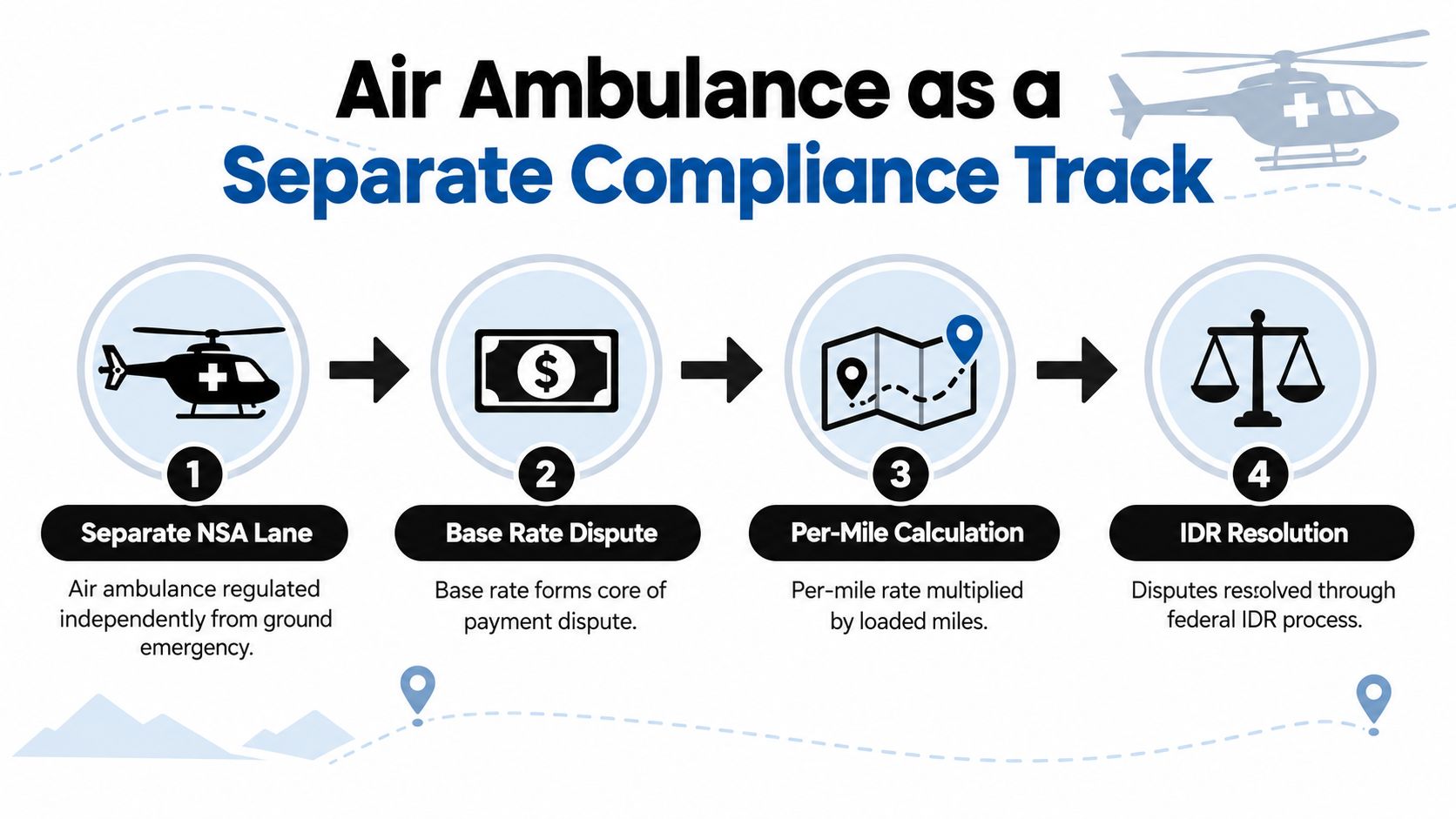
Air ambulance requires a separate reimbursement workflow. CMS guidance places out-of-network air ambulance services within federal protections (CMS No Surprises Act consumer guidance), yet transport claims carry payment and documentation variables that hospital emergency claims do not. Treating them as ordinary emergency claim lines creates avoidable disputes.
Reconcile every transport component
Begin with the flight record, not the outstanding balance. Confirm the base rate, per-mile charge, loaded miles, dispatch location, destination, aircraft type, crew, and medical necessity. Payers may accept one component while challenging another, so the dispute packet must tie each billed line to the flight and billing records.
Rotor-wing transports add multi-state complexity. A provider may dispatch from one state, pick up in another, cross state lines, and deliver to a facility operating under a different network or insurance environment. Set a consistent method for identifying applicable plan rules, the originating site, provider enrollment, and the medical necessity standard for every transport.
Federal reporting shows 43,202 air ambulance disputes in 2025, about 8.8 times the government projection, with Tennessee and Texas among the major volume states in the second half of that year (CMS reported federal data). The volume supports a disciplined intake process, not indiscriminate filing. Build the transport record before the dispute reaches federal IDR.
Preserve evidence that supports payment
A persuasive file includes dispatch records, flight logs, GPS or route data, crew credentials, clinical notes, transfer rationale, and relevant weather or availability facts. It also explains why the transport was medically necessary. Reconcile loaded miles and base-rate terms before negotiation, while the underlying records are still accessible.
Patient protections remain operational requirements. Apply in-network cost-sharing treatment and stop staff or automated statements from shifting the disputed balance to the patient. Keep that patient-billing control separate from the provider evidence package, which must be detailed enough for federal IDR.
Multi-state operators should assign one owner to policy updates and another to claim-level documentation. Use one transport checklist, one escalation path, and one audit trail. Local billing habits should not determine which evidence survives review.
A focused air ambulance NSA guide can help structure policy design. The transport record still decides the case. Arbitrators cannot award payment for facts the provider never documented.
Operational Checklist for Emergency Revenue Integrity
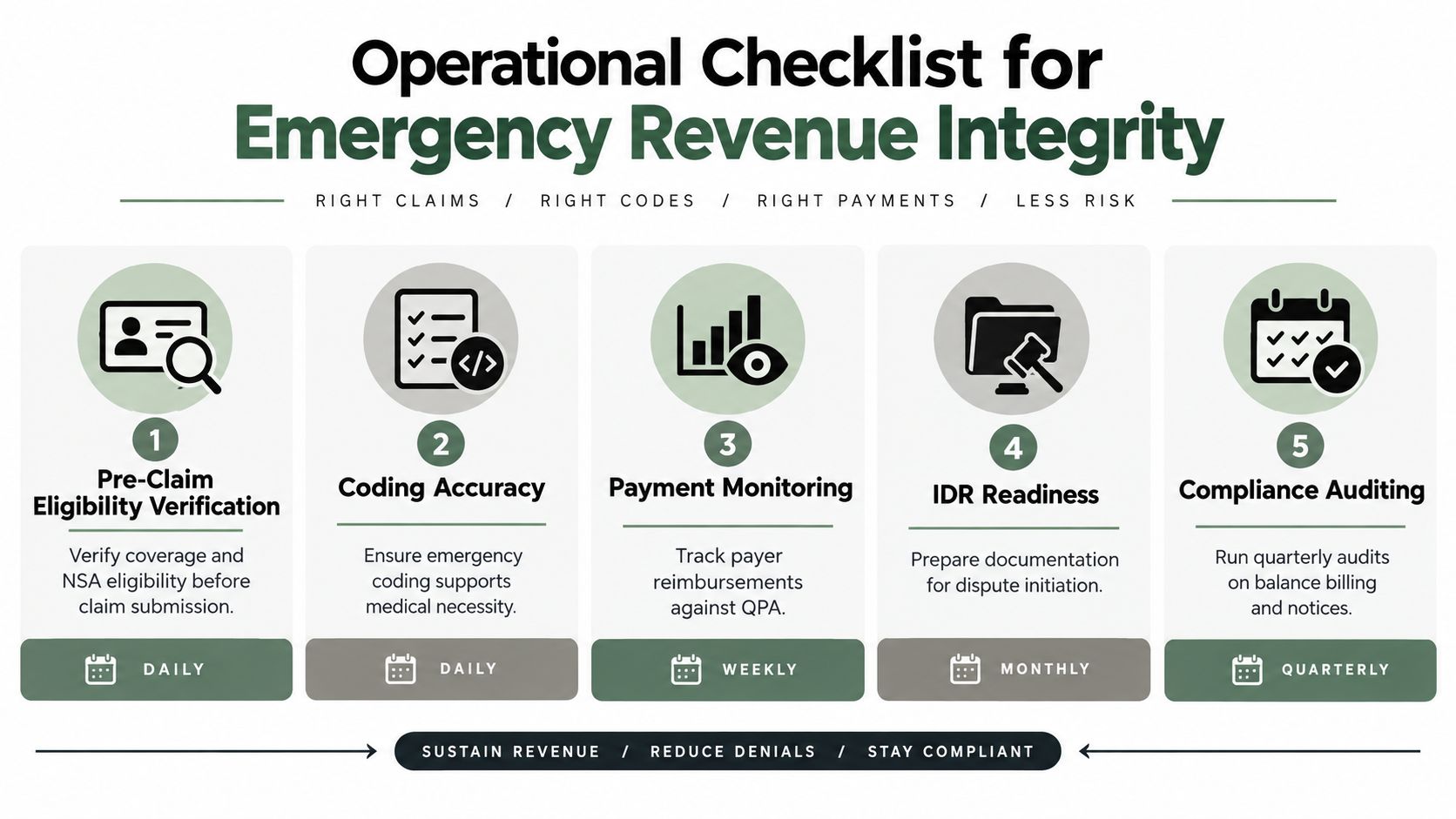
Emergency revenue integrity needs a cadence. Daily claim work, weekly payment variance review, and periodic leadership analysis should connect to the same evidence model. The following workflow assigns a clear operational owner to each control.
Start before the claim leaves the system
1. Verify eligibility and status, owned by registration and the biller. Confirm the patient's coverage, payer identity, facility status, provider enrollment, network indicators, and whether the encounter appears to involve protected emergency care. For uninsured patients, route the account through the Good Faith Estimate workflow when applicable. Don't let missing eligibility data become an excuse for a patient statement or a delayed claim.
2. Harden documentation, owned by the coder and medical director. Make the record explain the emergency condition under the prudent layperson standard. Coders should validate CPT and ICD specificity, while the medical director reviews recurring documentation gaps in high-value or frequently downcoded services. Transfer rationale, stabilization status, specialist involvement, and observation transitions belong in the audit trail.
3. Make submissions dispute-ready, owned by coding and billing. Separate facility and professional claim logic, validate modifiers, reconcile ancillary lines, and preserve the initial payer response. Create a batch-readiness flag only after checking the current IDR rules. The system should capture the dates required for negotiation and filing rather than relying on a shared inbox.
4. Monitor payment variance, owned by the RCM director and denial nurse. Compare allowed amounts with the QPA, expected contract logic, and historical payer behavior. Flag unexplained downcodes, bundling, missing QPA information, and patient-responsibility errors. Use a documented escalation threshold based on expected recovery, administrative cost, claim eligibility, and the time remaining before filing closes. Don't use a single dollar rule for every payer and service line.
5. Analyze post-payment behavior, owned by finance and executive leadership. Track provider win rate, payer response time, recurring code reductions, offer-to-award patterns, and unresolved patient-account corrections. Review the dashboard on a regular management cadence and use the results in payer negotiations, staffing decisions, and documentation education.
Make accountability visible
A useful RACI-adjacent model assigns one accountable role, one operational owner, and one escalation route for each step. The coder shouldn't be expected to interpret payer strategy alone. The medical director shouldn't receive a vague request to “improve documentation.” The RCM director should see the exact code, payer action, clinical gap, and recovery decision.
Use aging buckets that trigger action before the deadline, with separate queues for new payments, open negotiation, filing-ready disputes, and post-decision reconciliation. Review persistence at 30, 60, and 90 days as management checkpoints, but verify the current federal filing and batching rules before treating any interval as a legal deadline.
Management standard: Every underpayment should end in one of three documented decisions, correct it, negotiate it, or prepare it for IDR.
Quarterly audits should sample patient statements, EOBs, emergency code changes, observation conversions, specialist claims, and air transport records where applicable. A compliance audit that checks only balance billing misses the revenue leakage created by downcoding and incomplete dispute preparation.
Common Questions About NSA Emergency Compliance
Is the QPA binding? No. It's a benchmark used in the payment process, not an automatic payment ceiling. Treat it as the payer's anchor, then decide whether the clinical, market, and provider evidence supports a different offer.
Does the filing clock reset after open negotiation? The timeline depends on the applicable federal process and the dates created by the negotiation cycle. Don't calculate from the original claim date alone. Capture every notice, offer, and negotiation date in the IDR tracker, then verify the current rule before filing.
Can air ambulance and ground ambulance claims use the same batch? Don't assume they can. Air ambulance has distinct federal treatment and documentation issues, and batching eligibility depends on the specific dispute characteristics and current portal rules.
What happens when an ED visit becomes observation? Separate the emergency service from later observation work. The record should identify the clinical transition, the responsible physician, the orders, and the services performed after the emergency phase.
What if the plan won't provide the QPA? Escalate in writing, preserve the request and response, and include the missing-information issue in the negotiation and dispute record. A missing benchmark shouldn't disappear into a phone note.
How do you challenge a silent Level 5 to Level 3 reduction? Treat it as an adjudication variance. Compare the submitted claim, EOB, payer reason code, and clinical record. Request the rationale, correct the coding only if the record supports correction, and prepare the issue for payer escalation or IDR when the claim qualifies.
The federal system keeps changing. The IDR market reached 2.56 million total disputes in 2025, and emergency services represented 52% of settled disputes, according to reporting on federal data and implementation trends (Georgetown Center on Health Insurance Reforms complaint and implementation analysis). A compliance manual that never changes with fee structures, portal rules, batching requirements, and payer behavior is a liability.
RevGuard connects emergency revenue-cycle operations with NSA enforcement, including claim monitoring, payment variance analysis, dispute-ready documentation, and IDR case management. If your team is losing reimbursement through downcoding, QPA anchoring, or missed filing opportunities, visit RevGuard to evaluate a workflow built around emergency-service recovery.